Japan Cereal Herbicides Market Size & Growth Rate
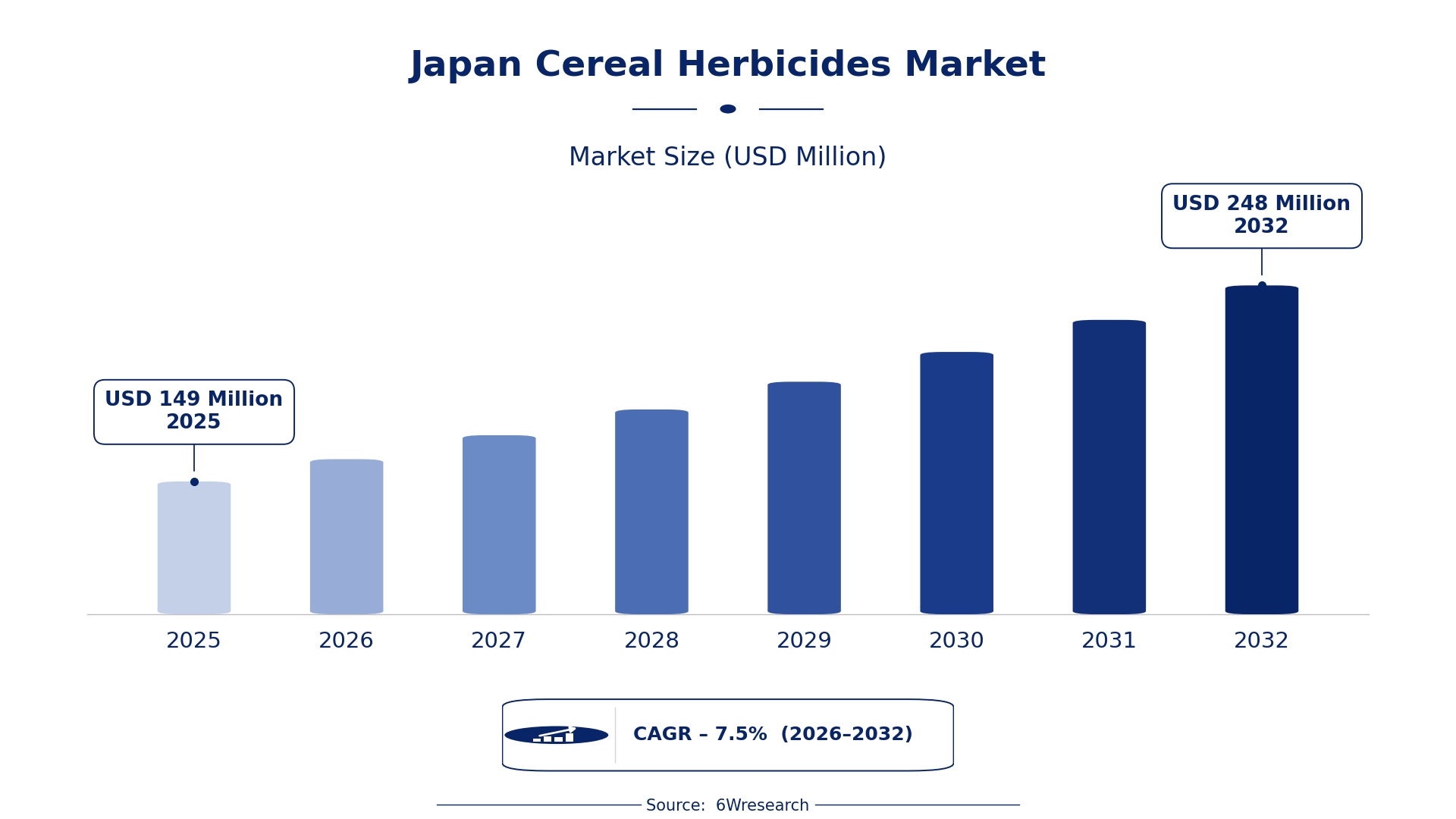
According to 6Wresearch internal database and industry insights, the Japan Cereal Herbicides Market was valued at USD 149 Million in 2025 and is projected to reach USD 248 Million by 2032, growing at a CAGR of approximately 7.5% during 2026–2032.
Japan Cereal Herbicides Market Highlights
| Report Metric | Details |
| Report Name | Japan Cereal Herbicides Market (2026-2032) |
| Market Size 2025 | USD 149 Million |
| Market Size 2032 | USD 248 Million |
| Absolute Growth 2025–2032 | USD 99 Million |
| CAGR 2026–2032 | 7.5% |
| Peak Annual Growth | 8.5% in 2028 |
| Forecast Period | 2026–2032 |
| Historical Data | 2022–2025 |
| Base Year | 2025 |
| Leading Herbicide Type, 2025 | Pre-emergent (42% share) |
| Leading Mode of Action, 2025 | Cell Division Inhibitor (40% share) |
| Leading Application Timing, 2025 | Pre-Planting (38% share) |
| Leading Crop Targeted, 2025 | Wheat (34% share) |
| Fastest-Growing Herbicide Type | Post-emergent (10.4% CAGR) |
| Fastest-Growing Mode of Action | Photosynthesis Blocker (9.4% CAGR) |
| Fastest-Growing Application Timing | Post-Germination (10.0% CAGR) |
| Fastest-Growing Crop Targeted | Barley (9.7% CAGR) |
| Growing Sector | Agriculture |
| Key End Users | Farmers, agricultural cooperatives, crop producers, agronomists |
Japan Cereal Herbicides Market Year-wise Growth Rate and Key Drivers (2022–2032)
This graph illustrates the annual growth rates of the market from 2022 to 2032, highlighting a steady upward trajectory and projected market expansion over the forecast period.
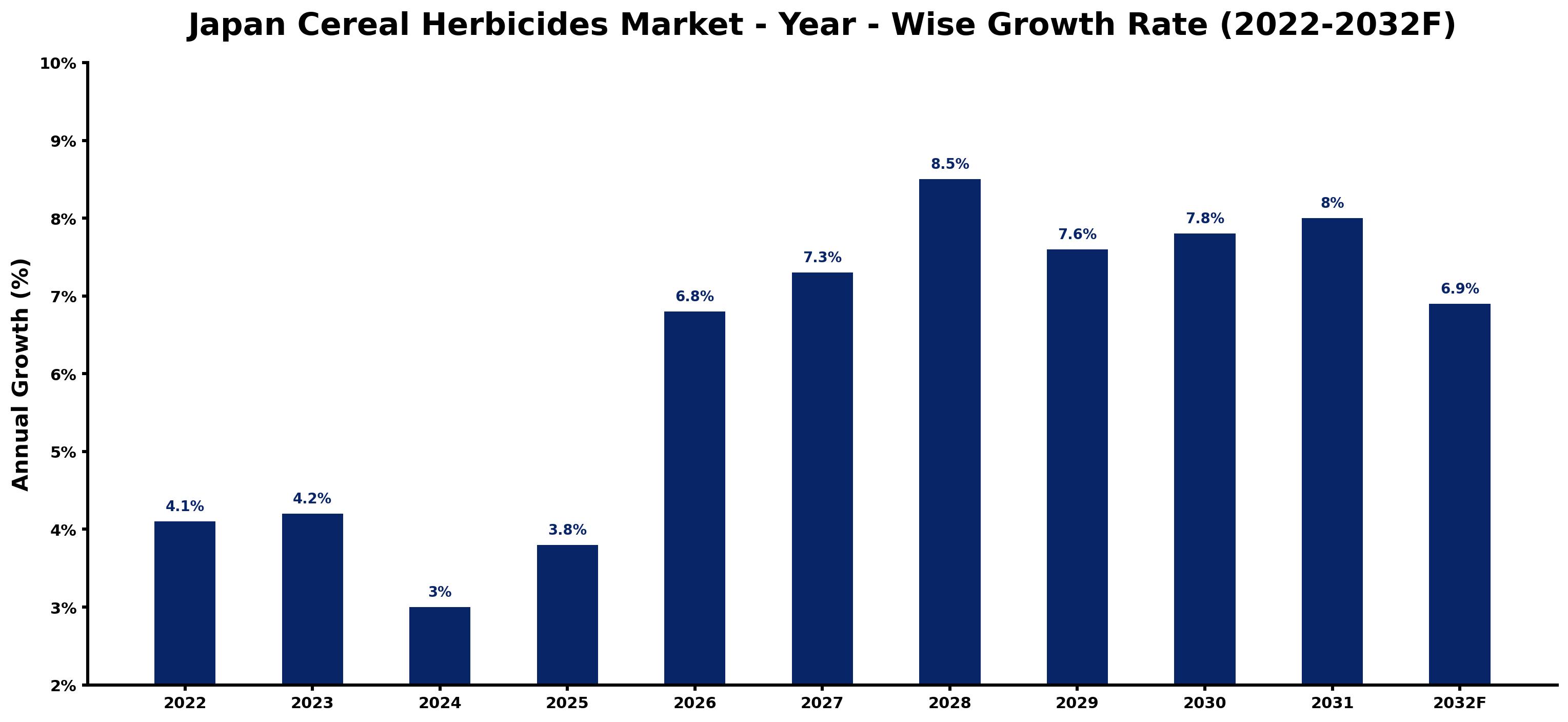
For each year, the table pairs the estimated growth rate with the leading influence on demand, showing how the drivers changed across the period.
| Year | Estimated Annual Growth (%) | Market Rationale |
| 2022 | 4.1 | The market experienced steady growth due to effective weed management practices. |
| 2023 | 4.2 | Demand increased as agricultural users sought better crop yields through herbicide application. |
| 2024 | 3.0 | Growth slowed as market saturation began to affect new purchases. |
| 2025 | 3.8 | Demand rose again as barley production increased, requiring more herbicide applications. |
| 2026 | 6.8 | The market is expected to accelerate as new herbicide technologies emerge, driving purchases. |
| 2027 | 7.3 | Demand will continue to rise due to improved crop management practices among farmers. |
| 2028 | 8.5 | The peak growth year will see investments in herbicide application equipment. |
| 2029 | 7.6 | Growth will slow as the market begins to stabilise after rapid expansion. |
| 2030 | 7.8 | Demand is projected to increase again as farmers adopt more sustainable herbicide practices. |
| 2031 | 8.0 | The market will grow as new herbicide-resistant crop varieties gain popularity. |
| 2032 | 6.9 | Growth is expected to slow as the market matures, focusing on quality and efficiency. |
Note: Market size estimations and growth projections presented in this report are based on 6Wresearch's proprietary forecasting methodology, utilizing the latest available industry data, government publications, and primary research inputs.
Japan Cereal Herbicides Market Synopsis
Cereal herbicides are chemical substances used to control unwanted plants in cereal crops such as wheat, barley, corn, and rice. They prevent weed competition and improve agricultural efficiency through various application methods. The Japan Cereal Herbicides Market is expanding due to rising demand from domestic agricultural users, particularly in the Kanto region, where effective weed management is essential. Initiatives promoting sustainable herbicide use and advancements in technology are driving market growth.
Market Dynamics Impact Analysis (2026–2032)
| Factor | Type | Impact | Primary Segment Affected |
| Growing barley production increases demand for effective weed management solutions, driving herbicide sales. | Driver | High | Barley |
| Rising awareness of sustainable agricultural practices encourages the adoption of environmentally friendly herbicides. | Driver | Medium | Pre-emergent |
| The installed base of herbicide application equipment is projected to grow, creating opportunities for suppliers to meet increased demand. | Opportunity | High | Pre-emergent |
| The launch of the sustainable herbicide use programme in 2023 opens avenues for investment in innovative products. | Opportunity | Medium | Pre-emergent |
| Strict JIS standards complicate the approval process for new herbicide products, limiting market entry for some suppliers. | Restraint | High | Pre-emergent |
| Rising production costs, including raw materials, can elevate herbicide prices, impacting buyer budgets. | Restraint | Medium | Rice |
| Intense competition among producers leads to price reductions, squeezing profit margins for manufacturers in Japan. | Challenge | High | Rice |
| Rapid advancements in herbicide application technology require distributors to invest heavily in new equipment, increasing operational costs. | Challenge | Medium | Pre-emergent |
Evaluation of Drivers in Japan Cereal Herbicides Market (2026–2032)
Key forces behind demand, with the segment each one moves most, are listed below.
| Drivers | Primary Segment Affected | Why It Matters (Evidence) |
| Rising barley production increases demand for herbicides | Barley | Barley production reached 1.2 million tons in 2022, necessitating effective weed management. |
| Growing adoption of herbicide-resistant crops boosts market growth | Wheat | The Japanese government supports research on herbicide-resistant varieties to improve crop yields. |
| Technological advancements in herbicides improve application efficiency | Pre-emergent | New formulations allow for lower application rates, increasing usage among farmers. |
| Increased awareness of sustainable farming practices drives demand | Post-emergent | The 2023 program promoting sustainable herbicide use encourages responsible application. |
| Expansion of herbicide application equipment increases usage rates | Systemic Herbicides | The installed base of approximately 500,000 units supports higher herbicide application. |
Spending rises because barley production reached 1.2 million tons in 2022, increasing the need for effective weed management solutions. New formulations allow for lower application rates, which increases usage among farmers. Support for research on herbicide-resistant crop varieties further drives demand, as farmers seek efficient solutions. Awareness of sustainable practices is also growing, encouraging responsible herbicide application among agricultural users. The installed base of herbicide application equipment facilitates greater herbicide use across the agricultural sector.
Evaluation of Restraints in Japan Cereal Herbicides Market
The following restraints limit how fast demand can grow.
| Market Restraint | Primary Segment Affected | Why It Matters (Evidence) |
| Regulatory scrutiny on herbicide formulations may limit market growth | Pre-emergent | The Ministry of Agriculture, Forestry and Fisheries oversees pesticide regulations, impacting product availability. |
| Limited awareness of sustainable practices can hinder adoption | Pre-emergent | Farmers may not fully understand the benefits of sustainable herbicide use, affecting purchases. |
| High production costs for manufacturers restrict pricing flexibility | Systemic Herbicides | Manufacturers face increased costs for raw materials, impacting their competitiveness. |
| Market saturation may slow new product introductions | Pre-emergent | As the market matures, fewer new products are being launched. |
| Supply chain disruptions affect availability of herbicide products | Pre-emergent | Global supply chain issues have led to delays in product delivery to farmers. |
Japan Cereal Herbicides Market Challenges
Intense competition among producers leads to price reductions, which squeeze profit margins for manufacturers in Japan. Buyers face procurement delays due to stringent JIS standards, complicating their access to essential products and potentially hindering timely crop management. Rapid advancements in herbicide application technology require distributors to invest heavily in new equipment, increasing operational costs. Rising production expenses, including raw materials, can elevate herbicide prices for buyers by up to 15%, straining their budgets and impacting their crop management strategies.
Trends in the Japan Cereal Herbicides Market
Several trends are reshaping the Japan Cereal Herbicides Market; the most important are set out below.
- Shift towards Sustainable Herbicide Use: The Kanto region is increasingly adopting sustainable herbicide practices, driven by a 2023 government program promoting responsible usage. This shift is expected to improve crop yields while reducing environmental impact.
- Transition from Traditional to Advanced Herbicide Technologies: In 2023, new formulations of pre-emergent herbicides emerged, allowing for lower application rates. This transition is leading to increased efficiency in weed management across various cereal crops.
- Emergence of Herbicide-Resistant Crop Varieties: The Japanese government has initiated support for research on herbicide-resistant crops, targeting improved agricultural efficiency by 2025. This trend is projected to drive demand for compatible herbicides.
- Growing Focus on Integrated Weed Management: In 2023, the Crop Protection Association of Japan advocated for integrated weed management strategies. This approach aims to combine herbicides with cultural practices, improving overall effectiveness in weed control.
Investment Opportunities in the Japan Cereal Herbicides Market
Several openings in the Japan Cereal Herbicides Market merit attention from investors.
- Entry through Joint Ventures in Agricultural Technology: Investing in joint ventures with local agricultural technology firms can improve market penetration. The Kanto region is ideal for such initiatives, especially with a projected market size of USD 248 million by 2032.
- Timing for Sustainable Herbicide Solutions: As the market shifts towards sustainability, there is an opportunity to supply eco-friendly herbicides. The 2023 government program promotes sustainable practices, creating demand among farmers.
- Gap in Awareness of Herbicide Benefits: With 40% of the market share held by pre-emergent herbicides, there is a gap in awareness of their benefits. Targeting educational campaigns towards farmers can boost adoption rates.
- Investment in Herbicide Application Equipment: The installed base of herbicide application equipment presents an opportunity to supply advanced application systems. Collaborating with agricultural cooperatives can facilitate market entry.
Government Initiatives in the Japan Cereal Herbicides Market
The Industrial Standardization Act governs JIS product and test standards, ensuring that herbicides meet safety and quality requirements. Compliance with these standards is crucial for producers to maintain market access and for buyers to ensure effective product performance. In 2023, the government launched a programme to promote sustainable herbicide use, aiming to enhance agricultural efficiency while reducing environmental impact. This initiative supports research and development in herbicide-resistant crop varieties, benefiting both producers and agricultural users.
The Ministry of Agriculture, Forestry and Fisheries oversees the approval and regulation of herbicides in Japan. It funds research initiatives aimed at improving herbicide efficacy and safety, ensuring that products align with sustainable agricultural practices. The agency also monitors compliance with pesticide regulations, which impacts how producers develop and market their products. By 2025, the ministry aims to approve new environmentally friendly herbicides, supporting the shift towards sustainable farming methods.
Future Insight of the Japan Cereal Herbicides Market
Innovations in herbicide-resistant crop varieties will transform demand by 2032, enabling farmers to use fewer chemicals while sustaining yields. The rollout of automated herbicide application systems will enhance precision and efficiency in weed control. By 2032, the installed base of herbicide application equipment is projected to reach approximately 600,000 units, indicating a shift towards modernised agricultural practices. Japan's focus on sustainable herbicide use will likely drive a 20% increase in the adoption of environmentally friendly products, benefiting both buyers and suppliers.
Market Segmentation Analysis
Japan Cereal Herbicides Market report covers a detailed analysis of the following market segments:
By Herbicide Type – Pre-emergent Leads, Post-emergent Expected to Grow Fastest
According to Saurav Kr Singh, Senior Research Analyst at 6Wresearch, Pre-emergent took 42% of herbicide type revenue in 2025, more than any other category. Pre-emergent herbicides hold the largest share as they effectively prevent weed growth before crops emerge, which is vital for maintaining high yields. This is particularly important in the Kanto region, a key area for rice production in Japan, where effective weed management is crucial. Post-emergent is projected to grow fastest, at a CAGR of 10.4% during 2026–2032. Post-emergent herbicides are witnessing rapid growth due to the increasing demand for solutions to manage existing weeds after crops have emerged. The rise in barley production, reaching 1.2 million tons in 2022, significantly contributes to this demand. Suppliers should focus on developing advanced post-emergent solutions to meet the increasing needs of barley farmers.
By Mode of Action – Cell Division Inhibitor Leads, Photosynthesis Blocker Expected to Grow Fastest
With 40% of mode of action revenue in 2025, Cell Division Inhibitor was the largest category. Cell Division Inhibitor herbicides dominate the market owing to their effectiveness in disrupting weed growth at the cellular level, making them a preferred choice for weed control. Their adoption aligns with the rigorous JIS standards that ensure quality in herbicide applications across Japan. The quickest growth will come from Photosynthesis Blocker, forecast to expand at a CAGR of 9.4% between 2026 and 2032. Photosynthesis Blocker herbicides are gaining traction as they effectively inhibit the photosynthesis process in weeds, enhancing their overall efficacy. The government's support for research on herbicide-resistant crops further propels this segment's growth. Buyers may benefit from diversifying their herbicide use to include photosynthesis blockers for improved weed management.
By Application Timing – Pre-Planting Leads, Post-Germination Expected to Grow Fastest
In 2025, Pre-Planting led the application timing split with a 38% share. Pre-Planting herbicides are preferred as they prepare the field effectively before planting, ensuring optimal conditions for crop growth. This practice is vital in Japan's intensive agricultural landscape, where precise timing is critical for achieving successful yields. Over 2026–2032, Post-Germination is expected to post the fastest growth, at a CAGR of 10.0%. Post-Germination herbicides are rapidly gaining popularity as they address weed management needs after crops have germinated, which is essential for maintaining crop health. The increase in barley production necessitates timely interventions to manage weed competition effectively. Suppliers should prioritise the development of post-germination herbicides to cater to the evolving needs of farmers post-planting.
By Crop Targeted – Wheat Leads, Barley Expected to Grow Fastest
Wheat held 34% of the Japan Cereal Herbicides Market by crop targeted in 2025. Wheat is the primary target for herbicide application, holding a substantial share of the market due to its significance in Japan's agriculture. The extensive installed base of herbicide application equipment facilitates the widespread use of herbicides on this crop. Barley is set to record the highest CAGR in this split, 9.7% over 2026–2032. Barley is experiencing the fastest growth as its production increases, leading to a higher demand for effective weed management solutions. The focus on improving barley yields drives farmers to seek advanced herbicide options. Buyers should consider investing in barley-targeted herbicides to maximise their crop yields in response to rising production demands.
Key Attractiveness of the Report
- 10 Years of Market Numbers
- Historical Data Starting from 2022 to 2025
- Base Year 2025
- Forecast Data until 2032
- Key Performance Indicators Impacting the Market
- Major Upcoming Developments and Projects
Key Highlights of the Report:
- Japan Cereal Herbicides Market Outlook
- Market Size of Japan Cereal Herbicides Market, 2025
- Forecast of Japan Cereal Herbicides Market, 2032
- Historical Data and Forecast of Japan Cereal Herbicides Revenues & Volume for the Period 2022-2032F
- Japan Cereal Herbicides Market Trend Evolution
- Japan Cereal Herbicides Market Drivers and Challenges
- Japan Cereal Herbicides Price Trends
- Japan Cereal Herbicides Porter's Five Forces
- Japan Cereal Herbicides Industry Life Cycle
- Historical Data and Forecast of Japan Cereal Herbicides Market Revenues & Volume By Herbicide Type for the Period 2022-2032F
- Historical Data and Forecast of Japan Cereal Herbicides Market Revenues & Volume By Pre-emergent for the Period 2022-2032F
- Historical Data and Forecast of Japan Cereal Herbicides Market Revenues & Volume By Post-emergent for the Period 2022-2032F
- Historical Data and Forecast of Japan Cereal Herbicides Market Revenues & Volume By Contact Herbicides for the Period 2022-2032F
- Historical Data and Forecast of Japan Cereal Herbicides Market Revenues & Volume By Systemic Herbicides for the Period 2022-2032F
- Historical Data and Forecast of Japan Cereal Herbicides Market Revenues & Volume By Mode of Action for the Period 2022-2032F
- Historical Data and Forecast of Japan Cereal Herbicides Market Revenues & Volume By Cell Division Inhibitor for the Period 2022-2032F
- Historical Data and Forecast of Japan Cereal Herbicides Market Revenues & Volume By Photosynthesis Blocker for the Period 2022-2032F
- Historical Data and Forecast of Japan Cereal Herbicides Market Revenues & Volume By Leaf Burn for the Period 2022-2032F
- Historical Data and Forecast of Japan Cereal Herbicides Market Revenues & Volume By Root Kill for the Period 2022-2032F
- Historical Data and Forecast of Japan Cereal Herbicides Market Revenues & Volume By Application Timing for the Period 2022-2032F
- Historical Data and Forecast of Japan Cereal Herbicides Market Revenues & Volume By Pre-Planting for the Period 2022-2032F
- Historical Data and Forecast of Japan Cereal Herbicides Market Revenues & Volume By Post-Germination for the Period 2022-2032F
- Historical Data and Forecast of Japan Cereal Herbicides Market Revenues & Volume By Early Growth Stage for the Period 2022-2032F
- Historical Data and Forecast of Japan Cereal Herbicides Market Revenues & Volume By Mid-Season for the Period 2022-2032F
- Historical Data and Forecast of Japan Cereal Herbicides Market Revenues & Volume By Crop Targeted for the Period 2022-2032F
- Historical Data and Forecast of Japan Cereal Herbicides Market Revenues & Volume By Wheat for the Period 2022-2032F
- Historical Data and Forecast of Japan Cereal Herbicides Market Revenues & Volume By Barley for the Period 2022-2032F
- Historical Data and Forecast of Japan Cereal Herbicides Market Revenues & Volume By Corn for the Period 2022-2032F
- Historical Data and Forecast of Japan Cereal Herbicides Market Revenues & Volume By Rice for the Period 2022-2032F
- Japan Cereal Herbicides Import Export Trade Statistics
- Market Opportunity Assessment By Herbicide Type
- Market Opportunity Assessment By Mode of Action
- Market Opportunity Assessment By Application Timing
- Market Opportunity Assessment By Crop Targeted
- Japan Cereal Herbicides Top Companies Market Share
- Japan Cereal Herbicides Competitive Benchmarking By Technical and Operational Parameters
- Japan Cereal Herbicides Company Profiles
- Japan Cereal Herbicides Key Strategic Recommendations
Market Covered
The report covers the following segments.
By Herbicide Type
- Pre-emergent
- Post-emergent
- Contact Herbicides
- Systemic Herbicides
By Mode of Action
- Cell Division Inhibitor
- Photosynthesis Blocker
- Leaf Burn
- Root Kill
By Application Timing
- Pre-Planting
- Post-Germination
- Early Growth Stage
- Mid-Season
By Crop Targeted
- Wheat
- Barley
- Corn
- Rice






































