Japan Chelating Agents for Agriculture Market Size & Growth Rate
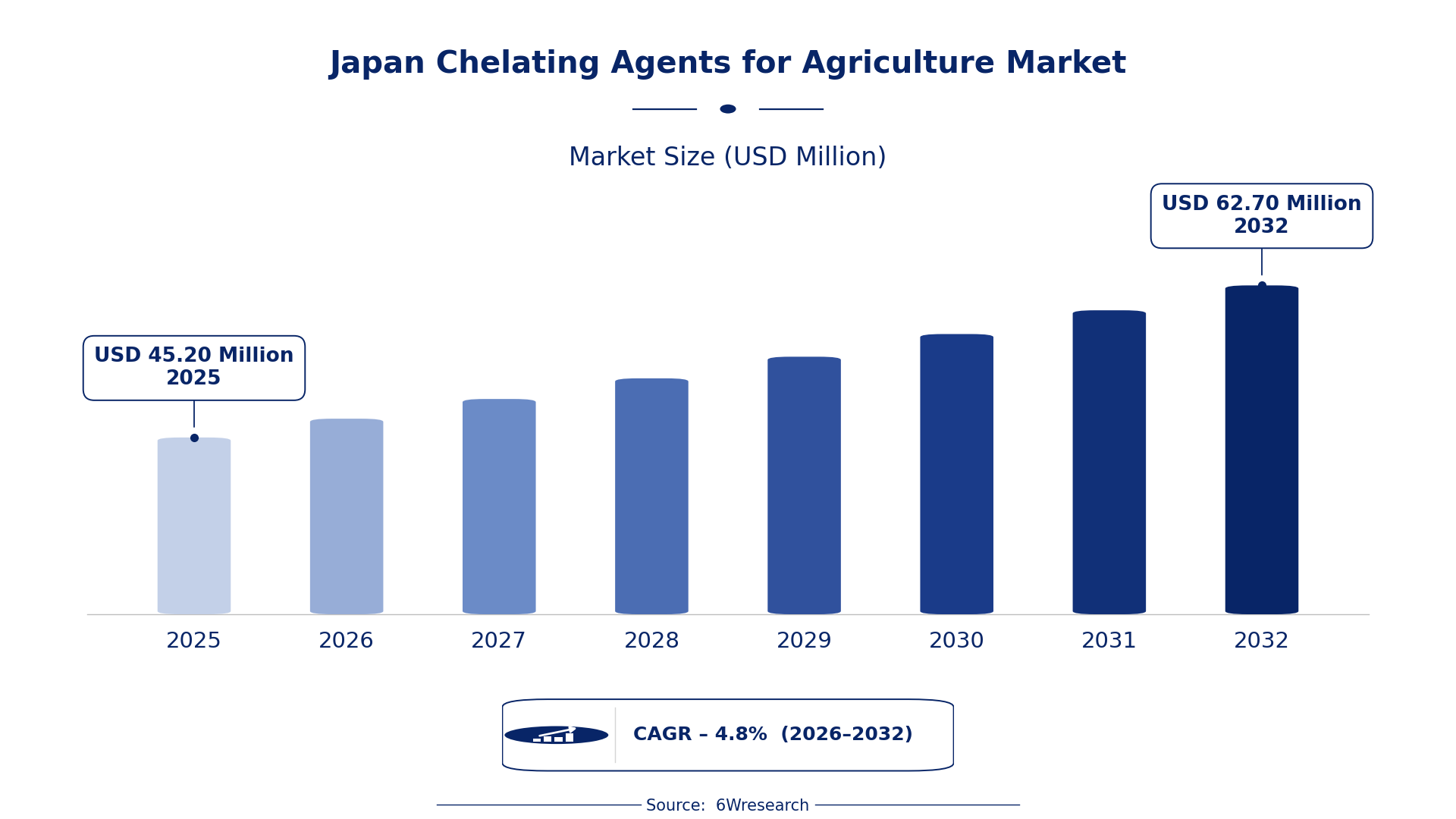
According to 6Wresearch internal database and industry insights, the Japan Chelating Agents for Agriculture Market was valued at USD 45.20 Million in 2025 and is projected to reach USD 62.70 Million by 2032, growing at a CAGR of approximately 4.8% during 2026–2032.
Japan Chelating Agents for Agriculture Market Highlights
| Report Metric | Details |
| Report Name | Japan Chelating Agents for Agriculture Market (2026-2032) |
| Market Size 2025 | USD 45.20 Million |
| Market Size 2032 | USD 62.70 Million |
| Absolute Growth 2025–2032 | USD 17.50 Million |
| CAGR 2026–2032 | 4.8% |
| Peak Annual Growth | 5.6% in 2027 |
| Forecast Period | 2026–2032 |
| Historical Data | 2022–2025 |
| Base Year | 2025 |
| Leading Agent Type, 2025 | EDTA (45% share) |
| Leading Crop Type, 2025 | Cereals (46% share) |
| Leading Application Method, 2025 | Foliar Spray (41% share) |
| Leading Solubility, 2025 | High (40% share) |
| Fastest-Growing Agent Type | DTPA (6.8% CAGR) |
| Fastest-Growing Crop Type | Fruits (7.2% CAGR) |
| Fastest-Growing Application Method | Soil Application (6.5% CAGR) |
| Fastest-Growing Solubility | Moderate (6.3% CAGR) |
| Growing Sector | Soil Application |
| Key End Users | Foliar Spray, Soil Application, Drip Irrigation, Hydroponics |
Japan Chelating Agents for Agriculture Market Year-wise Growth Rate and Key Drivers (2022–2032)
This graph illustrates the annual growth rates of the market from 2022 to 2032, highlighting a steady upward trajectory and projected market expansion over the forecast period.
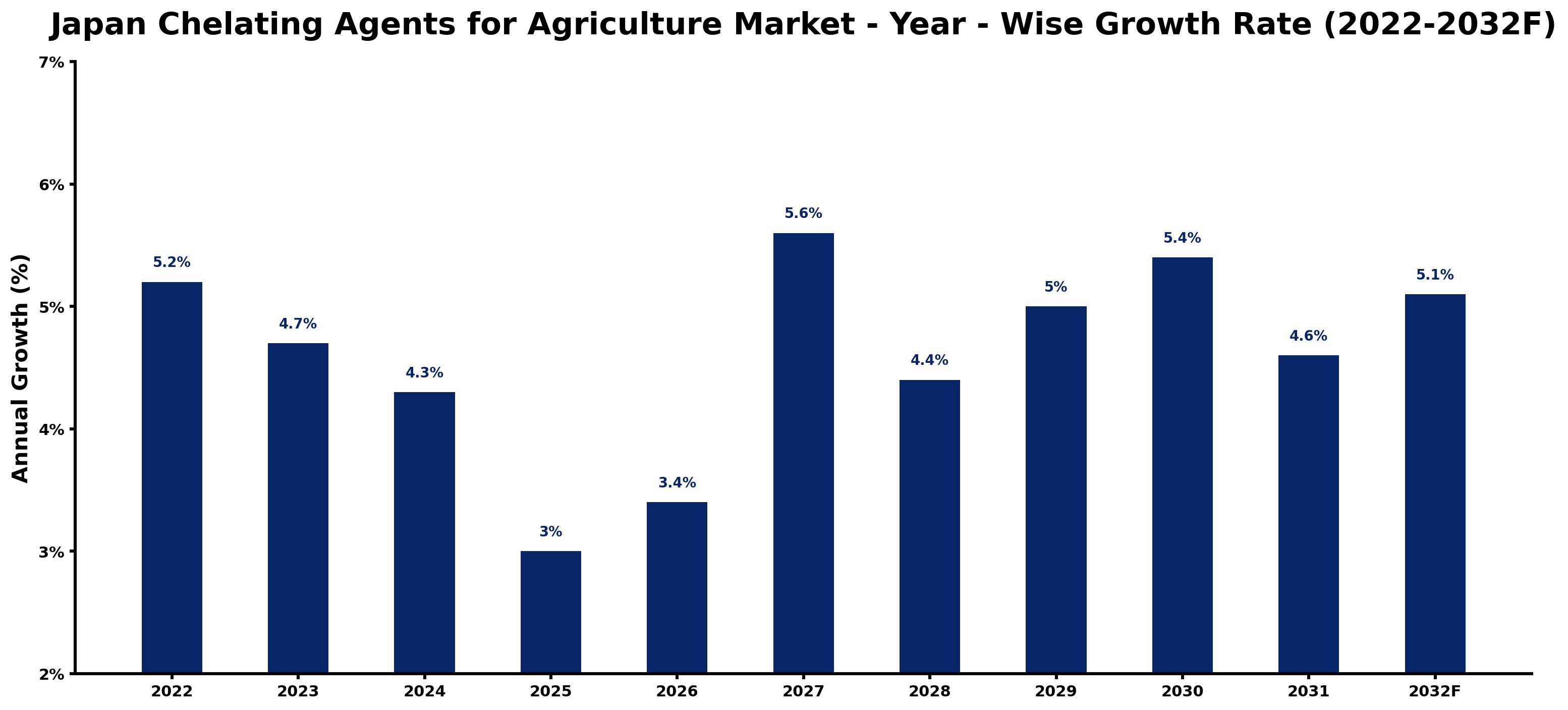
Each row of the following table gives one year's estimated growth and the event or demand shift that explains it.
| Year | Estimated Annual Growth (%) | Market Rationale |
| 2022 | 5.2 | The market showed strong demand due to increased agricultural productivity initiatives. |
| 2023 | 4.7 | Growth slowed as farmers adjusted to rising input costs and changing regulations. |
| 2024 | 4.3 | Market expansion continued but at a reduced pace as input prices remained high. |
| 2025 | 3.0 | Demand growth slowed further as farmers faced challenges in managing input costs. |
| 2026 | 3.4 | Growth is expected to accelerate as new sustainable practices gain traction. |
| 2027 | 5.6 | The market will peak with heightened adoption of advanced nutrient management techniques. |
| 2028 | 4.4 | Growth will slow as market saturation begins to affect demand levels. |
| 2029 | 5.0 | An increase in demand is projected as farmers adopt new agricultural technologies. |
| 2030 | 5.4 | Growth is expected to rise as the focus on sustainable practices continues. |
| 2031 | 4.6 | A slight slowdown is anticipated as the market stabilises after rapid growth. |
| 2032 | 5.1 | Demand will increase as agricultural cooperatives expand their use of chelating agents. |
Note: Market size estimations and growth projections presented in this report are based on 6Wresearch's proprietary forecasting methodology, utilizing the latest available industry data, government publications, and primary research inputs.
Japan Chelating Agents for Agriculture Market Synopsis
Chelating agents for agriculture are compounds that bind metal ions, improving nutrient availability to plants. In Japan, over 10,000 tons of these agents are utilized annually, particularly in rice and vegetable cultivation. The Japan Chelating Agents for Agriculture Market is expanding due to rising agricultural productivity, driven by government programmes promoting sustainable practices.
Market Dynamics Impact Analysis (2026–2032)
| Factor | Type | Impact | Primary Segment Affected |
| Increasing adoption of sustainable farming practices | Driver | High | EDTA |
| Rising demand for high-quality crop yields | Driver | High | Fruits |
| Growing urban agriculture initiatives | Opportunity | High | Hydroponics |
| Expansion of agricultural cooperatives | Opportunity | Medium | Cereals |
| High production costs impacting farmers | Restraint | High | EDDHA |
| Limited awareness of chelating agents' benefits | Restraint | Medium | DTPA |
| Compliance with stringent agricultural regulations | Challenge | High | NTA |
| Capacity constraints in local production facilities | Challenge | Medium | Soil Application |
Evaluation of Drivers in Japan Chelating Agents for Agriculture Market (2026–2032)
Key forces behind demand, with the segment each one moves most, are listed below.
| Drivers | Primary Segment Affected | Why It Matters (Evidence) |
| Sustainable farming practices are increasingly adopted by farmers | EDTA | This shift is reflected in rice cultivation across the Kanto region, where usage exceeds 10,000 tons annually. |
| The need for high-quality yields is driving demand for chelating agents | Fruits | In Yamagata, foliar spray applications are common, boosting fruit quality and growth by enhancing nutrient uptake. |
| Urban agriculture is on the rise, particularly in hydroponics | Hydroponics | Adoption of hydroponic systems in urban areas increased by 20%, generating new demand for nutrient management solutions. |
| Agricultural cooperatives are expanding their offerings | Cereals | With over 1 million hectares dedicated to cereals, cooperatives are promoting the use of chelating agents to improve yields. |
| Research on nutrient management is being supported by government initiatives | EDDHA | The Agricultural Research Organization funds studies to improve nutrient delivery in crops, enhancing overall agricultural productivity. |
Behind the steady rise in orders sits a growing focus on sustainable farming practices, particularly in rice cultivation. The demand for high-quality yields is clear in fruit production, where foliar spray applications significantly boost growth. Urban agriculture is thriving, with hydroponic systems seeing a notable increase in adoption in metropolitan areas. Agricultural cooperatives are broadening their offerings, particularly for cereals, which occupy over 1 million hectares.
Evaluation of Restraints in Japan Chelating Agents for Agriculture Market
Several factors work against faster growth; the main ones are summarised below.
| Market Restraint | Primary Segment Affected | Why It Matters (Evidence) |
| Limited domestic production of chelating agents affects supply reliability | EDTA | Farmers face supply disruptions, delaying crop nutrient application by weeks, which can lead to reduced yields. |
| Rising production costs burden agricultural cooperatives | EDDHA | Stringent compliance with ISO 9001 increases prices, raising expenses by up to 15%, impacting affordability. |
| Inconsistent availability of specific agents impacts crop yields | Fruits | Buyers struggle to source EDDHA, leading to potential yield losses of 20% in strawberry production. |
| Shortage of skilled agricultural technicians hampers nutrient management | Cereals | This inefficiency can reduce crop quality and profitability for producers, affecting overall agricultural output. |
| High input costs constrain farmers' purchasing power | Vegetables | Rising prices limit the ability to invest in necessary chelating agents, impacting crop health. |
Japan Chelating Agents for Agriculture Market Challenges
Agricultural cooperatives in Japan face delays in nutrient application due to limited domestic production of chelating agents, which can postpone harvests by weeks. Rising production costs, driven by strict ISO 9001 standards, push prices up by 15%, forcing producers to absorb these expenses. Buyers encounter inconsistent availability of EDDHA, crucial for strawberry cultivation, risking yield losses of 20% in affected regions. A shortage of skilled agricultural technicians hampers effective nutrient management, leading to inefficiencies that can reduce crop quality and profitability for producers.
Trends in the Japan Chelating Agents for Agriculture Market
The following changes are redrawing the Japan Chelating Agents for Agriculture Market.
- Shift towards Sustainable Practices: Farmers are increasingly adopting sustainable practices to improve crop yields, particularly in rice cultivation. The Ministry of Agriculture, Forestry and Fisheries supports these initiatives, promoting responsible use of chelating agents, which are important for nutrient management.
- Increase in Hydroponic Systems: Urban areas have seen a 20% rise in hydroponic system adoption, reflecting a shift towards modern farming methods. This trend is creating new demand for chelating agents, particularly in controlled environments where nutrient delivery is crucial.
- Focus on Advanced Nutrient Management: The emphasis on advanced nutrient management techniques is reshaping agricultural practices. Research initiatives funded by the Agricultural Research Organization are driving innovations in nutrient delivery systems, boosting crop productivity and sustainability.
- Expansion of Agricultural Cooperatives: Agricultural cooperatives are expanding their offerings to support local farmers. This trend is particularly evident in cereal production, where over 1 million hectares are dedicated to cultivation, facilitating better access to chelating agents.
Investment Opportunities in the Japan Chelating Agents for Agriculture Market
The following areas offer the clearest openings for investors and suppliers in the Japan Chelating Agents for Agriculture Market.
- Timing for Investment in Urban Agriculture: With urban hydroponic systems experiencing a 20% increase, there is a notable opportunity to supply chelating agents to urban farmers. Collaborating with local cooperatives can facilitate market entry and improve product distribution.
- Growing Demand for High-Quality Yields: The need for high-quality yields is driving demand for chelating agents, particularly in fruits. Investing in production facilities in regions like Yamagata can effectively meet this rising demand.
- Support for Sustainable Practices: Government programmes promoting sustainable practices create opportunities for suppliers of chelating agents. Engaging with agricultural cooperatives can improve market penetration and product visibility.
- Research and Development in Nutrient Management: Increased funding for research on nutrient management presents opportunities for innovation. Collaborating with the Agricultural Research Organization can lead to advancements in product offerings and improved agricultural outcomes.
Government Initiatives in the Japan Chelating Agents for Agriculture Market
The Waste Management and Public Cleansing Act of 1970 establishes guidelines for the safe treatment and disposal of industrial waste, impacting producers of chelating agents by imposing strict compliance standards. This law ensures that agricultural chemicals meet safety requirements, influencing production practices and promoting environmental sustainability.
The Ministry of Agriculture, Forestry and Fisheries implements various schemes to promote sustainable agricultural practices. These initiatives support research on nutrient management, allowing buyers to access improved chelating agents that boost crop yields and overall agricultural efficiency.
Future Insight of the Japan Chelating Agents for Agriculture Market
Farmers will increasingly adopt advanced nutrient management techniques, significantly improving crop efficiency. By 2032, the Ministry of Agriculture, Forestry and Fisheries is expected to implement new sustainable practices that promote responsible use of chelating agents. Research initiatives from the Agricultural Research Organization will drive innovations in nutrient management, enhancing crop yields. The average farm size of 1.5 hectares will encourage cooperative purchasing among farmers, improving pricing and availability of chelating agents.
Market Segmentation Analysis
Japan Chelating Agents for Agriculture Market report covers a detailed analysis of the following market segments:
By Agent Type – EDTA Leads, DTPA Expected to Grow Fastest
According to Saurav Kr Singh, Senior Research Analyst at 6Wresearch, EDTA held 45% of the Japan Chelating Agents for Agriculture Market by agent type in 2025. EDTA holds the largest share as it is extensively used for nutrient delivery in various crops, especially in rice and vegetables grown in the Kanto region. Its widespread application among local farmers and agricultural cooperatives underpins its dominance in the market. Over 2026–2032, DTPA is expected to post the fastest growth, at a CAGR of 6.8%. DTPA is experiencing rapid growth due to its effectiveness in alkaline soils, particularly in the Tohoku region where soil conditions necessitate its use. This targeted application is attracting more farmers seeking to optimise nutrient availability. Suppliers should focus on promoting DTPA to capitalise on its growing demand in specific regions.
By Crop Type – Cereals Lead, Fruits Expected to Grow Fastest
The largest crop type category in 2025 was Cereals, at 46% of revenue. Cereals dominate the market because over 1 million hectares are dedicated to their cultivation, making them vital for nutrient enhancement through chelating agents. This extensive area under cultivation ensures a consistent demand for these compounds within the agricultural sector. Fruits are projected to grow fastest, at a CAGR of 7.2% during 2026–2032. Fruits are witnessing rapid growth as they are essential for achieving quality yield and growth, particularly in regions like Yamagata where foliar applications are prevalent. This shift indicates a trend towards prioritising high-value crop production among farmers. Buyers should prioritise investments in chelating agents tailored for fruit production to optimise yield quality.
By Application Method – Foliar Spray Leads, Soil Application Expected to Grow Fastest
Foliar Spray took 41% of application method revenue in 2025, more than any other category. Foliar spray is the preferred application method due to its capacity for immediate nutrient application, especially effective in fruit orchards found in regions like Yamagata. Its popularity among farmers underscores its critical role in boosting crop yields. The quickest growth will come from Soil Application, forecast to expand at a CAGR of 6.5% between 2026 and 2032. Soil application is experiencing swift growth, accounting for 60% of chelating agent usage, as it offers long-term nutrient availability in the soil. This method is increasingly favoured by farmers aiming for sustainable agricultural practices. Suppliers must enhance their product offerings for soil application methods to meet the rising demand.
By Solubility – High Leads, Moderate Expected to Grow Fastest
In 2025, High led the solubility split with a 40% share. High solubility chelating agents dominate the market due to their effectiveness in delivering nutrients efficiently to plants, making them the preferred choice among farmers. Their widespread use reflects the need for optimal nutrient availability in agriculture. Moderate is set to record the highest CAGR in this split, 6.3% over 2026–2032. Moderate solubility agents are gaining traction in specific conditions, catering to unique agricultural needs that require tailored solutions. This growth suggests a diversification in farmer preferences based on soil and crop types. Suppliers should develop and market moderate solubility products to address niche market demands.
Key Attractiveness of the Report
- 10 Years of Market Numbers
- Historical Data Starting from 2022 to 2025
- Base Year 2025
- Forecast Data until 2032
- Key Performance Indicators Impacting the Market
- Major Upcoming Developments and Projects
Key Highlights of the Report:
- Japan Chelating Agents for Agriculture Market Outlook
- Market Size of Japan Chelating Agents for Agriculture Market, 2025
- Forecast of Japan Chelating Agents for Agriculture Market, 2032
- Historical Data and Forecast of Japan Chelating Agents for Agriculture Revenues & Volume for the Period 2022-2032F
- Japan Chelating Agents for Agriculture Market Trend Evolution
- Japan Chelating Agents for Agriculture Market Drivers and Challenges
- Japan Chelating Agents for Agriculture Price Trends
- Japan Chelating Agents for Agriculture Porter's Five Forces
- Japan Chelating Agents for Agriculture Industry Life Cycle
- Historical Data and Forecast of Japan Chelating Agents for Agriculture Market Revenues & Volume By Agent Type for the Period 2022-2032F
- Historical Data and Forecast of Japan Chelating Agents for Agriculture Market Revenues & Volume By EDTA for the Period 2022-2032F
- Historical Data and Forecast of Japan Chelating Agents for Agriculture Market Revenues & Volume By DTPA for the Period 2022-2032F
- Historical Data and Forecast of Japan Chelating Agents for Agriculture Market Revenues & Volume By EDDHA for the Period 2022-2032F
- Historical Data and Forecast of Japan Chelating Agents for Agriculture Market Revenues & Volume By NTA for the Period 2022-2032F
- Historical Data and Forecast of Japan Chelating Agents for Agriculture Market Revenues & Volume By Crop Type for the Period 2022-2032F
- Historical Data and Forecast of Japan Chelating Agents for Agriculture Market Revenues & Volume By Cereals for the Period 2022-2032F
- Historical Data and Forecast of Japan Chelating Agents for Agriculture Market Revenues & Volume By Fruits for the Period 2022-2032F
- Historical Data and Forecast of Japan Chelating Agents for Agriculture Market Revenues & Volume By Vegetables for the Period 2022-2032F
- Historical Data and Forecast of Japan Chelating Agents for Agriculture Market Revenues & Volume By Oilseeds for the Period 2022-2032F
- Historical Data and Forecast of Japan Chelating Agents for Agriculture Market Revenues & Volume By Application Method for the Period 2022-2032F
- Historical Data and Forecast of Japan Chelating Agents for Agriculture Market Revenues & Volume By Foliar Spray for the Period 2022-2032F
- Historical Data and Forecast of Japan Chelating Agents for Agriculture Market Revenues & Volume By Soil Application for the Period 2022-2032F
- Historical Data and Forecast of Japan Chelating Agents for Agriculture Market Revenues & Volume By Drip Irrigation for the Period 2022-2032F
- Historical Data and Forecast of Japan Chelating Agents for Agriculture Market Revenues & Volume By Hydroponics for the Period 2022-2032F
- Historical Data and Forecast of Japan Chelating Agents for Agriculture Market Revenues & Volume By Solubility for the Period 2022-2032F
- Historical Data and Forecast of Japan Chelating Agents for Agriculture Market Revenues & Volume By High for the Period 2022-2032F
- Historical Data and Forecast of Japan Chelating Agents for Agriculture Market Revenues & Volume By Moderate for the Period 2022-2032F
- Historical Data and Forecast of Japan Chelating Agents for Agriculture Market Revenues & Volume By High for the Period 2022-2032F
- Historical Data and Forecast of Japan Chelating Agents for Agriculture Market Revenues & Volume By Low for the Period 2022-2032F
- Japan Chelating Agents for Agriculture Import Export Trade Statistics
- Market Opportunity Assessment By Agent Type
- Market Opportunity Assessment By Crop Type
- Market Opportunity Assessment By Application Method
- Market Opportunity Assessment By Solubility
- Japan Chelating Agents for Agriculture Top Companies Market Share
- Japan Chelating Agents for Agriculture Competitive Benchmarking By Technical and Operational Parameters
- Japan Chelating Agents for Agriculture Company Profiles
- Japan Chelating Agents for Agriculture Key Strategic Recommendations
Market Covered
The study includes the following segmentation.
By Agent Type
- EDTA
- DTPA
- EDDHA
- NTA
By Crop Type
- Cereals
- Fruits
- Vegetables
- Oilseeds
By Application Method
- Foliar Spray
- Soil Application
- Drip Irrigation
- Hydroponics
By Solubility
- High
- Moderate
- Low






































