Japan Chemical and Petrochemical Market Size & Growth Rate
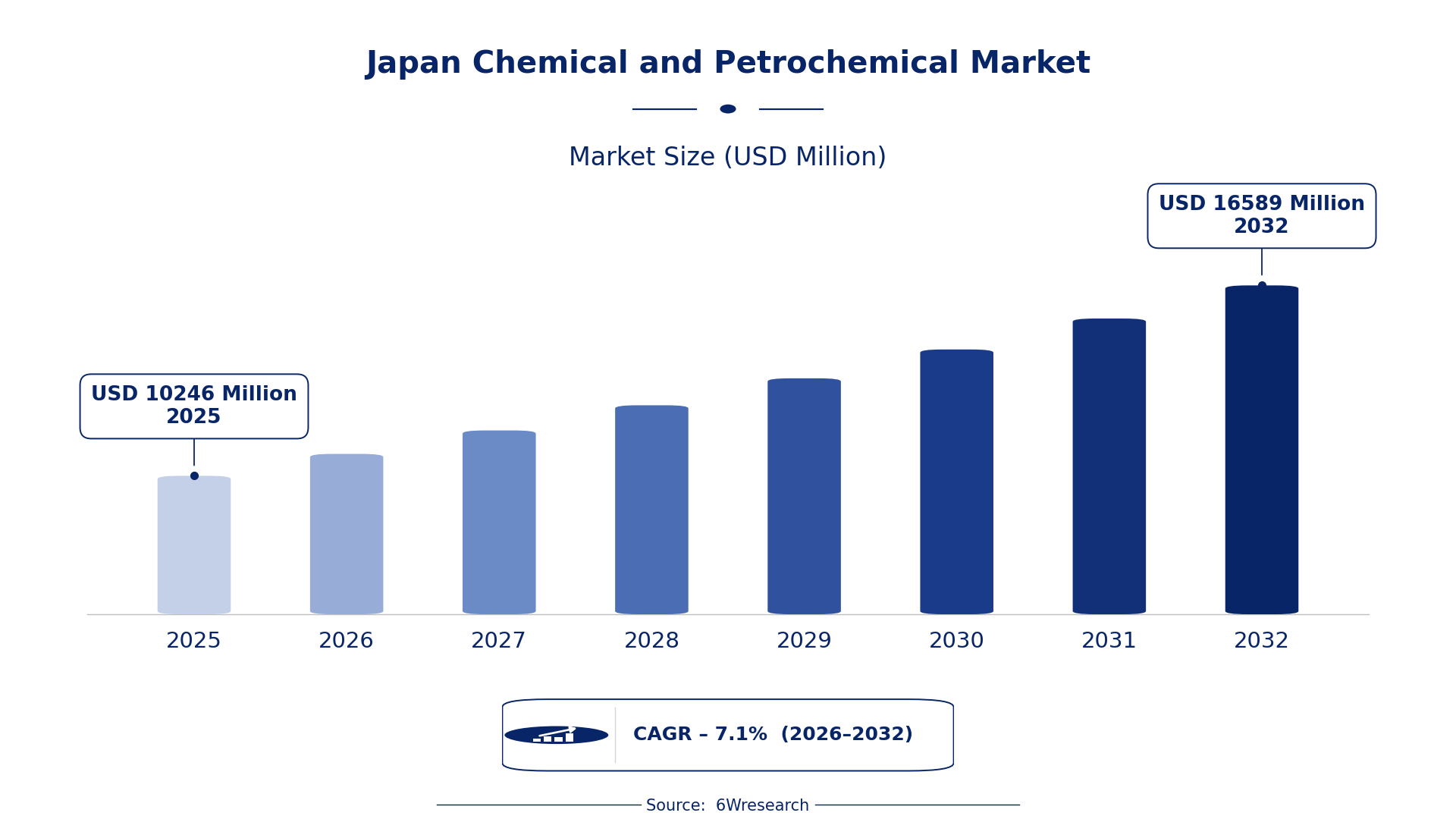
According to 6Wresearch internal database and industry insights, the Japan Chemical and Petrochemical Market was valued at USD 10,246 Million in 2025 and is projected to reach USD 16,589 Million by 2032, growing at a CAGR of approximately 7.1% during 2026–2032.
Japan Chemical and Petrochemical Market Highlights
| Report Metric | Details |
| Report Name | Japan Chemical and Petrochemical Market (2026-2032) |
| Market Size 2025 | USD 10,246 Million |
| Market Size 2032 | USD 16,589 Million |
| Absolute Growth 2025–2032 | USD 6,343 Million |
| CAGR 2026–2032 | 7.1% |
| Peak Annual Growth | 8.0% in 2030 |
| Forecast Period | 2026–2032 |
| Historical Data | 2022–2025 |
| Base Year | 2025 |
| Leading Refining Product, 2025 | Crude Oil (33% share) |
| Leading Chemical Products, 2025 | Benzene (33% share) |
| Leading Coal and Coal Chemicals, 2025 | Methane (40% share) |
| Fastest-Growing Refining Product | LPG (10.5% CAGR) |
| Fastest-Growing Chemical Products | HDPE (10.9% CAGR) |
| Fastest-Growing Coal and Coal Chemicals | Hydrogen (9.9% CAGR) |
| Growing Sector | Chemical Products |
| Key End Users | Manufacturers, construction firms, energy companies |
Japan Chemical and Petrochemical Market Year-wise Growth Rate and Key Drivers (2022–2032)
This graph illustrates the annual growth rates of the market from 2022 to 2032, highlighting a steady upward trajectory and projected market expansion over the forecast period.
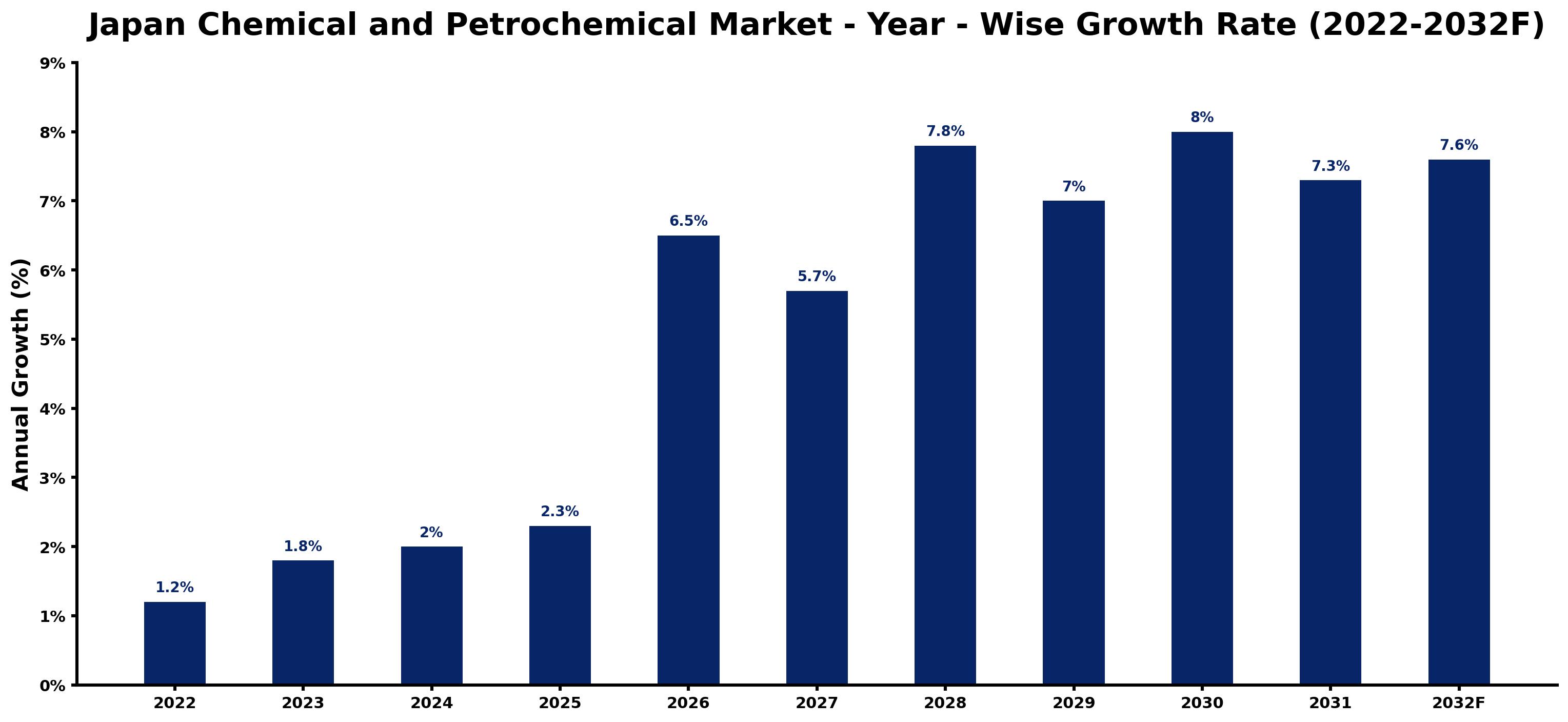
The table below sets out the estimated growth rate for each year and the main factor behind it.
| Year | Estimated Annual Growth (%) | Market Rationale |
| 2022 | 1.2 | The market showed steady growth due to stable demand from domestic users. |
| 2023 | 1.8 | Growth accelerated as the refining sector responded to increased energy needs. |
| 2024 | 2.0 | Demand continued to rise as industrial applications expanded their use of chemicals. |
| 2025 | 2.3 | The market peaked historically as investments in petrochemical production increased. |
| 2026 | 6.5 | Growth surged as the focus on hydrogen production is expected to gain momentum. |
| 2027 | 5.7 | A slowdown occurred as the market adjusts to previous high growth rates. |
| 2028 | 7.8 | Demand is projected to rise again, driven by the packaging industry's expansion. |
| 2029 | 7.0 | Growth is expected to slow slightly as market conditions stabilise after rapid increases. |
| 2030 | 8.0 | The market is projected to peak again with heightened investments in sustainable practices. |
| 2031 | 7.3 | Growth is expected to slow as the market begins to normalise after reaching peak levels. |
| 2032 | 7.6 | Demand is expected to rise as decarbonisation efforts intensify. |
Note: Market size estimations and growth projections presented in this report are based on 6Wresearch's proprietary forecasting methodology, utilizing the latest available industry data, government publications, and primary research inputs.
Japan Chemical and Petrochemical Market Synopsis
Chemical and petrochemical products are derived from crude oil and natural gas, crucial for manufacturing, construction, and energy. The Japan Chemical and Petrochemical Market is expanding due to robust domestic demand and exports, with fuels, plastics, and chemicals as key contributors. Investments in decarbonisation, targeting JPY 150 trillion over ten years, alongside a focus on hydrogen production, are generating new demand opportunities.
Market Dynamics Impact Analysis (2026–2032)
| Factor | Type | Impact | Primary Segment Affected |
| Increasing demand for high-quality plastics | Driver | High | Crude Oil |
| Rising investments in hydrogen production | Driver | High | Hydrogen |
| Expansion of the packaging industry | Opportunity | High | Crude Oil |
| Growing interest in sustainable practices | Opportunity | Medium | Crude Oil |
| Regulatory compliance costs | Restraint | High | Crude Oil |
| Fluctuating crude oil prices | Restraint | High | Crude Oil |
| High operational costs for refining | Challenge | High | Crude Oil |
| Technological adaptation delays | Challenge | Medium | Crude Oil |
Evaluation of Drivers in Japan Chemical and Petrochemical Market (2026–2032)
Key forces behind demand, with the segment each one moves most, are listed below.
| Drivers | Primary Segment Affected | Why It Matters (Evidence) |
| Rising demand for fuels and chemicals | Crude Oil | Japan produced 4.5 million barrels of crude oil per day in 2022, driving the need for refined products. |
| Increased hydrogen production | Hydrogen | Hydrogen production is part of Japan's strategy for energy transition, with a budget of $1 billion for 2023. |
| Growth in the packaging sector | LLDPE | The packaging industry in Japan is valued at $200 billion, boosting demand for HDPE and LLDPE. |
| Decarbonisation investments | Crude Oil | Japan targets JPY 150 trillion for decarbonisation investment over 10 years, supporting sustainable production. |
| Demand for ammonia in agriculture | Ammonia | Japan's ammonia production is crucial for food security, with significant investments in agricultural chemicals. |
A wider customer base explains much of the growth, as demand for fuels and chemicals from the refining sector has surged. The packaging industry, valued at $200 billion, is expanding, driving demand for various plastic products. The focus on hydrogen production is rising, supported by a $1 billion budget for 2023. Investments in decarbonisation are also increasing, with a target of JPY 150 trillion over ten years, promoting sustainable practices in production.
Evaluation of Restraints in Japan Chemical and Petrochemical Market
Below are the constraints most often cited by buyers and suppliers, with the segment each affects.
| Market Restraint | Primary Segment Affected | Why It Matters (Evidence) |
| High compliance costs due to regulations | Crude Oil | The PRTR Law requires reporting of chemical releases, increasing operational costs for producers. |
| Volatility in crude oil prices | Crude Oil | Japan's heavy reliance on crude oil makes it vulnerable to price fluctuations, impacting profitability. |
| Limited domestic feedstock availability | Crude Oil | Japan's reliance on imports for raw materials constrains production capabilities. |
| Environmental regulations affecting production | Crude Oil | The Chemical Substances Control Law mandates strict evaluation of chemicals, complicating production processes. |
| Market saturation in certain chemical segments | Crude Oil | Increased competition in the chemical sector has led to price pressures and reduced margins. |
Japan Chemical and Petrochemical Market Challenges
Kerosene consumption reached 1.2 million kiloliters in 2021, driving up supply chain costs for buyers who rely on this essential material. Fierce competition in the petrochemical sector, with exports valued at $15 billion in 2022, pressures suppliers to reduce prices, which can compromise quality. Producers face technological limitations that hinder their ability to meet JIS quality standards, delaying product availability for buyers. Regulatory changes aimed at a 46% reduction in greenhouse-gas emissions by 2030 impose costly adjustments on manufacturers, increasing operational expenses that ultimately affect pricing for buyers.
Trends in the Japan Chemical and Petrochemical Market
The following changes are redrawing the Japan Chemical and Petrochemical Market.
- Shift to Sustainable Production: Since 2023, the chemical industry has increasingly prioritised sustainable practices. The Japan Chemical Industry Association promotes recycling initiatives, leading to a 15% increase in recycled materials used in production.
- Increase in Hydrogen Applications: The focus on hydrogen production has surged since 2023, particularly in energy applications. Hydrogen production is projected to reach 1 million tons by 2030, impacting energy transition efforts.
- Growth of High-Density Polyethylene: The demand for HDPE has risen sharply since 2022, driven by the packaging industry. HDPE demand in Japan was 1.8 million tons in 2022, reflecting a strong market trend.
- Expansion of Ammonia Production: Ammonia production has been prioritised since 2023, important for agriculture. Japan's ammonia production supports food security, with a target of increasing output by 20% by 2030.
Investment Opportunities in the Japan Chemical and Petrochemical Market
Below are the investment opportunities with the strongest case in the Japan Chemical and Petrochemical Market.
- Investment in Hydrogen Infrastructure: The opportunity for hydrogen infrastructure investment is present now, with Japan committing $1 billion for 2023. Energy producers are seeking partnerships to enhance hydrogen supply chains.
- Expansion of Recycling Facilities: With a growing focus on sustainability, there is a need for advanced recycling facilities. The Tokyo Metropolitan Government's initiatives promote recycling, creating demand for new technologies.
- Development of Sustainable Chemicals: Investing in sustainable chemical production is timely, as regulations tighten. Chemical producers are looking to innovate in eco-friendly products to meet new standards.
- Enhancement of Petrochemical Exports: Japan's petrochemical exports were valued at $15 billion in 2022, indicating a strong market. Exporters can benefit from partnerships to expand their reach in international markets.
Government Initiatives in the Japan Chemical and Petrochemical Market
The Chemical Substances Control Law requires manufacturers to evaluate and control chemical substances, impacting production processes. This law ensures that producers adhere to safety and environmental standards, which are important for maintaining market competitiveness. Additionally, the PRTR Law mandates reporting of chemical releases, increasing transparency and accountability in the industry.
Japan is committing JPY 150 trillion for decarbonisation investments over ten years, with the Ministry of Economy, Trade and Industry overseeing these initiatives. This funding supports projects that promote sustainability in the chemical sector, encouraging innovation and compliance with environmental standards.
Future Insight of the Japan Chemical and Petrochemical Market
By 2032, buyers will benefit from enhanced energy efficiency as advancements in hydrogen fuel technology reshape production processes, with substantial investments supporting this transition. The chemical sector will see a surge in decarbonisation initiatives driven by the GX Basic Policy, targeting significant funding for sustainable practices. Suppliers will adapt to evolving JIS standards, resulting in improved product quality that meets market demands. Initiatives in the Tokyo Metropolitan area will promote increased recycling of plastics, creating new opportunities for sustainable sourcing and production.
Market Segmentation Analysis
Japan Chemical and Petrochemical Market report covers a detailed analysis of the following market segments:
By Refining Product – Crude Oil Leads, LPG Expected to Grow Fastest
According to Sumit Sagar, AM at 6Wresearch, the largest refining product category in 2025 was Crude Oil, at 33% of revenue. Crude oil holds the largest share in the refining product segment as it is the primary feedstock for producing essential fuels and chemicals, crucial for Japan's energy needs. The output from the Tokyo Bay area, a major refining hub, highlights its importance in fulfilling domestic requirements. LPG is set to record the highest CAGR in this split, 10.5% over 2026–2032. LPG is experiencing rapid growth driven by its increasing use in residential heating and cooking, which aligns with Japan's transition towards cleaner energy sources. The government's decarbonisation initiatives are further stimulating this upward trajectory in LPG consumption. Suppliers should focus on expanding their LPG offerings to meet the rising demand for cleaner energy options.
By Chemical Products – Benzene Leads, HDPE Expected to Grow Fastest
Benzene took 33% of chemical products revenue in 2025, more than any other category. Benzene is the leading sub-segment because it serves as a key raw material for various chemical products, essential in multiple industrial applications. Its widespread use across different sectors solidifies its dominant position. Over 2026–2032, HDPE is expected to post the fastest growth, at a CAGR of 10.9%. HDPE is the fastest-growing sub-segment, primarily driven by its extensive application in packaging and containers, which is a booming market valued at $200 billion. This trend indicates a shift towards sustainable packaging solutions. Buyers should consider sourcing more HDPE products to align with market trends towards sustainability.
By Coal and Coal Chemicals – Methane Leads, Hydrogen Expected to Grow Fastest
In 2025, Methane led the coal and coal chemicals split with a 40% share. Methane leads the coal and coal chemicals segment as it is widely used as both a fuel and a chemical feedstock, essential for various industrial processes. Its extensive application ensures consistent demand across multiple sectors, solidifying its market dominance. Hydrogen is projected to grow fastest, at a CAGR of 9.9% during 2026–2032. Hydrogen is rapidly growing due to its expanding applications in clean energy, supported by significant government investments in hydrogen technology. This trend indicates a crucial shift towards sustainable energy solutions within Japan's market. Suppliers must adapt their strategies to leverage the increasing importance of hydrogen in the energy landscape.
Key Attractiveness of the Report
- 10 Years of Market Numbers
- Historical Data Starting from 2022 to 2025
- Base Year 2025
- Forecast Data until 2032
- Key Performance Indicators Impacting the Market
- Major Upcoming Developments and Projects
Key Highlights of the Report:
- Japan Chemical and Petrochemical Market Outlook
- Market Size of Japan Chemical and Petrochemical Market, 2025
- Forecast of Japan Chemical and Petrochemical Market, 2032
- Historical Data and Forecast of Japan Chemical and Petrochemical Revenues & Volume for the Period 2022-2032
- Japan Chemical and Petrochemical Market Trend Evolution
- Japan Chemical and Petrochemical Market Drivers and Challenges
- Japan Chemical and Petrochemical Price Trends
- Japan Chemical and Petrochemical Porter's Five Forces
- Japan Chemical and Petrochemical Industry Life Cycle
- Historical Data and Forecast of Japan Chemical and Petrochemical Market Revenues & Volume By Refining Product for the Period 2022-2032
- Historical Data and Forecast of Japan Chemical and Petrochemical Market Revenues & Volume By Crude Oil for the Period 2022-2032
- Historical Data and Forecast of Japan Chemical and Petrochemical Market Revenues & Volume By Kerosene for the Period 2022-2032
- Historical Data and Forecast of Japan Chemical and Petrochemical Market Revenues & Volume By Marine Oil for the Period 2022-2032
- Historical Data and Forecast of Japan Chemical and Petrochemical Market Revenues & Volume By Asphalt for the Period 2022-2032
- Historical Data and Forecast of Japan Chemical and Petrochemical Market Revenues & Volume By LPG for the Period 2022-2032
- Historical Data and Forecast of Japan Chemical and Petrochemical Market Revenues & Volume By Propane for the Period 2022-2032
- Historical Data and Forecast of Japan Chemical and Petrochemical Market Revenues & Volume By Butane for the Period 2022-2032
- Historical Data and Forecast of Japan Crude Oil Chemical and Petrochemical Market Revenues & Volume By Sulfur for the Period 2022-2032
- Historical Data and Forecast of Japan Chemical and Petrochemical Market Revenues & Volume By Chemical Products for the Period 2022-2032
- Historical Data and Forecast of Japan Chemical and Petrochemical Market Revenues & Volume By Benzene for the Period 2022-2032
- Historical Data and Forecast of Japan Chemical and Petrochemical Market Revenues & Volume By Styrene for the Period 2022-2032
- Historical Data and Forecast of Japan Chemical and Petrochemical Market Revenues & Volume By HDPE for the Period 2022-2032
- Historical Data and Forecast of Japan Chemical and Petrochemical Market Revenues & Volume By LLDPE for the Period 2022-2032
- Historical Data and Forecast of Japan Chemical and Petrochemical Market Revenues & Volume By PP for the Period 2022-2032
- Historical Data and Forecast of Japan Chemical and Petrochemical Market Revenues & Volume By Butene - 1 for the Period 2022-2032
- Historical Data and Forecast of Japan Chemical and Petrochemical Market Revenues & Volume By Butadine for the Period 2022-2032
- Historical Data and Forecast of Japan Chemical and Petrochemical Market Revenues & Volume By MTBE for the Period 2022-2032
- Historical Data and Forecast of Japan Chemical and Petrochemical Market Revenues & Volume By Coal and Coal Chemicals for the Period 2022-2032
- Historical Data and Forecast of Japan Chemical and Petrochemical Market Revenues & Volume By Methane for the Period 2022-2032
- Historical Data and Forecast of Japan Chemical and Petrochemical Market Revenues & Volume By Carbon Monoxide for the Period 2022-2032
- Historical Data and Forecast of Japan Chemical and Petrochemical Market Revenues & Volume By Hydrogen for the Period 2022-2032
- Historical Data and Forecast of Japan Chemical and Petrochemical Market Revenues & Volume By Ammonia for the Period 2022-2032
- Historical Data and Forecast of Japan Chemical and Petrochemical Market Revenues & Volume By Hydrogen Sulfide for the Period 2022-2032
- Historical Data and Forecast of Japan Chemical and Petrochemical Market Revenues & Volume By Others for the Period 2022-2032
- Japan Chemical and Petrochemical Import Export Trade Statistics
- Market Opportunity Assessment By Refining Product
- Market Opportunity Assessment By Chemical Products
- Market Opportunity Assessment By Coal and Coal Chemicals
- Japan Chemical and Petrochemical Top Companies Market Share
- Japan Chemical and Petrochemical Competitive Benchmarking By Technical and Operational Parameters
- Japan Chemical and Petrochemical Company Profiles
- Japan Chemical and Petrochemical Key Strategic Recommendations
Market Covered
Coverage by segment is as follows.
By Refining Product
- Crude Oil
- Kerosene
- Marine Oil
- Asphalt
- LPG
- Propane
- Butane
- Sulfur
By Chemical Products
- Benzene
- Styrene
- HDPE
- LLDPE
- PP
- Butene - 1
- Butadine
- MTBE
By Coal and Coal Chemicals
- Methane
- Carbon Monoxide
- Hydrogen
- Ammonia
- Hydrogen Sulfide
- Others































