Japan Chlor Alkali Market Size & Growth Rate
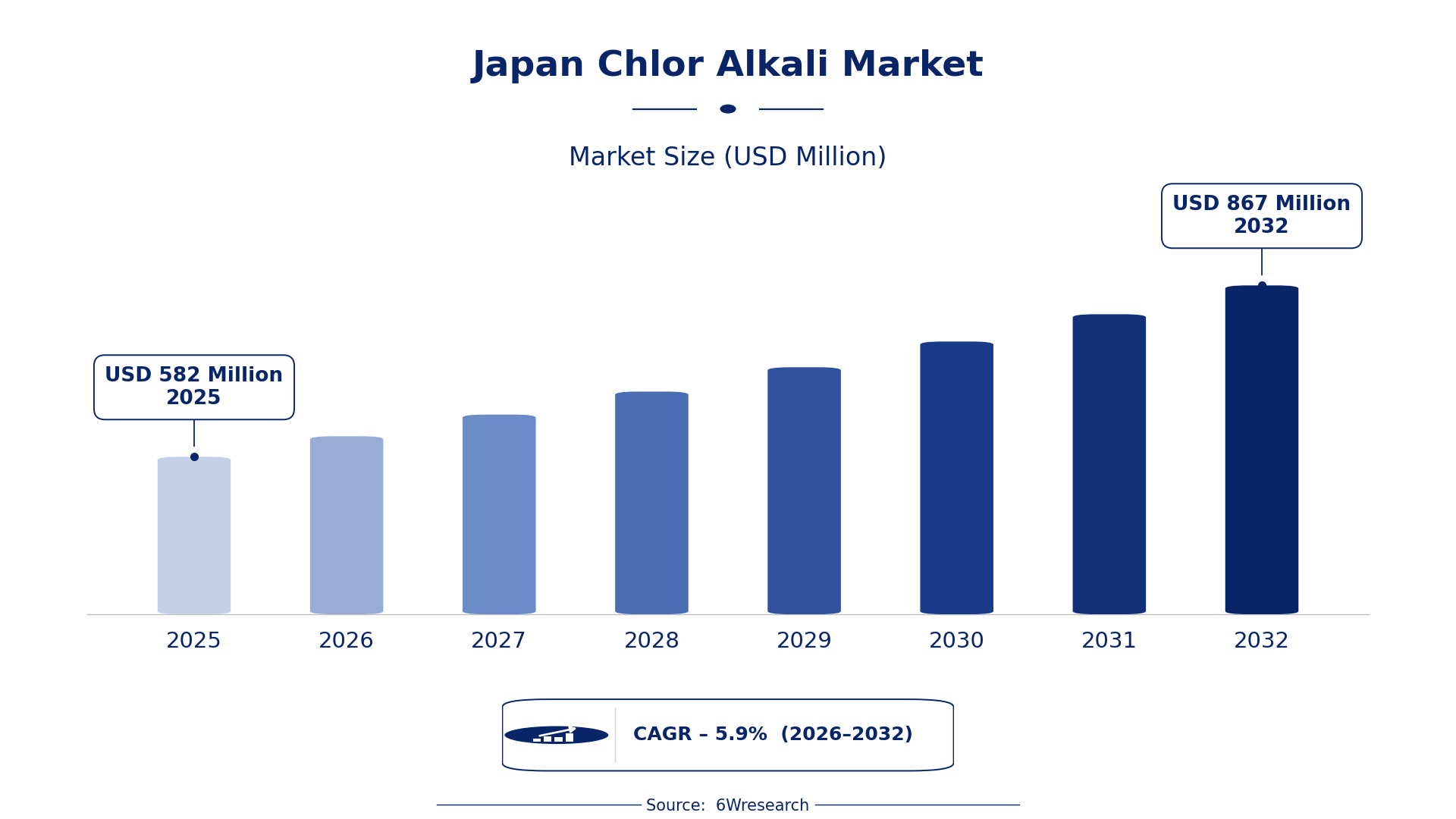
According to 6Wresearch internal database and industry insights, the Japan Chlor Alkali Market was valued at USD 582 Million in 2025 and is projected to reach USD 867 Million by 2032, growing at a CAGR of approximately 5.9% during 2026–2032.
Japan Chlor Alkali Market Highlights
| Report Metric | Details |
| Report Name | Japan Chlor Alkali Market (2026-2032) |
| Market Size 2025 | USD 582 Million |
| Market Size 2032 | USD 867 Million |
| Absolute Growth 2025–2032 | USD 285 Million |
| CAGR 2026–2032 | 5.9% |
| Peak Annual Growth | 6.6% in 2027 |
| Forecast Period | 2026–2032 |
| Historical Data | 2022–2025 |
| Base Year | 2025 |
| Leading Product, 2025 | Caustic Soda (43% share) |
| Leading Production Process, 2025 | Membrane Cell (47% share) |
| Leading Application, 2025 | Pulp and Paper (44% share) |
| Fastest-Growing Product | Chlorine (7.9% CAGR) |
| Fastest-Growing Production Process | Diaphragm Cell (7.8% CAGR) |
| Fastest-Growing Application | Organic Chemical (8.3% CAGR) |
| Growing Sector | Chemical Manufacturing |
| Key End Users | Water treatment facilities, soap and detergent manufacturers, organic chemical producers, pulp and paper industry |
Japan Chlor Alkali Market Year-wise Growth Rate and Key Drivers (2022–2032)
This graph illustrates the annual growth rates of the market from 2022 to 2032, highlighting a steady upward trajectory and projected market expansion over the forecast period.
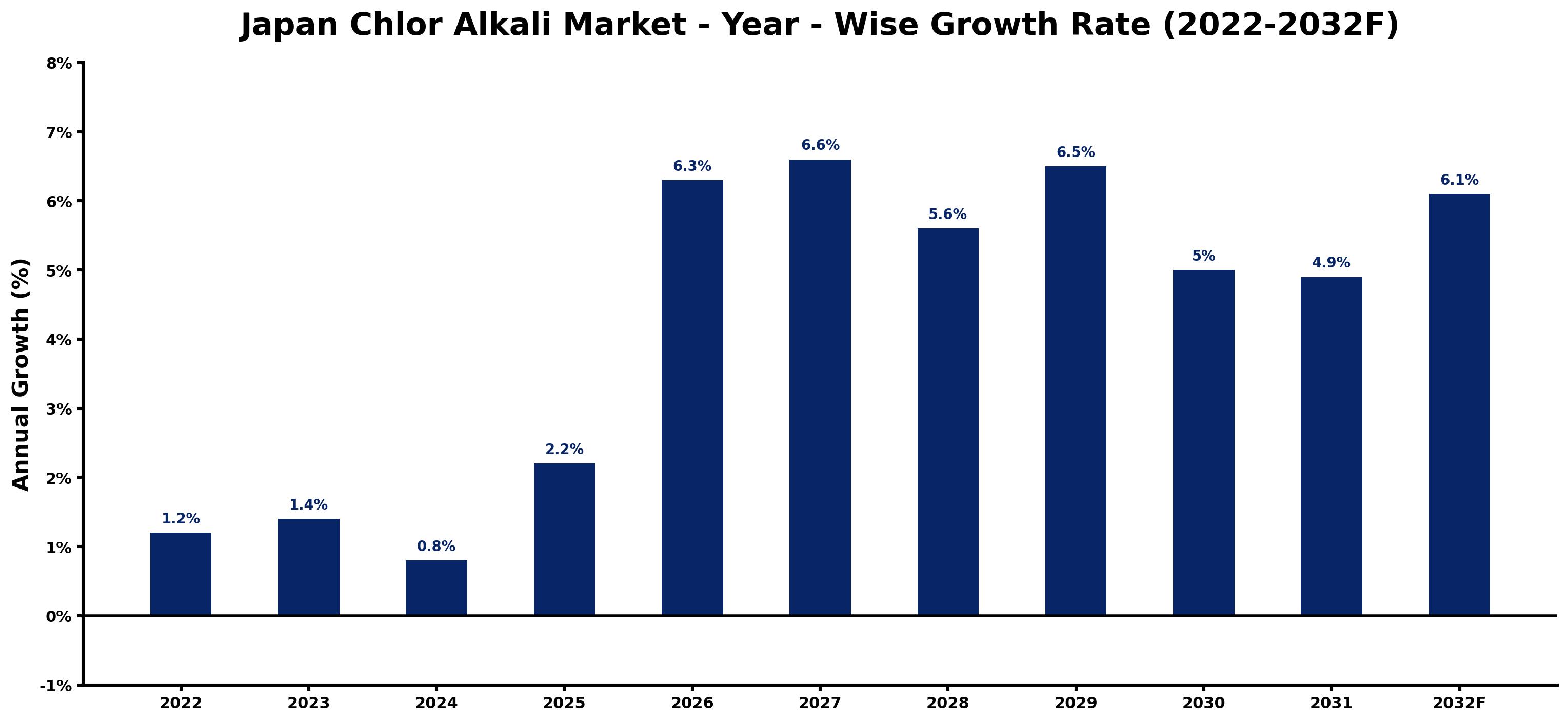
The following figures match every annual growth estimate with the main market development of that year, giving the reasoning behind each rise or slowdown.
| Year | Estimated Annual Growth (%) | Market Rationale |
| 2022 | 1.2 | The market experienced modest growth, driven by steady demand from the chemical sector. |
| 2023 | 1.4 | Growth accelerated as production capacity expanded to meet rising industrial needs. |
| 2024 | 0.8 | The market growth slowed due to temporary fluctuations in demand from key industries. |
| 2025 | 2.2 | Increased demand from the soap and detergent sector contributed to improved growth rates. |
| 2026 | 6.3 | Investment in membrane cell technology is expected to spur growth in production efficiency. |
| 2027 | 6.6 | The peak growth year will see heightened demand from water treatment applications. |
| 2028 | 5.6 | A slight slowdown is projected as production stabilises following the previous peak. |
| 2029 | 6.5 | Demand will surge again, driven by growth in the organic chemical sector. |
| 2030 | 5.0 | Growth will moderate as market conditions normalise after the previous surge. |
| 2031 | 4.9 | A further slowdown is expected as the market adjusts to new production levels. |
| 2032 | 6.1 | Growth is projected to rebound as investments in sustainable chemicals gain momentum. |
Note: Market size estimations and growth projections presented in this report are based on 6Wresearch's proprietary forecasting methodology, utilizing the latest available industry data, government publications, and primary research inputs.
Japan Chlor Alkali Market Synopsis
Chlor alkali encompasses the production of chlorine, caustic soda, and soda ash through the electrolysis of saltwater. The Japan Chlor Alkali Market caters to domestic users, particularly in water treatment and chemical manufacturing. Demand is increasing due to the soap and detergent sector, underpinned by government initiatives for sustainable chemicals and investments in advanced production technologies. The installed capacity for caustic soda stands at approximately 1 million tons annually, while chlorine production supports over 100 million people, underscoring the industry's importance.
Market Dynamics Impact Analysis (2026–2032)
| Factor | Type | Impact | Primary Segment Affected |
| Rising demand from the soap and detergent sector | Driver | High | Caustic Soda |
| Increased adoption of membrane cell technology | Driver | High | Chlorine |
| Growing need for water treatment solutions | Opportunity | High | Chlorine |
| Expansion of the organic chemical sector | Opportunity | High | Organic Chemical |
| Regulatory compliance costs for chemical production | Restraint | Medium | Chlorine |
| Fluctuations in raw material prices | Restraint | Medium | Caustic Soda |
| Limited production capacity in certain regions | Challenge | High | Soda Ash |
| Technological upgrades required for older production methods | Challenge | Medium | Diaphragm Cell |
Evaluation of Drivers in Japan Chlor Alkali Market (2026–2032)
The main growth drivers and the segments they affect most are set out below.
| Drivers | Primary Segment Affected | Why It Matters (Evidence) |
| Increased production of cleaning agents | Caustic Soda | The soap and detergent sector's growth, valued at 1 million tons, drives higher caustic soda demand. |
| Adoption of modern production techniques | Chlorine | Membrane cell technology accounts for over 70% of chlorine production, improving efficiency and output. |
| Demand for water treatment solutions | Chlorine | Chlorine serves over 100 million people in Japan, ensuring a steady market for water treatment. |
| Expansion of organic chemical applications | Organic Chemical | The organic chemical sector's growth, with a CAGR of 8.3%, fuels demand for chlor alkali products. |
| Investment in sustainable chemical initiatives | Soda Ash | Government support for sustainable chemicals boosts investments in soda ash production. |
Spending rises because the soap and detergent sector is expanding, driving demand for caustic soda, which is used in various industrial processes. The organic chemical sector is also growing, increasing the need for chlor alkali products. Chlorine production, primarily for water treatment, serves over 100 million people, ensuring a stable market. Investment in membrane cell technology, which accounts for over 70% of chlorine production, improves efficiency and output, further supporting demand. The push for sustainable chemicals is creating new opportunities for suppliers to innovate and meet evolving market needs.
Evaluation of Restraints in Japan Chlor Alkali Market
Several factors work against faster growth; the main ones are summarised below.
| Market Restraint | Primary Segment Affected | Why It Matters (Evidence) |
| Regulatory compliance costs for chemical production | Chlorine | Compliance with the Chemical Substances Control Law increases operational costs for producers. |
| Fluctuations in raw material prices | Caustic Soda | Variability in salt prices affects production costs and profitability for manufacturers. |
| Limited production capacity in certain regions | Soda Ash | Concentration of production in the Chubu region restricts supply flexibility across Japan. |
| Technological upgrades required for older production methods | Diaphragm Cell | Older diaphragm cell technology is less efficient, necessitating costly upgrades for competitiveness. |
| Environmental regulations impacting production processes | Chlorine | Stricter regulations under the PRTR Law impose additional reporting and compliance burdens. |
Japan Chlor Alkali Market Challenges
Producers are grappling with escalating energy costs, which can elevate operational expenses by up to 15% annually, affecting profitability. Buyers in the soap and detergent sector encounter fluctuating caustic soda prices, which may surge by 10% during peak demand, straining budgets. Supply chain risks arise as production is concentrated in the Chubu region, potentially delaying deliveries to buyers by weeks during natural disasters. Regulatory compliance under the Chemical Substances Control Law adds complexity, necessitating extensive documentation and potentially delaying product launches for manufacturers by several months.
Trends in the Japan Chlor Alkali Market
Buyers and suppliers in the Japan Chlor Alkali Market are adjusting to the following trends.
- Shift in Water Treatment Practices: Water treatment facilities are increasingly adopting chlorine for its effectiveness, with over 100 million people relying on it in Japan. This trend reflects a growing focus on public health and safety.
- Transition to Sustainable Chemical Production: The chlor alkali industry is moving towards sustainable practices, driven by initiatives in 2023. This shift is expected to improve environmental compliance and efficiency.
- Emergence of Advanced Production Technologies: Membrane cell technology is becoming the standard for chlorine production, accounting for over 70% of output in Japan. This advancement indicates a move towards more efficient manufacturing processes.
- Growing Demand in Organic Chemicals: The organic chemical sector is increasingly utilising chlor alkali products, with a projected CAGR of 8.3%. This growth highlights the versatility and importance of chlor alkali in various applications.
Investment Opportunities in the Japan Chlor Alkali Market
Where to invest in the Japan Chlor Alkali Market: the main openings are set out below.
- Investment in Sustainable Chemical Initiatives: With the government's push for sustainable chemicals, there is an opportunity for investment in eco-friendly production methods, particularly in the Chubu region, where capacity is concentrated.
- Expansion of Water Treatment Facilities: As demand for clean water rises, there is a need for more chlorine production to support new water treatment facilities, particularly in urban areas, creating investment opportunities.
- Growth in Organic Chemical Production: The organic chemical sector's growth presents opportunities for suppliers of chlor alkali products, especially in regions with high industrial activity, such as Chubu.
- Technological Upgrades in Production Processes: Investment in modern membrane cell technology can improve production efficiency, with potential partnerships in the Chubu region to facilitate entry into the market.
Government Initiatives in the Japan Chlor Alkali Market
The Chemical Substances Control Law mandates that producers evaluate and control chemical substances, impacting chlorine production. Compliance requires investment in testing and reporting, ensuring safety and environmental standards are met.
In 2023, the Economic Security Promotion Act allocated funding to improve supply-chain resilience for critical chemical products. The Ministry of Economy, Trade and Industry oversees this programme, which supports producers in maintaining operational stability.
Future Insight of the Japan Chlor Alkali Market
Investment in membrane cell technology will enhance production efficiency, creating a demand for around 1 million tons of caustic soda by 2032. The government initiative for sustainable chemicals will drive suppliers to adopt eco-friendly practices. Improved ISO 9001 standards will strengthen quality assurance processes, ensuring buyers receive more reliable products. The increasing need for water treatment solutions will lead to the establishment of new facilities, expanding access to chlorine for millions.
Market Segmentation Analysis
Japan Chlor Alkali Market report covers a detailed analysis of the following market segments:
By Product – Caustic Soda Leads, Chlorine Expected to Grow Fastest
According to Ravi Bhandari, Research Head at 6Wresearch, Caustic Soda held 43% of the Japan Chlor Alkali Market by product in 2025. Caustic soda commands the largest market share because it is essential in various industrial processes, particularly in soap and detergent production, which is vital for consumer goods. With an installed capacity of approximately 1 million tons annually, it supports multiple sectors across Japan. Over 2026–2032, Chlorine is expected to post the fastest growth, at a CAGR of 7.9%. Chlorine is experiencing rapid growth as it plays a crucial role in water treatment, serving over 100 million people in Japan. The increasing emphasis on ensuring safe drinking water is a primary factor driving its market expansion. Suppliers need to scale up production to meet the rising demand for both caustic soda and chlorine.
By Production Process – Membrane Cell Leads, Diaphragm Cell Expected to Grow Fastest
In 2025, Membrane Cell led the production process split with a 47% share. The membrane cell process holds the largest share as it is a modern and efficient production method widely adopted in Japan, ensuring high-quality output. Its prevalence in chlorine production, accounting for over 70%, underscores its importance in the chlor alkali market. The quickest growth will come from Diaphragm Cell, forecast to expand at a CAGR of 7.8% between 2026 and 2032. The diaphragm cell process, while older and less efficient, is still in use and shows growth due to its lower initial investment costs for certain producers. This continued use indicates a transitional phase where suppliers may upgrade to more efficient methods over time. Investing in advanced production technologies could provide suppliers with a competitive edge in the evolving market.
By Application – Pulp and Paper Leads, Organic Chemical Expected to Grow Fastest
Pulp and Paper accounted for 44% of the market by application in 2025. The pulp and paper sector leads the application segment as caustic soda is indispensable for the bleaching and processing of paper products, which are important for both local use and exports. This stable industry ensures a steady demand for chlor alkali products. Organic Chemical is set to record the highest CAGR in this split, 8.3% over 2026–2032. Organic chemicals are growing rapidly as they serve as key raw materials for various organic compounds, with expanding industrial applications propelling this trend. This indicates a shift towards more sustainable chemical solutions within the market. Buyers in the organic chemical sector should anticipate price increases and secure their supply chains to align with production needs.
Key Attractiveness of the Report
- 10 Years of Market Numbers
- Historical Data Starting from 2022 to 2025
- Base Year 2025
- Forecast Data until 2032
- Key Performance Indicators Impacting the Market
- Major Upcoming Developments and Projects
Key Highlights of the Report:
- Japan Chlor Alkali Market Outlook
- Market Size of Japan Chlor Alkali Market, 2025
- Forecast of Japan Chlor Alkali Market, 2032
- Historical Data and Forecast of Japan Chlor Alkali Revenues & Volume for the Period 2022-2032
- Japan Chlor Alkali Market Trend Evolution
- Japan Chlor Alkali Market Drivers and Challenges
- Japan Chlor Alkali Price Trends
- Japan Chlor Alkali Porter's Five Forces
- Japan Chlor Alkali Industry Life Cycle
- Historical Data and Forecast of Japan Chlor Alkali Market Revenues & Volume By Product for the Period 2022-2032
- Historical Data and Forecast of Japan Chlor Alkali Market Revenues & Volume By Caustic Soda for the Period 2022-2032
- Historical Data and Forecast of Japan Chlor Alkali Market Revenues & Volume By Chlorine for the Period 2022-2032
- Historical Data and Forecast of Japan Chlor Alkali Market Revenues & Volume By Soda Ash for the Period 2022-2032
- Historical Data and Forecast of Japan Chlor Alkali Market Revenues & Volume By Production Process for the Period 2022-2032
- Historical Data and Forecast of Japan Chlor Alkali Market Revenues & Volume By Membrane Cell for the Period 2022-2032
- Historical Data and Forecast of Japan Chlor Alkali Market Revenues & Volume By Diaphragm Cell for the Period 2022-2032
- Historical Data and Forecast of Japan Chlor Alkali Market Revenues & Volume By Other Production Processes for the Period 2022-2032
- Historical Data and Forecast of Japan Chlor Alkali Market Revenues & Volume By Application for the Period 2022-2032
- Historical Data and Forecast of Japan Chlor Alkali Market Revenues & Volume By Pulp and Paper for the Period 2022-2032
- Historical Data and Forecast of Japan Chlor Alkali Market Revenues & Volume By Organic Chemical for the Period 2022-2032
- Historical Data and Forecast of Japan Chlor Alkali Market Revenues & Volume By Inorganic Chemical for the Period 2022-2032
- Historical Data and Forecast of Japan Chlor Alkali Market Revenues & Volume By Soap and Detergent for the Period 2022-2032
- Historical Data and Forecast of Japan Chlor Alkali Market Revenues & Volume By Alumina for the Period 2022-2032
- Historical Data and Forecast of Japan Chlor Alkali Market Revenues & Volume By Textile for the Period 2022-2032
- Historical Data and Forecast of Japan Chlor Alkali Market Revenues & Volume By Other for the Period 2022-2032
- Japan Chlor Alkali Import Export Trade Statistics
- Market Opportunity Assessment By Product
- Market Opportunity Assessment By Production Process
- Market Opportunity Assessment By Application
- Japan Chlor Alkali Top Companies Market Share
- Japan Chlor Alkali Competitive Benchmarking By Technical and Operational Parameters
- Japan Chlor Alkali Company Profiles
- Japan Chlor Alkali Key Strategic Recommendations
Market Covered
Segments analysed in this report are listed below.
By Product
- Caustic Soda
- Chlorine
- Soda Ash
By Production Process
- Membrane Cell
- Diaphragm Cell
- Other Production Processes
By Application
- Pulp and Paper
- Organic Chemical
- Inorganic Chemical
- Soap and Detergent
- Alumina
- Textile
- Other































