Japan Cleaning Products Market Size & Growth Rate
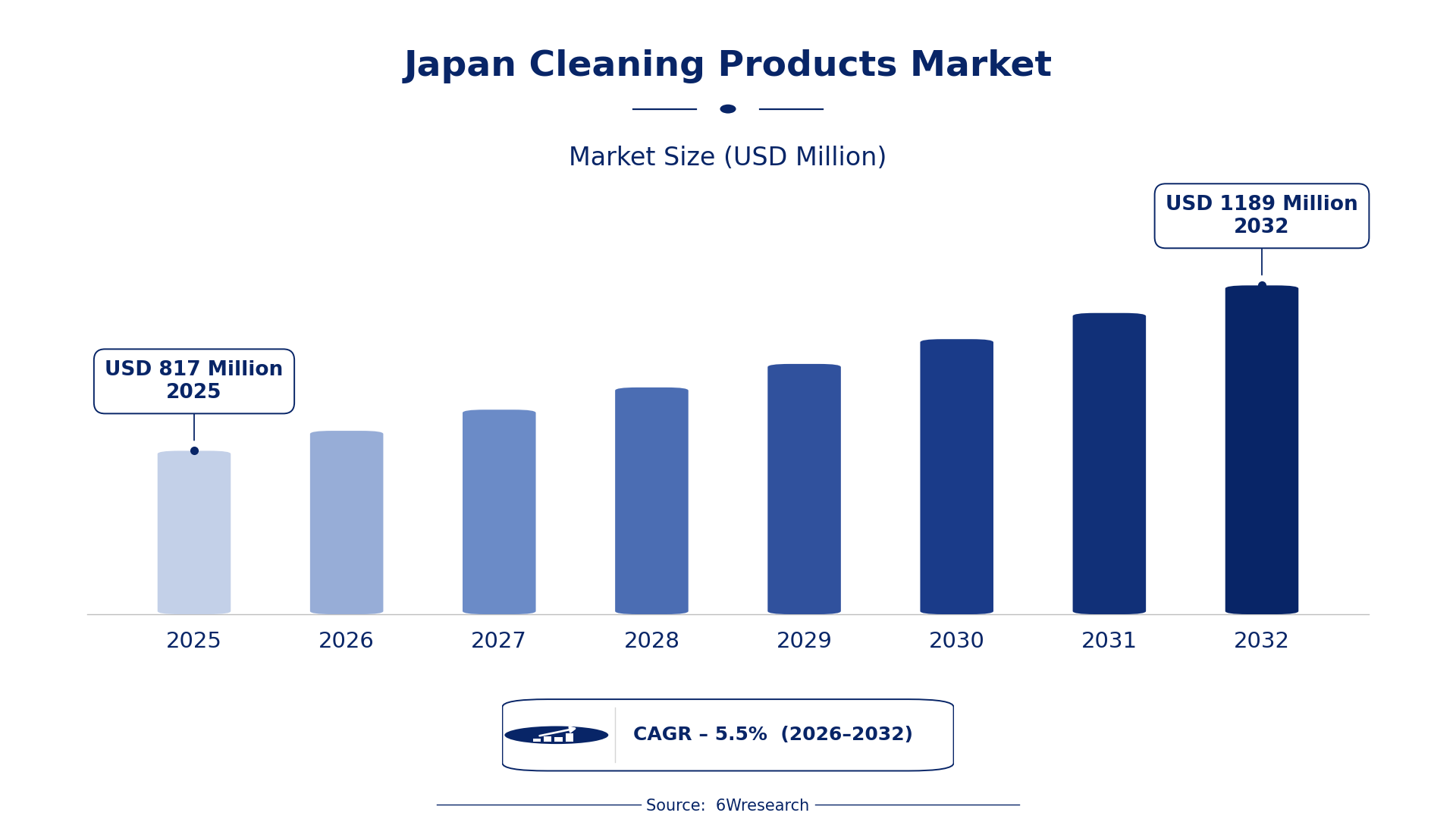
According to 6Wresearch internal database and industry insights, the Japan Cleaning Products Market was valued at USD 817 Million in 2025 and is projected to reach USD 1,189 Million by 2032, growing at a CAGR of approximately 5.5% during 2026–2032.
Japan Cleaning Products Market Highlights
| Report Metric | Details |
| Report Name | Japan Cleaning Products Market (2026-2032) |
| Market Size 2025 | USD 817 Million |
| Market Size 2032 | USD 1,189 Million |
| Absolute Growth 2025–2032 | USD 372 Million |
| CAGR 2026–2032 | 5.5% |
| Peak Annual Growth | 6.3% in 2030 |
| Forecast Period | 2026–2032 |
| Historical Data | 2022–2025 |
| Base Year | 2025 |
| Leading Product Type, 2025 | Chemicals (44% share) |
| Leading End User, 2025 | Residential (57% share) |
| Leading Distribution Channel, 2025 | Offline Channel (61% share) |
| Fastest-Growing Product Type | Consumables (7.7% CAGR) |
| Fastest-Growing End User | Commercial (6.8% CAGR) |
| Fastest-Growing Distribution Channel | Online Channel (7.0% CAGR) |
| Growing Sector | Residential cleaning products |
| Key End Users | Residential users, commercial establishments, cleaning service providers, industrial users |
Japan Cleaning Products Market Year-wise Growth Rate and Key Drivers (2022–2032)
This graph illustrates the annual growth rates of the market from 2022 to 2032, highlighting a steady upward trajectory and projected market expansion over the forecast period.
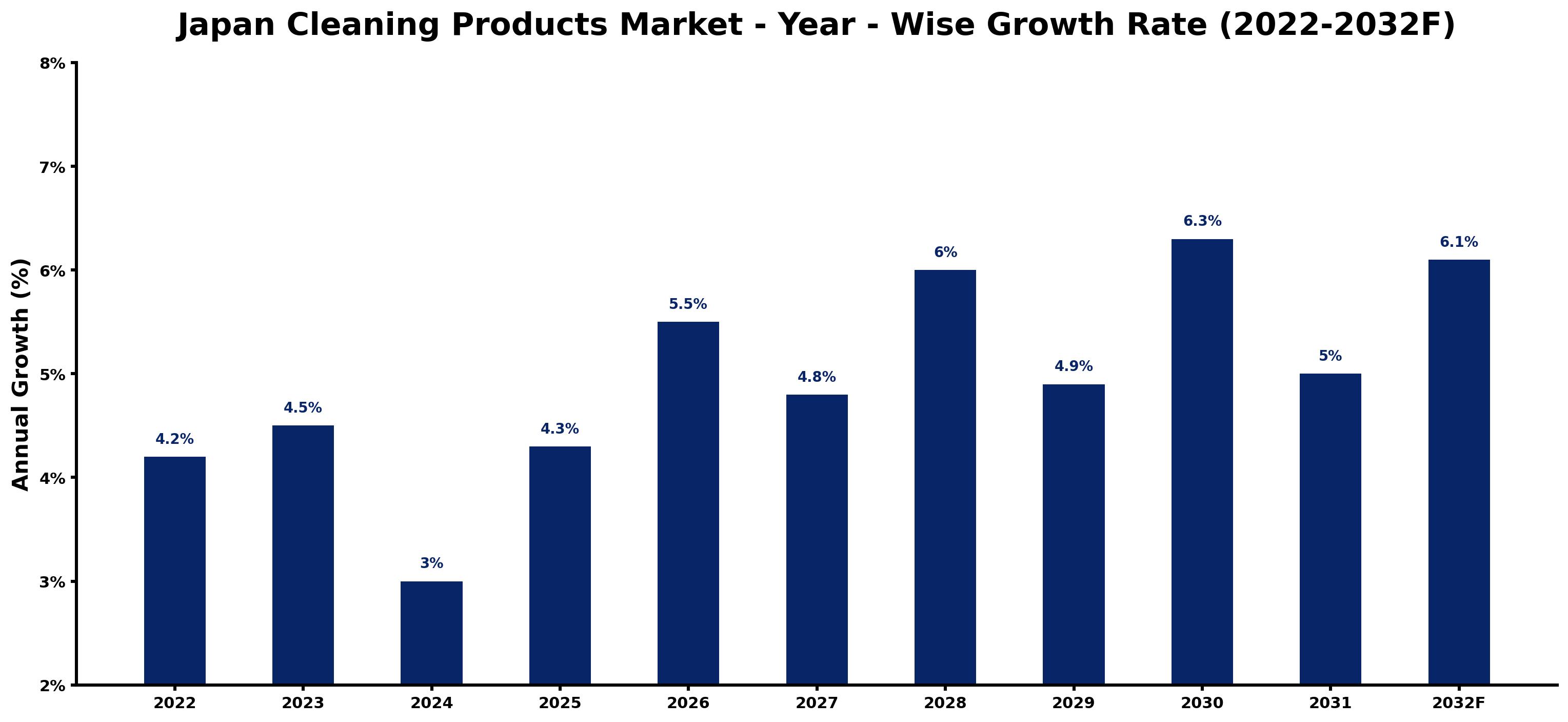
The table below sets out the estimated growth rate for each year and the main factor behind it.
| Year | Estimated Annual Growth (%) | Market Rationale |
| 2022 | 4.2 | The market experienced stable growth, reflecting consistent consumer demand for cleaning products. |
| 2023 | 4.5 | Growth accelerated due to increased household cleaning needs and heightened hygiene awareness. |
| 2024 | 3.0 | A slowdown occurred as consumers adjusted spending habits amid economic uncertainties. |
| 2025 | 4.3 | Demand rose again as urbanization and population density drove cleaning product usage. |
| 2026 | 5.5 | Growth is expected to rise with increased investments in eco-friendly cleaning solutions and technologies. |
| 2027 | 4.8 | A slowdown is projected as market saturation begins to influence purchasing patterns. |
| 2028 | 6.0 | Demand is expected to surge as consumers increasingly prefer sustainable and efficient cleaning options. |
| 2029 | 4.9 | Growth is projected to slow slightly as competition intensifies among cleaning product manufacturers. |
| 2030 | 6.3 | A peak growth year, driven by new product launches and heightened consumer awareness. |
| 2031 | 5.0 | Growth is expected to decelerate as market conditions stabilise following previous peaks. |
| 2032 | 6.1 | Demand is projected to rise again as new eco-friendly regulations take effect. |
Note: Market size estimations and growth projections presented in this report are based on 6Wresearch's proprietary forecasting methodology, utilizing the latest available industry data, government publications, and primary research inputs.
Japan Cleaning Products Market Synopsis
Cleaning products in Japan encompass a range of substances designed to maintain cleanliness in both residential and commercial environments, produced through chemical processes involving surfactants and solvents. The market primarily relies on residential users, who account for approximately 60% of total demand. Factors such as urbanisation, a population of around 125 million, and an increasing emphasis on hygiene and sustainability are driving market growth. The government's recent initiative to promote eco-friendly cleaning products further supports this trend, creating opportunities for investment in sustainable solutions.
Market Dynamics Impact Analysis (2026–2032)
| Factor | Type | Impact | Primary Segment Affected |
| Rising urbanization increases the need for efficient cleaning solutions. | Driver | High | Residential |
| Growing consumer awareness of hygiene drives demand for cleaning products. | Driver | High | Commercial |
| The shift towards eco-friendly products presents new market opportunities. | Opportunity | High | Consumables |
| Increasing disposable income allows consumers to purchase more cleaning products. | Opportunity | High | Chemicals |
| Market saturation may limit growth potential for new entrants. | Restraint | Medium | Cleaning Equipment |
| Regulatory compliance can increase operational costs for manufacturers. | Restraint | Medium | Chemicals |
| Rising raw material costs challenge profit margins for producers. | Challenge | High | Consumables |
| Compliance with stringent regulations can delay product launches. | Challenge | Medium | Cleaning Equipment |
Evaluation of Drivers in Japan Cleaning Products Market (2026–2032)
Key forces behind demand, with the segment each one moves most, are listed below.
| Drivers | Primary Segment Affected | Why It Matters (Evidence) |
| Increased urbanization leads to higher demand for cleaning products in residential areas. | Residential | Tokyo and Osaka, major urban centres, contribute significantly to cleaning product consumption, with households using around 15 different products. |
| Heightened hygiene awareness drives demand for commercial cleaning services. | Commercial | The projected value of commercial cleaning services in Japan is ¥1 trillion by 2025, reflecting increased spending on cleanliness. |
| The growing trend towards eco-friendly products boosts demand for sustainable cleaning solutions. | Consumables | In 2023, the government allocated ¥500 million for research on sustainable cleaning technologies, influencing consumer preferences. |
| Rising disposable income allows households to invest in a wider range of cleaning products. | Chemicals | Households are increasingly spending more on cleaning products, reflecting a shift towards premium offerings. |
| New product launches create demand in the cleaning products market. | Cleaning Equipment | Innovative cleaning technologies are being developed to meet the needs of urban consumers seeking efficiency. |
Orders keep climbing as urbanization fuels demand for cleaning products, particularly in major cities where households utilise a variety of cleaning items. The heightened awareness of hygiene has increased spending on commercial cleaning services, projected to reach ¥1 trillion by 2025. Investment in sustainable cleaning technologies is shifting consumer preferences towards eco-friendly products. Rising disposable income enables households to purchase a broader range of cleaning solutions, while new product launches cater to the demand for efficiency in urban settings.
Evaluation of Restraints in Japan Cleaning Products Market
The main factors holding the market back are set out below.
| Market Restraint | Primary Segment Affected | Why It Matters (Evidence) |
| Market saturation limits opportunities for new entrants. | Cleaning Equipment | With over 300 types of cleaning chemicals available, new products face stiff competition in the market. |
| Regulatory compliance increases operational costs for manufacturers. | Chemicals | The Chemical Substances Control Law requires extensive evaluation and control of cleaning product ingredients. |
| Rising raw material costs can pressure profit margins for producers. | Consumables | Fluctuations in the prices of key ingredients affect the overall production costs for cleaning products. |
| Compliance with regulations can delay product launches in the market. | Cleaning Equipment | The PRTR Law mandates reporting of chemical substances, which can slow down the introduction of new products. |
| Consumer preference for established brands may hinder market entry for newcomers. | Chemicals | Brand loyalty in cleaning products is strong, making it challenging for new entrants to gain market share. |
Japan Cleaning Products Market Challenges
In 2023, the average household in Japan uses around 15 different cleaning products, creating a skills gap among users who often lack the expertise to choose the most effective options, resulting in suboptimal cleaning outcomes. Regulatory oversight from the Ministry of Health, Labour and Welfare can extend product approval processes, causing delays that lead to missed revenue opportunities for suppliers. Supply chain issues particularly affect the availability of eco-friendly products, with delays of up to three months for commercial users. Rising production costs associated with compliance to ISO 14001 may increase prices by 10%, impacting budgets for both residential and commercial buyers.
Trends in the Japan Cleaning Products Market
Four trends stand out in the Japan Cleaning Products Market.
- Shift Towards Eco-Friendly Products: In 2023, the Japanese government initiated a programme promoting eco-friendly cleaning products, reflecting a growing consumer preference for sustainability. This initiative is shaping purchasing decisions, resulting in a notable increase in demand for green alternatives.
- Rise of Online Purchasing Channels: Since 2022, online channels have become a preferred method for purchasing cleaning products. The Online Channel is projected to grow at a CAGR of 7.0% as consumers embrace convenience and accessibility.
- Increased Focus on Hygiene Practices: The heightened awareness surrounding hygiene has led to stricter cleaning standards in commercial spaces. This shift has triggered a surge in demand for cleaning products across various sectors, reflecting changing consumer priorities.
- Expansion of Cleaning Equipment Segment: With urbanisation on the rise, the cleaning equipment segment is set to grow. Increased demand for efficient cleaning solutions in densely populated areas is driving this expansion.
Investment Opportunities in the Japan Cleaning Products Market
The openings below show where demand in the Japan Cleaning Products Market is visible and how suppliers can enter.
- Residential Buyers Seeking Eco-Friendly Options: With approximately 60% of total demand coming from residential users, there is a growing opportunity to supply eco-friendly cleaning products. This aligns with the government's 2023 initiative to promote sustainability.
- Commercial Sector's Need for Advanced Cleaning Solutions: The commercial cleaning services market is expected to reach ¥1 trillion by 2025, highlighting the need for advanced cleaning solutions. Suppliers can enter this market by collaborating with local service providers.
- Urban Areas Requiring Efficient Cleaning Products: As urbanisation increases, the demand for efficient cleaning products in metropolitan areas is on the rise. Suppliers can effectively target urban centres like Tokyo and Osaka to meet this demand.
- Investment in Sustainable Cleaning Technologies: The government allocated ¥500 million for research on sustainable cleaning technologies, creating investment opportunities for manufacturers focused on eco-friendly innovations.
Government Initiatives in the Japan Cleaning Products Market
The PRTR Law requires businesses to report the release of designated chemical substances, ensuring transparency and safety in cleaning products. Compliance with this law influences manufacturers' operational practices and market access, affecting their competitiveness. Additionally, the Chemical Substances Control Law mandates the evaluation and control of cleaning product ingredients, overseen by the Ministry of Health, Labour and Welfare, ensuring that products meet safety standards and impacting both producers and consumers.
The Ministry of Health, Labour and Welfare oversees the Chemical Substances Control Law, which mandates the evaluation and control of cleaning product ingredients. This regulation ensures that products are safe for consumers and compliant with industry standards, affecting manufacturers' operational practices and market access.
Future Insight of the Japan Cleaning Products Market
By 2032, a substantial shift towards eco-friendly cleaning products will reshape the market, driven by government initiatives and consumer demand for sustainability. The recent allocation of ¥500 million for research into sustainable cleaning technologies will encourage innovation among suppliers. Urbanisation will necessitate more efficient cleaning solutions in densely populated regions, influencing product development. As commercial cleaning services expand, new market opportunities will emerge for suppliers to introduce advanced cleaning solutions.
Market Segmentation Analysis
Japan Cleaning Products Market report covers a detailed analysis of the following market segments:
By Product Type – Chemicals Lead, Consumables Expected to Grow Fastest
According to Sumit Sagar, AM at 6Wresearch, Chemicals held 44% of the Japan Cleaning Products Market by product type in 2025. Chemicals hold the largest share in the market as they are essential components in the formulation of various cleaning products, widely used in households and businesses alike. For instance, the average household in Japan utilises around 15 different cleaning products, predominantly based on these chemicals. Over 2026–2032, Consumables are expected to post the fastest growth, at a CAGR of 7.7%. Consumables are experiencing rapid growth due to their necessity in everyday cleaning routines, with increasing hygiene awareness driving their popularity. The government's recent programme promoting eco-friendly cleaning products is expected to further accelerate this segment's growth. Suppliers should focus on developing consumables to meet the rising consumer demand for hygiene-focused products.
By End User – Residential Leads, Commercial Expected to Grow Fastest
Residential took 57% of end user revenue in 2025, more than any other category. The residential segment leads the market, accounting for approximately 60% of total demand, as households consistently require cleaning products for upkeep. This strong consumer base is reinforced by the extensive variety of products utilised in everyday home maintenance. Commercial is projected to grow fastest, at a CAGR of 6.8% during 2026–2032. Commercial cleaning is set for rapid growth, propelled by the projected value of commercial cleaning services reaching ¥1 trillion by 2025. This trend indicates an escalating demand for cleanliness within businesses and institutions. Buyers in the commercial sector should anticipate a broader array of cleaning solutions as their needs continue to grow.
By Distribution Channel – Offline Channel Leads, Online Channel Expected to Grow Fastest
With 61% of distribution channel revenue in 2025, Offline Channel was the largest category. The offline channel leads the market as it is the main method for purchasing cleaning products, with consumers preferring in-store shopping for immediate access and product inspection. This preference is especially strong in urban centres like Tokyo and Osaka, where shopping options are abundant. The quickest growth will come from Online Channel, forecast to expand at a CAGR of 7.0% between 2026 and 2032. The online channel is growing quickly, reflecting a shift in consumer behaviour towards the convenience of e-commerce platforms. This trend is likely to continue as more consumers seek easy and accessible ways to purchase cleaning products. Suppliers must enhance their online presence to cater to the increasing number of consumers opting for digital shopping.
Key Attractiveness of the Report
- 10 Years of Market Numbers
- Historical Data Starting from 2022 to 2025
- Base Year 2025
- Forecast Data until 2032
- Key Performance Indicators Impacting the Market
- Major Upcoming Developments and Projects
Key Highlights of the Report:
- Japan Cleaning Products Market Outlook
- Market Size of Japan Cleaning Products Market, 2025
- Forecast of Japan Cleaning Products Market, 2032
- Historical Data and Forecast of Japan Cleaning Products Revenues & Volume for the Period 2022-2032
- Japan Cleaning Products Market Trend Evolution
- Japan Cleaning Products Market Drivers and Challenges
- Japan Cleaning Products Price Trends
- Japan Cleaning Products Porter's Five Forces
- Japan Cleaning Products Industry Life Cycle
- Historical Data and Forecast of Japan Cleaning Products Market Revenues & Volume By Product Type for the Period 2022-2032
- Historical Data and Forecast of Japan Cleaning Products Market Revenues & Volume By Cleaning Equipment for the Period 2022-2032
- Historical Data and Forecast of Japan Cleaning Products Market Revenues & Volume By Consumables for the Period 2022-2032
- Historical Data and Forecast of Japan Cleaning Products Market Revenues & Volume By Chemicals for the Period 2022-2032
- Historical Data and Forecast of Japan Cleaning Products Market Revenues & Volume By Powders for the Period 2022-2032
- Historical Data and Forecast of Japan Cleaning Products Market Revenues & Volume By Gels for the Period 2022-2032
- Historical Data and Forecast of Japan Cleaning Products Market Revenues & Volume By End User for the Period 2022-2032
- Historical Data and Forecast of Japan Cleaning Products Market Revenues & Volume By Residential for the Period 2022-2032
- Historical Data and Forecast of Japan Cleaning Products Market Revenues & Volume By Commercial for the Period 2022-2032
- Historical Data and Forecast of Japan Cleaning Products Market Revenues & Volume By Distribution Channel for the Period 2022-2032
- Historical Data and Forecast of Japan Cleaning Products Market Revenues & Volume By Offline Channel for the Period 2022-2032
- Historical Data and Forecast of Japan Cleaning Products Market Revenues & Volume By Online Channel for the Period 2022-2032
- Japan Cleaning Products Import Export Trade Statistics
- Market Opportunity Assessment By Product Type
- Market Opportunity Assessment By End User
- Market Opportunity Assessment By Distribution Channel
- Japan Cleaning Products Top Companies Market Share
- Japan Cleaning Products Competitive Benchmarking By Technical and Operational Parameters
- Japan Cleaning Products Company Profiles
- Japan Cleaning Products Key Strategic Recommendations
Market Covered
The report covers the following segments.
By Product Type
- Cleaning Equipment
- Consumables
- Chemicals
- Powders
- Gels
By End User
- Residential
- Commercial
By Distribution Channel
- Offline Channel
- Online Channel































