Japan Climate-Resilient Agriculture Market Size & Growth Rate
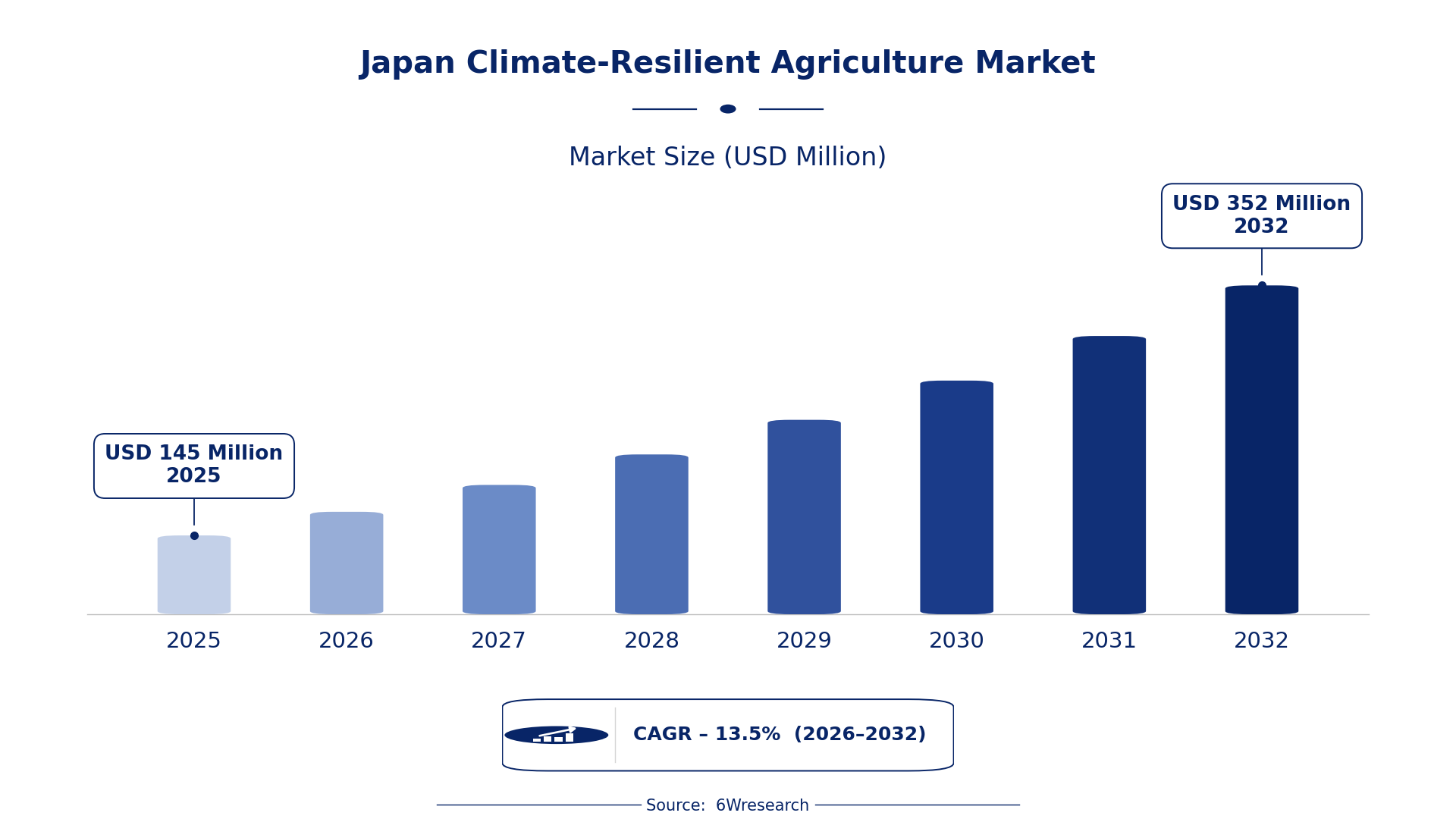
According to 6Wresearch internal database and industry insights, the Japan Climate-Resilient Agriculture Market was valued at USD 145 Million in 2025 and is projected to reach USD 352 Million by 2032, growing at a CAGR of approximately 13.5% during 2026–2032.
Japan Climate-Resilient Agriculture Market Highlights
| Report Metric | Details |
| Report Name | Japan Climate-Resilient Agriculture Market (2026-2032) |
| Market Size 2025 | USD 145 Million |
| Market Size 2032 | USD 352 Million |
| Absolute Growth 2025–2032 | USD 207 Million |
| CAGR 2026–2032 | 13.5% |
| Peak Annual Growth | 15.6% in 2032 |
| Forecast Period | 2026–2032 |
| Historical Data | 2022–2025 |
| Base Year | 2025 |
| Leading Technology Type, 2025 | Drought-Tolerant Seeds (42% share) |
| Leading Adaptation Strategy, 2025 | Seed Genetics (41% share) |
| Leading Crop Focus, 2025 | Cereal Crops (43% share) |
| Leading Deployment Method, 2025 | Direct Seeding (42% share) |
| Fastest-Growing Technology Type | Precision Irrigation (19.5% CAGR) |
| Fastest-Growing Adaptation Strategy | Sensor-Controlled (18.4% CAGR) |
| Fastest-Growing Crop Focus | Vegetables (17.7% CAGR) |
| Fastest-Growing Deployment Method | Drip/Sprinkler (19.1% CAGR) |
| Growing Sector | Agriculture |
| Key End Users | Farmers, Agricultural Cooperatives, Research Institutions, Agricultural Scientists |
Japan Climate-Resilient Agriculture Market Year-wise Growth Rate and Key Drivers (2022–2032)
This graph illustrates the annual growth rates of the market from 2022 to 2032, highlighting a steady upward trajectory and projected market expansion over the forecast period.
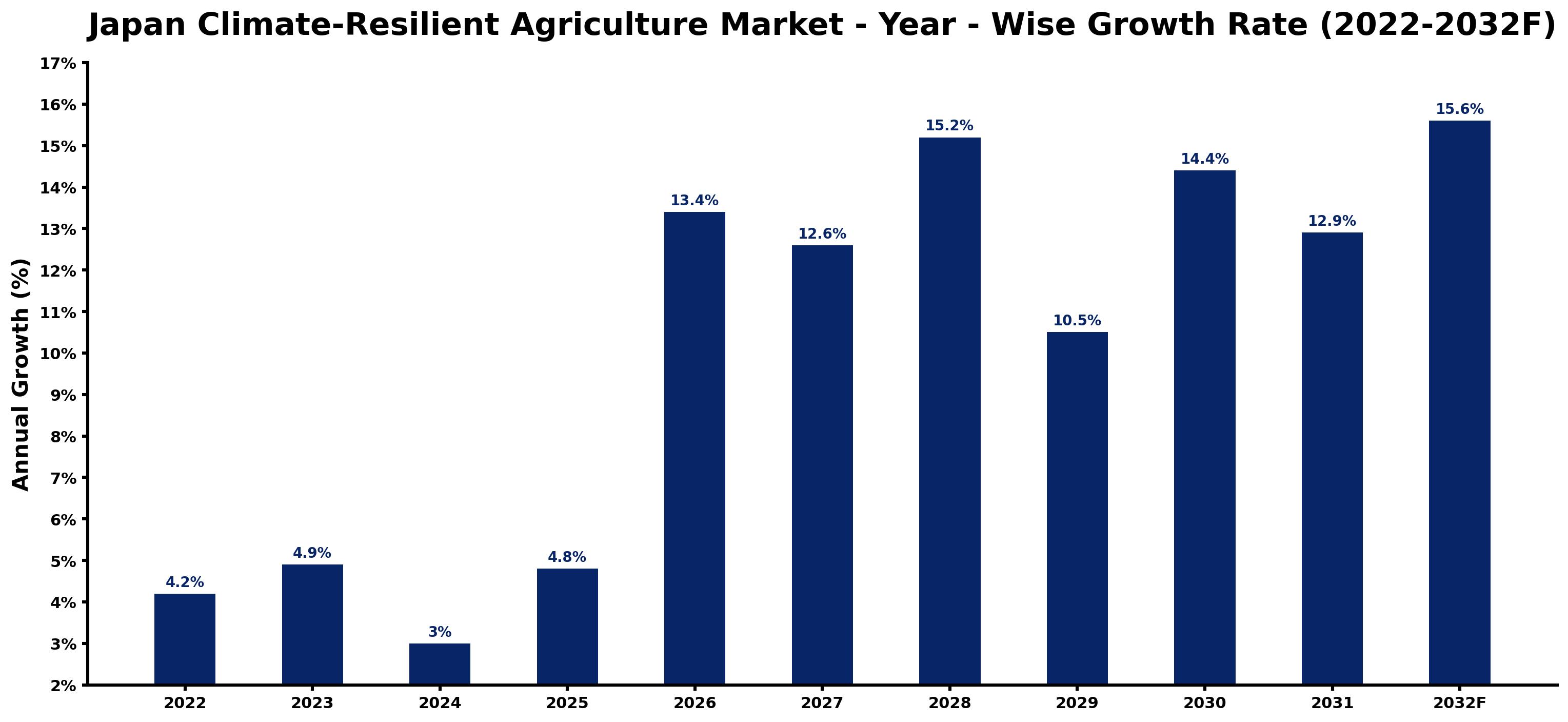
Year by year, the estimates below pair each growth rate with the development that shaped it.
| Year | Estimated Annual Growth (%) | Market Rationale |
| 2022 | 4.2 | The market showed steady growth due to increasing awareness of climate change impacts. |
| 2023 | 4.9 | Growth accelerated as drought-tolerant rice varieties were tested in various prefectures. |
| 2024 | 3.0 | A slowdown occurred as adoption rates for precision irrigation technologies began to stabilise. |
| 2025 | 4.8 | Growth picked up again with more farmers adopting climate-resilient practices across the country. |
| 2026 | 13.4 | The market is expected to surge as precision irrigation systems gain traction in regions like Hokkaido. |
| 2027 | 12.6 | A slight slowdown is projected as the market adjusts to new technology implementations. |
| 2028 | 15.2 | Growth is expected to rebound with increased investments in agricultural technology research and development. |
| 2029 | 10.5 | A slowdown is anticipated as the market matures and adoption rates reach saturation. |
| 2030 | 14.4 | Growth is projected to accelerate again as the government launches new smart agriculture initiatives. |
| 2031 | 12.9 | The market is expected to experience a slowdown as the average age of farmers highlights the need for innovation. |
| 2032 | 15.6 | The market is projected to peak as demand for climate-resilient agriculture reaches new heights. |
Note: Market size estimations and growth projections presented in this report are based on 6Wresearch's proprietary forecasting methodology, utilizing the latest available industry data, government publications, and primary research inputs.
Japan Climate-Resilient Agriculture Market Synopsis
Climate-Resilient Agriculture focuses on improving agricultural productivity while adapting to climate change through practices such as drought-tolerant seeds and precision irrigation systems. The Japan Climate-Resilient Agriculture Market is projected to grow robustly, driven by domestic farmers and research institutions. In 2023, the government allocated ¥10 billion for agricultural technology research, supporting advancements in this sector. The increasing adoption of precision agriculture and the development of drought-tolerant varieties are propelling this growth, ensuring food security and sustainable farming practices.
Market Dynamics Impact Analysis (2026–2032)
| Factor | Type | Impact | Primary Segment Affected |
| Increasing adoption of precision irrigation systems | Driver | High | Precision Irrigation |
| Development of drought-tolerant seeds | Driver | High | Drought-Tolerant Seeds |
| Growing demand for sustainable farming practices | Opportunity | High | Soil Health Systems |
| Expansion of agricultural technology research | Opportunity | High | Crop Monitoring AI |
| High average age of farmers | Restraint | Medium | Drought-Tolerant Seeds |
| Limited awareness of climate-resilient practices | Restraint | Medium | Precision Irrigation |
| Resistance to adopting new technologies | Challenge | High | Crop Monitoring AI |
| High initial investment costs for new systems | Challenge | Medium | Soil Health Systems |
Evaluation of Drivers in Japan Climate-Resilient Agriculture Market (2026–2032)
Key forces behind demand, with the segment each one moves most, are listed below.
| Drivers | Primary Segment Affected | Why It Matters (Evidence) |
| Increased government funding for agricultural technology research | Precision Irrigation | The government allocated ¥10 billion in 2023, encouraging farmers to adopt advanced irrigation systems. |
| Development of drought-tolerant rice varieties | Drought-Tolerant Seeds | Testing in various prefectures is improving resilience, prompting farmers to invest in these seeds. |
| Growing interest in sustainable farming practices | Soil Health Systems | Farmers are adopting practices that maintain soil fertility, leading to higher demand for these systems. |
| Rising adoption of precision agriculture technologies | Crop Monitoring AI | An expected adoption rate of 30% by 2025 indicates strong market growth potential. |
| Support from agricultural cooperatives | Drought-Tolerant Seeds | The Japan Agricultural Cooperatives assist farmers in implementing climate-resilient practices. |
This financial support encourages farmers to adopt precision irrigation systems, projected to see widespread use in regions like Hokkaido. The development of drought-tolerant rice varieties, tested across various prefectures, is prompting farmers to invest in these resilient crops. Interest in sustainable farming practices is also driving demand for soil health systems, crucial for maintaining soil fertility. Agricultural cooperatives play a key role in supporting farmers in implementing these climate-resilient practices, boosting productivity and sustainability.
Evaluation of Restraints in Japan Climate-Resilient Agriculture Market
These restraints slow adoption and weigh on supplier margins.
| Market Restraint | Primary Segment Affected | Why It Matters (Evidence) |
| High average age of farmers limits technology adoption | Drought-Tolerant Seeds | With an average age of 67, many farmers are hesitant to adopt new practices. |
| Limited awareness of climate-resilient practices among farmers | Precision Irrigation | Many farmers lack information about the benefits of precision irrigation technologies, limiting uptake. |
| Resistance to adopting new technologies due to traditional practices | Crop Monitoring AI | Some farmers prefer conventional methods, which hinders the uptake of advanced technologies. |
| High initial investment costs for new systems deter farmers | Soil Health Systems | The financial burden of implementing new practices can discourage farmers from transitioning. |
| Slow dissemination of research findings to farmers | Drought-Tolerant Seeds | Research results take time to reach farmers, delaying the adoption of new varieties. |
Japan Climate-Resilient Agriculture Market Challenges
Producers testing drought-tolerant rice varieties face delays in adoption due to insufficient research funding, which can extend implementation timelines by up to two years. Importers struggle against competition from lower-priced foreign agricultural products, resulting in profit margin reductions of 15%. Buyers encounter rising costs as the average age of farmers is 67, creating a shrinking workforce that can inflate labour expenses by 20%. Technology adoption is hindered by the slow integration of precision agriculture, with only 30% expected to be operational by 2025, limiting productivity improvements for farmers.
Trends in the Japan Climate-Resilient Agriculture Market
These developments are changing demand patterns in the Japan Climate-Resilient Agriculture Market.
- Launch of Smart Agriculture Technologies in 2023: A new program was initiated in 2023 to support the development of smart agriculture technologies, aiming to modernise farming practices. This initiative allocated ¥10 billion for research, boosting productivity across the sector.
- Increased Use of Satellite Imagery for Crop Monitoring: In the Tohoku region, satellite imagery is increasingly utilised for crop monitoring, improving decision-making for farmers. This trend aligns with the anticipated adoption rate of precision agriculture technologies reaching 30% by 2025.
- Shift Towards Sustainable Farming Practices: Farmers are adopting sustainable practices, with the government aiming for organic farming to reach 3% of total farmland by 2025. This shift reflects a growing awareness of environmental impacts among the agricultural community.
- Growing Interest in Drought-Tolerant Varieties: The development of drought-tolerant rice varieties has gained momentum, with testing in various prefectures. This trend addresses climate change challenges and ensures food security for local populations.
Investment Opportunities in the Japan Climate-Resilient Agriculture Market
The following areas offer the clearest openings for investors and suppliers in the Japan Climate-Resilient Agriculture Market.
- Investment in Precision Irrigation Systems: With the adoption rate projected to reach 30% by 2025, investing in precision irrigation systems presents a timely opportunity for suppliers. Farmers in Hokkaido and Kumamoto are particularly interested in these technologies.
- Supply of Drought-Tolerant Seeds: The demand for drought-tolerant seeds is rising as farmers seek to adapt to changing weather patterns. Collaborating with agricultural cooperatives can facilitate entry into this growing market.
- Development of Soil Health Systems: Investing in soil health systems is timely as farmers focus on sustainable practices. The Japan Agricultural Cooperatives support initiatives that promote soil fertility, creating opportunities for suppliers.
- Expansion of Crop Monitoring AI Technologies: As the adoption of precision agriculture technologies grows, there is an opportunity to supply crop monitoring AI solutions. Farmers are increasingly looking for tools that improve decision-making.
Government Initiatives in the Japan Climate-Resilient Agriculture Market
The Waste Management and Public Cleansing Act of 1970 regulates the treatment of agricultural waste, ensuring producers manage waste effectively. This law impacts farmers by requiring them to implement sustainable waste disposal practices, which promotes a cleaner environment. The government allocated ¥10 billion for agricultural technology research in 2023, supporting advancements in climate-resilient agriculture.
The Ministry of Agriculture, Forestry and Fisheries approves funding for agricultural technology projects, including those aimed at climate resilience. This approval process facilitates the development of solutions that enhance agricultural productivity and sustainability.
Future Insight of the Japan Climate-Resilient Agriculture Market
A policy-driven shift towards climate-resilient agriculture will transform Japan's agricultural sector, with organic farming projected to encompass 3% of total farmland by 2025. The government allocated ¥10 billion for agricultural technology research in 2023, propelling advancements in farming practices. Satellite imagery will increasingly support crop monitoring, improving yield predictions and resource management. As smart agriculture technologies develop, suppliers will provide customised solutions, aligning with the evolving needs of the agricultural sector.
Market Segmentation Analysis
Japan Climate-Resilient Agriculture Market report covers a detailed analysis of the following market segments:
By Technology Type – Drought-Tolerant Seeds Lead, Precision Irrigation Expected to Grow Fastest
According to Saurav Kr Singh, Senior Research Analyst at 6Wresearch, with 42% of technology type revenue in 2025, Drought-Tolerant Seeds was the largest category. Drought-tolerant seeds are essential for farmers facing climate variability, ensuring crop survival during adverse weather conditions. The strong support from government initiatives enhances their adoption, solidifying their position as a critical agricultural input. Precision Irrigation is set to record the highest CAGR in this split, 19.5% over 2026–2032. Precision irrigation systems are gaining traction due to their effectiveness in improving water efficiency, particularly in regions like Hokkaido and Kumamoto. As water scarcity becomes a pressing issue, their adoption among farmers is expected to accelerate. Suppliers should focus on expanding the availability of precision irrigation technologies to meet the increasing demand.
By Adaptation Strategy – Seed Genetics Lead, Sensor-Controlled Expected to Grow Fastest
Seed Genetics took 41% of adaptation strategy revenue in 2025, more than any other category. Seed genetics plays a crucial role in developing resilient crop varieties, enabling farmers to effectively combat climate challenges and secure food supply. The Ministry of Agriculture, Forestry and Fisheries actively promotes these initiatives, strengthening their market presence. Over 2026–2032, Sensor-Controlled is expected to post the fastest growth, at a CAGR of 18.4%. Sensor-controlled technologies are becoming increasingly popular as they enhance precision agriculture, leading to better resource utilisation. Their integration into farming practices is likely to rise as farmers seek to maximise yields under climate stress. Buyers will benefit from investing in sensor-controlled solutions to enhance farming efficiency and adaptability.
By Crop Focus – Cereal Crops Lead, Vegetables Expected to Grow Fastest
The largest crop focus category in 2025 was Cereal Crops, at 43% of revenue. Cereal crops are fundamental to Japan's agricultural output, underpinning food security and supporting farmer livelihoods. Their widespread cultivation creates a consistent demand for climate-resilient practices among the agricultural community. The quickest growth will come from Vegetables, forecast to expand at a CAGR of 17.7% between 2026 and 2032. Vegetables are a significant part of the Japanese diet, which drives the need for advanced agricultural practices to ensure a stable supply. As consumer preferences shift, the focus on vegetable production is expected to stimulate growth in this segment. Suppliers should adapt their offerings to align with the increasing emphasis on vegetable crops in climate-resilient agriculture.
By Deployment Method – Direct Seeding Leads, Drip/Sprinkler Expected to Grow Fastest
Direct Seeding accounted for 42% of the market by deployment method in 2025. Direct seeding is prevalent due to its efficiency, allowing farmers to plant with minimal soil disturbance and optimise yields. This established method contributes to its leading position in the market. Drip/Sprinkler is projected to grow fastest, at a CAGR of 19.1% during 2026–2032. Drip and sprinkler irrigation methods are becoming increasingly popular for conserving water, particularly as farmers confront growing water scarcity. Their adoption is expected to surge as efficiency becomes a key priority in agricultural practices. Buyers should explore investments in drip and sprinkler systems to improve water management in their farming operations.
Key Attractiveness of the Report
- 10 Years of Market Numbers
- Historical Data Starting from 2022 to 2025
- Base Year 2025
- Forecast Data until 2032
- Key Performance Indicators Impacting the Market
- Major Upcoming Developments and Projects
Key Highlights of the Report:
- Japan Climate-Resilient Agriculture Market Outlook
- Market Size of Japan Climate-Resilient Agriculture Market, 2025
- Forecast of Japan Climate-Resilient Agriculture Market, 2032
- Historical Data and Forecast of Japan Climate-Resilient Agriculture Revenues & Volume for the Period 2022-2032F
- Japan Climate-Resilient Agriculture Market Trend Evolution
- Japan Climate-Resilient Agriculture Market Drivers and Challenges
- Japan Climate-Resilient Agriculture Price Trends
- Japan Climate-Resilient Agriculture Porter's Five Forces
- Japan Climate-Resilient Agriculture Industry Life Cycle
- Historical Data and Forecast of Japan Climate-Resilient Agriculture Market Revenues & Volume By Technology Type for the Period 2022-2032F
- Historical Data and Forecast of Japan Climate-Resilient Agriculture Market Revenues & Volume By Drought-Tolerant Seeds for the Period 2022-2032F
- Historical Data and Forecast of Japan Climate-Resilient Agriculture Market Revenues & Volume By Precision Irrigation for the Period 2022-2032F
- Historical Data and Forecast of Japan Climate-Resilient Agriculture Market Revenues & Volume By Crop Monitoring AI for the Period 2022-2032F
- Historical Data and Forecast of Japan Climate-Resilient Agriculture Market Revenues & Volume By Soil Health Systems for the Period 2022-2032F
- Historical Data and Forecast of Japan Climate-Resilient Agriculture Market Revenues & Volume By Adaptation Strategy for the Period 2022-2032F
- Historical Data and Forecast of Japan Climate-Resilient Agriculture Market Revenues & Volume By Seed Genetics for the Period 2022-2032F
- Historical Data and Forecast of Japan Climate-Resilient Agriculture Market Revenues & Volume By Sensor-Controlled for the Period 2022-2032F
- Historical Data and Forecast of Japan Climate-Resilient Agriculture Market Revenues & Volume By Satellite + Drones for the Period 2022-2032F
- Historical Data and Forecast of Japan Climate-Resilient Agriculture Market Revenues & Volume By Organic Inputs for the Period 2022-2032F
- Historical Data and Forecast of Japan Climate-Resilient Agriculture Market Revenues & Volume By Crop Focus for the Period 2022-2032F
- Historical Data and Forecast of Japan Climate-Resilient Agriculture Market Revenues & Volume By Cereal Crops for the Period 2022-2032F
- Historical Data and Forecast of Japan Climate-Resilient Agriculture Market Revenues & Volume By Vegetables for the Period 2022-2032F
- Historical Data and Forecast of Japan Climate-Resilient Agriculture Market Revenues & Volume By Fruits for the Period 2022-2032F
- Historical Data and Forecast of Japan Climate-Resilient Agriculture Market Revenues & Volume By Pulses/Legumes for the Period 2022-2032F
- Historical Data and Forecast of Japan Climate-Resilient Agriculture Market Revenues & Volume By Deployment Method for the Period 2022-2032F
- Historical Data and Forecast of Japan Climate-Resilient Agriculture Market Revenues & Volume By Direct Seeding for the Period 2022-2032F
- Historical Data and Forecast of Japan Climate-Resilient Agriculture Market Revenues & Volume By Drip/Sprinkler for the Period 2022-2032F
- Historical Data and Forecast of Japan Climate-Resilient Agriculture Market Revenues & Volume By Remote Monitoring for the Period 2022-2032F
- Historical Data and Forecast of Japan Climate-Resilient Agriculture Market Revenues & Volume By On-Field Deployment for the Period 2022-2032F
- Japan Climate-Resilient Agriculture Import Export Trade Statistics
- Market Opportunity Assessment By Technology Type
- Market Opportunity Assessment By Adaptation Strategy
- Market Opportunity Assessment By Crop Focus
- Market Opportunity Assessment By Deployment Method
- Japan Climate-Resilient Agriculture Top Companies Market Share
- Japan Climate-Resilient Agriculture Competitive Benchmarking By Technical and Operational Parameters
- Japan Climate-Resilient Agriculture Company Profiles
- Japan Climate-Resilient Agriculture Key Strategic Recommendations
Market Covered
Coverage by segment is as follows.
By Technology Type
- Drought-Tolerant Seeds
- Precision Irrigation
- Crop Monitoring AI
- Soil Health Systems
By Adaptation Strategy
- Seed Genetics
- Sensor-Controlled
- Satellite + Drones
- Organic Inputs
By Crop Focus
- Cereal Crops
- Vegetables
- Fruits
- Pulses/Legumes
By Deployment Method
- Direct Seeding
- Drip/Sprinkler
- Remote Monitoring
- On-Field Deployment






































