Japan Cloud Managed Services Market Size & Growth Rate (2026-2032)
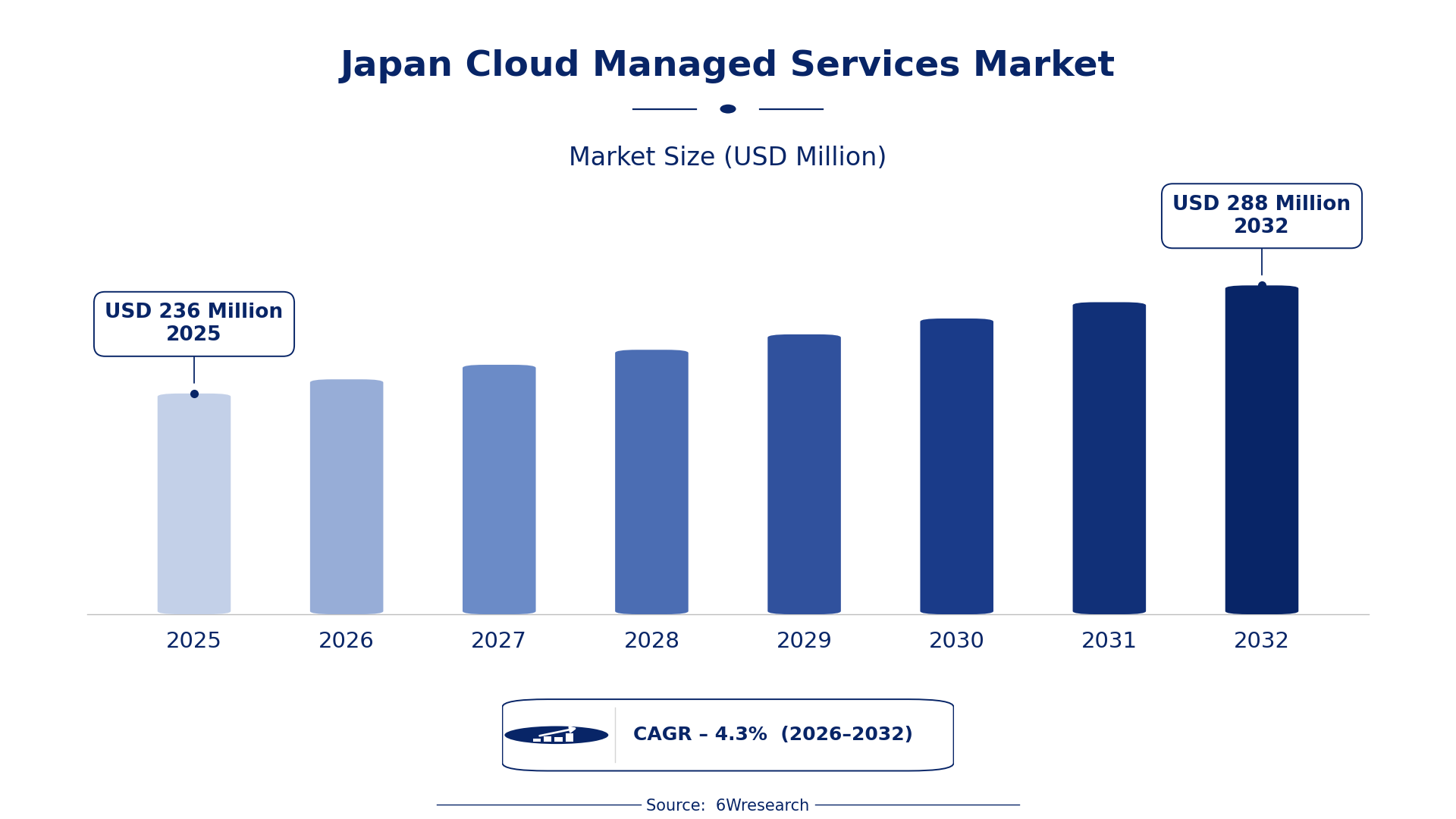
The Japan Cloud Managed Services Market was estimated at USD 236 Million in 2025 and is projected to reach USD 288 Million by 2032, growing at a CAGR of 4.3% from 2026 to 2032.
Japan Cloud Managed Services Market Synopsis
Japan's businesses are increasingly turning to cloud managed services as a means to enhance operational efficiency and reduce costs. This trend is largely driven by the pressing need for scalable IT solutions that can adapt to the dynamic demands of various sectors, including finance, healthcare, and manufacturing.
As digital transformation initiatives gain momentum, organizations are keen to outsource their cloud management to specialized providers. This shift not only allows for improved focus on core business activities but also enhances compliance with stringent data security regulations prevalent in Japan.
Japan Cloud Managed Services Market Year-wise Growth Rate and Key Drivers
This graph illustrates the annual growth rates of the Japan Cloud Managed Services Market from 2021 to 2032, highlighting a steady upward trajectory and projected expansion over the forecast period.
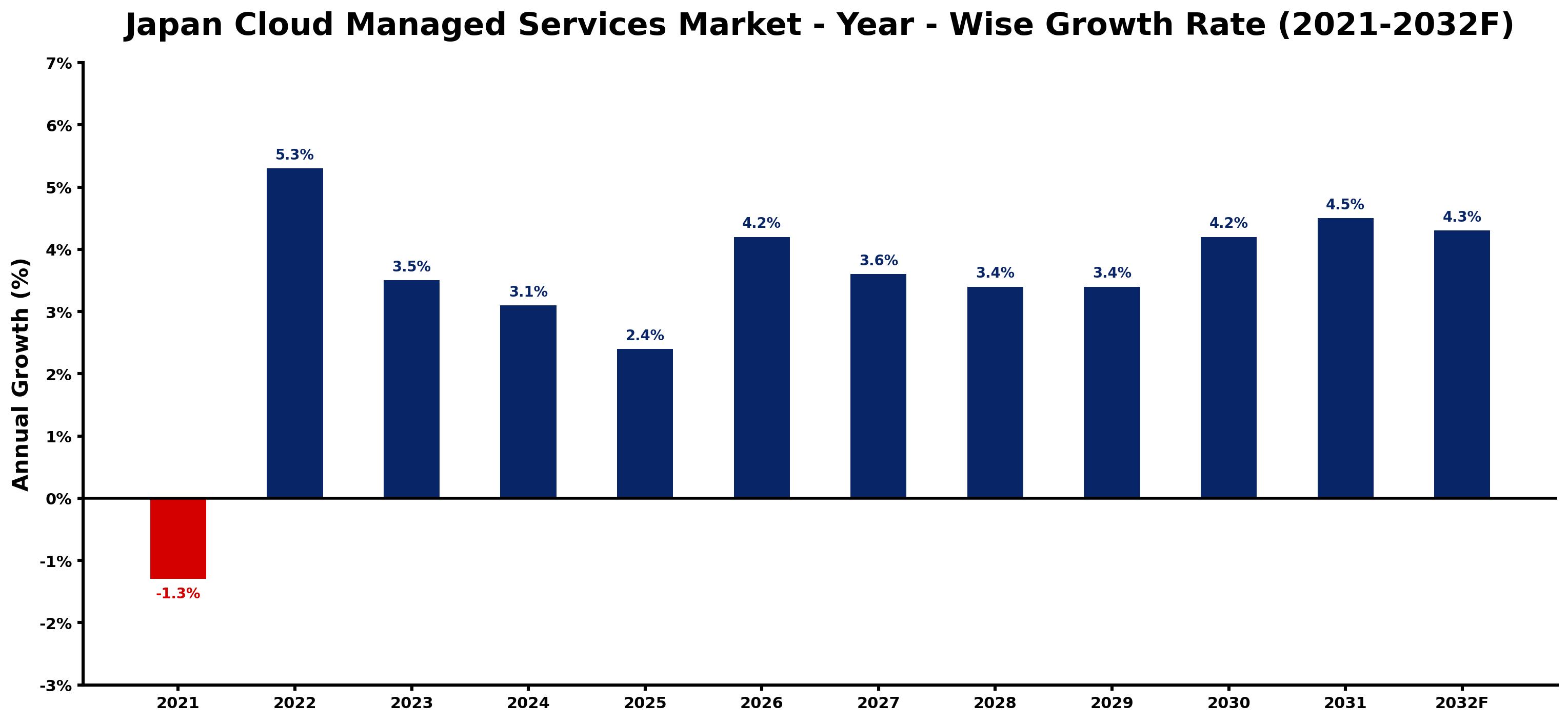
The table below presents the year‑wise growth rates along with the key drivers influencing the market
| Year | Growth Rate | Major Drivers |
| 2021 | -1.3% | Shift towards in-house IT management post-COVID-19. |
| 2022 | 5.3% | Increased adoption of cloud technology by SMEs |
| 2023 | 3.5% | Government's Digital Agency promotes cloud-first policies |
| 2024 | 3.1% | Rising cybersecurity regulations driving cloud service demand |
| 2025 | 2.4% | Growth of remote work enhancing managed services uptake |
| 2026 | 4.2% | Local AI startups boosting demand for cloud solutions |
| 2027 | 3.6% | Increased investment in digital transformation by enterprises |
| 2028 | 3.4% | Support from Japanese banks for cloud migration projects |
| 2029 | 3.4% | Major tech companies expanding their cloud offerings locally |
| 2030 | 4.2% | Growth of IoT applications requiring scalable cloud services |
| 2031 | 4.5% | Legislation favoring data localization drives cloud adoption |
| 2032 | 4.3% | Emerging business models centered on cloud innovations |
Note: Market size estimations and growth projections presented in this report are based on 6Wresearch's proprietary forecasting methodology, utilizing the latest available industry data, government publications, and primary research inputs.
Japan Cloud Managed Services Market Key Takeaways
Below are some of the specific key takeaways from the market, including:
- Increasing adoption of multi-cloud strategies to optimize resources and manage risks.
- Growing demand for managed security services to combat escalating cybersecurity threats.
- Focus on automation and AI-driven solutions to improve operational efficiencies.
- Intensified competition among service providers leading to innovative offerings.
- Emerging need for industry-specific solutions tailored to vertical markets.
Evaluation of Restraints in Japan Cloud Managed Services Market
Despite its growth potential, the Japan Cloud Managed Services Market faces notable challenges. Traditional in-house IT systems still dominate many businesses, as cultural preferences lean towards on-premises solutions. Concerns regarding data security and compliance with local regulations further complicate the adoption of cloud services.
on top of that, international providers often struggle with language barriers and the need for localized support. The shortage of skilled professionals in cloud technologies continues to be a significant obstacle. For providers to thrive, they must offer customized solutions and invest in local partnerships to overcome these hurdles.
Japan Cloud Managed Services Market Trends
A marked trend in the Japan Cloud Managed Services Market is the preference for multi-cloud environments, allowing businesses to harness the strengths of various cloud platforms. This approach not only enhances flexibility but also mitigates risks associated with vendor lock-in.
Additionally, the demand for managed security services is on the rise, as companies prioritize cybersecurity measures amid increasing threats. Automation and AI-driven solutions are also gaining traction, enhancing operational efficiency while reducing manual workloads.
Japan Cloud Managed Services Market Opportunities
The potential for growth in the Japan Cloud Managed Services Market is substantial. As more organizations embrace digital transformation, there’s a clear opportunity for providers to offer tailored cloud management services. Areas such as cloud migration, monitoring, and optimization are ripe for investment.
on top of that, partnerships with local service providers can unlock new avenues for market entry and expansion, allowing companies to meet the evolving needs of Japanese businesses effectively.
Government Initiatives in the Japan Cloud Managed Services Market
The Japanese government is taking active steps to foster a supportive environment for cloud managed services. Through various initiatives, policymakers are promoting digital innovation and ensuring that businesses can confidently adopt cloud technologies while adhering to stringent security standards.
- A national digital infrastructure upgrade program currently underway aims to enhance cloud service accessibility across various sectors.
- The Japan Cloud Consortium, recently launched, focuses on fostering collaboration among cloud providers to enhance service offerings.
- Ongoing regulatory reforms are aimed at streamlining data protection laws to bolster cloud service adoption.
- A planned public-private initiative expected to launch in 2026 will facilitate the development of a more robust cybersecurity framework for cloud services.
Future Insights of the Japan Cloud Managed Services Market
Looking ahead to 2026-2032, the Japan Cloud Managed Services Market is set for substantial expansion. The drive towards cost-effective IT solutions and improved operational flexibility will fuel this growth. Companies are increasingly recognizing the importance of secure, reliable data management, particularly in light of remote work trends and the proliferation of IoT devices.
As a result, service providers who can offer customized, scalable solutions will find themselves in a prime position to capitalize on the burgeoning demand across multiple industries.
Japan Cloud Managed Services Market Latest Developments
Recent activity in the Japan Cloud Managed Services Market has highlighted a surge in innovation and competitive dynamics. Companies are increasingly focused on enhancing their service offerings to cater to the specific needs of various industries, creating a vibrant market environment.
- A leading regional operator launched a new suite of AI-driven cloud management tools in early 2025, enhancing operational efficiencies for clients.
- A major technology vendor is currently implementing a multi-cloud strategy that began in Q3 2025, aimed at improving service reliability.
- A partnership between two significant players to develop industry-specific solutions is expected to commence in late 2025.
- An initiative focused on boosting cybersecurity measures in cloud services is presently underway, with a completion target set for early 2026.
Japan Cloud Managed Services Market - Key Attractiveness of the Report
- 10 Years of Market Numbers
- Historical Data Starting from 2022 to 2025
- Base Year: 2025
- Forecast Data until 2032
- Key Performance Indicators Impacting the Market
- Major Upcoming Developments and Projects
Key Highlights of the Report:
- Japan Cloud Managed Services Market Outlook
- Market Size of Japan Cloud Managed Services Market, 2025
- Forecast of Japan Cloud Managed Services Market, 2032
- Historical Data and Forecast of Japan Cloud Managed Services Revenues & Volume for the Period 2022-2032F
- Japan Cloud Managed Services Market Trend Evolution
- Japan Cloud Managed Services Market Drivers and Challenges
- Japan Cloud Managed Services Price Trends
- Japan Cloud Managed Services Porter's Five Forces
- Japan Cloud Managed Services Industry Life Cycle
- Historical Data and Forecast of Japan Cloud Managed Services Market Revenues & Volume By Service Type for the Period 2022-2032F
- Historical Data and Forecast of Japan Cloud Managed Services Market Revenues & Volume By Managed Security Services for the Period 2022-2032F
- Historical Data and Forecast of Japan Cloud Managed Services Market Revenues & Volume By Managed Network Services for the Period 2022-2032F
- Historical Data and Forecast of Japan Cloud Managed Services Market Revenues & Volume By Managed Infrastructure Services for the Period 2022-2032F
- Historical Data and Forecast of Japan Cloud Managed Services Market Revenues & Volume By Managed Communication & Collaboration Services for the Period 2022-2032F
- Historical Data and Forecast of Japan Cloud Managed Services Market Revenues & Volume By Managed Mobility Services for the Period 2022-2032F
- Historical Data and Forecast of Japan Cloud Managed Services Market Revenues & Volume By Managed Business Services for the Period 2022-2032F
- Historical Data and Forecast of Japan Cloud Managed Services Market Revenues & Volume By Security Services for the Period 2022-2032F
- Historical Data and Forecast of Japan Cloud Managed Services Market Revenues & Volume By Managed Identity & Access Management for the Period 2022-2032F
- Historical Data and Forecast of Japan Cloud Managed Services Market Revenues & Volume By Managed Antivirus/Anti-Malware for the Period 2022-2032F
- Historical Data and Forecast of Japan Cloud Managed Services Market Revenues & Volume By Managed Firewall for the Period 2022-2032F
- Historical Data and Forecast of Japan Cloud Managed Services Market Revenues & Volume By Managed Risk & Compliance Management for the Period 2022-2032F
- Historical Data and Forecast of Japan Cloud Managed Services Market Revenues & Volume By Managed Vulnerability Management for the Period 2022-2032F
- Historical Data and Forecast of Japan Cloud Managed Services Market Revenues & Volume By Managed Security Information & Event Management for the Period 2022-2032F
- Historical Data and Forecast of Japan Cloud Managed Services Market Revenues & Volume By Managed Intrusion Detection System/Intrusion Prevention System for the Period 2022-2032F
- Historical Data and Forecast of Japan Cloud Managed Services Market Revenues & Volume By Managed Data Loss Prevention for the Period 2022-2032F
- Historical Data and Forecast of Japan Cloud Managed Services Market Revenues & Volume By Network Services for the Period 2022-2032F
- Historical Data and Forecast of Japan Cloud Managed Services Market Revenues & Volume By Managed Network Provisioning for the Period 2022-2032F
- Historical Data and Forecast of Japan Cloud Managed Services Market Revenues & Volume By Managed Network Monitoring & Management for the Period 2022-2032F
- Historical Data and Forecast of Japan Cloud Managed Services Market Revenues & Volume By Infrastructure Services for the Period 2022-2032F
- Historical Data and Forecast of Japan Cloud Managed Services Market Revenues & Volume By Storage Management for the Period 2022-2032F
- Historical Data and Forecast of Japan Cloud Managed Services Market Revenues & Volume By Server Management for the Period 2022-2032F
- Historical Data and Forecast of Japan Cloud Managed Services Market Revenues & Volume By Managed Print Services for the Period 2022-2032F
- Historical Data and Forecast of Japan Cloud Managed Services Market Revenues & Volume By Managed Communication & Collaboration Services for the Period 2022-2032F
- Historical Data and Forecast of Japan Cloud Managed Services Market Revenues & Volume By Managed Voice Over Internet Protocol for the Period 2022-2032F
- Historical Data and Forecast of Japan Cloud Managed Services Market Revenues & Volume By Managed Unified Communication as a Service for the Period 2022-2032F
- Historical Data and Forecast of Japan Cloud Managed Services Market Revenues & Volume By Managed Mobility Services for the Period 2022-2032F
- Historical Data and Forecast of Japan Cloud Managed Services Market Revenues & Volume By Device Management Services for the Period 2022-2032F
- Historical Data and Forecast of Japan Cloud Managed Services Market Revenues & Volume By Application Management Services for the Period 2022-2032F
- Historical Data and Forecast of Japan Cloud Managed Services Market Revenues & Volume By Managed Business Services for the Period 2022-2032F
- Historical Data and Forecast of Japan Cloud Managed Services Market Revenues & Volume By Business Process Services for the Period 2022-2032F
- Historical Data and Forecast of Japan Cloud Managed Services Market Revenues & Volume By Continuity & Disaster Recovery Services for the Period 2022-2032F
- Historical Data and Forecast of Japan Cloud Managed Services Market Revenues & Volume By Other Managed Business Services for the Period 2022-2032F
- Historical Data and Forecast of Japan Cloud Managed Services Market Revenues & Volume By Organization Size for the Period 2022-2032F
- Historical Data and Forecast of Japan Cloud Managed Services Market Revenues & Volume By SMEs for the Period 2022-2032F
- Historical Data and Forecast of Japan Cloud Managed Services Market Revenues & Volume By Large Enterprises for the Period 2022-2032F
- Japan Cloud Managed Services Import Export Trade Statistics
- Market Opportunity Assessment By Service Type
- Market Opportunity Assessment By Security Services
- Market Opportunity Assessment By Network Services
- Market Opportunity Assessment By Infrastructure Services
- Market Opportunity Assessment By Managed Communication & Collaboration Services
- Market Opportunity Assessment By Managed Mobility Services
- Market Opportunity Assessment By Managed Business Services
- Market Opportunity Assessment By Organization Size
- Japan Cloud Managed Services Top Companies Market Share
- Japan Cloud Managed Services Competitive Benchmarking By Technical and Operational Parameters
- Japan Cloud Managed Services Company Profiles
- Japan Cloud Managed Services Key Strategic Recommendations






































