Japan Cold Chain for Agri Produce Market Size & Growth Rate
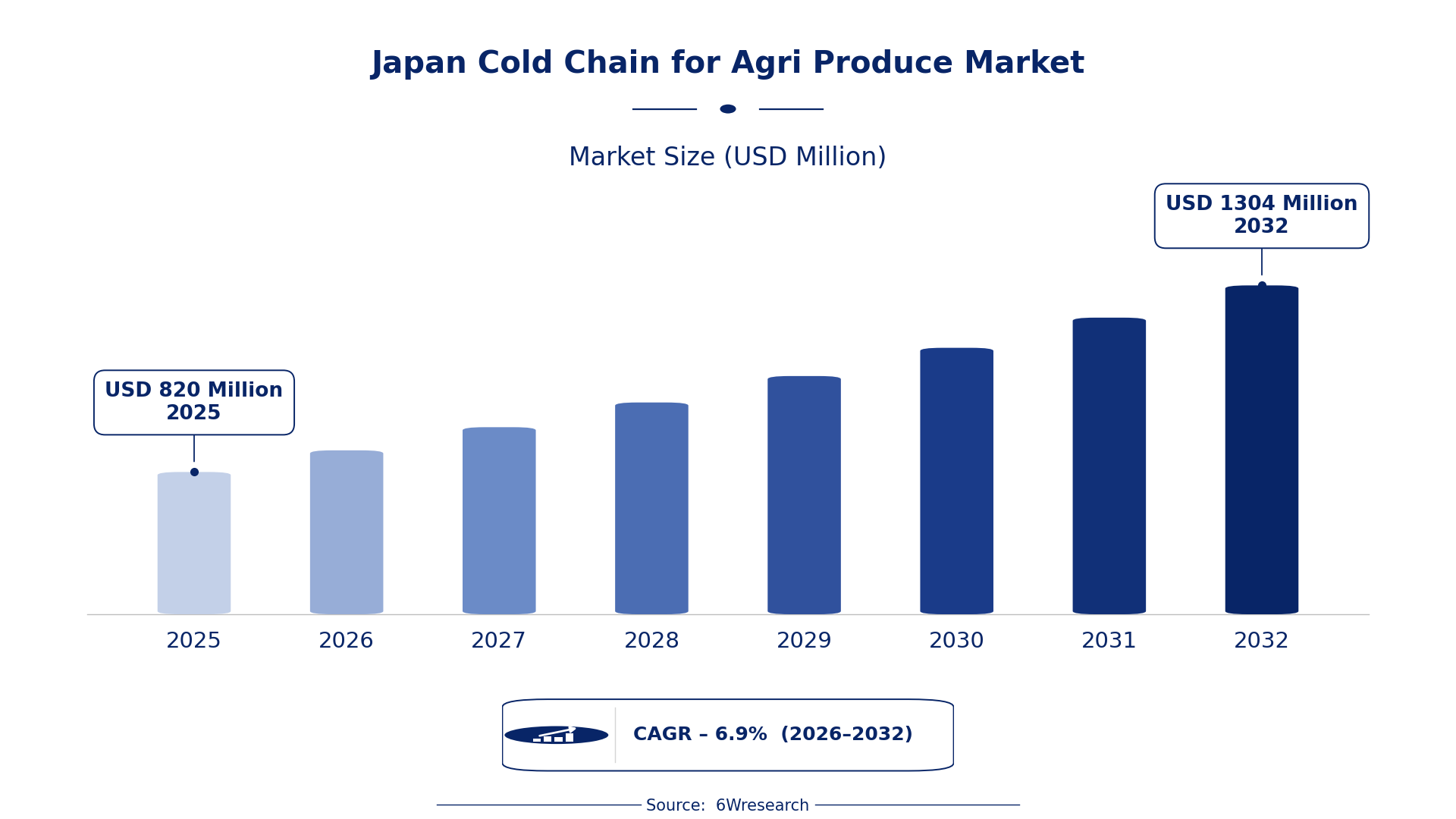
According to 6Wresearch internal database and industry insights, the Japan Cold Chain for Agri Produce Market was valued at USD 820 Million in 2025 and is projected to reach USD 1,304 Million by 2032, growing at a CAGR of approximately 6.9% during 2026–2032.
Japan Cold Chain for Agri Produce Market Highlights
| Report Metric | Details |
| Report Name | Japan Cold Chain for Agri Produce Market (2026-2032) |
| Market Size 2025 | USD 820 Million |
| Market Size 2032 | USD 1,304 Million |
| Absolute Growth 2025–2032 | USD 484 Million |
| CAGR 2026–2032 | 6.9% |
| Peak Annual Growth | 8.2% in 2026 |
| Forecast Period | 2026–2032 |
| Historical Data | 2022–2025 |
| Base Year | 2025 |
| Leading Produce Type, 2025 | Berries (51% share) |
| Leading Storage Temp, 2025 | 0–4°C (50% share) |
| Leading Packaging Method, 2025 | Clamshell Pack (33% share) |
| Leading Transportation Mode, 2025 | Reefer Truck (54% share) |
| Leading Shelf-Life Extended, 2025 | 10 Days (50% share) |
| Fastest-Growing Storage Temp | 1–3°C (8.6% CAGR) |
| Fastest-Growing Packaging Method | Crates with Film (9.5% CAGR) |
| Fastest-Growing Transportation Mode | Air Cargo (8.9% CAGR) |
| Fastest-Growing Shelf-Life Extended | 7 Days (8.7% CAGR) |
| Growing Sector | Cold Chain Logistics |
| Key End Users | Agricultural producers, food distributors, retailers, consumers |
Japan Cold Chain for Agri Produce Market Year-wise Growth Rate and Key Drivers (2022–2032)
This graph illustrates the annual growth rates of the market from 2022 to 2032, highlighting a steady upward trajectory and projected market expansion over the forecast period.
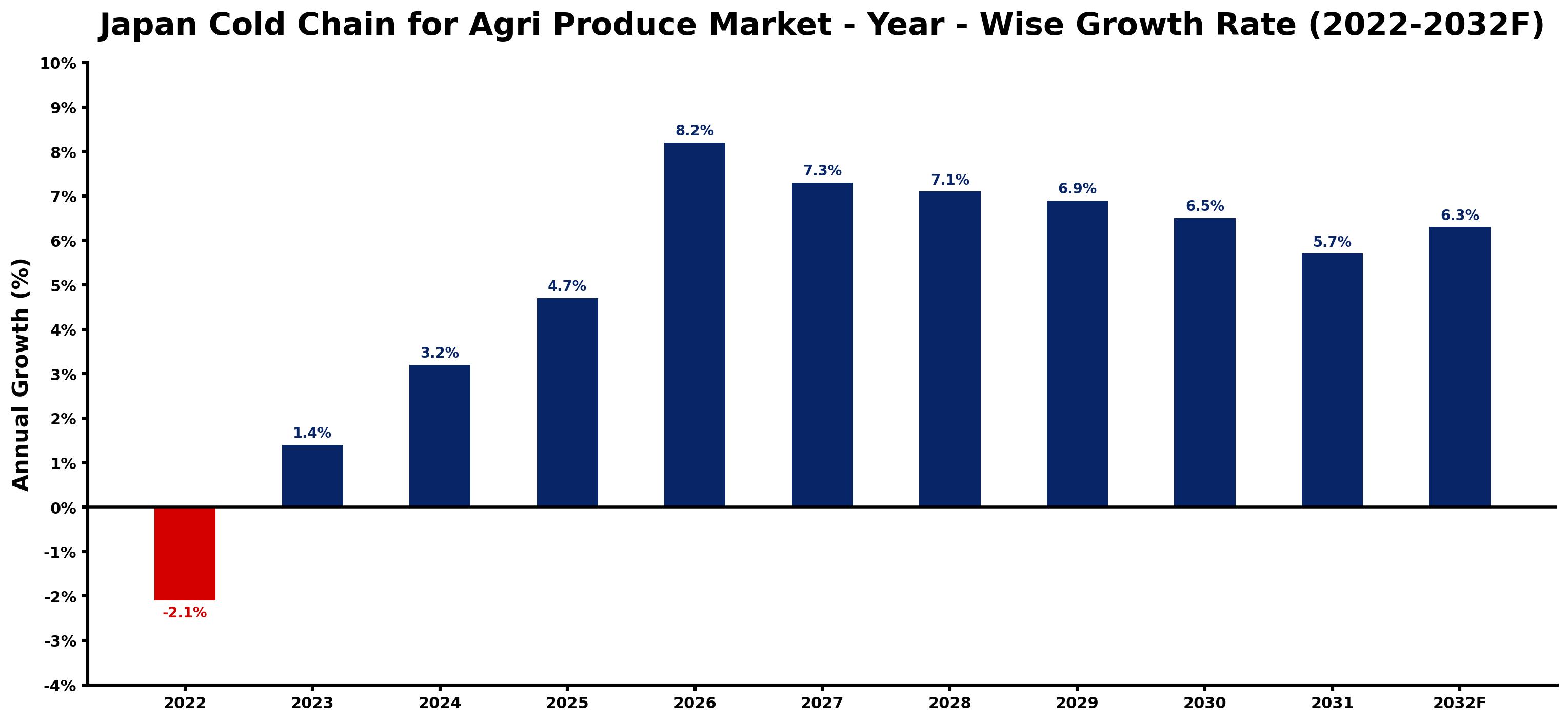
The table below sets out the estimated growth rate for each year and the main factor behind it.
| Year | Estimated Annual Growth (%) | Market Rationale |
| 2022 | -2.1 | The market faced challenges due to supply chain disruptions and fluctuating demand. |
| 2023 | 1.4 | Growth improved as cold chain technology adoption began to rise among producers. |
| 2024 | 3.2 | Increased consumer awareness of food safety drove higher demand for cold chain logistics. |
| 2025 | 4.7 | Demand surged as urban areas expanded, increasing the need for efficient distribution. |
| 2026 | 8.2 | The peak growth year is driven by investments in cold chain infrastructure. |
| 2027 | 7.3 | Growth slowed slightly as the market adjusted to new operational capacities. |
| 2028 | 7.1 | Continued investment in technology maintained a steady growth rate in the market. |
| 2029 | 6.9 | The market growth rate slowed as saturation in certain segments began to occur. |
| 2030 | 6.5 | Growth continued to slow as competition intensified among cold chain providers. |
| 2031 | 5.7 | The market saw a further slowdown as operational efficiencies were maximised. |
| 2032 | 6.3 | Growth picked up again due to renewed focus on reducing food waste. |
Note: Market size estimations and growth projections presented in this report are based on 6Wresearch's proprietary forecasting methodology, utilizing the latest available industry data, government publications, and primary research inputs.
Japan Cold Chain for Agri Produce Market Synopsis
Cold chain for agricultural produce in Japan involves temperature-controlled supply chains that preserve the quality and safety of perishable goods. Valued at approximately 1 trillion yen, the market thrives on urbanisation and the need for efficient distribution of fresh produce. The Ministry of Agriculture, Forestry and Fisheries encourages technology adoption, while the Food Sanitation Act amendment supports sector growth by ensuring adherence to food safety standards.
Market Dynamics Impact Analysis (2026–2032)
| Factor | Type | Impact | Primary Segment Affected |
| Increasing urbanisation drives demand for efficient distribution of perishable goods. | Driver | High | Reefer Truck |
| Growing consumer awareness of food safety standards boosts the need for cold chain solutions. | Driver | High | Clamshell Pack |
| Investment in cold chain infrastructure is rising, creating opportunities for new players. | Opportunity | High | Cold Vans |
| The trend towards sustainable packaging opens new markets for innovative solutions. | Opportunity | Medium | Crates with Film |
| High operational costs limit profitability for smaller cold chain providers. | Restraint | High | Air Cargo |
| Limited cold storage facilities in rural areas restrict access for local producers. | Restraint | Medium | 0–4°C |
| Competition among providers can lead to price wars, affecting margins. | Challenge | High | Berries |
| Technological advancements require continuous investment, straining smaller firms. | Challenge | Medium | Citrus Fruits |
Evaluation of Drivers in Japan Cold Chain for Agri Produce Market (2026–2032)
The factors lifting demand, and the evidence behind each, are summarised below.
| Drivers | Primary Segment Affected | Why It Matters (Evidence) |
| Urbanisation increases demand for efficient cold chain logistics. | Reefer Truck | The cold chain market is primarily driven by urban regions, which require more reefer trucks for distribution. |
| Consumer awareness of food safety standards is rising. | Clamshell Pack | The use of clamshell packaging has increased by 20% for berry transport in 2023. |
| Investment in cold chain infrastructure is growing. | Cold Vans | The government allocated 5 billion yen for cold chain infrastructure improvements in 2023. |
| Adoption of IoT technology improves monitoring capabilities. | 1–3°C | The rising adoption of IoT technology in cold chain monitoring is improving operational efficiency. |
| Focus on reducing food waste drives demand for cold chain solutions. | 10 Days | The government aims to reduce food waste by 50% through improved cold chain practices by 2030. |
Several shifts outside the market lift sales. Urbanisation in regions like Tokyo and Osaka increases demand for efficient logistics, particularly for reefer trucks. Awareness of food safety standards has risen, leading to a 20% increase in clamshell packaging usage for berry transport. The adoption of IoT technology is improving monitoring capabilities, further driving demand. The goal to reduce food waste by 50% by 2030 is pushing for better practices in the cold chain.
Evaluation of Restraints in Japan Cold Chain for Agri Produce Market
Several factors work against faster growth; the main ones are summarised below.
| Market Restraint | Primary Segment Affected | Why It Matters (Evidence) |
| High operational costs limit profitability for smaller providers. | Air Cargo | Operational costs for air cargo can be prohibitive, affecting smaller firms' ability to compete. |
| Limited cold storage facilities in rural areas restrict access for local producers. | 0–4°C | Rural areas lack adequate cold storage facilities, making it difficult for local producers to access markets. |
| Regulatory compliance can be costly and complex for operators. | Clamshell Pack | Compliance with food safety regulations increases operational costs for packaging providers. |
| Technological advancements require continuous investment, straining smaller firms. | Berries | Smaller firms struggle to keep up with the pace of technological change in cold chain management. |
| Market saturation in urban areas limits growth potential. | Reefer Truck | High competition in urban areas has led to market saturation, limiting growth opportunities. |
Japan Cold Chain for Agri Produce Market Challenges
Japan's cold chain for agricultural produce struggles with a supply issue, as over 500 certified cold storage facilities cannot adequately serve 127 million consumers. This limitation occurs because facilities are primarily located in urban areas, resulting in distribution delays for producers and increased risk of spoilage. A skills gap persists, with over 100,000 workers needed but insufficient training programmes available, leading to operational inefficiencies. Heightened competition from emerging markets forces buyers to seek lower prices, which can jeopardise quality and safety standards across the supply chain.
Trends in the Japan Cold Chain for Agri Produce Market
The shifts below are changing how Japan Cold Chain for Agri Produce Market products are bought and supplied.
- Shift Towards Sustainable Packaging Solutions: A growing trend towards sustainable packaging solutions is shaping the cold chain market. The Plastic Resource Circulation Act promotes the use of biodegradable plastics, aiming to reduce plastic waste by 2025.
- Increase in IoT Adoption for Cold Chain Monitoring: The adoption of IoT technology in cold chain monitoring is increasing, improving operational efficiency. In 2023, over 100,000 workers in cold chain logistics are benefiting from these technological advancements.
- Rising Demand for Last-Mile Delivery Solutions: Cold vans are becoming popular for last-mile deliveries in urban settings, reflecting a shift in consumer expectations for fresh produce. This segment is expected to grow as urbanisation continues to rise.
- Expansion of Cold Chain Infrastructure: Investment in cold chain infrastructure is expanding, with the government allocating 5 billion yen for improvements in 2023. This funding is aimed at enhancing logistics capabilities across Japan.
Investment Opportunities in the Japan Cold Chain for Agri Produce Market
The opportunities below stand out in the Japan Cold Chain for Agri Produce Market for new entrants and existing suppliers.
- Growing Demand for Cold Chain Solutions: With a market value of approximately 1 trillion yen, there is a strong demand for cold chain solutions. Urban areas like Tokyo present opportunities for providers to establish new facilities.
- Investment in Sustainable Packaging: The trend towards sustainable packaging solutions is gaining traction. Companies focusing on biodegradable options can find opportunities in urban markets where consumers are environmentally conscious.
- Expansion of Cold Storage Facilities: The government’s 5 billion yen investment in cold chain infrastructure creates opportunities for new cold storage facilities. Collaborating with local partners can facilitate entry into this market.
- Increasing Use of IoT Technology: The rising adoption of IoT technology in cold chain monitoring creates opportunities for tech providers. Partnering with logistics firms can lead to successful implementations.
Government Initiatives in the Japan Cold Chain for Agri Produce Market
The Food Sanitation Act amendment, implemented in 2023, mandates stricter compliance with food safety regulations, ensuring that cold chain providers maintain high-quality standards throughout the supply chain. This act is important for buyers who rely on safe and fresh produce, enhancing their confidence in the market.
The Japan Cold Chain Association approves funding for cold chain infrastructure improvements. This agency supports projects aimed at improving cold chain logistics, ensuring that producers can meet demand for perishable goods.
Future Insight of the Japan Cold Chain for Agri Produce Market
Investment in cold chain infrastructure will total 5 billion yen, creating demand for improved temperature monitoring technologies. The adoption of IoT technology will facilitate real-time tracking, enhancing efficiency for suppliers and ensuring higher quality for buyers. Efforts to reduce food waste by 50% will drive improvements in cold chain practices, benefiting both producers and consumers. Implementing standards like ISO 22000 will strengthen food safety management, building compliance and trust in the market.
Market Segmentation Analysis
Japan Cold Chain for Agri Produce Market report covers a detailed analysis of the following market segments:
By Produce Type – Berries Lead and Record the Fastest Growth
According to Saurav Kr Singh, Senior Research Analyst at 6Wresearch, Berries held 51% of the Japan Cold Chain for Agri Produce Market by produce type in 2025. Berries hold the largest share due to their high perishability and sensitivity to temperature changes, necessitating stringent cold chain practices. The average shelf life for berries is extended to 10 days with proper cold chain management, which is vital for maintaining their quality during distribution. Its lead should widen, with a projected CAGR of 9.3% during 2026–2032, the highest in this split. The berry segment is also the fastest growing as consumer demand for fresh and high-quality fruits continues to rise. The increase in clamshell packaging usage by 20% for berry transport in 2023 demonstrates a commitment to preserving berry freshness, further solidifying its market lead. Suppliers should focus on enhancing cold chain practices for berries to meet rising consumer expectations.
By Storage Temp – 0–4°C Leads, 1–3°C Expected to Grow Fastest
The largest storage temp category in 2025 was 0–4°C, at 50% of revenue. The 0–4°C temperature range dominates the market as it is optimal for most perishable goods, ensuring quality and safety during storage and transport. This standard is widely adopted across various cold storage facilities in urban areas, catering to Japan's dense population. Over 2026–2032, 1–3°C is expected to post the fastest growth, at a CAGR of 8.6%. The 1–3°C segment is growing rapidly as it caters to specific products that require colder storage to maintain their quality. The increasing adoption of IoT technology in cold chain monitoring supports this trend by ensuring precise temperature control. Buyers should invest in storage solutions that can effectively maintain the 1–3°C range for products requiring stricter temperature control.
By Packaging Method – Clamshell Pack Leads, Crates with Film Expected to Grow Fastest
With 33% of packaging method revenue in 2025, Clamshell Pack was the largest category. Clamshell packaging leads the market as it effectively preserves the quality of delicate produce like berries. This method is particularly favoured for items sensitive to handling and environmental conditions, ensuring their freshness during transport. Crates with Film is set to record the highest CAGR in this split, 9.5% over 2026–2032. Crates with film are experiencing the fastest growth as they are commonly used to enhance the shelf life of various perishables. This trend indicates a shift towards packaging solutions that improve product longevity and minimise waste. Suppliers should consider integrating crates with film into their offerings to align with changing consumer preferences.
By Transportation Mode – Reefer Truck Leads, Air Cargo Expected to Grow Fastest
In 2025, Reefer Truck led the transportation mode split with a 54% share. Reefer trucks are the primary mode for transporting perishables, constituting a substantial share of cold chain logistics in Japan. Their widespread use ensures that temperature-sensitive goods are delivered efficiently and safely to markets and consumers. The quickest growth will come from Air Cargo, forecast to expand at a CAGR of 8.9% between 2026 and 2032. Air cargo is witnessing the fastest growth as it is essential for high-value, time-sensitive shipments that require rapid delivery. This trend highlights a growing emphasis on speed in the distribution of perishable goods, expanding the market for air transport. Suppliers should explore partnerships with air cargo services to meet the demand for swift delivery of high-value perishables.
By Shelf-Life Extended – 10 Days Lead, 7 Days Expected to Grow Fastest
10 Days took 50% of shelf-life extended revenue in 2025, more than any other category. The 10-day shelf life is the leader in this category, particularly for berries, which require careful handling to maximise freshness. This extended shelf life is crucial for maintaining product quality and meeting consumer expectations in a competitive market. 7 Days are projected to grow fastest, at a CAGR of 8.7% during 2026–2032. The 3-day shelf life segment is growing rapidly, especially for leafy vegetables that benefit from effective cold chain practices. This growth reflects an increasing consumer preference for fresher produce with longer usability, driving demand for improved cold chain solutions. Buyers should seek cold chain solutions that effectively extend product shelf life to reduce waste and enhance marketability.
Key Attractiveness of the Report
- 10 Years of Market Numbers
- Historical Data Starting from 2022 to 2025
- Base Year 2025
- Forecast Data until 2032
- Key Performance Indicators Impacting the Market
- Major Upcoming Developments and Projects
Key Highlights of the Report:
- Japan Cold Chain for Agri Produce Market Outlook
- Market Size of Japan Cold Chain for Agri Produce Market, 2025
- Forecast of Japan Cold Chain for Agri Produce Market, 2032
- Historical Data and Forecast of Japan Cold Chain for Agri Produce Revenues & Volume for the Period 2022-2032F
- Japan Cold Chain for Agri Produce Market Trend Evolution
- Japan Cold Chain for Agri Produce Market Drivers and Challenges
- Japan Cold Chain for Agri Produce Price Trends
- Japan Cold Chain for Agri Produce Porter's Five Forces
- Japan Cold Chain for Agri Produce Industry Life Cycle
- Historical Data and Forecast of Japan Cold Chain for Agri Produce Market Revenues & Volume By Produce Type for the Period 2022-2032F
- Historical Data and Forecast of Japan Cold Chain for Agri Produce Market Revenues & Volume By Leafy Vegetables for the Period 2022-2032F
- Historical Data and Forecast of Japan Cold Chain for Agri Produce Market Revenues & Volume By Berries for the Period 2022-2032F
- Historical Data and Forecast of Japan Cold Chain for Agri Produce Market Revenues & Volume By Citrus Fruits for the Period 2022-2032F
- Historical Data and Forecast of Japan Cold Chain for Agri Produce Market Revenues & Volume By Root Crops for the Period 2022-2032F
- Historical Data and Forecast of Japan Cold Chain for Agri Produce Market Revenues & Volume By Storage Temp for the Period 2022-2032F
- Historical Data and Forecast of Japan Cold Chain for Agri Produce Market Revenues & Volume By 0 4 C for the Period 2022-2032F
- Historical Data and Forecast of Japan Cold Chain for Agri Produce Market Revenues & Volume By 1 3 C for the Period 2022-2032F
- Historical Data and Forecast of Japan Cold Chain for Agri Produce Market Revenues & Volume By 4 6 C for the Period 2022-2032F
- Historical Data and Forecast of Japan Cold Chain for Agri Produce Market Revenues & Volume By 5 10 C for the Period 2022-2032F
- Historical Data and Forecast of Japan Cold Chain for Agri Produce Market Revenues & Volume By Packaging Method for the Period 2022-2032F
- Historical Data and Forecast of Japan Cold Chain for Agri Produce Market Revenues & Volume By Crates with Film for the Period 2022-2032F
- Historical Data and Forecast of Japan Cold Chain for Agri Produce Market Revenues & Volume By Clamshell Pack for the Period 2022-2032F
- Historical Data and Forecast of Japan Cold Chain for Agri Produce Market Revenues & Volume By Net Bags for the Period 2022-2032F
- Historical Data and Forecast of Japan Cold Chain for Agri Produce Market Revenues & Volume By Open Mesh for the Period 2022-2032F
- Historical Data and Forecast of Japan Cold Chain for Agri Produce Market Revenues & Volume By Transportation Mode for the Period 2022-2032F
- Historical Data and Forecast of Japan Cold Chain for Agri Produce Market Revenues & Volume By Reefer Truck for the Period 2022-2032F
- Historical Data and Forecast of Japan Cold Chain for Agri Produce Market Revenues & Volume By Air Cargo for the Period 2022-2032F
- Historical Data and Forecast of Japan Cold Chain for Agri Produce Market Revenues & Volume By Rail Freight for the Period 2022-2032F
- Historical Data and Forecast of Japan Cold Chain for Agri Produce Market Revenues & Volume By Cold Vans for the Period 2022-2032F
- Historical Data and Forecast of Japan Cold Chain for Agri Produce Market Revenues & Volume By Shelf-Life Extended for the Period 2022-2032F
- Historical Data and Forecast of Japan Cold Chain for Agri Produce Market Revenues & Volume By 7 Days for the Period 2022-2032F
- Historical Data and Forecast of Japan Cold Chain for Agri Produce Market Revenues & Volume By 10 Days for the Period 2022-2032F
- Historical Data and Forecast of Japan Cold Chain for Agri Produce Market Revenues & Volume By 3 Weeks for the Period 2022-2032F
- Historical Data and Forecast of Japan Cold Chain for Agri Produce Market Revenues & Volume By 2 Weeks for the Period 2022-2032F
- Japan Cold Chain for Agri Produce Import Export Trade Statistics
- Market Opportunity Assessment By Produce Type
- Market Opportunity Assessment By Storage Temp
- Market Opportunity Assessment By Packaging Method
- Market Opportunity Assessment By Transportation Mode
- Market Opportunity Assessment By Shelf-Life Extended
- Japan Cold Chain for Agri Produce Top Companies Market Share
- Japan Cold Chain for Agri Produce Competitive Benchmarking By Technical and Operational Parameters
- Japan Cold Chain for Agri Produce Company Profiles
- Japan Cold Chain for Agri Produce Key Strategic Recommendations
Market Covered
The report covers the following segments.
By Produce Type
- Leafy Vegetables
- Berries
- Citrus Fruits
- Root Crops
By Storage Temp
- 0–4°C
- 1–3°C
- 4–6°C
- 5–10°C
By Packaging Method
- Crates with Film
- Clamshell Pack
- Net Bags
- Open Mesh
By Transportation Mode
- Reefer Truck
- Air Cargo
- Rail Freight
- Cold Vans
By Shelf-Life Extended
- 7 Days
- 10 Days
- 3 Weeks
- 2 Weeks






































