Japan Combined Feed Additive Market Size & Growth Rate
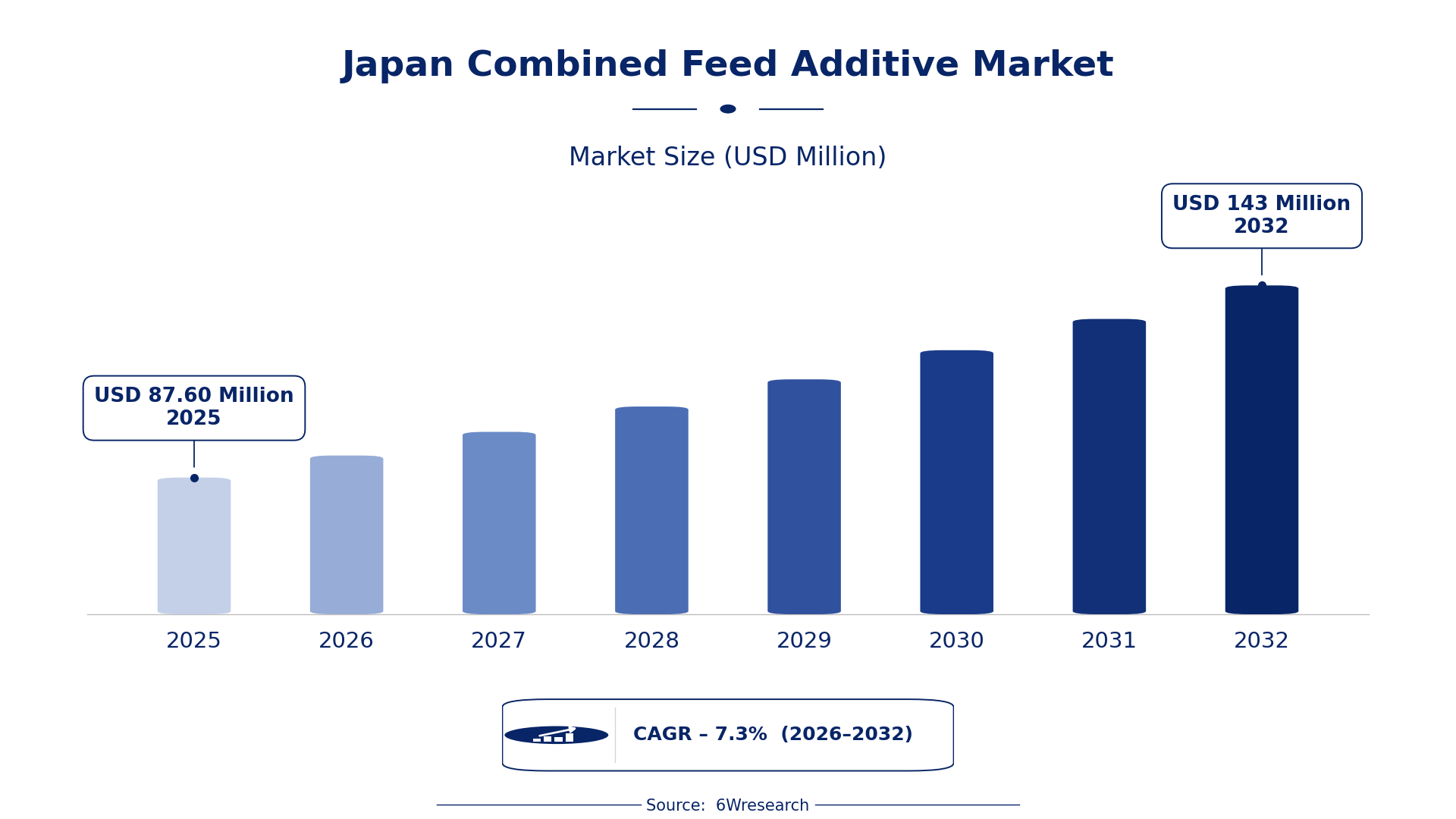
According to 6Wresearch internal database and industry insights, the Japan Combined Feed Additive Market was valued at USD 87.60 Million in 2025 and is projected to reach USD 143 Million by 2032, growing at a CAGR of approximately 7.3% during 2026–2032.
Japan Combined Feed Additive Market Highlights
| Report Metric | Details |
| Report Name | Japan Combined Feed Additive Market (2026-2032) |
| Market Size 2025 | USD 87.60 Million |
| Market Size 2032 | USD 143 Million |
| Absolute Growth 2025–2032 | USD 55.40 Million |
| CAGR 2026–2032 | 7.3% |
| Peak Annual Growth | 8.1% in 2028 |
| Forecast Period | 2026–2032 |
| Historical Data | 2022–2025 |
| Base Year | 2025 |
| Leading Additive Type, 2025 | Vitamin + Enzyme (52% share) |
| Leading Animal Type, 2025 | Poultry (53% share) |
| Leading Functional Use, 2025 | Digestion Support (40% share) |
| Leading Delivery Form, 2025 | Pellet (39% share) |
| Leading Application Mode, 2025 | Premix (47% share) |
| Fastest-Growing Additive Type | Probiotic + Mineral (10.4% CAGR) |
| Fastest-Growing Animal Type | Cattle (10.1% CAGR) |
| Fastest-Growing Functional Use | Growth Promotion (9.4% CAGR) |
| Fastest-Growing Delivery Form | Granule (10.3% CAGR) |
| Fastest-Growing Application Mode | Feed Add-On (9.7% CAGR) |
| Growing Sector | Aquaculture |
| Key End Users | Poultry producers, cattle farmers, aquaculture operators, swine producers |
Japan Combined Feed Additive Market Year-wise Growth Rate and Key Drivers (2022–2032)
This graph illustrates the annual growth rates of the market from 2022 to 2032, highlighting a steady upward trajectory and projected market expansion over the forecast period.
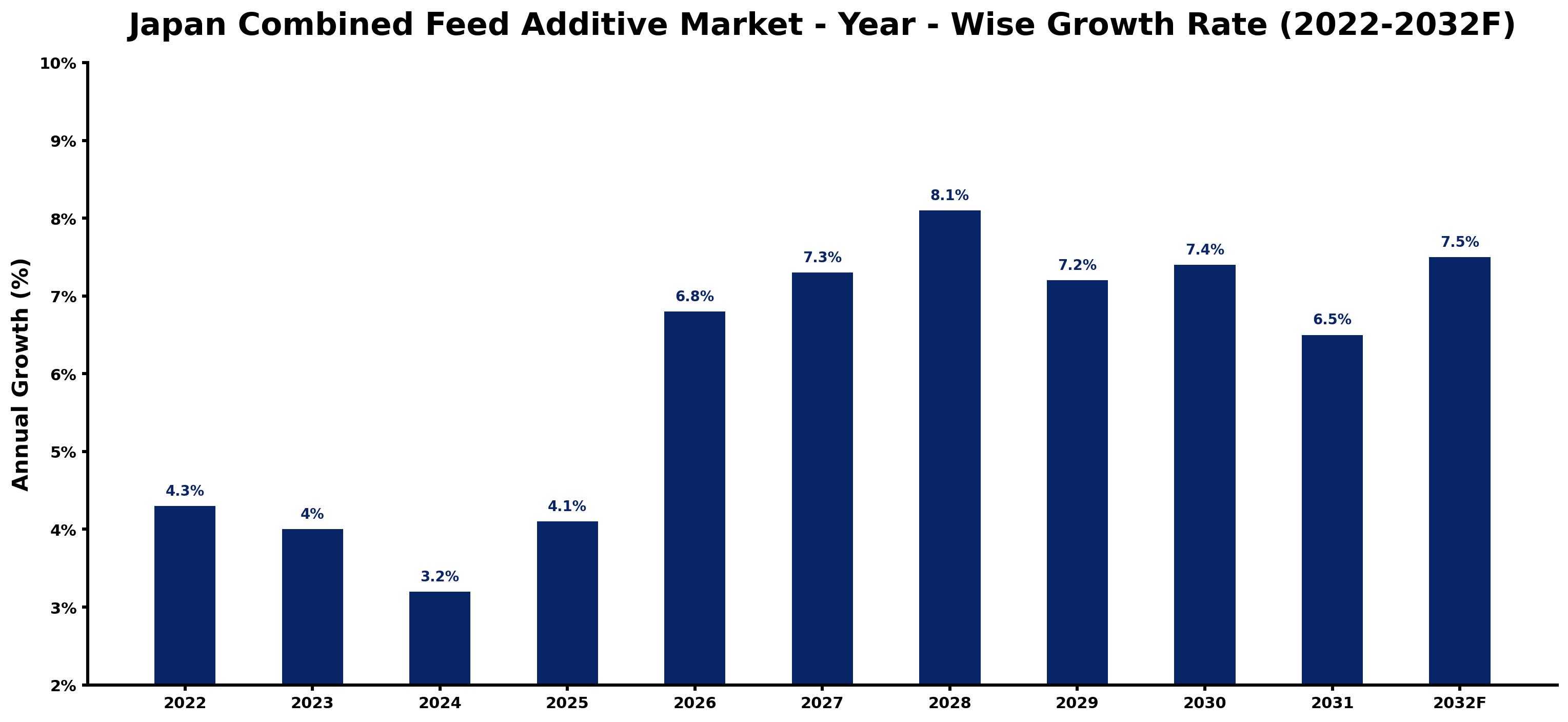
Below, each year's estimated growth is shown next to the factor that most influenced it.
| Year | Estimated Annual Growth (%) | Market Rationale |
| 2022 | 4.3 | The market experienced steady growth due to strong demand from the poultry sector. |
| 2023 | 4.0 | Growth slowed as buyers adjusted to rising feed prices and supply chain challenges. |
| 2024 | 3.2 | The market continued to grow, albeit at a slower pace, as producers focused on efficiency. |
| 2025 | 4.1 | Growth accelerated as investments in feed efficiency programmes gained traction. |
| 2026 | 6.8 | Demand is expected to rise as cattle farming initiatives expand across the country. |
| 2027 | 7.3 | The market is projected to experience further growth driven by rising awareness of animal health. |
| 2028 | 8.1 | Peak growth is anticipated as the aquaculture sector expands, boosting feed additive demand. |
| 2029 | 7.2 | Growth is expected to slow slightly as the market stabilises after previous peaks in demand. |
| 2030 | 7.4 | Demand will rise again as producers adopt more advanced feed formulations. |
| 2031 | 6.5 | The market growth rate is projected to decrease as competition intensifies among suppliers. |
| 2032 | 7.5 | Growth is expected to resume as new technologies in feed additives emerge, attracting buyers. |
Note: Market size estimations and growth projections presented in this report are based on 6Wresearch's proprietary forecasting methodology, utilizing the latest available industry data, government publications, and primary research inputs.
Japan Combined Feed Additive Market Synopsis
Combined feed additives are substances added to animal feed to improve nutritional value and support animal health. They consist of vitamins, minerals, and probiotics, with demand from the poultry, cattle, and aquaculture sectors. The Japan Combined Feed Additive Market is expanding due to rising livestock populations, increased focus on animal health, and government initiatives promoting sustainable practices. For instance, the Green Food System encourages efficient feed use, driving purchases across various livestock categories. The market is valued at approximately 1.2 trillion yen, indicating strong growth potential.
Market Dynamics Impact Analysis (2026–2032)
| Factor | Type | Impact | Primary Segment Affected |
| Rising livestock populations drive demand for feed additives to enhance nutrition and health. | Driver | High | Poultry |
| Increased focus on animal health and productivity leads to higher adoption of probiotics. | Driver | High | Probiotic + Mineral |
| The aquaculture sector is expanding rapidly, creating a need for effective feed solutions. | Opportunity | High | Aquaculture |
| Growing awareness of sustainable practices opens avenues for innovative feed products. | Opportunity | Medium | Vitamin + Enzyme |
| Strict regulations on antibiotic use limit certain feed additive options for producers. | Restraint | High | Cattle |
| Market competition among suppliers can lead to price pressures affecting profitability. | Restraint | Medium | Swine |
| Rising costs of raw materials can delay production schedules for feed manufacturers. | Challenge | High | Mixed Feed |
| Technological advancements require continuous investment, posing a challenge for smaller producers. | Challenge | Medium | Premix |
Evaluation of Drivers in Japan Combined Feed Additive Market (2026–2032)
Demand rests on the following drivers, each shown with the segment it touches most.
| Drivers | Primary Segment Affected | Why It Matters (Evidence) |
| Increased livestock populations necessitate higher feed additive consumption. | Poultry | Japan's poultry population includes 150 million birds, driving demand for nutrition-focused additives. |
| Growing awareness of gut health among producers leads to higher probiotic usage. | Probiotic + Mineral | The use of probiotics in feed has increased by 20% in the last five years, encouraging purchases. |
| Expansion of the aquaculture sector drives demand for specialised feed solutions. | Aquaculture | With 1.5 million tons of fish produced annually, aquaculture requires effective feed additives. |
| Government initiatives promote sustainable livestock practices, increasing feed efficiency. | Vitamin + Enzyme | The Green Food System supports efficient feed use, boosting demand for quality additives. |
| Focus on animal health drives the adoption of digestion support additives. | Digestion Support | Additives that support digestion are vital for the health of 30 million pigs raised annually. |
Spending rises because Japan's livestock population includes 150 million poultry, necessitating higher feed additive consumption to improve nutrition. The use of probiotics in feed has increased by 20% in the last five years, reflecting a growing awareness of gut health among producers. The aquaculture sector, producing 1.5 million tons of fish annually, drives demand for specialised feed solutions. Additives that support digestion are essential for the health of 30 million pigs raised annually, further driving purchases.
Evaluation of Restraints in Japan Combined Feed Additive Market
The key brakes on demand, and where they bite hardest, are shown below.
| Market Restraint | Primary Segment Affected | Why It Matters (Evidence) |
| Strict regulations on antibiotic use limit certain feed additive options. | Cattle | Japan has strict regulations on antibiotic use in livestock feed, restricting available additives. |
| Market competition among suppliers can lead to price pressures affecting profitability. | Swine | Intense competition in the swine feed market can drive prices down, impacting margins. |
| Rising costs of raw materials can delay production schedules for feed manufacturers. | Mixed Feed | Increased raw material costs can disrupt production timelines, affecting supply availability. |
| Technological advancements require continuous investment, posing a challenge for smaller producers. | Premix | Smaller producers may struggle to keep up with technological advancements due to funding limitations. |
| Consumer preferences shifting towards organic products may limit conventional feed additive sales. | Aquaculture | As consumers demand organic fish, producers may reduce reliance on traditional feed additives. |
Japan Combined Feed Additive Market Challenges
Producers face increased costs due to strict regulations on antibiotic use in livestock, raising production expenses by 15% for some farmers. Buyers experience delays in obtaining feed as compliance with ISO 22000 standards requires extensive documentation, potentially leading to shortages during peak demand. Skills shortages in the livestock sector hinder the effective implementation of advanced feed efficiency programs, resulting in a 10% decrease in productivity for certain farms. Technology adoption is slow, with only 20% of producers integrating new additives, limiting their competitive edge in a growing market.
Trends in the Japan Combined Feed Additive Market
The shifts below are changing how Japan Combined Feed Additive Market products are bought and supplied.
- Shift towards Probiotics in Livestock Feed: Since 2018, there has been a notable increase in the use of probiotics in livestock feed. This trend is evidenced by a 20% rise in probiotic usage over five years, reflecting a growing focus on gut health among producers.
- Transition to Sustainable Feed Practices: The Green Food System, launched in 2023, promotes sustainable livestock practices. This initiative encourages farmers to adopt efficient feed solutions, resulting in increased demand for eco-friendly feed additives.
- Emergence of Granule Delivery Forms: Granule forms of feed additives are gaining popularity, with a projected CAGR of 10.3% from 2026 to 2032. This shift is driven by their ease of use and effectiveness in livestock feeding.
- Growth of Feed Add-On Applications: The Feed Add-On application mode is expected to grow, with a CAGR of 9.7% projected for 2026-2032. This trend highlights the increasing focus on improving existing feeds for better animal health.
Investment Opportunities in the Japan Combined Feed Additive Market
The following areas offer the clearest openings for investors and suppliers in the Japan Combined Feed Additive Market.
- Timing for Sustainable Practices: With the Japanese government promoting sustainable livestock practices, there is a growing opportunity for suppliers of eco-friendly feed additives. The livestock feed market is valued at approximately 1.2 trillion yen, indicating a strong investment potential.
- Gap in Probiotic Supply: The rising use of probiotics presents an opportunity for suppliers to fill the gap in the market. The focus on gut health among livestock producers is driving demand for effective probiotic solutions.
- Entry through Joint Ventures: Now is an ideal time for foreign suppliers to enter the market through joint ventures with local producers. Collaborations can facilitate access to the growing livestock sector and improve product offerings.
- Supply of Innovative Feed Solutions: Investing in the development of innovative feed solutions aligns with the shift towards sustainable practices. The Japanese Feed Association advocates for quality standards, creating a pathway for new entrants.
Government Initiatives in the Japan Combined Feed Additive Market
The Economic Security Promotion Act of 2022 affects buyers by supporting supply-chain resilience for critical products, including feed additives. This law encourages producers to invest in sustainable practices and ensures a stable supply of essential materials for livestock feed production. Compliance with ISO 22000 standards in feed safety management is mandatory, enhancing the quality and safety of feed additives in the market.
The Ministry of Agriculture, Forestry and Fisheries regulates livestock feed, ensuring that producers adhere to strict safety standards. The agency supports initiatives aimed at improving feed efficiency, such as the 2023 programme for cattle farming, which encourages the adoption of advanced feed formulations to enhance livestock health and productivity.
Future Insight of the Japan Combined Feed Additive Market
Livestock producers will see significant changes by 2032 as the 2023 program aimed at improving feed efficiency enhances productivity by 10%. The increased use of probiotics will support animal health and growth, while the Green Food System will drive a shift towards sustainable practices in feed production. Quality standards promoted by the Japanese Feed Association will ensure safer and more effective additives in the market. Innovations in feed technology will further improve livestock health and operational efficiency.
Market Segmentation Analysis
Japan Combined Feed Additive Market report covers a detailed analysis of the following market segments:
By Additive Type – Vitamin + Enzyme Leads, Probiotic + Mineral Expected to Grow Fastest
According to Saurav Kr Singh, Senior Research Analyst at 6Wresearch, Vitamin + Enzyme took 52% of additive type revenue in 2025, more than any other category. The Vitamin + Enzyme segment holds the largest share due to its essential role in enhancing animal health, particularly in poultry and cattle. This demand is driven by livestock producers who adhere to rigorous safety standards and quality regulations. The quickest growth will come from Probiotic + Mineral, forecast to expand at a CAGR of 10.4% between 2026 and 2032. Probiotic + Mineral is experiencing rapid growth as it effectively supports gut health in livestock, evidenced by a 20% increase in probiotic usage over the last five years. This surge is further supported by government initiatives promoting sustainable livestock management practices. Suppliers should focus on expanding their probiotic product lines to meet the rising market demand.
By Animal Type – Poultry Leads, Cattle Expected to Grow Fastest
Poultry accounted for 53% of the market by animal type in 2025. Poultry is the leading segment in Japan's livestock industry, with a population of 150 million birds that require substantial feed additives for health and productivity. This large volume drives consistent demand from feed producers nationwide. Cattle is projected to grow fastest, at a CAGR of 10.1% during 2026–2032. Cattle is the fastest-growing segment, primarily due to the increasing focus on dairy and beef production to satisfy domestic consumption needs. Recent initiatives aimed at enhancing feed efficiency in cattle farming are expected to further accelerate this growth. Buyers in the cattle sector should prepare for intensified competition and advancements in feed solutions.
By Functional Use – Digestion Support Leads, Growth Promotion Expected to Grow Fastest
In 2025, Digestion Support led the functional use split with a 40% share. Digestion Support is the foremost functional use as it is crucial for overall animal health, allowing livestock to efficiently process feed and absorb nutrients. This is particularly important given the large scale of Japan's livestock population. Growth Promotion is set to record the highest CAGR in this split, 9.4% over 2026–2032. Growth Promotion is the fastest-growing functional use, driven by the need for additives that enhance weight gain and productivity in livestock. As meat demand continues to rise, this segment is likely to see further expansion. Suppliers should prioritise the development of products that focus on growth promotion to align with market needs.
By Delivery Form – Pellet Leads, Granule Expected to Grow Fastest
With 39% of delivery form revenue in 2025, Pellet was the largest category. Pellet is the dominant delivery form in Japan, widely used in feed formulations for its ease of handling and effectiveness in nutrient delivery. Many livestock producers prefer this format for its consistency and efficiency in feeding. Over 2026–2032, Granule is expected to post the fastest growth, at a CAGR of 10.3%. Granule is the fastest-growing delivery form, especially suitable for applications requiring precise dosing. Its adaptability in enhancing existing feeds has contributed to its rapid adoption among producers. Suppliers should consider investing in granule production capabilities to capitalise on emerging market opportunities.
By Application Mode – Premix Leads, Feed Add-On Expected to Grow Fastest
The largest application mode category in 2025 was Premix, at 47% of revenue. Premix is the leading application mode, extensively used in feed formulations for effectively blending various additives. This method is favoured by producers for its convenience and effectiveness in ensuring balanced nutrition. The quickest growth will come from Feed Add-On, forecast to expand at a CAGR of 9.7% between 2026 and 2032. Feed Add-On is the fastest-growing application mode, used to enhance existing feeds with additional nutrients. This trend reflects a growing preference for tailored feeding solutions among livestock producers. Buyers should explore the integration of feed add-ons into their feeding strategies to optimise livestock health.
Key Attractiveness of the Report
- 10 Years of Market Numbers
- Historical Data Starting from 2022 to 2025
- Base Year 2025
- Forecast Data until 2032
- Key Performance Indicators Impacting the Market
- Major Upcoming Developments and Projects
Key Highlights of the Report:
- Japan Combined Feed Additive Market Outlook
- Market Size of Japan Combined Feed Additive Market, 2025
- Forecast of Japan Combined Feed Additive Market, 2032
- Historical Data and Forecast of Japan Combined Feed Additive Revenues & Volume for the Period 2022-2032F
- Japan Combined Feed Additive Market Trend Evolution
- Japan Combined Feed Additive Market Drivers and Challenges
- Japan Combined Feed Additive Price Trends
- Japan Combined Feed Additive Porter's Five Forces
- Japan Combined Feed Additive Industry Life Cycle
- Historical Data and Forecast of Japan Combined Feed Additive Market Revenues & Volume By Additive Type for the Period 2022-2032F
- Historical Data and Forecast of Japan Combined Feed Additive Market Revenues & Volume By Vitamin + Enzyme for the Period 2022-2032F
- Historical Data and Forecast of Japan Combined Feed Additive Market Revenues & Volume By Probiotic + Mineral for the Period 2022-2032F
- Historical Data and Forecast of Japan Combined Feed Additive Market Revenues & Volume By Antioxidant + Acid for the Period 2022-2032F
- Historical Data and Forecast of Japan Combined Feed Additive Market Revenues & Volume By Herbal + Enzyme for the Period 2022-2032F
- Historical Data and Forecast of Japan Combined Feed Additive Market Revenues & Volume By Animal Type for the Period 2022-2032F
- Historical Data and Forecast of Japan Combined Feed Additive Market Revenues & Volume By Poultry for the Period 2022-2032F
- Historical Data and Forecast of Japan Combined Feed Additive Market Revenues & Volume By Cattle for the Period 2022-2032F
- Historical Data and Forecast of Japan Combined Feed Additive Market Revenues & Volume By Swine for the Period 2022-2032F
- Historical Data and Forecast of Japan Combined Feed Additive Market Revenues & Volume By Aquaculture for the Period 2022-2032F
- Historical Data and Forecast of Japan Combined Feed Additive Market Revenues & Volume By Functional Use for the Period 2022-2032F
- Historical Data and Forecast of Japan Combined Feed Additive Market Revenues & Volume By Digestion Support for the Period 2022-2032F
- Historical Data and Forecast of Japan Combined Feed Additive Market Revenues & Volume By Growth Promotion for the Period 2022-2032F
- Historical Data and Forecast of Japan Combined Feed Additive Market Revenues & Volume By Immune Boost for the Period 2022-2032F
- Historical Data and Forecast of Japan Combined Feed Additive Market Revenues & Volume By Nutrient Absorption for the Period 2022-2032F
- Historical Data and Forecast of Japan Combined Feed Additive Market Revenues & Volume By Delivery Form for the Period 2022-2032F
- Historical Data and Forecast of Japan Combined Feed Additive Market Revenues & Volume By Pellet for the Period 2022-2032F
- Historical Data and Forecast of Japan Combined Feed Additive Market Revenues & Volume By Granule for the Period 2022-2032F
- Historical Data and Forecast of Japan Combined Feed Additive Market Revenues & Volume By Liquid for the Period 2022-2032F
- Historical Data and Forecast of Japan Combined Feed Additive Market Revenues & Volume By Powder for the Period 2022-2032F
- Historical Data and Forecast of Japan Combined Feed Additive Market Revenues & Volume By Application Mode for the Period 2022-2032F
- Historical Data and Forecast of Japan Combined Feed Additive Market Revenues & Volume By Premix for the Period 2022-2032F
- Historical Data and Forecast of Japan Combined Feed Additive Market Revenues & Volume By Feed Add-On for the Period 2022-2032F
- Historical Data and Forecast of Japan Combined Feed Additive Market Revenues & Volume By Direct Feed for the Period 2022-2032F
- Historical Data and Forecast of Japan Combined Feed Additive Market Revenues & Volume By Mixed Feed for the Period 2022-2032F
- Japan Combined Feed Additive Import Export Trade Statistics
- Market Opportunity Assessment By Additive Type
- Market Opportunity Assessment By Animal Type
- Market Opportunity Assessment By Functional Use
- Market Opportunity Assessment By Delivery Form
- Market Opportunity Assessment By Application Mode
- Japan Combined Feed Additive Top Companies Market Share
- Japan Combined Feed Additive Competitive Benchmarking By Technical and Operational Parameters
- Japan Combined Feed Additive Company Profiles
- Japan Combined Feed Additive Key Strategic Recommendations
Market Covered
The study includes the following segmentation.
By Additive Type
- Vitamin + Enzyme
- Probiotic + Mineral
- Antioxidant + Acid
- Herbal + Enzyme
By Animal Type
- Poultry
- Cattle
- Swine
- Aquaculture
By Functional Use
- Digestion Support
- Growth Promotion
- Immune Boost
- Nutrient Absorption
By Delivery Form
- Pellet
- Granule
- Liquid
- Powder
By Application Mode
- Premix
- Feed Add-On
- Direct Feed
- Mixed Feed






































