Japan Compost and Soil Amendments Market Size & Growth Rate
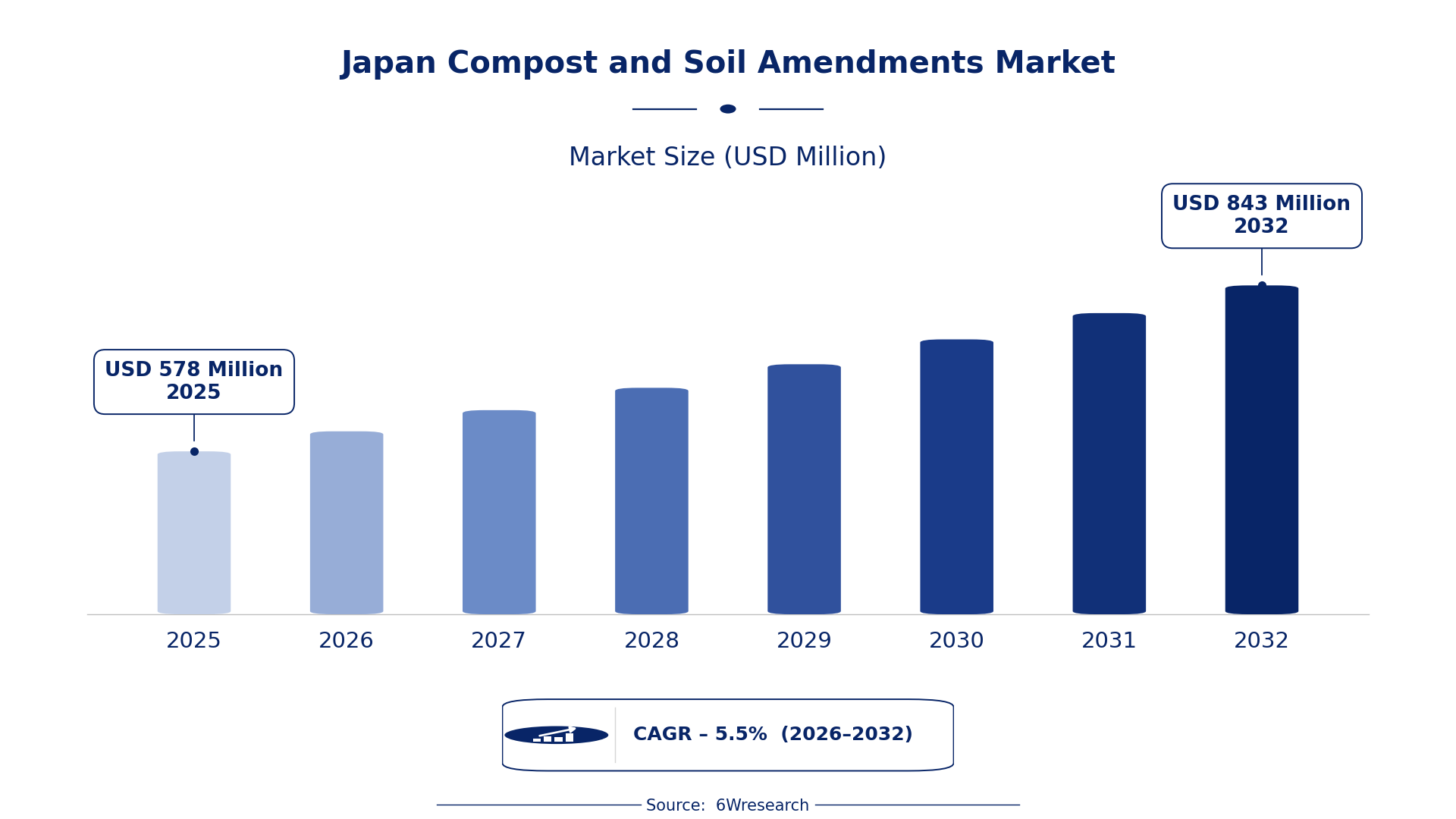
According to 6Wresearch internal database and industry insights, the Japan Compost and Soil Amendments Market was valued at USD 578 Million in 2025 and is projected to reach USD 843 Million by 2032, growing at a CAGR of approximately 5.5% during 2026–2032.
Japan Compost and Soil Amendments Market Highlights
| Report Metric | Details |
| Report Name | Japan Compost and Soil Amendments Market (2026-2032) |
| Market Size 2025 | USD 578 Million |
| Market Size 2032 | USD 843 Million |
| Absolute Growth 2025–2032 | USD 265 Million |
| CAGR 2026–2032 | 5.5% |
| Peak Annual Growth | 7.1% in 2032 |
| Forecast Period | 2026–2032 |
| Historical Data | 2022–2025 |
| Base Year | 2025 |
| Leading Amendment Type, 2025 | Organic Compost (46% share) |
| Leading Material Source, 2025 | Plant Waste (45% share) |
| Leading Application Method, 2025 | Broadcast Spreading (48% share) |
| Leading Crop Type, 2025 | Vegetables (44% share) |
| Leading Benefit Provided, 2025 | Nutrient Enrichment (38% share) |
| Fastest-Growing Amendment Type | Biochar Mix (8.0% CAGR) |
| Fastest-Growing Material Source | Charred Biomass (8.2% CAGR) |
| Fastest-Growing Application Method | Soil Mixing (7.4% CAGR) |
| Fastest-Growing Crop Type | Fruit Trees (7.8% CAGR) |
| Fastest-Growing Benefit Provided | Water Retention (7.2% CAGR) |
| Growing Sector | Agriculture |
| Key End Users | Local farmers, urban gardeners, agricultural cooperatives |
Japan Compost and Soil Amendments Market Year-wise Growth Rate and Key Drivers (2022–2032)
This graph illustrates the annual growth rates of the market from 2022 to 2032, highlighting a steady upward trajectory and projected market expansion over the forecast period.
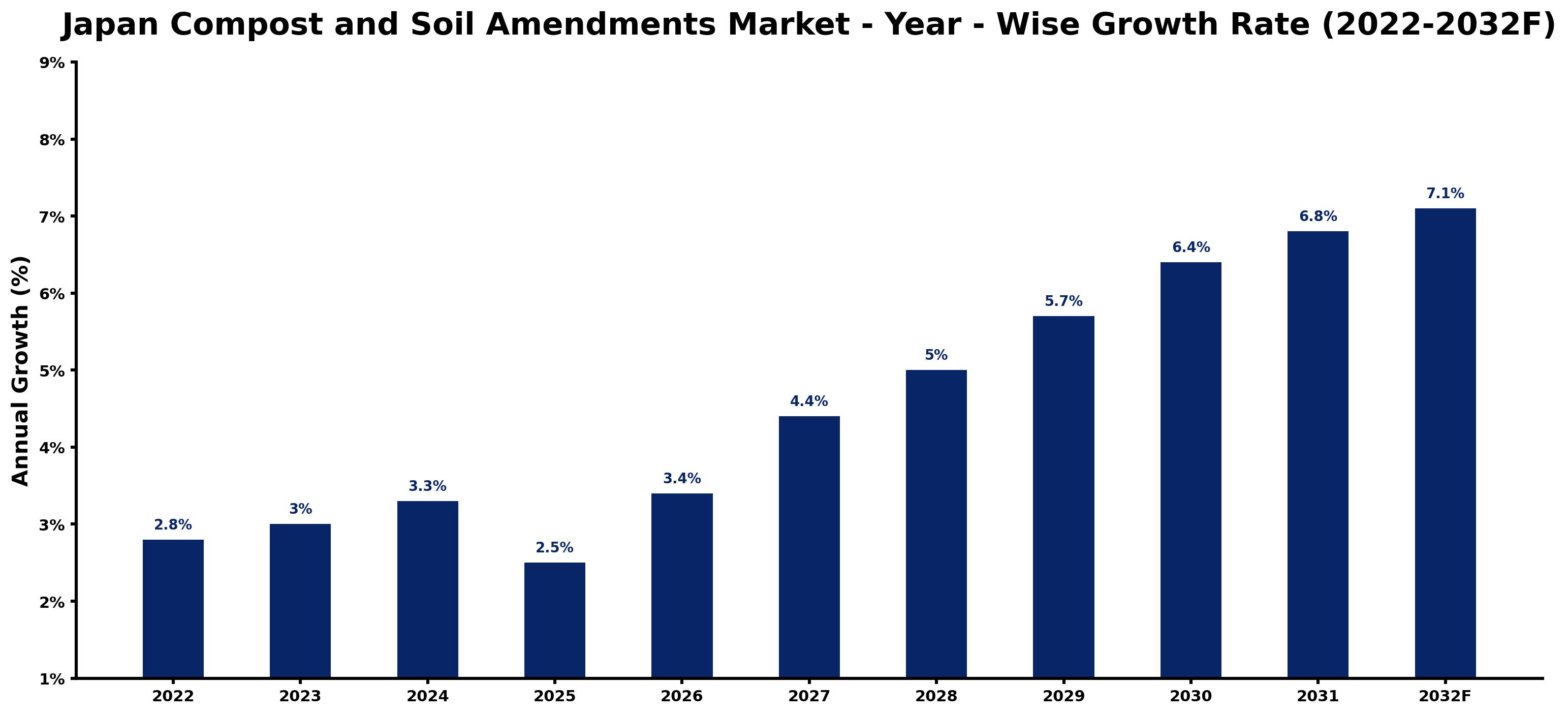
Below, each year's estimated growth is shown next to the factor that most influenced it.
| Year | Estimated Annual Growth (%) | Market Rationale |
| 2022 | 2.8 | The market showed steady growth with strong demand from local farmers and urban gardeners. |
| 2023 | 3.0 | Increased awareness of sustainable practices led to a rise in compost usage among agricultural sectors. |
| 2024 | 3.3 | The introduction of new organic farming standards further boosted the adoption of soil amendments. |
| 2025 | 2.5 | Growth slowed slightly as farmers adjusted to market fluctuations and supply chain issues. |
| 2026 | 3.4 | Demand is expected to increase as urban gardening initiatives gain traction in metropolitan areas. |
| 2027 | 4.4 | The expansion of organic farming practices will contribute to a notable rise in compost applications. |
| 2028 | 5.0 | Rising interest in sustainable agriculture is projected to drive further adoption of soil amendments. |
| 2029 | 5.7 | The focus on improving soil health in vegetable cultivation will lead to increased purchases of compost. |
| 2030 | 6.4 | Growing environmental awareness is expected to prompt investments in compost production and usage. |
| 2031 | 6.8 | The anticipated government targets for organic farming will spur additional demand for soil amendments. |
| 2032 | 7.1 | The market is projected to peak as urban and rural sectors embrace compost for sustainable agricultural practices. |
Note: Market size estimations and growth projections presented in this report are based on 6Wresearch's proprietary forecasting methodology, utilizing the latest available industry data, government publications, and primary research inputs.
Japan Compost and Soil Amendments Market Synopsis
Compost and soil amendments are organic materials added to soil to improve fertility and structure, primarily derived from decomposed plant and animal matter. The Japan Compost and Soil Amendments Market is growing due to rising demand from local farmers and urban gardening initiatives. The Ministry of Agriculture, Forestry and Fisheries promotes organic farming practices, while a government program allocated $5 million for sustainable agriculture initiatives, driving further investment and usage in the sector. This growth is supported by a strong emphasis on improving soil quality and productivity across various agricultural practices.
Market Dynamics Impact Analysis (2026–2032)
| Factor | Type | Impact | Primary Segment Affected |
| Rising demand for organic farming practices | Driver | High | Organic Compost |
| Increased urban gardening initiatives | Driver | High | Biochar Mix |
| Growing interest in sustainable agriculture | Opportunity | Medium | Peat-Free Compost |
| High demand for nutrient-rich soil amendments | Opportunity | Medium | Manure-Based |
| High production costs for composting facilities | Restraint | High | Organic Compost |
| Limited availability of raw materials for compost production | Restraint | Medium | Biochar Mix |
| High competition among local producers | Challenge | Medium | Peat-Free Compost |
| Regulatory compliance costs for quality standards | Challenge | Medium | Manure-Based |
Evaluation of Drivers in Japan Compost and Soil Amendments Market (2026–2032)
These are the developments adding the most demand over the forecast period.
| Drivers | Primary Segment Affected | Why It Matters (Evidence) |
| Increased vegetable cultivation area | Organic Compost | The 1.3 million hectares dedicated to vegetable farming drives demand for nutrient-rich compost. |
| Urban gardening trends | Biochar Mix | In 2022, 80% of urban gardeners reported using compost, reflecting a trend towards sustainable practices. |
| Government support for organic farming | Peat-Free Compost | The aim to increase organic farming to 25% by 2030 fuels demand for sustainable amendments. |
| Rising environmental awareness | Manure-Based | 80% of farmers reported using soil amendments, boosting the market for manure-based products. |
| Focus on soil health improvement | Organic Compost | The average pH level in agricultural soil necessitates the use of compost for balance. |
Several shifts outside the market lift sales. The expansion of vegetable cultivation increases demand for organic compost, prompting farmers to invest in nutrient-rich soil amendments. Urban gardening trends in metropolitan areas drive up biochar usage, with 80% of urban gardeners reporting compost usage in 2022. The aim to increase organic farming to 25% by 2030 fuels demand for sustainable products. A large percentage of farmers reported using soil amendments, reflecting a strong focus on improving soil health. The average pH level in agricultural soil necessitates the use of compost for balance, further driving demand.
Evaluation of Restraints in Japan Compost and Soil Amendments Market
These are the pressures that could keep growth below its potential.
| Market Restraint | Primary Segment Affected | Why It Matters (Evidence) |
| High production costs for composting facilities | Organic Compost | Producers face elevated costs, impacting pricing and accessibility for small-scale farmers. |
| Limited availability of raw materials for compost production | Biochar Mix | The reliance on specific feedstocks constrains production capacity and raises prices. |
| High competition among local producers | Peat-Free Compost | Intense competition results in price wars, affecting profit margins for manufacturers. |
| Regulatory compliance costs for quality standards | Manure-Based | Producers must invest in testing and certification, increasing operational costs. |
| Market fluctuations affecting supply chain stability | Organic Compost | Volatile market conditions can disrupt supply chains, leading to inconsistent availability. |
Japan Compost and Soil Amendments Market Challenges
In 2022, Japan produced 3 million tons of compost, but high production costs due to limited farm sizes, averaging 1.5 hectares, hinder profitability for local farmers. Supply chain disruptions have delayed soil amendments, particularly in urban areas like Tokyo, where demand is high and local producers struggle to meet it. A shortage of skilled labour in organic farming practices restricts effective compost usage, limiting farmers' ability to maximise crop yields. Competition from lower-priced imported soil amendments pressures local producers to reduce prices, which can compromise the quality of domestic products.
Trends in the Japan Compost and Soil Amendments Market
The trends below show where the Japan Compost and Soil Amendments Market is heading.
- Shift Towards Urban Gardening: Urban gardening initiatives are gaining momentum, particularly in the Tokyo metropolitan area, where demand for soil amendments has surged. In 2022, over 80% of urban gardeners reported using compost, reflecting a trend towards sustainable practices.
- Transition from Peat to Peat-Free Products: Environmental regulations are encouraging a shift from peat-based products to peat-free compost alternatives. The adoption of peat-free compost is rising, with a notable increase in usage reported among local farmers in 2023.
- Growing Popularity of Biochar: Biochar is emerging as a popular soil amendment due to its carbon sequestration benefits. In 2022, biochar usage in Japan increased by 15%, supported by environmental agencies promoting its advantages.
- Increased Focus on Soil Health: The Japanese Society of Soil Science and Plant Nutrition is advocating for improved soil health practices. This focus has led to a rise in the adoption of nutrient enrichment amendments among farmers.
Investment Opportunities in the Japan Compost and Soil Amendments Market
Below are the investment opportunities with the strongest case in the Japan Compost and Soil Amendments Market.
- Gap in Organic Compost Supply: With Japan targeting a 46% reduction in greenhouse gas emissions by 2030, the demand for organic compost is set to rise. Suppliers can focus on improving production capabilities in the Kanto region, a major compost production area.
- Investment in Biochar Production: The increasing interest in carbon sequestration presents an opportunity for biochar producers. Local farmers in regions like Hokkaido are looking for sustainable soil amendments, creating a market for biochar products.
- Expansion of Peat-Free Compost: The shift towards peat-free compost offers an opportunity for suppliers. Urban gardeners in the Tokyo area are actively seeking alternatives, making this a promising market for new entrants.
- Partnerships in Sustainable Agriculture: The $5 million allocated for sustainable agriculture initiatives in 2023 opens doors for partnerships. Collaborating with local governments can enhance market presence and support compost production efforts.
Government Initiatives in the Japan Compost and Soil Amendments Market
The Waste Management and Public Cleansing Act of 1970 regulates the treatment and disposal of waste, ensuring that compost production adheres to strict environmental standards. This law has facilitated the growth of the compost market by promoting responsible waste management practices and encouraging the use of organic materials in agriculture. Additionally, the Industrial Standardization Act, amended in 2019, establishes quality standards for compost, enhancing consumer confidence and market stability.
Local governments implement programs under the GX Basic Policy, which aims for substantial public-private investment in decarbonisation. The Ministry of Agriculture, Forestry and Fisheries oversees initiatives that promote organic farming, providing funding for projects that support compost production. These efforts assist farmers in adopting sustainable practices and improving soil health.
Future Insight of the Japan Compost and Soil Amendments Market
Advancements in precision agriculture technology will reshape demand for compost and soil amendments by 2032, enabling targeted application and improved efficiency. Government initiatives, including a $5 million investment in sustainable agriculture, will stimulate innovation and support local farmers. Stricter JIS standards will improve compost quality, benefiting both buyers and suppliers. As urban gardening in the Tokyo metropolitan area expands, the demand for effective soil amendments will rise, encouraging suppliers to diversify their product offerings.
Market Segmentation Analysis
Japan Compost and Soil Amendments Market report covers a detailed analysis of the following market segments:
By Amendment Type – Organic Compost Leads, Biochar Mix Expected to Grow Fastest
According to Saurav Kr Singh, Senior Research Analyst at 6Wresearch, with 46% of amendment type revenue in 2025, Organic Compost was the largest category. Organic compost is the most widely used amendment in Japan, particularly in vegetable and fruit cultivation, where it significantly enriches soil fertility. Its dominance is reinforced by government initiatives promoting organic farming practices, which encourage its adoption among local farmers. Biochar Mix is set to record the highest CAGR in this split, 8.0% over 2026–2032. Biochar mix is rapidly gaining traction due to its recognised benefits for enhancing soil carbon content, especially as environmental agencies advocate for its use in sustainable agriculture. This segment's growth is likely to accelerate as awareness of carbon sequestration increases among farmers. Suppliers should focus on developing organic compost and biochar mix products to meet the growing demand for sustainable agricultural practices.
By Material Source – Plant Waste Leads, Charred Biomass Expected to Grow Fastest
Plant Waste held 45% of the Japan Compost and Soil Amendments Market by material source in 2025. Plant waste is the leading source for composting in Japan, largely due to its availability and the agricultural sector's reliance on it for producing organic compost. This resource is essential for enriching soil nutrients, particularly in regions with high agricultural activity. The quickest growth will come from Charred Biomass, forecast to expand at a CAGR of 8.2% between 2026 and 2032. Charred biomass is experiencing rapid growth as it is increasingly recognised for its environmental benefits in biochar production. The push for sustainable practices in agriculture is driving demand for this material as a soil amendment. Buyers should consider sourcing charred biomass to enhance their soil amendment options and align with sustainability goals.
By Application Method – Broadcast Spreading Leads, Soil Mixing Expected to Grow Fastest
Broadcast Spreading took 48% of application method revenue in 2025, more than any other category. Broadcast spreading is the preferred method for applying soil amendments across large agricultural areas, making it essential for efficient nutrient distribution. This technique is widely adopted by farmers to ensure effective enhancement of soil quality. Soil Mixing is projected to grow fastest, at a CAGR of 7.4% during 2026–2032. Soil mixing is quickly becoming popular as it effectively incorporates amendments into the soil, improving their efficacy and overall impact on crop productivity. Farmers are increasingly recognising the advantages of this method for enhancing soil health. Suppliers should educate buyers on the benefits of soil mixing to promote its adoption in agricultural practices.
By Crop Type – Vegetables Lead, Fruit Trees Expected to Grow Fastest
In 2025, Vegetables led the crop type split with a 44% share. Vegetables are the primary crop type benefiting from soil amendments in Japan, reflecting their importance in the agricultural sector. The extensive land dedicated to vegetable cultivation underscores the strong demand for effective soil enhancement solutions in this category. Over 2026–2032, Fruit Trees are expected to post the fastest growth, at a CAGR of 7.8%. Fruit trees are seeing the fastest increase in soil amendment usage, particularly in orchards focused on maximising yields and improving fruit quality. This trend is driven by the growing emphasis on productivity in fruit cultivation. Suppliers should target the fruit tree segment to capitalise on the rising demand for soil amendments in orchards.
By Benefit Provided – Nutrient Enrichment Leads, Water Retention Expected to Grow Fastest
The largest benefit provided category in 2025 was Nutrient Enrichment, at 38% of revenue. Nutrient enrichment is the key benefit of soil amendments, directly supporting plant growth and agricultural productivity. This function is vital for farmers aiming to optimise their crop yields and improve overall soil health. Water Retention is set to record the highest CAGR in this split, 7.2% over 2026–2032. Water retention is becoming increasingly important, especially in regions facing arid conditions where soil moisture is critical for crop survival. The focus on sustainable water management is propelling this segment's growth. Buyers should prioritise products that improve water retention to effectively tackle challenges related to climate variability.
Key Attractiveness of the Report
- 10 Years of Market Numbers
- Historical Data Starting from 2022 to 2025
- Base Year 2025
- Forecast Data until 2032
- Key Performance Indicators Impacting the Market
- Major Upcoming Developments and Projects
Key Highlights of the Report:
- Japan Compost and Soil Amendments Market Outlook
- Market Size of Japan Compost and Soil Amendments Market, 2025
- Forecast of Japan Compost and Soil Amendments Market, 2032
- Historical Data and Forecast of Japan Compost and Soil Amendments Revenues & Volume for the Period 2022-2032F
- Japan Compost and Soil Amendments Market Trend Evolution
- Japan Compost and Soil Amendments Market Drivers and Challenges
- Japan Compost and Soil Amendments Price Trends
- Japan Compost and Soil Amendments Porter's Five Forces
- Japan Compost and Soil Amendments Industry Life Cycle
- Historical Data and Forecast of Japan Compost and Soil Amendments Market Revenues & Volume By Amendment Type for the Period 2022-2032F
- Historical Data and Forecast of Japan Compost and Soil Amendments Market Revenues & Volume By Organic Compost for the Period 2022-2032F
- Historical Data and Forecast of Japan Compost and Soil Amendments Market Revenues & Volume By Biochar Mix for the Period 2022-2032F
- Historical Data and Forecast of Japan Compost and Soil Amendments Market Revenues & Volume By Manure-Based for the Period 2022-2032F
- Historical Data and Forecast of Japan Compost and Soil Amendments Market Revenues & Volume By Peat-Free Compost for the Period 2022-2032F
- Historical Data and Forecast of Japan Compost and Soil Amendments Market Revenues & Volume By Material Source for the Period 2022-2032F
- Historical Data and Forecast of Japan Compost and Soil Amendments Market Revenues & Volume By Plant Waste for the Period 2022-2032F
- Historical Data and Forecast of Japan Compost and Soil Amendments Market Revenues & Volume By Charred Biomass for the Period 2022-2032F
- Historical Data and Forecast of Japan Compost and Soil Amendments Market Revenues & Volume By Animal Manure for the Period 2022-2032F
- Historical Data and Forecast of Japan Compost and Soil Amendments Market Revenues & Volume By Green Waste for the Period 2022-2032F
- Historical Data and Forecast of Japan Compost and Soil Amendments Market Revenues & Volume By Application Method for the Period 2022-2032F
- Historical Data and Forecast of Japan Compost and Soil Amendments Market Revenues & Volume By Broadcast Spreading for the Period 2022-2032F
- Historical Data and Forecast of Japan Compost and Soil Amendments Market Revenues & Volume By Soil Mixing for the Period 2022-2032F
- Historical Data and Forecast of Japan Compost and Soil Amendments Market Revenues & Volume By Tillage Incorporation for the Period 2022-2032F
- Historical Data and Forecast of Japan Compost and Soil Amendments Market Revenues & Volume By Top Dressing for the Period 2022-2032F
- Historical Data and Forecast of Japan Compost and Soil Amendments Market Revenues & Volume By Crop Type for the Period 2022-2032F
- Historical Data and Forecast of Japan Compost and Soil Amendments Market Revenues & Volume By Vegetables for the Period 2022-2032F
- Historical Data and Forecast of Japan Compost and Soil Amendments Market Revenues & Volume By Fruit Trees for the Period 2022-2032F
- Historical Data and Forecast of Japan Compost and Soil Amendments Market Revenues & Volume By Cereals for the Period 2022-2032F
- Historical Data and Forecast of Japan Compost and Soil Amendments Market Revenues & Volume By Ornamentals for the Period 2022-2032F
- Historical Data and Forecast of Japan Compost and Soil Amendments Market Revenues & Volume By Benefit Provided for the Period 2022-2032F
- Historical Data and Forecast of Japan Compost and Soil Amendments Market Revenues & Volume By Nutrient Enrichment for the Period 2022-2032F
- Historical Data and Forecast of Japan Compost and Soil Amendments Market Revenues & Volume By Soil Aeration for the Period 2022-2032F
- Historical Data and Forecast of Japan Compost and Soil Amendments Market Revenues & Volume By Water Retention for the Period 2022-2032F
- Historical Data and Forecast of Japan Compost and Soil Amendments Market Revenues & Volume By pH Balance for the Period 2022-2032F
- Japan Compost and Soil Amendments Import Export Trade Statistics
- Market Opportunity Assessment By Amendment Type
- Market Opportunity Assessment By Material Source
- Market Opportunity Assessment By Application Method
- Market Opportunity Assessment By Crop Type
- Market Opportunity Assessment By Benefit Provided
- Japan Compost and Soil Amendments Top Companies Market Share
- Japan Compost and Soil Amendments Competitive Benchmarking By Technical and Operational Parameters
- Japan Compost and Soil Amendments Company Profiles
- Japan Compost and Soil Amendments Key Strategic Recommendations
Market Covered
This report examines the market across the segments below.
By Amendment Type
- Organic Compost
- Biochar Mix
- Manure-Based
- Peat-Free Compost
By Material Source
- Plant Waste
- Charred Biomass
- Animal Manure
- Green Waste
By Application Method
- Broadcast Spreading
- Soil Mixing
- Tillage Incorporation
- Top Dressing
By Crop Type
- Vegetables
- Fruit Trees
- Cereals
- Ornamentals
By Benefit Provided
- Nutrient Enrichment
- Soil Aeration
- Water Retention
- pH Balance






































