Japan Concrete Chain Saw Market Size Growth Rate
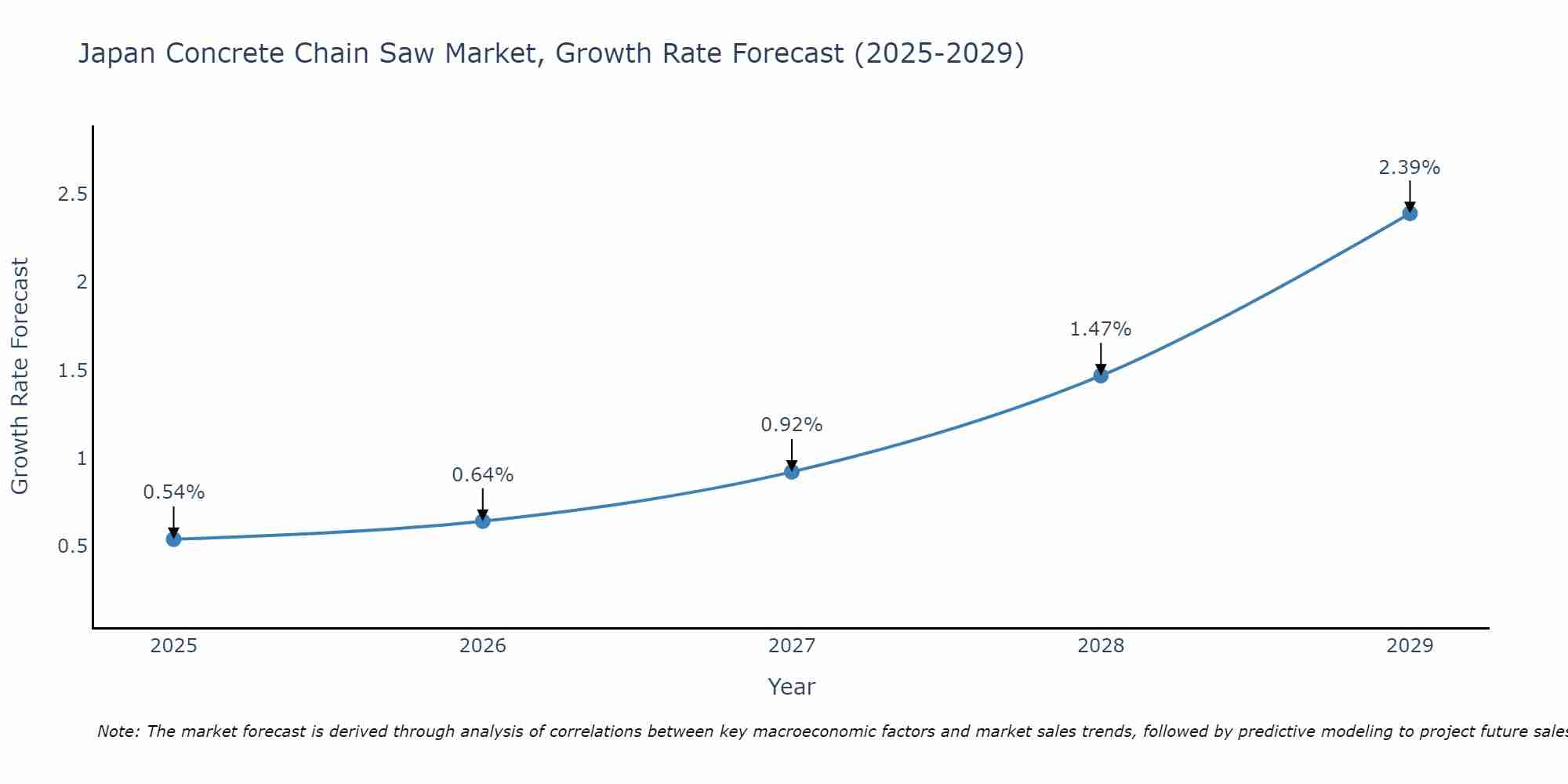
The Japan Concrete Chain Saw Market is likely to experience consistent growth rate gains over the period 2025 to 2029. From 0.54% in 2025, the growth rate steadily ascends to 2.39% in 2029.
Japan Concrete Chain Saw Market Overview
The Japan Concrete Chain Saw Market is witnessing steady growth due to the increasing demand for efficient and precision cutting tools in the construction and infrastructure sectors. The market is driven by the rising adoption of advanced technology in construction activities, leading to the preference for lightweight and portable concrete chain saws that offer high performance and durability. Key players in the market are focusing on product innovations to cater to the evolving needs of end-users, coupled with strategic partnerships and collaborations to expand their market presence. Moreover, stringent regulations regarding worker safety and environmental concerns are further propelling the demand for concrete chain saws with enhanced safety features and reduced emissions, driving the market growth in Japan.
Japan Concrete Chain Saw Market Trends
Currently, the Japan Concrete Chain Saw Market is witnessing a growing demand for lightweight and portable models that offer high performance and precision cutting capabilities. Manufacturers are focusing on developing innovative features such as improved ergonomics, reduced vibration, and enhanced safety measures to cater to the needs of construction professionals and contractors. Additionally, there is a shift towards electric-powered concrete chain saws due to their eco-friendly nature and lower maintenance costs compared to traditional gas-powered models. The market is also seeing a rise in the adoption of diamond chains for increased cutting efficiency and durability. Overall, the Japan Concrete Chain Saw Market is experiencing a trend towards more efficient, user-friendly, and environmentally sustainable products to meet the evolving demands of the construction industry.
Japan Concrete Chain Saw Market Challenges
In the Japan Concrete Chain Saw market, manufacturers face challenges such as intense competition from domestic and international players offering similar products, resulting in price wars and margin pressures. Additionally, strict regulations and standards for construction equipment in Japan require continuous product innovation and adaptation to meet changing requirements. The market also experiences fluctuations in demand due to the cyclical nature of the construction industry, impacting sales and revenue growth for concrete chain saw manufacturers. Furthermore, the need for efficient distribution channels and strong after-sales service to support customers and build brand loyalty poses a challenge in this market. Overall, companies operating in the Japan Concrete Chain Saw market must navigate these obstacles to maintain a competitive edge and sustain growth.
Japan Concrete Chain Saw Market Investment Opportunities
The Japan concrete chain saw market presents promising investment opportunities due to the increasing demand for efficient and precise cutting equipment in the construction and infrastructure sectors. The growing urbanization and infrastructure development projects in Japan are driving the need for advanced cutting tools such as concrete chain saws. Investors can consider opportunities in manufacturing and distributing high-quality and innovative concrete chain saws tailored to the specific requirements of the Japanese market. Additionally, investing in research and development to enhance product performance, safety features, and environmental sustainability can provide a competitive edge in this market segment. Collaborating with local construction companies and distributors to establish a strong presence and distribution network can also be key strategies for success in the Japan concrete chain saw market.
Japan Concrete Chain Saw Market Government Policy
In Japan, the government has implemented regulations and standards for the Concrete Chain Saw Market to ensure safety and quality. The Ministry of Land, Infrastructure, Transport, and Tourism (MLIT) has specific guidelines for the use of concrete chain saws in construction projects to prevent accidents and maintain workplace safety. Additionally, the Japan Industrial Standards (JIS) sets criteria for the design, production, and performance of concrete chain saws to meet quality and reliability standards. Compliance with these regulations is mandatory for manufacturers, distributors, and users to operate legally in the market. Overall, the government policies in Japan aim to promote a safe and competitive environment within the Concrete Chain Saw Market through strict adherence to regulatory requirements and industry standards.
Japan Concrete Chain Saw Market Future Outlook
The Japan Concrete Chain Saw Market is expected to witness steady growth in the coming years due to increasing demand for efficient and precise cutting tools in the construction and infrastructure development sectors. The market is likely to be driven by ongoing urbanization projects, renovation activities, and the growing adoption of advanced technologies in the construction industry. Additionally, the emphasis on improving safety standards and reducing operational costs is expected to propel the demand for concrete chain saws with enhanced features and functionalities. Manufacturers are likely to focus on product innovation, such as lightweight and ergonomic designs, improved cutting performance, and enhanced durability, to cater to the evolving needs of customers. Overall, the Japan Concrete Chain Saw Market is poised for growth opportunities, driven by technological advancements and the increasing construction activities in the country.
Key Highlights of the Report:
- Japan Concrete Chain Saw Market Outlook
- Market Size of Japan Concrete Chain Saw Market, 2021
- Forecast of Japan Concrete Chain Saw Market, 2031
- Historical Data and Forecast of Japan Concrete Chain Saw Revenues & Volume for the Period 2018 - 2031
- Japan Concrete Chain Saw Market Trend Evolution
- Japan Concrete Chain Saw Market Drivers and Challenges
- Japan Concrete Chain Saw Price Trends
- Japan Concrete Chain Saw Porter's Five Forces
- Japan Concrete Chain Saw Industry Life Cycle
- Historical Data and Forecast of Japan Concrete Chain Saw Market Revenues & Volume By Type for the Period 2018 - 2031
- Historical Data and Forecast of Japan Concrete Chain Saw Market Revenues & Volume By Gas Chain Saw for the Period 2018 - 2031
- Historical Data and Forecast of Japan Concrete Chain Saw Market Revenues & Volume By Hydraulic Chain Saw for the Period 2018 - 2031
- Historical Data and Forecast of Japan Concrete Chain Saw Market Revenues & Volume By Pneumatic Chain Saw for the Period 2018 - 2031
- Japan Concrete Chain Saw Import Export Trade Statistics
- Market Opportunity Assessment By Type
- Japan Concrete Chain Saw Top Companies Market Share
- Japan Concrete Chain Saw Competitive Benchmarking By Technical and Operational Parameters
- Japan Concrete Chain Saw Company Profiles
- Japan Concrete Chain Saw Key Strategic Recommendations






































