Japan Connected Street Lighting Market Size & Growth Rate
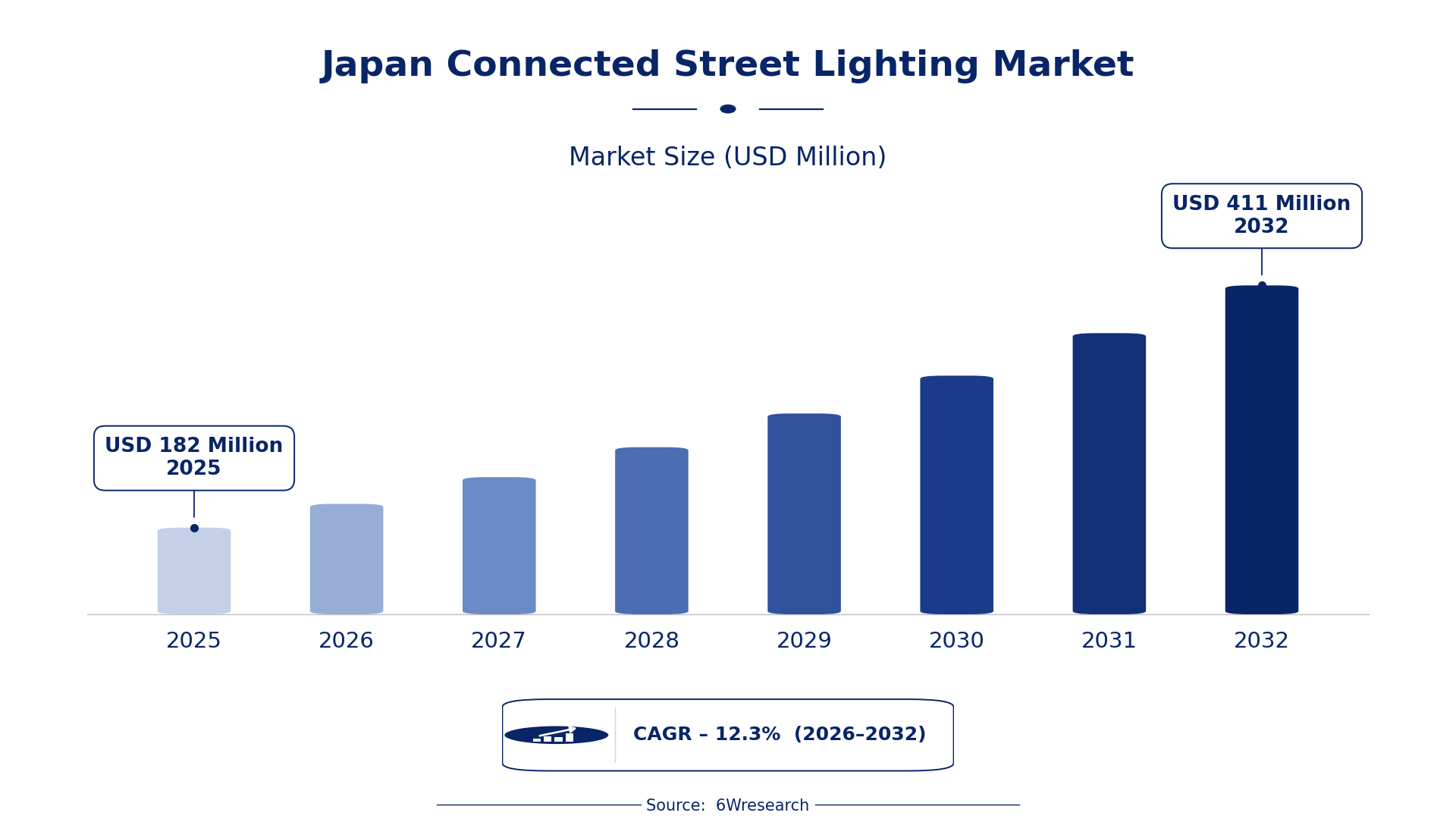
According to 6Wresearch internal database and industry insights, the Japan Connected Street Lighting Market was valued at USD 182 Million in 2025 and is projected to reach USD 411 Million by 2032, growing at a CAGR of approximately 12.3% during 2026–2032.
Japan Connected Street Lighting Market Highlights
| Report Metric | Details |
| Report Name | Japan Connected Street Lighting Market (2026-2032) |
| Market Size 2025 | USD 182 Million |
| Market Size 2032 | USD 411 Million |
| Absolute Growth 2025–2032 | USD 229 Million |
| CAGR 2026–2032 | 12.3% |
| Peak Annual Growth | 13.7% in 2032 |
| Forecast Period | 2026–2032 |
| Historical Data | 2022–2025 |
| Base Year | 2025 |
| Leading Component, 2025 | Hardware (44% share) |
| Leading Connectivity, 2025 | Wired (64% share) |
| Fastest-Growing Component | Software (17.6% CAGR) |
| Fastest-Growing Connectivity | Wireless (16.3% CAGR) |
| Growing Sector | Urban Infrastructure Development |
| Key End Users | Local governments, urban municipalities, city planners |
Japan Connected Street Lighting Market Year-wise Growth Rate and Key Drivers (2022–2032)
This graph illustrates the annual growth rates of the market from 2022 to 2032, highlighting a steady upward trajectory and projected market expansion over the forecast period.
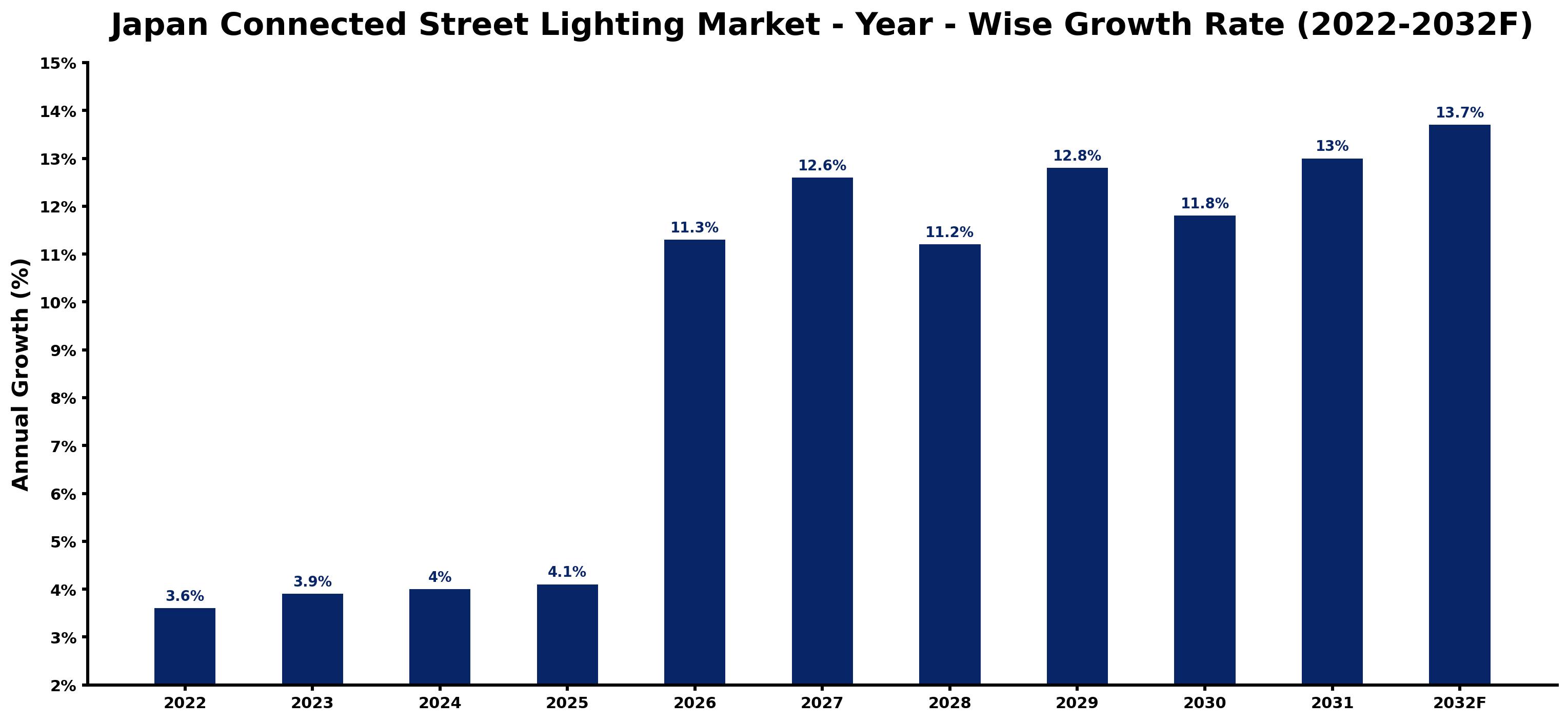
For each year, the table pairs the estimated growth rate with the leading influence on demand, showing how the drivers changed across the period.
| Year | Estimated Annual Growth (%) | Market Rationale |
| 2022 | 3.6 | The market showed steady growth, reflecting ongoing urbanisation trends. |
| 2023 | 3.9 | Investment in smart city projects accelerated growth compared to the previous year. |
| 2024 | 4.0 | The expansion of connected infrastructure continued to drive demand for efficient solutions. |
| 2025 | 4.1 | Energy-efficient initiatives by urban municipalities propelled growth further. |
| 2026 | 11.3 | The introduction of innovative technologies is expected to boost market expansion. |
| 2027 | 12.6 | Awareness of sustainability practices will increase demand for connected systems. |
| 2028 | 11.2 | The market is projected to experience a slowdown due to saturation in some areas. |
| 2029 | 12.8 | Renewed interest in smart city initiatives will lead to faster growth again. |
| 2030 | 11.8 | Demand is expected to stabilise as municipalities adapt to new technologies. |
| 2031 | 13.0 | Funding for urban development projects will support market growth. |
| 2032 | 13.7 | Peak growth will be driven by extensive upgrades in urban lighting systems. |
Note: Market size estimations and growth projections presented in this report are based on 6Wresearch's proprietary forecasting methodology, utilizing the latest available industry data, government publications, and primary research inputs.
Japan Connected Street Lighting Market Synopsis
Connected street lighting integrates systems with sensors and communication capabilities to improve urban infrastructure. The Japan Connected Street Lighting Market is projected to grow, propelled by over 50 smart city projects and local government investments focused on significantly reducing energy costs. The Tokyo Metropolitan Government's allocation of ¥2 billion for smart lighting projects underscores the strong demand for energy-efficient solutions in urban areas, bolstering public safety and sustainability.
Market Dynamics Impact Analysis (2026–2032)
| Factor | Type | Impact | Primary Segment Affected |
| Investment in smart city initiatives | Driver | High | Hardware |
| Growing focus on energy efficiency | Driver | High | Software |
| Rising demand for sustainability solutions | Opportunity | High | Wireless |
| Increased urbanisation and population density | Opportunity | Medium | Wired |
| High initial costs for implementation | Restraint | High | Hardware |
| Limited awareness among local governments | Restraint | Medium | Software |
| Compliance with safety regulations | Challenge | High | Hardware |
| Capacity constraints in technology adoption | Challenge | Medium | Software |
Evaluation of Drivers in Japan Connected Street Lighting Market (2026–2032)
The main growth drivers and the segments they affect most are set out below.
| Drivers | Primary Segment Affected | Why It Matters (Evidence) |
| Investment in smart city projects | Hardware | Local governments are investing heavily in connected street lighting, with over 50 projects underway. |
| Focus on energy efficiency | Software | Energy-efficient solutions are driving demand for connected street lighting systems, as municipalities seek to lower costs. |
| Demand for sustainable solutions | Wireless | Connected street lighting can reduce CO2 emissions by approximately 1.5 million tons annually, appealing to eco-conscious buyers. |
| Population density in urban areas | Wired | Japan's urban areas have an average population density of around 4,500 people per square kilometer, increasing demand for efficient lighting. |
| Government funding for urban development | Hardware | The Tokyo Metropolitan Government allocated ¥2 billion for smart lighting projects in 2023, supporting local initiatives. |
A wider customer base explains much of the growth, as local governments increasingly invest in connected street lighting projects. The demand for sustainable solutions is rising, with connected systems capable of reducing CO2 emissions by approximately 1.5 million tons annually. Urban areas in Japan drive the need for efficient lighting solutions, with an average population density of around 4,500 people per square kilometer. The allocation of ¥2 billion for smart lighting projects in 2023 further illustrates the commitment to sustainable urban development. These factors make the market appealing to municipalities seeking to improve infrastructure and reduce energy costs.
Evaluation of Restraints in Japan Connected Street Lighting Market
The table below lists the restraints and the evidence behind each.
| Market Restraint | Primary Segment Affected | Why It Matters (Evidence) |
| High initial costs for connected lighting systems | Hardware | The substantial investment required for installation limits adoption by some municipalities. |
| Limited awareness of benefits among local governments | Software | Some local governments are unaware of the advantages of connected street lighting. |
| Compliance with safety standards | Hardware | Producers must ensure adherence to the Electrical Appliance and Material Safety Act to maintain market access. |
| Capacity constraints in technology adoption | Software | Local governments may lack the technical expertise to implement advanced systems effectively. |
| Dependence on wireless technology | Wireless | The preference for wireless solutions can lead to challenges in connectivity reliability. |
Japan Connected Street Lighting Market Challenges
Local governments face lengthy project approvals due to complex regulations, which delay the implementation of energy-efficient street lighting by several months. Funding competition among municipalities results in fragmented projects, leading to inefficiencies that waste up to 20% of potential energy savings. Sourcing energy-efficient LED fixtures encounters supply chain issues, causing lead times to extend by over 12 weeks, forcing planners to delay installation schedules. Compliance with ISO 50001 standards can inflate project costs, with local governments potentially experiencing increases of up to 30% in expenses.
Trends in the Japan Connected Street Lighting Market
The trends below show where the Japan Connected Street Lighting Market is heading.
- Shift towards Energy-Efficient Solutions: Japan's emphasis on energy-efficient street lighting is clear in the adoption of connected systems. The total installed base of street lights exceeds 10 million units, highlighting the necessity for upgrades to reduce energy consumption.
- Transition from Wired to Wireless Connectivity: The preference for wireless solutions is increasing due to their flexibility and ease of installation. This trend aligns with ongoing smart city initiatives aimed at enhancing urban living through technology integration.
- Increase in Smart City Projects: Over 50 smart city initiatives in Japan are driving the demand for connected street lighting. These projects aim to enhance urban infrastructure and sustainability, reflecting a commitment to modernisation and efficiency.
- Rising Investment in Urban Development: The Tokyo Metropolitan Government's allocation of ¥2 billion for smart lighting projects demonstrates a strong commitment to urban development. This investment is expected to improve public safety and reduce energy consumption in urban areas.
Investment Opportunities in the Japan Connected Street Lighting Market
Where to invest in the Japan Connected Street Lighting Market: the main openings are set out below.
- Timing for Smart City Investments: With over 50 smart city projects underway, now is the perfect time to invest in connected street lighting solutions. Local governments are actively pursuing advanced technologies to improve urban infrastructure.
- Urban Areas as Key Markets: Urban municipalities, particularly in Tokyo, present a significant opportunity for connected street lighting. The average population density of 4,500 people per square kilometer creates a demand for efficient lighting solutions.
- Supply of Energy-Efficient Technologies: There is an increasing need for energy-efficient lighting technologies as municipalities aim to reduce energy costs by up to 30%. This presents opportunities for suppliers of advanced lighting systems.
- Investment in Sustainable Infrastructure: The allocation of ¥2 billion for smart lighting projects in Tokyo highlights the funding gap for sustainable urban infrastructure. Suppliers can enter this market by collaborating with local governments.
Government Initiatives in the Japan Connected Street Lighting Market
The Electrical Appliance and Material Safety Act, enacted in 1961, regulates the safety of electrical appliances, including street lighting systems. This law ensures that producers adhere to safety standards, facilitating consumer confidence in connected street lighting solutions. The AI Promotion Act of 2025 further supports the integration of AI technologies in urban infrastructure, improving operational efficiency.
The Digital Agency oversees the approval of smart city projects and funding allocations. It plays an important role in facilitating the development of connected street lighting systems, ensuring that local governments receive the necessary support for implementation. This agency's initiatives aim to streamline processes and promote digital transformation in urban areas.
Future Insight of the Japan Connected Street Lighting Market
Urban municipalities will increasingly adopt connected street lighting by 2032, driven by the need to lower energy costs and improve public safety. The Smart City Strategy of 2023 will guide these initiatives, promoting technology integration across urban areas. Wireless connectivity will simplify installations and provide operational flexibility. By implementing energy-efficient technologies, local governments can collectively reduce CO2 emissions by approximately 1.5 million tons annually, aligning with national environmental goals.
Market Segmentation Analysis
Japan Connected Street Lighting Market report covers a detailed analysis of the following market segments:
By Component – Hardware Leads, Software Expected to Grow Fastest
According to Sumit Sagar, AM at 6Wresearch, Hardware accounted for 44% of the market by component in 2025. Hardware holds the largest share because it is crucial for the operation of connected street lighting systems. With over 10 million street lights installed in Japan, reliable hardware is indispensable for effective functionality. Over 2026–2032, Software is expected to post the fastest growth, at a CAGR of 17.6%. Software is witnessing rapid growth as urban municipalities increasingly demand sophisticated data management and analysis for their connected lighting systems. The integration of IoT technology is a key factor driving this surge in demand. Suppliers should prioritise the development of advanced software solutions to cater to the rising needs of urban municipalities.
By Connectivity – Wired Leads, Wireless Expected to Grow Fastest
Wired took 64% of connectivity revenue in 2025, more than any other category. Wired connectivity dominates the market as it has been the conventional choice for street lighting systems. Its longstanding presence is reflected in the reliance of municipalities on wired solutions for their infrastructure. The quickest growth will come from Wireless, forecast to expand at a CAGR of 16.3% between 2026 and 2032. Wireless connectivity is experiencing swift growth due to its ease of installation and flexibility in urban settings. The ongoing smart city initiatives across Japan are accelerating the shift towards wireless solutions. Suppliers must focus on wireless solutions to meet the evolving preferences of local governments.
Key Attractiveness of the Report
- 10 Years of Market Numbers
- Historical Data Starting from 2022 to 2025
- Base Year 2025
- Forecast Data until 2032
- Key Performance Indicators Impacting the Market
- Major Upcoming Developments and Projects
Key Highlights of the Report:
- Japan Connected Street Lighting Market Outlook
- Market Size of Japan Connected Street Lighting Market, 2025
- Forecast of Japan Connected Street Lighting Market, 2032
- Historical Data and Forecast of Japan Connected Street Lighting Revenues & Volume for the Period 2022-2032
- Japan Connected Street Lighting Market Trend Evolution
- Japan Connected Street Lighting Market Drivers and Challenges
- Japan Connected Street Lighting Price Trends
- Japan Connected Street Lighting Porter's Five Forces
- Japan Connected Street Lighting Industry Life Cycle
- Historical Data and Forecast of Japan Connected Street Lighting Market Revenues & Volume By Component for the Period 2022-2032
- Historical Data and Forecast of Japan Connected Street Lighting Market Revenues & Volume By Hardware for the Period 2022-2032
- Historical Data and Forecast of Japan Connected Street Lighting Market Revenues & Volume By Software for the Period 2022-2032
- Historical Data and Forecast of Japan Connected Street Lighting Market Revenues & Volume By Services for the Period 2022-2032
- Historical Data and Forecast of Japan Connected Street Lighting Market Revenues & Volume By Connectivity for the Period 2022-2032
- Historical Data and Forecast of Japan Connected Street Lighting Market Revenues & Volume By Wired for the Period 2022-2032
- Historical Data and Forecast of Japan Connected Street Lighting Market Revenues & Volume By Wireless for the Period 2022-2032
- Japan Connected Street Lighting Import Export Trade Statistics
- Market Opportunity Assessment By Component
- Market Opportunity Assessment By Connectivity
- Japan Connected Street Lighting Top Companies Market Share
- Japan Connected Street Lighting Competitive Benchmarking By Technical and Operational Parameters
- Japan Connected Street Lighting Company Profiles
- Japan Connected Street Lighting Key Strategic Recommendations
Market Covered
The following segment groups are covered in the report.
By Component
- Hardware
- Software
- Services
By Connectivity
- Wired
- Wireless































