Japan Controlled-Release Fertilizer Coating Market Size & Growth Rate
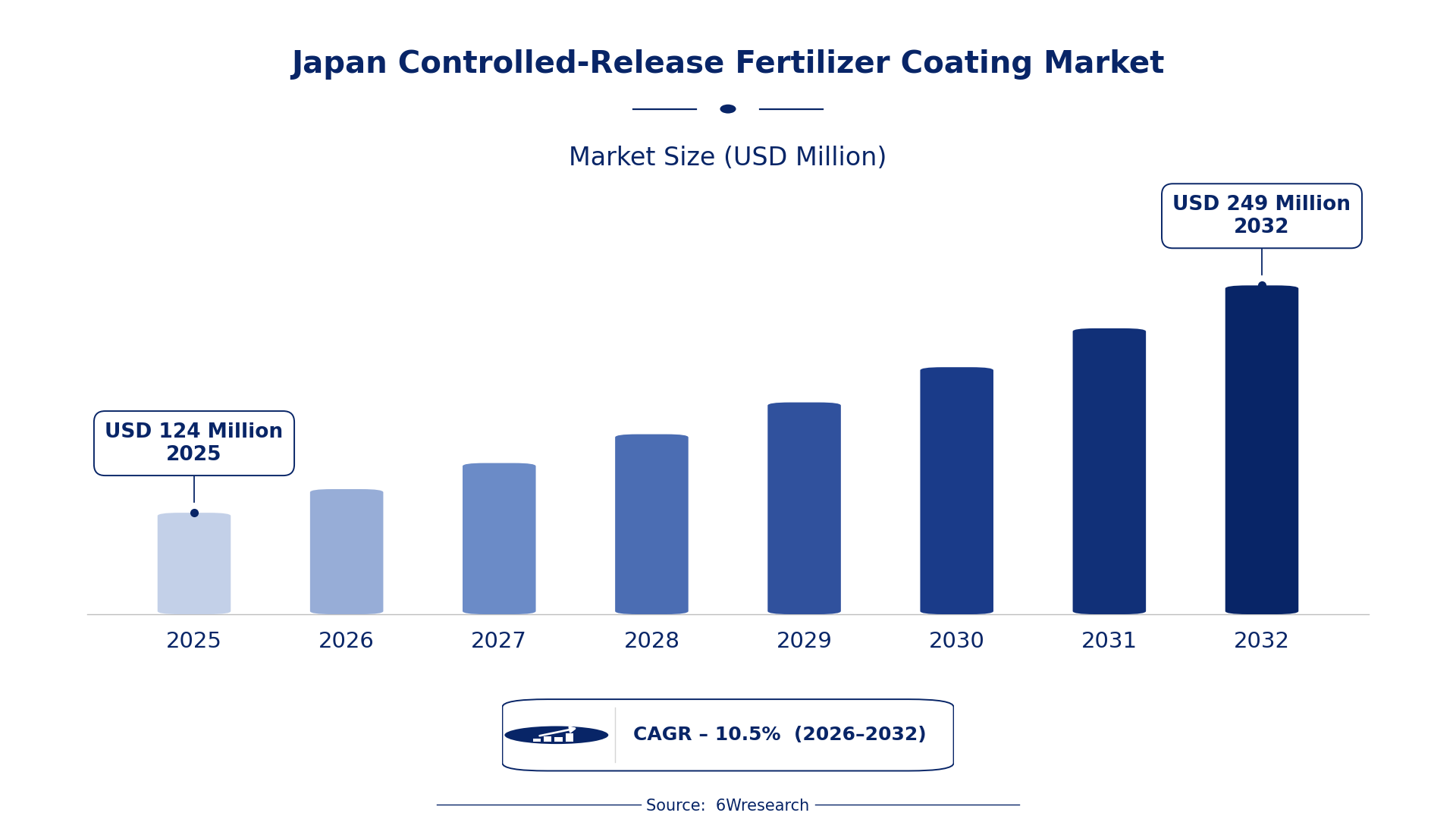
According to 6Wresearch internal database and industry insights, the Japan Controlled-Release Fertilizer Coating Market was valued at USD 124 Million in 2025 and is projected to reach USD 249 Million by 2032, growing at a CAGR of approximately 10.5% during 2026–2032.
Japan Controlled-Release Fertilizer Coating Market Highlights
| Report Metric | Details |
| Report Name | Japan Controlled-Release Fertilizer Coating Market (2026-2032) |
| Market Size 2025 | USD 124 Million |
| Market Size 2032 | USD 249 Million |
| Absolute Growth 2025–2032 | USD 125 Million |
| CAGR 2026–2032 | 10.5% |
| Peak Annual Growth | 11.3% in 2028 |
| Forecast Period | 2026–2032 |
| Historical Data | 2022–2025 |
| Base Year | 2025 |
| Leading Segment, 2025 | Polymer Coatings (40% share) |
| Leading Coating Type, 2025 | Sulfur-Coated Urea (38% share) |
| Leading Fertilizer Type, 2025 | Nitrogen Fertilizers (47% share) |
| Leading Crop Type, 2025 | Cereals (47% share) |
| Leading Application Method, 2025 | Soil Application (52% share) |
| Fastest-Growing Segment | Composite Coatings (13.5% CAGR) |
| Fastest-Growing Coating Type | Resin-Coated Urea (14.6% CAGR) |
| Fastest-Growing Fertilizer Type | Micronutrient Fertilizers (14.7% CAGR) |
| Fastest-Growing Crop Type | Fruits & Vegetables (14.8% CAGR) |
| Fastest-Growing Application Method | Drip Irrigation (13.9% CAGR) |
| Growing Sector | Agricultural sector |
| Key End Users | Farmers, Agricultural cooperatives, Fertilizer distributors |
Japan Controlled-Release Fertilizer Coating Market Year-wise Growth Rate and Key Drivers (2022–2032)
This graph illustrates the annual growth rates of the market from 2022 to 2032, highlighting a steady upward trajectory and projected market expansion over the forecast period.
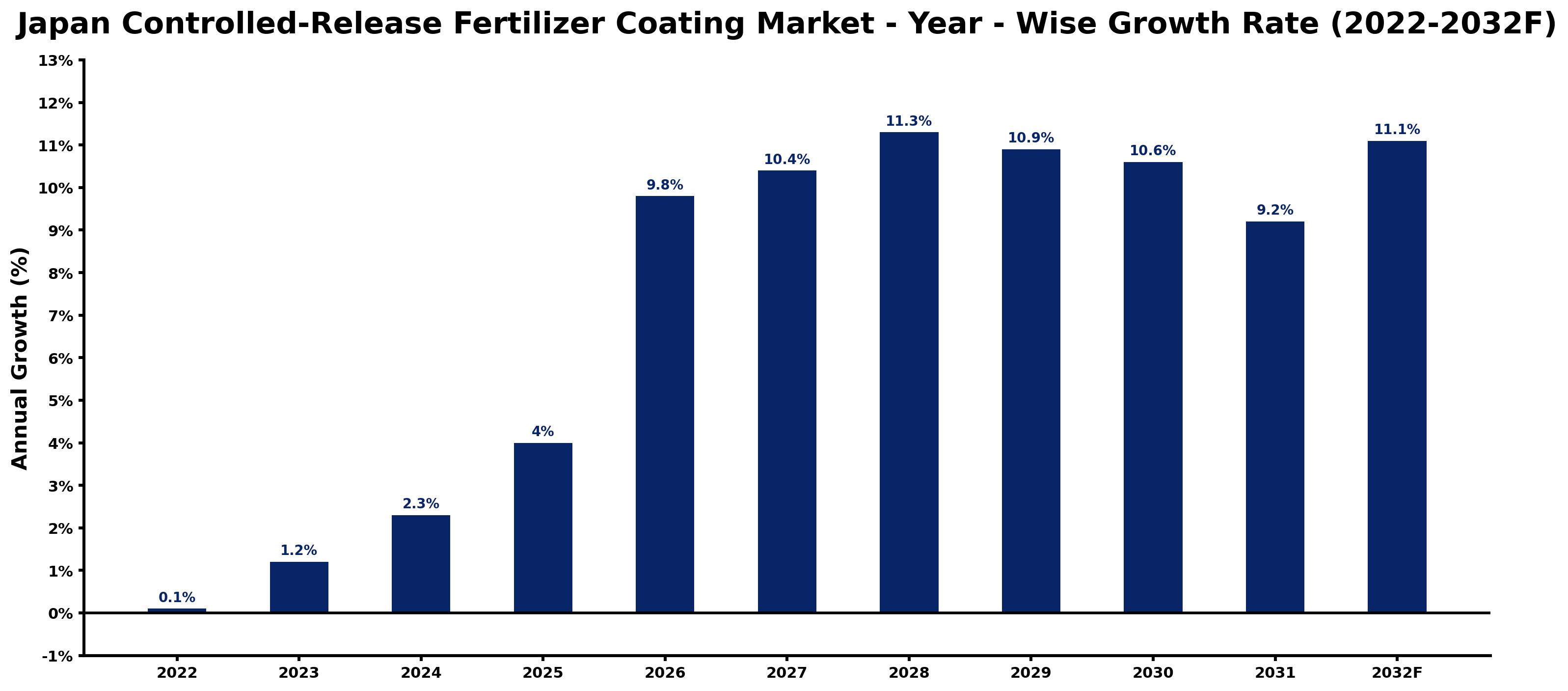
The table below sets out the estimated growth rate for each year and the main factor behind it.
| Year | Estimated Annual Growth (%) | Market Rationale |
| 2022 | 0.1 | The market showed minimal growth, reflecting a cautious approach among farmers. |
| 2023 | 1.2 | Growth accelerated as farmers began to adopt more efficient fertilization methods. |
| 2024 | 2.3 | Increasing awareness of nutrient management led to further adoption of coatings. |
| 2025 | 4.0 | A surge in demand was driven by the need for improved crop yields. |
| 2026 | 9.8 | Investment in agricultural technologies is expected to boost the market. |
| 2027 | 10.4 | Rising interest in sustainable farming practices will continue to drive demand. |
| 2028 | 11.3 | The market peaked as farmers increasingly recognised the benefits of controlled-release fertilizers. |
| 2029 | 10.9 | Growth is projected to slow slightly as market saturation begins to occur. |
| 2030 | 10.6 | A further slowdown is expected as the market stabilises. |
| 2031 | 9.2 | Continued interest in innovation will keep the market growing, albeit at a slower rate. |
| 2032 | 11.1 | Demand is expected to rise again as new technologies emerge. |
Note: Market size estimations and growth projections presented in this report are based on 6Wresearch's proprietary forecasting methodology, utilizing the latest available industry data, government publications, and primary research inputs.
Japan Controlled-Release Fertilizer Coating Market Synopsis
Controlled-Release Fertilizer Coating is a technology that regulates the release rates of nutrients to plants, improving crop yield and reducing nutrient leaching. The Japan Controlled-Release Fertilizer Coating Market is expanding due to rising agricultural innovation, driven by domestic farmers and cooperatives. The government's allocation of ¥10 billion for agricultural innovation programs and the increasing adoption of efficient farming practices are key factors contributing to market growth.
Market Dynamics Impact Analysis (2026–2032)
| Factor | Type | Impact | Primary Segment Affected |
| Growing adoption of controlled-release fertilizers among farmers | Driver | High | Polymer Coatings |
| Increased focus on sustainable agriculture | Driver | High | Sulfur Coatings |
| Emerging demand for nutrient-efficient fertilizers | Opportunity | Medium | Composite Coatings |
| Rising investment in agricultural technology | Opportunity | Medium | Resin-Coated Urea |
| High production costs of controlled-release fertilizers | Restraint | High | Sulfur-Coated Urea |
| Strict regulations on fertilizer quality | Restraint | Medium | Nitrogen Fertilizers |
| Aging farmer population affecting labor supply | Challenge | High | Cereals |
| Competition from traditional fertilizers | Challenge | Medium | Soil Application |
Evaluation of Drivers in Japan Controlled-Release Fertilizer Coating Market (2026–2032)
These are the developments adding the most demand over the forecast period.
| Drivers | Primary Segment Affected | Why It Matters (Evidence) |
| Increased crop yields due to efficient nutrient delivery | Polymer Coatings | Japan's agricultural land covers approximately 4.5 million hectares, leading to higher demand for effective solutions. |
| Shift towards sustainable farming practices | Sulfur Coatings | Over 50% of total fertilizer use is nitrogen fertilizers, prompting farmers to seek efficient solutions. |
| Rising awareness of nutrient leaching issues | Composite Coatings | The Ministry of Agriculture, Forestry and Fisheries promotes controlled-release fertilizers to address nutrient loss. |
| Investment in agricultural innovation programs | Resin-Coated Urea | In 2023, the government allocated ¥10 billion for agricultural innovation, increasing demand for advanced solutions. |
| Growing consumer demand for high-quality produce | Nitrogen Fertilizers | The Tokyo region is significant for fruit and vegetable production, necessitating effective fertilization. |
Much of the new demand traces back to the increasing focus on sustainable agriculture, which has become vital for farmers. Japan's agricultural land covers approximately 4.5 million hectares, creating a pressing need for efficient nutrient delivery. The Tokyo region is significant for fruit and vegetable production, driving interest in effective solutions. Agricultural cooperatives are promoting these fertilizers to address nutrient leaching issues, further boosting demand.
Evaluation of Restraints in Japan Controlled-Release Fertilizer Coating Market
These restraints slow adoption and weigh on supplier margins.
| Market Restraint | Primary Segment Affected | Why It Matters (Evidence) |
| High production costs of controlled-release fertilizers limit adoption | Sulfur Coatings | Production costs are elevated, restricting farmers' ability to invest in advanced solutions. |
| Strict regulations on fertilizer quality and environmental impact | Nitrogen Fertilizers | Japan has stringent regulations that require compliance, increasing operational costs for producers. |
| Limited awareness among some farmers about benefits | Composite Coatings | A portion of farmers lacks knowledge about the advantages of controlled-release fertilizers, hindering market growth. |
| Competition from traditional fertilizers remains strong | Resin-Coated Urea | Conventional fertilizers are often cheaper and more familiar to farmers, affecting market penetration. |
| Aging farmer population affects labor supply | Cereals | The average age of farmers contributes to a declining workforce, impacting production capabilities. |
Japan Controlled-Release Fertilizer Coating Market Challenges
Farmers in Japan encounter escalating costs for controlled-release fertilizers, with prices surging by 15% this year due to sourcing difficulties. Buyers experience delays in product availability as technological advancements in coating materials progress slowly, potentially extending lead times by six months. Stringent regulations on fertilizer quality disrupt supply chains, causing production delays that can push back planting schedules for producers. The average age of farmers, approximately 67 years, hampers the workforce's ability to adapt to new agricultural technologies, which can diminish overall productivity and yield.
Trends in the Japan Controlled-Release Fertilizer Coating Market
Several trends are reshaping the Japan Controlled-Release Fertilizer Coating Market; the most important are set out below.
- Shift towards Sustainable Fertilization Practices: In 2023, the government allocated ¥10 billion for agricultural innovation, promoting sustainable practices among farmers. This funding encourages the adoption of controlled-release fertilizers, leading to improved crop yields.
- Rise in Drip Irrigation Adoption: Drip irrigation systems are increasingly adopted, especially in vegetable cultivation, improving nutrient delivery efficiency. This method is expected to grow as farmers seek to optimise water and fertilizer use.
- Growing Demand for High-Quality Produce: Farmers are focusing on high-value crops like fruits and vegetables, which benefit significantly from controlled-release fertilizers. In 2022, Japan produced around 8 million tons of rice, indicating a shift towards quality.
- Increased Investment in Agricultural Technologies: The agricultural sector is seeing heightened investment in technologies that improve nutrient management. This trend is supported by the Ministry of Agriculture, Forestry and Fisheries, which promotes innovation.
Investment Opportunities in the Japan Controlled-Release Fertilizer Coating Market
The following areas offer the clearest openings for investors and suppliers in the Japan Controlled-Release Fertilizer Coating Market.
- Timing for Investment in Controlled-Release Fertilizers: With the government allocating ¥10 billion for agricultural innovation, there is a prime opportunity to invest in controlled-release fertilizers. Farmers are increasingly seeking efficient solutions to improve crop yields.
- Supply of Advanced Fertilizer Coatings: There is a growing need for advanced fertilizer coatings, particularly among agricultural cooperatives. Investing in high-quality coatings can meet the demand for improved nutrient delivery.
- Support for Sustainable Farming Initiatives: Agricultural cooperatives are actively seeking sustainable solutions, creating a demand for controlled-release fertilizers. Collaborating with these cooperatives can facilitate market entry.
- Entry through Joint Ventures: Forming joint ventures with local agricultural cooperatives can provide access to the Japanese market. This approach allows for shared resources and knowledge, improving product distribution.
Government Initiatives in the Japan Controlled-Release Fertilizer Coating Market
The Food Sanitation Act amendment (2018) introduced a positive list system for synthetic resins, which ensures that only approved materials are used in controlled-release fertilizers. This measure raises safety standards and promotes consumer confidence in the products available in the market.
The Electrical Appliance and Material Safety Act regulates the safety of materials used in fertilizers. This ensures that producers comply with safety standards, allowing buyers to trust the quality of the fertilizers they purchase.
Future Insight of the Japan Controlled-Release Fertilizer Coating Market
Investment in agricultural innovation programmes will stimulate demand for advanced controlled-release fertilizers, driven by a government allocation of ¥10 billion. By 2032, the implementation of new JIS standards for coated fertilizers will improve quality and reliability for suppliers. The integration of precision agriculture technologies will optimise nutrient delivery, benefiting both buyers and producers. Enhanced focus on environmental regulations will encourage sustainable practices, shaping the future of agricultural production.
Market Segmentation Analysis
Japan Controlled-Release Fertilizer Coating Market report covers a detailed analysis of the following market segments:
By Segment – Polymer Coatings Lead, Composite Coatings Expected to Grow Fastest
According to Saurav Kr Singh, Senior Research Analyst at 6Wresearch, Polymer Coatings held 40% of the Japan Controlled-Release Fertilizer Coating Market by segment in 2025. Polymer Coatings hold the largest share as they are extensively utilised by farmers for their efficient nutrient release capabilities. The endorsement from the Ministry of Agriculture, Forestry and Fisheries reinforces their widespread application in various agricultural practices throughout Japan. The quickest growth will come from Composite Coatings, forecast to expand at a CAGR of 13.5% between 2026 and 2032. Composite Coatings are experiencing rapid growth due to their use in specialised farming techniques that require precise nutrient delivery. The increasing focus on precision agriculture is driving this segment's expansion as farmers seek tailored solutions to improve productivity. Suppliers should prioritise the development of advanced composite solutions to meet the rising demand from specialised agricultural sectors.
By Coating Type – Sulfur-Coated Urea Leads, Resin-Coated Urea Expected to Grow Fastest
With 38% of coating type revenue in 2025, Sulfur-Coated Urea was the largest category. Sulfur-Coated Urea leads the market as it is preferred by farmers for its dependable nitrogen release, essential for maintaining crop health. Its compliance with Japan's stringent fertilizer quality regulations makes it a popular choice among agricultural practitioners. Resin-Coated Urea is set to record the highest CAGR in this split, 14.6% over 2026–2032. Resin-Coated Urea is witnessing rapid growth due to its valued slow-release properties, which are crucial in contemporary agricultural practices. As sustainable farming becomes increasingly important, the demand for these coatings is projected to rise significantly. Buyers should consider investing in resin-coated options to improve nutrient efficiency and align with environmental standards.
By Fertilizer Type – Nitrogen Fertilizers Lead, Micronutrient Fertilizers Expected to Grow Fastest
Nitrogen Fertilizers accounted for 47% of the market by fertilizer type in 2025. Nitrogen Fertilizers account for over 50% of total fertilizer use in Japan, making them essential for crop growth and yield. This heavy dependence on nitrogen for key crops ensures that this segment maintains a robust market position. Micronutrient Fertilizers are projected to grow fastest, at a CAGR of 14.7% during 2026–2032. Micronutrient Fertilizers are rapidly expanding as farmers increasingly focus on addressing specific nutrient deficiencies in their crops. The growing awareness of the importance of micronutrients for optimal plant health is propelling this segment forward. Suppliers need to broaden their offerings in micronutrient fertilizers to meet the evolving needs of farmers seeking comprehensive nutrient solutions.
By Crop Type – Cereals Lead, Fruits & Vegetables Expected to Grow Fastest
The largest crop type category in 2025 was Cereals, at 47% of revenue. Cereals are the dominant crop category in Japan, with a significant portion of agricultural land dedicated to their cultivation. This reliance on cereals ensures a steady demand for controlled-release fertilizers to optimise their yields. Over 2026–2032, Fruits & Vegetables are expected to post the fastest growth, at a CAGR of 14.8%. Fruits & Vegetables are experiencing rapid growth as high-value crops that greatly benefit from controlled-release coatings. The rising consumer preference for fresh produce is motivating farmers to adopt advanced fertilisation techniques. Suppliers should focus on the fruit and vegetable sector with customised solutions to capitalise on this growth trend.
By Application Method – Soil Application Leads, Drip Irrigation Expected to Grow Fastest
Soil Application took 52% of application method revenue in 2025, more than any other category. Soil Application remains the leading method for fertilizer distribution, as it is the traditional approach favoured by many farmers. This established practice ensures a strong market for controlled-release fertilizers in soil applications. The quickest growth will come from Drip Irrigation, forecast to expand at a CAGR of 13.9% between 2026 and 2032. Drip Irrigation is gaining traction due to its efficiency in nutrient delivery, especially in vegetable cultivation. The increasing adoption of this method signals a shift towards more sustainable agricultural practices. Buyers should investigate drip irrigation systems to maximise nutrient efficiency and reduce waste in their farming operations.
Key Attractiveness of the Report
- 10 Years of Market Numbers
- Historical Data Starting from 2022 to 2025
- Base Year 2025
- Forecast Data until 2032
- Key Performance Indicators Impacting the Market
- Major Upcoming Developments and Projects
Key Highlights of the Report:
- Japan Controlled-Release Fertilizer Coating Market Outlook
- Market Size of Japan Controlled-Release Fertilizer Coating Market, 2025
- Forecast of Japan Controlled-Release Fertilizer Coating Market, 2032
- Historical Data and Forecast of Japan Controlled-Release Fertilizer Coating Revenues & Volume for the Period 2022-2032F
- Japan Controlled-Release Fertilizer Coating Market Trend Evolution
- Japan Controlled-Release Fertilizer Coating Market Drivers and Challenges
- Japan Controlled-Release Fertilizer Coating Price Trends
- Japan Controlled-Release Fertilizer Coating Porter's Five Forces
- Japan Controlled-Release Fertilizer Coating Industry Life Cycle
- Historical Data and Forecast of Japan Controlled-Release Fertilizer Coating Market Revenues & Volume By Segment for the Period 2022-2032F
- Historical Data and Forecast of Japan Controlled-Release Fertilizer Coating Market Revenues & Volume By Polymer Coatings for the Period 2022-2032F
- Historical Data and Forecast of Japan Controlled-Release Fertilizer Coating Market Revenues & Volume By Sulfur Coatings for the Period 2022-2032F
- Historical Data and Forecast of Japan Controlled-Release Fertilizer Coating Market Revenues & Volume By Wax Coatings for the Period 2022-2032F
- Historical Data and Forecast of Japan Controlled-Release Fertilizer Coating Market Revenues & Volume By Composite Coatings for the Period 2022-2032F
- Historical Data and Forecast of Japan Controlled-Release Fertilizer Coating Market Revenues & Volume By Coating Type for the Period 2022-2032F
- Historical Data and Forecast of Japan Controlled-Release Fertilizer Coating Market Revenues & Volume By Sulfur-Coated Urea for the Period 2022-2032F
- Historical Data and Forecast of Japan Controlled-Release Fertilizer Coating Market Revenues & Volume By Resin-Coated Urea for the Period 2022-2032F
- Historical Data and Forecast of Japan Controlled-Release Fertilizer Coating Market Revenues & Volume By Urea Formaldehyde for the Period 2022-2032F
- Historical Data and Forecast of Japan Controlled-Release Fertilizer Coating Market Revenues & Volume By Multi-Nutrient Blends for the Period 2022-2032F
- Historical Data and Forecast of Japan Controlled-Release Fertilizer Coating Market Revenues & Volume By Fertilizer Type for the Period 2022-2032F
- Historical Data and Forecast of Japan Controlled-Release Fertilizer Coating Market Revenues & Volume By Nitrogen Fertilizers for the Period 2022-2032F
- Historical Data and Forecast of Japan Controlled-Release Fertilizer Coating Market Revenues & Volume By Phosphorus Fertilizers for the Period 2022-2032F
- Historical Data and Forecast of Japan Controlled-Release Fertilizer Coating Market Revenues & Volume By Potassium Fertilizers for the Period 2022-2032F
- Historical Data and Forecast of Japan Controlled-Release Fertilizer Coating Market Revenues & Volume By Micronutrient Fertilizers for the Period 2022-2032F
- Historical Data and Forecast of Japan Controlled-Release Fertilizer Coating Market Revenues & Volume By Crop Type for the Period 2022-2032F
- Historical Data and Forecast of Japan Controlled-Release Fertilizer Coating Market Revenues & Volume By Cereals for the Period 2022-2032F
- Historical Data and Forecast of Japan Controlled-Release Fertilizer Coating Market Revenues & Volume By Fruits & Vegetables for the Period 2022-2032F
- Historical Data and Forecast of Japan Controlled-Release Fertilizer Coating Market Revenues & Volume By Oilseeds for the Period 2022-2032F
- Historical Data and Forecast of Japan Controlled-Release Fertilizer Coating Market Revenues & Volume By Pulses for the Period 2022-2032F
- Historical Data and Forecast of Japan Controlled-Release Fertilizer Coating Market Revenues & Volume By Application Method for the Period 2022-2032F
- Historical Data and Forecast of Japan Controlled-Release Fertilizer Coating Market Revenues & Volume By Broadcast for the Period 2022-2032F
- Historical Data and Forecast of Japan Controlled-Release Fertilizer Coating Market Revenues & Volume By Drip Irrigation for the Period 2022-2032F
- Historical Data and Forecast of Japan Controlled-Release Fertilizer Coating Market Revenues & Volume By Foliar Spray for the Period 2022-2032F
- Historical Data and Forecast of Japan Controlled-Release Fertilizer Coating Market Revenues & Volume By Soil Application for the Period 2022-2032F
- Japan Controlled-Release Fertilizer Coating Import Export Trade Statistics
- Market Opportunity Assessment By Segment
- Market Opportunity Assessment By Coating Type
- Market Opportunity Assessment By Fertilizer Type
- Market Opportunity Assessment By Crop Type
- Market Opportunity Assessment By Application Method
- Japan Controlled-Release Fertilizer Coating Top Companies Market Share
- Japan Controlled-Release Fertilizer Coating Competitive Benchmarking By Technical and Operational Parameters
- Japan Controlled-Release Fertilizer Coating Company Profiles
- Japan Controlled-Release Fertilizer Coating Key Strategic Recommendations
Market Covered
This report examines the market across the segments below.
By Segment
- Polymer Coatings
- Sulfur Coatings
- Wax Coatings
- Composite Coatings
By Coating Type
- Sulfur-Coated Urea
- Resin-Coated Urea
- Urea Formaldehyde
- Multi-Nutrient Blends
By Fertilizer Type
- Nitrogen Fertilizers
- Phosphorus Fertilizers
- Potassium Fertilizers
- Micronutrient Fertilizers
By Crop Type
- Cereals
- Fruits & Vegetables
- Oilseeds
- Pulses
By Application Method
- Broadcast
- Drip Irrigation
- Foliar Spray
- Soil Application






































