Japan Cookware Market Size & Growth Rate
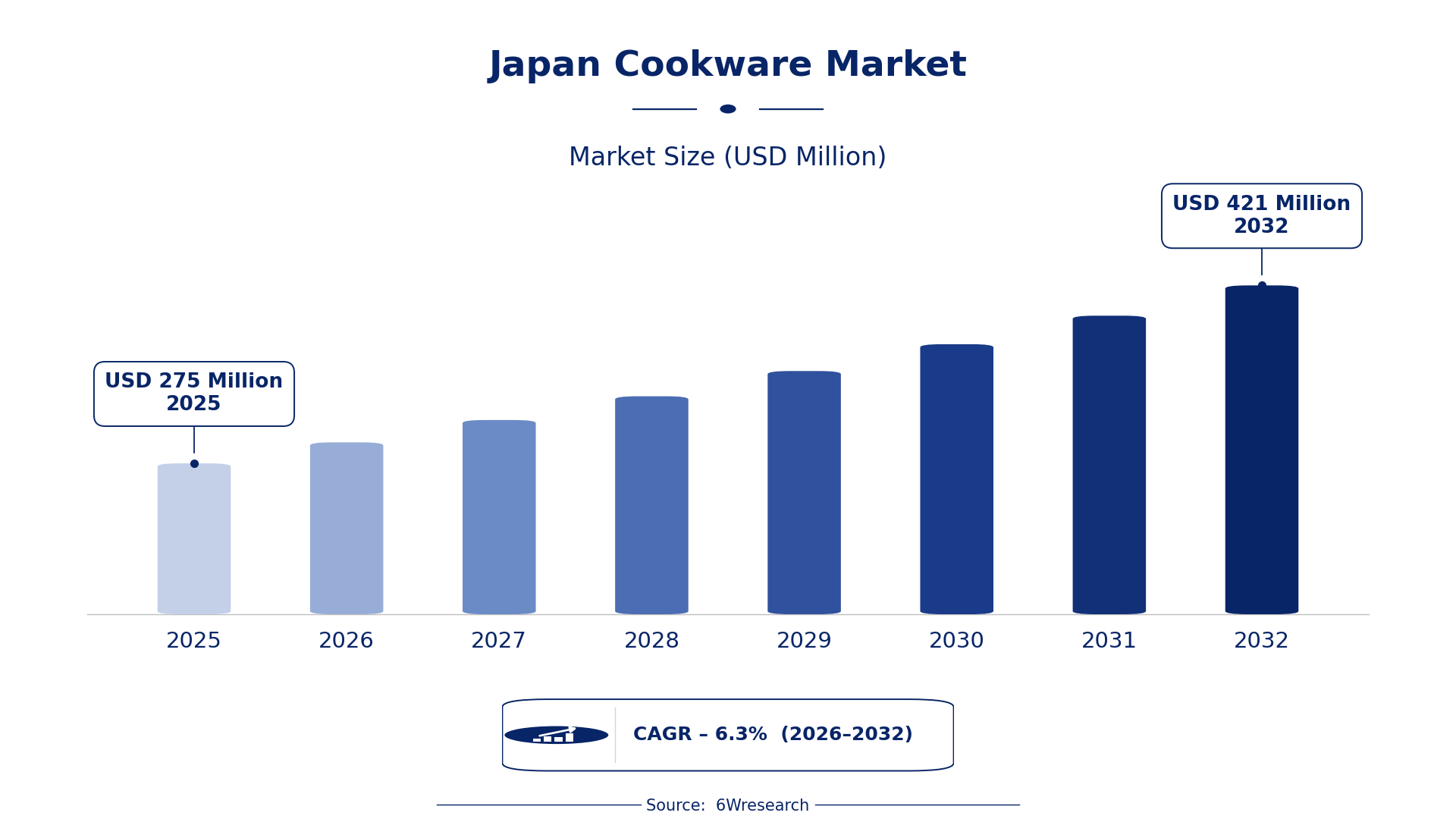
According to 6Wresearch internal database and industry insights, the Japan Cookware Market was valued at USD 275 Million in 2025 and is projected to reach USD 421 Million by 2032, growing at a CAGR of approximately 6.3% during 2026–2032.
Japan Cookware Market Highlights
| Report Metric | Details |
| Report Name | Japan Cookware Market (2026-2032) |
| Market Size 2025 | USD 275 Million |
| Market Size 2032 | USD 421 Million |
| Absolute Growth 2025–2032 | USD 146 Million |
| CAGR 2026–2032 | 6.3% |
| Peak Annual Growth | 7.1% in 2028 |
| Forecast Period | 2026–2032 |
| Historical Data | 2022–2025 |
| Base Year | 2025 |
| Leading Material Type, 2025 | Aluminium (46% share) |
| Leading Distribution Channels, 2025 | Offline (57% share) |
| Fastest-Growing Material Type | Stainless Steel (8.6% CAGR) |
| Fastest-Growing Distribution Channels | Online (8.2% CAGR) |
| Growing Sector | Online |
| Key End Users | Offline, Online |
Japan Cookware Market Year-wise Growth Rate and Key Drivers (2022–2032)
This graph illustrates the annual growth rates of the market from 2022 to 2032, highlighting a steady upward trajectory and projected market expansion over the forecast period.
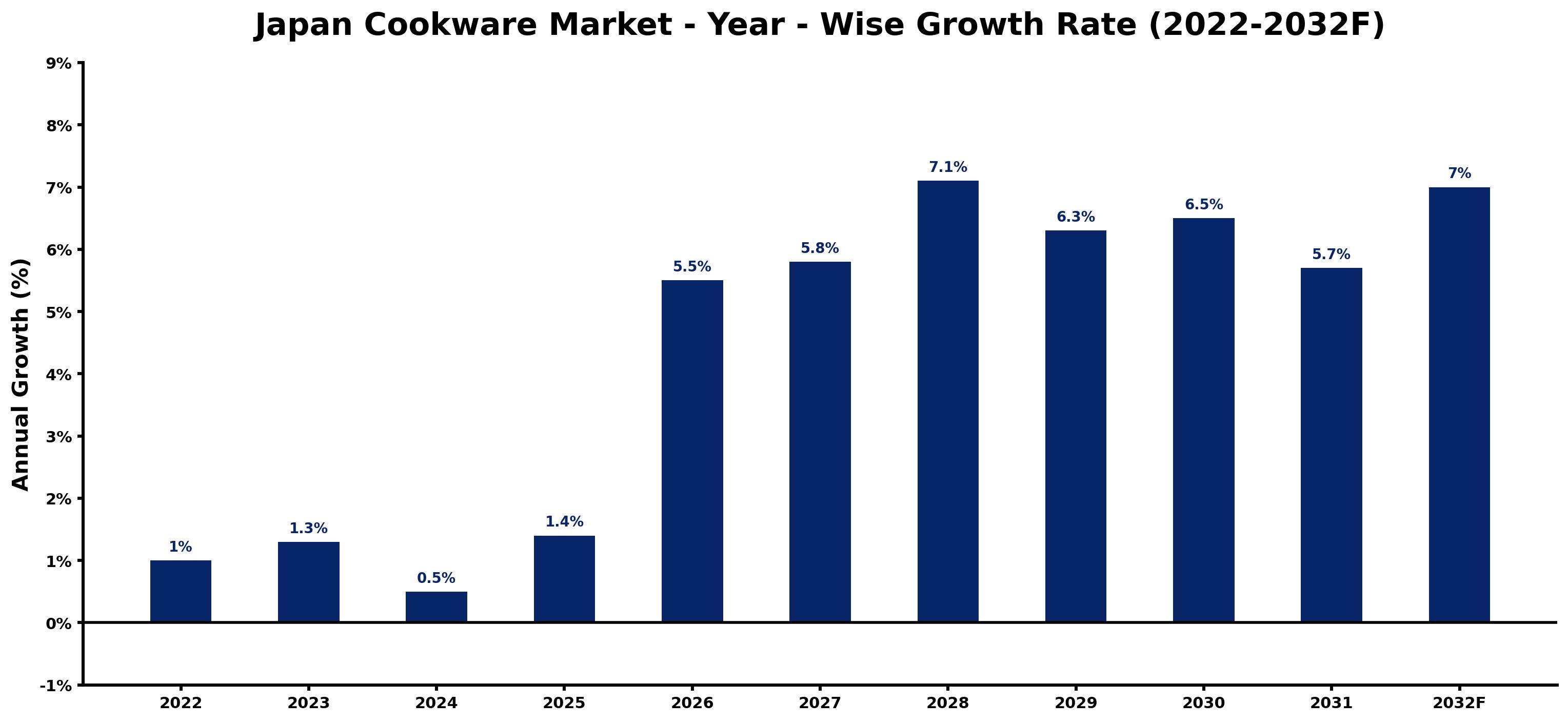
Below, each year's estimated growth is shown next to the factor that most influenced it.
| Year | Estimated Annual Growth (%) | Market Rationale |
| 2022 | 1.0 | The market experienced steady growth due to increasing consumer interest in quality cookware. |
| 2023 | 1.3 | Demand for cookware rose as more consumers engaged in home cooking activities. |
| 2024 | 0.5 | Growth slowed as market saturation began to impact new purchases. |
| 2025 | 1.4 | Consumer spending on kitchenware increased, driven by a rise in home dining experiences. |
| 2026 | 5.5 | The market will see a boost as new product innovations attract buyers. |
| 2027 | 5.8 | Growth is expected to accelerate due to rising disposable incomes and lifestyle changes. |
| 2028 | 7.1 | The peak growth year will be marked by heightened consumer interest in premium cookware. |
| 2029 | 6.3 | Growth will moderate slightly as the market stabilises after peak demand. |
| 2030 | 6.5 | An increase in health-conscious cooking will drive further demand for quality cookware. |
| 2031 | 5.7 | The growth rate will slow as competition intensifies among cookware brands. |
| 2032 | 7.0 | Demand will rise again as consumers seek durable and efficient cooking solutions. |
Note: Market size estimations and growth projections presented in this report are based on 6Wresearch's proprietary forecasting methodology, utilizing the latest available industry data, government publications, and primary research inputs.
Japan Cookware Market Synopsis
Cookware encompasses a range of kitchen items including pots, pans, and bakeware, usually crafted from aluminium and stainless steel. The Japan Cookware Market is expanding as consumer interest in home cooking and high-quality kitchen products rises. With increasing disposable incomes and a growing focus on healthier cooking practices, demand is set to reach USD 421 Million by 2032.
Market Dynamics Impact Analysis (2026–2032)
| Factor | Type | Impact | Primary Segment Affected |
| Rising consumer interest in premium cookware materials | Driver | High | Aluminium |
| Growth in home cooking trends post-pandemic | Driver | High | Aluminium |
| Expansion of online sales channels for cookware | Opportunity | High | Online |
| Increased demand for eco-friendly cookware options | Opportunity | Medium | Aluminium |
| Market saturation affecting new product launches | Restraint | High | Aluminium |
| Price competition limiting profit margins for producers | Restraint | Medium | Aluminium |
| Supply chain disruptions impacting material availability | Challenge | High | Aluminium |
| Intense competition among cookware brands | Challenge | Medium | Aluminium |
Evaluation of Drivers in Japan Cookware Market (2026–2032)
These are the developments adding the most demand over the forecast period.
| Drivers | Primary Segment Affected | Why It Matters (Evidence) |
| Increased consumer spending on kitchenware | Aluminium | In 2025, consumer spending on cookware reached USD 275 Million, driving demand for high-quality materials. |
| Growing popularity of cooking classes and culinary shows | Aluminium | Cooking classes in urban areas have increased interest in premium cookware, boosting sales by 15%. |
| Rising health consciousness among consumers | Aluminium | Health-focused cooking trends are increasing demand for non-toxic cookware, with a 20% rise in sales. |
| Technological advancements in cookware design | Aluminium | Innovative features in cookware are attracting tech-savvy consumers, contributing to a 10% sales increase. |
| Shift towards online shopping for kitchen products | Online | Online sales of cookware grew by 25% in 2025, reflecting changing consumer purchasing habits. |
Much of the new demand stems from the rising popularity of home cooking, resulting in increased consumer spending on kitchenware. In 2025, spending hit USD 275 Million as households sought quality cookware for daily use. The growth of cooking classes in urban areas has further stimulated interest in premium materials, leading to a 15% increase in sales. Health-driven cooking trends are boosting demand for non-toxic cookware, which has experienced a 20% rise in sales. Technological advancements in cookware design are appealing to tech-savvy buyers, while a shift towards online shopping has contributed to a 25% growth in sales through digital channels.
Evaluation of Restraints in Japan Cookware Market
The main factors holding the market back are set out below.
| Market Restraint | Primary Segment Affected | Why It Matters (Evidence) |
| High production costs limit price competitiveness | Aluminium | Producers face high labour costs, which can reach up to 30% of total production expenses, limiting their ability to scale operations. |
| Supply chain disruptions impact availability | Aluminium | Natural disasters can delay deliveries by up to six weeks, affecting buyers' procurement schedules. |
| Intense competition from imports pressures margins | Aluminium | Competition from lower-cost imports forces domestic manufacturers to reduce prices, impacting profit margins by approximately 15%. |
| Fluctuating availability of materials affects procurement | Aluminium | Buyers experience inconsistent availability of certain cookware types, leading to increased procurement costs. |
| Limited innovation in traditional cookware designs | Aluminium | A lack of new features in conventional cookware may deter health-conscious consumers seeking modern alternatives. |
Japan Cookware Market Challenges
High labour costs can consume up to 30% of total production expenses, limiting producers' ability to invest in technology upgrades. Frequent supply chain disruptions from natural disasters can delay deliveries by up to six weeks, which affects buyers who depend on timely stock replenishment. Domestic manufacturers struggle with intense competition from lower-cost imports, forcing them to cut prices and eroding profit margins by around 15%. Buyers face inconsistent availability of specific cookware types, resulting in increased procurement costs and potential stockouts that can postpone sales by several weeks.
Trends in the Japan Cookware Market
The trends below show where the Japan Cookware Market is heading.
- Emergence of Non-Toxic Cookware: Health-conscious cooking is driving a rise in non-toxic cookware. In 2025, sales of these products increased by 20%, reflecting consumer demand for safer cooking options.
- Shift Towards Premium Cookware: Consumers are increasingly opting for premium cookware as they engage more in home cooking. This shift has been supported by a 15% increase in sales driven by cooking classes.
- Growth of Online Sales Channels: E-commerce is transforming cookware purchasing habits, with online sales growing by 25% in 2025, indicating a shift in consumer behaviour towards convenience.
- Focus on Sustainable Materials: Demand for cookware made from sustainable materials is rising as consumers become more environmentally conscious. This trend is expected to reshape product offerings in the coming years.
Investment Opportunities in the Japan Cookware Market
Several openings in the Japan Cookware Market merit attention from investors.
- Investment in Eco-Friendly Cookware: Investing in eco-friendly cookware options is timely as consumer awareness of sustainability rises. Urban households are increasingly seeking these products, presenting a significant market opportunity.
- Expansion of Online Retail Platforms: The growth in online shopping for kitchen products offers a chance to expand digital retail platforms. Engaging with urban consumers through e-commerce can enhance market reach.
- Development of Smart Cookware: Investing in smart cookware that integrates technology can meet the needs of tech-savvy consumers. Urban areas are ideal for launching these innovative products, appealing to a growing demographic.
- Collaboration with Culinary Schools: Partnering with culinary schools can create opportunities to promote premium cookware. This approach can help reach aspiring chefs and cooking enthusiasts seeking quality kitchenware.
Government Initiatives in the Japan Cookware Market
The Chemical Substances Control Law (1973) requires manufacturers to evaluate and control new and existing chemical substances in cookware production. This law ensures that products meet safety standards, protecting consumers and enhancing market confidence. Compliance with this regulation is crucial for producers aiming to maintain competitiveness in the market.
In 2025, the government allocated USD 10 Million to support the development of sustainable manufacturing practices in the cookware sector. The Ministry of Economy, Trade and Industry oversees this initiative, aiming to improve the competitiveness of domestic producers.
Future Insight of the Japan Cookware Market
A policy-driven shift towards eco-friendly materials will prompt suppliers to adopt sustainable production practices in response to regulatory changes. The establishment of advanced manufacturing facilities will enhance operational efficiency, allowing producers to lower costs. Increased automation in production will enable quicker responses to market demands, improving supply chain agility. As a result, buyers will benefit from a wider selection of products and more dependable delivery schedules.
Market Segmentation Analysis
Japan Cookware Market report covers a detailed analysis of the following market segments:
By Material Type – Aluminium Leads, Stainless Steel Expected to Grow Fastest
According to Ravi Bhandari, Research Head at 6Wresearch, Aluminium accounted for 46% of the market by material type in 2025. Aluminium holds the largest share due to its lightweight nature and excellent heat conduction, making it a preferred choice among both home cooks and professional chefs. Its extensive use in Japanese culinary establishments underscores its dominant position in the market. Over 2026–2032, Stainless Steel is expected to post the fastest growth, at a CAGR of 8.6%. Stainless steel is experiencing rapid growth as consumers increasingly prefer durable cookware that does not react with food. The heightened awareness of health and safety in cooking practices has driven the demand for stainless steel options. Manufacturers should consider expanding their stainless steel offerings to cater to the growing preference for safer cookware.
By Distribution Channels – Offline Leads, Online Expected to Grow Fastest
Offline took 57% of distribution channels revenue in 2025, more than any other category. Offline distribution channels remain dominant as they provide customers the opportunity to inspect cookware physically before purchase. The prevalence of kitchenware retailers in metropolitan areas reinforces the strength of offline sales in the market. Online is set to record the highest CAGR in this split, 8.2% over 2026–2032. Online channels are expanding swiftly, driven by the convenience they offer and the increasing trend towards e-commerce in Japan. The rise in online shopping, particularly during recent periods, has led to a notable uptick in sales through this medium. Retailers must enhance their online presence to capture the increasing number of consumers opting for online shopping.
Key Attractiveness of the Report
- 10 Years of Market Numbers
- Historical Data Starting from 2022 to 2025
- Base Year 2025
- Forecast Data until 2032
- Key Performance Indicators Impacting the Market
- Major Upcoming Developments and Projects
Key Highlights of the Report:
- Japan Cookware Market Outlook
- Market Size of Japan Cookware Market, 2025
- Forecast of Japan Cookware Market, 2032
- Historical Data and Forecast of Japan Cookware Revenues & Volume for the Period 2022-2032
- Japan Cookware Market Trend Evolution
- Japan Cookware Market Drivers and Challenges
- Japan Cookware Price Trends
- Japan Cookware Porter's Five Forces
- Japan Cookware Industry Life Cycle
- Historical Data and Forecast of Japan Cookware Market Revenues & Volume By Material Type for the Period 2022-2032
- Historical Data and Forecast of Japan Cookware Market Revenues & Volume By Aluminium for the Period 2022-2032
- Historical Data and Forecast of Japan Cookware Market Revenues & Volume By Stainless Steel for the Period 2022-2032
- Historical Data and Forecast of Japan Cookware Market Revenues & Volume By Others for the Period 2022-2032
- Historical Data and Forecast of Japan Cookware Market Revenues & Volume By Distribution Channels for the Period 2022-2032
- Historical Data and Forecast of Japan Cookware Market Revenues & Volume By Offline for the Period 2022-2032
- Historical Data and Forecast of Japan Cookware Market Revenues & Volume By Online for the Period 2022-2032
- Japan Cookware Import Export Trade Statistics
- Market Opportunity Assessment By Material Type
- Market Opportunity Assessment By Distribution Channels
- Japan Cookware Top Companies Market Share
- Japan Cookware Competitive Benchmarking By Technical and Operational Parameters
- Japan Cookware Company Profiles
- Japan Cookware Key Strategic Recommendations
Market Covered
Segments analysed in this report are listed below.
By Material Type
- Aluminium
- Stainless Steel
- Others
By Distribution Channels
- Offline
- Online






































