Japan Cottonseed Following Market Size & Growth Rate
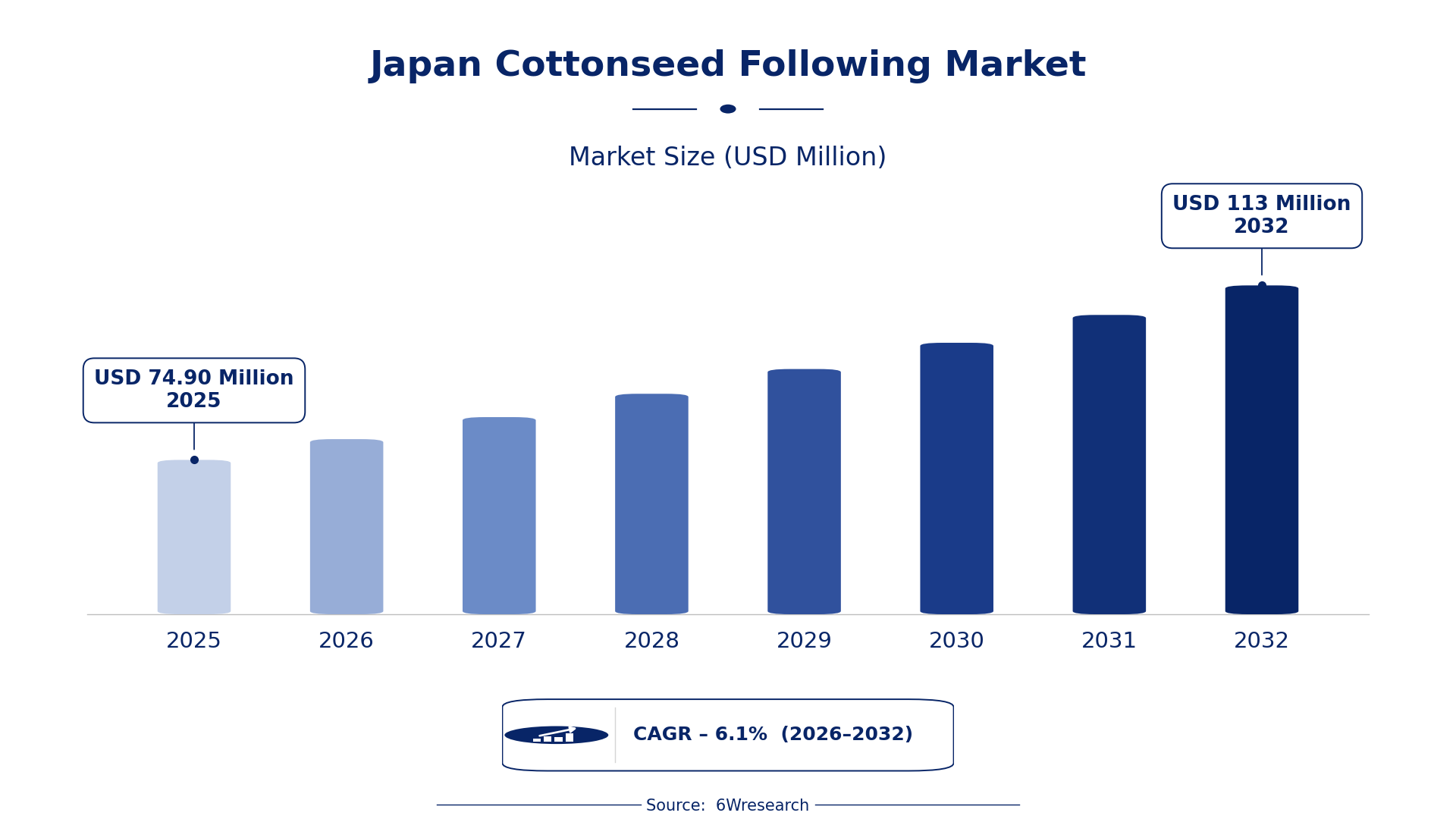
According to 6Wresearch internal database and industry insights, the Japan Cottonseed Following Market was valued at USD 74.90 Million in 2025 and is projected to reach USD 113 Million by 2032, growing at a CAGR of approximately 6.1% during 2026–2032.
Japan Cottonseed Following Market Highlights
| Report Metric | Details |
| Report Name | Japan Cottonseed Following Market (2026-2032) |
| Market Size 2025 | USD 74.90 Million |
| Market Size 2032 | USD 113 Million |
| Absolute Growth 2025–2032 | USD 38.10 Million |
| CAGR 2026–2032 | 6.1% |
| Peak Annual Growth | 6.6% in 2032 |
| Forecast Period | 2026–2032 |
| Historical Data | 2022–2025 |
| Base Year | 2025 |
| Leading Product Type, 2025 | Cottonseed Oil (40% share) |
| Leading Processing Method, 2025 | Mechanical Extraction (39% share) |
| Leading Application Area, 2025 | Edible Oil Production (44% share) |
| Leading Distribution Channel, 2025 | Wholesale Markets (48% share) |
| Leading End User, 2025 | Food Manufacturers (33% share) |
| Fastest-Growing Product Type | Cottonseed Meal (8.5% CAGR) |
| Fastest-Growing Processing Method | Solvent Extraction (8.9% CAGR) |
| Fastest-Growing Application Area | Animal Feed (7.3% CAGR) |
| Fastest-Growing Distribution Channel | Agricultural Distributors (7.7% CAGR) |
| Fastest-Growing End User | Feed Producers (7.9% CAGR) |
| Growing Sector | Animal Feed |
| Key End Users | Food Manufacturers, Livestock Farms, Agricultural Distributors, Dairy Farms |
Japan Cottonseed Following Market Year-wise Growth Rate and Key Drivers (2022–2032)
This graph illustrates the annual growth rates of the market from 2022 to 2032, highlighting a steady upward trajectory and projected market expansion over the forecast period.
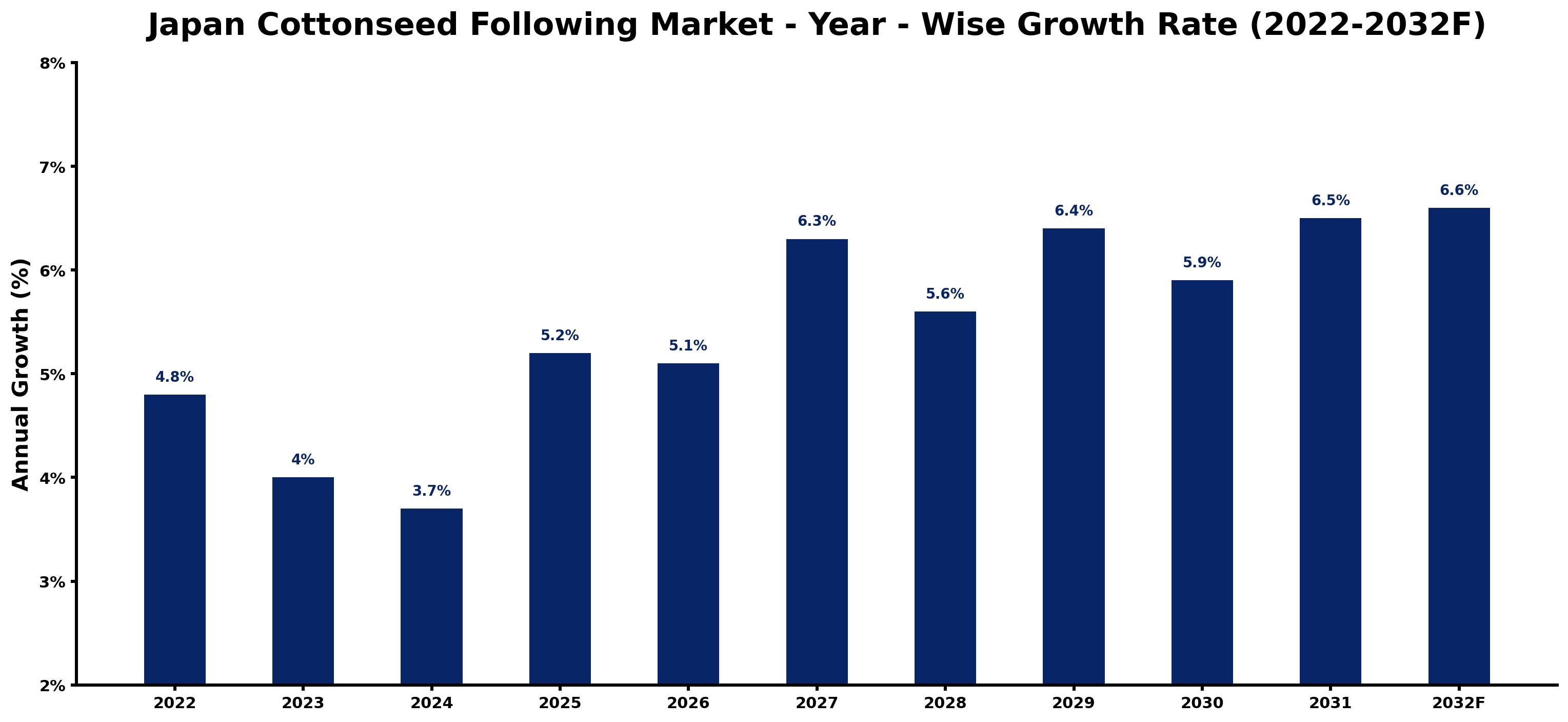
The yearly estimates that follow link every growth rate to its principal driver, so readers can see why the pace changed in each period.
| Year | Estimated Annual Growth (%) | Market Rationale |
| 2022 | 4.8 | The market experienced steady growth due to consistent demand from the agricultural sector. |
| 2023 | 4.0 | Growth slowed as market adjustments occurred following previous years' expansions. |
| 2024 | 3.7 | The market continued to grow, albeit at a reduced pace, influenced by changing buyer preferences. |
| 2025 | 5.2 | Growth accelerated as food manufacturers increased their use of cottonseed oil. |
| 2026 | 5.1 | The market growth rate is expected to slow slightly as competition intensifies among suppliers. |
| 2027 | 6.3 | Increased demand from livestock farms will drive higher growth rates in cottonseed meal usage. |
| 2028 | 5.6 | Growth is projected to moderate as market saturation begins to impact purchasing decisions. |
| 2029 | 6.4 | A resurgence in demand from food manufacturers is expected to lead to faster growth rates. |
| 2030 | 5.9 | The market will experience a slight slowdown as buyers adjust to new pricing dynamics. |
| 2031 | 6.5 | Growth is projected to pick up again as sustainable practices gain traction among producers. |
| 2032 | 6.6 | The market is expected to peak with strong demand for cottonseed oil in food production. |
Note: Market size estimations and growth projections presented in this report are based on 6Wresearch's proprietary forecasting methodology, utilizing the latest available industry data, government publications, and primary research inputs.
Japan Cottonseed Following Market Synopsis
Cottonseed Following is a byproduct of cotton processing, primarily used for oil extraction and animal feed. The Japan Cottonseed Following Market is experiencing growth due to rising demand from food manufacturers and livestock farms, driven by the need for sustainable practices and efficient protein sources. In 2023, a government programme supported sustainable cotton farming, further boosting market potential. With Japan's population of approximately 125 million, the demand for edible oils and protein sources continues to expand, creating opportunities for producers, as cottonseed oil accounts for about 10% of edible oil consumption in the country.
Market Dynamics Impact Analysis (2026–2032)
| Factor | Type | Impact | Primary Segment Affected |
| Rising demand for edible oils from food manufacturers | Driver | High | Cottonseed Oil |
| Increased livestock production requiring protein sources | Driver | High | Cottonseed Meal |
| Growing interest in sustainable farming practices | Opportunity | High | Cottonseed Oil |
| Expansion of agricultural distributors to enhance supply chains | Opportunity | Medium | Agricultural Distributors |
| Competition from alternative protein sources in animal feed | Restraint | High | Cottonseed Meal |
| Market saturation affecting price stability | Restraint | Medium | Cottonseed Oil |
| Fluctuating cotton prices impacting supply costs | Challenge | High | Cottonseed Oil |
| Regulatory changes affecting processing standards | Challenge | Medium | Cottonseed Meal |
Evaluation of Drivers in Japan Cottonseed Following Market (2026–2032)
These are the developments adding the most demand over the forecast period.
| Drivers | Primary Segment Affected | Why It Matters (Evidence) |
| Increased consumption of cottonseed oil in food production | Cottonseed Oil | Cottonseed oil accounts for about 10% of edible oil consumption in Japan, driving demand from food manufacturers. |
| Growing livestock sector requiring high-protein feed | Cottonseed Meal | The livestock sector in Japan is valued at approximately 1 trillion yen, leading to higher demand for cottonseed meal. |
| Sustainability initiatives encouraging local sourcing | Cottonseed Oil | The National Federation of Agricultural Cooperative Associations promotes local cotton products, supporting market growth. |
| Rising animal feed production volumes | Cottonseed Meal | Animal feed production in Japan reached 10 million tons in 2022, increasing the need for cottonseed meal. |
| Expansion of agricultural distributors improving market access | Agricultural Distributors | Agricultural distributors are essential for supplying cottonseed products to farms and producers, improving availability. |
Most of the extra volume comes from the increasing consumption of cottonseed oil in food production, which accounted for about 10% of Japan's edible oil consumption in 2022. The livestock sector, valued at approximately 1 trillion yen, is driving demand for cottonseed meal as a high-protein feed source. In 2022, animal feed production reached 10 million tons, which increased the need for cottonseed meal. Local agricultural cooperatives are encouraging the use of domestic cotton products, which supports market growth. The expansion of agricultural distributors is improving access to these products for farmers and producers, resulting in increased purchasing activity.
Evaluation of Restraints in Japan Cottonseed Following Market
Several factors work against faster growth; the main ones are summarised below.
| Market Restraint | Primary Segment Affected | Why It Matters (Evidence) |
| Competition from alternative protein sources in animal feed | Cottonseed Meal | Feed producers are increasingly using alternatives, limiting the market share for cottonseed meal. |
| Market saturation affecting price stability | Cottonseed Oil | As the market matures, price fluctuations are becoming more common, impacting profitability for suppliers. |
| Rising costs of cotton production impacting supply | Cottonseed Oil | Fluctuating cotton prices can lead to higher costs for cottonseed oil production, affecting suppliers. |
| Regulatory changes affecting processing standards | Cottonseed Meal | New regulations may require additional investments in processing facilities, impacting operational costs. |
| Limited consumer awareness of cottonseed products | Cottonseed Oil | Low consumer awareness can hinder market growth for cottonseed oil in the food sector. |
Japan Cottonseed Following Market Challenges
Producers face increased costs from the need to import 300,000 tons of cottonseed annually for processing. This reliance leads to processing delays, raising operational expenses for local oil extraction facilities. Rising production costs squeeze profit margins, particularly for feed producers reliant on cottonseed meal as a protein source for livestock. Buyers encounter heightened competition from alternative protein sources, which pressures their purchasing strategies and could result in decreased sales of cottonseed products.
Trends in the Japan Cottonseed Following Market
These developments are changing demand patterns in the Japan Cottonseed Following Market.
- Shift towards Sustainable Cotton Farming: The Kanto region is leading a shift towards sustainable cotton farming, supported by a government programme launched in 2023. This initiative aims to reduce waste by 30% by 2025.
- Increase in Cottonseed Meal Usage in Livestock Feed: The use of cottonseed meal as a protein source in livestock feed is increasing, particularly in dairy farming. In 2022, cottonseed meal accounted for a notable portion of feed formulations, with a growing trend towards using locally sourced ingredients.
- Rise in Edible Oil Production from Cottonseed: In Japan, edible oil production from cottonseed is gaining traction, with cottonseed oil accounting for 10% of total edible oil consumption. This trend is expected to continue as food manufacturers seek cost-effective and sustainable oil sources.
- Expansion of Agricultural Distributors for Cottonseed Products: Agricultural distributors are expanding their networks to improve the supply of cottonseed products. With a projected growth rate of 7.7% for agricultural distributors, this trend is improving market accessibility for producers and farmers.
Investment Opportunities in the Japan Cottonseed Following Market
The opportunities below stand out in the Japan Cottonseed Following Market for new entrants and existing suppliers.
- Cottonseed Oil Supply for Edible Oil Production: The demand for cottonseed oil is increasing due to its use in food production. Food manufacturers are seeking reliable suppliers to meet this growing demand, as cottonseed oil accounts for about 10% of edible oil consumption in Japan.
- Cottonseed Meal for Livestock Feed: With the livestock sector valued at approximately 1 trillion yen, there is an opportunity to supply cottonseed meal as a cost-effective protein source. Livestock farms are increasingly integrating cottonseed meal into their feed formulations, enhancing nutritional value.
- Sustainable Cotton Products for Agricultural Distributors: The push for sustainable farming practices creates opportunities for agricultural distributors to supply local cotton products. This is particularly relevant in regions like Kanto, which are focusing on sustainable agriculture, as local sourcing becomes more important.
- Investment in Cottonseed Processing Facilities: Investment in processing facilities for cottonseed products is essential now, as the market is projected to grow. Establishing local processing units can improve supply chain efficiency for agricultural distributors, meeting rising demand.
Government Initiatives in the Japan Cottonseed Following Market
The Waste Management and Public Cleansing Act of 1970 mandates the proper treatment and disposal of industrial waste, impacting cottonseed producers by enforcing waste reduction measures. The Food Recycling Law of 2000 requires food businesses to recycle waste into feed and fertiliser, promoting the use of cottonseed byproducts in animal feed.
The Ministry of Agriculture, Forestry and Fisheries oversees agricultural policies, including funding for sustainable cotton farming initiatives. This agency approves projects aimed at improving the efficiency of cotton production and supports farmers transitioning to sustainable practices.
Future Insight of the Japan Cottonseed Following Market
The Ministry of Agriculture's new programme will drive a policy shift that encourages eco-friendly farming practices by 2032, prompting producers to adapt their methods. As animal feed production grows, the demand for cottonseed meal will rise, providing a cost-effective protein source for livestock. The implementation of the JIS standard for cottonseed oil will ensure quality and safety, benefiting both buyers and suppliers in food production. Enhanced local production capabilities will further reduce reliance on imports, creating a more resilient market.
Market Segmentation Analysis
Japan Cottonseed Following Market report covers a detailed analysis of the following market segments:
By Product Type – Cottonseed Oil Leads, Cottonseed Meal Expected to Grow Fastest
According to Vasu Joshi, Associate Consultant at 6Wresearch, Cottonseed Oil accounted for 40% of the market by product type in 2025. Cottonseed oil holds the largest share due to its extensive use in food production, especially in the Kanto region where cotton is cultivated. Its contribution to about 10% of edible oil consumption in Japan highlights its importance in the market. Over 2026–2032, Cottonseed Meal is expected to post the fastest growth, at a CAGR of 8.5%. Cottonseed meal is experiencing rapid growth as feed producers increasingly adopt it for its high protein content, particularly beneficial in livestock nutrition. The livestock sector, valued at approximately 1 trillion yen, significantly drives this demand. This trend indicates that suppliers should focus on increasing the availability of cottonseed meal to meet the rising needs of feed producers.
By Processing Method – Mechanical Extraction Leads, Solvent Extraction Expected to Grow Fastest
Mechanical Extraction took 39% of processing method revenue in 2025, more than any other category. Mechanical extraction is the leading method for oil extraction, widely used due to its established efficiency and effectiveness in the industry. This method is the standard practice for producing cottonseed oil in Japan, ensuring a reliable supply. Solvent Extraction is projected to grow fastest, at a CAGR of 8.9% during 2026–2032. Solvent extraction is growing quickly because it allows for more efficient oil recovery, appealing to producers aiming to maximise output. This method's efficiency will likely attract more users, further boosting its market presence. Suppliers may need to invest in solvent extraction technologies to remain competitive and meet the increasing demand for efficient processing methods.
By Application Area – Edible Oil Production Leads, Animal Feed Expected to Grow Fastest
Edible Oil Production held 44% of the Japan Cottonseed Following Market by application area in 2025. Edible oil production represents the primary application for cottonseed oil, which is vital for food manufacturers in Japan. The oil's established role in cooking and food processing contributes to its dominant share in this segment. Animal Feed is set to record the highest CAGR in this split, 7.3% over 2026–2032. Animal feed is the fastest-growing application area as feed producers are integrating cottonseed meal into their formulations due to its high protein content. This shift indicates a change in livestock nutrition practices and feed formulation strategies. Suppliers should consider expanding their product offerings to meet the rising demand for cottonseed meal in animal feed applications.
By Distribution Channel – Wholesale Markets Lead, Agricultural Distributors Expected to Grow Fastest
The largest distribution channel category in 2025 was Wholesale Markets, at 48% of revenue. Wholesale markets serve as the leading distribution channel for cottonseed products, effectively linking food manufacturers and feed producers. This well-established network ensures a steady supply of products across various segments in the market. The quickest growth will come from Agricultural Distributors, forecast to expand at a CAGR of 7.7% between 2026 and 2032. Agricultural distributors are emerging as the fastest-growing channel, supplying cottonseed products directly to farms and producers in response to the increasing demand for local sourcing. This shift reflects the movement towards more direct supply chains within the agricultural sector. Suppliers may need to strengthen partnerships with agricultural distributors to expand their market presence and adapt to evolving distribution trends.
By End User – Food Manufacturers Lead, Feed Producers Expected to Grow Fastest
With 33% of end user revenue in 2025, Food Manufacturers was the largest category. Food manufacturers are the primary end users of cottonseed oil, utilising it extensively across a wide range of food products. Their considerable demand underscores the oil's vital role in the food production process in Japan. Over 2026–2032, Feed Producers are expected to post the fastest growth, at a CAGR of 7.9%. Feed producers are the fastest-growing end users as they increasingly incorporate cottonseed into their formulations, driven by the need for cost-effective protein sources in animal feed. This trend signifies a shift towards more sustainable feed options in the industry. Suppliers should prioritise developing relationships with feed producers to capitalise on the growing integration of cottonseed products in animal nutrition.
Key Attractiveness of the Report
- 10 Years of Market Numbers
- Historical Data Starting from 2022 to 2025
- Base Year 2025
- Forecast Data until 2032
- Key Performance Indicators Impacting the Market
- Major Upcoming Developments and Projects
Key Highlights of the Report:
- Japan Cottonseed Following Market Outlook
- Market Size of Japan Cottonseed Following Market, 2025
- Forecast of Japan Cottonseed Following Market, 2032
- Historical Data and Forecast of Japan Cottonseed Following Market Revenues & Volume for the Period 2022-2032F
- Japan Cottonseed Following Market Trend Evolution
- Japan Cottonseed Following Market Drivers and Challenges
- Japan Cottonseed Following Market Price Trends
- Japan Cottonseed Following Market Porter's Five Forces
- Japan Cottonseed Following Market Industry Life Cycle
- Historical Data and Forecast of Japan Cottonseed Following Market Revenues & Volume By Product Type for the Period 2022-2032F
- Historical Data and Forecast of Japan Cottonseed Following Market Revenues & Volume By Cottonseed Oil for the Period 2022-2032F
- Historical Data and Forecast of Japan Cottonseed Following Market Revenues & Volume By Cottonseed Meal for the Period 2022-2032F
- Historical Data and Forecast of Japan Cottonseed Following Market Revenues & Volume By Cottonseed Hulls for the Period 2022-2032F
- Historical Data and Forecast of Japan Cottonseed Following Market Revenues & Volume By Whole Cottonseed for the Period 2022-2032F
- Historical Data and Forecast of Japan Cottonseed Following Market Revenues & Volume By Processing Method for the Period 2022-2032F
- Historical Data and Forecast of Japan Cottonseed Following Market Revenues & Volume By Mechanical Extraction for the Period 2022-2032F
- Historical Data and Forecast of Japan Cottonseed Following Market Revenues & Volume By Solvent Extraction for the Period 2022-2032F
- Historical Data and Forecast of Japan Cottonseed Following Market Revenues & Volume By Crushing Process for the Period 2022-2032F
- Historical Data and Forecast of Japan Cottonseed Following Market Revenues & Volume By Minimal Processing for the Period 2022-2032F
- Historical Data and Forecast of Japan Cottonseed Following Market Revenues & Volume By Application Area for the Period 2022-2032F
- Historical Data and Forecast of Japan Cottonseed Following Market Revenues & Volume By Edible Oil Production for the Period 2022-2032F
- Historical Data and Forecast of Japan Cottonseed Following Market Revenues & Volume By Animal Feed for the Period 2022-2032F
- Historical Data and Forecast of Japan Cottonseed Following Market Revenues & Volume By Feed Additives for the Period 2022-2032F
- Historical Data and Forecast of Japan Cottonseed Following Market Revenues & Volume By Feed Blends for the Period 2022-2032F
- Historical Data and Forecast of Japan Cottonseed Following Market Revenues & Volume By Distribution Channel for the Period 2022-2032F
- Historical Data and Forecast of Japan Cottonseed Following Market Revenues & Volume By Wholesale Markets for the Period 2022-2032F
- Historical Data and Forecast of Japan Cottonseed Following Market Revenues & Volume By Agricultural Distributors for the Period 2022-2032F
- Historical Data and Forecast of Japan Cottonseed Following Market Revenues & Volume By Direct Sales for the Period 2022-2032F
- Historical Data and Forecast of Japan Cottonseed Following Market Revenues & Volume By Cooperatives for the Period 2022-2032F
- Historical Data and Forecast of Japan Cottonseed Following Market Revenues & Volume By End User for the Period 2022-2032F
- Historical Data and Forecast of Japan Cottonseed Following Market Revenues & Volume By Food Manufacturers for the Period 2022-2032F
- Historical Data and Forecast of Japan Cottonseed Following Market Revenues & Volume By Livestock Farms for the Period 2022-2032F
- Historical Data and Forecast of Japan Cottonseed Following Market Revenues & Volume By Dairy Farms for the Period 2022-2032F
- Historical Data and Forecast of Japan Cottonseed Following Market Revenues & Volume By Feed Producers for the Period 2022-2032F
- Japan Cottonseed Following Market Import Export Trade Statistics
- Market Opportunity Assessment By Product Type
- Market Opportunity Assessment By Processing Method
- Market Opportunity Assessment By Application Area
- Market Opportunity Assessment By Distribution Channel
- Market Opportunity Assessment By End User
- Japan Cottonseed Following Market Top Companies Market Share
- Japan Cottonseed Following Market Competitive Benchmarking By Technical and Operational Parameters
- Japan Cottonseed Following Market Company Profiles
- Japan Cottonseed Following Market Key Strategic Recommendations
Market Covered
The report covers the following segments.
By Product Type
- Cottonseed Oil
- Cottonseed Meal
- Cottonseed Hulls
- Whole Cottonseed
By Processing Method
- Mechanical Extraction
- Solvent Extraction
- Crushing Process
- Minimal Processing
By Application Area
- Edible Oil Production
- Animal Feed
- Feed Additives
- Feed Blends
By Distribution Channel
- Wholesale Markets
- Agricultural Distributors
- Direct Sales
- Cooperatives
By End User
- Food Manufacturers
- Livestock Farms
- Dairy Farms
- Feed Producers






































