Japan Crop Collection Machinery Market Size & Growth Rate
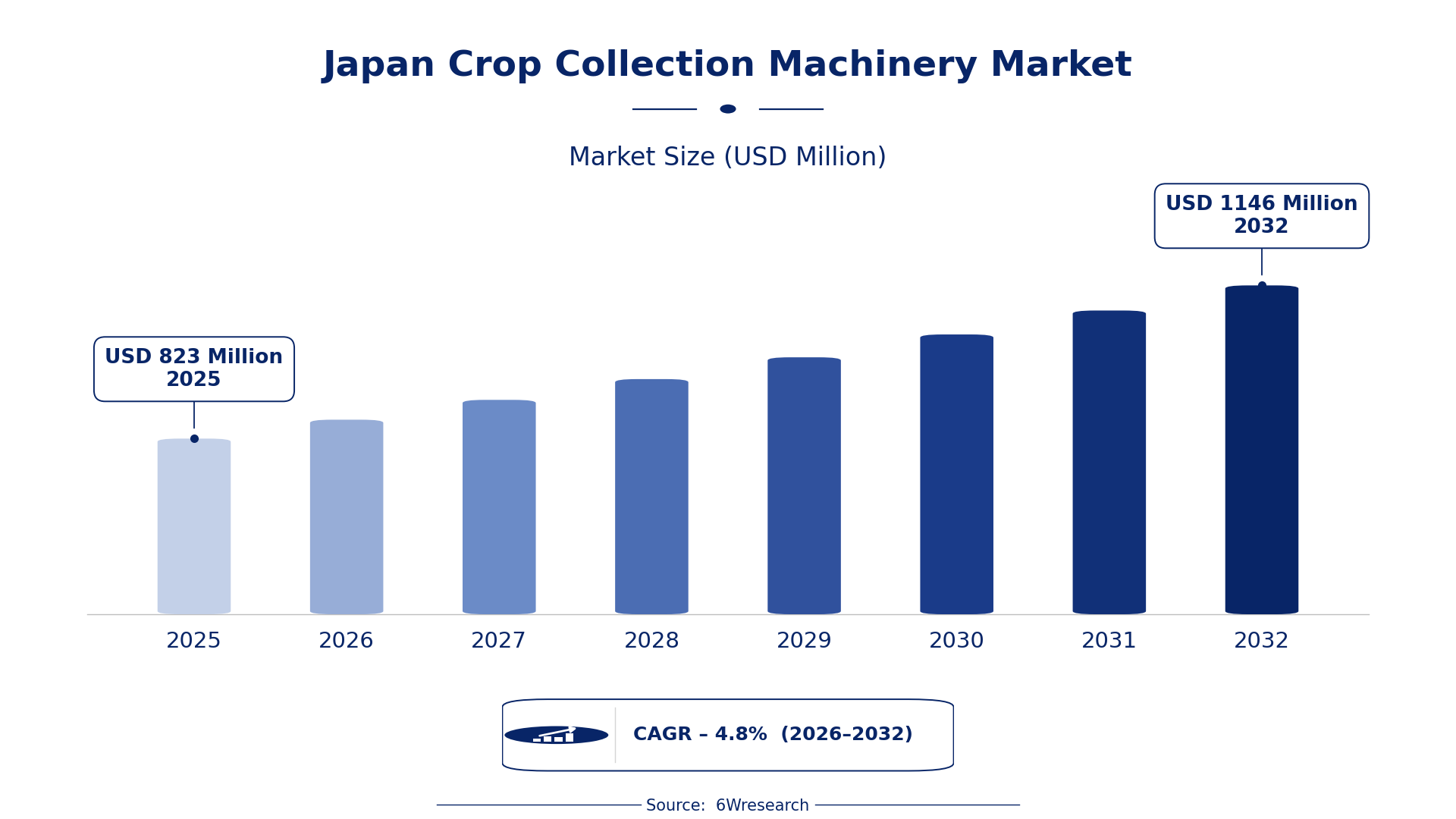
According to 6Wresearch internal database and industry insights, the Japan Crop Collection Machinery Market was valued at USD 823 Million in 2025 and is projected to reach USD 1,146 Million by 2032, growing at a CAGR of approximately 4.8% during 2026–2032.
Japan Crop Collection Machinery Market Highlights
| Report Metric | Details |
| Report Name | Japan Crop Collection Machinery Market (2026-2032) |
| Market Size 2025 | USD 823 Million |
| Market Size 2032 | USD 1,146 Million |
| Absolute Growth 2025–2032 | USD 323 Million |
| CAGR 2026–2032 | 4.8% |
| Peak Annual Growth | 5.8% in 2029 |
| Forecast Period | 2026–2032 |
| Historical Data | 2022–2025 |
| Base Year | 2025 |
| Leading Equipment Type, 2025 | Combine Harvesters (39% share) |
| Leading Mechanism, 2025 | Self-Propelled (43% share) |
| Leading Power Source, 2025 | Diesel (38% share) |
| Leading End User, 2025 | Large Farms (52% share) |
| Fastest-Growing Equipment Type | Forage Harvesters (6.6% CAGR) |
| Fastest-Growing Mechanism | Automatic (6.4% CAGR) |
| Fastest-Growing Power Source | Electric (6.9% CAGR) |
| Fastest-Growing End User | Cooperatives (6.1% CAGR) |
| Growing Sector | Agriculture |
| Key End Users | Large Farms, Cooperatives, Agro Companies, Contract Harvesters |
Japan Crop Collection Machinery Market Year-wise Growth Rate and Key Drivers (2022–2032)
This graph illustrates the annual growth rates of the market from 2022 to 2032, highlighting a steady upward trajectory and projected market expansion over the forecast period.
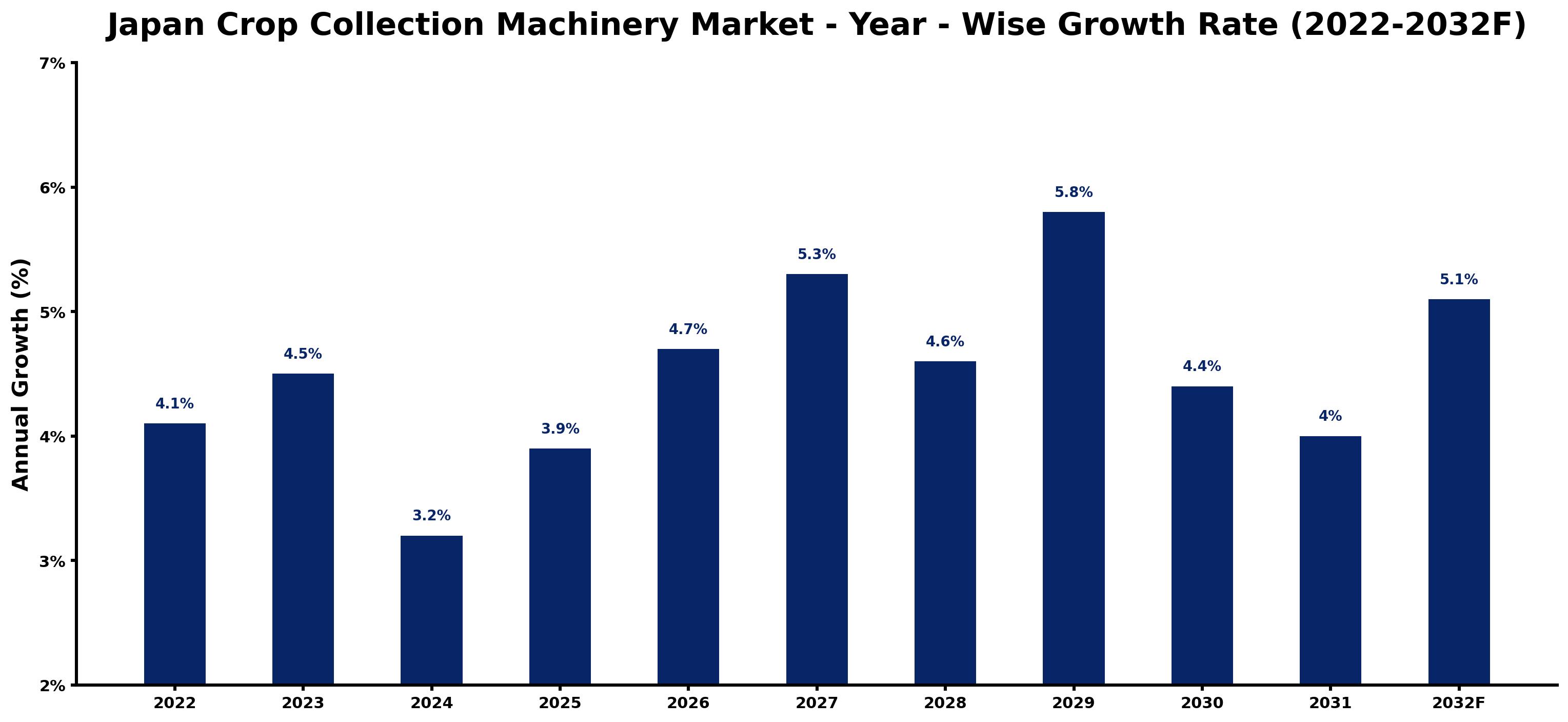
Year by year, the estimates below pair each growth rate with the development that shaped it.
| Year | Estimated Annual Growth (%) | Market Rationale |
| 2022 | 4.1 | The market experienced steady growth, supported by demand from large farms and cooperatives. |
| 2023 | 4.5 | Growth accelerated as farmers adopted more efficient harvesting technologies and machinery. |
| 2024 | 3.2 | A slowdown occurred due to market saturation and cautious investment in new equipment. |
| 2025 | 3.9 | Demand increased again as modernization efforts gained traction among agricultural operators. |
| 2026 | 4.7 | Growth is expected to rise as agricultural cooperatives expand their machinery fleets for efficiency. |
| 2027 | 5.3 | The market is projected to continue rising, bolstered by technological advancements in harvesting equipment. |
| 2028 | 4.6 | A slight slowdown is anticipated as the market adjusts to previous high growth rates. |
| 2029 | 5.8 | Growth is expected to peak as modern harvesting solutions are widely adopted across the sector. |
| 2030 | 4.4 | The market will experience a slowdown as competition intensifies among machinery providers. |
| 2031 | 4.0 | Growth will continue to decelerate as the market matures and demand stabilises. |
| 2032 | 5.1 | An increase in demand for advanced machinery is projected as modernization efforts continue. |
Note: Market size estimations and growth projections presented in this report are based on 6Wresearch's proprietary forecasting methodology, utilizing the latest available industry data, government publications, and primary research inputs.
Japan Crop Collection Machinery Market Synopsis
Crop collection machinery includes essential equipment like combine harvesters and balers, vital for efficient harvesting in agriculture. The Japan Crop Collection Machinery Market is expanding, driven by large farms and cooperatives investing in modern equipment. Factors such as government initiatives, including the 2023 subsidy program for modernising agricultural machinery, and technological advancements are propelling growth. The increasing focus on cooperative farming practices is further driving demand for efficient harvesting solutions, leading to higher investments in modern machinery.
Market Dynamics Impact Analysis (2026–2032)
| Factor | Type | Impact | Primary Segment Affected |
| Rising adoption of advanced harvesting technologies | Driver | High | Combine Harvesters |
| Increased investment in agricultural modernization | Driver | High | Forage Harvesters |
| Growing demand for efficient harvesting solutions | Opportunity | High | Balers |
| Expansion of cooperative farming practices | Opportunity | Medium | Grain Collectors |
| High initial investment costs for modern machinery | Restraint | High | Combine Harvesters |
| Limited availability of skilled operators for advanced machinery | Restraint | Medium | Forage Harvesters |
| Fluctuating agricultural commodity prices affecting purchasing decisions | Challenge | High | Balers |
| Competition from imported machinery impacting local manufacturers | Challenge | Medium | Grain Collectors |
Evaluation of Drivers in Japan Crop Collection Machinery Market (2026–2032)
The table below links each growth driver to the segment it affects and the evidence for it.
| Drivers | Primary Segment Affected | Why It Matters (Evidence) |
| Increased mechanisation in agriculture | Combine Harvesters | This trend arises from the need for efficiency, with over 1.5 million registered agricultural vehicles in Japan. |
| Government subsidies for modernisation | Forage Harvesters | The 2023 subsidy program encourages farmers to upgrade equipment, boosting sales of advanced harvesters. |
| Growing cooperative farming practices | Balers | Cooperatives pool resources, resulting in higher demand for efficient baling solutions among members. |
| Technological advancements in machinery | Grain Collectors | Innovations in design and functionality are increasing the appeal of grain collectors among farmers. |
| Rising agricultural productivity demands | Combine Harvesters | The need to maximise yields in regions like Tohoku drives demand for high-efficiency harvesters. |
Much of the new demand traces back to the Hokkaido region, where large-scale potato and vegetable farming relies heavily on advanced harvesting solutions. In 2022, Japan's agricultural machinery market was valued at approximately 1 trillion yen, reflecting substantial investment in modernisation. The average farm size of about 1.5 hectares necessitates efficient harvesting solutions, leading to increased purchases of forage harvesters. The push for advanced farming technologies is stimulating demand for balers and grain collectors. Cooperative farming practices are improving machinery utilisation, driving sales further across the agricultural sector.
Evaluation of Restraints in Japan Crop Collection Machinery Market
These restraints slow adoption and weigh on supplier margins.
| Market Restraint | Primary Segment Affected | Why It Matters (Evidence) |
| High initial investment costs for advanced machinery | Combine Harvesters | The upfront costs deter some farmers from upgrading equipment, limiting market growth. |
| Limited availability of skilled operators for advanced machinery | Forage Harvesters | A shortage of trained personnel affects the effective use of modern harvesting equipment. |
| Fluctuating agricultural commodity prices affecting purchasing decisions | Balers | Price volatility makes farmers hesitant to invest in new machinery, impacting overall sales. |
| Competition from imported machinery impacting local manufacturers | Grain Collectors | Local producers face challenges from cheaper imports, affecting their market share and pricing. |
| Market saturation in certain regions limiting new sales | Combine Harvesters | In areas with established machinery use, growth is constrained as farmers are less likely to upgrade. |
Japan Crop Collection Machinery Market Challenges
Japan's stringent regulations on agricultural machinery create lengthy approval processes, which can delay producers from obtaining necessary equipment. Supply chain disruptions, particularly in the Tohoku region, have increased lead times for combine harvesters, impacting buyers who rely on timely harvests and risking crop losses. Competition from advanced farming technologies compels producers to invest in costly upgrades, which may take years to yield returns. A shortage of skilled operators for advanced machinery results in a productivity loss estimated at 20% during peak harvest periods, directly affecting farm profitability.
Trends in the Japan Crop Collection Machinery Market
Below are the shifts with the largest effect on the Japan Crop Collection Machinery Market.
- Shift towards Electric-Powered Harvesting Machines: The trend towards electric-powered harvesting machines is gaining traction, particularly in urban farming initiatives. In 2023, the Japanese government supported this shift with new funding, reflecting a growing interest in sustainable practices.
- Transition to Cooperative Farming Models: Cooperative farming models are becoming more prevalent, improving machinery utilisation among farmers. In 2023, Japan saw an increase in cooperative practices, resulting in more efficient harvesting operations and shared resources.
- Emergence of Automatic Harvesting Solutions: Automatic harvesting solutions are increasingly preferred, driven by demands for operational efficiency. The adoption rate is projected to rise, with a CAGR of 6.4% for automatic mechanisms by 2032.
- Prioritisation of Agricultural Machinery Safety Standards: The JIS B 1001 standard is being prioritised to ensure safety and performance in agricultural machinery. Compliance with these standards is essential for manufacturers to meet regulatory requirements and improve market competitiveness.
Investment Opportunities in the Japan Crop Collection Machinery Market
The openings below show where demand in the Japan Crop Collection Machinery Market is visible and how suppliers can enter.
- Investment in Electric Harvesting Equipment: With a growing interest in sustainability, there is an opportunity to supply electric harvesting equipment. The market for electric machines is expected to grow by 6.9% by 2032, attracting urban farmers seeking efficient solutions.
- Expansion of Cooperative Farming Practices: The increasing trend towards cooperative farming creates a demand for shared harvesting machinery. With over 1.5 million registered agricultural vehicles, cooperatives can make joint investments to improve efficiency.
- Modernisation of Agricultural Machinery: The 2023 subsidy program for modernising agricultural machinery presents a substantial opportunity. Suppliers can engage with cooperatives and large farms to provide advanced harvesting solutions.
- Development of Training Programs for Operators: The demand for skilled operators is rising, creating an opportunity to develop training programs. By partnering with agricultural institutions, suppliers can improve the workforce's capabilities in using advanced machinery.
Government Initiatives in the Japan Crop Collection Machinery Market
The Industrial Safety and Health Act of 1972 mandates employer responsibilities regarding machinery safety, ensuring that producers adhere to safety standards. Additionally, the Act on the Rational Use of Energy, established in 1979, requires large energy users to improve efficiency, influencing machinery design and operation.
In 2023, the Japanese government launched a subsidy program to support the modernisation of agricultural machinery, administered by the Ministry of Agriculture, Forestry and Fisheries. This initiative aims to improve productivity and efficiency in the agricultural sector, benefiting farmers across the country.
Future Insight of the Japan Crop Collection Machinery Market
Investment in advanced farming technologies will rise, driven by government subsidies for modernising agricultural equipment. By 2032, demand for electric-powered harvesting machines will grow, particularly in urban farming initiatives, creating new opportunities for suppliers. The average farm size of approximately 1.5 hectares will necessitate compact, efficient equipment designed for smaller operations. Adhering to the JIS B 1001 standard will improve safety and performance benchmarks, ensuring higher quality machinery for buyers.
Market Segmentation Analysis
Japan Crop Collection Machinery Market report covers a detailed analysis of the following market segments:
By Equipment Type – Combine Harvesters Lead, Forage Harvesters Expected to Grow Fastest
According to Saurav Kr Singh, Senior Research Analyst at 6Wresearch, Combine Harvesters took 39% of equipment type revenue in 2025, more than any other category. Combine harvesters dominate the market as they are essential for harvesting grains, particularly in regions like Tohoku, which is renowned for rice production. Their widespread adoption among large farms solidifies their leading position in the agricultural machinery sector. Over 2026–2032, Forage Harvesters are expected to post the fastest growth, at a CAGR of 6.6%. Forage harvesters are experiencing rapid growth due to the increasing demand for efficient cutting and collecting of forage crops, especially with the rise of cooperative farming practices. This growth is further bolstered by government initiatives aimed at modernising agricultural machinery. Suppliers should focus on enhancing forage harvester offerings to capitalise on this expanding market.
By Mechanism – Self-Propelled Leads, Automatic Expected to Grow Fastest
Self-Propelled accounted for 43% of the market by mechanism in 2025. Self-propelled machinery is preferred for its mobility and efficiency, making it indispensable for large-scale harvesting operations. This type of equipment meets the diverse requirements of Japan's agricultural sector effectively. Automatic is projected to grow fastest, at a CAGR of 6.4% during 2026–2032. Automatic mechanisms are becoming increasingly popular as they enhance operational efficiency and simplify usage, aligning with modern farming practices. The growing emphasis on automation is supported by government initiatives promoting advanced farming technologies. Buyers may increasingly favour automatic solutions to improve productivity and reduce labour expenses.
By Power Source – Diesel Leads, Electric Expected to Grow Fastest
Diesel held 38% of the Japan Crop Collection Machinery Market by power source in 2025. Diesel remains the most common power source for heavy machinery in Japan, providing the necessary power and reliability for demanding agricultural tasks. Its established presence in the market ensures that a large number of machines continue to operate on this fuel type. The quickest growth will come from Electric, forecast to expand at a CAGR of 6.9% between 2026 and 2032. Electric-powered harvesting machines are emerging as a viable alternative, particularly in urban farming initiatives that prioritise sustainability. The increasing interest in eco-friendly solutions is likely to drive further adoption of electric machines in the coming years. Suppliers should consider expanding their electric offerings to meet the growing demand for sustainable agricultural solutions.
By End User – Large Farms Lead, Cooperatives Expected to Grow Fastest
In 2025, Large Farms led the end user split with a 52% share. Large farms are the primary users of crop collection machinery, utilising these machines to enhance operational efficiency across extensive agricultural activities. Their scale necessitates advanced harvesting equipment to maintain competitiveness in the market. Cooperatives are set to record the highest CAGR in this split, 6.1% over 2026–2032. Cooperatives are rapidly growing as they enable resource pooling for efficient harvesting, allowing smaller farms to access advanced machinery. This collaborative model is gaining momentum, driven by the need for cost-effective agricultural solutions. Suppliers may need to adapt their marketing strategies to effectively address the evolving needs of cooperatives as they gain influence in the market.
Key Attractiveness of the Report
- 10 Years of Market Numbers
- Historical Data Starting from 2022 to 2025
- Base Year 2025
- Forecast Data until 2032
- Key Performance Indicators Impacting the Market
- Major Upcoming Developments and Projects
Key Highlights of the Report:
- Japan Crop Collection Machinery Market Outlook
- Market Size of Japan Crop Collection Machinery Market, 2025
- Forecast of Japan Crop Collection Machinery Market, 2032
- Historical Data and Forecast of Japan Crop Collection Machinery Revenues & Volume for the Period 2022-2032F
- Japan Crop Collection Machinery Market Trend Evolution
- Japan Crop Collection Machinery Market Drivers and Challenges
- Japan Crop Collection Machinery Price Trends
- Japan Crop Collection Machinery Porter's Five Forces
- Japan Crop Collection Machinery Industry Life Cycle
- Historical Data and Forecast of Japan Crop Collection Machinery Market Revenues & Volume By Equipment Type for the Period 2022-2032F
- Historical Data and Forecast of Japan Crop Collection Machinery Market Revenues & Volume By Combine Harvesters for the Period 2022-2032F
- Historical Data and Forecast of Japan Crop Collection Machinery Market Revenues & Volume By Forage Harvesters for the Period 2022-2032F
- Historical Data and Forecast of Japan Crop Collection Machinery Market Revenues & Volume By Balers for the Period 2022-2032F
- Historical Data and Forecast of Japan Crop Collection Machinery Market Revenues & Volume By Grain Collectors for the Period 2022-2032F
- Historical Data and Forecast of Japan Crop Collection Machinery Market Revenues & Volume By Mechanism for the Period 2022-2032F
- Historical Data and Forecast of Japan Crop Collection Machinery Market Revenues & Volume By Self-Propelled for the Period 2022-2032F
- Historical Data and Forecast of Japan Crop Collection Machinery Market Revenues & Volume By PTO-Driven for the Period 2022-2032F
- Historical Data and Forecast of Japan Crop Collection Machinery Market Revenues & Volume By Automatic for the Period 2022-2032F
- Historical Data and Forecast of Japan Crop Collection Machinery Market Revenues & Volume By Manual Assist for the Period 2022-2032F
- Historical Data and Forecast of Japan Crop Collection Machinery Market Revenues & Volume By Power Source for the Period 2022-2032F
- Historical Data and Forecast of Japan Crop Collection Machinery Market Revenues & Volume By Diesel for the Period 2022-2032F
- Historical Data and Forecast of Japan Crop Collection Machinery Market Revenues & Volume By Tractor-Powered for the Period 2022-2032F
- Historical Data and Forecast of Japan Crop Collection Machinery Market Revenues & Volume By Electric for the Period 2022-2032F
- Historical Data and Forecast of Japan Crop Collection Machinery Market Revenues & Volume By Hydraulic for the Period 2022-2032F
- Historical Data and Forecast of Japan Crop Collection Machinery Market Revenues & Volume By End User for the Period 2022-2032F
- Historical Data and Forecast of Japan Crop Collection Machinery Market Revenues & Volume By Large Farms for the Period 2022-2032F
- Historical Data and Forecast of Japan Crop Collection Machinery Market Revenues & Volume By Cooperatives for the Period 2022-2032F
- Historical Data and Forecast of Japan Crop Collection Machinery Market Revenues & Volume By Contract Harvesters for the Period 2022-2032F
- Historical Data and Forecast of Japan Crop Collection Machinery Market Revenues & Volume By Agro Companies for the Period 2022-2032F
- Japan Crop Collection Machinery Import Export Trade Statistics
- Market Opportunity Assessment By Equipment Type
- Market Opportunity Assessment By Mechanism
- Market Opportunity Assessment By Power Source
- Market Opportunity Assessment By End User
- Japan Crop Collection Machinery Top Companies Market Share
- Japan Crop Collection Machinery Competitive Benchmarking By Technical and Operational Parameters
- Japan Crop Collection Machinery Company Profiles
- Japan Crop Collection Machinery Key Strategic Recommendations
Market Covered
The report covers the following segments.
By Equipment Type
- Combine Harvesters
- Forage Harvesters
- Balers
- Grain Collectors
By Mechanism
- Self-Propelled
- PTO-Driven
- Automatic
- Manual Assist
By Power Source
- Diesel
- Tractor-Powered
- Electric
- Hydraulic
By End User
- Large Farms
- Cooperatives
- Contract Harvesters
- Agro Companies






































