Japan Crop Enhancement Products Market Size & Growth Rate
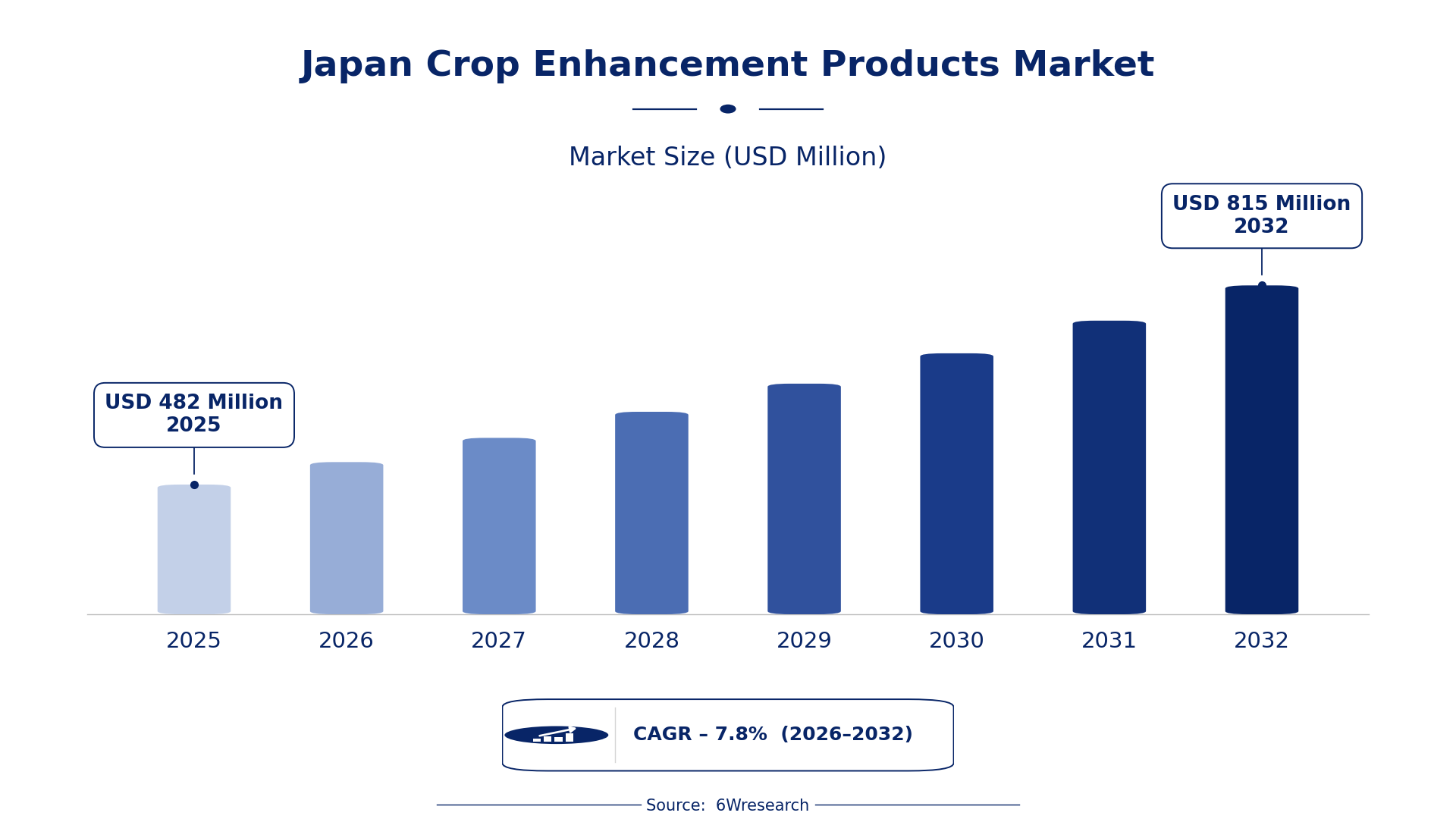
According to 6Wresearch internal database and industry insights, the Japan Crop Enhancement Products Market was valued at USD 482 Million in 2025 and is projected to reach USD 815 Million by 2032, growing at a CAGR of approximately 7.8% during 2026–2032.
Japan Crop Enhancement Products Market Highlights
| Report Metric | Details |
| Report Name | Japan Crop Enhancement Products Market (2026-2032) |
| Market Size 2025 | USD 482 Million |
| Market Size 2032 | USD 815 Million |
| Absolute Growth 2025–2032 | USD 333 Million |
| CAGR 2026–2032 | 7.8% |
| Peak Annual Growth | 8.8% in 2032 |
| Forecast Period | 2026–2032 |
| Historical Data | 2022–2025 |
| Base Year | 2025 |
| Leading Product Type, 2025 | Biostimulants (51% share) |
| Leading Mode of Action, 2025 | Physiological (45% share) |
| Leading Form Type, 2025 | Liquid (43% share) |
| Leading End User, 2025 | Organic Farms (44% share) |
| Fastest-Growing Product Type | Plant Growth Regulators (11.2% CAGR) |
| Fastest-Growing Mode of Action | Hormonal (9.9% CAGR) |
| Fastest-Growing Form Type | Granular (11.0% CAGR) |
| Fastest-Growing End User | Large Farms (10.3% CAGR) |
| Growing Sector | Large Farms |
| Key End Users | Organic Farms, Large Farms, Cooperatives, Horticulture Units |
Japan Crop Enhancement Products Market Year-wise Growth Rate and Key Drivers (2022–2032)
This graph illustrates the annual growth rates of the market from 2022 to 2032, highlighting a steady upward trajectory and projected market expansion over the forecast period.
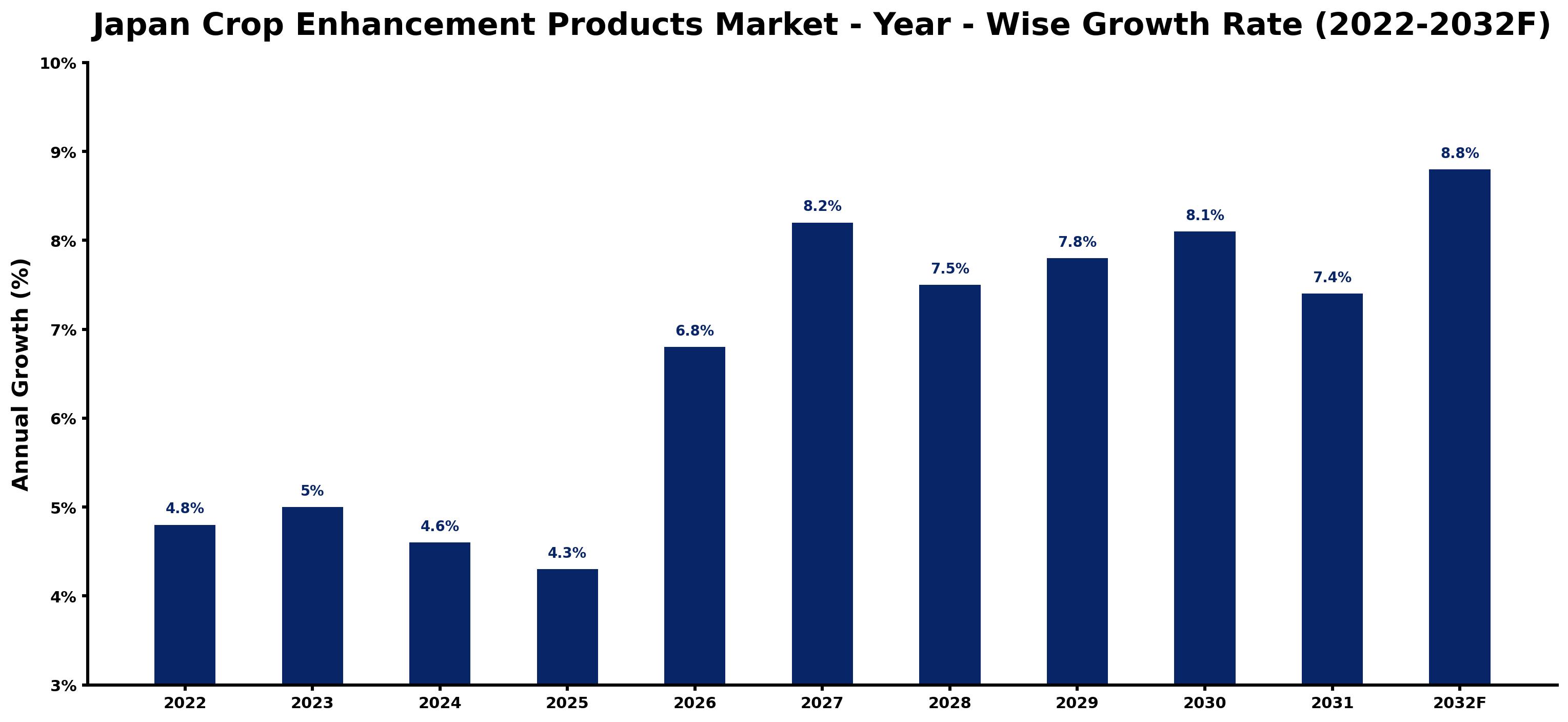
For each year, the table pairs the estimated growth rate with the leading influence on demand, showing how the drivers changed across the period.
| Year | Estimated Annual Growth (%) | Market Rationale |
| 2022 | 4.8 | The market experienced steady growth, reflecting ongoing agricultural advancements. |
| 2023 | 5.0 | Growth accelerated due to increased adoption of crop improvement products among farmers. |
| 2024 | 4.6 | Growth slowed slightly as market adjustments took place after the previous year's surge. |
| 2025 | 4.3 | The market continued to grow, but at a reduced rate due to market saturation. |
| 2026 | 6.8 | Growth is expected to increase as demand surges for agricultural solutions. |
| 2027 | 8.2 | Demand is projected to rise further, driven by awareness of sustainable farming practices. |
| 2028 | 7.5 | Growth is anticipated to decelerate as the market stabilises after rapid expansion. |
| 2029 | 7.8 | Demand is expected to rise as more farmers adopt advanced crop technologies. |
| 2030 | 8.1 | The market will continue its upward trend, supported by ongoing agricultural innovation. |
| 2031 | 7.4 | Growth is projected to moderate slightly as the market reaches a mature phase. |
| 2032 | 8.8 | The market is expected to peak with strong demand for advanced crop improvement solutions. |
Note: Market size estimations and growth projections presented in this report are based on 6Wresearch's proprietary forecasting methodology, utilizing the latest available industry data, government publications, and primary research inputs.
Japan Crop Enhancement Products Market Synopsis
Crop enhancement products in Japan include biostimulants, plant growth regulators, micronutrient blends, and soil conditioners, designed to improve crop yield and health. The Japan Crop Enhancement Products Market is growing due to rising demand from organic farms and large agricultural operations, alongside government initiatives promoting sustainable practices. In 2023, the total area of organic farmland reached 80,000 hectares, highlighting the need for effective crop improvement solutions and support from the Sustainable Agriculture Program.
Market Dynamics Impact Analysis (2026–2032)
| Factor | Type | Impact | Primary Segment Affected |
| Increasing adoption of biostimulants in organic farming | Driver | High | Biostimulants |
| Growing demand for plant growth regulators in horticulture | Driver | High | Plant Growth Regulators |
| Investment in sustainable agriculture practices | Opportunity | High | Organic Farms |
| Expansion of agricultural cooperatives supporting local farmers | Opportunity | Medium | Cooperatives |
| Regulatory challenges in product approval processes | Restraint | High | Soil Conditioners |
| Limited awareness of crop enhancement benefits among traditional farmers | Restraint | Medium | Micronutrient Blends |
| High competition among local producers | Challenge | High | Plant Growth Regulators |
| Rising costs of raw materials affecting pricing | Challenge | Medium | Biostimulants |
Evaluation of Drivers in Japan Crop Enhancement Products Market (2026–2032)
The factors lifting demand, and the evidence behind each, are summarised below.
| Drivers | Primary Segment Affected | Why It Matters (Evidence) |
| Increased demand for biostimulants | Biostimulants | The total area of organic farmland reached 80,000 hectares in 2023, driving purchases of biostimulants for sustainable farming. |
| Growing use of plant growth regulators in horticulture | Plant Growth Regulators | Research on plant growth regulators is increasing, leading to higher demand in high-value crops, which produced approximately 8 million tons in 2023. |
| Rising need for micronutrient blends in rice cultivation | Micronutrient Blends | Micronutrient blends are essential for rice cultivation, which produced around 8 million tons in 2023. |
| Increasing demand for soil conditioners in Hokkaido | Soil Conditioners | Demand for soil conditioners is rising in regions like Hokkaido, improving soil quality and fertility, which is crucial for agricultural productivity. |
| Expansion of agricultural cooperatives | Cooperatives | Cooperatives support local farmers, increasing resource availability and driving demand for crop improvement products, benefiting over 1.5 million agricultural workers. |
A wider customer base explains much of the growth, as the total area of organic farmland in Japan reached 80,000 hectares in 2023. The demand for biostimulants stems from the need for sustainable farming solutions, particularly in rice cultivation, which produced approximately 8 million tons in 2023. Soil conditioners are increasingly sought after in regions like Hokkaido, where farmers aim to improve soil quality for better yields. Agricultural cooperatives are expanding, providing local farmers with resources that stimulate interest in crop improvement products. The growing awareness of sustainable practices is prompting more farmers to invest in effective agricultural solutions.
Evaluation of Restraints in Japan Crop Enhancement Products Market
The key brakes on demand, and where they bite hardest, are shown below.
| Market Restraint | Primary Segment Affected | Why It Matters (Evidence) |
| Limited domestic production of crop improvement products | Biostimulants | The reliance on imports can lead to supply shortages, affecting availability for farmers. |
| Stringent regulatory compliance costs | Plant Growth Regulators | Compliance with the Industrial Standardization Act increases costs for suppliers, impacting pricing. |
| Supply chain disruptions due to regulations | Micronutrient Blends | Regulatory complexities can delay product availability, affecting timely access for farmers. |
| Competition from imported alternatives | Soil Conditioners | Imported products can offer lower prices, making it challenging for local suppliers to compete. |
| Market saturation in certain segments | Cooperatives | As the market matures, growth opportunities may become limited for existing players. |
Japan Crop Enhancement Products Market Challenges
In 2023, Japan's agricultural sector produced approximately 8 million tons of rice, but buyers face rising costs due to limited domestic production of crop enhancement products. Competition from imported alternatives pressures local suppliers, resulting in delays that can extend lead times by up to three weeks for farmers. Strict regulations often disrupt supply chains, causing essential inputs to arrive late and costing farmers valuable growing time. Compliance with JIS standards for soil conditioners complicates operations for suppliers, increasing their costs, which are then passed on to buyers and squeezing their profit margins.
Trends in the Japan Crop Enhancement Products Market
Buyers and suppliers in the Japan Crop Enhancement Products Market are adjusting to the following trends.
- Shift towards Sustainable Farming Practices: Japanese farmers are increasingly adopting sustainable agricultural practices, motivated by environmental concerns and government support. In 2023, the total area of organic farmland reached 80,000 hectares, indicating a shift towards eco-friendly farming methods.
- Transition to Advanced Crop Improvement Technologies: The introduction of new crop improvement technologies is reshaping the market. The promotion of biostimulants under the Sustainable Agriculture Program is gaining traction among farmers seeking better yields.
- Emergence of Granular Formulations: Granular formulations are becoming more popular due to their slow-release properties. This trend is supported by the increasing demand for soil conditioners, particularly in regions like Hokkaido.
- Increased Focus on Nutritional Products: There is a growing emphasis on micronutrient blends to support crop health. The demand for these products is rising as farmers aim to optimise yields in rice and vegetable cultivation.
Investment Opportunities in the Japan Crop Enhancement Products Market
The opportunities below stand out in the Japan Crop Enhancement Products Market for new entrants and existing suppliers.
- Collaborating with Agricultural Cooperatives: Partnering with agricultural cooperatives can provide access to a broader farmer base. With over 1.5 million people engaged in agriculture, this presents a substantial market opportunity for suppliers.
- Investment in Biostimulants Production Facilities: Establishing production facilities for biostimulants can meet the increasing demand. The Japanese government allocated ¥10 billion for agricultural innovation in 2023, supporting such initiatives and facilitating market entry.
- Development of Granular Soil Conditioners: Investing in granular soil conditioners can tap into the growing market. The demand for these products is increasing, particularly in regions like Hokkaido, where soil quality is a priority.
- Focus on Nutritional Micronutrient Blends: Supplying micronutrient blends tailored for rice and vegetable cultivation can address specific farmer needs. The agricultural sector produced approximately 8 million tons of rice in 2023, highlighting the demand for these products.
Government Initiatives in the Japan Crop Enhancement Products Market
The GX Basic Policy, adopted in 2023, aims for about JPY 150 trillion of public-private decarbonisation investment over 10 years, supporting sustainable agricultural practices. This builds on the Industrial Standardization Act, which governs the use of crop improvement products to ensure safety and efficacy.
In 2023, the Ministry of Agriculture, Forestry and Fisheries (MAFF) allocated ¥10 billion for agricultural innovation, promoting research and development in crop improvement technologies. This funding is vital for advancing the sector and ensuring compliance with JIS standards for soil conditioners.
Future Insight of the Japan Crop Enhancement Products Market
The rollout of agricultural innovation projects will transform the market by 2032. The government's ¥10 billion allocation for agricultural innovation will drive advancements in crop enhancement technologies. Research on plant growth regulators will yield improved formulations, benefiting farmers with better yields. The total area of organic farmland is expected to expand significantly, creating opportunities for suppliers to develop tailored solutions that enhance crop management for buyers.
Market Segmentation Analysis
Japan Crop Enhancement Products Market report covers a detailed analysis of the following market segments:
By Product Type – Biostimulants Lead, Plant Growth Regulators Expected to Grow Fastest
According to Saurav Kr Singh, Senior Research Analyst at 6Wresearch, Biostimulants held 51% of the Japan Crop Enhancement Products Market by product type in 2025. Biostimulants hold the largest share owing to their widespread adoption among farmers seeking to enhance crop health and yield. The Ministry of Agriculture, Forestry and Fisheries actively promotes these products, resulting in over 1,500 registered biostimulant products in Japan. The quickest growth will come from Plant Growth Regulators, forecast to expand at a CAGR of 11.2% between 2026 and 2032. The rapid growth of Plant Growth Regulators is attributed to their increasing use in modern agricultural practices. As farmers strive to optimise crop productivity, the demand for these regulators has particularly surged in staple crops like rice. Suppliers should expand their biostimulant offerings while also focusing on the development of plant growth regulators to meet rising market demands.
By Mode of Action – Physiological Leads, Hormonal Expected to Grow Fastest
With 45% of mode of action revenue in 2025, Physiological was the largest category. The Physiological mode of action leads the market as it directly impacts plant physiological processes essential for crop performance. Farmers widely adopt this method for effective crop management strategies. Hormonal is projected to grow fastest, at a CAGR of 9.9% during 2026–2032. Hormonal action is experiencing the fastest growth due to its critical role in regulating plant hormones, which is increasingly recognised as vital for maximising crop yields. The trend towards precision agriculture is driving this demand as farmers seek targeted solutions. Suppliers should consider developing products that utilise hormonal modes of action to align with the growing interest in advanced agricultural techniques.
By Form Type – Liquid Leads, Granular Expected to Grow Fastest
Liquid took 43% of form type revenue in 2025, more than any other category. Liquid formulations dominate the market as they are favoured for their ease of application, particularly beneficial for large-scale farming operations. This convenience allows farmers to efficiently utilise crop enhancement products across extensive areas. Granular is set to record the highest CAGR in this split, 11.0% over 2026–2032. Granular forms are rapidly gaining popularity due to their slow-release characteristics, which cater to farmers looking for long-lasting solutions. The shift towards sustainable farming practices is further propelling growth in this segment. Manufacturers should prioritise the development of granular products to address the increasing demand for slow-release crop enhancement solutions.
By End User – Organic Farms Lead, Large Farms Expected to Grow Fastest
The largest end user category in 2025 was Organic Farms, at 44% of revenue. Organic Farms represent the largest share as they emphasise sustainable farming practices, aligning with current agricultural trends in Japan. Government initiatives and consumer preferences for organic produce support the growth of this segment. Over 2026–2032, Large Farms are expected to post the fastest growth, at a CAGR of 10.3%. Large Farms are witnessing the fastest growth as they require efficient crop enhancement solutions to maximise yield across their extensive land areas. The average size of large farms in Japan, approximately 50 hectares, necessitates scalable and effective products. Suppliers should tailor their offerings to meet the specific needs of large farms, ensuring they provide scalable and efficient crop enhancement solutions.
Key Attractiveness of the Report
- 10 Years of Market Numbers
- Historical Data Starting from 2022 to 2025
- Base Year 2025
- Forecast Data until 2032
- Key Performance Indicators Impacting the Market
- Major Upcoming Developments and Projects
Key Highlights of the Report:
- Japan Crop Enhancement Products Market Outlook
- Market Size of Japan Crop Enhancement Products Market, 2025
- Forecast of Japan Crop Enhancement Products Market, 2032
- Historical Data and Forecast of Japan Crop Enhancement Products Revenues & Volume for the Period 2022-2032F
- Japan Crop Enhancement Products Market Trend Evolution
- Japan Crop Enhancement Products Market Drivers and Challenges
- Japan Crop Enhancement Products Price Trends
- Japan Crop Enhancement Products Porter's Five Forces
- Japan Crop Enhancement Products Industry Life Cycle
- Historical Data and Forecast of Japan Crop Enhancement Products Market Revenues & Volume By Product Type for the Period 2022-2032F
- Historical Data and Forecast of Japan Crop Enhancement Products Market Revenues & Volume By Biostimulants for the Period 2022-2032F
- Historical Data and Forecast of Japan Crop Enhancement Products Market Revenues & Volume By Plant Growth Regulators for the Period 2022-2032F
- Historical Data and Forecast of Japan Crop Enhancement Products Market Revenues & Volume By Micronutrient Blends for the Period 2022-2032F
- Historical Data and Forecast of Japan Crop Enhancement Products Market Revenues & Volume By Soil Conditioners for the Period 2022-2032F
- Historical Data and Forecast of Japan Crop Enhancement Products Market Revenues & Volume By Mode of Action for the Period 2022-2032F
- Historical Data and Forecast of Japan Crop Enhancement Products Market Revenues & Volume By Physiological for the Period 2022-2032F
- Historical Data and Forecast of Japan Crop Enhancement Products Market Revenues & Volume By Hormonal for the Period 2022-2032F
- Historical Data and Forecast of Japan Crop Enhancement Products Market Revenues & Volume By Nutritional for the Period 2022-2032F
- Historical Data and Forecast of Japan Crop Enhancement Products Market Revenues & Volume By Root Stimulating for the Period 2022-2032F
- Historical Data and Forecast of Japan Crop Enhancement Products Market Revenues & Volume By Form Type for the Period 2022-2032F
- Historical Data and Forecast of Japan Crop Enhancement Products Market Revenues & Volume By Liquid for the Period 2022-2032F
- Historical Data and Forecast of Japan Crop Enhancement Products Market Revenues & Volume By Granular for the Period 2022-2032F
- Historical Data and Forecast of Japan Crop Enhancement Products Market Revenues & Volume By Powder for the Period 2022-2032F
- Historical Data and Forecast of Japan Crop Enhancement Products Market Revenues & Volume By Pellets for the Period 2022-2032F
- Historical Data and Forecast of Japan Crop Enhancement Products Market Revenues & Volume By End User for the Period 2022-2032F
- Historical Data and Forecast of Japan Crop Enhancement Products Market Revenues & Volume By Organic Farms for the Period 2022-2032F
- Historical Data and Forecast of Japan Crop Enhancement Products Market Revenues & Volume By Large Farms for the Period 2022-2032F
- Historical Data and Forecast of Japan Crop Enhancement Products Market Revenues & Volume By Cooperatives for the Period 2022-2032F
- Historical Data and Forecast of Japan Crop Enhancement Products Market Revenues & Volume By Horticulture Units for the Period 2022-2032F
- Japan Crop Enhancement Products Import Export Trade Statistics
- Market Opportunity Assessment By Product Type
- Market Opportunity Assessment By Mode of Action
- Market Opportunity Assessment By Form Type
- Market Opportunity Assessment By End User
- Japan Crop Enhancement Products Top Companies Market Share
- Japan Crop Enhancement Products Competitive Benchmarking By Technical and Operational Parameters
- Japan Crop Enhancement Products Company Profiles
- Japan Crop Enhancement Products Key Strategic Recommendations
Market Covered
Coverage by segment is as follows.
By Product Type
- Biostimulants
- Plant Growth Regulators
- Micronutrient Blends
- Soil Conditioners
By Mode of Action
- Physiological
- Hormonal
- Nutritional
- Root Stimulating
By Form Type
- Liquid
- Granular
- Powder
- Pellets
By End User
- Organic Farms
- Large Farms
- Cooperatives
- Horticulture Units






































