Japan Crop Harvesting Equipment Market Size & Growth Rate
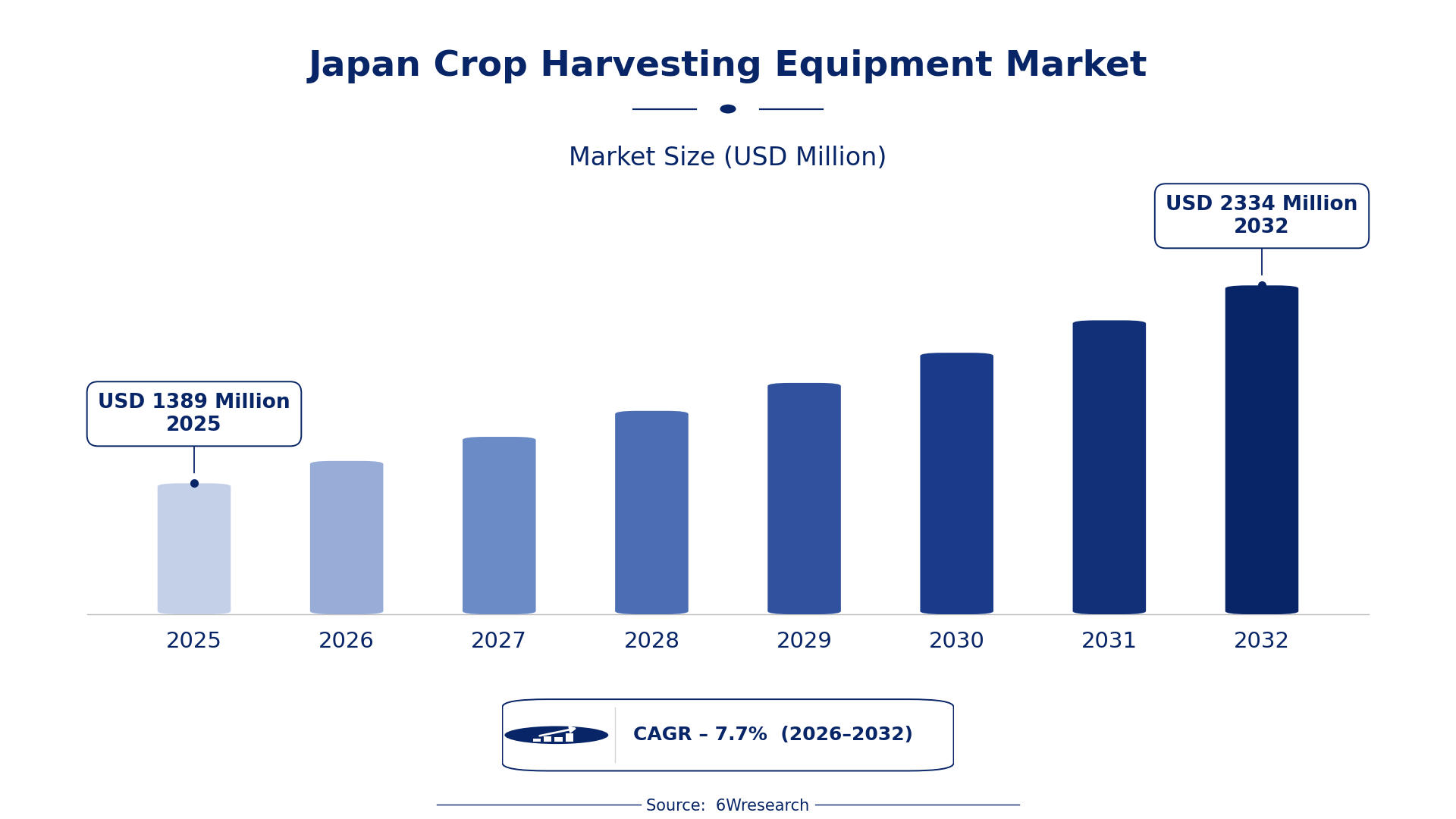
According to 6Wresearch internal database and industry insights, the Japan Crop Harvesting Equipment Market was valued at USD 1,389 Million in 2025 and is projected to reach USD 2,334 Million by 2032, growing at a CAGR of approximately 7.7% during 2026–2032.
Japan Crop Harvesting Equipment Market Highlights
| Report Metric | Details |
| Report Name | Japan Crop Harvesting Equipment Market (2026-2032) |
| Market Size 2025 | USD 1,389 Million |
| Market Size 2032 | USD 2,334 Million |
| Absolute Growth 2025–2032 | USD 945 Million |
| CAGR 2026–2032 | 7.7% |
| Peak Annual Growth | 8.3% in 2028 |
| Forecast Period | 2026–2032 |
| Historical Data | 2022–2025 |
| Base Year | 2025 |
| Leading Equipment Type, 2025 | Combine Harvesters (48% share) |
| Leading Mechanization Level, 2025 | Fully-Automatic (43% share) |
| Leading Fuel Type, 2025 | Diesel (49% share) |
| Leading End User, 2025 | Agro Companies (45% share) |
| Fastest-Growing Mechanization Level | Semi-Automatic (10.3% CAGR) |
| Fastest-Growing Fuel Type | Electric (11.2% CAGR) |
| Fastest-Growing End User | Contract Farmers (9.9% CAGR) |
| Growing Sector | agriculture |
| Key End Users | Agro Companies, Cooperatives, Small Farms, Contract Farmers |
Japan Crop Harvesting Equipment Market Year-wise Growth Rate and Key Drivers (2022–2032)
This graph illustrates the annual growth rates of the market from 2022 to 2032, highlighting a steady upward trajectory and projected market expansion over the forecast period.
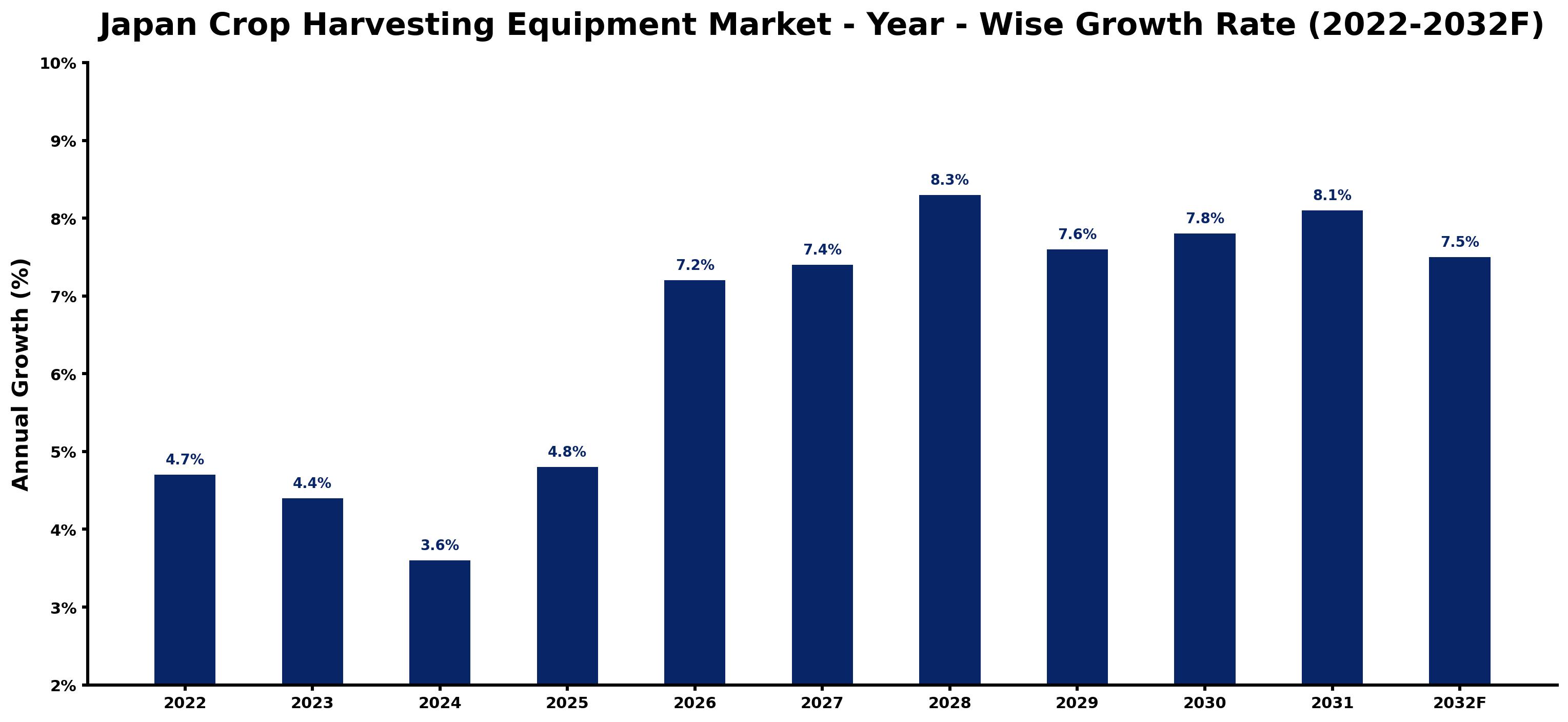
Year by year, the estimates below pair each growth rate with the development that shaped it.
| Year | Estimated Annual Growth (%) | Market Rationale |
| 2022 | 4.7 | The market showed stable growth, reflecting ongoing investment in agricultural mechanization. |
| 2023 | 4.4 | Growth slowed slightly due to market saturation in certain segments, yet demand remained strong. |
| 2024 | 3.6 | A further slowdown occurred as buyers adjusted to previous investments and market conditions. |
| 2025 | 4.8 | Growth accelerated as agro companies increased their investments in advanced harvesting technologies. |
| 2026 | 7.2 | Demand is projected to surge as mechanization efforts expand, particularly in large-scale farming operations. |
| 2027 | 7.4 | The market will continue to grow as technological advancements attract more buyers. |
| 2028 | 8.3 | Peak growth is anticipated, driven by high demand for efficient harvesting solutions. |
| 2029 | 7.6 | Growth is expected to slow as market maturity sets in, with buyers becoming more selective in purchases. |
| 2030 | 7.8 | A slight increase in growth is anticipated as new technologies enter the market. |
| 2031 | 8.1 | The market will experience a healthy rise, supported by ongoing mechanization trends. |
| 2032 | 7.5 | Growth is projected to slow as market saturation approaches, leading to more cautious investment. |
Note: Market size estimations and growth projections presented in this report are based on 6Wresearch's proprietary forecasting methodology, utilizing the latest available industry data, government publications, and primary research inputs.
Japan Crop Harvesting Equipment Market Synopsis
Crop harvesting equipment includes machines designed for the efficient collection of crops from fields, such as combine harvesters and reapers. The Japan Crop Harvesting Equipment Market is increasingly adopting mechanisation to improve productivity, driven by the need for efficiency and the ageing farmer population. The market is supported by over 4 million hectares of arable land and initiatives from the Ministry of Agriculture, Forestry and Fisheries to promote modern farming techniques, leading to a growing market for crop harvesting equipment.
Market Dynamics Impact Analysis (2026–2032)
| Factor | Type | Impact | Primary Segment Affected |
| Increased mechanization in agriculture | Driver | High | Combine Harvesters |
| Growing demand for efficiency in large-scale farming | Driver | High | Agro Companies |
| Rising interest in electric harvesting solutions | Opportunity | Medium | Electric |
| Expansion of cooperatives facilitating shared equipment use | Opportunity | Medium | Cooperatives |
| High initial investment costs for advanced machinery | Restraint | High | Fully-Automatic |
| Aging farmer population leading to labour shortages | Restraint | High | Small Farms |
| Fluctuating fuel prices impacting operational costs | Challenge | High | Diesel |
| Technological advancements requiring ongoing training for operators | Challenge | Medium | Semi-Automatic |
Evaluation of Drivers in Japan Crop Harvesting Equipment Market (2026–2032)
These are the developments adding the most demand over the forecast period.
| Drivers | Primary Segment Affected | Why It Matters (Evidence) |
| Investment in advanced harvesting technologies | Combine Harvesters | In 2022, Japan's agricultural machinery market was valued at approximately 1 trillion yen, prompting agro companies to invest in combine harvesters for efficiency. |
| Government initiatives promoting mechanization | Agro Companies | Government initiatives are encouraging mechanization, leading to increased purchases from agro companies, which improves their operational capabilities. |
| Growing interest in electric harvesting equipment | Electric | Government initiatives are fostering the development of electric harvesting equipment, appealing to environmentally conscious buyers. |
| Rising demand from cooperatives for shared resources | Cooperatives | With over 1,000 cooperatives in Japan, demand for shared harvesting equipment is increasing to optimize costs. |
| Aging farmer population driving automation needs | Small Farms | The average age of farmers in Japan exceeds 67 years, increasing the need for automated harvesting solutions. |
Several shifts outside the market lift sales. In 2022, Japan's agricultural machinery market was valued at approximately 1 trillion yen, prompting agro companies to invest in combine harvesters for efficiency. Increased mechanisation is anticipated as the ageing farmer population drives the need for automation, with many farmers retiring. Demand for electric harvesting equipment is growing, appealing to environmentally conscious buyers. The number of cooperatives is rising, facilitating shared equipment use and reducing costs for small farms. This combination of factors is reshaping the market.
Evaluation of Restraints in Japan Crop Harvesting Equipment Market
These are the pressures that could keep growth below its potential.
| Market Restraint | Primary Segment Affected | Why It Matters (Evidence) |
| High initial investment costs for advanced machinery | Fully-Automatic | Initial costs for fully-automatic harvesters can exceed millions of yen, limiting purchases by small farms. |
| Aging farmer population leading to labour shortages | Small Farms | With many farmers retiring, there is a shortage of available labour for harvesting. |
| Fluctuating fuel prices impacting operational costs | Diesel | Rising diesel prices can increase operational costs for farmers relying on traditional machinery. |
| Limited availability of skilled operators for advanced machinery | Semi-Automatic | As technology advances, the need for skilled operators is growing, which is currently lacking in the market. |
| Regulatory compliance costs for new equipment | Electric | New electric harvesting equipment must meet strict JIS standards, raising compliance costs for manufacturers. |
Japan Crop Harvesting Equipment Market Challenges
Access to crop harvesting equipment remains a critical hurdle for producers, as many rely on outdated machinery that hampers efficiency. This problem exists due to the high costs of modernising equipment, which can increase operational expenses by up to 15%. Technological adoption is slow, particularly among the ageing farmer population, resulting in lower productivity levels across the agricultural sector. Compliance with standards like ISO 9001 creates additional burdens for smaller manufacturers, extending production timelines and raising costs for clinics and cooperatives. Skills shortages in the agricultural workforce hinder effective machinery use, compelling producers to invest in lengthy training programmes.
Trends in the Japan Crop Harvesting Equipment Market
Buyers and suppliers in the Japan Crop Harvesting Equipment Market are adjusting to the following trends.
- Shift towards Fully-Automatic Harvesting: The transition to fully-automatic harvesting equipment is gaining traction in the Tohoku region, known for rice production. By 2025, 43% of mechanisation levels are expected to be attributed to fully-automatic machines.
- Transition to Electric Harvesting Equipment: The development of electric harvesting equipment is becoming more prominent, supported by recent government initiatives. In 2023, Japan launched a program to enhance agricultural productivity through technology, with electric solutions projected to grow at an 11.2% CAGR.
- Emergence of Cooperative Farming Models: Cooperatives are increasingly pooling resources for shared harvesting equipment, facilitating access for small farms. With over 1,000 cooperatives in Japan, this model is expected to optimise costs and improve efficiency in the agricultural sector.
- Increased Adoption of ISO 9001 Standards: The adoption of ISO 9001 standards in agricultural machinery manufacturing is becoming more prevalent. This shift ensures quality and safety, aligning with the increasing need for reliable equipment in the market.
Investment Opportunities in the Japan Crop Harvesting Equipment Market
The following areas offer the clearest openings for investors and suppliers in the Japan Crop Harvesting Equipment Market.
- Agro Companies seeking advanced machinery: Agro companies are increasingly looking for advanced harvesting solutions, with the market expanding rapidly. Collaborating with local manufacturers can facilitate entry into this growing segment.
- Growing demand for electric harvesting solutions: With electric harvesting equipment projected to grow at an 11.2% CAGR, suppliers can target agro companies interested in sustainable practices. Establishing joint ventures with local firms can improve market penetration.
- Small farms needing efficient harvesting equipment: Small farms are seeking efficient harvesting solutions to cope with labour shortages, presenting an opportunity for suppliers. Targeting cooperatives can facilitate access to this buyer group.
- Investment in mechanization for cooperatives: Cooperatives are looking to invest in shared harvesting equipment, driven by the need for cost efficiency. Suppliers can enter this market through partnerships with local cooperatives.
Government Initiatives in the Japan Crop Harvesting Equipment Market
The Act on the Rational Use of Energy requires large energy users to improve energy efficiency and report energy consumption. This law affects producers of crop harvesting equipment, compelling them to invest in energy-efficient technologies to comply with regulations, thereby enhancing their market competitiveness.
The Ministry of Agriculture, Forestry and Fisheries funds programs that support small farms in purchasing new equipment. This initiative allows small farmers to access advanced harvesting technologies, improving their operational efficiency and productivity.
Future Insight of the Japan Crop Harvesting Equipment Market
Producers will increasingly embrace automation by 2032, as government initiatives drive agricultural productivity through technology. Electric harvesting equipment will gain traction, supported by subsidies for purchasing machinery. The number of cooperatives will rise, enabling shared access to advanced equipment and reducing costs for farmers. With over 4 million hectares of arable land, the focus on mechanisation will empower producers to efficiently meet rising agricultural demands.
Market Segmentation Analysis
Japan Crop Harvesting Equipment Market report covers a detailed analysis of the following market segments:
By Equipment Type – Combine Harvesters Lead and Record the Fastest Growth
According to Saurav Kr Singh, Senior Research Analyst at 6Wresearch, Combine Harvesters held 48% of the Japan Crop Harvesting Equipment Market by equipment type in 2025. Combine harvesters dominate the market due to their ability to integrate multiple harvesting processes, making them essential for large-scale agricultural operations. Their widespread utilisation in Hokkaido for wheat and barley production underscores their critical role in boosting Japan's agricultural efficiency. Its lead should widen, with a projected CAGR of 9.5% during 2026–2032, the highest in this split. The ongoing advancements in combine harvester technology ensure their continued growth, as these machines are regularly updated to meet contemporary agricultural demands. With government initiatives promoting mechanisation, the demand for these sophisticated machines is expected to increase further. This means suppliers should focus on technological enhancements to align with the rising demand for advanced combine harvesting solutions.
By Mechanization Level – Fully-Automatic Leads, Semi-Automatic Expected to Grow Fastest
In 2025, Fully-Automatic led the mechanization level split with a 43% share. Fully-automatic machines are preferred for their independence and minimal need for human intervention, making them ideal for large agricultural operations. This preference is driven by the ageing farmer population, which necessitates more automation in farming practices. Semi-Automatic is set to record the highest CAGR in this split, 10.3% over 2026–2032. Semi-automatic machines are gaining traction as they provide a balance between automation and manual control, appealing to farmers looking for cost-effective solutions. As the demand for automation rises, the semi-automatic segment is expected to expand rapidly. Buyers may benefit from exploring semi-automatic options as a cost-effective alternative to fully-automatic machines.
By Fuel Type – Diesel Leads, Electric Expected to Grow Fastest
With 49% of fuel type revenue in 2025, Diesel was the largest category. Diesel remains the primary fuel choice for heavy machinery due to its efficiency and reliability in agricultural settings. Its established presence in the market ensures that diesel-powered equipment continues to dominate the sector. Electric is projected to grow fastest, at a CAGR of 11.2% during 2026–2032. Electric harvesting equipment is emerging as a viable alternative, driven by government initiatives aimed at promoting sustainable practices in agriculture. As technology advances and infrastructure improves, electric options are likely to see increased adoption. Suppliers should consider investing in electric technology to align with the growing trend towards sustainability in agriculture.
By End User – Agro Companies Lead, Contract Farmers Expected to Grow Fastest
Agro Companies took 45% of end user revenue in 2025, more than any other category. Agro companies represent the largest user group, relying on efficient harvesting to maximise productivity in large-scale operations. Their substantial investment in advanced harvesting equipment highlights their critical role in the market. The quickest growth will come from Contract Farmers, forecast to expand at a CAGR of 9.9% between 2026 and 2032. Contract farmers are experiencing rapid growth as they offer harvesting services to multiple farms, increasing the demand for versatile equipment. This trend reflects a shift towards service-oriented agricultural practices, which is likely to continue. Suppliers should tailor their offerings to meet the specific needs of contract farmers, who require adaptable and efficient harvesting solutions.
Key Attractiveness of the Report
- 10 Years of Market Numbers
- Historical Data Starting from 2022 to 2025
- Base Year 2025
- Forecast Data until 2032
- Key Performance Indicators Impacting the Market
- Major Upcoming Developments and Projects
Key Highlights of the Report:
- Japan Crop Harvesting Equipment Market Outlook
- Market Size of Japan Crop Harvesting Equipment Market, 2025
- Forecast of Japan Crop Harvesting Equipment Market, 2032
- Historical Data and Forecast of Japan Crop Harvesting Equipment Revenues & Volume for the Period 2022-2032F
- Japan Crop Harvesting Equipment Market Trend Evolution
- Japan Crop Harvesting Equipment Market Drivers and Challenges
- Japan Crop Harvesting Equipment Price Trends
- Japan Crop Harvesting Equipment Porter's Five Forces
- Japan Crop Harvesting Equipment Industry Life Cycle
- Historical Data and Forecast of Japan Crop Harvesting Equipment Market Revenues & Volume By Equipment Type for the Period 2022-2032F
- Historical Data and Forecast of Japan Crop Harvesting Equipment Market Revenues & Volume By Reapers for the Period 2022-2032F
- Historical Data and Forecast of Japan Crop Harvesting Equipment Market Revenues & Volume By Combine Harvesters for the Period 2022-2032F
- Historical Data and Forecast of Japan Crop Harvesting Equipment Market Revenues & Volume By Sugarcane Harvesters for the Period 2022-2032F
- Historical Data and Forecast of Japan Crop Harvesting Equipment Market Revenues & Volume By Potato Harvesters for the Period 2022-2032F
- Historical Data and Forecast of Japan Crop Harvesting Equipment Market Revenues & Volume By Mechanization Level for the Period 2022-2032F
- Historical Data and Forecast of Japan Crop Harvesting Equipment Market Revenues & Volume By Semi-Automatic for the Period 2022-2032F
- Historical Data and Forecast of Japan Crop Harvesting Equipment Market Revenues & Volume By Fully-Automatic for the Period 2022-2032F
- Historical Data and Forecast of Japan Crop Harvesting Equipment Market Revenues & Volume By Manual Assist for the Period 2022-2032F
- Historical Data and Forecast of Japan Crop Harvesting Equipment Market Revenues & Volume By Tractor Mounted for the Period 2022-2032F
- Historical Data and Forecast of Japan Crop Harvesting Equipment Market Revenues & Volume By Fuel Type for the Period 2022-2032F
- Historical Data and Forecast of Japan Crop Harvesting Equipment Market Revenues & Volume By Diesel for the Period 2022-2032F
- Historical Data and Forecast of Japan Crop Harvesting Equipment Market Revenues & Volume By Diesel for the Period 2022-2032F
- Historical Data and Forecast of Japan Crop Harvesting Equipment Market Revenues & Volume By Electric for the Period 2022-2032F
- Historical Data and Forecast of Japan Crop Harvesting Equipment Market Revenues & Volume By PTO for the Period 2022-2032F
- Historical Data and Forecast of Japan Crop Harvesting Equipment Market Revenues & Volume By End User for the Period 2022-2032F
- Historical Data and Forecast of Japan Crop Harvesting Equipment Market Revenues & Volume By Small Farms for the Period 2022-2032F
- Historical Data and Forecast of Japan Crop Harvesting Equipment Market Revenues & Volume By Agro Companies for the Period 2022-2032F
- Historical Data and Forecast of Japan Crop Harvesting Equipment Market Revenues & Volume By Cooperatives for the Period 2022-2032F
- Historical Data and Forecast of Japan Crop Harvesting Equipment Market Revenues & Volume By Contract Farmers for the Period 2022-2032F
- Japan Crop Harvesting Equipment Import Export Trade Statistics
- Market Opportunity Assessment By Equipment Type
- Market Opportunity Assessment By Mechanization Level
- Market Opportunity Assessment By Fuel Type
- Market Opportunity Assessment By End User
- Japan Crop Harvesting Equipment Top Companies Market Share
- Japan Crop Harvesting Equipment Competitive Benchmarking By Technical and Operational Parameters
- Japan Crop Harvesting Equipment Company Profiles
- Japan Crop Harvesting Equipment Key Strategic Recommendations
Market Covered
The report covers the following segments.
By Equipment Type
- Reapers
- Combine Harvesters
- Sugarcane Harvesters
- Potato Harvesters
By Mechanization Level
- Semi-Automatic
- Fully-Automatic
- Manual Assist
- Tractor Mounted
By Fuel Type
- Diesel
- Electric
- PTO
By End User
- Small Farms
- Agro Companies
- Cooperatives
- Contract Farmers






































