Japan Crop Monitoring AI Market Size & Growth Rate
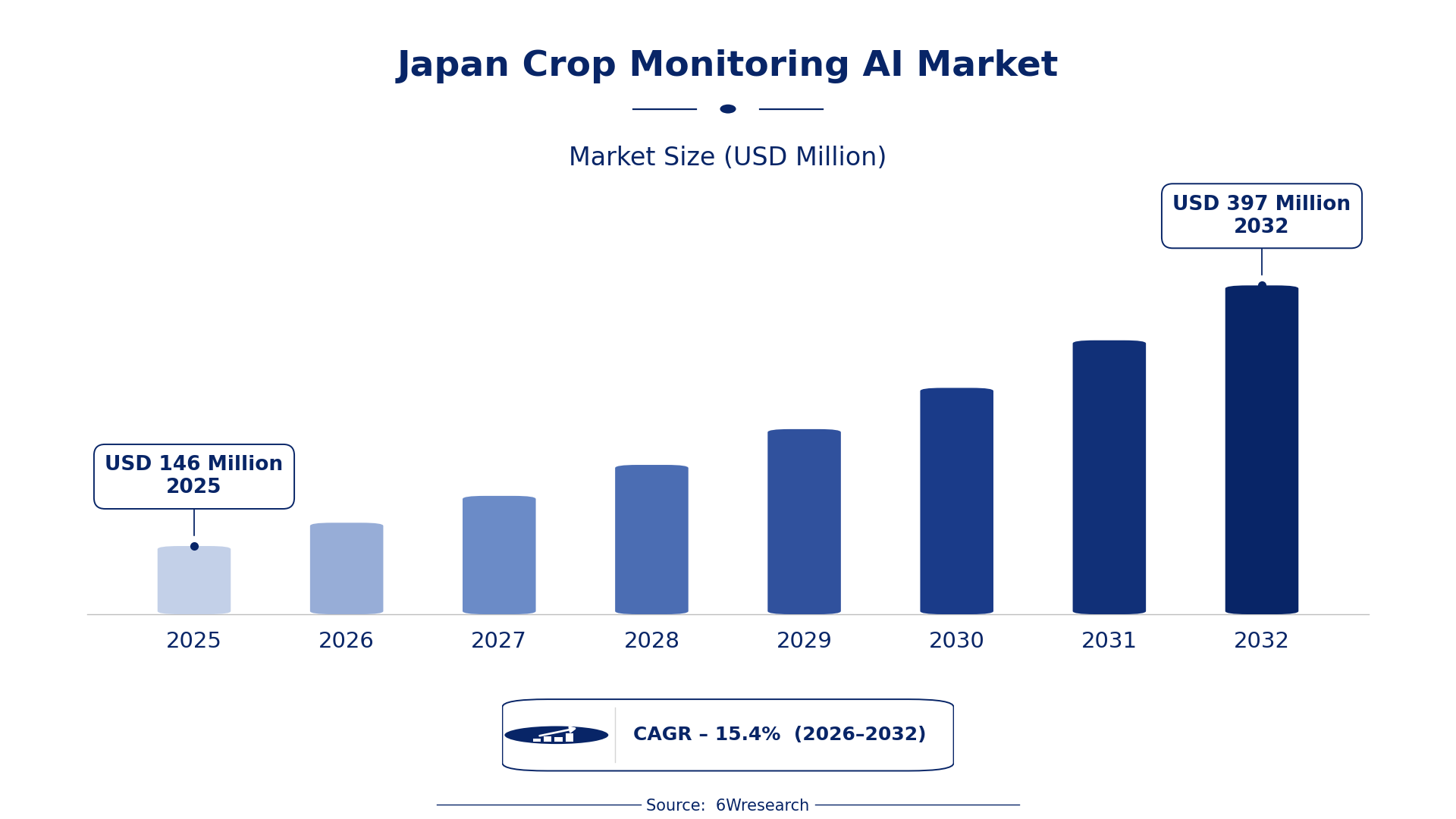
According to 6Wresearch internal database and industry insights, the Japan Crop Monitoring AI Market was valued at USD 146 Million in 2025 and is projected to reach USD 397 Million by 2032, growing at a CAGR of approximately 15.4% during 2026–2032.
Japan Crop Monitoring AI Market Highlights
| Report Metric | Details |
| Report Name | Japan Crop Monitoring AI Market (2026-2032) |
| Market Size 2025 | USD 146 Million |
| Market Size 2032 | USD 397 Million |
| Absolute Growth 2025–2032 | USD 251 Million |
| CAGR 2026–2032 | 15.4% |
| Peak Annual Growth | 16.2% in 2032 |
| Forecast Period | 2026–2032 |
| Historical Data | 2022–2025 |
| Base Year | 2025 |
| Leading Solution Type, 2025 | Disease Detection (37% share) |
| Leading Technology Used, 2025 | Machine Learning (39% share) |
| Leading Data Source, 2025 | Satellite Imagery (38% share) |
| Leading End User, 2025 | Agritech Firms (53% share) |
| Fastest-Growing Solution Type | Yield Prediction (16.9% CAGR) |
| Fastest-Growing Technology Used | Deep Learning (16.8% CAGR) |
| Fastest-Growing Data Source | Drone Images (18.0% CAGR) |
| Fastest-Growing End User | Smart Farms (20.2% CAGR) |
| Growing Sector | Agritech |
| Key End Users | Agritech Firms, Smart Farms, Research Institutions |
Japan Crop Monitoring AI Market Year-wise Growth Rate and Key Drivers (2022–2032)
This graph illustrates the annual growth rates of the market from 2022 to 2032, highlighting a steady upward trajectory and projected market expansion over the forecast period.
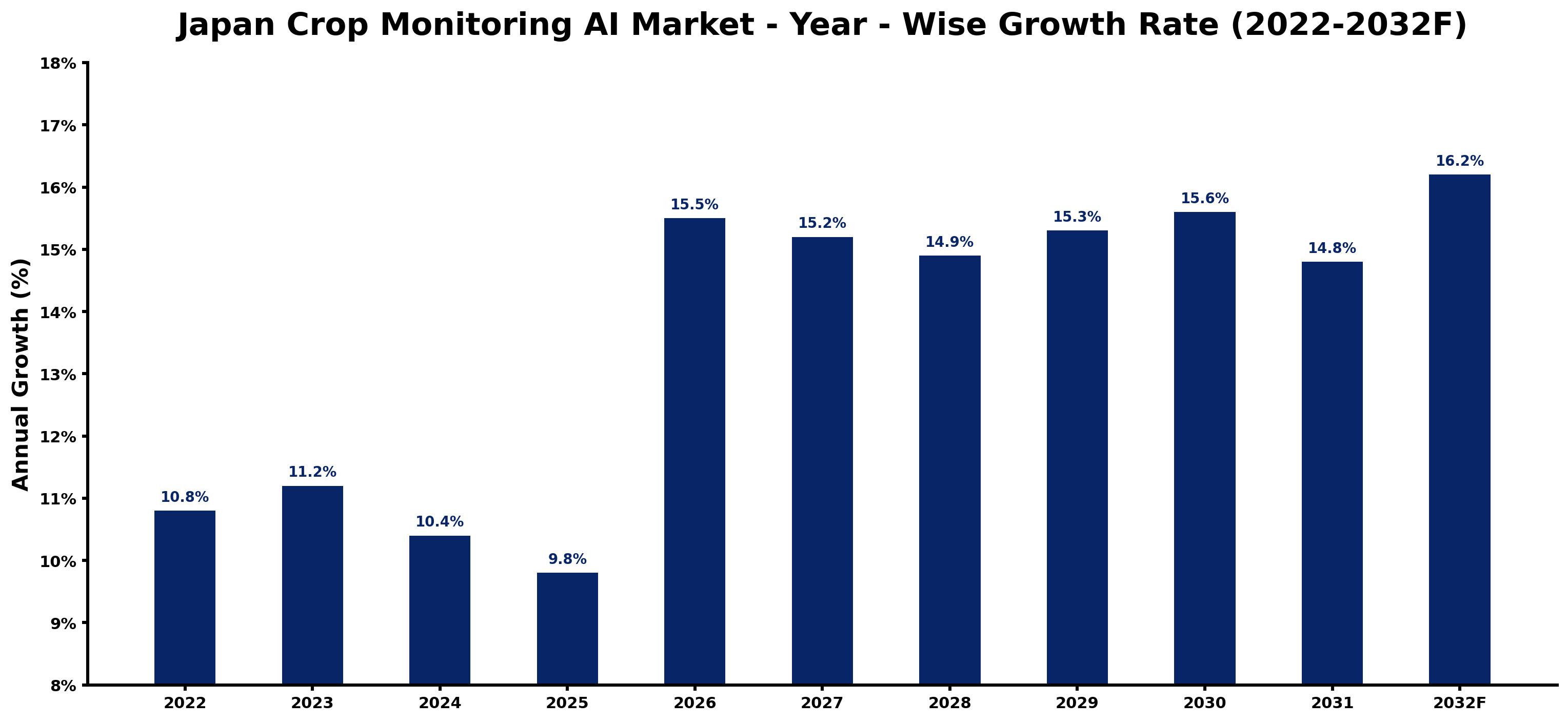
The table below sets out the estimated growth rate for each year and the main factor behind it.
| Year | Estimated Annual Growth (%) | Market Rationale |
| 2022 | 10.8 | The market experienced steady growth as agritech firms began adopting AI technologies. |
| 2023 | 11.2 | Growth accelerated due to increased investments in smart agriculture initiatives. |
| 2024 | 10.4 | The growth rate slowed slightly as market adoption reached a more mature phase. |
| 2025 | 9.8 | A further slowdown occurred as competition intensified among technology providers. |
| 2026 | 15.5 | Growth rebounded sharply with rising demand for yield prediction solutions. |
| 2027 | 15.2 | The growth rate moderated as the market adjusted to new technological advancements. |
| 2028 | 14.9 | Demand remained strong, although growth continued to decelerate slightly. |
| 2029 | 15.3 | A resurgence in growth occurred as more smart farms adopted AI solutions. |
| 2030 | 15.6 | Growth continued to rise as predictive analytics gained traction among users. |
| 2031 | 14.8 | The market saw a slight slowdown as maturity set in for established technologies. |
| 2032 | 16.2 | Growth peaked due to heightened focus on sustainable agricultural practices. |
Note: Market size estimations and growth projections presented in this report are based on 6Wresearch's proprietary forecasting methodology, utilizing the latest available industry data, government publications, and primary research inputs.
Japan Crop Monitoring AI Market Synopsis
Crop Monitoring AI refers to the use of artificial intelligence technologies to monitor crop health, predict yields, and manage resources efficiently. The Japan Crop Monitoring AI Market is expanding as agritech firms and research institutions increasingly adopt these technologies. With over 1.5 million farms in the country, demand is driven by government initiatives and the growing adoption of IoT sensors, expected to reach a 40% adoption rate by 2025, improving agricultural productivity.
Market Dynamics Impact Analysis (2026–2032)
| Factor | Type | Impact | Primary Segment Affected |
| Increasing adoption of AI technologies by agritech firms | Driver | High | Disease Detection |
| Government support for smart agriculture initiatives | Driver | High | Yield Prediction |
| Rising investment in agricultural innovation programs | Opportunity | High | Pest Monitoring |
| Growing demand for precision agriculture solutions | Opportunity | High | Soil Health AI |
| High costs associated with AI technology implementation | Restraint | Medium | Disease Detection |
| Limited awareness among traditional farmers about AI benefits | Restraint | Medium | Yield Prediction |
| Challenges in integrating AI with existing farming practices | Challenge | High | Pest Monitoring |
| Dependence on high-quality data for accurate AI predictions | Challenge | Medium | Soil Health AI |
Evaluation of Drivers in Japan Crop Monitoring AI Market (2026–2032)
Key forces behind demand, with the segment each one moves most, are listed below.
| Drivers | Primary Segment Affected | Why It Matters (Evidence) |
| Growing number of smart farms adopting AI solutions | Yield Prediction | In 2023, approximately 30% of farmers in major areas began using AI technology, improving yield forecasting. |
| Government funding for agricultural innovation | Pest Monitoring | The government allocated ¥5 billion in 2023 for programs supporting AI in agriculture. |
| Rising use of IoT sensors for real-time data collection | Soil Health AI | The adoption rate of IoT sensors is projected to reach 40% by 2025, improving soil monitoring. |
| Increased focus on sustainable farming practices | Disease Detection | Research institutions are collaborating with agritech firms to develop AI models for crop health assessment. |
| Expansion of drone technology in agriculture | Pest Monitoring | Over 10,000 drones are registered for farm monitoring, improving pest management capabilities. |
Purchasing is picking up as the agricultural sector increasingly embraces AI technologies. In 2023, approximately 30% of farmers in major agricultural areas adopted AI solutions, leading to improved yield forecasting and pest management. As the adoption rate of IoT sensors rises, real-time data collection will enhance soil monitoring. The registration of over 10,000 drones for farm monitoring is improving pest management capabilities across various regions.
Evaluation of Restraints in Japan Crop Monitoring AI Market
The key brakes on demand, and where they bite hardest, are shown below.
| Market Restraint | Primary Segment Affected | Why It Matters (Evidence) |
| High costs associated with implementing AI technologies | Disease Detection | The initial investment for AI systems can exceed ¥1 million, limiting adoption among traditional farmers. |
| Limited awareness of AI benefits among farmers | Yield Prediction | Many farmers lack knowledge about the advantages AI can provide, hindering market growth. |
| Challenges in integrating AI with existing farming practices | Pest Monitoring | The complexity of integrating new technologies can deter farmers from adopting AI solutions. |
| Dependence on high-quality data for accurate predictions | Soil Health AI | Inaccurate or insufficient data can lead to unreliable AI outputs, affecting decision-making. |
| Slow adoption rates in rural areas | Disease Detection | Farmers in less accessible regions may struggle to implement AI technologies effectively. |
Japan Crop Monitoring AI Market Challenges
In 2023, 70% of farmers in major agricultural areas do not use AI technology, limiting buyers' access to advanced crop monitoring solutions. This low adoption rate exists due to initial costs often exceeding ¥1 million for sophisticated systems, which delays technological advancements for producers. Competition intensifies as agritech firms innovate rapidly, forcing producers to invest heavily just to remain viable. Supply chain issues arise from reliance on imported components for AI systems, causing deployment delays and increasing operational costs for distributors by up to 15%.
Trends in the Japan Crop Monitoring AI Market
The following changes are redrawing the Japan Crop Monitoring AI Market.
- Shift from Traditional to Smart Farming: Tokyo is experiencing a shift towards smart farming as agritech firms adopt AI technologies. In 2023, the number of smart farms implementing AI-based pest monitoring systems exceeded 500.
- Emergence of Drone Technology in Agriculture: Agritech firms are increasingly using drones for crop monitoring, with over 10,000 registered drones in Japan. This trend improves data collection and pest management capabilities across various regions.
- Transition from Conventional to Precision Agriculture: The launch of the Economic Security Promotion Act in 2022 is driving the transition to precision agriculture. This initiative aims to improve productivity through advanced technologies, impacting numerous farms nationwide.
- Growing Focus on Sustainable Farming Practices: The Ministry of Agriculture, Forestry and Fisheries is promoting sustainable farming practices through technology. In 2023, the government allocated ¥5 billion for agricultural innovation programs to support this shift.
Investment Opportunities in the Japan Crop Monitoring AI Market
The following opportunities in the Japan Crop Monitoring AI Market pair current demand with a clear way in.
- Investment in AI-based Pest Monitoring Solutions: With the increasing demand for pest management, there is a chance to supply AI-based solutions. The market is ripe for investment as over 500 smart farms are adopting these technologies.
- Development of IoT Sensors for Agriculture: Now is the time to invest in IoT sensors as their adoption rate is expected to rise significantly. Collaborating with agritech firms in Hokkaido could facilitate market entry.
- Supply of Drone Technology for Crop Monitoring: The growing use of drones in agriculture presents an opportunity to supply advanced drone technology. With over 10,000 registered drones, partnerships with cooperatives can improve market access.
- Expansion of AI Solutions for Soil Health Monitoring: The focus on soil health creates an opportunity to develop AI solutions tailored for monitoring. Engaging with research institutions in Tokyo can support product development and market entry.
Government Initiatives in the Japan Crop Monitoring AI Market
The framework for agricultural innovation in Japan is shaped by laws such as the Semiconductor and Digital Industry Strategy from June 2021 and the Economic Security Promotion Act of 2022. These measures promote the adoption of advanced technologies in agriculture, ensuring that producers can access the latest innovations and remain competitive in the market.
In 2023, a subsidy program was introduced to support the adoption of AI technologies among farmers. The Japan Agricultural Cooperatives (JA) facilitates this program, assisting farmers in integrating AI solutions into their practices effectively.
Future Insight of the Japan Crop Monitoring AI Market
The emergence of tailored AI models will reshape demand for crop monitoring technologies. By 2032, the government’s investment in agricultural innovation will facilitate the development of predictive analytics for yield forecasting. As the adoption of IoT sensors in agriculture reaches 40%, suppliers will need to adapt their offerings to meet the needs of smart farms. With over 10,000 registered drones for farm monitoring, the focus will shift towards enhancing resource management and crop health assessment.
Market Segmentation Analysis
Japan Crop Monitoring AI Market report covers a detailed analysis of the following market segments:
By Solution Type – Disease Detection Leads, Yield Prediction Expected to Grow Fastest
According to Saurav Kr Singh, Senior Research Analyst at 6Wresearch, Disease Detection held 37% of the Japan Crop Monitoring AI Market by solution type in 2025. Disease detection holds the largest share as it is essential for identifying crop diseases early, ensuring the health of the crops. The implementation of AI-based systems in over 500 smart farms highlights its critical role in agricultural practices. Yield Prediction is set to record the highest CAGR in this split, 16.9% over 2026–2032. Yield prediction is rapidly growing due to its importance in optimising harvest planning, with a notable increase in the use of predictive analytics across the sector. This trend is further supported by the government's subsidy programme for farmers adopting advanced technologies. Suppliers should prioritise the development of yield prediction solutions to align with the increasing market demand.
By Technology Used – Machine Learning Leads, Deep Learning Expected to Grow Fastest
Machine Learning took 39% of technology used revenue in 2025, more than any other category. Machine learning holds the largest share as it serves as the essential technology for data analysis, enabling farmers to make informed decisions. Its widespread implementation among agritech firms highlights its critical role in improving agricultural productivity. The quickest growth will come from Deep Learning, forecast to expand at a CAGR of 16.8% between 2026 and 2032. Deep learning is witnessing rapid growth due to its ability to significantly enhance image recognition capabilities, which are crucial for effective crop monitoring. The surge in investments in agritech startups, reaching ¥10 billion in 2023, is expected to further accelerate this trend. Suppliers should focus on developing solutions that leverage deep learning to stay competitive in the precision agriculture market.
By Data Source – Satellite Imagery Leads, Drone Images Expected to Grow Fastest
The largest data source category in 2025 was Satellite Imagery, at 38% of revenue. Satellite imagery leads the market as it offers extensive coverage for monitoring vast agricultural areas, making it indispensable for effective crop management. The total area of farmland monitored by satellite imagery in Japan is approximately 4.5 million hectares, showcasing its extensive applicability. Over 2026–2032, Drone Images are expected to post the fastest growth, at a CAGR of 18.0%. Drone images are rapidly gaining traction as they provide detailed aerial views of crops, significantly improving monitoring capabilities. With over 10,000 registered drones for farm monitoring, this shift towards drone technology is becoming increasingly evident. Suppliers need to prioritise advancements in drone technology to meet the rising demand for detailed crop monitoring solutions.
By End User – Agritech Firms Lead, Smart Farms Expected to Grow Fastest
In 2025, Agritech Firms led the end user split with a 53% share. Agritech firms are the largest user group of AI solutions, playing a pivotal role in driving technology adoption within the agricultural sector. Their active participation in developing models for assessing crop health underscores their importance in the market. Smart Farms are projected to grow fastest, at a CAGR of 20.2% during 2026–2032. Smart farms are emerging as the fastest-growing user segment, as they integrate advanced technologies for precision agriculture to boost productivity. The government's Smart Agriculture Strategy, launched in 2022, is propelling the adoption of smart farming practices. Suppliers should customise their offerings to align with the specific needs of smart farms to take advantage of this growth opportunity.
Key Attractiveness of the Report
- 10 Years of Market Numbers
- Historical Data Starting from 2022 to 2025
- Base Year 2025
- Forecast Data until 2032
- Key Performance Indicators Impacting the Market
- Major Upcoming Developments and Projects
Key Highlights of the Report:
- Japan Crop Monitoring AI Market Outlook
- Market Size of Japan Crop Monitoring AI Market, 2025
- Forecast of Japan Crop Monitoring AI Market, 2032
- Historical Data and Forecast of Japan Crop Monitoring AI Revenues & Volume for the Period 2022-2032F
- Japan Crop Monitoring AI Market Trend Evolution
- Japan Crop Monitoring AI Market Drivers and Challenges
- Japan Crop Monitoring AI Price Trends
- Japan Crop Monitoring AI Porter's Five Forces
- Japan Crop Monitoring AI Industry Life Cycle
- Historical Data and Forecast of Japan Crop Monitoring AI Market Revenues & Volume By Solution Type for the Period 2022-2032F
- Historical Data and Forecast of Japan Crop Monitoring AI Market Revenues & Volume By Disease Detection for the Period 2022-2032F
- Historical Data and Forecast of Japan Crop Monitoring AI Market Revenues & Volume By Yield Prediction for the Period 2022-2032F
- Historical Data and Forecast of Japan Crop Monitoring AI Market Revenues & Volume By Pest Monitoring for the Period 2022-2032F
- Historical Data and Forecast of Japan Crop Monitoring AI Market Revenues & Volume By Soil Health AI for the Period 2022-2032F
- Historical Data and Forecast of Japan Crop Monitoring AI Market Revenues & Volume By Technology Used for the Period 2022-2032F
- Historical Data and Forecast of Japan Crop Monitoring AI Market Revenues & Volume By Machine Learning for the Period 2022-2032F
- Historical Data and Forecast of Japan Crop Monitoring AI Market Revenues & Volume By Deep Learning for the Period 2022-2032F
- Historical Data and Forecast of Japan Crop Monitoring AI Market Revenues & Volume By AI Vision Models for the Period 2022-2032F
- Historical Data and Forecast of Japan Crop Monitoring AI Market Revenues & Volume By Predictive Analytics for the Period 2022-2032F
- Historical Data and Forecast of Japan Crop Monitoring AI Market Revenues & Volume By Data Source for the Period 2022-2032F
- Historical Data and Forecast of Japan Crop Monitoring AI Market Revenues & Volume By Satellite Imagery for the Period 2022-2032F
- Historical Data and Forecast of Japan Crop Monitoring AI Market Revenues & Volume By Drone Images for the Period 2022-2032F
- Historical Data and Forecast of Japan Crop Monitoring AI Market Revenues & Volume By IoT Sensors for the Period 2022-2032F
- Historical Data and Forecast of Japan Crop Monitoring AI Market Revenues & Volume By Field Cameras for the Period 2022-2032F
- Historical Data and Forecast of Japan Crop Monitoring AI Market Revenues & Volume By End User for the Period 2022-2032F
- Historical Data and Forecast of Japan Crop Monitoring AI Market Revenues & Volume By Agritech Firms for the Period 2022-2032F
- Historical Data and Forecast of Japan Crop Monitoring AI Market Revenues & Volume By Smart Farms for the Period 2022-2032F
- Historical Data and Forecast of Japan Crop Monitoring AI Market Revenues & Volume By Cooperatives for the Period 2022-2032F
- Historical Data and Forecast of Japan Crop Monitoring AI Market Revenues & Volume By Agri Research for the Period 2022-2032F
- Japan Crop Monitoring AI Import Export Trade Statistics
- Market Opportunity Assessment By Solution Type
- Market Opportunity Assessment By Technology Used
- Market Opportunity Assessment By Data Source
- Market Opportunity Assessment By End User
- Japan Crop Monitoring AI Top Companies Market Share
- Japan Crop Monitoring AI Competitive Benchmarking By Technical and Operational Parameters
- Japan Crop Monitoring AI Company Profiles
- Japan Crop Monitoring AI Key Strategic Recommendations
Market Covered
The report covers the following segments.
By Solution Type
- Disease Detection
- Yield Prediction
- Pest Monitoring
- Soil Health AI
By Technology Used
- Machine Learning
- Deep Learning
- AI Vision Models
- Predictive Analytics
By Data Source
- Satellite Imagery
- Drone Images
- IoT Sensors
- Field Cameras
By End User
- Agritech Firms
- Smart Farms
- Cooperatives
- Agri Research






































