Japan Crop Monitoring Robots Market Size & Growth Rate
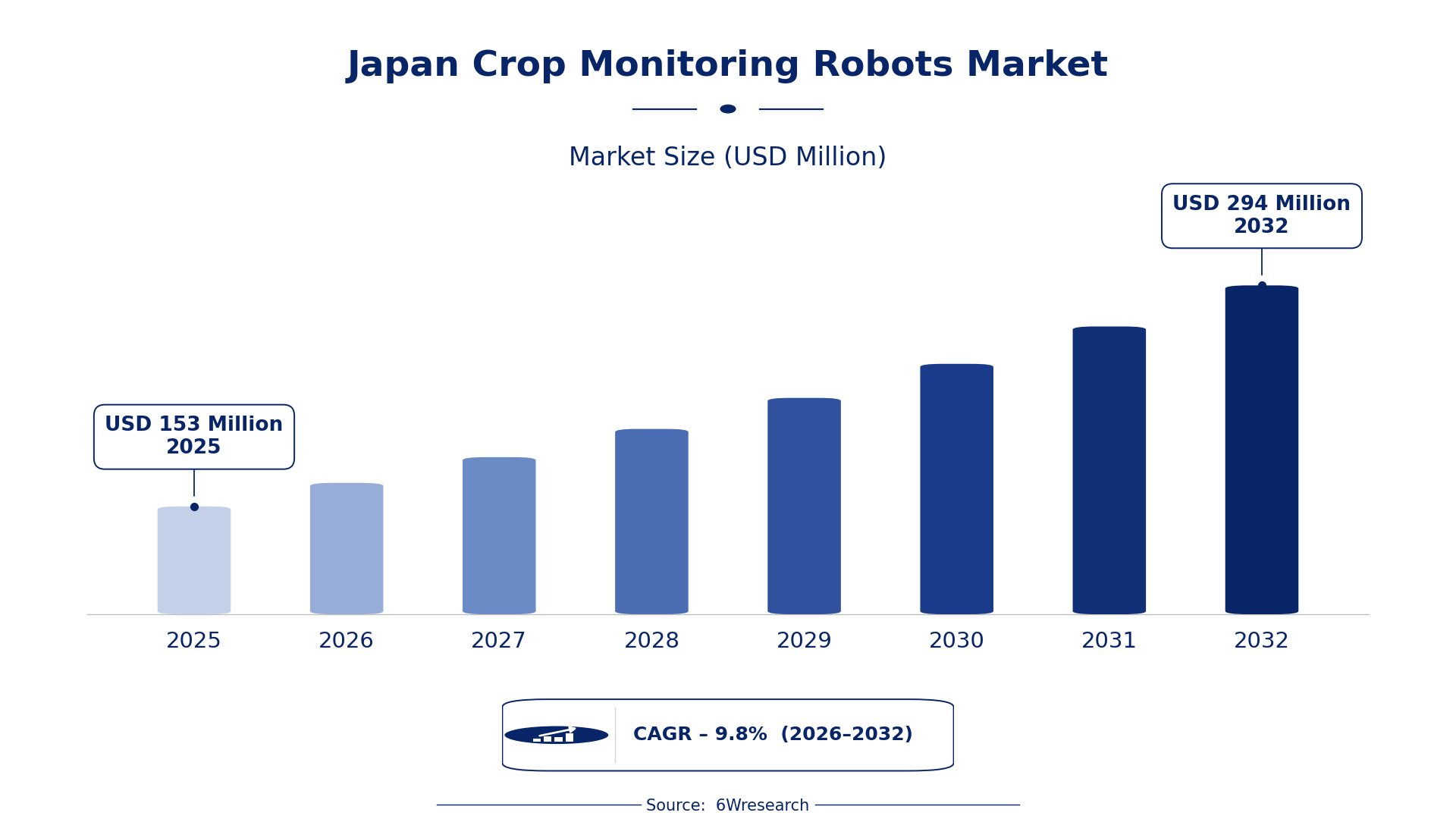
According to 6Wresearch internal database and industry insights, the Japan Crop Monitoring Robots Market was valued at USD 153 Million in 2025 and is projected to reach USD 294 Million by 2032, growing at a CAGR of approximately 9.8% during 2026–2032.
Japan Crop Monitoring Robots Market Highlights
| Report Metric | Details |
| Report Name | Japan Crop Monitoring Robots Market (2026-2032) |
| Market Size 2025 | USD 153 Million |
| Market Size 2032 | USD 294 Million |
| Absolute Growth 2025–2032 | USD 141 Million |
| CAGR 2026–2032 | 9.8% |
| Peak Annual Growth | 11.0% in 2032 |
| Forecast Period | 2026–2032 |
| Historical Data | 2022–2025 |
| Base Year | 2025 |
| Leading Robot Type, 2025 | Scouting Robots (46% share) |
| Leading Functionality, 2025 | Crop Imaging (38% share) |
| Leading Navigation Tech, 2025 | GPS/RTK (49% share) |
| Leading End User, 2025 | Agribusinesses (53% share) |
| Fastest-Growing Robot Type | Weeding Robots (14.4% CAGR) |
| Fastest-Growing Functionality | Targeted Spraying (12.8% CAGR) |
| Fastest-Growing Navigation Tech | Vision Sensors (13.4% CAGR) |
| Fastest-Growing End User | Large Farms (12.7% CAGR) |
| Growing Sector | Agricultural technology |
| Key End Users | Agribusinesses, Agri Tech Firms, Large Farms, Research Farms |
Japan Crop Monitoring Robots Market Year-wise Growth Rate and Key Drivers (2022–2032)
This graph illustrates the annual growth rates of the market from 2022 to 2032, highlighting a steady upward trajectory and projected market expansion over the forecast period.
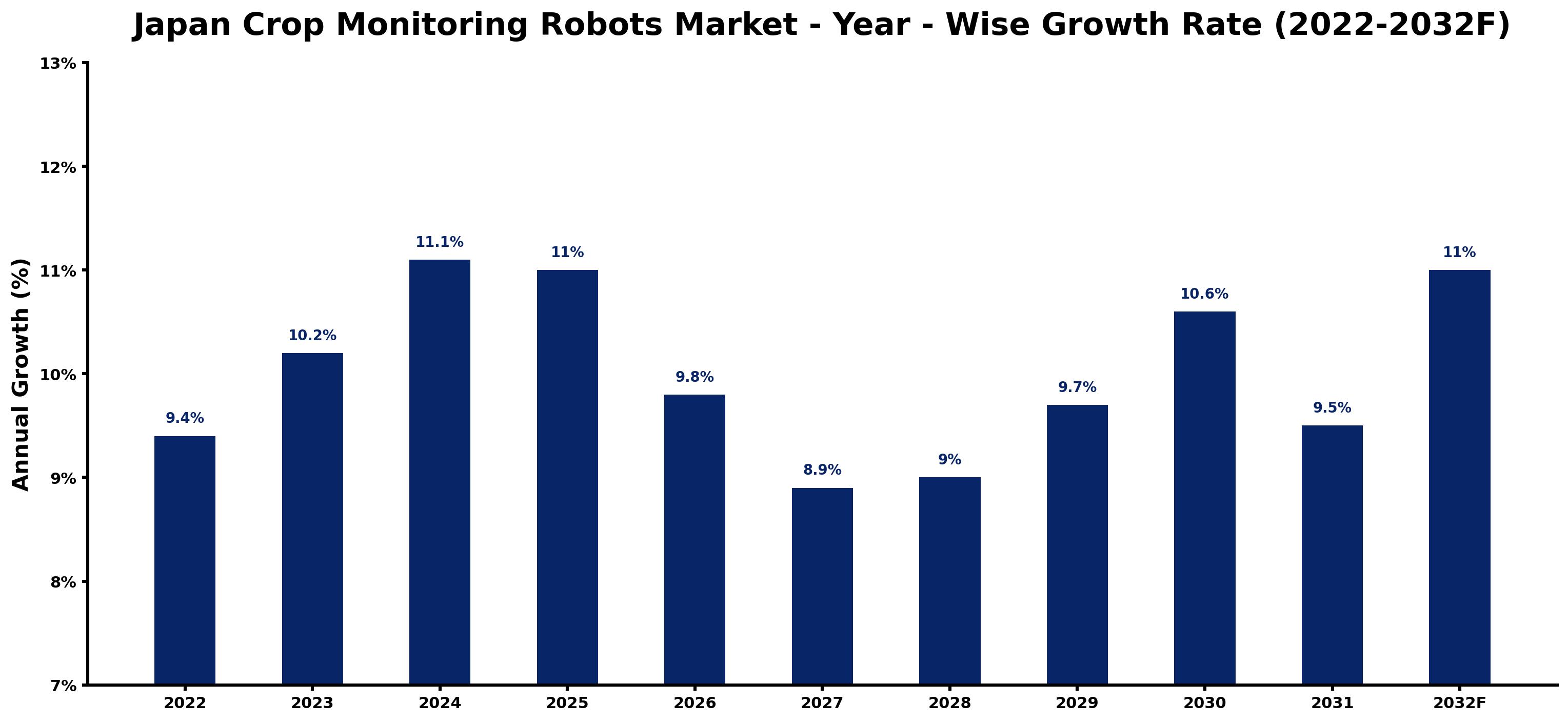
The following figures match every annual growth estimate with the main market development of that year, giving the reasoning behind each rise or slowdown.
| Year | Estimated Annual Growth (%) | Market Rationale |
| 2022 | 9.4 | The market experienced steady growth driven by increased automation in agriculture. |
| 2023 | 10.2 | Demand surged as agribusinesses adopted advanced technologies for efficiency. |
| 2024 | 11.1 | Growth accelerated due to heightened investment in agricultural robotics. |
| 2025 | 11.0 | The market continued to expand, though at a slightly slower pace than before. |
| 2026 | 9.8 | Demand growth is expected to slow as market saturation in some areas begins to appear. |
| 2027 | 8.9 | The market will maintain growth despite a continued slowdown in the rate. |
| 2028 | 9.0 | Growth is projected to pick up again as new technologies enter the market. |
| 2029 | 9.7 | Demand will increase as agribusinesses seek to improve productivity further. |
| 2030 | 10.6 | The market is expected to see a rise in demand driven by technological advancements. |
| 2031 | 9.5 | Growth will slow again as the market begins to stabilise. |
| 2032 | 11.0 | The market is projected to grow rapidly due to rising efficiency needs. |
Note: Market size estimations and growth projections presented in this report are based on 6Wresearch's proprietary forecasting methodology, utilizing the latest available industry data, government publications, and primary research inputs.
Japan Crop Monitoring Robots Market Synopsis
Crop monitoring robots improve farming efficiency and productivity by using robotics, sensors, and AI for real-time data collection and analysis. The Japan Crop Monitoring Robots Market is growing due to the rising demand for automation, primarily from agribusinesses and agri-tech firms. The government's investment of 10 billion yen in agricultural technology development in 2023 further propels market growth, as producers pursue advanced solutions to enhance farming practices and resource management.
Market Dynamics Impact Analysis (2026–2032)
| Factor | Type | Impact | Primary Segment Affected |
| Increased automation in agriculture is driving demand for crop monitoring robots. | Driver | High | Scouting Robots |
| Growing investment in agricultural technology enhances the capabilities of crop monitoring robots. | Driver | High | Monitoring Drones |
| The rise in large farms creates a significant demand for efficient farming solutions. | Opportunity | High | Large Farms |
| The adoption of precision agriculture techniques is increasing the need for advanced monitoring solutions. | Opportunity | Medium | Agri Tech Firms |
| High initial investment costs can deter smaller agribusinesses from adopting these technologies. | Restraint | High | Weeding Robots |
| Limited awareness of the benefits of automation may slow market penetration in certain regions. | Restraint | Medium | Crop Imaging |
| Supply chain disruptions can delay the availability of essential components for robots. | Challenge | High | Rover Robots |
| Competition among agri-tech firms can lead to price wars, affecting profitability. | Challenge | Medium | Targeted Spraying |
Evaluation of Drivers in Japan Crop Monitoring Robots Market (2026–2032)
The following drivers explain most of the expected growth.
| Drivers | Primary Segment Affected | Why It Matters (Evidence) |
| Growing demand for precision agriculture solutions is increasing the adoption of scouting robots. | Scouting Robots | In Japan, over 4.5 million hectares of arable land requires efficient monitoring. |
| The rise in agricultural investment is driving the use of monitoring drones. | Monitoring Drones | Agri-tech firms have seen a 20% increase in investment towards robotics since 2020. |
| The need for efficient weed management is boosting the adoption of weeding robots. | Weeding Robots | Large farms, averaging 30 hectares, require automation to improve productivity. |
| The integration of AI technologies is improving the capabilities of crop imaging. | Crop Imaging | ISO 18400 standard supports soil quality assessment, driving demand for imaging solutions. |
| Increased focus on sustainability is promoting targeted spraying technologies. | Targeted Spraying | Farmers aim to reduce chemical usage while maintaining crop health. |
Buyers are adding capacity as the agricultural sector increasingly adopts automation technologies. The agricultural sector employs approximately 1.5 million people, creating a strong market for crop monitoring robots. The average size of large farms in Japan is around 30 hectares, necessitating efficient farming solutions. Investment in robotics has surged, with a 20% increase since 2020, further driving demand for these advanced technologies.
Evaluation of Restraints in Japan Crop Monitoring Robots Market
Below are the constraints most often cited by buyers and suppliers, with the segment each affects.
| Market Restraint | Primary Segment Affected | Why It Matters (Evidence) |
| High initial costs of crop monitoring robots limit adoption among smaller agribusinesses. | Scouting Robots | Many small farms cannot afford the upfront investment required for automation, with costs exceeding their budgets. |
| Limited awareness of automation benefits may slow market penetration in rural areas. | Monitoring Drones | Farmers in less developed regions may hesitate to adopt new technologies, resulting in lower sales. |
| Supply chain disruptions can delay the availability of essential components for robots. | Weeding Robots | Global supply chain issues have affected the delivery of robotics parts, impacting production timelines. |
| Regulatory hurdles can complicate the deployment of new agricultural technologies. | Crop Imaging | Compliance with standards can be time-consuming and costly for producers, delaying market entry. |
| Intense competition among agri-tech firms may lead to price wars, impacting profitability. | Targeted Spraying | Competition can drive prices down, affecting margins for producers and limiting investment. |
Japan Crop Monitoring Robots Market Challenges
High operational costs challenge producers, as Japan's minimum wage reached JPY 1,055 per hour, raising expenses for farmers. A shortage of skilled workers hinders technology adoption, with the agricultural sector employing about 1.5 million people, limiting access to qualified personnel for advanced systems. Supply chain disruptions stem from reliance on specific technologies, delaying the deployment of crop monitoring robots and affecting timely data collection for farmers. Competition intensifies as agri-tech firms have increased investments in robotics by 20% since 2020, urging smaller producers to adopt new technologies quickly or risk obsolescence.
Trends in the Japan Crop Monitoring Robots Market
Four trends stand out in the Japan Crop Monitoring Robots Market.
- Rise in Drone Usage for Crop Management: In 2023, monitoring drones gained popularity in the Tohoku region for rice field management, enhancing efficiency in crop monitoring. This trend is reflected in a notable increase in demand for aerial surveillance.
- Adoption of Crop Imaging Technologies: Crop imaging technology is being embraced in prefectures like Akita and Niigata, providing improved yield predictions. This trend underscores the growing recognition of visual data's role in optimising farming practices.
- Expansion of Precision Agriculture Practices: The Japanese agricultural market is transitioning towards precision agriculture, driven by the need for efficiency. This shift is supported by a 20% increase in investment towards robotics in agriculture since 2020, indicating a strong market change.
- Increased Focus on Sustainable Practices: Farmers are emphasising sustainable practices, leading to a rise in targeted spraying technologies. This trend is clear as agribusinesses strive to reduce chemical usage while maintaining crop health.
Investment Opportunities in the Japan Crop Monitoring Robots Market
Below are the investment opportunities with the strongest case in the Japan Crop Monitoring Robots Market.
- Growing Demand for Automation Solutions: With over 4.5 million hectares of arable land, Japan presents a considerable opportunity for automation solutions. Agribusinesses are seeking partners to implement advanced robotics, enhancing productivity and efficiency.
- Investment in Research Farms: Research farms in regions like Hokkaido and Kumamoto are ideal for testing new agricultural technologies. Collaborating with these facilities can yield insights into innovative practices and drive technology adoption.
- Expansion of Large Farms: The average size of large farms in Japan is about 30 hectares, creating a demand for efficient farming solutions. Investing in automation technologies can cater to this growing segment, particularly in rural areas.
- Integration of AI in Agriculture: The AI Promotion Act (2025) opens new avenues for investment in AI-driven agricultural technologies. Engaging with agri-tech firms can facilitate the development of advanced crop monitoring solutions.
Government Initiatives in the Japan Crop Monitoring Robots Market
Various policies influence crop monitoring robots and their buyers, including the Industrial Standardization Act (1949), which governs product standards. The New Robot Strategy (2015) aims to broaden the use of robots in agriculture, encouraging innovation and technology adoption across the sector.
The Ministry of Agriculture, Forestry and Fisheries (MAFF) oversees the approval and funding of agricultural technology projects. In 2023, the government allocated 10 billion yen for agricultural technology development, supporting initiatives that integrate robotics into farming.
Future Insight of the Japan Crop Monitoring Robots Market
The investment pipeline for agricultural technology is broadening, driven by a 10 billion yen allocation for development, which will generate strong demand for crop monitoring robots. By 2032, the integration of standards like ISO 18400 will improve soil quality assessments, streamlining operations for producers. Crop imaging technology will see broader adoption in regions such as Akita and Niigata, enhancing yield predictions. Robotics integration will gain momentum through initiatives from the Ministry of Agriculture, Forestry and Fisheries, promoting efficiency across the agricultural sector.
Market Segmentation Analysis
Japan Crop Monitoring Robots Market report covers a detailed analysis of the following market segments:
By Robot Type – Scouting Robots Lead, Weeding Robots Expected to Grow Fastest
According to Saurav Kr Singh, Senior Research Analyst at 6Wresearch, the largest robot type category in 2025 was Scouting Robots, at 46% of revenue. Scouting robots hold the largest share due to their essential role in assessing crop health across Japan's extensive arable land. Their prevalent use among agribusinesses, especially in regions like Hokkaido, highlights their critical function in modern farming practices. The quickest growth will come from Weeding Robots, forecast to expand at a CAGR of 14.4% between 2026 and 2032. Weeding robots are experiencing rapid growth driven by the increasing need for efficient weed management solutions, evidenced by a 20% rise in investment towards robotics since 2020. This trend indicates that scouting robots will maintain their lead as automation becomes more integral to farming. Suppliers should focus on enhancing weeding robot technologies to cater to the growing automation demands of large farms.
By Functionality – Crop Imaging Leads, Targeted Spraying Expected to Grow Fastest
Crop Imaging took 38% of functionality revenue in 2025, more than any other category. Crop imaging technology leads the market as it provides essential visual data for crop assessment, enabling agribusinesses to make informed decisions. Its widespread use in prefectures like Akita and Niigata highlights its importance in improving yield predictions. Targeted Spraying is set to record the highest CAGR in this split, 12.8% over 2026–2032. Targeted spraying is growing swiftly as it allows for precise application of pesticides and fertilizers, which is increasingly vital for sustainable farming. The push for more efficient resource management in agriculture is propelling this segment's rapid expansion. Buyers are likely to prioritise suppliers who offer advanced targeted spraying solutions to optimise their agricultural practices.
By Navigation Tech – GPS/RTK Leads, Vision Sensors Expected to Grow Fastest
GPS/RTK held 49% of the Japan Crop Monitoring Robots Market by navigation tech in 2025. GPS/RTK technology is the leading segment as it provides essential accurate positioning for farming tasks across Japan's agricultural landscape. Its extensive application in large-scale operations ensures effective crop monitoring and resource management, solidifying its market position. Vision Sensors are projected to grow fastest, at a CAGR of 13.4% during 2026–2032. Vision sensors are growing rapidly as they significantly improve the identification of crop conditions and pests in real-time. The increasing complexity of agricultural challenges will further drive vision sensor adoption, reinforcing the dominance of GPS/RTK technology. Suppliers must prioritise the advancement of vision sensor technologies to address the needs of large farms seeking enhanced operational efficiency.
By End User – Agribusinesses Lead, Large Farms Expected to Grow Fastest
With 53% of end user revenue in 2025, Agribusinesses was the largest category. Agribusinesses are the primary users of crop monitoring technologies, leveraging these tools to enhance productivity in their operations. Their substantial investments in automation reflect the rising demand for advanced agricultural solutions in Japan's market. Over 2026–2032, Large Farms are expected to post the fastest growth, at a CAGR of 12.7%. Large farms are quickly adopting automation technologies to improve operational efficiency and effectively manage their extensive land. This trend is expected to continue, as larger farm sizes necessitate further advancements in crop monitoring. Suppliers should tailor their offerings to meet the specific needs of large farms, ensuring compatibility with established agricultural practices.
Key Attractiveness of the Report
- 10 Years of Market Numbers
- Historical Data Starting from 2022 to 2025
- Base Year 2025
- Forecast Data until 2032
- Key Performance Indicators Impacting the Market
- Major Upcoming Developments and Projects
Key Highlights of the Report:
- Japan Crop Monitoring Robots Market Outlook
- Market Size of Japan Crop Monitoring Robots Market, 2025
- Forecast of Japan Crop Monitoring Robots Market, 2032
- Historical Data and Forecast of Japan Crop Monitoring Robots Revenues & Volume for the Period 2022-2032F
- Japan Crop Monitoring Robots Market Trend Evolution
- Japan Crop Monitoring Robots Market Drivers and Challenges
- Japan Crop Monitoring Robots Price Trends
- Japan Crop Monitoring Robots Porter's Five Forces
- Japan Crop Monitoring Robots Industry Life Cycle
- Historical Data and Forecast of Japan Crop Monitoring Robots Market Revenues & Volume By Robot Type for the Period 2022-2032F
- Historical Data and Forecast of Japan Crop Monitoring Robots Market Revenues & Volume By Scouting Robots for the Period 2022-2032F
- Historical Data and Forecast of Japan Crop Monitoring Robots Market Revenues & Volume By Weeding Robots for the Period 2022-2032F
- Historical Data and Forecast of Japan Crop Monitoring Robots Market Revenues & Volume By Monitoring Drones for the Period 2022-2032F
- Historical Data and Forecast of Japan Crop Monitoring Robots Market Revenues & Volume By Rover Robots for the Period 2022-2032F
- Historical Data and Forecast of Japan Crop Monitoring Robots Market Revenues & Volume By Functionality for the Period 2022-2032F
- Historical Data and Forecast of Japan Crop Monitoring Robots Market Revenues & Volume By Crop Imaging for the Period 2022-2032F
- Historical Data and Forecast of Japan Crop Monitoring Robots Market Revenues & Volume By Targeted Spraying for the Period 2022-2032F
- Historical Data and Forecast of Japan Crop Monitoring Robots Market Revenues & Volume By Overhead Mapping for the Period 2022-2032F
- Historical Data and Forecast of Japan Crop Monitoring Robots Market Revenues & Volume By Ground Sensing for the Period 2022-2032F
- Historical Data and Forecast of Japan Crop Monitoring Robots Market Revenues & Volume By Navigation Tech for the Period 2022-2032F
- Historical Data and Forecast of Japan Crop Monitoring Robots Market Revenues & Volume By GPS/RTK for the Period 2022-2032F
- Historical Data and Forecast of Japan Crop Monitoring Robots Market Revenues & Volume By Vision Sensors for the Period 2022-2032F
- Historical Data and Forecast of Japan Crop Monitoring Robots Market Revenues & Volume By Autopilot for the Period 2022-2032F
- Historical Data and Forecast of Japan Crop Monitoring Robots Market Revenues & Volume By Lidar for the Period 2022-2032F
- Historical Data and Forecast of Japan Crop Monitoring Robots Market Revenues & Volume By End User for the Period 2022-2032F
- Historical Data and Forecast of Japan Crop Monitoring Robots Market Revenues & Volume By Agribusinesses for the Period 2022-2032F
- Historical Data and Forecast of Japan Crop Monitoring Robots Market Revenues & Volume By Large Farms for the Period 2022-2032F
- Historical Data and Forecast of Japan Crop Monitoring Robots Market Revenues & Volume By Agri Tech Firms for the Period 2022-2032F
- Historical Data and Forecast of Japan Crop Monitoring Robots Market Revenues & Volume By Research Farms for the Period 2022-2032F
- Japan Crop Monitoring Robots Import Export Trade Statistics
- Market Opportunity Assessment By Robot Type
- Market Opportunity Assessment By Functionality
- Market Opportunity Assessment By Navigation Tech
- Market Opportunity Assessment By End User
- Japan Crop Monitoring Robots Top Companies Market Share
- Japan Crop Monitoring Robots Competitive Benchmarking By Technical and Operational Parameters
- Japan Crop Monitoring Robots Company Profiles
- Japan Crop Monitoring Robots Key Strategic Recommendations
Market Covered
The study includes the following segmentation.
By Robot Type
- Scouting Robots
- Weeding Robots
- Monitoring Drones
- Rover Robots
By Functionality
- Crop Imaging
- Targeted Spraying
- Overhead Mapping
- Ground Sensing
By Navigation Tech
- GPS/RTK
- Vision Sensors
- Autopilot
- Lidar
By End User
- Agribusinesses
- Large Farms
- Agri Tech Firms
- Research Farms






































