Japan Crop Monitoring Software Market Size & Growth Rate
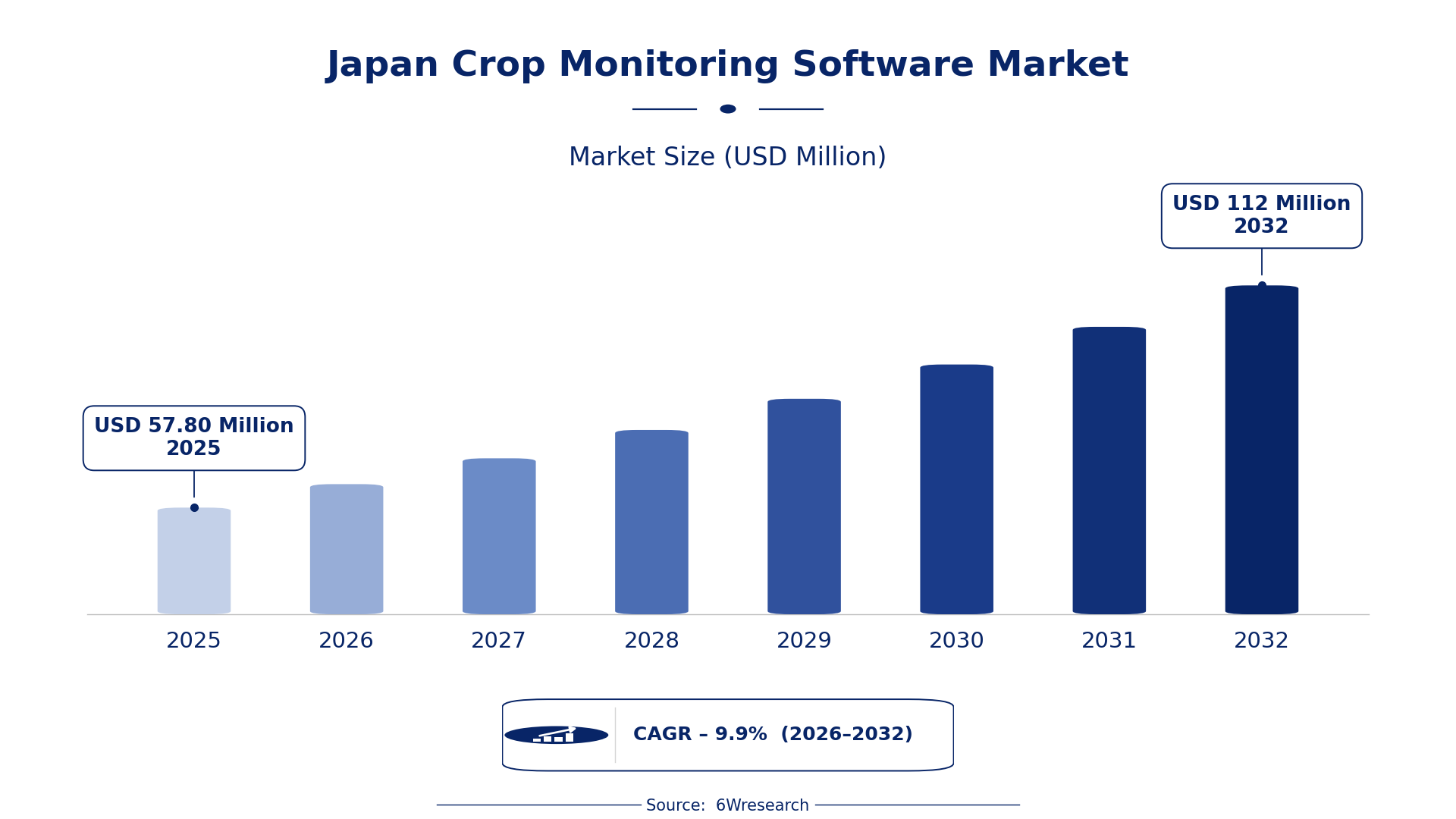
According to 6Wresearch internal database and industry insights, the Japan Crop Monitoring Software Market was valued at USD 57.80 Million in 2025 and is projected to reach USD 112 Million by 2032, growing at a CAGR of approximately 9.9% during 2026–2032.
Japan Crop Monitoring Software Market Highlights
| Report Metric | Details |
| Report Name | Japan Crop Monitoring Software Market (2026-2032) |
| Market Size 2025 | USD 57.80 Million |
| Market Size 2032 | USD 112 Million |
| Absolute Growth 2025–2032 | USD 54.20 Million |
| CAGR 2026–2032 | 9.9% |
| Peak Annual Growth | 11.7% in 2032 |
| Forecast Period | 2026–2032 |
| Historical Data | 2022–2025 |
| Base Year | 2025 |
| Leading Software Type, 2025 | Farm Management (47% share) |
| Leading Platform, 2025 | Web-Based (35% share) |
| Leading Features, 2025 | Mapping (33% share) |
| Leading End User, 2025 | Farmers (48% share) |
| Fastest-Growing Software Type | Satellite Monitoring (15.4% CAGR) |
| Fastest-Growing Platform | Cloud-Based (14.5% CAGR) |
| Fastest-Growing Features | Alerts (14.6% CAGR) |
| Fastest-Growing End User | Agro Corporations (13.4% CAGR) |
| Growing Sector | Agricultural technology |
| Key End Users | Farmers, Agro Corporations, Smart Farms, Cooperatives |
Japan Crop Monitoring Software Market Year-wise Growth Rate and Key Drivers (2022–2032)
This graph illustrates the annual growth rates of the market from 2022 to 2032, highlighting a steady upward trajectory and projected market expansion over the forecast period.
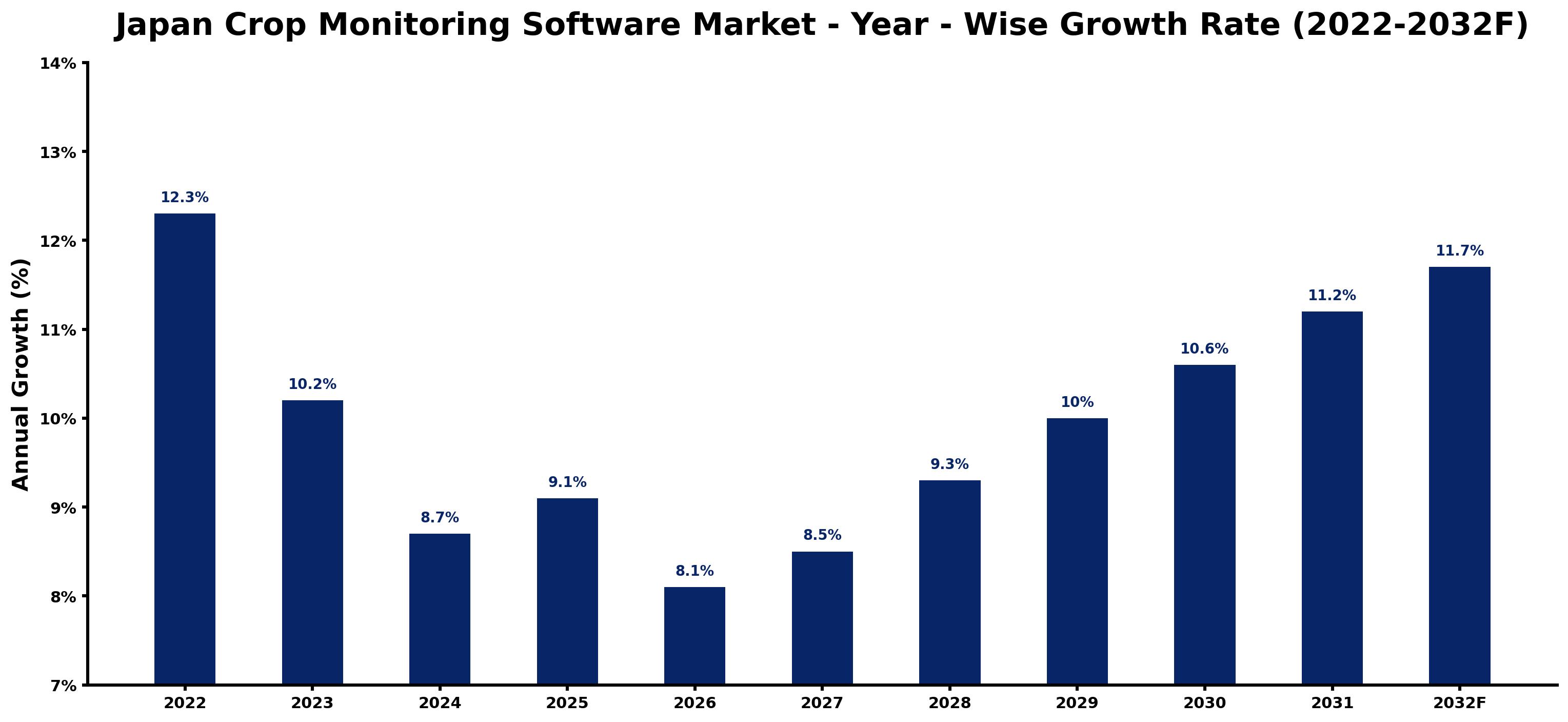
The following figures match every annual growth estimate with the main market development of that year, giving the reasoning behind each rise or slowdown.
| Year | Estimated Annual Growth (%) | Market Rationale |
| 2022 | 12.3 | The market experienced strong growth due to increased adoption of technology among farmers. |
| 2023 | 10.2 | Growth slowed as farmers adjusted to new technologies and market conditions. |
| 2024 | 8.7 | The market continued to grow, albeit at a slower pace, as digital agriculture gained traction. |
| 2025 | 9.1 | Growth accelerated as more farmers recognised the benefits of crop monitoring software. |
| 2026 | 8.1 | Growth is expected to slow again as market saturation begins to impact new user acquisition. |
| 2027 | 8.5 | The market is projected to rebound with renewed interest in precision agriculture technologies. |
| 2028 | 9.3 | Growth is expected to continue as more farmers integrate IoT solutions into their operations. |
| 2029 | 10.0 | Demand is projected to increase further as awareness of data-driven farming practices spreads. |
| 2030 | 10.6 | The market is expected to maintain its upward trend as technological advancements continue to emerge. |
| 2031 | 11.2 | Growth is projected to remain strong as farmers increasingly rely on software for efficiency. |
| 2032 | 11.7 | The market is expected to peak with widespread adoption of advanced monitoring technologies. |
Note: Market size estimations and growth projections presented in this report are based on 6Wresearch's proprietary forecasting methodology, utilizing the latest available industry data, government publications, and primary research inputs.
Japan Crop Monitoring Software Market Synopsis
Crop Monitoring Software assists farmers in managing agricultural practices through data analysis and monitoring, utilising satellite imagery and IoT sensors. In Japan, over 1.5 million farms are embracing these technologies, propelled by the "Smart Agriculture" programme. The increasing average age of farmers, the rise of smart farms, and a growing interest in local food production are driving market growth.
Market Dynamics Impact Analysis (2026–2032)
| Factor | Type | Impact | Primary Segment Affected |
| Rising adoption of precision agriculture technologies | Driver | High | Farm Management |
| Increased investment in agricultural innovation | Driver | High | Satellite Monitoring |
| Growing demand for real-time data on crop health | Opportunity | High | Drone Data Software |
| Expansion of smart farms in urban areas | Opportunity | Medium | IoT Integration Software |
| High average age of farmers limiting technology uptake | Restraint | Medium | Farm Management |
| Limited awareness of advanced software capabilities | Restraint | Medium | Satellite Monitoring |
| Resistance to change among traditional farmers | Challenge | High | Drone Data Software |
| High initial investment costs for technology adoption | Challenge | Medium | IoT Integration Software |
Evaluation of Drivers in Japan Crop Monitoring Software Market (2026–2032)
The following drivers explain most of the expected growth.
| Drivers | Primary Segment Affected | Why It Matters (Evidence) |
| Increased efficiency in resource management | Farm Management | Farmers are adopting software to optimise inputs, resulting in improved crop yields. |
| Growing demand for data-driven decision making | Satellite Monitoring | The average age of farmers, around 67 years, drives the need for intuitive technology solutions. |
| Need for timely alerts on crop conditions | Drone Data Software | The growing number of drone operators, exceeding 10,000, improves aerial monitoring capabilities. |
| Integration of IoT devices in agriculture | IoT Integration Software | The increasing use of IoT devices, surpassing 1 million units, facilitates better connectivity and data analysis. |
| Growth of urban farming initiatives | Web-Based | The Tokyo region is becoming a hub for agricultural technology startups, increasing software use. |
The strongest pull on demand comes from the increased efficiency in resource management, as farmers adopt software to optimise inputs and improve crop yields. The ageing farmer population, with an average age of 67 years, drives the need for intuitive technology solutions. The need for timely alerts on crop conditions is also growing, evidenced by the increasing number of drone operators, which now exceeds 10,000, enhancing aerial monitoring capabilities. Integration of IoT devices is transforming agricultural practices, with over 1 million units in use facilitating better connectivity and data analysis.
Evaluation of Restraints in Japan Crop Monitoring Software Market
These are the pressures that could keep growth below its potential.
| Market Restraint | Primary Segment Affected | Why It Matters (Evidence) |
| High average age of farmers limiting technology uptake | Farm Management | The average age of farmers in Japan is around 67 years, hindering technology adoption. |
| Limited awareness of advanced software capabilities | Satellite Monitoring | Many farmers are not informed about the advantages of crop monitoring technologies. |
| Resistance to change among traditional farmers | Drone Data Software | Some farmers prefer traditional methods, which delays the adoption of new technologies. |
| High initial investment costs for technology adoption | IoT Integration Software | The costs associated with implementing IoT solutions can deter smaller farms from investing. |
| Dependence on government initiatives for funding | Web-Based | Many farmers rely on government support, which may not always be guaranteed. |
Japan Crop Monitoring Software Market Challenges
Farmers face difficulties with regulatory compliance, as navigating various agricultural standards can delay the implementation of new technologies and raise costs, affecting profitability. Suppliers encounter a skills gap, with the average age of farmers at 67 years, resulting in a workforce that is less adept in modern agricultural practices, which can impede technology uptake. Buyers experience high costs due to the limited availability of advanced monitoring solutions, as only 200 smart farms currently operate, limiting their options for efficient resource management. Competition intensifies as the government invests ¥1 billion in agricultural innovation projects, compelling suppliers to adapt swiftly or risk obsolescence.
Trends in the Japan Crop Monitoring Software Market
The trends below show where the Japan Crop Monitoring Software Market is heading.
- Shift from Traditional to Digital Farming: Farmers are increasingly embracing digital tools for crop management, with the "Smart Agriculture" initiative encouraging technology adoption across Japan. In 2023, over 1.5 million farms employed various agricultural technologies.
- Emergence of Smart Farms: The number of smart farms in Japan has been expanding, with approximately 200 operational as of 2022. This trend underscores the shift towards high-tech farming practices, driven by the need for efficiency and productivity.
- Increase in Drone Usage for Crop Monitoring: Since 2023, the use of drones in agriculture has surged, with over 10,000 registered operators enhancing monitoring capabilities. This shift enables real-time data collection and analysis, improving crop management.
- Growth of IoT Integration in Agriculture: The integration of IoT devices in farming is increasing, with over 1 million units in use as of 2023. This trend supports better connectivity and data-driven decision-making among farmers.
Investment Opportunities in the Japan Crop Monitoring Software Market
The opportunities below stand out in the Japan Crop Monitoring Software Market for new entrants and existing suppliers.
- Farmers seeking efficient resource management: With the average yield of rice at 5.2 tons per hectare, farmers are searching for software solutions to optimise resources. Collaborating with agricultural technology startups in the Tokyo region can create opportunities for partnerships.
- Growing interest in local food production: Japan's population, approximately 126 million, is increasingly focused on local food, generating demand for crop monitoring software. Investing in technology for local farmers can capitalise on this rising trend.
- Demand for real-time crop health data: As farmers recognise the advantages of monitoring software, the demand for real-time data is rising. Collaborating with agricultural cooperatives can assist suppliers in effectively reaching this market.
- Expansion of smart farms in urban areas: The growth of smart farms, particularly in urban environments, offers opportunities for technology providers. Establishing joint ventures with local tech firms can facilitate market entry.
Government Initiatives in the Japan Crop Monitoring Software Market
The AI Promotion Act, established in 2025, lays the groundwork for the development and use of AI in agriculture, ensuring that producers can effectively utilise advanced technologies. This act supports the integration of AI in crop monitoring software, improving productivity and efficiency for farmers. The government allocated ¥1 billion for agricultural innovation projects, bolstering support for technology adoption among farmers.
The Digital Agency, established in September 2021, spearheads government initiatives promoting digital transformation in agriculture. Through funding and support for innovative projects, farmers can access advanced technologies, enhancing their operational capabilities and competitiveness in the market. The agency's efforts have led to increased adoption of digital tools, benefiting the agricultural sector.
Future Insight of the Japan Crop Monitoring Software Market
Farmers will increasingly adopt IoT devices, with over 1 million units already in use, improving data collection and resource management. The Smart Agriculture initiative will drive technological integration, enabling better crop yield optimisation and soil health monitoring. By 2032, the number of smart farms is expected to rise significantly, providing farmers with improved access to advanced monitoring tools. The Tokyo region will remain a hub for agricultural technology startups, promoting collaboration and innovation among suppliers.
Market Segmentation Analysis
Japan Crop Monitoring Software Market report covers a detailed analysis of the following market segments:
By Software Type – Farm Management Leads, Satellite Monitoring Expected to Grow Fastest
According to Saurav Kr Singh, Senior Research Analyst at 6Wresearch, Farm Management accounted for 47% of the market by software type in 2025. Farm Management software holds the largest share as it is essential for managing resources effectively across Japan's extensive network of over 1.5 million farms. This software supports farmers in improving their agricultural practices and achieving optimal yields, making it indispensable in the sector. Over 2026–2032, Satellite Monitoring is expected to post the fastest growth, at a CAGR of 15.4%. Satellite Monitoring is experiencing rapid growth due to the increasing demand for real-time insights into crop health and environmental conditions. The rise in registered drone operators, surpassing 10,000, reflects a significant trend towards integrating satellite technology in farming practices. Suppliers must focus on enhancing real-time monitoring capabilities to align with the evolving needs of farmers.
By Platform – Web-Based Leads, Cloud-Based Expected to Grow Fastest
Web-Based took 35% of platform revenue in 2025, more than any other category. Web-Based platforms dominate the market as they enable users to access software from any internet-enabled device, streamlining the management of agricultural operations. This accessibility is particularly advantageous given Japan's diverse 4.5 million hectares of arable land. The quickest growth will come from Cloud-Based, forecast to expand at a CAGR of 14.5% between 2026 and 2032. Cloud-Based platforms are growing swiftly because they offer scalable storage and processing capabilities that are crucial for managing large datasets from over 1 million IoT devices in agriculture. This growth indicates a trend towards more sophisticated data collection and analysis methods. Buyers are likely to prefer cloud solutions for their flexibility and scalability, which will encourage suppliers to invest in robust cloud infrastructure.
By Features – Mapping Leads, Alerts Expected to Grow Fastest
Mapping held 33% of the Japan Crop Monitoring Software Market by features in 2025. Mapping features are the most widely used as they are vital for visualising farm layouts and crop distribution, aiding farmers in planning and resource allocation. This is particularly important given the average yield of rice in Japan, which requires precise management. Alerts are projected to grow fastest, at a CAGR of 14.6% during 2026–2032. Alerts are gaining traction as they provide timely notifications for critical changes in crop conditions, which is essential for farmers to respond quickly to potential issues. The increasing complexity of farming operations necessitates such responsive features. Suppliers should prioritise developing alert systems to meet the urgent needs of farmers in managing crop health.
By End User – Farmers Lead, Agro Corporations Expected to Grow Fastest
With 48% of end user revenue in 2025, Farmers was the largest category. Farmers constitute the largest user group, as they are the primary users of crop monitoring software for effective management of their agricultural practices. The necessity for technology adoption is underscored by the average age of farmers in Japan, which is around 67 years. Agro Corporations are set to record the highest CAGR in this split, 13.4% over 2026–2032. Agro Corporations are the fastest-growing segment, utilising software for extensive agricultural operations, motivated by the need for improved efficiency and productivity. Their increasing investment in technology is likely to further accelerate this growth. Suppliers must address the specific needs of agro corporations to effectively tap into this expanding market segment.
Key Attractiveness of the Report
- 10 Years of Market Numbers
- Historical Data Starting from 2022 to 2025
- Base Year 2025
- Forecast Data until 2032
- Key Performance Indicators Impacting the Market
- Major Upcoming Developments and Projects
Key Highlights of the Report:
- Japan Crop Monitoring Software Market Outlook
- Market Size of Japan Crop Monitoring Software Market, 2025
- Forecast of Japan Crop Monitoring Software Market, 2032
- Historical Data and Forecast of Japan Crop Monitoring Software Revenues & Volume for the Period 2022-2032F
- Japan Crop Monitoring Software Market Trend Evolution
- Japan Crop Monitoring Software Market Drivers and Challenges
- Japan Crop Monitoring Software Price Trends
- Japan Crop Monitoring Software Porter's Five Forces
- Japan Crop Monitoring Software Industry Life Cycle
- Historical Data and Forecast of Japan Crop Monitoring Software Market Revenues & Volume By Software Type for the Period 2022-2032F
- Historical Data and Forecast of Japan Crop Monitoring Software Market Revenues & Volume By Farm Management for the Period 2022-2032F
- Historical Data and Forecast of Japan Crop Monitoring Software Market Revenues & Volume By Satellite Monitoring for the Period 2022-2032F
- Historical Data and Forecast of Japan Crop Monitoring Software Market Revenues & Volume By Drone Data Software for the Period 2022-2032F
- Historical Data and Forecast of Japan Crop Monitoring Software Market Revenues & Volume By IoT Integration Software for the Period 2022-2032F
- Historical Data and Forecast of Japan Crop Monitoring Software Market Revenues & Volume By Platform for the Period 2022-2032F
- Historical Data and Forecast of Japan Crop Monitoring Software Market Revenues & Volume By Web-Based for the Period 2022-2032F
- Historical Data and Forecast of Japan Crop Monitoring Software Market Revenues & Volume By Cloud-Based for the Period 2022-2032F
- Historical Data and Forecast of Japan Crop Monitoring Software Market Revenues & Volume By Mobile App for the Period 2022-2032F
- Historical Data and Forecast of Japan Crop Monitoring Software Market Revenues & Volume By On-Premise for the Period 2022-2032F
- Historical Data and Forecast of Japan Crop Monitoring Software Market Revenues & Volume By Features for the Period 2022-2032F
- Historical Data and Forecast of Japan Crop Monitoring Software Market Revenues & Volume By Mapping, Alerts for the Period 2022-2032F
- Historical Data and Forecast of Japan Crop Monitoring Software Market Revenues & Volume By Yield Prediction for the Period 2022-2032F
- Historical Data and Forecast of Japan Crop Monitoring Software Market Revenues & Volume By Image Analysis for the Period 2022-2032F
- Historical Data and Forecast of Japan Crop Monitoring Software Market Revenues & Volume By Sensor Data for the Period 2022-2032F
- Historical Data and Forecast of Japan Crop Monitoring Software Market Revenues & Volume By End User for the Period 2022-2032F
- Historical Data and Forecast of Japan Crop Monitoring Software Market Revenues & Volume By Farmers for the Period 2022-2032F
- Historical Data and Forecast of Japan Crop Monitoring Software Market Revenues & Volume By Agro Corporations for the Period 2022-2032F
- Historical Data and Forecast of Japan Crop Monitoring Software Market Revenues & Volume By Smart Farms for the Period 2022-2032F
- Historical Data and Forecast of Japan Crop Monitoring Software Market Revenues & Volume By Cooperatives for the Period 2022-2032F
- Japan Crop Monitoring Software Import Export Trade Statistics
- Market Opportunity Assessment By Software Type
- Market Opportunity Assessment By Platform
- Market Opportunity Assessment By Features
- Market Opportunity Assessment By End User
- Japan Crop Monitoring Software Top Companies Market Share
- Japan Crop Monitoring Software Competitive Benchmarking By Technical and Operational Parameters
- Japan Crop Monitoring Software Company Profiles
- Japan Crop Monitoring Software Key Strategic Recommendations
Market Covered
Coverage by segment is as follows.
By Software Type
- Farm Management
- Satellite Monitoring
- Drone Data Software
- IoT Integration Software
By Platform
- Web-Based
- Cloud-Based
- Mobile App
- On-Premise
By Features
- Mapping
- Alerts
- Yield Prediction
- Image Analysis
- Sensor Data
By End User
- Farmers
- Agro Corporations
- Smart Farms
- Cooperatives






































