Japan Crop Nutrient Testing Market Size & Growth Rate
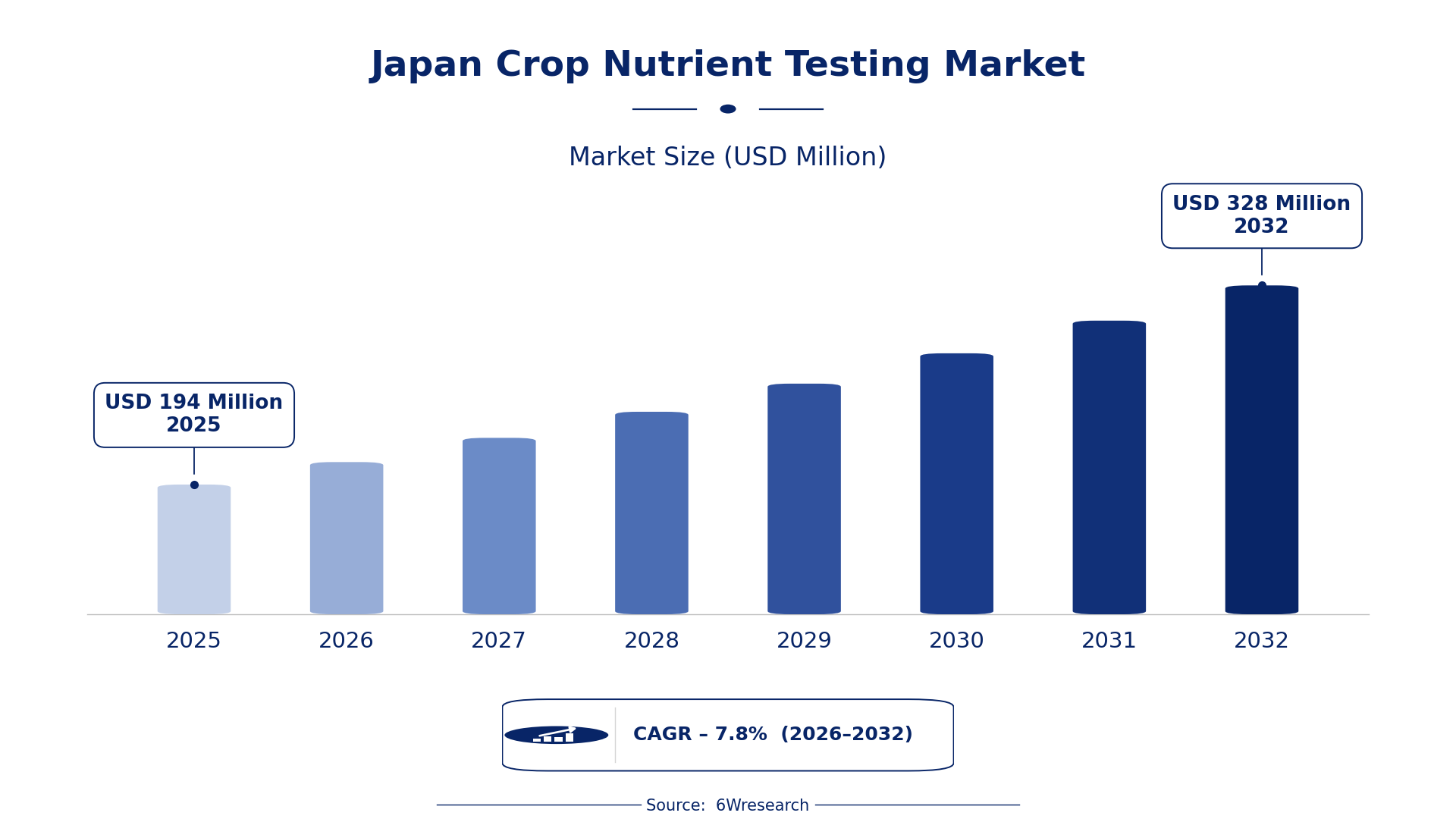
According to 6Wresearch internal database and industry insights, the Japan Crop Nutrient Testing Market was valued at USD 194 Million in 2025 and is projected to reach USD 328 Million by 2032, growing at a CAGR of approximately 7.8% during 2026–2032.
Japan Crop Nutrient Testing Market Highlights
| Report Metric | Details |
| Report Name | Japan Crop Nutrient Testing Market (2026-2032) |
| Market Size 2025 | USD 194 Million |
| Market Size 2032 | USD 328 Million |
| Absolute Growth 2025–2032 | USD 134 Million |
| CAGR 2026–2032 | 7.8% |
| Peak Annual Growth | 8.8% in 2028 |
| Forecast Period | 2026–2032 |
| Historical Data | 2022–2025 |
| Base Year | 2025 |
| Leading Test Type, 2025 | Soil Nutrient (44% share) |
| Leading Methodology, 2025 | Spectrometry (46% share) |
| Leading Sample Type, 2025 | Soil Samples (47% share) |
| Leading End User, 2025 | Fertilizer Companies (46% share) |
| Fastest-Growing Test Type | Plant Tissue (10.7% CAGR) |
| Fastest-Growing Methodology | Chromatography (11.0% CAGR) |
| Fastest-Growing Sample Type | Leaf Samples (11.2% CAGR) |
| Fastest-Growing End User | Agro Research (9.8% CAGR) |
| Growing Sector | Agro Research |
| Key End Users | Fertilizer Companies, Agro Research, Farmers, Food Producers |
Japan Crop Nutrient Testing Market Year-wise Growth Rate and Key Drivers (2022–2032)
This graph illustrates the annual growth rates of the market from 2022 to 2032, highlighting a steady upward trajectory and projected market expansion over the forecast period.
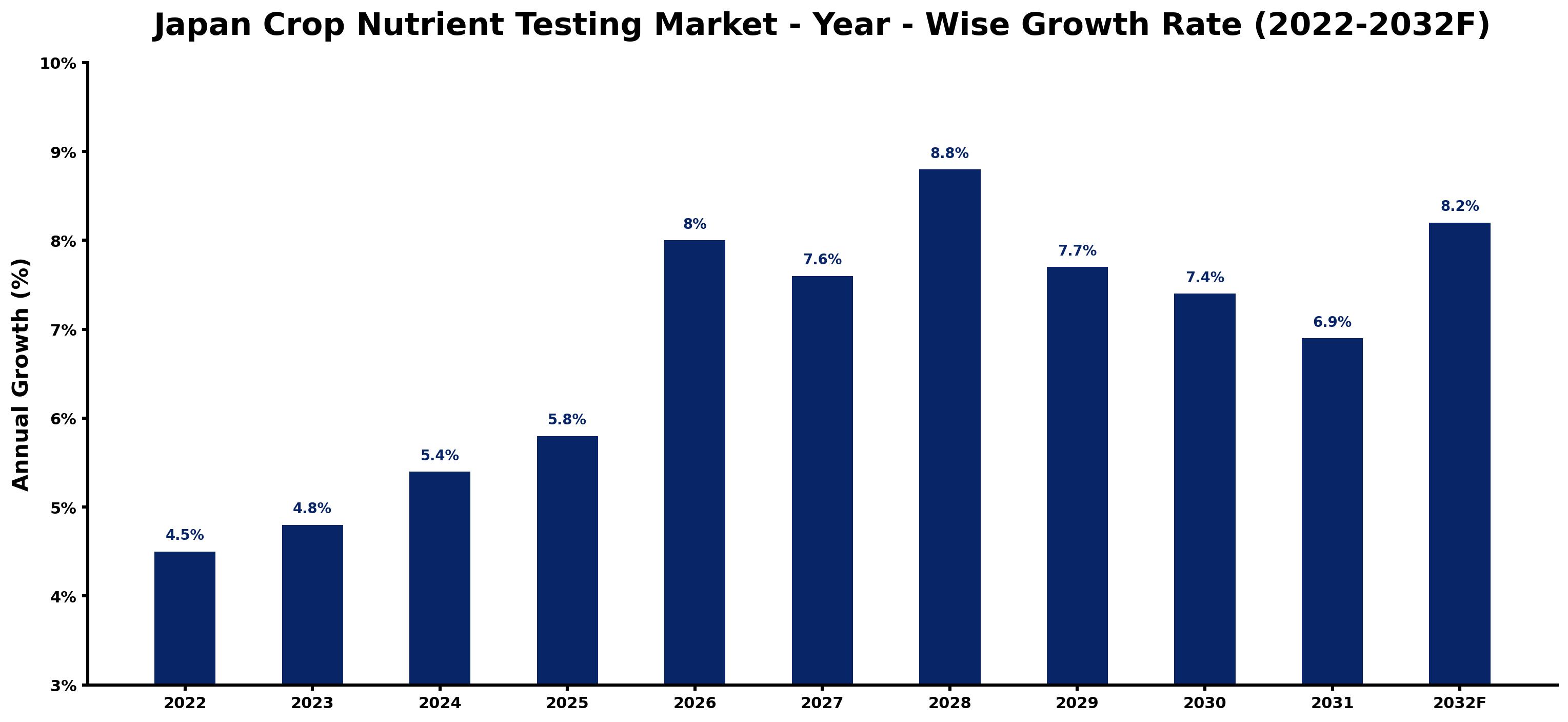
For each year, the table pairs the estimated growth rate with the leading influence on demand, showing how the drivers changed across the period.
| Year | Estimated Annual Growth (%) | Market Rationale |
| 2022 | 4.5 | The agricultural sector maintained steady operations, with nutrient testing already established. |
| 2023 | 4.8 | Increased awareness of sustainable practices led to a rise in nutrient testing adoption. |
| 2024 | 5.4 | Technological advancements in testing methodologies contributed to faster growth rates. |
| 2025 | 5.8 | The peak growth year saw heightened demand for soil nutrient analysis in rice production. |
| 2026 | 8.0 | Rising investments in agricultural innovation will drive demand for testing services. |
| 2027 | 7.6 | A slight slowdown is expected as the market adjusts to previous rapid growth. |
| 2028 | 8.8 | The introduction of new testing technologies will spur renewed interest and demand. |
| 2029 | 7.7 | Market growth is projected to slow as saturation in certain regions begins to take effect. |
| 2030 | 7.4 | Continued focus on sustainable practices will maintain steady growth in nutrient testing. |
| 2031 | 6.9 | The market is expected to experience another slowdown as growth rates stabilise. |
| 2032 | 8.2 | An increase in organic farming practices will boost demand for nutrient testing. |
Note: Market size estimations and growth projections presented in this report are based on 6Wresearch's proprietary forecasting methodology, utilizing the latest available industry data, government publications, and primary research inputs.
Japan Crop Nutrient Testing Market Synopsis
Crop nutrient testing involves analysing soil, plant, and water samples to assess nutrient content and deficiencies. The Japan Crop Nutrient Testing Market is growing as farmers increasingly recognise the importance of sustainable practices, with over 60% utilising some form of testing. The government's ¥5 billion investment in agricultural innovation and the push for sustainable farming practices are key growth drivers, particularly in regions like Tohoku, known for rice production.
Market Dynamics Impact Analysis (2026–2032)
| Factor | Type | Impact | Primary Segment Affected |
| Growing focus on sustainable agriculture practices | Driver | High | Soil Nutrient |
| Technological advancements in testing methodologies | Driver | High | Spectrometry |
| Increasing investments in agricultural innovation | Opportunity | High | Agro Research |
| Rising demand for organic farming solutions | Opportunity | High | Plant Tissue |
| High costs associated with advanced testing technologies | Restraint | Medium | Lab Analysis |
| Limited accessibility of testing services in rural areas | Restraint | Medium | Soil Samples |
| Aging farmer population leading to a skills gap | Challenge | High | Farmers |
| Competition from alternative agricultural practices | Challenge | Medium | Fertilizer Companies |
Evaluation of Drivers in Japan Crop Nutrient Testing Market (2026–2032)
The factors lifting demand, and the evidence behind each, are summarised below.
| Drivers | Primary Segment Affected | Why It Matters (Evidence) |
| Increased adoption of precision agriculture techniques | Soil Nutrient | This method optimises fertilizer application, with over 60% of farmers utilising nutrient testing to enhance crop management. |
| Technological advancements in testing methods | Spectrometry | The widespread use of spectrometry has improved accuracy, with agro-research institutions conducting over 100,000 tests annually. |
| Government investment in agricultural innovation | Agro Research | In 2023, Japan invested ¥5 billion in agricultural technologies, boosting demand for nutrient testing services. |
| Rising consumer demand for organic produce | Plant Tissue | Farmers are increasingly testing plant tissue to ensure quality, aligning with the government's goal of reducing chemical fertilizer use by 30% by 2030. |
| Growing focus on food security | Water Quality | Japan’s population of approximately 126 million drives the need for quality irrigation water testing to support agricultural sustainability. |
Much of the new demand traces back to the increasing adoption of precision agriculture techniques, with over 60% of farmers utilising nutrient testing to improve crop management. Technological advancements in testing methods have improved accuracy, enabling agro-research institutions to conduct over 100,000 tests annually. Japan's investment of ¥5 billion in agricultural innovation in 2023 has further boosted demand for testing services. Rising consumer demand for organic produce prompts farmers to test plant tissue to ensure quality, aligning with the goal of reducing chemical fertilizer use by 30% by 2030. The growing focus on food security, driven by Japan's population of approximately 126 million, necessitates quality irrigation water testing to support agricultural sustainability.
Evaluation of Restraints in Japan Crop Nutrient Testing Market
These are the pressures that could keep growth below its potential.
| Market Restraint | Primary Segment Affected | Why It Matters (Evidence) |
| Limited access to advanced testing technology | Soil Nutrient | This restricts farmers' ability to obtain accurate nutrient analysis, impacting crop yields. |
| High costs associated with nutrient testing | Plant Tissue | Many farmers find it difficult to invest in nutrient testing, which can exceed ¥100,000 per farm. |
| Regulatory delays in testing processes | Water Quality | Stringent regulations can slow down the testing timeline. |
| Aging farmer population | Soil Samples | The average age of farmers at 67 complicates the adoption of new testing methods. |
| Limited awareness of testing benefits | Lab Analysis | Some farmers remain unaware of how nutrient testing can improve agricultural sustainability. |
Japan Crop Nutrient Testing Market Challenges
A lack of advanced technology for nutrient analysis hampers accurate assessments, leading to inefficient fertilizer application for producers. Regulatory compliance with the Fertilizer Control Law introduces delays in testing, which affects timely crop management for agro-research institutions. High costs associated with nutrient analysis, averaging ¥100,000 per test, deter many producers from adopting precision agriculture techniques. The aging farmer population, with an average age of 67, complicates the implementation of modern testing methods, resulting in lower crop yields and threatening agricultural sustainability.
Trends in the Japan Crop Nutrient Testing Market
Below are the shifts with the largest effect on the Japan Crop Nutrient Testing Market.
- Shift Towards Sustainable Practices: Farmers are increasingly adopting sustainable farming techniques, supported by government initiatives and consumer demand. In 2023, over 60% of farmers engaged in nutrient testing to align with sustainable practices.
- Transition from Traditional to Precision Agriculture: Since 2023, there has been a notable shift towards precision agriculture, with farmers using technology for better crop management. This transition is supported by increased investment in agricultural innovation.
- Emergence of Organic Farming: The rise in organic farming practices has led to a growing need for nutrient testing. In 2023, the government aimed to reduce chemical fertilizer use by 30% by 2030.
- Growing Urban Farming Initiatives: The Tokyo Metropolitan Government has promoted urban farming initiatives since 2023, which include support for nutrient testing. This shift is reshaping local agricultural practices.
Investment Opportunities in the Japan Crop Nutrient Testing Market
The opportunities below stand out in the Japan Crop Nutrient Testing Market for new entrants and existing suppliers.
- Investment in Testing Technologies: With the government's investment of ¥5 billion in agricultural innovation, there is a pressing need for advanced testing technologies. Agro-research institutions can benefit from partnerships to improve testing capabilities.
- Expansion in Urban Farming: Urban farming initiatives are on the rise, particularly in Tokyo, where nutrient testing support is essential. Suppliers can enter this market by collaborating with local agricultural bodies.
- Focus on Organic Farming Solutions: As organic farming grows, farmers require nutrient testing solutions to ensure quality. Suppliers can tap into this demand by offering tailored testing services.
- Development of Precision Agriculture Tools: The increasing adoption of precision agriculture creates opportunities for suppliers to develop innovative testing tools. Collaborating with agro-research institutions can facilitate market entry.
Government Initiatives in the Japan Crop Nutrient Testing Market
The Waste Management and Public Cleansing Act of 1970 ensures that waste is properly treated and disposed of, preventing contamination of agricultural land, which is essential for accurate nutrient testing. The Food Recycling Law of 2000 mandates food businesses to recycle waste into fertiliser, promoting sustainable practices in agriculture and supporting nutrient testing efforts.
The Ministry of Agriculture, Forestry and Fisheries oversees agricultural testing standards and funds initiatives to improve testing capabilities. The agency supports research projects that develop nutrient testing technologies, ensuring compliance with national standards.
Future Insight of the Japan Crop Nutrient Testing Market
Technological advancements in nutrient analysis will improve efficiency, allowing for quicker results that benefit buyers and suppliers. A government programme promoting sustainable farming practices will drive the adoption of eco-friendly methods, reducing reliance on chemical fertilizers. Increased investment in agricultural innovation, amounting to ¥5 billion, will strengthen testing capabilities, aiding agro-research institutions. By 2032, urban farming initiatives will further integrate nutrient analysis, supporting Japan's commitment to food security and agricultural sustainability.
Market Segmentation Analysis
Japan Crop Nutrient Testing Market report covers a detailed analysis of the following market segments:
By Test Type – Soil Nutrient Leads, Plant Tissue Expected to Grow Fastest
According to Saurav Kr Singh, Senior Research Analyst at 6Wresearch, Soil Nutrient accounted for 44% of the market by test type in 2025. Soil nutrient testing holds the largest share due to its essential role in assessing soil health and nutrient levels, particularly for rice production, which constitutes 20% of Japan's agriculture. With over 60% of farmers utilising this method, it underscores its importance in the agricultural sector. Plant Tissue is set to record the highest CAGR in this split, 10.7% over 2026–2032. The plant tissue testing segment is experiencing rapid growth as it is critical for determining nutrient uptake in crops, aligning with the increasing adoption of precision agriculture techniques. This growth is further supported by government initiatives promoting sustainable farming practices, ensuring its relevance. Suppliers should enhance their offerings in plant tissue testing to accommodate the rising demand from farmers.
By Methodology – Spectrometry Leads, Chromatography Expected to Grow Fastest
With 46% of methodology revenue in 2025, Spectrometry was the largest category. Spectrometry leads the market due to its extensive use for precise nutrient analysis, making it a preferred choice among testing laboratories. Its reliability is vital for meeting the standards established by the Ministry of Agriculture, Forestry and Fisheries, ensuring quality in testing. Over 2026–2032, Chromatography is expected to post the fastest growth, at a CAGR of 11.0%. Chromatography is the fastest-growing methodology as it is commonly employed for separating and analysing compounds, which is increasingly necessary due to the complexity of agricultural inputs. This trend reflects the industry's demand for detailed nutrient profiling, enhancing testing capabilities. Buyers should invest in chromatography services to maintain competitiveness in nutrient analysis.
By Sample Type – Soil Samples Lead, Leaf Samples Expected to Grow Fastest
In 2025, Soil Samples led the sample type split with a 47% share. Soil samples dominate the market as the primary sample type for nutrient assessment, crucial for optimising fertilizer application across Japan's 4 million hectares of arable land. This method is integral to the practices of many agro-research institutions conducting extensive testing. Leaf Samples are projected to grow fastest, at a CAGR of 11.2% during 2026–2032. Leaf samples are rapidly gaining importance as they are used to evaluate nutrient status in plants, particularly with the rising focus on organic fertilizers. This trend highlights the need for more comprehensive testing solutions as farming practices evolve. Suppliers must expand their capabilities in leaf sample testing to meet the evolving demands of farmers.
By End User – Fertilizer Companies Lead, Agro Research Expected to Grow Fastest
Fertilizer Companies took 46% of end user revenue in 2025, more than any other category. Fertilizer companies account for the largest share of the market as they utilise testing to refine product formulations, directly influencing crop yields and sustainability. Their substantial investment in nutrient testing is driven by regulatory requirements and competitive pressures in the agricultural sector. The quickest growth will come from Agro Research, forecast to expand at a CAGR of 9.8% between 2026 and 2032. The agro research segment is experiencing the fastest growth as it conducts testing for research and development, which is crucial for advancing agricultural practices. This growth is bolstered by government investments in agricultural innovation, ensuring ongoing relevance. Suppliers should target agro-research institutions to seize opportunities in this expanding segment.
Key Attractiveness of the Report
- 10 Years of Market Numbers
- Historical Data Starting from 2022 to 2025
- Base Year 2025
- Forecast Data until 2032
- Key Performance Indicators Impacting the Market
- Major Upcoming Developments and Projects
Key Highlights of the Report:
- Japan Crop Nutrient Testing Market Outlook
- Market Size of Japan Crop Nutrient Testing Market, 2025
- Forecast of Japan Crop Nutrient Testing Market, 2032
- Historical Data and Forecast of Japan Crop Nutrient Testing Revenues & Volume for the Period 2022-2032F
- Japan Crop Nutrient Testing Market Trend Evolution
- Japan Crop Nutrient Testing Market Drivers and Challenges
- Japan Crop Nutrient Testing Price Trends
- Japan Crop Nutrient Testing Porter's Five Forces
- Japan Crop Nutrient Testing Industry Life Cycle
- Historical Data and Forecast of Japan Crop Nutrient Testing Market Revenues & Volume By Test Type for the Period 2022-2032F
- Historical Data and Forecast of Japan Crop Nutrient Testing Market Revenues & Volume By Soil Nutrient for the Period 2022-2032F
- Historical Data and Forecast of Japan Crop Nutrient Testing Market Revenues & Volume By Plant Tissue for the Period 2022-2032F
- Historical Data and Forecast of Japan Crop Nutrient Testing Market Revenues & Volume By Water Quality for the Period 2022-2032F
- Historical Data and Forecast of Japan Crop Nutrient Testing Market Revenues & Volume By Fertilizer Residue for the Period 2022-2032F
- Historical Data and Forecast of Japan Crop Nutrient Testing Market Revenues & Volume By Methodology for the Period 2022-2032F
- Historical Data and Forecast of Japan Crop Nutrient Testing Market Revenues & Volume By Spectrometry for the Period 2022-2032F
- Historical Data and Forecast of Japan Crop Nutrient Testing Market Revenues & Volume By Chromatography for the Period 2022-2032F
- Historical Data and Forecast of Japan Crop Nutrient Testing Market Revenues & Volume By Titration for the Period 2022-2032F
- Historical Data and Forecast of Japan Crop Nutrient Testing Market Revenues & Volume By Lab Analysis for the Period 2022-2032F
- Historical Data and Forecast of Japan Crop Nutrient Testing Market Revenues & Volume By Sample Type for the Period 2022-2032F
- Historical Data and Forecast of Japan Crop Nutrient Testing Market Revenues & Volume By Soil Samples for the Period 2022-2032F
- Historical Data and Forecast of Japan Crop Nutrient Testing Market Revenues & Volume By Leaf Samples for the Period 2022-2032F
- Historical Data and Forecast of Japan Crop Nutrient Testing Market Revenues & Volume By Irrigation Water for the Period 2022-2032F
- Historical Data and Forecast of Japan Crop Nutrient Testing Market Revenues & Volume By Post-Harvest for the Period 2022-2032F
- Historical Data and Forecast of Japan Crop Nutrient Testing Market Revenues & Volume By End User for the Period 2022-2032F
- Historical Data and Forecast of Japan Crop Nutrient Testing Market Revenues & Volume By Fertilizer Companies for the Period 2022-2032F
- Historical Data and Forecast of Japan Crop Nutrient Testing Market Revenues & Volume By Agro Research for the Period 2022-2032F
- Historical Data and Forecast of Japan Crop Nutrient Testing Market Revenues & Volume By Farmers for the Period 2022-2032F
- Historical Data and Forecast of Japan Crop Nutrient Testing Market Revenues & Volume By Food Producers for the Period 2022-2032F
- Japan Crop Nutrient Testing Import Export Trade Statistics
- Market Opportunity Assessment By Test Type
- Market Opportunity Assessment By Methodology
- Market Opportunity Assessment By Sample Type
- Market Opportunity Assessment By End User
- Japan Crop Nutrient Testing Top Companies Market Share
- Japan Crop Nutrient Testing Competitive Benchmarking By Technical and Operational Parameters
- Japan Crop Nutrient Testing Company Profiles
- Japan Crop Nutrient Testing Key Strategic Recommendations
Market Covered
The following segment groups are covered in the report.
By Test Type
- Soil Nutrient
- Plant Tissue
- Water Quality
- Fertilizer Residue
By Methodology
- Spectrometry
- Chromatography
- Titration
- Lab Analysis
By Sample Type
- Soil Samples
- Leaf Samples
- Irrigation Water
- Post-Harvest
By End User
- Fertilizer Companies
- Agro Research
- Farmers
- Food Producers






































