Japan Crop Nutrition Market Size & Growth Rate
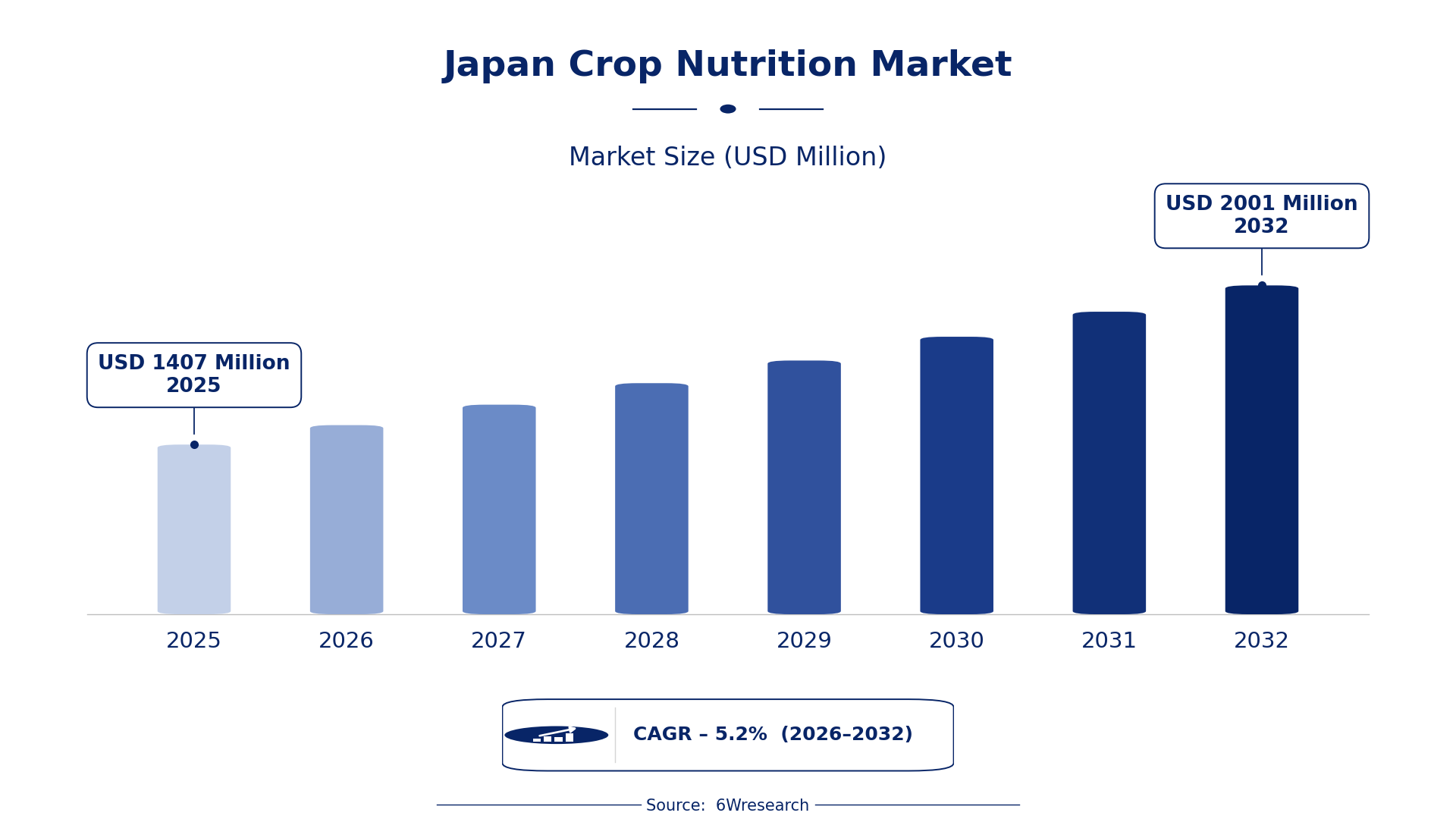
According to 6Wresearch internal database and industry insights, the Japan Crop Nutrition Market was valued at USD 1,407 Million in 2025 and is projected to reach USD 2,001 Million by 2032, growing at a CAGR of approximately 5.2% during 2026–2032.
Japan Crop Nutrition Market Highlights
| Report Metric | Details |
| Report Name | Japan Crop Nutrition Market (2026-2032) |
| Market Size 2025 | USD 1,407 Million |
| Market Size 2032 | USD 2,001 Million |
| Absolute Growth 2025–2032 | USD 594 Million |
| CAGR 2026–2032 | 5.2% |
| Peak Annual Growth | 6.4% in 2028 |
| Forecast Period | 2026–2032 |
| Historical Data | 2022–2025 |
| Base Year | 2025 |
| Leading Nutrient Type, 2025 | Macronutrients (51% share) |
| Leading Delivery System, 2025 | Granular (54% share) |
| Leading Composition, 2025 | NPK (42% share) |
| Leading End User, 2025 | Large Farms (44% share) |
| Fastest-Growing Nutrient Type | Organic Inputs (7.3% CAGR) |
| Fastest-Growing Delivery System | Liquid (7.6% CAGR) |
| Fastest-Growing Composition | Seaweed (6.8% CAGR) |
| Fastest-Growing End User | Organic Farms (6.7% CAGR) |
| Growing Sector | Organic Farming |
| Key End Users | Large Farms, Agro Dealers, Organic Farms |
Japan Crop Nutrition Market Year-wise Growth Rate and Key Drivers (2022–2032)
This graph illustrates the annual growth rates of the market from 2022 to 2032, highlighting a steady upward trajectory and projected market expansion over the forecast period.
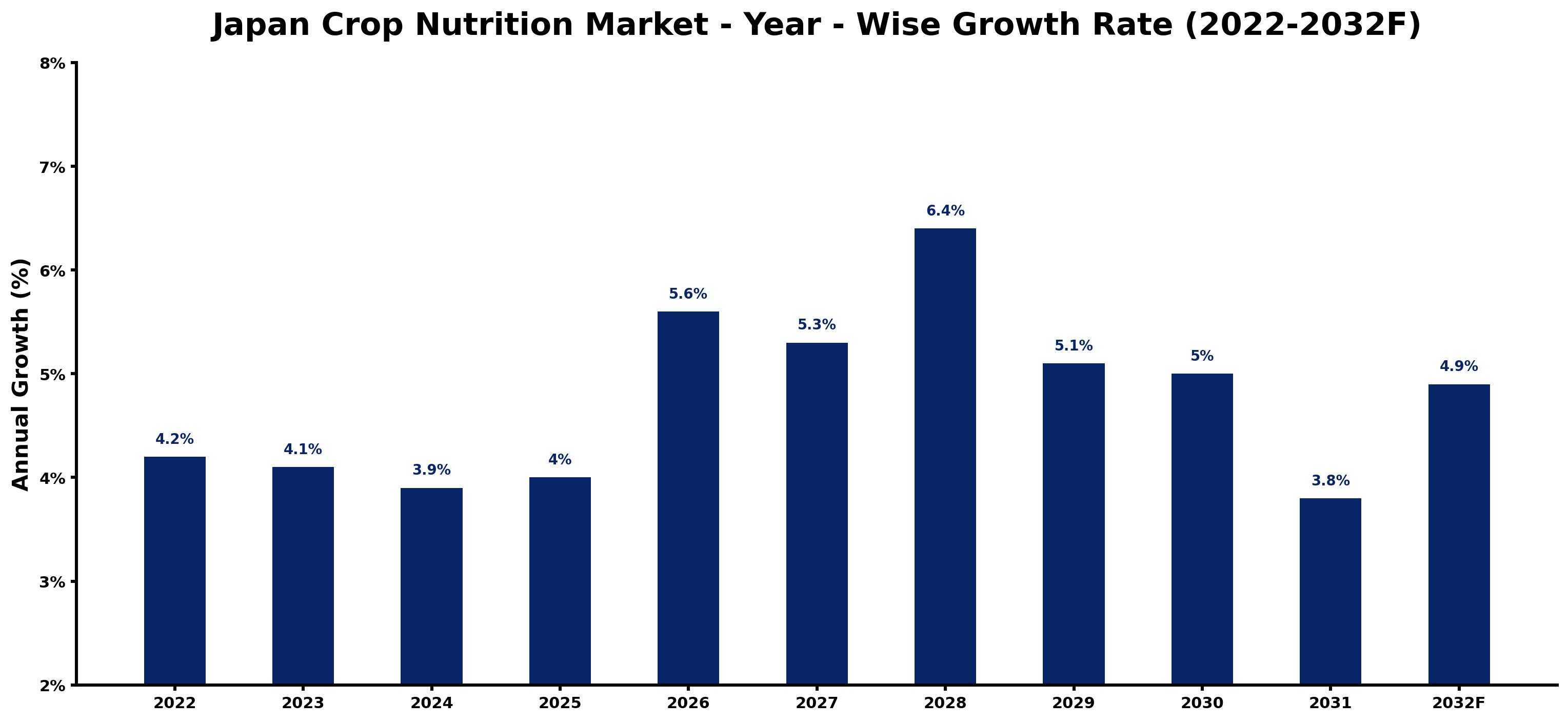
Below, each year's estimated growth is shown next to the factor that most influenced it.
| Year | Estimated Annual Growth (%) | Market Rationale |
| 2022 | 4.2 | The agricultural sector showed stable demand, reflecting ongoing investments in crop yields. |
| 2023 | 4.1 | Growth slowed slightly as farmers adjusted to market conditions and input costs. |
| 2024 | 3.9 | Growth moderated as farmers adopted new practices, maintaining positive demand in the sector. |
| 2025 | 4.0 | Increased demand for fertilizers emerged as crop health became a priority. |
| 2026 | 5.6 | Higher growth is expected to be driven by rising interest in sustainable farming techniques. |
| 2027 | 5.3 | Growth is projected to moderate as the market adjusts to supply chain changes. |
| 2028 | 6.4 | Strong demand is anticipated as farmers seek to maximise yields in competitive markets. |
| 2029 | 5.1 | A slowdown is expected as market saturation begins to affect growth rates. |
| 2030 | 5.0 | Growth is projected to slow again as farmers face challenges in sourcing inputs. |
| 2031 | 3.8 | Continued adjustments in farming practices will lead to a further slowdown in growth. |
| 2032 | 4.9 | A resurgence in growth is expected as sustainable practices gain traction. |
Note: Market size estimations and growth projections presented in this report are based on 6Wresearch's proprietary forecasting methodology, utilizing the latest available industry data, government publications, and primary research inputs.
Japan Crop Nutrition Market Synopsis
Crop nutrition encompasses essential nutrients supplied to plants primarily through fertilizers, produced via chemical synthesis or organic processes. The Japan Crop Nutrition Market is driven by large farms and agro dealers responding to rising consumer demand for quality produce. Factors such as increased fertilizer application rates, government initiatives promoting sustainable agriculture, and the projected growth of organic farming to 3% of total farmland by 2030 are propelling market expansion.
Market Dynamics Impact Analysis (2026–2032)
| Factor | Type | Impact | Primary Segment Affected |
| Increasing adoption of sustainable farming practices | Driver | High | Organic Inputs |
| Growing demand for high-value crops | Driver | High | Foliar Nutrition |
| Rising interest in organic fertilizers | Opportunity | High | Organic Inputs |
| Expansion of agro dealer networks in urban areas | Opportunity | Medium | Granular |
| Aging farming population affecting productivity | Restraint | High | Large Farms |
| Dependence on imports for specialized nutrients | Restraint | Medium | Micronutrients |
| High costs of organic certification processes | Challenge | High | Organic Inputs |
| Limited awareness of advanced fertilization techniques | Challenge | Medium | Foliar Nutrition |
Evaluation of Drivers in Japan Crop Nutrition Market (2026–2032)
The factors lifting demand, and the evidence behind each, are summarised below.
| Drivers | Primary Segment Affected | Why It Matters (Evidence) |
| Increased fertilizer application rates | NPK | In 2022, the average fertilizer application rate was about 100 kg/ha, leading to higher purchases by large farms. |
| Government initiatives promoting sustainable agriculture | Organic Inputs | The Japanese government aims to increase organic farming to 3% of total farmland by 2030, boosting demand for organic fertilizers. |
| Growing focus on crop yield enhancement | Foliar Nutrition | The use of foliar nutrition is increasing in high-value crops like fruits and vegetables, driving demand among farmers. |
| Expansion of agro dealer networks | Granular | The Tokyo region has the highest concentration of agro dealers, facilitating access to crop nutrition products. |
| Rising consumer demand for organic produce | Organic Inputs | Organic farming area in Japan reached 400,000 hectares in 2021, increasing the need for organic fertilizers. |
Several shifts outside the market lift sales. The average fertilizer application rate reached approximately 100 kg/ha in 2022, prompting large farms to increase purchases of NPK fertilizers. The use of foliar nutrition is on the rise, particularly in high-value crops, as farmers seek to improve yields. The concentration of agro dealers in the Tokyo region facilitates easier access to granular fertilizers, further supporting market growth.
Evaluation of Restraints in Japan Crop Nutrition Market
These restraints slow adoption and weigh on supplier margins.
| Market Restraint | Primary Segment Affected | Why It Matters (Evidence) |
| Aging farming population affecting productivity | Large Farms | The average age of farmers in Japan is over 67 years, impacting productivity and limiting market growth. |
| Dependence on imports for specialized nutrients | Micronutrients | Japan imports approximately 30% of its fertilizer needs, which can lead to supply chain vulnerabilities. |
| High costs of organic certification processes | Organic Inputs | The costs associated with organic certification can deter farmers from adopting organic fertilizers. |
| Limited awareness of advanced fertilization techniques | Foliar Nutrition | Many farmers lack knowledge about the benefits of foliar nutrition, hindering its adoption. |
| Regulatory hurdles in fertilizer distribution | Granular | Regulations complicate the sale and distribution of fertilizers, affecting market entry. |
Japan Crop Nutrition Market Challenges
In 2022, Japan's agricultural sector contributed approximately 1% to GDP, highlighting a cost burden on farmers who struggle to achieve profitable yields. The average age of farmers exceeds 67 years, leading to skills shortages that hinder the adoption of modern agricultural techniques, delaying productivity improvements for producers. Many farmers depend on outdated technology, which restricts their ability to apply fertilizers effectively, negatively affecting crop health for buyers. Japan imports around 30% of its fertilizer needs, creating supply challenges that disrupt availability for agricultural businesses during critical planting periods.
Trends in the Japan Crop Nutrition Market
Several trends are reshaping the Japan Crop Nutrition Market; the most important are set out below.
- Shift towards Organic Farming Practices: Japan is experiencing a transition towards organic farming, with the organic farming area reaching 400,000 hectares in 2021. This trend reflects a growing consumer preference for organic produce, prompting farmers to adopt organic fertilizers.
- Increase in Foliar Nutrition Usage: The use of foliar nutrition is increasing in high-value crops, particularly in regions like Tokyo. With rising consumer demand for quality produce, farmers are investing in foliar products to improve crop yields.
- Expansion of Agro Dealer Networks: The Tokyo region is seeing an expansion of agro dealer networks, improving access to crop nutrition products. This growth supports farmers in sourcing essential fertilizers, contributing to overall market growth.
- Rising Demand for NPK Fertilizers: NPK fertilizers remain predominant in rice cultivation regions, with their usage reflecting the need for improved crop yields. The agricultural sector's focus on productivity drives continued demand for these fertilizers.
Investment Opportunities in the Japan Crop Nutrition Market
Where to invest in the Japan Crop Nutrition Market: the main openings are set out below.
- Large Farms Seeking Sustainable Solutions: Large farms are increasingly looking for sustainable crop nutrition solutions, especially as organic farming gains traction. With organic farming projected to reach 3% of total farmland by 2030, suppliers can enter through local partnerships.
- Agro Dealers Expanding Product Lines: Agro dealers are expanding their product lines to include organic fertilizers, responding to rising consumer demand. This presents an opportunity for suppliers to collaborate with dealers in urban areas.
- Investment in Advanced Fertilization Technologies: Investments in advanced fertilization technologies are essential as farmers seek to maximise yields. The government’s budget of ¥1 billion for agricultural innovation in 2023 supports this investment opportunity.
- Growing Interest in Foliar Nutrition: Farmers are increasingly adopting foliar nutrition methods, especially in high-value crops. Suppliers can target this segment by providing education and resources to farmers.
Government Initiatives in the Japan Crop Nutrition Market
The Fertilizer Control Law ensures that fertilizers meet specific quality standards, impacting producers as they must comply with regulations to market their products effectively. This law influences the overall quality of crop nutrition available to farmers and ensures safety for consumers.
The Ministry of Agriculture, Forestry and Fisheries (MAFF) oversees agricultural practices and funds initiatives to promote sustainable agriculture. With a budget of ¥1 billion for agricultural innovation in 2023, MAFF supports projects that improve crop nutrition and sustainability.
Future Insight of the Japan Crop Nutrition Market
The rise of precision agriculture technology will transform demand for crop nutrition by 2032, enabling farmers to tailor fertilizer applications to specific crop needs. The government's goal to expand organic farming to 3% of total farmland by 2030 will shift focus towards organic fertilizers, benefiting suppliers. With MAFF's budget of ¥1 billion dedicated to agricultural innovation, advancements in nutrient delivery systems will improve efficiency. Increased emphasis on sustainable practices will drive greater use of nutrient management technologies, positively influencing both buyers and suppliers.
Market Segmentation Analysis
Japan Crop Nutrition Market report covers a detailed analysis of the following market segments:
By Nutrient Type – Macronutrients Lead, Organic Inputs Expected to Grow Fastest
According to Saurav Kr Singh, Senior Research Analyst at 6Wresearch, Macronutrients accounted for 51% of the market by nutrient type in 2025. Macronutrients hold a substantial share of fertilizer consumption in Japan, as they are crucial for plant growth and enhancing crop yields. The strong reliance on NPK fertilizers, particularly in rice cultivation regions, highlights their essential role in agricultural productivity. Over 2026–2032, Organic Inputs are expected to post the fastest growth, at a CAGR of 7.3%. Organic inputs are witnessing rapid growth, spurred by government initiatives that aim to elevate organic farming to 3% of total farmland by 2030. This movement is evidenced by an increasing number of farmers adopting organic fertilizers to meet sustainable farming goals. Suppliers should focus on expanding their organic product lines to meet the rising demand from farmers pursuing sustainable agricultural practices.
By Delivery System – Granular Leads, Liquid Expected to Grow Fastest
The largest delivery system category in 2025 was Granular, at 54% of revenue. Granular fertilizers are widely utilised in Japan, particularly for soil application, making them a staple in the agricultural sector. Their established presence in large-scale farming operations underscores their significance in crop nutrition. Liquid is projected to grow fastest, at a CAGR of 7.6% during 2026–2032. Liquid fertilizers are experiencing rapid growth due to their effectiveness in fertigation and foliar feeding, which are increasingly preferred methods among modern farmers. This trend is indicative of a broader shift towards more efficient application methods. Buyers may benefit from exploring liquid options to improve nutrient delivery and maximise crop yields.
By Composition – NPK Leads, Seaweed Expected to Grow Fastest
In 2025, NPK led the composition split with a 42% share. NPK fertilizers dominate the market as the most widely used type, essential for meeting the nutritional needs of various crops across Japan. Their established usage in conventional farming practices solidifies their leading position in the market. The quickest growth will come from Seaweed, forecast to expand at a CAGR of 6.8% between 2026 and 2032. Seaweed-based fertilizers are gaining traction, particularly in organic farming practices, as they align with the growing trend towards sustainable agriculture. This niche market is likely to expand as more farmers seek eco-friendly alternatives. Suppliers should consider diversifying their offerings to include seaweed-based products to cater to the increasing demand for organic solutions.
By End User – Large Farms Lead, Organic Farms Expected to Grow Fastest
Large Farms took 44% of end user revenue in 2025, more than any other category. Large farms are the primary consumers of crop nutrition products, significantly shaping market trends due to their extensive agricultural operations. Their substantial demand for fertilizers reflects their vital role in maintaining agricultural output across Japan. Organic Farms are set to record the highest CAGR in this split, 6.7% over 2026–2032. Organic farms are progressively incorporating organic fertilizers, signalling a shift towards sustainable farming practices among producers. This trend is expected to gain momentum as more farmers transition to organic methods, increasing their market influence. Suppliers must adapt their strategies to effectively cater to the growing organic farming segment and its specific nutrient needs.
Key Attractiveness of the Report
- 10 Years of Market Numbers
- Historical Data Starting from 2022 to 2025
- Base Year 2025
- Forecast Data until 2032
- Key Performance Indicators Impacting the Market
- Major Upcoming Developments and Projects
Key Highlights of the Report:
- Japan Crop Nutrition Market Outlook
- Market Size of Japan Crop Nutrition Market, 2025
- Forecast of Japan Crop Nutrition Market, 2032
- Historical Data and Forecast of Japan Crop Nutrition Revenues & Volume for the Period 2022-2032F
- Japan Crop Nutrition Market Trend Evolution
- Japan Crop Nutrition Market Drivers and Challenges
- Japan Crop Nutrition Price Trends
- Japan Crop Nutrition Porter's Five Forces
- Japan Crop Nutrition Industry Life Cycle
- Historical Data and Forecast of Japan Crop Nutrition Market Revenues & Volume By Nutrient Type for the Period 2022-2032F
- Historical Data and Forecast of Japan Crop Nutrition Market Revenues & Volume By Macronutrients for the Period 2022-2032F
- Historical Data and Forecast of Japan Crop Nutrition Market Revenues & Volume By Micronutrients for the Period 2022-2032F
- Historical Data and Forecast of Japan Crop Nutrition Market Revenues & Volume By Organic Inputs for the Period 2022-2032F
- Historical Data and Forecast of Japan Crop Nutrition Market Revenues & Volume By Foliar Nutrition for the Period 2022-2032F
- Historical Data and Forecast of Japan Crop Nutrition Market Revenues & Volume By Delivery System for the Period 2022-2032F
- Historical Data and Forecast of Japan Crop Nutrition Market Revenues & Volume By Granular for the Period 2022-2032F
- Historical Data and Forecast of Japan Crop Nutrition Market Revenues & Volume By Liquid for the Period 2022-2032F
- Historical Data and Forecast of Japan Crop Nutrition Market Revenues & Volume By Bio-Based for the Period 2022-2032F
- Historical Data and Forecast of Japan Crop Nutrition Market Revenues & Volume By Spray for the Period 2022-2032F
- Historical Data and Forecast of Japan Crop Nutrition Market Revenues & Volume By Composition for the Period 2022-2032F
- Historical Data and Forecast of Japan Crop Nutrition Market Revenues & Volume By NPK for the Period 2022-2032F
- Historical Data and Forecast of Japan Crop Nutrition Market Revenues & Volume By Fe, Zn, Mn for the Period 2022-2032F
- Historical Data and Forecast of Japan Crop Nutrition Market Revenues & Volume By Seaweed, Compost for the Period 2022-2032F
- Historical Data and Forecast of Japan Crop Nutrition Market Revenues & Volume By Chelated Mixes for the Period 2022-2032F
- Historical Data and Forecast of Japan Crop Nutrition Market Revenues & Volume By End User for the Period 2022-2032F
- Historical Data and Forecast of Japan Crop Nutrition Market Revenues & Volume By Large Farms for the Period 2022-2032F
- Historical Data and Forecast of Japan Crop Nutrition Market Revenues & Volume By Smallholders for the Period 2022-2032F
- Historical Data and Forecast of Japan Crop Nutrition Market Revenues & Volume By Organic Farms for the Period 2022-2032F
- Historical Data and Forecast of Japan Crop Nutrition Market Revenues & Volume By Agro Dealers for the Period 2022-2032F
- Japan Crop Nutrition Import Export Trade Statistics
- Market Opportunity Assessment By Nutrient Type
- Market Opportunity Assessment By Delivery System
- Market Opportunity Assessment By Composition
- Market Opportunity Assessment By End User
- Japan Crop Nutrition Top Companies Market Share
- Japan Crop Nutrition Competitive Benchmarking By Technical and Operational Parameters
- Japan Crop Nutrition Company Profiles
- Japan Crop Nutrition Key Strategic Recommendations
Market Covered
Segments analysed in this report are listed below.
By Nutrient Type
- Macronutrients
- Micronutrients
- Organic Inputs
- Foliar Nutrition
By Delivery System
- Granular
- Liquid
- Bio-Based
- Spray
By Composition
- NPK
- Fe
- Zn
- Mn
- Seaweed
- Compost
- Chelated Mixes
By End User
- Large Farms
- Smallholders
- Organic Farms
- Agro Dealers






































