Japan Crop Protection Additives Market Size & Growth Rate
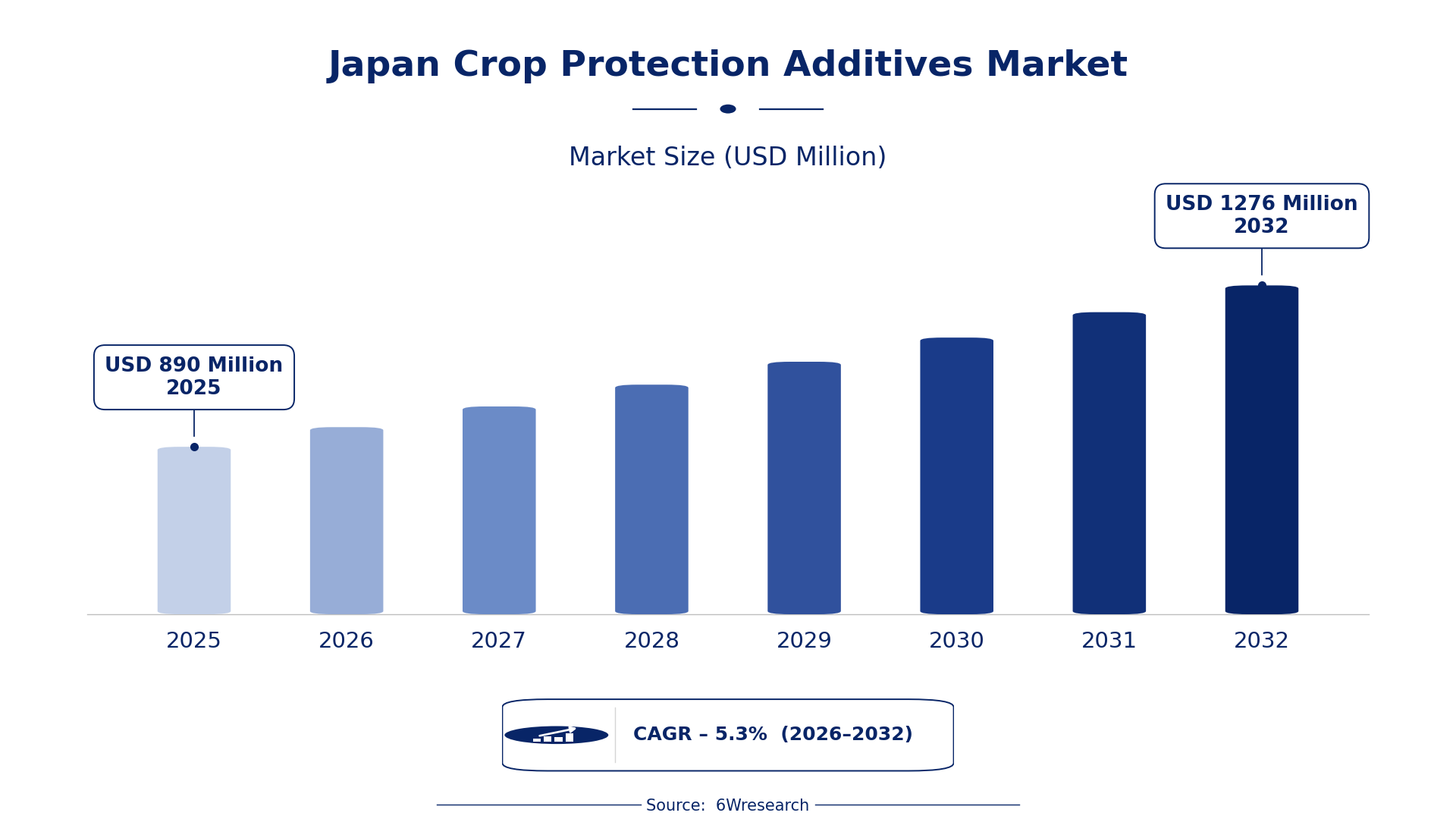
According to 6Wresearch internal database and industry insights, the Japan Crop Protection Additives Market was valued at USD 890 Million in 2025 and is projected to reach USD 1,276 Million by 2032, growing at a CAGR of approximately 5.3% during 2026–2032.
Japan Crop Protection Additives Market Highlights
| Report Metric | Details |
| Report Name | Japan Crop Protection Additives Market (2026-2032) |
| Market Size 2025 | USD 890 Million |
| Market Size 2032 | USD 1,276 Million |
| Absolute Growth 2025–2032 | USD 386 Million |
| CAGR 2026–2032 | 5.3% |
| Peak Annual Growth | 6.4% in 2032 |
| Forecast Period | 2026–2032 |
| Historical Data | 2022–2025 |
| Base Year | 2025 |
| Leading Additive Type, 2025 | Surfactants (36% share) |
| Leading Functionality, 2025 | Spray Retention (53% share) |
| Leading Application Form, 2025 | Liquid (51% share) |
| Leading End User, 2025 | Pesticide Makers (37% share) |
| Fastest-Growing Additive Type | Drift Control Agents (7.5% CAGR) |
| Fastest-Growing Functionality | Droplet Control (7.0% CAGR) |
| Fastest-Growing Application Form | Concentrate (7.2% CAGR) |
| Fastest-Growing End User | Agrochemical Firms (6.9% CAGR) |
| Growing Sector | agricultural production |
| Key End Users | Pesticide Makers, Agrochemical Firms, Farmers |
Japan Crop Protection Additives Market Year-wise Growth Rate and Key Drivers (2022–2032)
This graph illustrates the annual growth rates of the market from 2022 to 2032, highlighting a steady upward trajectory and projected market expansion over the forecast period.

Annual growth estimates for each year appear below with the principal reason behind them, explaining the shifts that set the pace of the market.
| Year | Estimated Annual Growth (%) | Market Rationale |
| 2022 | 0.1 | The market experienced minimal growth due to stable demand from pesticide makers. |
| 2023 | 1.3 | Demand increased as agrochemical firms adopted new formulations and practices. |
| 2024 | 2.1 | Growth continued as farmers sought more effective crop protection solutions. |
| 2025 | 2.8 | The market saw improved performance driven by rising pesticide production. |
| 2026 | 5.7 | The pace of growth is expected to accelerate as demand for surfactants surges among users. |
| 2027 | 5.1 | Growth is projected to slow slightly as the market adjusts to new supply capacities. |
| 2028 | 4.4 | Demand is expected to continue growing, albeit at a slower rate than the previous year. |
| 2029 | 5.6 | The market is projected to rebound with increased interest in drift control agents. |
| 2030 | 5.5 | Growth is expected to decelerate as the market stabilises after previous peaks. |
| 2031 | 4.3 | The pace of growth is projected to slow as the market reaches a more mature phase. |
| 2032 | 6.4 | The market is expected to peak as sustainable practices gain traction among buyers. |
Note: Market size estimations and growth projections presented in this report are based on 6Wresearch's proprietary forecasting methodology, utilizing the latest available industry data, government publications, and primary research inputs.
Japan Crop Protection Additives Market Synopsis
Crop protection additives are chemical substances used to improve the effectiveness of pesticides and herbicides, particularly in spray retention and droplet control. The Japan Crop Protection Additives Market is growing due to rising agricultural production and a focus on sustainable practices. In 2023, a new programme promoting sustainable agriculture is expected to drive demand further, particularly from pesticide makers and agrochemical firms engaged in agricultural production.
Market Dynamics Impact Analysis (2026–2032)
| Factor | Type | Impact | Primary Segment Affected |
| Increasing demand for effective pest management solutions | Driver | High | Surfactants |
| Growing adoption of sustainable agricultural practices | Driver | High | Drift Control Agents |
| Rising interest in formulations that improve pesticide efficiency | Opportunity | Medium | Wetting Agents |
| Expansion of agrochemical firms seeking innovative additives | Opportunity | Medium | Agrochemical Firms |
| Stringent environmental regulations affecting product formulations | Restraint | High | pH Modifiers |
| Limited awareness of benefits among small-scale farmers | Restraint | Medium | Farmers |
| Supply chain disruptions affecting additive availability | Challenge | High | Distributors |
| High production costs for advanced formulations | Challenge | Medium | Pesticide Makers |
Evaluation of Drivers in Japan Crop Protection Additives Market (2026–2032)
These are the developments adding the most demand over the forecast period.
| Drivers | Primary Segment Affected | Why It Matters (Evidence) |
| Rising agricultural production in Japan | Surfactants | In 2022, Japan produced around 150,000 tons of pesticides, increasing demand for additives that improve efficacy. |
| Focus on sustainable practices among farmers | Drift Control Agents | The 2023 programme to promote sustainable agriculture encourages the use of additives that minimise drift. |
| Need for improved pesticide performance | Wetting Agents | As the average farm size is about 1.5 hectares, farmers seek additives that maximise coverage on smaller plots. |
| Technological advancements in agrochemicals | Spray Retention | Recent innovations in additives are driving demand for better product formulations in the crop protection sector. |
| Increased competition among agrochemical firms | Droplet Control | Agrochemical firms are investing in new formulations to stay competitive, driving demand for effective additives. |
Most of the extra volume comes from rising agricultural production, with Japan producing approximately 150,000 tons of pesticides in 2022. With the average farm size being about 1.5 hectares, there is a pressing need for additives that improve pesticide coverage. Competitive pressures are pushing agrochemical firms to invest in effective additives, further stimulating market growth. Recent technological advancements are also driving demand for new formulations that cater to the unique agricultural needs in Japan.
Evaluation of Restraints in Japan Crop Protection Additives Market
Below are the constraints most often cited by buyers and suppliers, with the segment each affects.
| Market Restraint | Primary Segment Affected | Why It Matters (Evidence) |
| Stringent environmental regulations limiting formulation options | pH Modifiers | Japan's regulations require extensive testing of new chemical substances, complicating additive development. |
| Limited awareness of additive benefits among farmers | Farmers | Many small-scale farmers are unaware of how additives can improve pesticide effectiveness, leading to lower adoption. |
| Supply chain disruptions affecting availability of additives | Distributors | Recent global supply chain issues have made it challenging for distributors to maintain consistent stock levels. |
| High production costs for advanced formulations | Pesticide Makers | The cost of developing new, effective additives can be prohibitive, limiting production capabilities. |
| Competition from alternative pest management solutions | Agrochemical Firms | The rise of organic and integrated pest management approaches can divert attention from traditional additives. |
Japan Crop Protection Additives Market Challenges
Producers encounter supply chain disruptions due to a reliance on limited domestic sources for crop protection additives, causing production delays that can extend timelines by three months. Suppliers struggle with skills shortages, as the average farm size of 1.5 hectares complicates training on new additive applications, leading to a potential 20% reduction in pesticide effectiveness. Regulatory compliance with stringent environmental standards imposes additional challenges for suppliers, increasing product approval times by up to six months. High costs associated with these regulations can raise operational expenses for suppliers by approximately 10%.
Trends in the Japan Crop Protection Additives Market
Buyers and suppliers in the Japan Crop Protection Additives Market are adjusting to the following trends.
- Shift towards Sustainable Agricultural Practices: The Tokyo region is experiencing a shift towards sustainable agricultural practices, driven by a new 2023 initiative. This programme promotes the use of eco-friendly additives, with expectations of increased adoption rates among farmers.
- Transition from Conventional to Advanced Additives: The market is transitioning from conventional additives to advanced formulations that improve pesticide performance. The introduction of new surfactants in 2023 is anticipated to improve efficacy and reduce environmental impact.
- Drift Control Gaining Importance: The importance of drift control agents is increasing as regulations tighten. The 2023 initiative highlights the need for additives that minimise drift, with a target of reducing pesticide loss by 20%.
- Emerging Focus on Spray Retention: The focus on spray retention is emerging as a key trend, particularly among pesticide makers. New formulations introduced in 2023 aim to improve adherence, with expectations of a 15% increase in effectiveness.
Investment Opportunities in the Japan Crop Protection Additives Market
Investors looking at the Japan Crop Protection Additives Market should consider the following areas.
- Collaborate with Agrochemical Firms: Partnering with agrochemical firms can facilitate entry into the sector. This collaboration can improve product development and distribution, addressing the growing market demand for effective additives.
- Supply Advanced Surfactants: The demand for surfactants is rising, with a projected market gap. Supplying advanced surfactants can meet the needs of pesticide makers looking for effective solutions.
- Invest in Drift Control Technologies: The market gap for drift control agents is significant, with a target of reducing pesticide loss by 20%. Investing in innovative drift control technologies can capture new market share.
- Focus on Sustainable Practices: The current emphasis on sustainability presents an opportunity to supply eco-friendly additives. Engaging with farmers through educational programmes can increase adoption and sales.
Government Initiatives in the Japan Crop Protection Additives Market
The Chemical Substances Control Law requires evaluation and control of new chemical substances in manufacture and import, ensuring that crop protection additives meet safety standards. This law mandates that producers test and certify their products, impacting the market by ensuring that only safe additives reach the market.
The Ministry of Agriculture, Forestry and Fisheries oversees the approval of new agrochemical products, including crop protection additives. Their stringent assessment process ensures that only effective and safe products are introduced, influencing buyer confidence in the market.
Future Insight of the Japan Crop Protection Additives Market
By 2032, buyers will benefit from advancements in formulations that improve the effectiveness of crop protection additives. The introduction of sustainable agricultural programmes will encourage the development of eco-friendly solutions, prompting suppliers to adapt their offerings. Enhanced collaboration between research institutions and industry stakeholders will facilitate the creation of advanced additives tailored for Japan's agricultural landscape. As the average farm size remains small, innovations will focus on providing effective solutions that cater specifically to the needs of smaller operations.
Market Segmentation Analysis
Japan Crop Protection Additives Market report covers a detailed analysis of the following market segments:
By Additive Type – Surfactants Lead, Drift Control Agents Expected to Grow Fastest
According to Saurav Kr Singh, Senior Research Analyst at 6Wresearch, the largest additive type category in 2025 was Surfactants, at 36% of revenue. Surfactants hold the largest share due to their essential function in enhancing pesticide effectiveness by reducing surface tension, which ensures better coverage on crops. Their widespread use among pesticide manufacturers in Japan underscores their critical importance in achieving optimal application results. Over 2026–2032, Drift Control Agents are expected to post the fastest growth, at a CAGR of 7.5%. Drift Control Agents are experiencing rapid growth as they effectively minimise pesticide drift, ensuring precise application and reducing environmental impact. The recent government initiatives promoting sustainable agricultural practices in Japan are significantly boosting the demand for these additives. Suppliers must focus on developing advanced drift control technologies to meet the increasing demand from agrochemical firms.
By Functionality – Spray Retention Leads, Droplet Control Expected to Grow Fastest
With 53% of functionality revenue in 2025, Spray Retention was the largest category. Spray Retention leads the market as it significantly increases the adherence of pesticides to crops, thereby improving their effectiveness. This functionality is particularly valued by pesticide manufacturers in Japan, where optimal application is crucial for maximising crop yield. Droplet Control is projected to grow fastest, at a CAGR of 7.0% during 2026–2032. Droplet Control is witnessing fast growth due to its ability to regulate droplet size, which is vital for efficient pesticide application. The rising adoption of precision agriculture techniques in Japan is driving the demand for this functionality. Suppliers should invest in advanced droplet control technologies to align with the preferences of agrochemical firms.
By Application Form – Liquid Leads, Concentrate Expected to Grow Fastest
Liquid accounted for 51% of the market by application form in 2025. Liquid formulations dominate the market as they are the most common and convenient form for applying crop protection additives. Their ease of use makes them particularly popular among pesticide makers in Japan, facilitating widespread adoption across the agricultural sector. The quickest growth will come from Concentrate, forecast to expand at a CAGR of 7.2% between 2026 and 2032. Concentrate forms are rapidly gaining traction as they allow for easy mixing with water before application, making them efficient for large-scale use. The increasing preference for concentrated solutions among agrochemical firms is propelling this growth. Suppliers should enhance their offerings in concentrated formulations to meet the evolving demands of the market.
By End User – Pesticide Makers Lead, Agrochemical Firms Expected to Grow Fastest
In 2025, Pesticide Makers led the end user split with a 37% share. Pesticide Makers represent the largest end user group as they are the primary consumers of crop protection additives, relying on them to enhance product effectiveness. Their pivotal role in the agrochemical supply chain in Japan highlights their significance to this market. Agrochemical Firms are set to record the highest CAGR in this split, 6.9% over 2026–2032. Agrochemical Firms are the fastest-growing segment as they not only produce but also distribute crop protection additives, expanding their market presence. The increasing emphasis on sustainable agricultural practices is encouraging these firms to incorporate more additives into their products. This indicates that suppliers should strengthen partnerships with agrochemical firms to capitalise on the growing opportunities in the market.
Key Attractiveness of the Report
- 10 Years of Market Numbers
- Historical Data Starting from 2022 to 2025
- Base Year 2025
- Forecast Data until 2032
- Key Performance Indicators Impacting the Market
- Major Upcoming Developments and Projects
Key Highlights of the Report:
- Japan Crop Protection Additives Market Outlook
- Market Size of Japan Crop Protection Additives Market, 2025
- Forecast of Japan Crop Protection Additives Market, 2032
- Historical Data and Forecast of Japan Crop Protection Additives Revenues & Volume for the Period 2022-2032F
- Japan Crop Protection Additives Market Trend Evolution
- Japan Crop Protection Additives Market Drivers and Challenges
- Japan Crop Protection Additives Price Trends
- Japan Crop Protection Additives Porter's Five Forces
- Japan Crop Protection Additives Industry Life Cycle
- Historical Data and Forecast of Japan Crop Protection Additives Market Revenues & Volume By Additive Type for the Period 2022-2032F
- Historical Data and Forecast of Japan Crop Protection Additives Market Revenues & Volume By Surfactants for the Period 2022-2032F
- Historical Data and Forecast of Japan Crop Protection Additives Market Revenues & Volume By Drift Control Agents for the Period 2022-2032F
- Historical Data and Forecast of Japan Crop Protection Additives Market Revenues & Volume By Wetting Agents for the Period 2022-2032F
- Historical Data and Forecast of Japan Crop Protection Additives Market Revenues & Volume By pH Modifiers for the Period 2022-2032F
- Historical Data and Forecast of Japan Crop Protection Additives Market Revenues & Volume By Functionality for the Period 2022-2032F
- Historical Data and Forecast of Japan Crop Protection Additives Market Revenues & Volume By Spray Retention for the Period 2022-2032F
- Historical Data and Forecast of Japan Crop Protection Additives Market Revenues & Volume By Droplet Control for the Period 2022-2032F
- Historical Data and Forecast of Japan Crop Protection Additives Market Revenues & Volume By Spreading Aid for the Period 2022-2032F
- Historical Data and Forecast of Japan Crop Protection Additives Market Revenues & Volume By Stability Control for the Period 2022-2032F
- Historical Data and Forecast of Japan Crop Protection Additives Market Revenues & Volume By Application Form for the Period 2022-2032F
- Historical Data and Forecast of Japan Crop Protection Additives Market Revenues & Volume By Liquid for the Period 2022-2032F
- Historical Data and Forecast of Japan Crop Protection Additives Market Revenues & Volume By Concentrate for the Period 2022-2032F
- Historical Data and Forecast of Japan Crop Protection Additives Market Revenues & Volume By Emulsifiable for the Period 2022-2032F
- Historical Data and Forecast of Japan Crop Protection Additives Market Revenues & Volume By Powder for the Period 2022-2032F
- Historical Data and Forecast of Japan Crop Protection Additives Market Revenues & Volume By End User for the Period 2022-2032F
- Historical Data and Forecast of Japan Crop Protection Additives Market Revenues & Volume By Pesticide Makers for the Period 2022-2032F
- Historical Data and Forecast of Japan Crop Protection Additives Market Revenues & Volume By Agrochemical Firms for the Period 2022-2032F
- Historical Data and Forecast of Japan Crop Protection Additives Market Revenues & Volume By Distributors for the Period 2022-2032F
- Historical Data and Forecast of Japan Crop Protection Additives Market Revenues & Volume By Farmers for the Period 2022-2032F
- Japan Crop Protection Additives Import Export Trade Statistics
- Market Opportunity Assessment By Additive Type
- Market Opportunity Assessment By Functionality
- Market Opportunity Assessment By Application Form
- Market Opportunity Assessment By End User
- Japan Crop Protection Additives Top Companies Market Share
- Japan Crop Protection Additives Competitive Benchmarking By Technical and Operational Parameters
- Japan Crop Protection Additives Company Profiles
- Japan Crop Protection Additives Key Strategic Recommendations
Market Covered
The report covers the following segments.
By Additive Type
- Surfactants
- Drift Control Agents
- Wetting Agents
- pH Modifiers
By Functionality
- Spray Retention
- Droplet Control
- Spreading Aid
- Stability Control
By Application Form
- Liquid
- Concentrate
- Emulsifiable
- Powder
By End User
- Pesticide Makers
- Agrochemical Firms
- Distributors
- Farmers






































