Japan Crop Protection Fabrics Market Size & Growth Rate
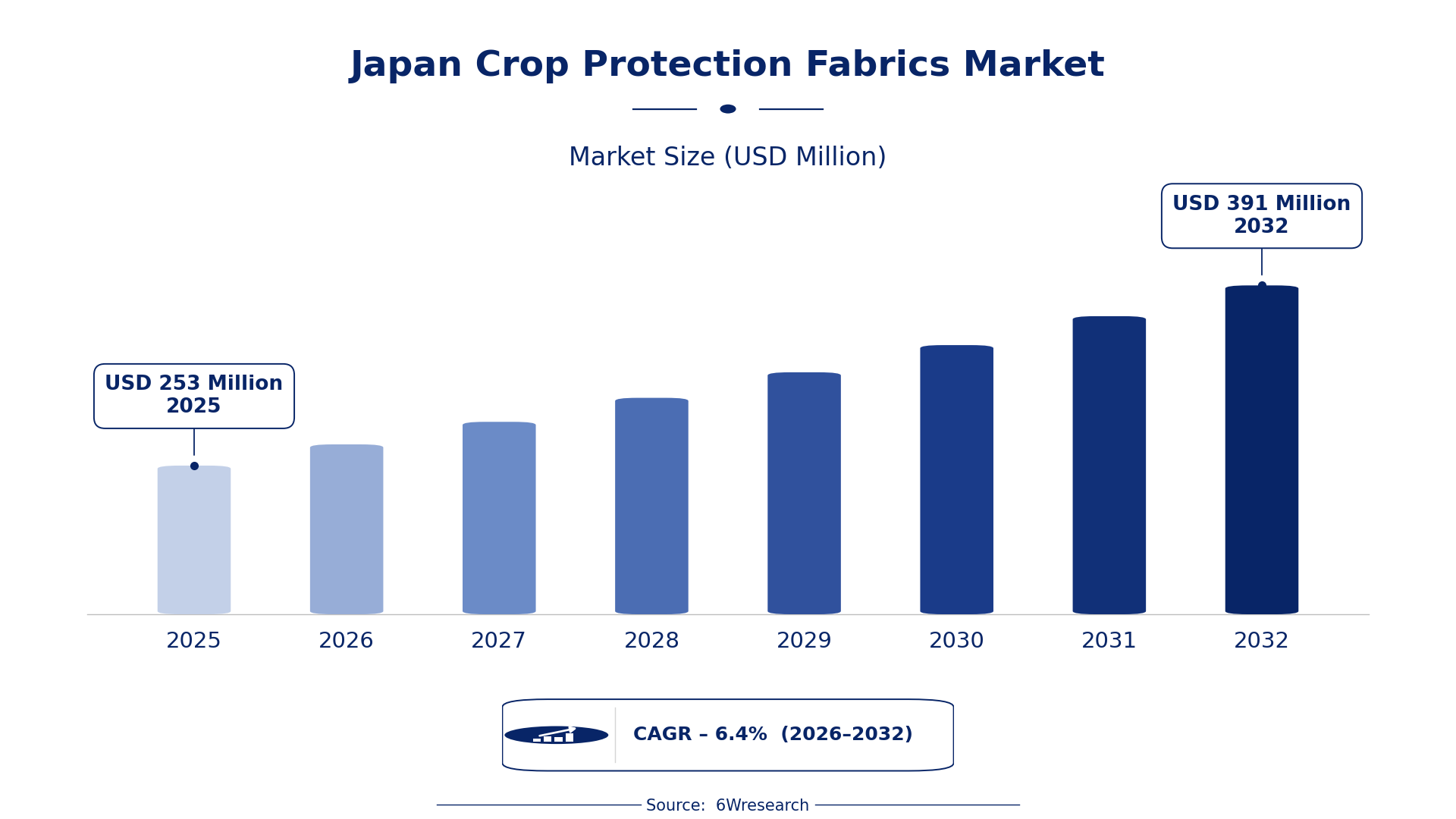
According to 6Wresearch internal database and industry insights, the Japan Crop Protection Fabrics Market was valued at USD 253 Million in 2025 and is projected to reach USD 391 Million by 2032, growing at a CAGR of approximately 6.4% during 2026–2032.
Japan Crop Protection Fabrics Market Highlights
| Report Metric | Details |
| Report Name | Japan Crop Protection Fabrics Market (2026-2032) |
| Market Size 2025 | USD 253 Million |
| Market Size 2032 | USD 391 Million |
| Absolute Growth 2025–2032 | USD 138 Million |
| CAGR 2026–2032 | 6.4% |
| Peak Annual Growth | 7.4% in 2028 |
| Forecast Period | 2026–2032 |
| Historical Data | 2022–2025 |
| Base Year | 2025 |
| Leading Fabric Type, 2025 | Shade Net (51% share) |
| Leading Material Used, 2025 | HDPE (41% share) |
| Leading Application Area, 2025 | Greenhouses (52% share) |
| Leading End User, 2025 | Nurseries (44% share) |
| Fastest-Growing Fabric Type | Weed Control Fabric (8.8% CAGR) |
| Fastest-Growing Material Used | Woven Polypropylene (9.1% CAGR) |
| Fastest-Growing Application Area | Farmlands (7.7% CAGR) |
| Fastest-Growing End User | Farmers (8.6% CAGR) |
| Growing Sector | Farmlands |
| Key End Users | Greenhouses, Farmlands, Horticulture, Orchards |
Japan Crop Protection Fabrics Market Year-wise Growth Rate and Key Drivers (2022–2032)
This graph illustrates the annual growth rates of the market from 2022 to 2032, highlighting a steady upward trajectory and projected market expansion over the forecast period.
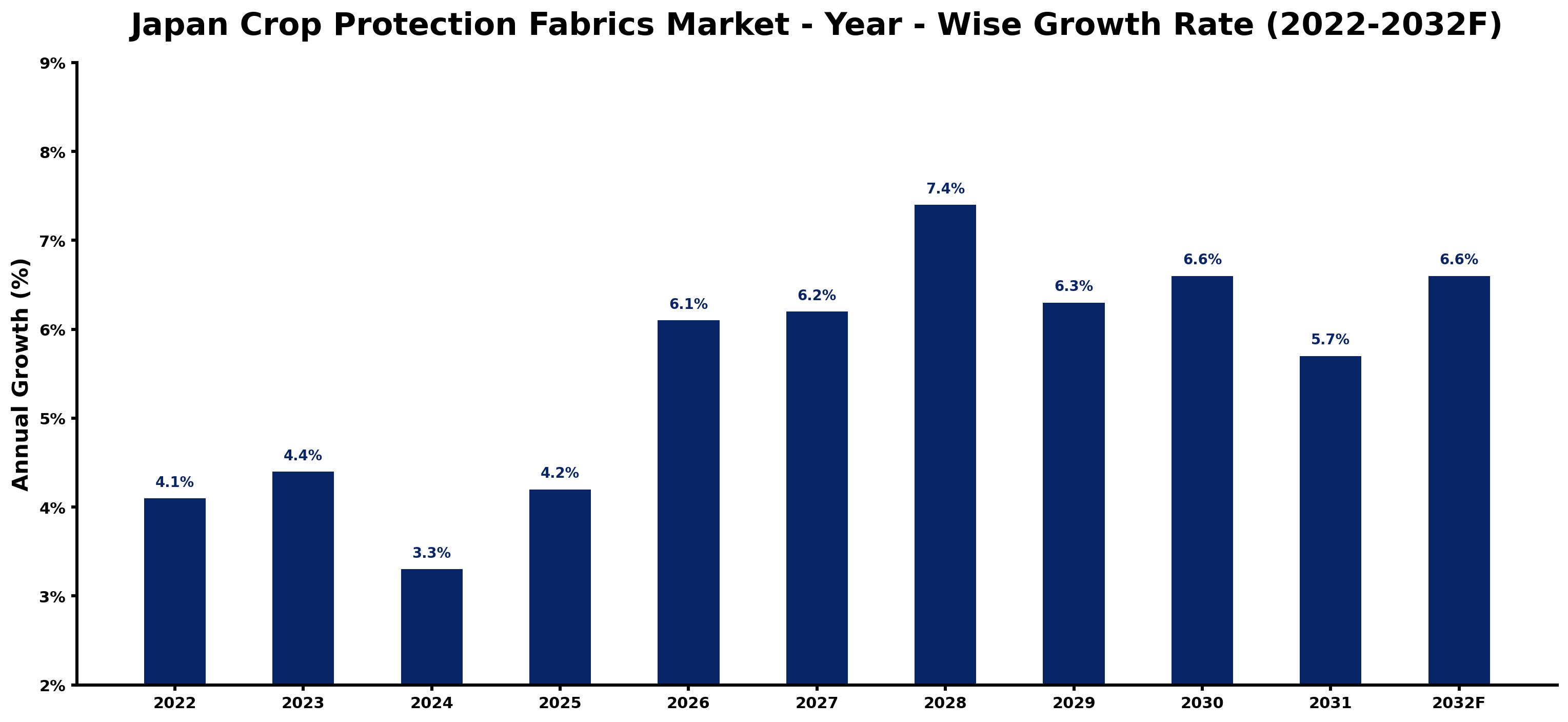
Each row of the following table gives one year's estimated growth and the event or demand shift that explains it.
| Year | Estimated Annual Growth (%) | Market Rationale |
| 2022 | 4.1 | The market experienced steady growth due to ongoing agricultural activities. |
| 2023 | 4.4 | Demand increased as farmers adopted more advanced crop protection methods. |
| 2024 | 3.3 | Growth slowed as some farmers faced challenges in adopting new technologies. |
| 2025 | 4.2 | The market rebounded with renewed interest in sustainable farming practices. |
| 2026 | 6.1 | Demand is projected to surge as investments in agricultural technologies begin to materialise. |
| 2027 | 6.2 | Growth will continue as more farmers recognise the benefits of crop protection fabrics. |
| 2028 | 7.4 | The peak growth year will see heightened investments in agricultural innovations. |
| 2029 | 6.3 | Growth is expected to slow as the market begins to stabilise after rapid expansion. |
| 2030 | 6.6 | Demand will pick up again as new farming initiatives are introduced. |
| 2031 | 5.7 | Growth is anticipated to slow as the market adjusts to new supply conditions. |
| 2032 | 6.6 | Demand is expected to rise steadily as sustainability becomes a priority. |
Note: Market size estimations and growth projections presented in this report are based on 6Wresearch's proprietary forecasting methodology, utilizing the latest available industry data, government publications, and primary research inputs.
Japan Crop Protection Fabrics Market Synopsis
Crop protection fabrics serve to shield crops from environmental factors and pests, primarily crafted from synthetic materials like polyethylene and polypropylene. The Japan Crop Protection Fabrics Market is growing due to rising agricultural activities and a shift towards sustainable farming practices. In 2022, Japan had around 1.3 million farms, and the Ministry of Agriculture, Forestry and Fisheries launched a programme in 2023 to promote sustainable farming, further driving demand for these protective solutions. This growth aligns with the increasing focus on organic farming, which represented 1.5% of total agricultural land in 2022, and the rising adoption of advanced agricultural technologies.
Market Dynamics Impact Analysis (2026–2032)
| Factor | Type | Impact | Primary Segment Affected |
| Increasing adoption of sustainable farming practices | Driver | High | Weed Control Fabric |
| Rising awareness of crop protection benefits | Driver | High | Shade Net |
| Growing demand for organic farming solutions | Opportunity | High | Insect Netting |
| Expansion of greenhouse farming | Opportunity | Medium | Greenhouses |
| High initial investment costs for farmers | Restraint | High | Frost Protection Fabric |
| Limited availability of advanced materials | Restraint | Medium | HDPE |
| Aging farmer population affecting adoption rates | Challenge | High | Nurseries |
| Competition from alternative pest control methods | Challenge | Medium | Organic Farms |
Evaluation of Drivers in Japan Crop Protection Fabrics Market (2026–2032)
Demand rests on the following drivers, each shown with the segment it touches most.
| Drivers | Primary Segment Affected | Why It Matters (Evidence) |
| Increased investments in agricultural technology | Weed Control Fabric | Farmers are investing more in effective solutions, leading to a 15% increase in insect netting usage over five years. |
| Growing focus on sustainability in agriculture | Shade Net | The rise in sustainable practices has led to a rise in demand for shade nets in greenhouses. |
| Rising consumer demand for organic produce | Insect Netting | As organic farming accounted for 1.5% of agricultural land in 2022, demand for insect netting has surged. |
| Expansion of greenhouse cultivation | Greenhouses | With 52% of the application area in greenhouses, demand for protective fabrics is increasing. |
| Research initiatives by agricultural institutes | Frost Protection Fabric | Agri institutes conduct over 100 research projects annually, promoting the use of protective fabrics. |
What keeps demand rising is the increasing focus on sustainability and the adoption of advanced agricultural technologies. In 2022, Japan had approximately 1.3 million farms, which drives demand for effective crop protection solutions. The rise in organic farming, representing 1.5% of total agricultural land in 2022, has led to an increase in the use of insect netting. Agricultural institutes conduct over 100 research projects annually, promoting practical applications of crop protection fabrics. The expansion of greenhouse farming has further boosted the need for protective materials, strengthening the overall market.
Evaluation of Restraints in Japan Crop Protection Fabrics Market
The table below lists the restraints and the evidence behind each.
| Market Restraint | Primary Segment Affected | Why It Matters (Evidence) |
| Producers face challenges with outdated technology in crop protection fabric production. | Weed Control Fabric | This issue arises from the high costs associated with upgrading machinery, causing delays in production. |
| Importers encounter skills shortages due to an ageing workforce. | Shade Net | The average age of farmers in Japan is 67 years, limiting the availability of trained professionals. |
| Buyers experience rising costs due to increased demand for insect netting. | Insect Netting | This surge in demand forces them to allocate more budget for pest management solutions. |
| Fluctuating prices of raw materials complicate budgeting for producers. | Frost Protection Fabric | These unpredictable costs can affect up to 20% of their annual expenses. |
| Competition from alternative pest management solutions can limit market growth. | Greenhouses | As new technologies emerge, traditional crop protection fabrics may face reduced demand. |
Japan Crop Protection Fabrics Market Challenges
Shade net producers face challenges with outdated technology, which limits their production efficiency. This issue arises from the high costs associated with upgrading equipment, resulting in lead times extending by up to 30% for farmers. Importers encounter a skills gap, as the average age of farmers is 67 years, restricting the availability of trained personnel. This shortage delays the distribution of essential materials, impacting timely supplies for buyers. Buyers contend with rising costs due to increased demand for insect netting, which has surged by 15% in the last five years, forcing them to allocate larger budgets for pest management solutions.
Trends in the Japan Crop Protection Fabrics Market
The shifts below are changing how Japan Crop Protection Fabrics Market products are bought and supplied.
- Launch of Sustainable Farming Programme: In 2023, the Ministry of Agriculture, Forestry and Fisheries initiated a programme to encourage sustainable farming practices, aiming to increase crop protection fabric usage across Japan.
- Shift Towards Organic Farming: The organic farming sector has been expanding, with organic land accounting for 1.5% of total agricultural land in 2022, increasing demand for eco-friendly crop protection solutions.
- Increase in Research Initiatives: Agricultural institutes are conducting over 100 research projects annually, focusing on practical applications of crop protection fabrics, driving advancements in the sector.
- Growth of Greenhouse Cultivation: The application area for greenhouses is projected to grow, with 52% of crop protection fabric demand coming from this sector, indicating a trend towards controlled environment agriculture.
Investment Opportunities in the Japan Crop Protection Fabrics Market
The openings below show where demand in the Japan Crop Protection Fabrics Market is visible and how suppliers can enter.
- Rising Demand for Eco-Friendly Solutions: With organic farming accounting for 1.5% of total agricultural land, there is an opportunity to supply eco-friendly crop protection fabrics to organic farms.
- Investment in Advanced Agricultural Technologies: Investments in agricultural technology are expected to rise, creating opportunities for suppliers of innovative crop protection solutions to farmers across Japan.
- Expansion of Greenhouse Facilities: The growth of greenhouse cultivation presents opportunities for suppliers to provide specialized crop protection fabrics tailored for controlled environments.
- Increasing Research Funding: With agricultural institutes conducting over 100 research projects annually, there is potential for collaboration to develop new crop protection fabric technologies.
Government Initiatives in the Japan Crop Protection Fabrics Market
The GX Basic Policy, adopted in 2023, aims for about JPY 150 trillion of public-private decarbonisation investment over the next decade, strengthening the regulatory framework for crop protection fabrics. This policy builds on the Industrial Standardization Act, which governs product standards, ensuring that producers comply with safety and quality requirements.
The Ministry of Agriculture, Forestry and Fisheries oversees the implementation of agricultural standards and approves funding for innovative farming practices. This agency supports initiatives that promote the use of advanced crop protection fabrics, ensuring that farmers have access to the latest technologies.
Future Insight of the Japan Crop Protection Fabrics Market
A policy-driven shift towards sustainable farming practices will reshape the crop protection fabrics market by 2032. The Ministry of Agriculture, Forestry and Fisheries' new programme will promote innovations that improve fabric durability and efficiency. Buyers will benefit from enhanced product standards, such as the JIS K 6259, ensuring higher quality materials. The increase in horticulture contributions, which amount to around 1 trillion yen annually, will further stimulate demand for advanced crop protection solutions, prompting suppliers to adapt their offerings to meet evolving market needs.
Market Segmentation Analysis
Japan Crop Protection Fabrics Market report covers a detailed analysis of the following market segments:
By Fabric Type – Shade Net Leads, Weed Control Fabric Expected to Grow Fastest
According to Saurav Kr Singh, Senior Research Analyst at 6Wresearch, the largest fabric type category in 2025 was Shade Net, at 51% of revenue. Shade nets hold the largest share as they provide essential shade for crops, particularly in greenhouses throughout Japan. Their widespread use in agricultural regions highlights their importance in enhancing crop yield and quality. Weed Control Fabric is projected to grow fastest, at a CAGR of 8.8% during 2026–2032. Weed control fabric is experiencing rapid growth because it effectively prevents weed growth, which is vital for improving crop productivity. The increasing focus on sustainable farming practices is further driving its adoption among farmers. Suppliers should focus on developing weed control fabrics to meet the rising market demand.
By Material Used – HDPE Leads, Woven Polypropylene Expected to Grow Fastest
HDPE accounted for 41% of the market by material used in 2025. HDPE is the leading material in crop protection fabrics, appreciated for its durability and resistance to environmental factors. Its widespread acceptance among farmers ensures a steady demand in the market. Woven Polypropylene is set to record the highest CAGR in this split, 9.1% over 2026–2032. Woven polypropylene is growing the fastest due to its strength and longevity, making it a preferred choice for various agricultural applications. As farmers increasingly seek reliable materials, this trend is expected to continue. Suppliers must include woven polypropylene in their offerings to take advantage of this growth opportunity.
By Application Area – Greenhouses Lead, Farmlands Expected to Grow Fastest
Greenhouses took 52% of application area revenue in 2025, more than any other category. Greenhouses are the primary application area for crop protection fabrics, as they are crucial for controlled environment agriculture, providing ideal conditions for crop growth. The significant investment in greenhouse technology by farmers solidifies this segment's leading position. Over 2026–2032, Farmlands are expected to post the fastest growth, at a CAGR of 7.7%. Farmlands are seeing the fastest increase in the use of crop protection fabrics, especially in open field farming, driven by the rise in sustainable agricultural practices. This trend indicates a shift towards more efficient farming methods. Suppliers should concentrate on the farmland sector to benefit from the growing use of crop protection fabrics in open field agriculture.
By End User – Nurseries Lead, Farmers Expected to Grow Fastest
With 44% of end user revenue in 2025, Nurseries was the largest category. Nurseries are the largest end user of crop protection fabrics, as they are critical for the growth of young plants and ensuring their survival. The high number of nurseries in Japan supports the strong demand for these materials. The quickest growth will come from Farmers, forecast to expand at a CAGR of 8.6% between 2026 and 2032. Farmers represent the fastest-growing end user segment due to their role as primary users of crop protection fabrics in various agricultural practices. Their increasing need for effective crop protection solutions drives this growth. Suppliers need to focus on developing tailored solutions for farmers to meet their specific crop protection needs.
Key Attractiveness of the Report
- 10 Years of Market Numbers
- Historical Data Starting from 2022 to 2025
- Base Year 2025
- Forecast Data until 2032
- Key Performance Indicators Impacting the Market
- Major Upcoming Developments and Projects
Key Highlights of the Report:
- Japan Crop Protection Fabrics Market Outlook
- Market Size of Japan Crop Protection Fabrics Market, 2025
- Forecast of Japan Crop Protection Fabrics Market, 2032
- Historical Data and Forecast of Japan Crop Protection Fabrics Revenues & Volume for the Period 2022-2032F
- Japan Crop Protection Fabrics Market Trend Evolution
- Japan Crop Protection Fabrics Market Drivers and Challenges
- Japan Crop Protection Fabrics Price Trends
- Japan Crop Protection Fabrics Porter's Five Forces
- Japan Crop Protection Fabrics Industry Life Cycle
- Historical Data and Forecast of Japan Crop Protection Fabrics Market Revenues & Volume By Fabric Type for the Period 2022-2032F
- Historical Data and Forecast of Japan Crop Protection Fabrics Market Revenues & Volume By Shade Net for the Period 2022-2032F
- Historical Data and Forecast of Japan Crop Protection Fabrics Market Revenues & Volume By Weed Control Fabric for the Period 2022-2032F
- Historical Data and Forecast of Japan Crop Protection Fabrics Market Revenues & Volume By Frost Protection Fabric for the Period 2022-2032F
- Historical Data and Forecast of Japan Crop Protection Fabrics Market Revenues & Volume By Insect Netting for the Period 2022-2032F
- Historical Data and Forecast of Japan Crop Protection Fabrics Market Revenues & Volume By Material Used for the Period 2022-2032F
- Historical Data and Forecast of Japan Crop Protection Fabrics Market Revenues & Volume By HDPE for the Period 2022-2032F
- Historical Data and Forecast of Japan Crop Protection Fabrics Market Revenues & Volume By Woven Polypropylene for the Period 2022-2032F
- Historical Data and Forecast of Japan Crop Protection Fabrics Market Revenues & Volume By Nonwoven for the Period 2022-2032F
- Historical Data and Forecast of Japan Crop Protection Fabrics Market Revenues & Volume By UV-Stabilized PE for the Period 2022-2032F
- Historical Data and Forecast of Japan Crop Protection Fabrics Market Revenues & Volume By Application Area for the Period 2022-2032F
- Historical Data and Forecast of Japan Crop Protection Fabrics Market Revenues & Volume By Greenhouses for the Period 2022-2032F
- Historical Data and Forecast of Japan Crop Protection Fabrics Market Revenues & Volume By Farmlands for the Period 2022-2032F
- Historical Data and Forecast of Japan Crop Protection Fabrics Market Revenues & Volume By Horticulture for the Period 2022-2032F
- Historical Data and Forecast of Japan Crop Protection Fabrics Market Revenues & Volume By Orchards for the Period 2022-2032F
- Historical Data and Forecast of Japan Crop Protection Fabrics Market Revenues & Volume By End User for the Period 2022-2032F
- Historical Data and Forecast of Japan Crop Protection Fabrics Market Revenues & Volume By Nurseries for the Period 2022-2032F
- Historical Data and Forecast of Japan Crop Protection Fabrics Market Revenues & Volume By Farmers for the Period 2022-2032F
- Historical Data and Forecast of Japan Crop Protection Fabrics Market Revenues & Volume By Agri Institutes for the Period 2022-2032F
- Historical Data and Forecast of Japan Crop Protection Fabrics Market Revenues & Volume By Organic Farms for the Period 2022-2032F
- Japan Crop Protection Fabrics Import Export Trade Statistics
- Market Opportunity Assessment By Fabric Type
- Market Opportunity Assessment By Material Used
- Market Opportunity Assessment By Application Area
- Market Opportunity Assessment By End User
- Japan Crop Protection Fabrics Top Companies Market Share
- Japan Crop Protection Fabrics Competitive Benchmarking By Technical and Operational Parameters
- Japan Crop Protection Fabrics Company Profiles
- Japan Crop Protection Fabrics Key Strategic Recommendations
Market Covered
This report examines the market across the segments below.
By Fabric Type
- Shade Net
- Weed Control Fabric
- Frost Protection Fabric
- Insect Netting
By Material Used
- HDPE
- Woven Polypropylene
- Nonwoven
- UV-Stabilized PE
By Application Area
- Greenhouses
- Farmlands
- Horticulture
- Orchards
By End User
- Nurseries
- Farmers
- Agri Institutes
- Organic Farms






































