Japan Crop Residue Management Equipment Market Size & Growth Rate
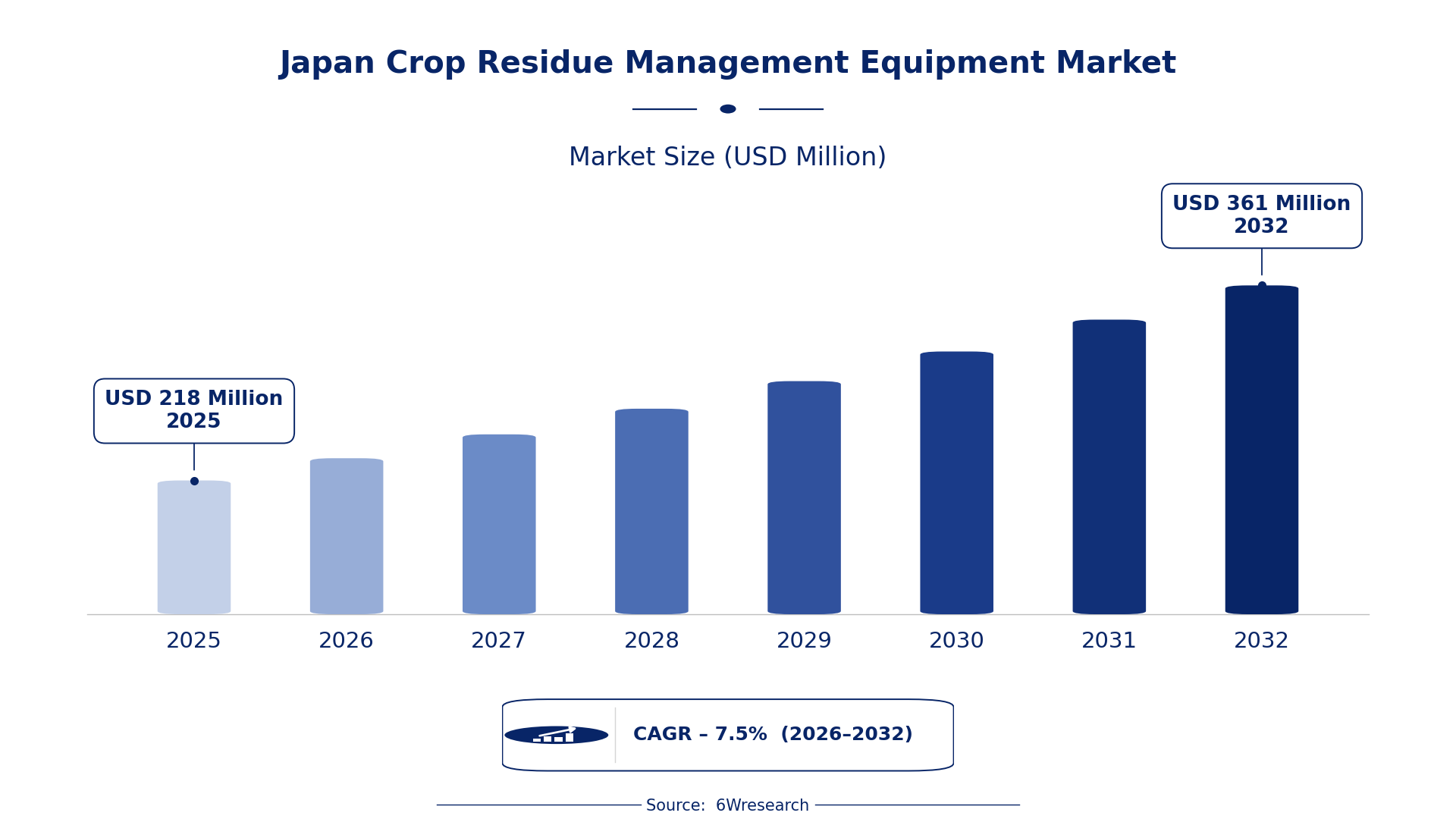
According to 6Wresearch internal database and industry insights, the Japan Crop Residue Management Equipment Market was valued at USD 218 Million in 2025 and is projected to reach USD 361 Million by 2032, growing at a CAGR of approximately 7.5% during 2026–2032.
Japan Crop Residue Management Equipment Market Highlights
| Report Metric | Details |
| Report Name | Japan Crop Residue Management Equipment Market (2026-2032) |
| Market Size 2025 | USD 218 Million |
| Market Size 2032 | USD 361 Million |
| Absolute Growth 2025–2032 | USD 143 Million |
| CAGR 2026–2032 | 7.5% |
| Peak Annual Growth | 8.4% in 2029 |
| Forecast Period | 2026–2032 |
| Historical Data | 2022–2025 |
| Base Year | 2025 |
| Leading Equipment Type, 2025 | Straw Chopper (39% share) |
| Leading Mechanism, 2025 | Hydraulic (41% share) |
| Leading Power Source, 2025 | PTO Driven (50% share) |
| Leading End User, 2025 | Large Farms (38% share) |
| Fastest-Growing Equipment Type | Rotavators (10.5% CAGR) |
| Fastest-Growing Mechanism | Blade-Based (9.8% CAGR) |
| Fastest-Growing Power Source | Diesel (11.1% CAGR) |
| Fastest-Growing End User | Agro Contractors (9.7% CAGR) |
| Growing Sector | agricultural sector |
| Key End Users | large farms, agro contractors, cooperatives, agro units |
Japan Crop Residue Management Equipment Market Year-wise Growth Rate and Key Drivers (2022–2032)
This graph illustrates the annual growth rates of the market from 2022 to 2032, highlighting a steady upward trajectory and projected market expansion over the forecast period.
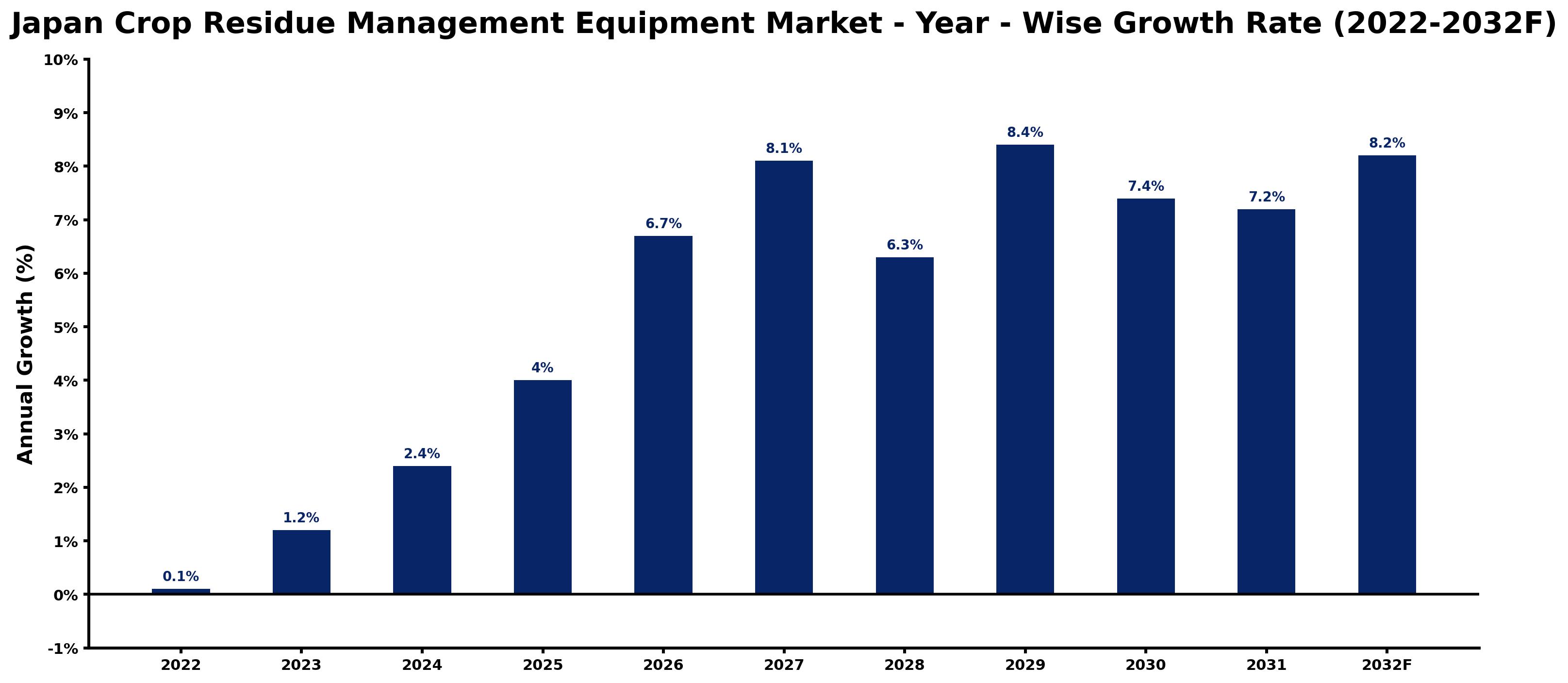
For each year, the table pairs the estimated growth rate with the leading influence on demand, showing how the drivers changed across the period.
| Year | Estimated Annual Growth (%) | Market Rationale |
| 2022 | 0.1 | The market showed minimal growth due to initial recovery from previous disruptions. |
| 2023 | 1.2 | Increased awareness of sustainable farming practices boosted demand for equipment. |
| 2024 | 2.4 | Investment in agricultural modernization initiatives led to higher equipment purchases. |
| 2025 | 4.0 | The introduction of new eco-friendly standards spurred growth in the market. |
| 2026 | 6.7 | Rising operational costs prompted farmers to invest in more efficient machinery. |
| 2027 | 8.1 | The expansion of agro contractors increased demand for versatile equipment. |
| 2028 | 6.3 | Growth slowed as market saturation began to affect new purchases. |
| 2029 | 8.4 | The peak growth year was driven by heightened focus on sustainable agriculture. |
| 2030 | 7.4 | Demand stabilised as buyers adjusted to the evolving market. |
| 2031 | 7.2 | The market continued to grow as technological advancements gained traction. |
| 2032 | 8.2 | Increased participation in cooperative programs is expected to further stimulate demand. |
Note: Market size estimations and growth projections presented in this report are based on 6Wresearch's proprietary forecasting methodology, utilizing the latest available industry data, government publications, and primary research inputs.
Japan Crop Residue Management Equipment Market Synopsis
Crop residue management equipment encompasses machinery designed to process agricultural residues, thereby improving soil health and minimising waste. This equipment plays a crucial role in enhancing soil fertility and preventing erosion. The Japan Crop Residue Management Equipment Market is growing due to increasing demand from large farms and agro contractors, spurred by investments in sustainable farming practices and government support for eco-friendly initiatives.
Market Dynamics Impact Analysis (2026–2032)
| Factor | Type | Impact | Primary Segment Affected |
| Government initiatives promoting sustainable agriculture practices are driving demand for eco-friendly equipment. | Driver | High | Straw Chopper |
| The increasing number of agro contractors provides a growing customer base for crop residue management solutions. | Driver | High | Balers |
| The rising adoption of mulchers in rural areas presents opportunities for suppliers to meet growing demand. | Opportunity | High | Mulchers |
| The government’s subsidy program for eco-friendly farming equipment encourages investment in new technologies. | Opportunity | High | Rotavators |
| High operational costs can deter farmers from investing in new equipment. | Restraint | Medium | Hydraulic |
| Limited awareness of advanced equipment among small-scale farmers restricts market growth. | Restraint | Medium | PTO Driven |
| Supply chain disruptions can delay equipment availability for buyers, affecting their operations. | Challenge | High | Agro Contractors |
| The need for skilled operators can limit the effective use of advanced machinery in rural areas. | Challenge | Medium | Large Farms |
Evaluation of Drivers in Japan Crop Residue Management Equipment Market (2026–2032)
Demand rests on the following drivers, each shown with the segment it touches most.
| Drivers | Primary Segment Affected | Why It Matters (Evidence) |
| Increased investments in sustainable farming practices are driving demand for crop residue management equipment. | Straw Chopper | In 2023, the government allocated 5 billion yen for agricultural modernization initiatives, leading to more purchases. |
| The growing number of agro contractors is boosting demand for versatile equipment. | Balers | Agro contractors provide services to over 100,000 farms, increasing the need for efficient residue management. |
| The rising adoption of mulchers prompts farmers to invest in equipment that improves soil health. | Mulchers | The adoption of mulchers has surged by 20% in rural areas, driving demand for these machines. |
| Government subsidies for eco-friendly farming equipment encourage investment in new technologies. | Rotavators | The Ministry of Agriculture, Forestry and Fisheries promotes sustainable agriculture practices, driving equipment purchases. |
| High operational costs push farmers to seek more efficient machinery. | Hydraulic | Japan's national weighted-average minimum wage rose to JPY 1,055 per hour in October 2024. |
The growing number of agro contractors, serving over 100,000 farms, drives demand for versatile machinery like balers. The adoption of mulchers has surged by 20% in rural areas, prompting farmers to invest in equipment that improves soil health. Rising operational costs compel farmers to seek efficient machinery, particularly hydraulic systems, ensuring continued market growth.
Evaluation of Restraints in Japan Crop Residue Management Equipment Market
The following restraints limit how fast demand can grow.
| Market Restraint | Primary Segment Affected | Why It Matters (Evidence) |
| High operational costs deter farmers from investing in new machinery, limiting market growth. | Hydraulic | Japan's national weighted-average minimum wage rose to JPY 1,055 per hour in October 2024. |
| Limited awareness of advanced machinery among small-scale farmers restricts market growth. | PTO Driven | The average size of a farm in Japan is about 1.5 hectares, limiting investment capacity. |
| Supply chain disruptions can delay equipment availability for buyers, affecting their operations. | Agro Contractors | Recent global supply chain issues have impacted the timely delivery of agricultural machinery. |
| Seasonal fluctuations in agricultural activities can lead to inconsistent demand for machinery. | Balers | The demand for balers peaks during harvest seasons, causing variability in sales. |
| Regulatory compliance costs can burden producers, impacting pricing strategies. | Mulchers | Compliance with JIS standards for agricultural machinery ensures safety and quality, adding costs. |
Japan Crop Residue Management Equipment Market Challenges
High operational costs burden producers as Japan's minimum wage reaches JPY 1,055 per hour, squeezing margins for farms averaging 1.5 hectares. Regulatory compliance with JIS standards leads to lengthy certification processes, which can delay product availability for distributors and inflate prices. Limited access to advanced technology hampers productivity for agro contractors serving over 100,000 farms, making it difficult to compete effectively. Buyers face challenges in utilising government subsidies for eco-friendly equipment, resulting in increased upfront costs that deter investment in sustainable practices.
Trends in the Japan Crop Residue Management Equipment Market
Below are the shifts with the largest effect on the Japan Crop Residue Management Equipment Market.
- Shift from Traditional to Eco-Friendly Equipment: In 2023, the uptake of eco-friendly machinery increased as farmers aimed to meet sustainability standards. The government seeks to reduce agricultural waste by 30% by 2030, prompting a transition towards sustainable technologies.
- Emergence of Agro Contractors: The number of agro contractors has grown considerably, providing services to over 100,000 farms. This trend illustrates a rising reliance on specialised services for effective crop residue management.
- Rise in Cooperative Programs: Farmers are increasingly participating in cooperative programs for resource sharing, improving efficiency in crop residue management. This shift is bolstered by government initiatives that promote collaboration among farmers.
- Growing Interest in Electric-Powered Equipment: Electric-powered machinery is becoming more popular in urban farming initiatives, with a marked increase in adoption. This trend aligns with Japan's commitment to sustainable agricultural practices.
Investment Opportunities in the Japan Crop Residue Management Equipment Market
Below are the investment opportunities with the strongest case in the Japan Crop Residue Management Equipment Market.
- Increase in Demand for Eco-Friendly Equipment: With the government aiming to reduce agricultural waste by 30% by 2030, there is a rising opportunity for suppliers of eco-friendly machinery. Agro contractors are particularly well-positioned to invest in these technologies.
- Expansion of Agro Contractors: The growing number of agro contractors indicates a demand for versatile equipment. Investing in machinery that meets their needs can capture this expanding market segment.
- Rising Adoption of Mulchers: The 20% increase in mulcher adoption in rural areas presents an opportunity for suppliers to address the growing demand. Focusing on this equipment type can yield substantial returns.
- Government Subsidies for Eco-Friendly Farming: The government's subsidy program for eco-friendly farming equipment creates an opportunity for suppliers to enter the market. Collaborating with local agro contractors can facilitate access to this segment.
Government Initiatives in the Japan Crop Residue Management Equipment Market
The Act on Japanese Industrial Standards governs the safety and quality of agricultural machinery, impacting producers of crop residue management equipment. Compliance with JIS standards ensures that manufacturers meet safety requirements, which is essential for market acceptance. The Ministry of Agriculture, Forestry and Fisheries promotes sustainable agriculture practices, encouraging the adoption of eco-friendly equipment among farmers. In 2023, the government allocated 5 billion yen for agricultural modernization initiatives, supporting advancements in this sector.
Agro contractors benefit from the government's subsidy program for eco-friendly farming equipment, which supports their investment in modern machinery. This initiative allows them to provide better services to numerous farms, improving their operational efficiency and sustainability.
Future Insight of the Japan Crop Residue Management Equipment Market
The investment pipeline for agricultural modernization will expand significantly, driven by government initiatives and increasing demand for sustainable practices. By 2032, the adoption of electric-powered equipment will rise, particularly in urban farming, creating new avenues for suppliers. The push for advanced machinery will improve soil health and streamline crop residue management. Cooperative programs will facilitate resource sharing among farmers, enhancing efficiency in managing agricultural waste and promoting sustainability.
Market Segmentation Analysis
Japan Crop Residue Management Equipment Market report covers a detailed analysis of the following market segments:
By Equipment Type – Straw Chopper Leads, Rotavators Expected to Grow Fastest
According to Saurav Kr Singh, Senior Research Analyst at 6Wresearch, in 2025, Straw Chopper led the equipment type split with a 39% share. The straw chopper holds the largest share due to its extensive use among farmers for effective straw management, particularly in Hokkaido where its application is prevalent. This equipment is vital for improving soil health and reducing waste, aligning with sustainable agricultural practices. Rotavators are projected to grow fastest, at a CAGR of 10.5% during 2026–2032. Rotavators are experiencing rapid growth, primarily driven by their increasing adoption for integrating crop residues into the soil, especially in rice cultivation areas like Niigata Prefecture. This trend underscores a strong movement towards enhancing soil quality and sustainability in farming methods. Suppliers should prioritise the availability of rotavators to address the growing demand from farmers.
By Mechanism – Hydraulic Leads, Blade-Based Expected to Grow Fastest
Hydraulic held 41% of the Japan Crop Residue Management Equipment Market by mechanism in 2025. Hydraulic mechanisms dominate the market as they are essential for lifting and operating various attachments, making them indispensable in the agricultural sector. Their reliability and efficiency in handling different tasks contribute to their widespread adoption among farmers. Over 2026–2032, Blade-Based is expected to post the fastest growth, at a CAGR of 9.8%. Blade-based mechanisms are gaining traction due to their efficiency in cutting and processing residues, which aligns with the increasing focus on effective crop residue management. This growth is indicative of a shift towards more efficient farming practices. Manufacturers should invest in developing advanced blade-based technologies to capture the growing market interest.
By Power Source – PTO Driven Leads, Diesel Expected to Grow Fastest
PTO Driven took 50% of power source revenue in 2025, more than any other category. PTO driven equipment is the leading power source as it allows easy connections to tractors, making it a practical choice for many farmers. This method is widely accepted across various regions, ensuring reliable performance in managing crop residues. The quickest growth will come from Diesel, forecast to expand at a CAGR of 11.1% between 2026 and 2032. Diesel power sources are rapidly gaining popularity, particularly for heavy-duty equipment, as they provide the necessary power for larger agricultural operations. This shift reflects the increasing demand for robust machinery capable of handling extensive farming tasks. Suppliers must maintain a consistent supply of diesel-powered equipment to meet the requirements of larger farms.
By End User – Large Farms Lead, Agro Contractors Expected to Grow Fastest
Large Farms accounted for 38% of the market by end user in 2025. Large farms are the primary users of crop residue management equipment, as they require efficient solutions to manage substantial amounts of agricultural waste. Their operational scale necessitates dependable machinery to support sustainable farming practices. Agro Contractors are set to record the highest CAGR in this split, 9.7% over 2026–2032. Agro contractors are witnessing the fastest growth as they provide services to multiple farms, utilising crop residue management equipment to enhance efficiency. This trend indicates a rising reliance on service providers for effective agricultural operations. Suppliers should focus on agro contractors with customised solutions to leverage this expanding market segment.
Key Attractiveness of the Report
- 10 Years of Market Numbers
- Historical Data Starting from 2022 to 2025
- Base Year 2025
- Forecast Data until 2032
- Key Performance Indicators Impacting the Market
- Major Upcoming Developments and Projects
Key Highlights of the Report:
- Japan Crop Residue Management Equipment Market Outlook
- Market Size of Japan Crop Residue Management Equipment Market, 2025
- Forecast of Japan Crop Residue Management Equipment Market, 2032
- Historical Data and Forecast of Japan Crop Residue Management Equipment Revenues & Volume for the Period 2022-2032F
- Japan Crop Residue Management Equipment Market Trend Evolution
- Japan Crop Residue Management Equipment Market Drivers and Challenges
- Japan Crop Residue Management Equipment Price Trends
- Japan Crop Residue Management Equipment Porter's Five Forces
- Japan Crop Residue Management Equipment Industry Life Cycle
- Historical Data and Forecast of Japan Crop Residue Management Equipment Market Revenues & Volume By Equipment Type for the Period 2022-2032F
- Historical Data and Forecast of Japan Crop Residue Management Equipment Market Revenues & Volume By Straw Chopper for the Period 2022-2032F
- Historical Data and Forecast of Japan Crop Residue Management Equipment Market Revenues & Volume By Rotavators for the Period 2022-2032F
- Historical Data and Forecast of Japan Crop Residue Management Equipment Market Revenues & Volume By Mulchers for the Period 2022-2032F
- Historical Data and Forecast of Japan Crop Residue Management Equipment Market Revenues & Volume By Balers for the Period 2022-2032F
- Historical Data and Forecast of Japan Crop Residue Management Equipment Market Revenues & Volume By Mechanism for the Period 2022-2032F
- Historical Data and Forecast of Japan Crop Residue Management Equipment Market Revenues & Volume By Hydraulic for the Period 2022-2032F
- Historical Data and Forecast of Japan Crop Residue Management Equipment Market Revenues & Volume By Blade-Based for the Period 2022-2032F
- Historical Data and Forecast of Japan Crop Residue Management Equipment Market Revenues & Volume By Flail Rotor for the Period 2022-2032F
- Historical Data and Forecast of Japan Crop Residue Management Equipment Market Revenues & Volume By Compression for the Period 2022-2032F
- Historical Data and Forecast of Japan Crop Residue Management Equipment Market Revenues & Volume By Power Source for the Period 2022-2032F
- Historical Data and Forecast of Japan Crop Residue Management Equipment Market Revenues & Volume By PTO Driven for the Period 2022-2032F
- Historical Data and Forecast of Japan Crop Residue Management Equipment Market Revenues & Volume By Diesel for the Period 2022-2032F
- Historical Data and Forecast of Japan Crop Residue Management Equipment Market Revenues & Volume By Tractor-Mounted for the Period 2022-2032F
- Historical Data and Forecast of Japan Crop Residue Management Equipment Market Revenues & Volume By Electric for the Period 2022-2032F
- Historical Data and Forecast of Japan Crop Residue Management Equipment Market Revenues & Volume By End User for the Period 2022-2032F
- Historical Data and Forecast of Japan Crop Residue Management Equipment Market Revenues & Volume By Large Farms for the Period 2022-2032F
- Historical Data and Forecast of Japan Crop Residue Management Equipment Market Revenues & Volume By Agro Contractors for the Period 2022-2032F
- Historical Data and Forecast of Japan Crop Residue Management Equipment Market Revenues & Volume By Cooperatives for the Period 2022-2032F
- Historical Data and Forecast of Japan Crop Residue Management Equipment Market Revenues & Volume By Agro Units for the Period 2022-2032F
- Japan Crop Residue Management Equipment Import Export Trade Statistics
- Market Opportunity Assessment By Equipment Type
- Market Opportunity Assessment By Mechanism
- Market Opportunity Assessment By Power Source
- Market Opportunity Assessment By End User
- Japan Crop Residue Management Equipment Top Companies Market Share
- Japan Crop Residue Management Equipment Competitive Benchmarking By Technical and Operational Parameters
- Japan Crop Residue Management Equipment Company Profiles
- Japan Crop Residue Management Equipment Key Strategic Recommendations
Market Covered
This report examines the market across the segments below.
By Equipment Type
- Straw Chopper
- Rotavators
- Mulchers
- Balers
By Mechanism
- Hydraulic
- Blade-Based
- Flail Rotor
- Compression
By Power Source
- PTO Driven
- Diesel
- Tractor-Mounted
- Electric
By End User
- Large Farms
- Agro Contractors
- Cooperatives
- Agro Units






































