Japan Crop-Specific Nutrient Market Size & Growth Rate
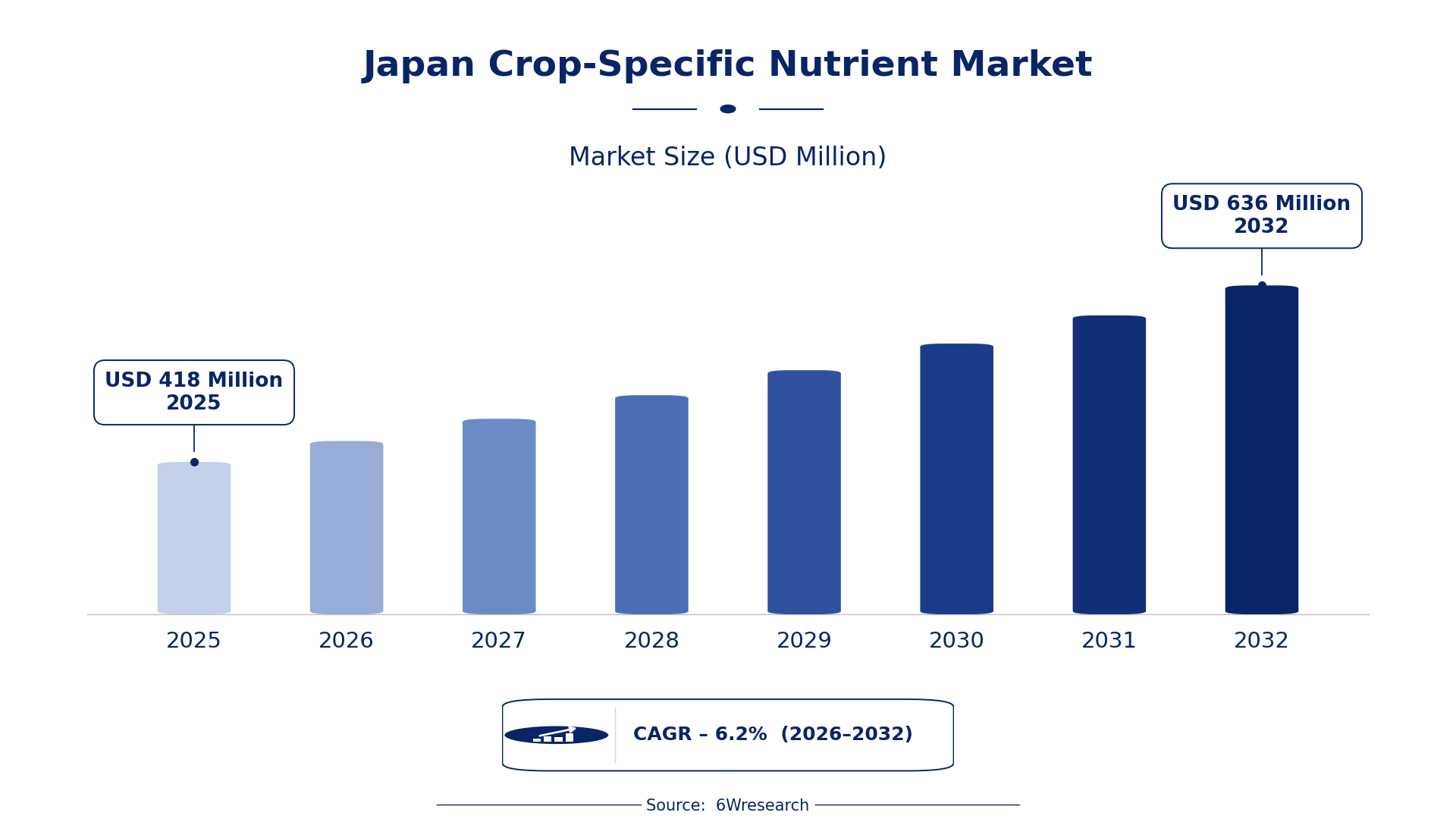
According to 6Wresearch internal database and industry insights, the Japan Crop-Specific Nutrient Market was valued at USD 418 Million in 2025 and is projected to reach USD 636 Million by 2032, growing at a CAGR of approximately 6.2% during 2026–2032.
Japan Crop-Specific Nutrient Market Highlights
| Report Metric | Details |
| Report Name | Japan Crop-Specific Nutrient Market (2026-2032) |
| Market Size 2025 | USD 418 Million |
| Market Size 2032 | USD 636 Million |
| Absolute Growth 2025–2032 | USD 218 Million |
| CAGR 2026–2032 | 6.2% |
| Peak Annual Growth | 7.1% in 2031 |
| Forecast Period | 2026–2032 |
| Historical Data | 2022–2025 |
| Base Year | 2025 |
| Leading Crop Type, 2025 | Rice (43% share) |
| Leading Nutrient Package, 2025 | NPK + Micronutrients (40% share) |
| Leading Form Type, 2025 | Granular (46% share) |
| Leading End User, 2025 | Paddy Growers (44% share) |
| Fastest-Growing Crop Type | Wheat (8.7% CAGR) |
| Fastest-Growing Nutrient Package | Sulfur + Zinc (8.1% CAGR) |
| Fastest-Growing Form Type | Powdered (9.1% CAGR) |
| Fastest-Growing End User | Commercial Farms (8.0% CAGR) |
| Growing Sector | Commercial Farms |
| Key End Users | Paddy Growers, Commercial Farms, Agro Traders, Agronomists |
Japan Crop-Specific Nutrient Market Year-wise Growth Rate and Key Drivers (2022–2032)
This graph illustrates the annual growth rates of the market from 2022 to 2032, highlighting a steady upward trajectory and projected market expansion over the forecast period.
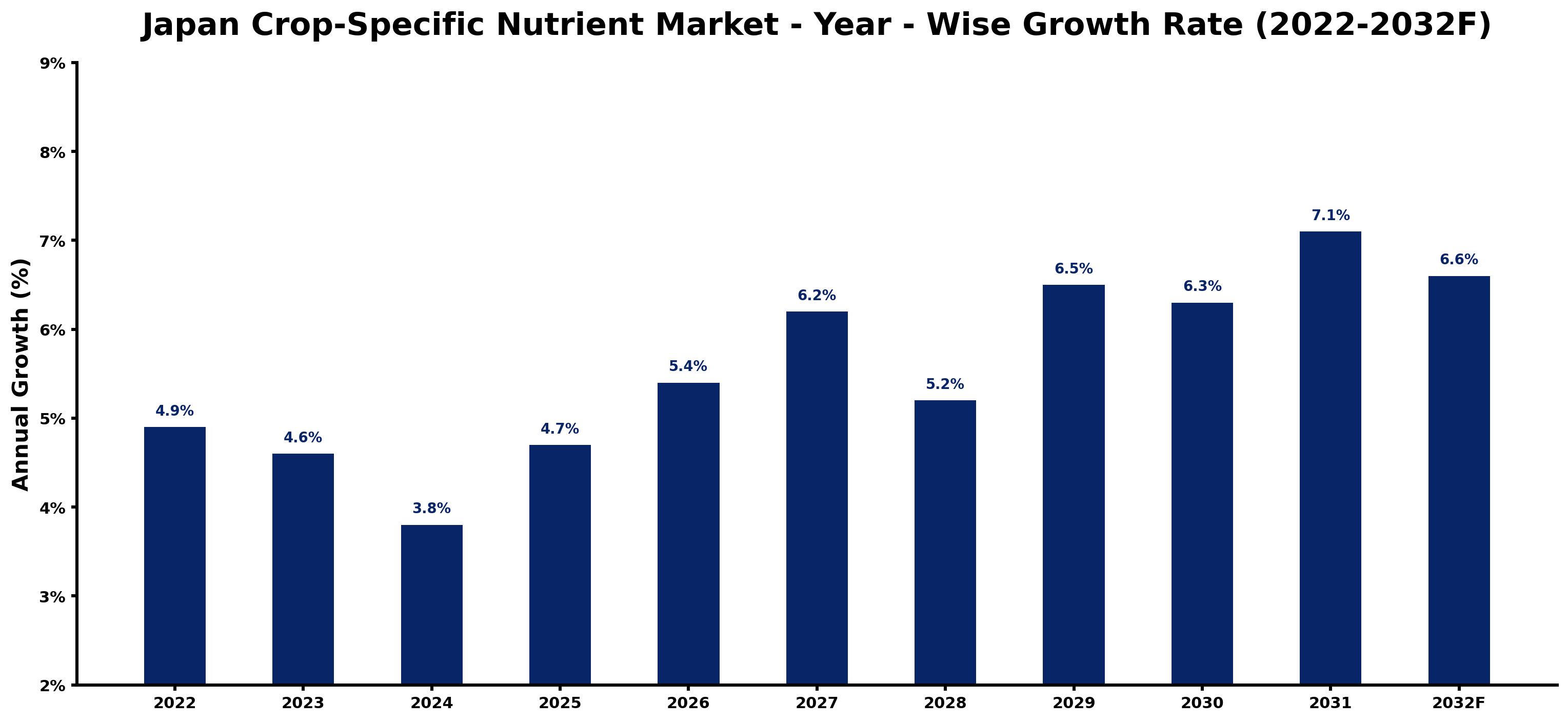
The following figures match every annual growth estimate with the main market development of that year, giving the reasoning behind each rise or slowdown.
| Year | Estimated Annual Growth (%) | Market Rationale |
| 2022 | 4.9 | The market experienced steady growth due to consistent demand from rice cultivation. |
| 2023 | 4.6 | Growth slowed slightly as farmers adjusted to nutrient application methods. |
| 2024 | 3.8 | The market saw a further slowdown as adoption of new technologies remained cautious. |
| 2025 | 4.7 | Demand increased as farmers responded to improved crop yield incentives. |
| 2026 | 5.4 | Growth is expected to accelerate with rising investments in nutrient-efficient farming practices. |
| 2027 | 6.2 | The market will continue to expand as nitrogen boosters gain popularity among growers. |
| 2028 | 5.2 | Growth is projected to slow again as farmers face challenges in nutrient management. |
| 2029 | 6.5 | Demand will rise as commercial farms expand their crop-specific nutrient usage. |
| 2030 | 6.3 | Growth is expected to slow slightly as the market stabilises after rapid expansion. |
| 2031 | 7.1 | The market will peak with heightened demand for sustainable nutrient solutions. |
| 2032 | 6.6 | Growth is projected to slow as the market adjusts to new regulatory standards. |
Note: Market size estimations and growth projections presented in this report are based on 6Wresearch's proprietary forecasting methodology, utilizing the latest available industry data, government publications, and primary research inputs.
Japan Crop-Specific Nutrient Market Synopsis
Crop-specific nutrients are specialised fertilizers designed to meet the nutritional needs of particular crops, improving yield and soil health. The Japan Crop-Specific Nutrient Market is propelled by the agricultural sector, especially rice and vegetable farming, with the Kanto region showcasing this trend. Substantial investments in sustainable nutrient use are apparent, supported by government initiatives like the 2023 programme promoting efficient nutrient application, alongside a growing adoption of nitrogen boosters and granular fertilizers among domestic users.
Market Dynamics Impact Analysis (2026–2032)
| Factor | Type | Impact | Primary Segment Affected |
| Rising investments in sustainable agriculture practices | Driver | High | NPK + Micronutrients |
| Increasing demand for higher crop yields from paddy growers | Driver | High | Rice |
| Growing interest in nutrient-efficient crop varieties | Opportunity | High | Commercial Farms |
| Expansion of agro traders facilitating nutrient distribution | Opportunity | Medium | Agro Traders |
| Challenges in nutrient management practices among older farmers | Restraint | High | Paddy Growers |
| Limited awareness of advanced nutrient application technologies | Restraint | Medium | Commercial Farms |
| Aging farmer population impacting technology adoption | Challenge | High | Paddy Growers |
| Regulatory changes affecting nutrient application standards | Challenge | Medium | Agro Traders |
Evaluation of Drivers in Japan Crop-Specific Nutrient Market (2026–2032)
The factors lifting demand, and the evidence behind each, are summarised below.
| Drivers | Primary Segment Affected | Why It Matters (Evidence) |
| Investment in nutrient-efficient technologies | NPK + Micronutrients | This investment leads to more efficient nutrient application, resulting in increased purchases by paddy growers, with the total agricultural land in Japan around 4.5 million hectares. |
| Growing demand for rice production | Rice | The high demand for rice drives farmers to seek effective crop-specific nutrients for optimal yields, contributing to rice production of approximately 7.5 million tons in 2022. |
| Increased adoption of nitrogen boosters | Nitrogen Boosters | Farmers are purchasing more nitrogen boosters to meet rising crop demands and improve growth, with usage increasing due to pressures for higher yields in rice and wheat. |
| Expansion of commercial farms | Commercial Farms | As commercial farms grow, their need for specialized nutrients increases, boosting overall market demand, which is reflected in the 44% share of paddy growers in 2025. |
| Rising awareness of sustainable practices | Granular | Farmers are increasingly opting for granular fertilizers due to their ease of application and effectiveness, with granular fertilizers accounting for 60% of the market. |
Volumes grow on the back of investments in nutrient-efficient technologies, projected to enhance crop yields significantly. The demand for rice production fuels purchases of crop-specific nutrients, with rice output at approximately 7.5 million tons in 2022. Increased adoption of nitrogen boosters is evident, as farmers seek to enhance crop growth, particularly in rice and wheat. The expansion of commercial farms reflects a significant shift towards specialized fertilizers, with granular forms dominating the market at 60% share.
Evaluation of Restraints in Japan Crop-Specific Nutrient Market
The key brakes on demand, and where they bite hardest, are shown below.
| Market Restraint | Primary Segment Affected | Why It Matters (Evidence) |
| Limited adoption of advanced nutrient technologies | Rice | Many farmers, averaging 66 years old, resist new methods due to a lack of training, leading to lower crop yields. |
| Intense competition among agro traders | Commercial Farms | This competition drives down prices, which can reduce the quality of crop-specific nutrients available to buyers. |
| Regulatory standards causing delays | NPK + Micronutrients | Standards such as the JIS for fertilizers can delay product approvals, impacting farmers' ability to meet planting schedules. |
| Pressure to reformulate products | Nitrogen Boosters | The government’s target to reduce fertilizer runoff by 30% by 2025 complicates supply chains for producers. |
| Challenges in nutrient management | Granular | Farmers face difficulties in managing nutrient applications effectively, which can hinder crop performance. |
Japan Crop-Specific Nutrient Market Challenges
Low uptake of new nutrient technologies presents a challenge, as farmers, with an average age of 66, often lack the necessary training, leading to stagnant crop yields. Price competition among agro traders forces many to prioritise cost over quality, undermining the effectiveness of crop-specific nutrients for buyers. Regulatory standards like the JIS for fertilizers can prolong product approval timelines, causing supply delays that disrupt farmers' planting schedules. Efforts to reduce fertilizer runoff by 30% by 2025 impose additional reformulation requirements on producers, complicating their supply chains and increasing costs for all stakeholders.
Trends in the Japan Crop-Specific Nutrient Market
The shifts below are changing how Japan Crop-Specific Nutrient Market products are bought and supplied.
- Shift Towards Granular Fertilizers: Paddy growers are increasingly opting for granular fertilizers due to their ease of application, with granular products making up 60% of the market in 2022.
- Transition to Sustainable Nutrient Practices: The 2023 government initiative encourages sustainable nutrient use, aiming to cut fertilizer runoff by 30% by 2025, influencing farming practices nationwide.
- Emergence of Nitrogen Boosters: Nitrogen boosters are gaining traction among farmers, with usage rising to meet the growing crop demands, particularly in rice production.
- Focus on Nutrient-Efficient Technologies: Investment in nutrient-efficient technologies is on the rise, with projections indicating a market size reflecting a shift in farming strategies.
Investment Opportunities in the Japan Crop-Specific Nutrient Market
The opportunities below stand out in the Japan Crop-Specific Nutrient Market for new entrants and existing suppliers.
- Investment in Nutrient-Efficient Technologies: The Kanto region offers an opportunity for investment in nutrient-efficient technologies, with a projected market size reflecting market potential by 2025.
- Supply of Granular Fertilizers: With granular fertilizers constituting 60% of the market, suppliers can focus on enhancing product offerings to satisfy demand among paddy growers.
- Development of Nitrogen Boosters: The increasing adoption of nitrogen boosters presents an opportunity for suppliers to create innovative products, especially in regions with high rice production.
- Expansion of Commercial Farms: As commercial farms grow, there is a rising need for specialised nutrients, making it an ideal time for suppliers to forge partnerships.
Government Initiatives in the Japan Crop-Specific Nutrient Market
The Act against Unjustifiable Premiums and Misleading Representations guarantees buyers receive accurate information about crop-specific nutrients, upholding quality standards and fostering trust among farmers and consumers. This law is crucial for maintaining market integrity and preventing misleading practices.
In 2023, the government allocated JPY 150 trillion for public-private decarbonisation investment, administered by the Government of Japan. This funding supports research on nutrient-efficient crop varieties, which enhances yield potential for farmers and promotes sustainable practices.
Future Insight of the Japan Crop-Specific Nutrient Market
A policy-driven shift towards sustainable nutrient practices will transform the market by 2032, prompting suppliers to innovate. The government's 2023 programme will facilitate the development of nutrient-efficient crop varieties, potentially increasing yields for farmers. Adoption of ISO 14001 standards will encourage producers to improve environmental management, aligning with market expectations. Research funding for advanced nutrient technologies is expected to yield more effective products, enhancing crop health and soil quality across Japan.
Market Segmentation Analysis
Japan Crop-Specific Nutrient Market report covers a detailed analysis of the following market segments:
By Crop Type – Rice Leads, Wheat Expected to Grow Fastest
According to Saurav Kr Singh, Senior Research Analyst at 6Wresearch, with 43% of crop type revenue in 2025, Rice was the largest category. Rice holds the largest share due to its critical role in Japan's agriculture, with production figures reaching around 7.5 million tons in 2022. The Kanto region, a key area for rice farming, heavily relies on crop-specific nutrients to optimise growth and yield. Wheat is set to record the highest CAGR in this split, 8.7% over 2026–2032. Wheat is experiencing rapid growth as farmers focus on enhancing both yield and quality, with an average yield of 3.5 tons per hectare. This increase is supported by government initiatives promoting sustainable farming practices and nutrient efficiency. Suppliers should prioritise developing tailored solutions for wheat to take advantage of its rising demand.
By Nutrient Package – NPK + Micronutrients Lead, Sulfur + Zinc Expected to Grow Fastest
NPK + Micronutrients held 40% of the Japan Crop-Specific Nutrient Market by nutrient package in 2025. NPK + Micronutrients dominates the market as it provides balanced nutrition essential for various crops, making it the preferred choice among farmers. Its widespread use is reinforced by the JIS standards ensuring quality and safety in fertilizers. Sulfur + Zinc is projected to grow fastest, at a CAGR of 8.1% during 2026–2032. Sulfur + Zinc is gaining traction as farmers address specific nutrient deficiencies, particularly in regions where these elements are lacking. The government's push for improved nutrient management further accelerates this trend. Buyers should consider incorporating Sulfur + Zinc into their nutrient management strategies to address specific crop needs.
By Form Type – Granular Leads, Powdered Expected to Grow Fastest
Granular took 46% of form type revenue in 2025, more than any other category. Granular fertilizers dominate the market, accounting for 60% of the share, primarily due to their ease of application and effectiveness in various farming practices. This form is particularly suited to Japan's average farm size of about 1.5 hectares, allowing for efficient nutrient distribution. Over 2026–2032, Powdered is expected to post the fastest growth, at a CAGR of 9.1%. Powdered fertilizers are witnessing significant growth, driven by their effectiveness in targeted nutrient delivery for specific applications. As farmers increasingly seek efficient solutions, the adoption of powdered forms is expected to rise substantially. Suppliers should focus on educating farmers about the advantages of powdered fertilizers to meet the growing demand.
By End User – Paddy Growers Lead, Commercial Farms Expected to Grow Fastest
Paddy Growers accounted for 44% of the market by end user in 2025. Paddy Growers represent the largest user group, being the primary consumers of crop-specific nutrients essential for rice cultivation. Their significant contribution to Japan's agricultural sector underscores the necessity for customised nutrient solutions. The quickest growth will come from Commercial Farms, forecast to expand at a CAGR of 8.0% between 2026 and 2032. Commercial Farms are rapidly increasing their utilisation of crop-specific nutrients across various crops, reflecting a broader trend towards intensive farming practices. This transition is likely to persist as these farms aim to maximise productivity and efficiency. Suppliers must devise strategies to address the diverse needs of commercial farms to capture this expanding segment.
Key Attractiveness of the Report
- 10 Years of Market Numbers
- Historical Data Starting from 2022 to 2025
- Base Year 2025
- Forecast Data until 2032
- Key Performance Indicators Impacting the Market
- Major Upcoming Developments and Projects
Key Highlights of the Report:
- Japan Crop-Specific Nutrient Market Outlook
- Market Size of Japan Crop-Specific Nutrient Market, 2025
- Forecast of Japan Crop-Specific Nutrient Market, 2032
- Historical Data and Forecast of Japan Crop-Specific Nutrient Revenues & Volume for the Period 2022-2032F
- Japan Crop-Specific Nutrient Market Trend Evolution
- Japan Crop-Specific Nutrient Market Drivers and Challenges
- Japan Crop-Specific Nutrient Price Trends
- Japan Crop-Specific Nutrient Porter's Five Forces
- Japan Crop-Specific Nutrient Industry Life Cycle
- Historical Data and Forecast of Japan Crop-Specific Nutrient Market Revenues & Volume By Crop Type for the Period 2022-2032F
- Historical Data and Forecast of Japan Crop-Specific Nutrient Market Revenues & Volume By Rice for the Period 2022-2032F
- Historical Data and Forecast of Japan Crop-Specific Nutrient Market Revenues & Volume By Wheat for the Period 2022-2032F
- Historical Data and Forecast of Japan Crop-Specific Nutrient Market Revenues & Volume By Maize for the Period 2022-2032F
- Historical Data and Forecast of Japan Crop-Specific Nutrient Market Revenues & Volume By Cotton for the Period 2022-2032F
- Historical Data and Forecast of Japan Crop-Specific Nutrient Market Revenues & Volume By Nutrient Package for the Period 2022-2032F
- Historical Data and Forecast of Japan Crop-Specific Nutrient Market Revenues & Volume By NPK + Micronutrients for the Period 2022-2032F
- Historical Data and Forecast of Japan Crop-Specific Nutrient Market Revenues & Volume By Sulfur + Zinc for the Period 2022-2032F
- Historical Data and Forecast of Japan Crop-Specific Nutrient Market Revenues & Volume By Nitrogen Boosters for the Period 2022-2032F
- Historical Data and Forecast of Japan Crop-Specific Nutrient Market Revenues & Volume By Potassium Focused for the Period 2022-2032F
- Historical Data and Forecast of Japan Crop-Specific Nutrient Market Revenues & Volume By Form Type for the Period 2022-2032F
- Historical Data and Forecast of Japan Crop-Specific Nutrient Market Revenues & Volume By Granular for the Period 2022-2032F
- Historical Data and Forecast of Japan Crop-Specific Nutrient Market Revenues & Volume By Powdered for the Period 2022-2032F
- Historical Data and Forecast of Japan Crop-Specific Nutrient Market Revenues & Volume By Liquid for the Period 2022-2032F
- Historical Data and Forecast of Japan Crop-Specific Nutrient Market Revenues & Volume By Foliar Spray for the Period 2022-2032F
- Historical Data and Forecast of Japan Crop-Specific Nutrient Market Revenues & Volume By End User for the Period 2022-2032F
- Historical Data and Forecast of Japan Crop-Specific Nutrient Market Revenues & Volume By Paddy Growers for the Period 2022-2032F
- Historical Data and Forecast of Japan Crop-Specific Nutrient Market Revenues & Volume By Commercial Farms for the Period 2022-2032F
- Historical Data and Forecast of Japan Crop-Specific Nutrient Market Revenues & Volume By Agro Traders for the Period 2022-2032F
- Historical Data and Forecast of Japan Crop-Specific Nutrient Market Revenues & Volume By Agronomists for the Period 2022-2032F
- Japan Crop-Specific Nutrient Import Export Trade Statistics
- Market Opportunity Assessment By Crop Type
- Market Opportunity Assessment By Nutrient Package
- Market Opportunity Assessment By Form Type
- Market Opportunity Assessment By End User
- Japan Crop-Specific Nutrient Top Companies Market Share
- Japan Crop-Specific Nutrient Competitive Benchmarking By Technical and Operational Parameters
- Japan Crop-Specific Nutrient Company Profiles
- Japan Crop-Specific Nutrient Key Strategic Recommendations
Market Covered
Coverage by segment is as follows.
By Crop Type
- Rice
- Wheat
- Maize
- Cotton
By Nutrient Package
- NPK + Micronutrients
- Sulfur + Zinc
- Nitrogen Boosters
- Potassium Focused
By Form Type
- Granular
- Powdered
- Liquid
- Foliar Spray
By End User
- Paddy Growers
- Commercial Farms
- Agro Traders
- Agronomists






































