Japan Crop Water Additives Market Size & Growth Rate
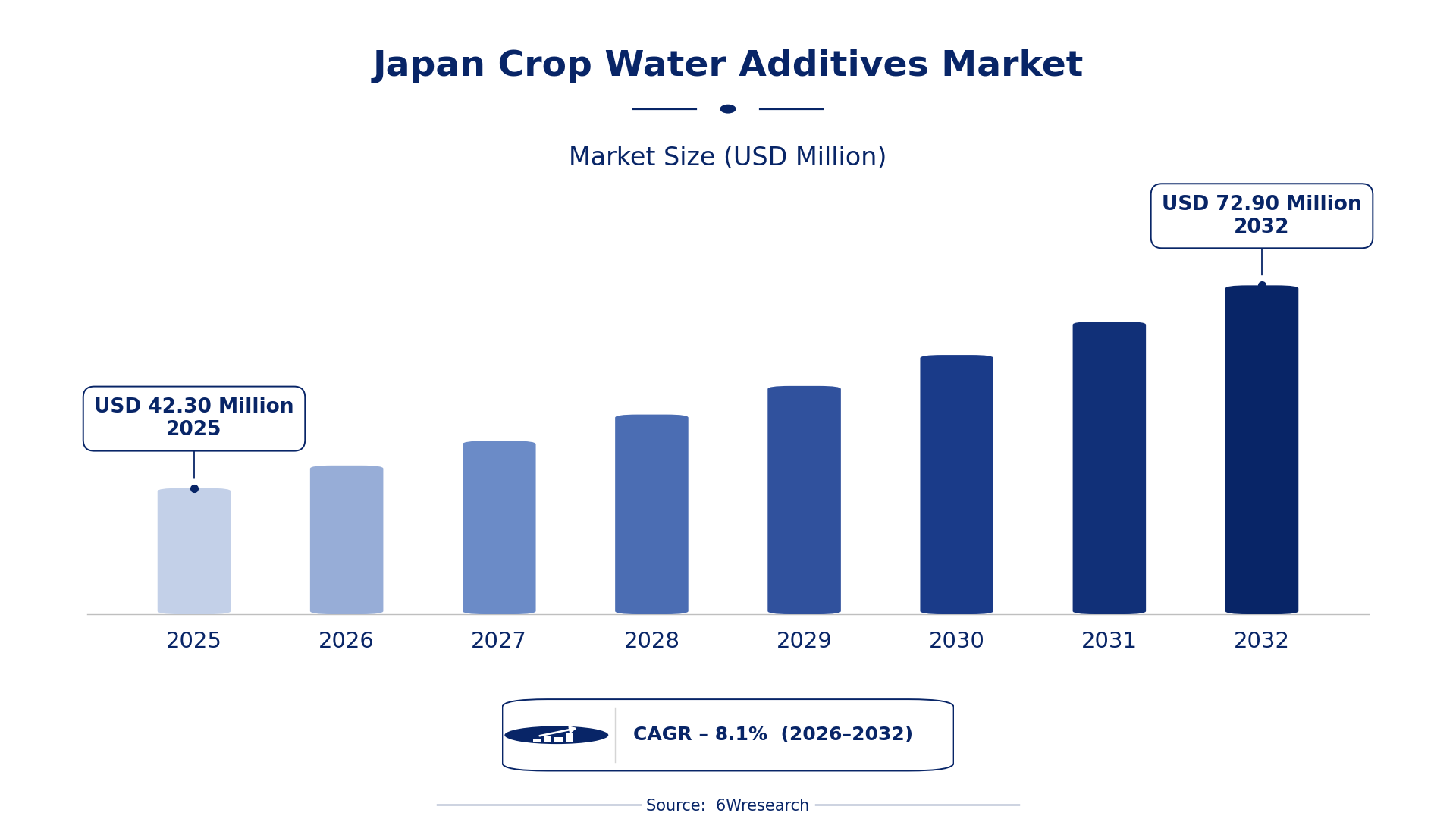
According to 6Wresearch internal database and industry insights, the Japan Crop Water Additives Market was valued at USD 42.30 Million in 2025 and is projected to reach USD 72.90 Million by 2032, growing at a CAGR of approximately 8.1% during 2026–2032.
Japan Crop Water Additives Market Highlights
| Report Metric | Details |
| Report Name | Japan Crop Water Additives Market (2026-2032) |
| Market Size 2025 | USD 42.30 Million |
| Market Size 2032 | USD 72.90 Million |
| Absolute Growth 2025–2032 | USD 30.60 Million |
| CAGR 2026–2032 | 8.1% |
| Peak Annual Growth | 9.7% in 2032 |
| Forecast Period | 2026–2032 |
| Historical Data | 2022–2025 |
| Base Year | 2025 |
| Leading Additive Type, 2025 | Biostimulants (46% share) |
| Leading Functionality, 2025 | Nutrient Efficiency (43% share) |
| Leading Application Mode, 2025 | Drip/Flood Systems (45% share) |
| Leading End User, 2025 | Farmers (32% share) |
| Fastest-Growing Functionality | Improved Uptake (10.6% CAGR) |
| Fastest-Growing Application Mode | Fertigation (11.1% CAGR) |
| Fastest-Growing End User | Organic Farms (11.2% CAGR) |
| Growing Sector | Organic Farming |
| Key End Users | Farmers, Agro Businesses, Organic Farms, Irrigation Units |
Japan Crop Water Additives Market Year-wise Growth Rate and Key Drivers (2022–2032)
This graph illustrates the annual growth rates of the market from 2022 to 2032, highlighting a steady upward trajectory and projected market expansion over the forecast period.
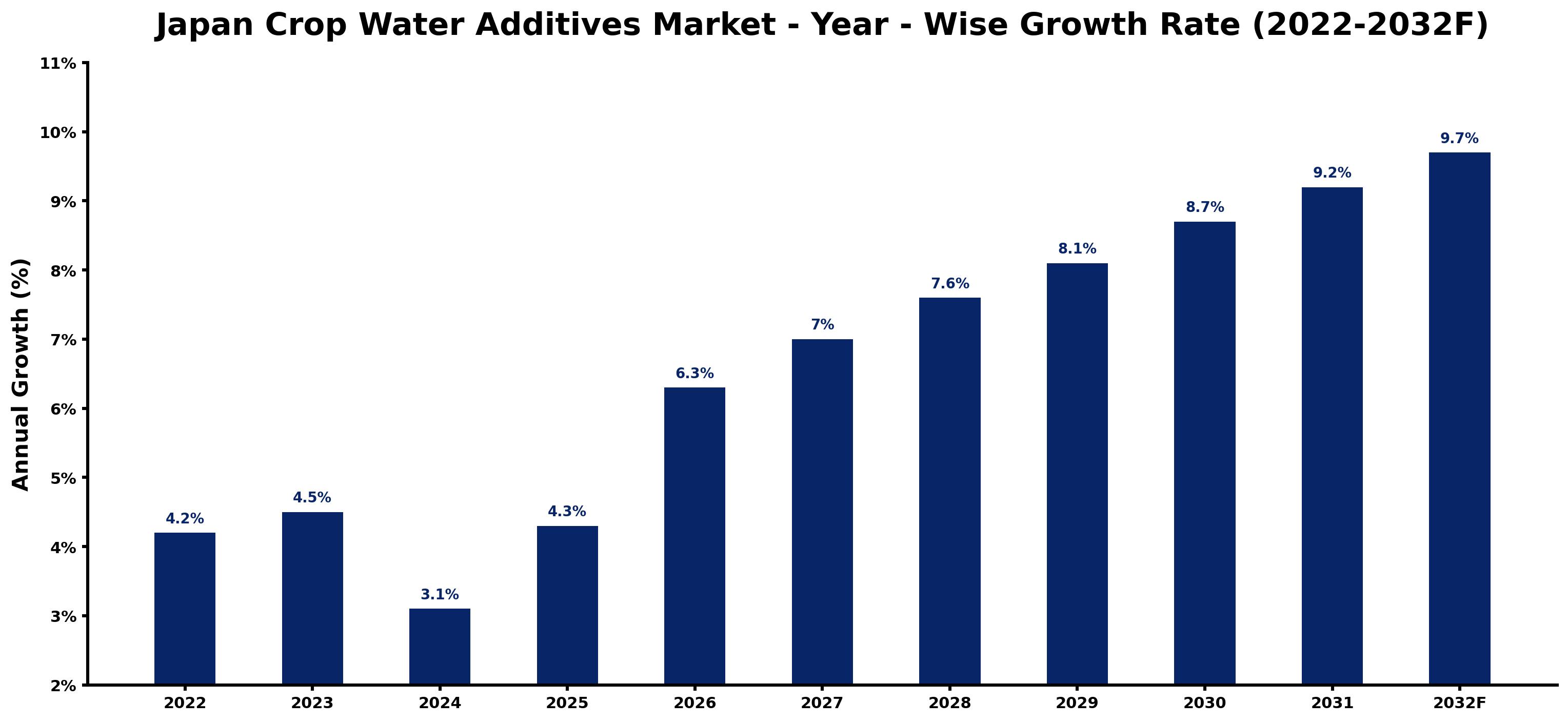
Annual growth estimates for each year appear below with the principal reason behind them, explaining the shifts that set the pace of the market.
| Year | Estimated Annual Growth (%) | Market Rationale |
| 2022 | 4.2 | The market experienced steady growth due to ongoing agricultural activities. |
| 2023 | 4.5 | Demand increased as farmers adopted more efficient irrigation methods. |
| 2024 | 3.1 | Growth slowed as market adjustments occurred following previous expansions. |
| 2025 | 4.3 | A resurgence in growth was driven by rising interest in sustainable practices. |
| 2026 | 6.3 | Investment in advanced irrigation technologies is expected to boost demand. |
| 2027 | 7.0 | The market will continue to rise as agro businesses expand their operations. |
| 2028 | 7.6 | Increased adoption of biostimulants is projected to contribute to higher growth rates. |
| 2029 | 8.1 | Demand will surge as organic farming practices gain wider acceptance. |
| 2030 | 8.7 | Investment in fertigation systems will further accelerate market growth. |
| 2031 | 9.2 | The market is projected to expand as awareness of water quality improvements increases. |
| 2032 | 9.7 | Peak growth is expected through enhanced agricultural productivity initiatives. |
Note: Market size estimations and growth projections presented in this report are based on 6Wresearch's proprietary forecasting methodology, utilizing the latest available industry data, government publications, and primary research inputs.
Japan Crop Water Additives Market Synopsis
Crop water additives are chemical formulations that improve water quality and agricultural productivity by enhancing nutrient uptake and reducing surface tension. The Japan Crop Water Additives Market is expanding, driven by a growing number of farmers, with approximately 1.5 million engaged in agriculture. Investment in sustainable practices and advanced irrigation technologies, such as drip and fertigation systems, is stimulating demand. In 2023, a new initiative was launched to educate farmers on the benefits of these additives, further promoting market growth.
Market Dynamics Impact Analysis (2026–2032)
| Factor | Type | Impact | Primary Segment Affected |
| Rising adoption of biostimulants in organic farming | Driver | High | Biostimulants |
| Increased investment in advanced irrigation technologies | Driver | High | Drip/Flood Systems |
| Growing demand for sustainable agriculture practices | Opportunity | High | Organic Farms |
| Expansion of agro businesses investing in crop productivity | Opportunity | High | Agro Businesses |
| Aging farmer population leading to workforce challenges | Restraint | High | Farmers |
| Limited awareness of crop water additives among new farmers | Restraint | Medium | Farmers |
| High initial costs of advanced irrigation systems | Challenge | High | Drip/Flood Systems |
| Dependence on traditional farming methods among older farmers | Challenge | Medium | Farmers |
Evaluation of Drivers in Japan Crop Water Additives Market (2026–2032)
Key forces behind demand, with the segment each one moves most, are listed below.
| Drivers | Primary Segment Affected | Why It Matters (Evidence) |
| Increased adoption of biostimulants | Biostimulants | Biostimulants promote plant growth, with organic farms using them accounting for 20% of total inputs. |
| Investment in advanced irrigation technologies | Drip/Flood Systems | Agro businesses are investing in technologies to improve productivity, with funding allocated for research on water-efficient farming technologies. |
| Growing awareness of nutrient efficiency | Nutrient Efficiency | Farmers are focusing on improving fertilizer effectiveness, leading to better yields and higher demand for additives. |
| Expansion of organic farming practices | Organic Farms | The organic farming area reached 0.5 million hectares, driving demand for water additives among farmers. |
| Regulatory support for sustainable agriculture | Agro Businesses | The government aims to increase organic farming by 25% by 2025, boosting additive demand. |
Buyers are adding capacity as investment in advanced irrigation technologies rises, with agro businesses increasing their spending on efficient systems. Approximately 30% of greenhouse operations in Japan utilise fertigation systems, improving productivity. The average pH level of agricultural soil is maintained between 5.5 to 6.5, supporting the use of pH balance additives. The target to increase organic farming by 25% by 2025 further drives demand for crop water additives. Farmers are increasingly adopting biostimulants, which account for 20% of total inputs, improving nutrient uptake and crop health.
Evaluation of Restraints in Japan Crop Water Additives Market
Several factors work against faster growth; the main ones are summarised below.
| Market Restraint | Primary Segment Affected | Why It Matters (Evidence) |
| Aging farmer population leading to workforce challenges | Farmers | With the average age of farmers at 67 years, there is a growing concern over the future workforce in agriculture. |
| Limited awareness of crop water additives among new farmers | Farmers | New entrants often lack knowledge about the benefits of crop water additives, slowing adoption. |
| High initial costs of advanced irrigation systems | Drip/Flood Systems | The investment required for modern irrigation technologies can deter farmers from upgrading. |
| Dependence on traditional farming methods among older farmers | Farmers | Older farmers may resist changing established practices, which restricts market expansion. |
| Regulatory compliance costs for organic farming | Organic Farms | Compliance with existing regulations can incur additional costs for organic farmers. |
Japan Crop Water Additives Market Challenges
Producers face higher costs due to stringent regulations on organic farming practices, which delay product availability for 1.5 million farmers. Suppliers encounter inconsistent supply chains, particularly affecting the delivery of water conditioners for 1 million hectares of drip irrigation systems, potentially disrupting planting schedules for growers. Buyers experience rising prices as limited access to advanced irrigation technologies constrains their ability to implement efficient farming methods, leading to potential yield losses. Technology adoption lags, with the average age of farmers at 67 years, hindering the transition to modern practices that could boost agricultural productivity.
Trends in the Japan Crop Water Additives Market
The trends below show where the Japan Crop Water Additives Market is heading.
- Shift from Traditional to Advanced Irrigation: Farmers in the Tohoku region are increasingly adopting advanced irrigation practices, with 1 million hectares now using drip systems. This shift improves water efficiency and crop yields.
- Transition from Conventional to Organic Farming: The organic farming area in Japan reached 0.5 million hectares in 2022, reflecting a growing trend towards sustainable practices. This shift is driving demand for biostimulants and water conditioners.
- Emergence of Fertigation as a Preferred Method: Fertigation systems are now used in 30% of greenhouse operations, highlighting a shift towards integrated fertilization and irrigation. This trend is expected to boost the market for crop water additives.
- Increased Focus on Nutrient Efficiency: Farmers are prioritising nutrient efficiency, with 43% of the market share in functionality held by nutrient efficiency additives. This focus is reshaping purchasing decisions across the agricultural sector.
Investment Opportunities in the Japan Crop Water Additives Market
Below are the investment opportunities with the strongest case in the Japan Crop Water Additives Market.
- Farmers seeking sustainable solutions: Farmers are increasingly looking for sustainable solutions, with the government targeting a 25% increase in organic farming by 2025. This creates opportunities for suppliers of biostimulants.
- Agro businesses investing in technology: Agro businesses are investing in advanced irrigation technologies, with a focus on improving productivity. This trend presents opportunities for partnerships in the development of effective water additives.
- Organic farms expanding their operations: Organic farms are expanding rapidly, with 20% of total inputs now allocated to biostimulants. Suppliers can enter this market through local partnerships and certifications.
- Irrigation units modernising systems: Irrigation units are modernising their systems to improve efficiency, creating demand for crop water additives. Suppliers can engage through joint ventures to meet this need.
Government Initiatives in the Japan Crop Water Additives Market
The Water Supply Act of 1957 sets standards for drinking-water quality, impacting the production of crop water additives. Additionally, the Sewerage Act of 1958 governs wastewater treatment, ensuring compliance for agricultural practices. Together, these regulations help maintain the quality of water used in farming operations.
In 2023, the Ministry of Agriculture allocated funds for research on water-efficient farming technologies. The Japan Agricultural Standards oversees the regulation of organic farming practices, ensuring quality and safety for producers.
Future Insight of the Japan Crop Water Additives Market
Advanced irrigation technologies will reshape demand for crop water additives by 2032, driven by the Ministry of Agriculture's initiative promoting sustainable agriculture. The government has allocated funds for research on water-efficient farming technologies, which will lead to product innovation and improved availability. Adoption of ISO 9001 standards will ensure higher quality in agricultural additives production, benefiting both buyers and suppliers. Educational initiatives will inform growers about the advantages of these formulations, likely shifting the market towards more efficient agricultural practices.
Market Segmentation Analysis
Japan Crop Water Additives Market report covers a detailed analysis of the following market segments:
By Additive Type – Biostimulants Lead and Record the Fastest Growth
According to Saurav Kr Singh, Senior Research Analyst at 6Wresearch, Biostimulants held 46% of the Japan Crop Water Additives Market by additive type in 2025. Biostimulants command the largest share as they are vital for promoting plant growth and health, especially in organic farming where their use is prevalent. The increasing area of organic farming in Japan, reaching 0.5 million hectares in 2022, illustrates their importance. Biostimulants are also forecast to expand faster than any other category, at a CAGR of 9.7% over 2026–2032. The rapid growth of biostimulants is driven by the rising demand for organic farming, with a government target to increase organic farming by 25% by 2025. This trend suggests that the adoption of biostimulants will continue to expand as farmers pursue sustainable practices. Suppliers should focus on developing biostimulant products to meet the growing demand from the organic farming sector.
By Functionality – Nutrient Efficiency Leads, Improved Uptake Expected to Grow Fastest
Nutrient Efficiency took 43% of functionality revenue in 2025, more than any other category. Nutrient Efficiency holds the largest share as it significantly enhances the effectiveness of fertilizers applied, which is crucial for farmers aiming to improve crop yields. This is particularly important given the government's initiative to promote sustainable agriculture, which encourages efficient farming practices. The quickest growth will come from Improved Uptake, forecast to expand at a CAGR of 10.6% between 2026 and 2032. Improved Uptake is witnessing rapid growth because it directly enhances nutrient absorption by plants, essential for boosting productivity. As farmers increasingly seek to optimise their inputs, the demand for solutions that ensure better nutrient uptake will continue to rise. This trend suggests that suppliers should focus on developing products that enhance nutrient efficiency and uptake to meet farmer needs.
By Application Mode – Drip/Flood Systems Lead, Fertigation Expected to Grow Fastest
The largest application mode category in 2025 was Drip/Flood Systems, at 45% of revenue. Drip/Flood Systems dominate the market as they are commonly used in modern irrigation practices across Japan, facilitating efficient water use on approximately 1 million hectares. This widespread adoption reflects the need for effective irrigation solutions in the agricultural sector. Fertigation is set to record the highest CAGR in this split, 11.1% over 2026–2032. Fertigation is growing quickly as it integrates fertilisation with irrigation, offering a more efficient approach to nutrient delivery. The increasing use of fertigation in 30% of greenhouse operations highlights its importance in contemporary farming methods. Suppliers should consider expanding their offerings in fertigation systems to cater to the increasing demand for efficient irrigation solutions.
By End User – Farmers Lead, Organic Farms Expected to Grow Fastest
With 32% of end user revenue in 2025, Farmers was the largest category. Farmers constitute the largest user group of crop water additives in Japan, with around 1.5 million actively utilising these products to improve agricultural productivity. Their direct engagement in the agricultural sector highlights the essential role of effective water additives in their operations. Organic Farms are projected to grow fastest, at a CAGR of 11.2% during 2026–2032. Organic Farms are the fastest-growing segment as they heavily depend on biostimulants and conditioners to maintain sustainable farming practices. The government's target to increase organic farming by 25% by 2025 is driving this demand for specific additives. Suppliers should focus on tailoring their products to cater to the unique requirements of organic farms to leverage this expanding market segment.
Key Attractiveness of the Report
- 10 Years of Market Numbers
- Historical Data Starting from 2022 to 2025
- Base Year 2025
- Forecast Data until 2032
- Key Performance Indicators Impacting the Market
- Major Upcoming Developments and Projects
Key Highlights of the Report:
- Japan Crop Water Additives Market Outlook
- Market Size of Japan Crop Water Additives Market, 2025
- Forecast of Japan Crop Water Additives Market, 2032
- Historical Data and Forecast of Japan Crop Water Additives Revenues & Volume for the Period 2022-2032F
- Japan Crop Water Additives Market Trend Evolution
- Japan Crop Water Additives Market Drivers and Challenges
- Japan Crop Water Additives Price Trends
- Japan Crop Water Additives Porter's Five Forces
- Japan Crop Water Additives Industry Life Cycle
- Historical Data and Forecast of Japan Crop Water Additives Market Revenues & Volume By Additive Type for the Period 2022-2032F
- Historical Data and Forecast of Japan Crop Water Additives Market Revenues & Volume By Water Conditioners for the Period 2022-2032F
- Historical Data and Forecast of Japan Crop Water Additives Market Revenues & Volume By Surfactants for the Period 2022-2032F
- Historical Data and Forecast of Japan Crop Water Additives Market Revenues & Volume By Antifoaming Agents for the Period 2022-2032F
- Historical Data and Forecast of Japan Crop Water Additives Market Revenues & Volume By Biostimulants for the Period 2022-2032F
- Historical Data and Forecast of Japan Crop Water Additives Market Revenues & Volume By Functionality for the Period 2022-2032F
- Historical Data and Forecast of Japan Crop Water Additives Market Revenues & Volume By pH Balance for the Period 2022-2032F
- Historical Data and Forecast of Japan Crop Water Additives Market Revenues & Volume By Improved Uptake for the Period 2022-2032F
- Historical Data and Forecast of Japan Crop Water Additives Market Revenues & Volume By Foam Reduction for the Period 2022-2032F
- Historical Data and Forecast of Japan Crop Water Additives Market Revenues & Volume By Nutrient Efficiency for the Period 2022-2032F
- Historical Data and Forecast of Japan Crop Water Additives Market Revenues & Volume By Application Mode for the Period 2022-2032F
- Historical Data and Forecast of Japan Crop Water Additives Market Revenues & Volume By Drip/Flood Systems for the Period 2022-2032F
- Historical Data and Forecast of Japan Crop Water Additives Market Revenues & Volume By Spray Systems for the Period 2022-2032F
- Historical Data and Forecast of Japan Crop Water Additives Market Revenues & Volume By Fertigation for the Period 2022-2032F
- Historical Data and Forecast of Japan Crop Water Additives Market Revenues & Volume By Tank Mixes for the Period 2022-2032F
- Historical Data and Forecast of Japan Crop Water Additives Market Revenues & Volume By End User for the Period 2022-2032F
- Historical Data and Forecast of Japan Crop Water Additives Market Revenues & Volume By Farmers for the Period 2022-2032F
- Historical Data and Forecast of Japan Crop Water Additives Market Revenues & Volume By Agro Businesses for the Period 2022-2032F
- Historical Data and Forecast of Japan Crop Water Additives Market Revenues & Volume By Irrigation Units for the Period 2022-2032F
- Historical Data and Forecast of Japan Crop Water Additives Market Revenues & Volume By Organic Farms for the Period 2022-2032F
- Japan Crop Water Additives Import Export Trade Statistics
- Market Opportunity Assessment By Additive Type
- Market Opportunity Assessment By Functionality
- Market Opportunity Assessment By Application Mode
- Market Opportunity Assessment By End User
- Japan Crop Water Additives Top Companies Market Share
- Japan Crop Water Additives Competitive Benchmarking By Technical and Operational Parameters
- Japan Crop Water Additives Company Profiles
- Japan Crop Water Additives Key Strategic Recommendations
Market Covered
Segments analysed in this report are listed below.
By Additive Type
- Water Conditioners
- Surfactants
- Antifoaming Agents
- Biostimulants
By Functionality
- pH Balance
- Improved Uptake
- Foam Reduction
- Nutrient Efficiency
By Application Mode
- Drip/Flood Systems
- Spray Systems
- Fertigation
- Tank Mixes
By End User
- Farmers
- Agro Businesses
- Irrigation Units
- Organic Farms






































