Japan Culinary Herbs Market Size & Growth Rate
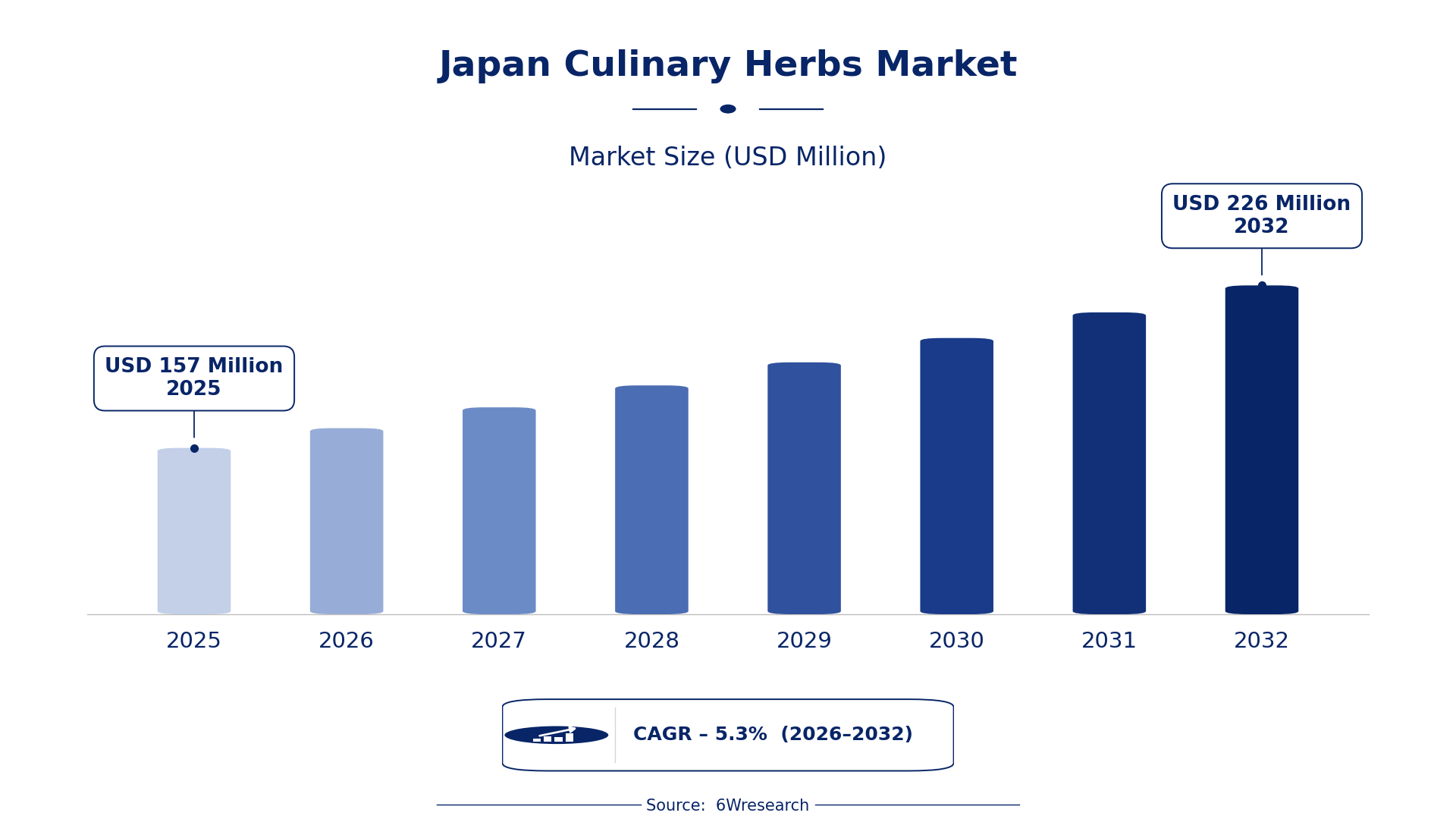
According to 6Wresearch internal database and industry insights, the Japan Culinary Herbs Market was valued at USD 157 Million in 2025 and is projected to reach USD 226 Million by 2032, growing at a CAGR of approximately 5.3% during 2026–2032.
Japan Culinary Herbs Market Highlights
| Report Metric | Details |
| Report Name | Japan Culinary Herbs Market (2026-2032) |
| Market Size 2025 | USD 157 Million |
| Market Size 2032 | USD 226 Million |
| Absolute Growth 2025–2032 | USD 69 Million |
| CAGR 2026–2032 | 5.3% |
| Peak Annual Growth | 6.5% in 2032 |
| Forecast Period | 2026–2032 |
| Historical Data | 2022–2025 |
| Base Year | 2025 |
| Leading Herb Type, 2025 | Basil (39% share) |
| Leading Form Type, 2025 | Fresh (37% share) |
| Leading Distribution Channel, 2025 | Supermarkets (53% share) |
| Leading End User, 2025 | Households (41% share) |
| Fastest-Growing Herb Type | Thyme (7.5% CAGR) |
| Fastest-Growing Form Type | Dried (7.9% CAGR) |
| Fastest-Growing Distribution Channel | Online Stores (7.1% CAGR) |
| Fastest-Growing End User | Food Processors (6.9% CAGR) |
| Growing Sector | Household cooking |
| Key End Users | Households, Restaurants, Food Processors, Catering Services |
Japan Culinary Herbs Market Year-wise Growth Rate and Key Drivers (2022–2032)
This graph illustrates the annual growth rates of the market from 2022 to 2032, highlighting a steady upward trajectory and projected market expansion over the forecast period.
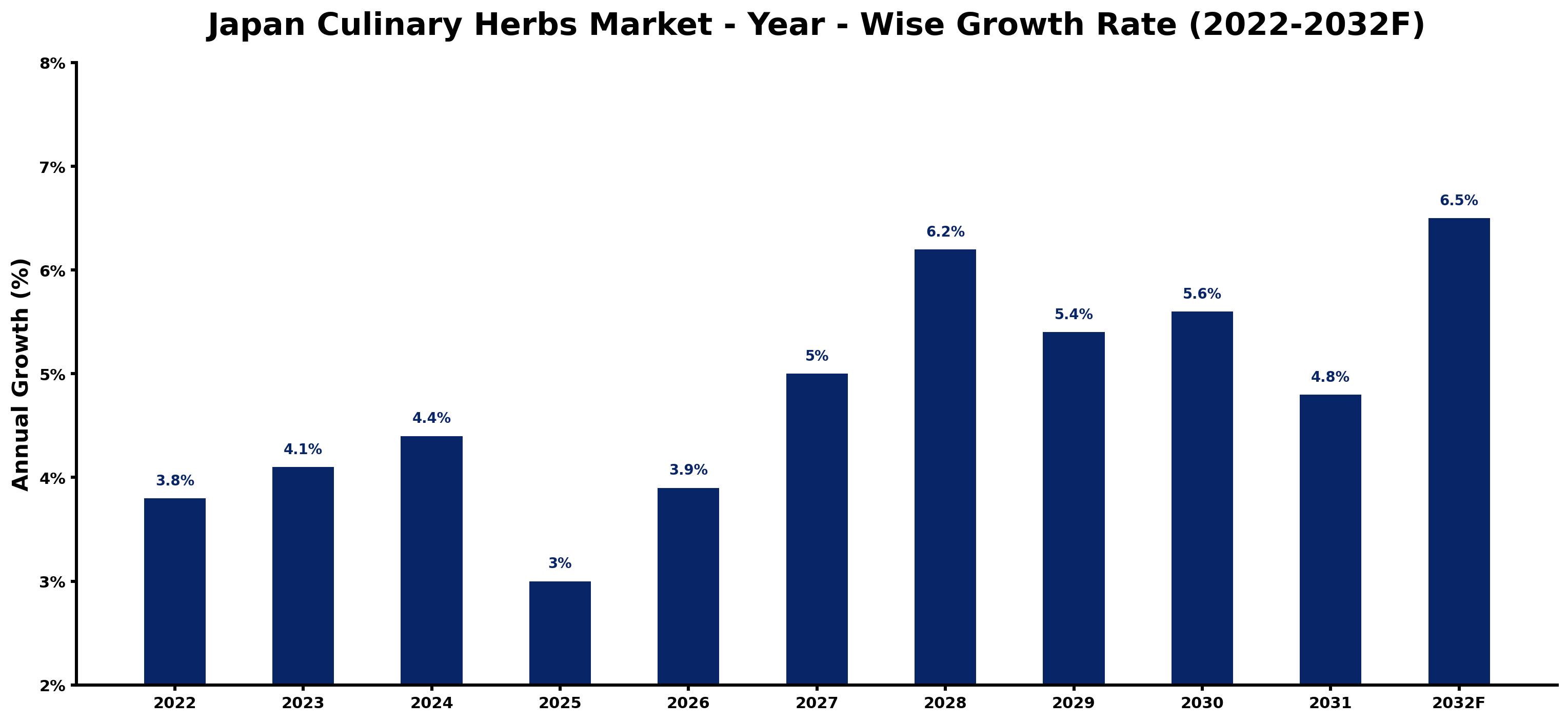
The table below sets out the estimated growth rate for each year and the main factor behind it.
| Year | Estimated Annual Growth (%) | Market Rationale |
| 2022 | 3.8 | The market showed steady growth due to rising culinary interest among households. |
| 2023 | 4.1 | Growth accelerated as urban centres increased their demand for fresh herbs. |
| 2024 | 4.4 | Continued interest in healthy eating drove further growth in herb consumption. |
| 2025 | 3.0 | Growth slowed as market saturation began to affect purchasing patterns. |
| 2026 | 3.9 | Demand is expected to pick up again as convenience becomes key with online grocery sales. |
| 2027 | 5.0 | Increased health awareness among consumers will boost the demand for fresh herbs. |
| 2028 | 6.2 | Growth is projected to surge as culinary trends embrace diverse flavours and fresh ingredients. |
| 2029 | 5.4 | A slowdown is anticipated as consumer preferences stabilise after previous rapid changes. |
| 2030 | 5.6 | Demand will rise again as urban gardening initiatives encourage local herb cultivation. |
| 2031 | 4.8 | Growth is expected to slow as competition intensifies among suppliers and distribution channels. |
| 2032 | 6.5 | The market is projected to peak as health trends and culinary diversity drive herb consumption. |
Note: Market size estimations and growth projections presented in this report are based on 6Wresearch's proprietary forecasting methodology, utilizing the latest available industry data, government publications, and primary research inputs.
Japan Culinary Herbs Market Synopsis
Culinary herbs are plant-derived seasonings used in cooking, commonly found in households, restaurants, and food processing. The Japan Culinary Herbs Market is growing as consumers increasingly seek fresh ingredients, with households spending around 5,000 yen each month on these seasonings. Urban centres like Tokyo serve as major demand sources, while the food service industry, valued at over 20 trillion yen, further drives consumption. The surge in online grocery sales, which reached 1.5 trillion yen in 2022, also supports this expanding market.
Market Dynamics Impact Analysis (2026–2032)
| Factor | Type | Impact | Primary Segment Affected |
| Growing health consciousness among consumers | Driver | High | Fresh |
| Rising demand for diverse culinary experiences | Driver | High | Dried |
| Expansion of online grocery shopping | Opportunity | High | Online Stores |
| Increased interest in local herb cultivation | Opportunity | Medium | Fresh |
| Market saturation affecting growth rates | Restraint | Medium | Dried |
| Competition from imported herbs | Restraint | High | Fresh |
| Supply chain disruptions impacting availability | Challenge | High | Fresh |
| Fluctuating consumer preferences for flavours | Challenge | Medium | Dried |
Evaluation of Drivers in Japan Culinary Herbs Market (2026–2032)
The following drivers explain most of the expected growth.
| Drivers | Primary Segment Affected | Why It Matters (Evidence) |
| Increased consumer spending on health and wellness | Fresh | Approximately 70% of households prefer fresh herbs, driving demand for local sourcing. |
| Growing culinary tourism in urban areas | Dried | Tokyo's food service industry, valued at over 20 trillion yen, boosts demand for diverse flavours. |
| Rise in home cooking trends | Online Stores | Online grocery sales reached 1.5 trillion yen in 2022, increasing convenience for consumers. |
| Promotion of local herb farming by government initiatives | Fresh | Subsidies from the Ministry of Agriculture, Forestry and Fisheries support local herb cultivation. |
| Health trends favouring organic and fresh ingredients | Dried | Government support for organic farming appeals to health-conscious consumers. |
Purchasing is picking up as consumer interest in health and wellness rises, with 70% of households preferring fresh herbs for cooking. Urban culinary tourism is also contributing to this trend, as the food service industry in Tokyo, valued at over 20 trillion yen, seeks diverse flavours. The growth of online grocery shopping has allowed consumers to access herbs conveniently, with sales reaching 1.5 trillion yen in 2022. These factors are boosting the culinary herbs market in Japan.
Evaluation of Restraints in Japan Culinary Herbs Market
The main factors holding the market back are set out below.
| Market Restraint | Primary Segment Affected | Why It Matters (Evidence) |
| Market saturation limiting growth potential | Dried | As the market matures, growth rates are slowing due to established consumer preferences. |
| Increased competition from imported herbs | Fresh | Imported herbs often offer lower prices, affecting local producers' market share. |
| Supply chain disruptions affecting availability | Fresh | Logistical challenges can lead to inconsistent supply, impacting consumer access to herbs. |
| Fluctuating consumer preferences for flavours | Dried | Changing culinary trends can lead to reduced demand for certain dried herbs. |
| High production costs for local herb farmers | Fresh | Rising costs can limit the ability of local producers to compete with imports. |
Japan Culinary Herbs Market Challenges
High costs for culinary herbs restrict household purchases, as families spend about 5,000 yen each month on seasonings. Supply challenges arise due to herb cultivation being concentrated in regions like Shizuoka and Kumamoto, leading to delays in deliveries to restaurants and food processors. Local suppliers face tough competition from imported herbs, which pressures them to reduce prices, adversely affecting their profit margins. Stringent regulations, including ISO 22000 standards for food safety, raise compliance costs for producers, resulting in higher retail prices for consumers.
Trends in the Japan Culinary Herbs Market
The shifts below are changing how Japan Culinary Herbs Market products are bought and supplied.
- Shift to Online Grocery Shopping: Urban consumers in Tokyo are increasingly turning to online grocery shopping, with sales reaching 1.5 trillion yen in 2022. This shift allows for greater access to fresh culinary herbs, benefiting suppliers who adapt to digital platforms.
- Growing Preference for Organic Herbs: Health-conscious consumers are prioritising organic herbs, as organic herb sales rise, appealing to buyers seeking healthier options.
- Increased Use of Fresh Herbs in Catering: Catering services are increasingly incorporating fresh herbs into their menus, improving flavour profiles. This trend is supported by the growing demand for diverse culinary experiences in Japan.
- Expansion of Urban Gardening Initiatives: Urban gardening initiatives in regions like Tokyo are encouraging local herb cultivation. The Tokyo Metropolitan Government supports these efforts, promoting fresh herb availability for households.
Investment Opportunities in the Japan Culinary Herbs Market
Several openings in the Japan Culinary Herbs Market merit attention from investors.
- Fresh Culinary Herbs: Investing in fresh culinary herbs is timely as consumer preference for fresh ingredients grows. Households in urban centres like Tokyo represent key buyers, and local partnerships can facilitate market entry.
- Dried Culinary Herbs: Demand for dried culinary herbs is on the rise, driven by health trends. Collaborating with local grocery chains can provide access to a growing consumer base seeking convenient options.
- Online Herb Sales: The online sales channel is expanding, with a notable growth rate of 7.1%. Engaging with online platforms can help suppliers connect with tech-savvy consumers looking for convenience.
- Organic Herb Farming: The organic herb market presents a ripe investment opportunity, supported by government initiatives. Partnering with local farmers in regions like Shizuoka can strengthen supply chains and meet consumer demand.
Government Initiatives in the Japan Culinary Herbs Market
The Food Recycling Law (2000) promotes sustainable practices in food businesses, requiring them to reduce waste and recycle it into usable products. This law complements the Food Sanitation Act amendments, which introduced a positive list system for food packaging, improving safety standards for culinary herbs. The Ministry of Agriculture, Forestry and Fisheries provides funding to support local herb cultivation, benefiting producers and consumers alike.
The Japan Herb Association utilises government schemes to promote culinary herbs in cooking and health. By securing funding for local herb cultivation, the association supports farmers and raises awareness among consumers about the benefits of using fresh herbs.
Future Insight of the Japan Culinary Herbs Market
Technological advancements in urban farming will transform the culinary herb market by 2032, leading to more efficient production methods. The Ministry of Agriculture, Forestry and Fisheries will continue to support local herb cultivation through subsidies, improving supply chains and reducing costs for buyers. Health trends will drive demand for fresh herbs, with 40% of total herb market revenue expected to come from supermarket sales. Online grocery sales are projected to reach 2 trillion yen, further enhancing access to culinary herbs for consumers.
Market Segmentation Analysis
Japan Culinary Herbs Market report covers a detailed analysis of the following market segments:
By Herb Type – Basil Leads, Thyme Expected to Grow Fastest
According to Saurav Kr Singh, Senior Research Analyst at 6Wresearch, the largest herb type category in 2025 was Basil, at 39% of revenue. Basil holds the largest share as it is widely used in Japanese cuisine for flavouring dishes, making it a staple in many households and restaurants. Its prominence is particularly notable in urban centres like Tokyo, where demand is high. The quickest growth will come from Thyme, forecast to expand at a CAGR of 7.5% between 2026 and 2032. Thyme is experiencing rapid growth as it is increasingly incorporated into fusion dishes, appealing to modern culinary trends. This trend is evident as chefs and home cooks seek to diversify their flavour profiles. Suppliers should focus on promoting thyme to capitalise on its growing popularity among consumers.
By Form Type – Fresh Leads, Dried Expected to Grow Fastest
Fresh held 37% of the Japan Culinary Herbs Market by form type in 2025. Fresh herbs dominate the market as they are the most preferred form for home cooking, with 70% of households opting for them. Their vibrant flavour and aroma significantly enhance the culinary experience, making them a top choice. Dried is projected to grow fastest, at a CAGR of 7.9% during 2026–2032. Dried herbs are witnessing growth due to their convenience and long shelf life, ideal for consumers seeking easy storage solutions. This trend appeals particularly to those wishing to stock up without compromising on quality. Suppliers must ensure a reliable supply of dried herbs to meet the increasing demand from consumers.
By Distribution Channel – Supermarkets Lead, Online Stores Expected to Grow Fastest
With 53% of distribution channel revenue in 2025, Supermarkets was the largest category. Supermarkets are the primary distribution channel for consumers, accounting for 40% of total herb market revenue. Their widespread presence and accessibility make them the go-to option for purchasing culinary herbs. Over 2026–2032, Online Stores are expected to post the fastest growth, at a CAGR of 7.1%. Online stores are gaining traction as a convenient shopping option, with online grocery sales reaching 1.5 trillion yen in 2022. This shift reflects changing consumer behaviour towards digital purchasing, particularly for fresh produce. Suppliers should invest in online platforms to enhance their market reach and cater to the growing demand for online shopping.
By End User – Households Lead, Food Processors Expected to Grow Fastest
Households accounted for 41% of the market by end user in 2025. Households represent the largest consumer segment for culinary herbs, with an average monthly expenditure of 5,000 yen on herbs and spices. This consistent demand underscores the importance of herbs in everyday cooking for families across Japan. Food Processors are set to record the highest CAGR in this split, 6.9% over 2026–2032. Food processors are increasingly utilising culinary herbs in prepared foods, driven by health trends that favour fresh ingredients. This growing focus on quality and flavour in processed foods is expected to boost herb consumption in the sector. Suppliers should target food processors to expand their market presence and align with health-conscious trends.
Key Attractiveness of the Report
- 10 Years of Market Numbers
- Historical Data Starting from 2022 to 2025
- Base Year 2025
- Forecast Data until 2032
- Key Performance Indicators Impacting the Market
- Major Upcoming Developments and Projects
Key Highlights of the Report:
- Japan Culinary Herbs Market Outlook
- Market Size of Japan Culinary Herbs Market, 2025
- Forecast of Japan Culinary Herbs Market, 2032
- Historical Data and Forecast of Japan Culinary Herbs Revenues & Volume for the Period 2022-2032F
- Japan Culinary Herbs Market Trend Evolution
- Japan Culinary Herbs Market Drivers and Challenges
- Japan Culinary Herbs Price Trends
- Japan Culinary Herbs Porter's Five Forces
- Japan Culinary Herbs Industry Life Cycle
- Historical Data and Forecast of Japan Culinary Herbs Market Revenues & Volume By Herb Type for the Period 2022-2032F
- Historical Data and Forecast of Japan Culinary Herbs Market Revenues & Volume By Basil for the Period 2022-2032F
- Historical Data and Forecast of Japan Culinary Herbs Market Revenues & Volume By Oregano for the Period 2022-2032F
- Historical Data and Forecast of Japan Culinary Herbs Market Revenues & Volume By Thyme for the Period 2022-2032F
- Historical Data and Forecast of Japan Culinary Herbs Market Revenues & Volume By Rosemary for the Period 2022-2032F
- Historical Data and Forecast of Japan Culinary Herbs Market Revenues & Volume By Form Type for the Period 2022-2032F
- Historical Data and Forecast of Japan Culinary Herbs Market Revenues & Volume By Fresh for the Period 2022-2032F
- Historical Data and Forecast of Japan Culinary Herbs Market Revenues & Volume By Dried for the Period 2022-2032F
- Historical Data and Forecast of Japan Culinary Herbs Market Revenues & Volume By Powdered for the Period 2022-2032F
- Historical Data and Forecast of Japan Culinary Herbs Market Revenues & Volume By Frozen for the Period 2022-2032F
- Historical Data and Forecast of Japan Culinary Herbs Market Revenues & Volume By Distribution Channel for the Period 2022-2032F
- Historical Data and Forecast of Japan Culinary Herbs Market Revenues & Volume By Supermarkets for the Period 2022-2032F
- Historical Data and Forecast of Japan Culinary Herbs Market Revenues & Volume By Online Stores for the Period 2022-2032F
- Historical Data and Forecast of Japan Culinary Herbs Market Revenues & Volume By Grocery Chains for the Period 2022-2032F
- Historical Data and Forecast of Japan Culinary Herbs Market Revenues & Volume By Specialty Stores for the Period 2022-2032F
- Historical Data and Forecast of Japan Culinary Herbs Market Revenues & Volume By End User for the Period 2022-2032F
- Historical Data and Forecast of Japan Culinary Herbs Market Revenues & Volume By Households for the Period 2022-2032F
- Historical Data and Forecast of Japan Culinary Herbs Market Revenues & Volume By Restaurants for the Period 2022-2032F
- Historical Data and Forecast of Japan Culinary Herbs Market Revenues & Volume By Food Processors for the Period 2022-2032F
- Historical Data and Forecast of Japan Culinary Herbs Market Revenues & Volume By Catering Services for the Period 2022-2032F
- Japan Culinary Herbs Import Export Trade Statistics
- Market Opportunity Assessment By Herb Type
- Market Opportunity Assessment By Form Type
- Market Opportunity Assessment By Distribution Channel
- Market Opportunity Assessment By End User
- Japan Culinary Herbs Top Companies Market Share
- Japan Culinary Herbs Competitive Benchmarking By Technical and Operational Parameters
- Japan Culinary Herbs Company Profiles
- Japan Culinary Herbs Key Strategic Recommendations
Market Covered
The report covers the following segments.
By Herb Type
- Basil
- Oregano
- Thyme
- Rosemary
By Form Type
- Fresh
- Dried
- Powdered
- Frozen
By Distribution Channel
- Supermarkets
- Online Stores
- Grocery Chains
- Specialty Stores
By End User
- Households
- Restaurants
- Food Processors
- Catering Services






































