Japan Cytokinins Market Size & Growth Rate
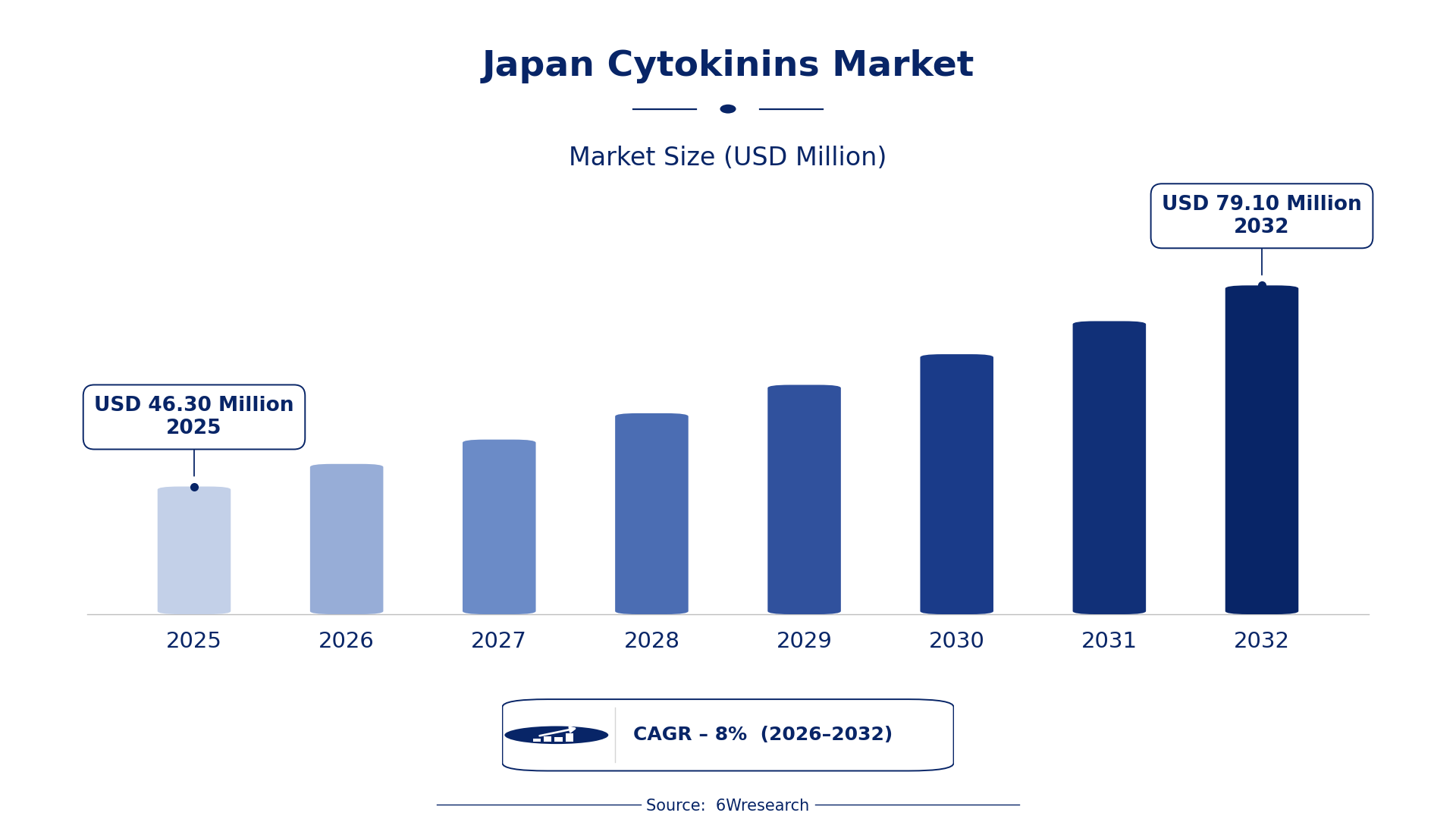
According to 6Wresearch internal database and industry insights, the Japan Cytokinins Market was valued at USD 46.30 Million in 2025 and is projected to reach USD 79.10 Million by 2032, growing at a CAGR of approximately 8% during 2026–2032.
Japan Cytokinins Market Highlights
| Report Metric | Details |
| Report Name | Japan Cytokinins Market (2026-2032) |
| Market Size 2025 | USD 46.30 Million |
| Market Size 2032 | USD 79.10 Million |
| Absolute Growth 2025–2032 | USD 32.80 Million |
| CAGR 2026–2032 | 8% |
| Peak Annual Growth | 8.5% in 2032 |
| Forecast Period | 2026–2032 |
| Historical Data | 2022–2025 |
| Base Year | 2025 |
| Leading Product Type, 2025 | Synthetic Cytokinins (38% share) |
| Leading Functionality, 2025 | Crop Yield Improvement (39% share) |
| Leading Application Area, 2025 | Agriculture (44% share) |
| Leading Distribution Channel, 2025 | Direct Sales (36% share) |
| Leading End User, 2025 | Farmers (49% share) |
| Fastest-Growing Product Type | Foliar Spray Formulation (11.4% CAGR) |
| Fastest-Growing Functionality | Germination (10.3% CAGR) |
| Fastest-Growing Application Area | Horticulture (10.0% CAGR) |
| Fastest-Growing Distribution Channel | Online Platforms (10.5% CAGR) |
| Fastest-Growing End User | Nurseries (10.4% CAGR) |
| Growing Sector | Agriculture |
| Key End Users | Farmers, Agrochemical Companies, Nurseries, Agricultural Firms |
Japan Cytokinins Market Year-wise Growth Rate and Key Drivers (2022–2032)
This graph illustrates the annual growth rates of the market from 2022 to 2032, highlighting a steady upward trajectory and projected market expansion over the forecast period.
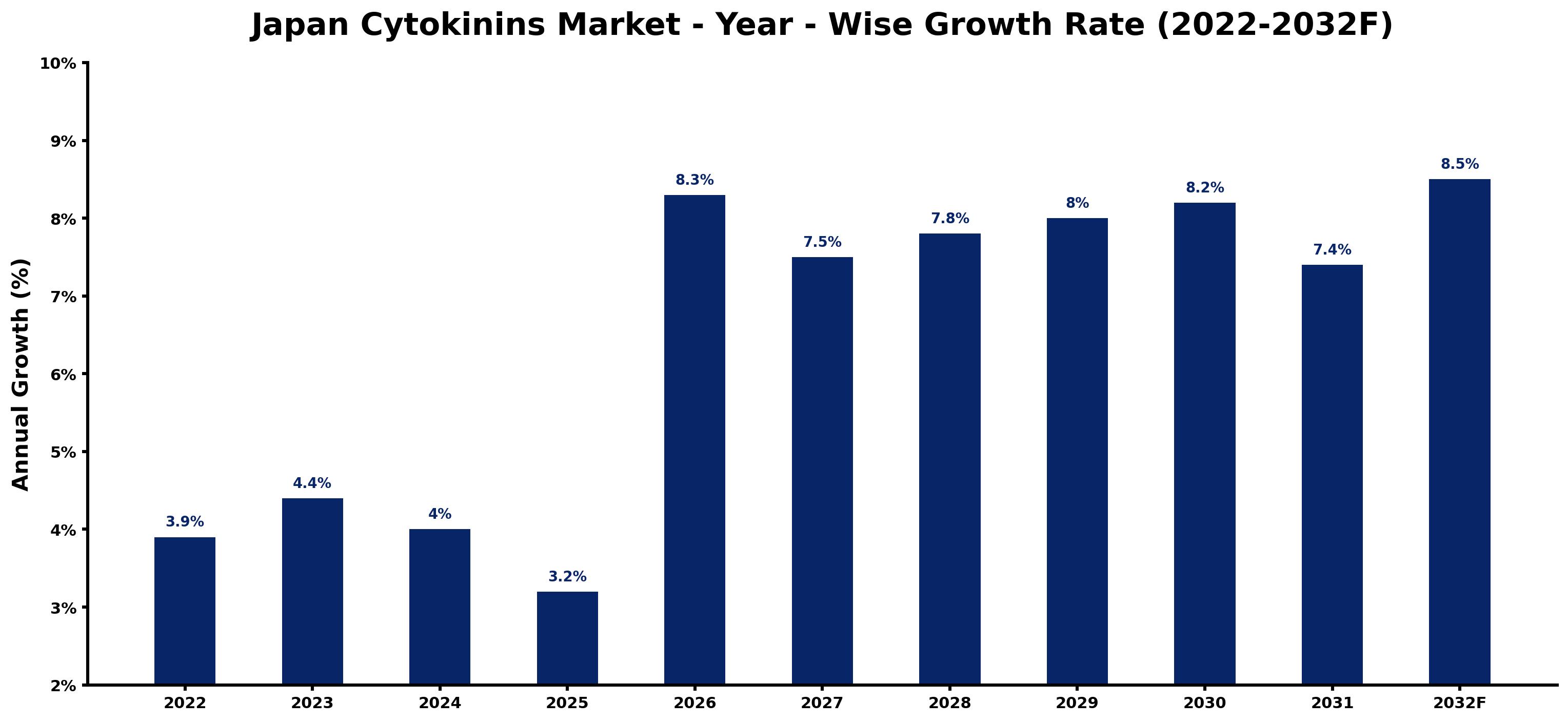
Below, each year's estimated growth is shown next to the factor that most influenced it.
| Year | Estimated Annual Growth (%) | Market Rationale |
| 2022 | 3.9 | The market experienced steady growth due to increased adoption of plant growth regulators. |
| 2023 | 4.4 | Demand surged as agricultural output reached approximately 8 trillion yen. |
| 2024 | 4.0 | Growth slowed slightly as the market adjusted to previous peaks in demand. |
| 2025 | 3.2 | A further slowdown occurred as farmers focused on sustainable practices. |
| 2026 | 8.3 | Growth is expected to accelerate as new formulations of cytokinins enter the market. |
| 2027 | 7.5 | Demand growth is projected to slow as market saturation begins to take effect. |
| 2028 | 7.8 | Growth is expected to pick up again as greenhouse production expands significantly. |
| 2029 | 8.0 | Increased interest in horticulture will drive demand for cytokinins. |
| 2030 | 8.2 | Demand is projected to continue rising as the agricultural sector embraces technology. |
| 2031 | 7.4 | Growth is expected to slow slightly as the market stabilises after rapid expansion. |
| 2032 | 8.5 | The market is projected to peak as new applications of cytokinins emerge. |
Note: Market size estimations and growth projections presented in this report are based on 6Wresearch's proprietary forecasting methodology, utilizing the latest available industry data, government publications, and primary research inputs.
Japan Cytokinins Market Synopsis
Cytokinins are vital plant hormones that promote cell division and growth, primarily used to improve crop yields and facilitate seed germination. The agricultural sector employs over 2 million farmers, with demand arising from agrochemical companies and horticulture. Market growth is driven by agricultural output valued at approximately 8 trillion yen and the adoption of modern agricultural techniques, including the use of plant growth regulators and new formulations.
Market Dynamics Impact Analysis (2026–2032)
| Factor | Type | Impact | Primary Segment Affected |
| Growing agricultural output drives demand for effective growth enhancers. | Driver | High | Crop Yield Improvement |
| Increased focus on sustainable farming practices creates opportunities for organic products. | Opportunity | High | Natural Cytokinins |
| Regulatory compliance can limit the introduction of new products in the market. | Restraint | High | Synthetic Cytokinins |
| Limited awareness of the benefits of cytokinins in certain farming communities presents a challenge. | Challenge | Medium | Agriculture |
| Expansion of greenhouse production increases the need for effective growth regulators. | Driver | Medium | Foliar Spray Formulation |
| The rise of online platforms offers new sales channels for agricultural products. | Opportunity | Medium | Online Platforms |
| Dependence on specific climatic conditions can affect crop yields. | Restraint | Medium | Horticulture |
| Cost pressures from rising raw material prices challenge producers' margins. | Challenge | High | Agrochemical Companies |
Evaluation of Drivers in Japan Cytokinins Market (2026–2032)
Demand rests on the following drivers, each shown with the segment it touches most.
| Drivers | Primary Segment Affected | Why It Matters (Evidence) |
| Increased agricultural output drives demand for cytokinins. | Crop Yield Improvement | In 2023, Japan's agricultural output was valued at approximately 8 trillion yen, prompting farmers to seek effective growth solutions. |
| Expansion of greenhouse cultivation boosts demand for foliar spray formulations. | Foliar Spray Formulation | Greenhouse production in Japan has increased to cover over 10,000 hectares, creating a need for effective nutrient delivery. |
| Growing interest in organic farming promotes the use of natural cytokinins. | Natural Cytokinins | Natural cytokinins sourced from plant extracts are increasingly adopted in organic farming practices. |
| Research on new formulations improves the effectiveness of cytokinins. | Seed Treatment | Research institutions in Japan focus on developing new formulations for improved efficacy in seed treatment. |
| Rising awareness of plant health benefits increases demand for cytokinins. | Plant Growth | Cytokinins are essential for improving the quality of fruits and vegetables, driving demand among farmers. |
Most of the extra volume comes from the agricultural sector, which employs over 2 million farmers. In 2023, Japan's agricultural output was valued at approximately 8 trillion yen, prompting farmers to seek effective growth solutions. The expansion of greenhouse production has increased the need for foliar spray formulations, while rising awareness of plant health benefits drives demand for these products among farmers. The growing interest in organic farming promotes the use of natural cytokinins sourced from plant extracts, further boosting market growth.
Evaluation of Restraints in Japan Cytokinins Market
These restraints slow adoption and weigh on supplier margins.
| Market Restraint | Primary Segment Affected | Why It Matters (Evidence) |
| Regulatory compliance can limit the introduction of new products in the market. | Synthetic Cytokinins | The Chemical Substances Control Law requires evaluation and control of new chemical substances, impacting product approvals. |
| Dependence on specific climatic conditions can affect crop yields. | Horticulture | Climatic variability can limit the effectiveness of cytokinins in certain regions. |
| Limited awareness of the benefits of cytokinins in certain farming communities presents a challenge. | Agriculture | Some farmers remain unaware of the advantages of using cytokinins for crop production. |
| Cost pressures from rising raw material prices challenge producers' margins. | Agrochemical Companies | Increased costs of production materials can affect pricing strategies for cytokinins. |
| Market saturation may limit growth opportunities for existing products. | Foliar Spray Formulation | As more products enter the market, differentiation becomes increasingly challenging. |
Japan Cytokinins Market Challenges
Producers face rising costs as prices for synthetic cytokinins increase, inflating production expenses by up to 15% annually. Regulatory hurdles emerge due to the Agricultural Chemicals Regulation Law, complicating compliance for suppliers and delaying product launches by several months. Competition intensifies as local producers struggle against cheaper imports, which can decrease profit margins for domestic suppliers by around 10%. Supply chain issues arise when natural cytokinins sourced from plant extracts encounter availability challenges, causing delays for farmers during critical planting periods.
Trends in the Japan Cytokinins Market
Buyers and suppliers in the Japan Cytokinins Market are adjusting to the following trends.
- Shift towards Organic Farming: In 2023, the trend towards organic farming gained momentum as natural cytokinins became more popular. Approximately 20% of Japan's agricultural production now involves organic methods, reflecting a shift in farming practices.
- Expansion of Greenhouse Production: Since 2023, greenhouse production has expanded to cover over 10,000 hectares, leading to increased use of cytokinins. This shift allows for more controlled growing conditions, improving crop quality and yield.
- Increased Adoption of Digital Platforms: The rise of online platforms for purchasing agricultural inputs has become evident, with a growth rate of 10.5% projected for the next few years. Farmers are increasingly using these platforms to access cytokinins and other agricultural products.
- Focus on Research and Development: Research institutions in Japan are intensifying efforts to develop new formulations of cytokinins. This focus on innovation aims to improve efficacy and meet the evolving needs of farmers.
Investment Opportunities in the Japan Cytokinins Market
The following opportunities in the Japan Cytokinins Market pair current demand with a clear way in.
- Investment in Organic Farming: With over 20% of agricultural production shifting to organic methods, there is an opportunity to supply natural cytokinins. Farmers seeking organic certifications are a key target market.
- Expansion of Greenhouse Facilities: As greenhouse production continues to grow, there is a pressing need for effective growth regulators. Supplying foliar spray formulations to these facilities presents a lucrative opportunity.
- Development of Online Sales Channels: The increasing trend of online purchasing in agriculture shows a gap for suppliers. Engaging with farmers through digital platforms can facilitate access to cytokinins.
- Research Collaboration with Institutions: Collaborating with research institutions can lead to the development of new formulations. This partnership can improve product offerings and appeal to forward-thinking farmers.
Government Initiatives in the Japan Cytokinins Market
The Chemical Substances Control Law governs the use of cytokinins, ensuring safety and efficacy in agricultural practices. Compliance with this law is important for producers and suppliers, as it requires rigorous testing and reporting of chemical substances. The Ministry of Agriculture, Forestry and Fisheries promotes the use of plant growth regulators, providing guidelines for their application in farming, which supports increased agricultural productivity by 10% by 2025.
The Ministry of Agriculture, Forestry and Fisheries oversees the approval of new agricultural chemicals, including cytokinins. Grants for research on plant hormones are provided by the government, encouraging innovation in the sector. These initiatives aim to improve agricultural productivity by 10% by 2025, benefiting both producers and buyers.
Future Insight of the Japan Cytokinins Market
Technological advancements will transform the market by 2032, leading to the development of more efficient formulations of synthetic cytokinins that could boost crop yields by 20%. Increased government funding for research will facilitate innovative applications that improve crop quality and sustainability. New standards from the Japan Plant Growth Regulators Association will enhance product consistency, benefiting suppliers. The growth of greenhouse production will drive demand for effective foliar spray applications, integrating modern techniques into traditional farming practices.
Market Segmentation Analysis
Japan Cytokinins Market report covers a detailed analysis of the following market segments:
By Product Type – Synthetic Cytokinins Lead, Foliar Spray Formulation Expected to Grow Fastest
According to Ayushi Shukla, Senior Research Analyst at 6Wresearch, with 38% of product type revenue in 2025, Synthetic Cytokinins was the largest category. Synthetic cytokinins dominate Japan's market as they are extensively used for commercial crop production, particularly by farmers seeking to maximise yields. Key production areas such as Shizuoka and Kumamoto contribute to a strong supply chain supporting this demand. Over 2026–2032, Foliar Spray Formulation is expected to post the fastest growth, at a CAGR of 11.4%. The foliar spray formulation is experiencing rapid growth due to its effective nutrient delivery directly to plant leaves, significantly enhancing growth rates. Its popularity in greenhouse cultivation, which spans over 10,000 hectares, underscores its increasing adoption. Suppliers should focus on developing foliar spray formulations to meet the rising demands of agricultural producers.
By Functionality – Crop Yield Improvement Leads, Germination Expected to Grow Fastest
Crop Yield Improvement accounted for 39% of the market by functionality in 2025. Crop yield improvement is the leading functionality, crucial for enhancing agricultural productivity, a primary goal for many farmers in Japan. The government's aim to increase productivity by 10% by 2025 underscores the importance of this functionality in the agricultural sector. Germination is set to record the highest CAGR in this split, 10.3% over 2026–2032. Germination is the fastest-growing functionality, driven by the essential need for successful seed sprouting, particularly in rice cultivation where cytokinins play a vital role. This emphasis on germination is critical for achieving optimal crop establishment and maximising yields. Buyers should prioritise products that enhance germination to improve their overall crop success rates.
By Application Area – Agriculture Leads, Horticulture Expected to Grow Fastest
The largest application area category in 2025 was Agriculture, at 44% of revenue. Agriculture remains the leading application area as it is the primary sector utilising cytokinins for crop production, with over 2 million farmers actively involved. The agricultural output valued at approximately 8 trillion yen highlights its significance. The quickest growth will come from Horticulture, forecast to expand at a CAGR of 10.0% between 2026 and 2032. Horticulture is the fastest-growing application area, reflecting the increasing demand for quality fruits and vegetables, which are essential for both domestic consumption and export. The International Horticultural Exhibition in 2023 showcased this trend towards sustainable practices. Suppliers should consider targeting horticultural applications to capitalise on this growth opportunity.
By Distribution Channel – Direct Sales Leads, Online Platforms Expected to Grow Fastest
Direct Sales took 36% of distribution channel revenue in 2025, more than any other category. Direct sales is the predominant distribution channel, serving as the primary method for farmers to obtain agricultural products directly from suppliers. This channel ensures that farmers receive essential inputs efficiently, supporting their operational needs. Online Platforms are projected to grow fastest, at a CAGR of 10.5% during 2026–2032. Online platforms are emerging as the fastest-growing distribution channel, appealing to a new generation of farmers who prefer the convenience of digital purchasing. This trend indicates a shift towards more agricultural inputs being sold through online channels. Suppliers must strengthen their online presence to effectively engage with the increasing number of customers opting for digital transactions.
By End User – Farmers Lead, Nurseries Expected to Grow Fastest
Farmers held 49% of the Japan Cytokinins Market by end user in 2025. Farmers are the primary end-users of cytokinins, relying heavily on these products to boost crop yields and improve quality. Their direct engagement with cytokinins significantly influences overall market demand in Japan. Over 2026–2032, Nurseries are expected to post the fastest growth, at a CAGR of 10.4%. Nurseries represent the fastest-growing end-user segment, increasingly using cytokinins for plant propagation, which is vital for ensuring robust plant stock. This trend is particularly significant in the horticultural sector, where maintaining quality is essential. Suppliers should tailor their offerings to meet the specific needs of nurseries to capitalise on this growth opportunity.
Key Attractiveness of the Report
- 10 Years of Market Numbers
- Historical Data Starting from 2022 to 2025
- Base Year 2025
- Forecast Data until 2032
- Key Performance Indicators Impacting the Market
- Major Upcoming Developments and Projects
Key Highlights of the Report:
- Japan Cytokinins Market Outlook
- Market Size of Japan Cytokinins Market, 2025
- Forecast of Japan Cytokinins Market, 2032
- Historical Data and Forecast of Japan Cytokinins Market Revenues & Volume for the Period 2022-2032F
- Japan Cytokinins Market Trend Evolution
- Japan Cytokinins Market Drivers and Challenges
- Japan Cytokinins Market Price Trends
- Japan Cytokinins Market Porter's Five Forces
- Japan Cytokinins Market Industry Life Cycle
- Historical Data and Forecast of Japan Cytokinins Market Revenues & Volume By Product Type for the Period 2022-2032F
- Historical Data and Forecast of Japan Cytokinins Market Revenues & Volume By Natural Cytokinins for the Period 2022-2032F
- Historical Data and Forecast of Japan Cytokinins Market Revenues & Volume By Synthetic Cytokinins for the Period 2022-2032F
- Historical Data and Forecast of Japan Cytokinins Market Revenues & Volume By Foliar Spray Formulation for the Period 2022-2032F
- Historical Data and Forecast of Japan Cytokinins Market Revenues & Volume By Seed Treatment for the Period 2022-2032F
- Historical Data and Forecast of Japan Cytokinins Market Revenues & Volume By Functionality for the Period 2022-2032F
- Historical Data and Forecast of Japan Cytokinins Market Revenues & Volume By Plant Growth for the Period 2022-2032F
- Historical Data and Forecast of Japan Cytokinins Market Revenues & Volume By Crop Yield Improvement for the Period 2022-2032F
- Historical Data and Forecast of Japan Cytokinins Market Revenues & Volume By Plant Development for the Period 2022-2032F
- Historical Data and Forecast of Japan Cytokinins Market Revenues & Volume By Germination for the Period 2022-2032F
- Historical Data and Forecast of Japan Cytokinins Market Revenues & Volume By Application Area for the Period 2022-2032F
- Historical Data and Forecast of Japan Cytokinins Market Revenues & Volume By Agriculture for the Period 2022-2032F
- Historical Data and Forecast of Japan Cytokinins Market Revenues & Volume By Horticulture for the Period 2022-2032F
- Historical Data and Forecast of Japan Cytokinins Market Revenues & Volume By Greenhouses for the Period 2022-2032F
- Historical Data and Forecast of Japan Cytokinins Market Revenues & Volume By Crop Protection for the Period 2022-2032F
- Historical Data and Forecast of Japan Cytokinins Market Revenues & Volume By Distribution Channel for the Period 2022-2032F
- Historical Data and Forecast of Japan Cytokinins Market Revenues & Volume By Direct Sales for the Period 2022-2032F
- Historical Data and Forecast of Japan Cytokinins Market Revenues & Volume By Online Platforms for the Period 2022-2032F
- Historical Data and Forecast of Japan Cytokinins Market Revenues & Volume By Specialty Suppliers for the Period 2022-2032F
- Historical Data and Forecast of Japan Cytokinins Market Revenues & Volume By Industrial Suppliers for the Period 2022-2032F
- Historical Data and Forecast of Japan Cytokinins Market Revenues & Volume By End User for the Period 2022-2032F
- Historical Data and Forecast of Japan Cytokinins Market Revenues & Volume By Farmers for the Period 2022-2032F
- Historical Data and Forecast of Japan Cytokinins Market Revenues & Volume By Agrochemical Companies for the Period 2022-2032F
- Historical Data and Forecast of Japan Cytokinins Market Revenues & Volume By Nurseries for the Period 2022-2032F
- Historical Data and Forecast of Japan Cytokinins Market Revenues & Volume By Agricultural Firms for the Period 2022-2032F
- Japan Cytokinins Market Import Export Trade Statistics
- Market Opportunity Assessment By Product Type
- Market Opportunity Assessment By Functionality
- Market Opportunity Assessment By Application Area
- Market Opportunity Assessment By Distribution Channel
- Market Opportunity Assessment By End User
- Japan Cytokinins Market Top Companies Market Share
- Japan Cytokinins Market Competitive Benchmarking By Technical and Operational Parameters
- Japan Cytokinins Market Company Profiles
- Japan Cytokinins Market Key Strategic Recommendations
Market Covered
Segments analysed in this report are listed below.
By Product Type
- Natural Cytokinins
- Synthetic Cytokinins
- Foliar Spray Formulation
- Seed Treatment
By Functionality
- Plant Growth
- Crop Yield Improvement
- Plant Development
- Germination
By Application Area
- Agriculture
- Horticulture
- Greenhouses
- Crop Protection
By Distribution Channel
- Direct Sales
- Online Platforms
- Specialty Suppliers
- Industrial Suppliers
By End User
- Farmers
- Agrochemical Companies
- Nurseries
- Agricultural Firms






































