Japan Dairy Farming Market Size & Growth Rate
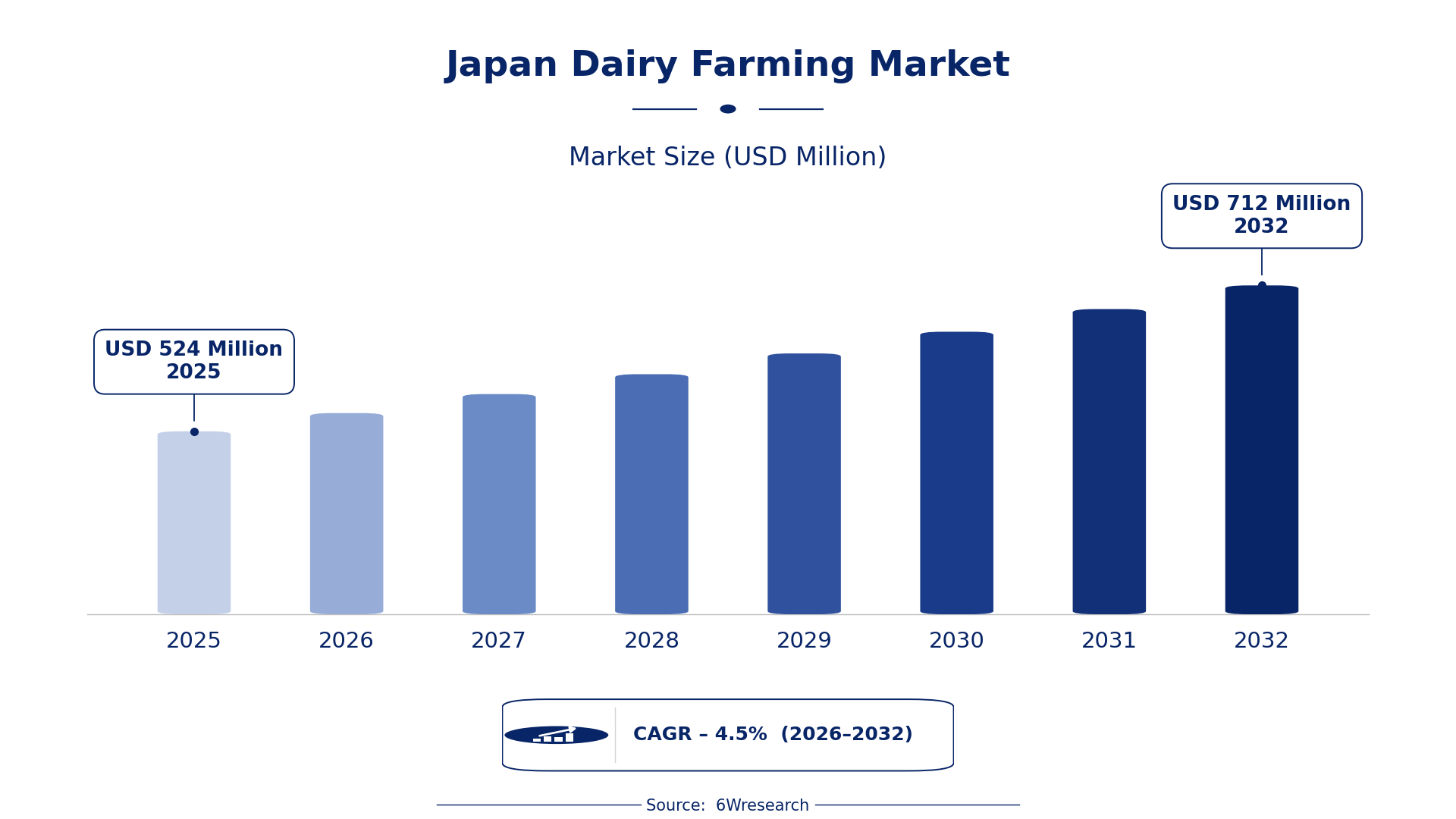
According to 6Wresearch internal database and industry insights, the Japan Dairy Farming Market was valued at USD 524 Million in 2025 and is projected to reach USD 712 Million by 2032, growing at a CAGR of approximately 4.5% during 2026–2032.
Japan Dairy Farming Market Highlights
| Report Metric | Details |
| Report Name | Japan Dairy Farming Market (2026-2032) |
| Market Size 2025 | USD 524 Million |
| Market Size 2032 | USD 712 Million |
| Absolute Growth 2025–2032 | USD 188 Million |
| CAGR 2026–2032 | 4.5% |
| Peak Annual Growth | 5.2% in 2026 |
| Forecast Period | 2026–2032 |
| Historical Data | 2022–2025 |
| Base Year | 2025 |
| Leading Farming Type, 2025 | Organic Farming (39% share) |
| Leading Livestock Type, 2025 | Cattle (39% share) |
| Leading Technology Use, 2025 | Manual/Semi-Auto (38% share) |
| Leading End User, 2025 | Small Farmers (38% share) |
| Fastest-Growing Farming Type | Commercial Farming (6.3% CAGR) |
| Fastest-Growing Livestock Type | Buffalo (6.6% CAGR) |
| Fastest-Growing Technology Use | Automated (6.7% CAGR) |
| Fastest-Growing End User | Large Dairies (5.7% CAGR) |
| Growing Sector | Dairy Products |
| Key End Users | Small Farmers, Large Dairies, Dairy Cooperatives |
Japan Dairy Farming Market Year-wise Growth Rate and Key Drivers (2022–2032)
This graph illustrates the annual growth rates of the market from 2022 to 2032, highlighting a steady upward trajectory and projected market expansion over the forecast period.
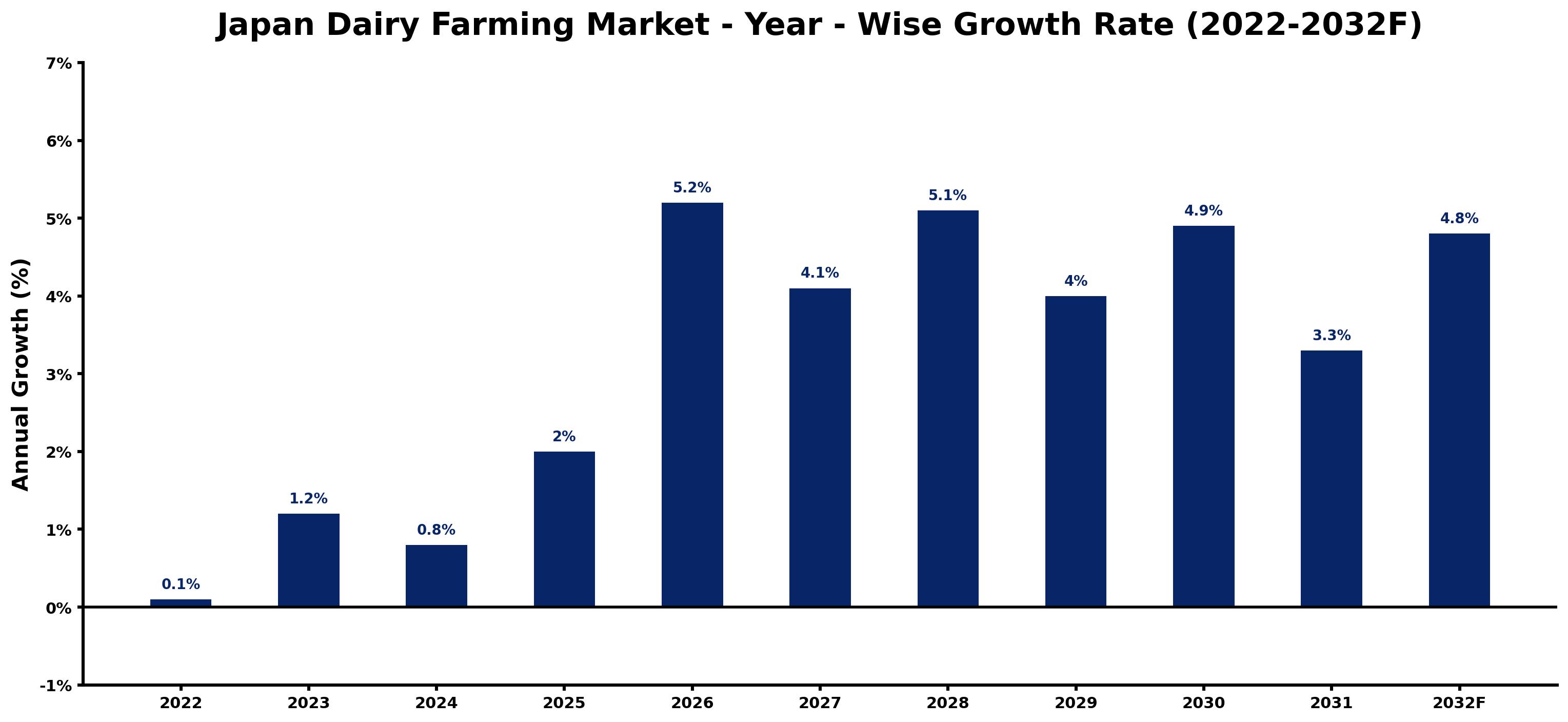
Below, each year's estimated growth is shown next to the factor that most influenced it.
| Year | Estimated Annual Growth (%) | Market Rationale |
| 2022 | 0.1 | The market showed minimal growth due to ongoing challenges in the dairy sector. |
| 2023 | 1.2 | A rise in consumer demand for dairy products contributed to improved growth rates. |
| 2024 | 0.8 | Growth slowed as market adjustments took place following previous increases. |
| 2025 | 2.0 | The market experienced an uptick as modernization efforts gained traction. |
| 2026 | 5.2 | A peak in growth is anticipated as technological advancements transform dairy practices. |
| 2027 | 4.1 | Growth is projected to slow as the market begins to stabilise after rapid expansion. |
| 2028 | 5.1 | The market is expected to rebound with renewed interest in automated farming technologies. |
| 2029 | 4.0 | Growth is projected to slow again as the market adjusts to new operational standards. |
| 2030 | 4.9 | An increase in demand for organic dairy products is expected to spur market activity. |
| 2031 | 3.3 | Growth is projected to slow as the market faces demographic challenges among farmers. |
| 2032 | 4.8 | A resurgence in interest for sustainable practices is expected to drive growth. |
Note: Market size estimations and growth projections presented in this report are based on 6Wresearch's proprietary forecasting methodology, utilizing the latest available industry data, government publications, and primary research inputs.
Japan Dairy Farming Market Synopsis
Dairy farming in Japan centres on breeding and managing dairy cattle for milk production, employing both traditional and modern techniques. Domestic consumer demand and local processing facilities drive the Japan Dairy Farming Market. With over 1.5 million dairy cows contributing approximately 0.6% to the economy, the sector is evolving through modernization efforts. Organic dairy farming has experienced a growth of 20% in the last five years, reflecting changing consumer preferences.
Market Dynamics Impact Analysis (2026–2032)
| Factor | Type | Impact | Primary Segment Affected |
| Increasing demand for organic dairy products | Driver | High | Organic Farming |
| Adoption of automated farming technologies | Driver | High | Automated |
| Growing interest in sustainable farming practices | Opportunity | High | Organic Farming |
| Expansion of dairy cooperatives in rural areas | Opportunity | Medium | Dairy Cooperatives |
| Aging population of dairy farmers | Restraint | High | Small Farmers |
| High operational costs associated with dairy farming | Restraint | Medium | Commercial Farming |
| Competition from imported dairy products | Challenge | High | Large Dairies |
| Limited access to modern farming technologies | Challenge | Medium | Small Farmers |
Evaluation of Drivers in Japan Dairy Farming Market (2026–2032)
Below are the drivers that matter most for revenue growth, with supporting evidence.
| Drivers | Primary Segment Affected | Why It Matters (Evidence) |
| Rising consumer demand for dairy products | Commercial Farming | This demand has led to increased production efforts, with the average milk yield per cow at about 8,000 liters annually. |
| Technological advancements in farming practices | Automated | Automation has improved efficiency in large dairy operations, with IoT technology adoption increasing by 30% since 2022. |
| Support from dairy cooperatives | Dairy Cooperatives | These cooperatives, with over 1,200 members nationwide, help in processing and marketing dairy products effectively. |
| Growth in organic farming | Organic Farming | The Japanese government aims to increase organic farming to 10% by 2025, meeting rising consumer preferences. |
| Modernization programs by the Ministry of Agriculture | Commercial Farming | These programs promote best practices and improve productivity within the dairy sector. |
Behind the steady rise in orders sits a growing consumer preference for dairy products, reflected in the average milk yield of about 8,000 liters per cow. The adoption of automated technologies has surged by 30% since 2022, enhancing operational efficiency in large dairy operations. Support from dairy cooperatives, which have over 1,200 members, plays a significant role in processing and marketing dairy products. The target to increase organic farming to 10% by 2025 aligns with rising demand for organic dairy.
Evaluation of Restraints in Japan Dairy Farming Market
The main factors holding the market back are set out below.
| Market Restraint | Primary Segment Affected | Why It Matters (Evidence) |
| Aging population of dairy farmers | Small Farmers | With an average age over 60 years, this demographic challenge limits the workforce available for dairy farming. |
| High operational costs associated with dairy farming | Commercial Farming | These costs hinder profitability and investment in necessary technologies for growth. |
| Competition from imported dairy products | Large Dairies | This competition pressures local producers to maintain pricing and quality standards. |
| Limited access to modern farming technologies | Small Farmers | Small-scale operations often struggle to invest in automation and advanced farming techniques. |
| Regulatory compliance costs | Dairy Cooperatives | Meeting JIS standards and other regulations can be financially burdensome for cooperatives. |
Japan Dairy Farming Market Challenges
Producers face rising input costs due to a limited local feed supply, which has increased prices by 15% over the past year, squeezing margins for farmers. Buyers encounter unpredictable milk prices from local processing facilities, complicating budgeting and leading to potential losses. Technology adoption remains low, with only 30% of farms using IoT, resulting in inefficiencies that hinder competitiveness against imports. Traditional producers struggle as organic dairy farming grows by 20%, forcing them to adapt to changing consumer preferences or risk losing market share.
Trends in the Japan Dairy Farming Market
The trends below show where the Japan Dairy Farming Market is heading.
- Shift towards Organic Dairy Farming: The Japanese government aims to increase organic farming to 10% by 2025, responding to consumer demand for organic products. This shift has resulted in a 20% growth in organic dairy farming over the last five years.
- Increase in Automated Dairy Operations: Automation is becoming more prevalent in dairy farming, with a 30% increase in IoT technology adoption since 2022. This trend is particularly noticeable in large dairies across Hokkaido, improving operational efficiency.
- Focus on Sustainable Practices: Dairy farming events in Hokkaido promote best practices, encouraging farmers to adopt sustainable methods. This has sparked increased consumer interest in environmentally friendly dairy products.
- Expansion of Dairy Cooperatives: Dairy cooperatives are extending their reach in rural areas, with over 1,200 members nationwide. This growth supports local farmers and enhances the supply chain for dairy products.
Investment Opportunities in the Japan Dairy Farming Market
Where to invest in the Japan Dairy Farming Market: the main openings are set out below.
- Gap in Organic Dairy Supply: With the target to increase organic farming to 10% by 2025, there exists an opportunity for suppliers to meet this demand. Small farmers in rural areas are seeking partners to transition to organic methods.
- Investment in Automated Farming Solutions: The rising adoption of automation presents an opportunity for technology providers to supply automated systems. Large dairies are actively pursuing partnerships to improve efficiency through technology.
- Support for Dairy Cooperatives: The expansion of dairy cooperatives offers investment opportunities for businesses that can provide processing and marketing support. Engaging with local cooperatives can facilitate market entry.
- Demand for Sustainable Practices: As consumer interest in sustainability grows, suppliers can invest in products that promote eco-friendly practices. Large dairies are increasingly prioritising sustainable sourcing and production methods.
Government Initiatives in the Japan Dairy Farming Market
The Food Sanitation Act amendment, fully applied in June 2021, mandates HACCP-based hygiene management for food businesses, including dairy producers. This regulation ensures that dairy products meet high safety standards, benefiting both producers and consumers by improving product quality.
Funding of approximately USD 10 million is allocated annually for modernization initiatives supporting dairy farming through various programs. The Ministry of Agriculture, Forestry and Fisheries aims to improve productivity and sustainability in the dairy sector.
Future Insight of the Japan Dairy Farming Market
By 2032, buyers will benefit from improved product quality as JIS standards evolve, ensuring safer and more nutritious dairy products. The government’s initiative to boost organic farming will encourage diversification, allowing suppliers to cater to health-conscious consumers. IoT technology adoption is expected to rise significantly, driving operational efficiency and enhancing milk yield. Dairy farming events in Hokkaido will continue to promote best practices, fostering collaboration and knowledge sharing among farmers.
Market Segmentation Analysis
Japan Dairy Farming Market report covers a detailed analysis of the following market segments:
By Farming Type – Organic Farming Leads, Commercial Farming Expected to Grow Fastest
According to Saurav Kr Singh, Senior Research Analyst at 6Wresearch, Organic Farming held 39% of the Japan Dairy Farming Market by farming type in 2025. Organic farming holds the largest share as it aligns with the rising consumer demand for organic products, particularly in urban markets. The government's goal to increase organic farming to 10% by 2025 further emphasises its critical role in Japan's dairy industry. The quickest growth will come from Commercial Farming, forecast to expand at a CAGR of 6.3% between 2026 and 2032. Commercial farming is experiencing rapid growth to meet the escalating demand for large-scale milk production, particularly in the Hokkaido region. The average milk yield per cow, around 8,000 litres annually, showcases the efficiency of this method. Suppliers must focus on supporting organic practices while also catering to the needs of the expanding commercial farming sector.
By Livestock Type – Cattle Leads, Buffalo Expected to Grow Fastest
Cattle took 39% of livestock type revenue in 2025, more than any other category. Cattle is the predominant livestock type for dairy production, providing the majority of milk supply in Japan. The established infrastructure and management practices surrounding cattle farming reinforce its leading position in the market. Buffalo is set to record the highest CAGR in this split, 6.6% over 2026–2032. Buffalo farming is gradually gaining traction as interest in diverse dairy products increases among niche markets. This growth is driven by a rising awareness of the nutritional benefits associated with buffalo milk, creating new opportunities. Buyers may explore buffalo products to diversify their offerings, while suppliers could promote techniques for buffalo farming.
By Technology Use – Manual/Semi-Auto Leads, Automated Expected to Grow Fastest
With 38% of technology use revenue in 2025, Manual/Semi-Auto was the largest category. Manual and semi-automatic systems are prevalent in smaller farms where full automation is not financially viable. This segment's dominance reflects the traditional practices still in use across many rural areas in Japan, ensuring continuity in operations. Over 2026–2032, Automated is expected to post the fastest growth, at a CAGR of 6.7%. Automated technology is rapidly gaining popularity as it significantly improves operational efficiency in larger dairy operations. The 30% increase in IoT technology adoption since 2022 highlights the shift towards more advanced farming methods. Investing in automated solutions will be crucial for suppliers aiming to attract larger dairy operations seeking enhanced efficiency.
By End User – Small Farmers Lead, Large Dairies Expected to Grow Fastest
In 2025, Small Farmers led the end user split with a 38% share. Small farmers play a vital role in the local dairy supply chain, making substantial contributions to community markets. Their extensive presence across Japan ensures a consistent demand for dairy products, underscoring their importance in the sector. Large Dairies are projected to grow fastest, at a CAGR of 5.7% during 2026–2032. Large dairies are expanding quickly as they dominate production capacity and meet the increasing demand for dairy products. Their ability to scale operations effectively positions them for sustained growth in the market. Suppliers should tailor their offerings to address the distinct needs of both small farmers and large dairies to maximise market reach.
Key Attractiveness of the Report
- 10 Years of Market Numbers
- Historical Data Starting from 2022 to 2025
- Base Year 2025
- Forecast Data until 2032
- Key Performance Indicators Impacting the Market
- Major Upcoming Developments and Projects
Key Highlights of the Report:
- Japan Dairy Farming Market Outlook
- Market Size of Japan Dairy Farming Market, 2025
- Forecast of Japan Dairy Farming Market, 2032
- Historical Data and Forecast of Japan Dairy Farming Revenues & Volume for the Period 2022-2032F
- Japan Dairy Farming Market Trend Evolution
- Japan Dairy Farming Market Drivers and Challenges
- Japan Dairy Farming Price Trends
- Japan Dairy Farming Porter's Five Forces
- Japan Dairy Farming Industry Life Cycle
- Historical Data and Forecast of Japan Dairy Farming Market Revenues & Volume By Farming Type for the Period 2022-2032F
- Historical Data and Forecast of Japan Dairy Farming Market Revenues & Volume By Organic Farming for the Period 2022-2032F
- Historical Data and Forecast of Japan Dairy Farming Market Revenues & Volume By Commercial Farming for the Period 2022-2032F
- Historical Data and Forecast of Japan Dairy Farming Market Revenues & Volume By Mixed Farming for the Period 2022-2032F
- Historical Data and Forecast of Japan Dairy Farming Market Revenues & Volume By Zero-Grazing Units for the Period 2022-2032F
- Historical Data and Forecast of Japan Dairy Farming Market Revenues & Volume By Livestock Type for the Period 2022-2032F
- Historical Data and Forecast of Japan Dairy Farming Market Revenues & Volume By Cattle for the Period 2022-2032F
- Historical Data and Forecast of Japan Dairy Farming Market Revenues & Volume By Buffalo for the Period 2022-2032F
- Historical Data and Forecast of Japan Dairy Farming Market Revenues & Volume By Cow & Goat for the Period 2022-2032F
- Historical Data and Forecast of Japan Dairy Farming Market Revenues & Volume By Cow for the Period 2022-2032F
- Historical Data and Forecast of Japan Dairy Farming Market Revenues & Volume By Technology Use for the Period 2022-2032F
- Historical Data and Forecast of Japan Dairy Farming Market Revenues & Volume By Manual/Semi-Auto for the Period 2022-2032F
- Historical Data and Forecast of Japan Dairy Farming Market Revenues & Volume By Automated for the Period 2022-2032F
- Historical Data and Forecast of Japan Dairy Farming Market Revenues & Volume By IoT & AI Monitoring for the Period 2022-2032F
- Historical Data and Forecast of Japan Dairy Farming Market Revenues & Volume By Controlled Feeding for the Period 2022-2032F
- Historical Data and Forecast of Japan Dairy Farming Market Revenues & Volume By End User for the Period 2022-2032F
- Historical Data and Forecast of Japan Dairy Farming Market Revenues & Volume By Small Farmers for the Period 2022-2032F
- Historical Data and Forecast of Japan Dairy Farming Market Revenues & Volume By Large Dairies for the Period 2022-2032F
- Historical Data and Forecast of Japan Dairy Farming Market Revenues & Volume By Agri Businesses for the Period 2022-2032F
- Historical Data and Forecast of Japan Dairy Farming Market Revenues & Volume By Dairy Cooperatives for the Period 2022-2032F
- Japan Dairy Farming Import Export Trade Statistics
- Market Opportunity Assessment By Farming Type
- Market Opportunity Assessment By Livestock Type
- Market Opportunity Assessment By Technology Use
- Market Opportunity Assessment By End User
- Japan Dairy Farming Top Companies Market Share
- Japan Dairy Farming Competitive Benchmarking By Technical and Operational Parameters
- Japan Dairy Farming Company Profiles
- Japan Dairy Farming Key Strategic Recommendations
Market Covered
Segments analysed in this report are listed below.
By Farming Type
- Organic Farming
- Commercial Farming
- Mixed Farming
- Zero-Grazing Units
By Livestock Type
- Cattle
- Buffalo
- Cow & Goat
- Cow
By Technology Use
- Manual/Semi-Auto
- Automated
- IoT & AI Monitoring
- Controlled Feeding
By End User
- Small Farmers
- Large Dairies
- Agri Businesses
- Dairy Cooperatives






































