Japan Data Center Market Size & Growth Rate (2026-2032)
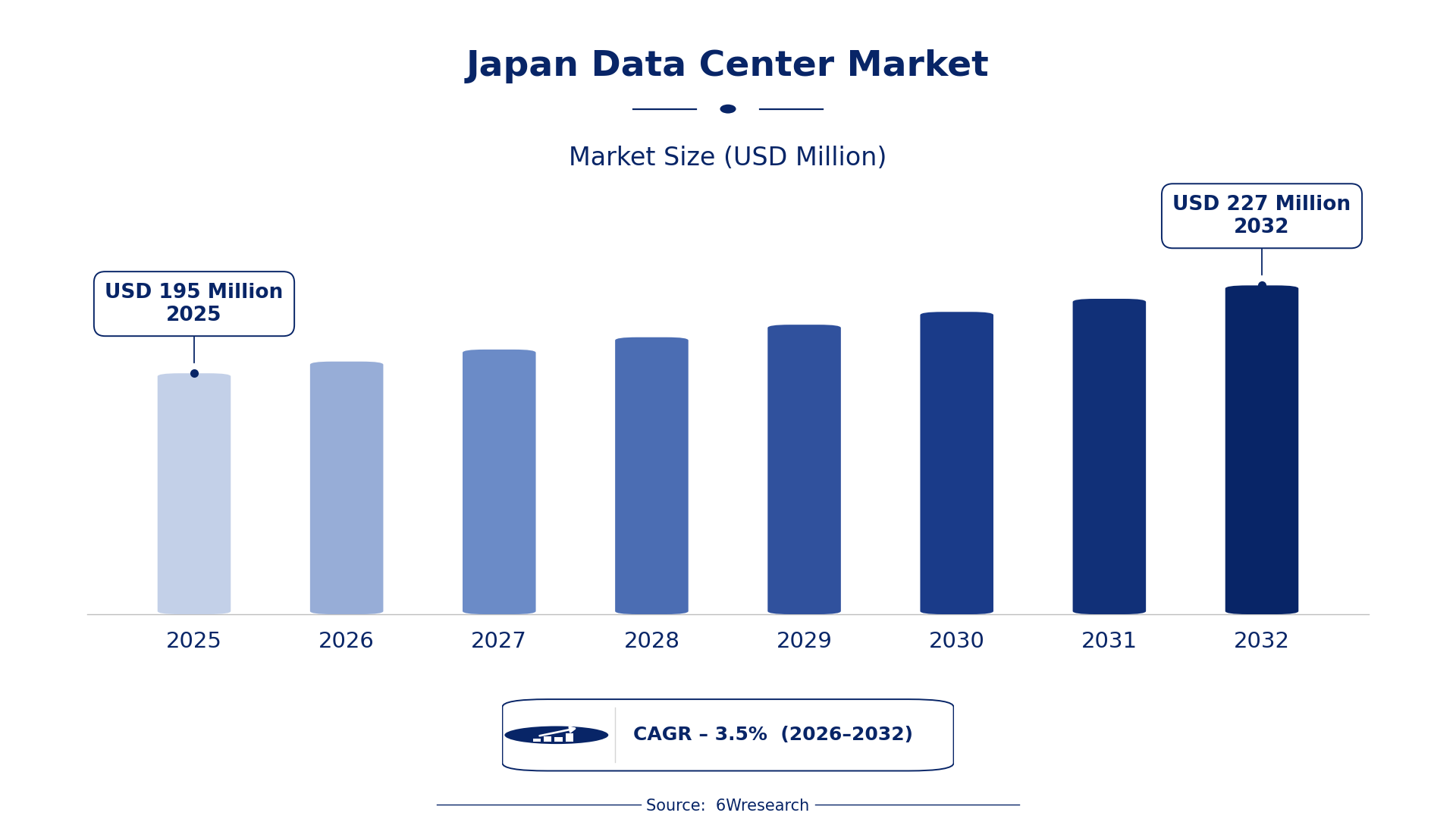
The Japan Data Center Market was estimated at USD 195 Million in 2025 and is projected to reach USD 227 Million by 2032, growing at a CAGR of 3.5% from 2026 to 2032.
Japan Data Center Market Synopsis
In recent years, the Japan Data Center Market has witnessed considerable momentum, fueled by a surge in digital transformation and cloud adoption. As the demand for data storage and processing escalates, the market is expected to evolve significantly, with emerging technologies and innovative services taking center stage.
The landscape is increasingly defined by both domestic and international players striving to meet the growing needs of various sectors, including finance and healthcare. Looking forward, the focus on sustainability and energy efficiency will be paramount, as stakeholders seek to align with governmental policies aimed at enhancing the sector's resilience and performance.
Japan Data Center Market Year-wise Growth Rate and Key Drivers
This graph illustrates the annual growth rates of the Japan Data Center Market from 2021 to 2032, highlighting a steady upward trajectory and projected expansion over the forecast period.
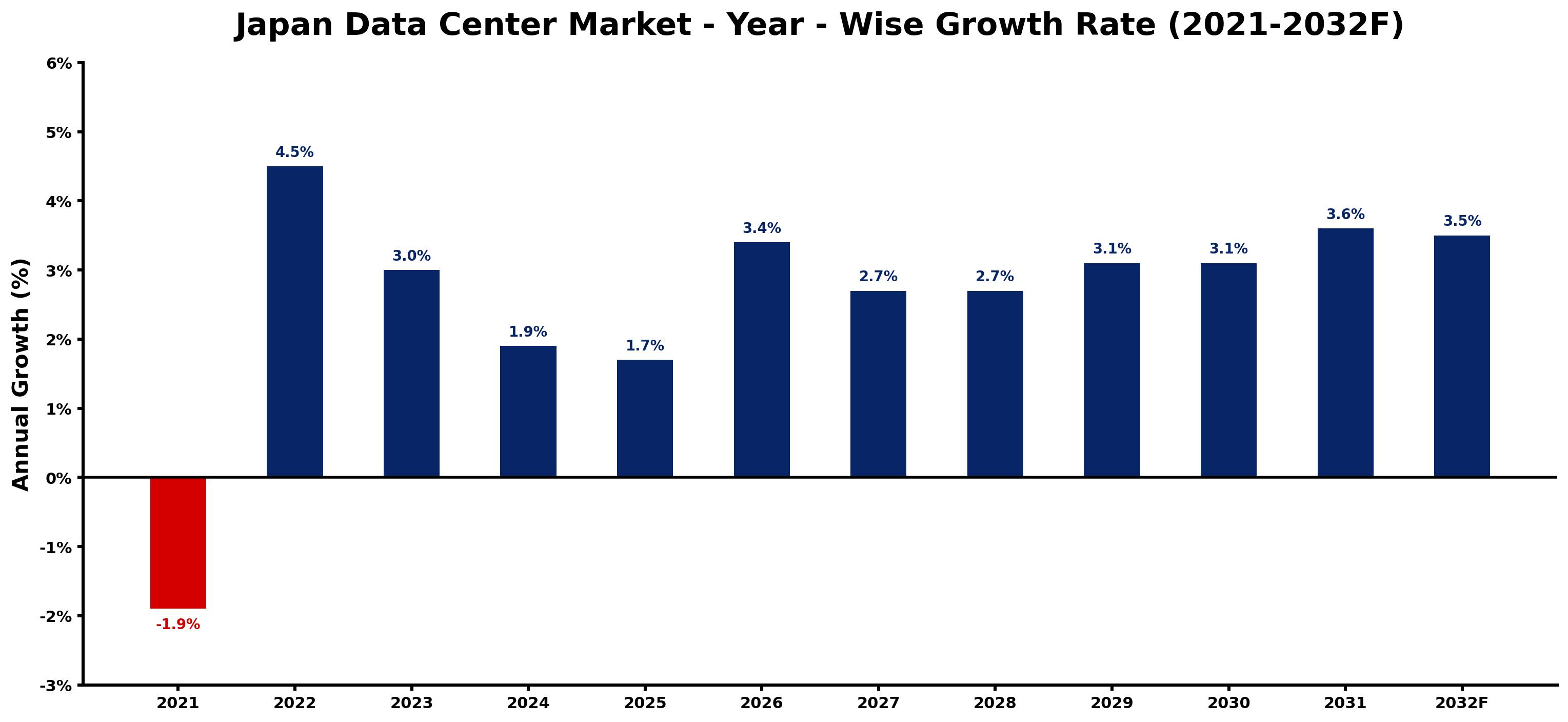
The table below presents the year‑wise growth rates along with the key drivers influencing the market
| Year | Growth Rate | Major Drivers |
| 2021 | -1.9% | Tighter energy regulations by METI hindered expansions. |
| 2022 | 4.5% | Tokyo Olympic legacy boosting digital infrastructure investments. |
| 2023 | 3.0% | Increased remote work driving demand for data storage. |
| 2024 | 1.9% | Strong e-commerce growth necessitating expanded data processing. |
| 2025 | 1.7% | Japanese firms shifting to hybrid cloud solutions. |
| 2026 | 3.4% | Regulatory changes enhancing data privacy compliance requirements. |
| 2027 | 2.7% | Emerging AI technologies boosting computational resource needs. |
| 2028 | 2.7% | Rising interest in edge computing for urban centers. |
| 2029 | 3.1% | Local government partnerships fostering tech innovation environments. |
| 2030 | 3.1% | Demand from fintech sector increasing data services workload. |
| 2031 | 3.6% | Smart city projects fueling demand for reliable data centers. |
| 2032 | 3.5% | Increased cybersecurity threats raising demand for secure infrastructures. |
Note: Market size estimations and growth projections presented in this report are based on 6Wresearch's proprietary forecasting methodology, utilizing the latest available industry data, government publications, and primary research inputs.
Japan Data Center Market Key Takeaways
Below are some of the specific key takeaways from the market, including:
- The market is driven by rising demand for cloud services and data analytics.
- Edge computing is becoming increasingly important for enhancing network performance.
- Government initiatives are promoting energy-efficient data center operations.
- Colocation services are expanding to meet industry-specific requirements.
- The market's growth is tempered by land scarcity and high construction costs.
Evaluation of Restraints in Japan Data Center Market
The Japan Data Center Market faces notable restraints that challenge its growth trajectory. One primary concern is the limited availability of land for new data center construction, particularly in metropolitan areas where demand is highest. Coupled with high construction costs, this limits the ability of providers to scale operations effectively.
Additionally, stringent regulations regarding data privacy and security necessitate compliance investments, further straining financial resources. The risk of natural disasters, particularly earthquakes, also compels companies to invest in disaster preparedness, adding to operational challenges. As competition intensifies, providers must innovate continually to maintain market share amidst these constraints.
Japan Data Center Market Trends
Several trends are shaping the Japan Data Center Market. The rise of edge computing is critical for enhancing data processing efficiency, allowing businesses to reduce latency and improve user experiences. Concurrently, there is a significant push towards green data centers, driven by both regulatory pressure and corporate sustainability goals.
Cybersecurity measures have also gained traction, with organizations increasingly prioritizing the protection of sensitive data against breaches. As digital transformation efforts accelerate, the integration of AI and machine learning into data center operations is becoming common, enabling smarter, more efficient infrastructure management.
Japan Data Center Market Opportunities
Opportunities in the Japan Data Center Market are plentiful, particularly in colocation services tailored to specific industries. The finance and healthcare sectors, in particular, are demanding more bespoke solutions that ensure compliance with local regulations while providing high levels of security and reliability.
Investments in innovative data management solutions are also on the rise, as businesses seek to harness the full potential of their data assets. on top of that, as companies continue to outsource data operations to third-party providers, there is a growing market for managed hosting solutions that can reduce operational costs and enhance efficiency.
Government Initiatives in the Japan Data Center Market
Government policy plays a crucial role in shaping the Japan Data Center Market, focusing on security, efficiency, and technological advancement. The Japanese government is actively implementing regulations to enhance data privacy and security, creating a favorable environment for data center operators. These initiatives not only encourage foreign investment but also prioritize the development of cutting-edge technology.
- A regulatory framework established in 2022 mandates stricter data privacy measures for operators, ensuring enhanced consumer protection.
- The Cool Japan Strategy, an ongoing initiative, aims to attract foreign investment in technology sectors, including data centers, by promoting Japan as a tech hub.
- Currently underway is a national digital infrastructure upgrade program designed to improve connectivity and support data center operations across the country.
- A planned public-private initiative is expected to launch in 2027, targeting enhancements in energy-efficient data center designs.
Future Insights of the Japan Data Center Market
The Japan Data Center Market is set for robust growth from 2026 to 2032, driven by escalating demand for cloud services, big data analytics, and IoT applications. As companies continue to digitize operations, the need for reliable and secure data storage solutions will only intensify.
The government's focus on advancing technological infrastructure will further stimulate market expansion, particularly as sustainability becomes a central theme. As these trends unfold, significant investments in new facilities and expansions will solidify Japan's position as a leading data center hub in the Asia-Pacific region.
Japan Data Center Market Latest Developments
Recent activity in the Japan Data Center Market reflects an industry that is both competitive and innovative. Over the past year, several notable developments have emerged, highlighting the sector's dynamism and its response to evolving market demands.
- A major technology vendor launched a new energy-efficient data center facility in Q2 2025, enhancing its service offerings in Tokyo.
- In early 2025, a leading regional operator completed the upgrade of its existing facilities to incorporate advanced cooling technologies, reducing energy consumption by 20%.
- Currently underway is a collaborative initiative between data center providers and tech firms to develop next-generation cybersecurity solutions, expected to conclude by late 2026.
- A rollout planned for mid-2026 aims to expand telecom infrastructure, enhancing connectivity for data centers in underserved regions.
Japan Data Center Market - Key Attractiveness of the Report
- 10 Years of Market Numbers
- Historical Data Starting from 2022 to 2025
- Base Year: 2025
- Forecast Data until 2032
- Key Performance Indicators Impacting the Market
- Major Upcoming Developments and Projects
Key Highlights of the Report:
- Japan Data Center Market Outlook
- Market Size of Japan Data Center Market, 2025
- Forecast of Japan Data Center Market, 2032
- Historical Data and Forecast of Japan Data Center Revenues & Volume for the Period 2022-2032F
- Japan Data Center Market Trend Evolution
- Japan Data Center Market Drivers and Challenges
- Japan Data Center Price Trends
- Japan Data Center Porter's Five Forces
- Japan Data Center Industry Life Cycle
- Historical Data and Forecast of Japan Data Center Market Revenues & Volume By Component for the Period 2022-2032F
- Historical Data and Forecast of Japan Data Center Market Revenues & Volume By Electrical for the Period 2022-2032F
- Historical Data and Forecast of Japan Data Center Market Revenues & Volume By Mechanical for the Period 2022-2032F
- Historical Data and Forecast of Japan Data Center Market Revenues & Volume By Networking for the Period 2022-2032F
- Historical Data and Forecast of Japan Data Center Market Revenues & Volume By Racks for the Period 2022-2032F
- Historical Data and Forecast of Japan Data Center Market Revenues & Volume By Security Systems for the Period 2022-2032F
- Historical Data and Forecast of Japan Data Center Market Revenues & Volume By Fire Systems for the Period 2022-2032F
- Historical Data and Forecast of Japan Data Center Market Revenues & Volume By Vertical for the Period 2022-2032F
- Historical Data and Forecast of Japan Data Center Market Revenues & Volume By Banking Financial Services & Insurance (BFSI) for the Period 2022-2032F
- Historical Data and Forecast of Japan Data Center Market Revenues & Volume By Government for the Period 2022-2032F
- Historical Data and Forecast of Japan Data Center Market Revenues & Volume By IT & Telecom for the Period 2022-2032F
- Historical Data and Forecast of Japan Data Center Market Revenues & Volume By Media for the Period 2022-2032F
- Historical Data and Forecast of Japan Data Center Market Revenues & Volume By Retail for the Period 2022-2032F
- Historical Data and Forecast of Japan Data Center Market Revenues & Volume By Manufacturing for the Period 2022-2032F
- Historical Data and Forecast of Japan Data Center Market Revenues & Volume By Others for the Period 2022-2032F
- Japan Data Center Import Export Trade Statistics
- Market Opportunity Assessment By Component
- Market Opportunity Assessment By Vertical
- Japan Data Center Top Companies Market Share
- Japan Data Center Competitive Benchmarking By Technical and Operational Parameters
- Japan Data Center Company Profiles
- Japan Data Center Key Strategic Recommendations






































