Japan Data Center Transformation Market Size & Growth Rate (2026-2032)
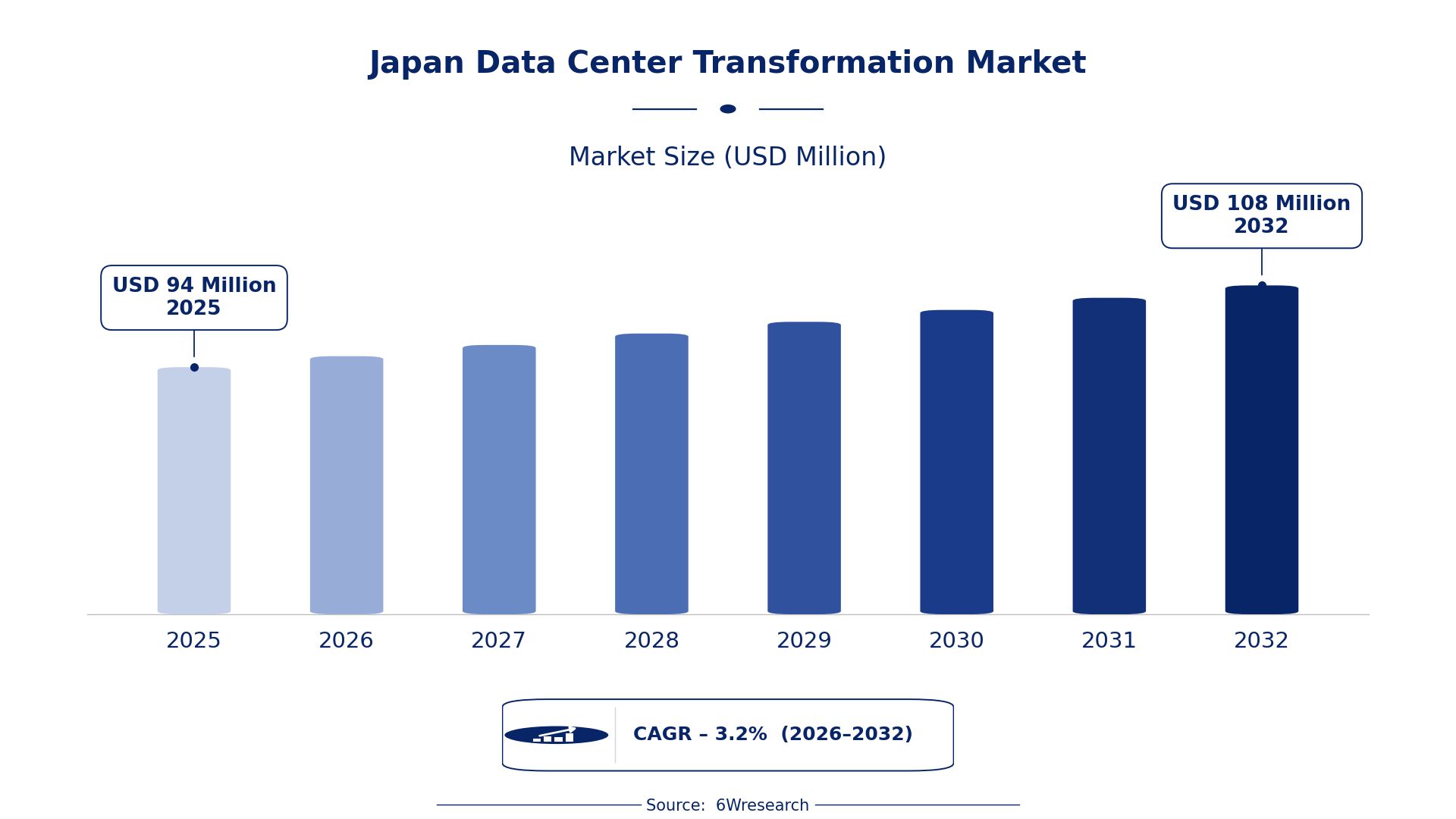
The Japan Data Center Transformation Market was estimated at USD 94 Million in 2025 and is projected to reach USD 108 Million by 2032, growing at a CAGR of 3.2% from 2026 to 2032.
Japan Data Center Transformation Market Synopsis
The Japan Data Center Transformation Market is experiencing a dynamic shift as enterprises pivot toward digitalization, driven by increased data consumption and the necessity for enhanced IT infrastructure. Organizations are modernizing their data centers to support emerging technologies like AI and IoT, while also focusing on operational efficiency and compliance with stringent regulations.
As businesses in Japan seek to optimize their IT environments, the demand for innovative data center solutions, including cloud services and energy-efficient technologies, is on the rise. This transformation is not just a matter of upgrading systems; it’s about aligning data center capabilities with the strategic goals of businesses aiming for agility and sustainability in their operations.
Japan Data Center Transformation Market Year-wise Growth Rate and Key Drivers
This graph illustrates the annual growth rates of the Japan Data Center Transformation Market from 2021 to 2032, highlighting a steady upward trajectory and projected expansion over the forecast period.
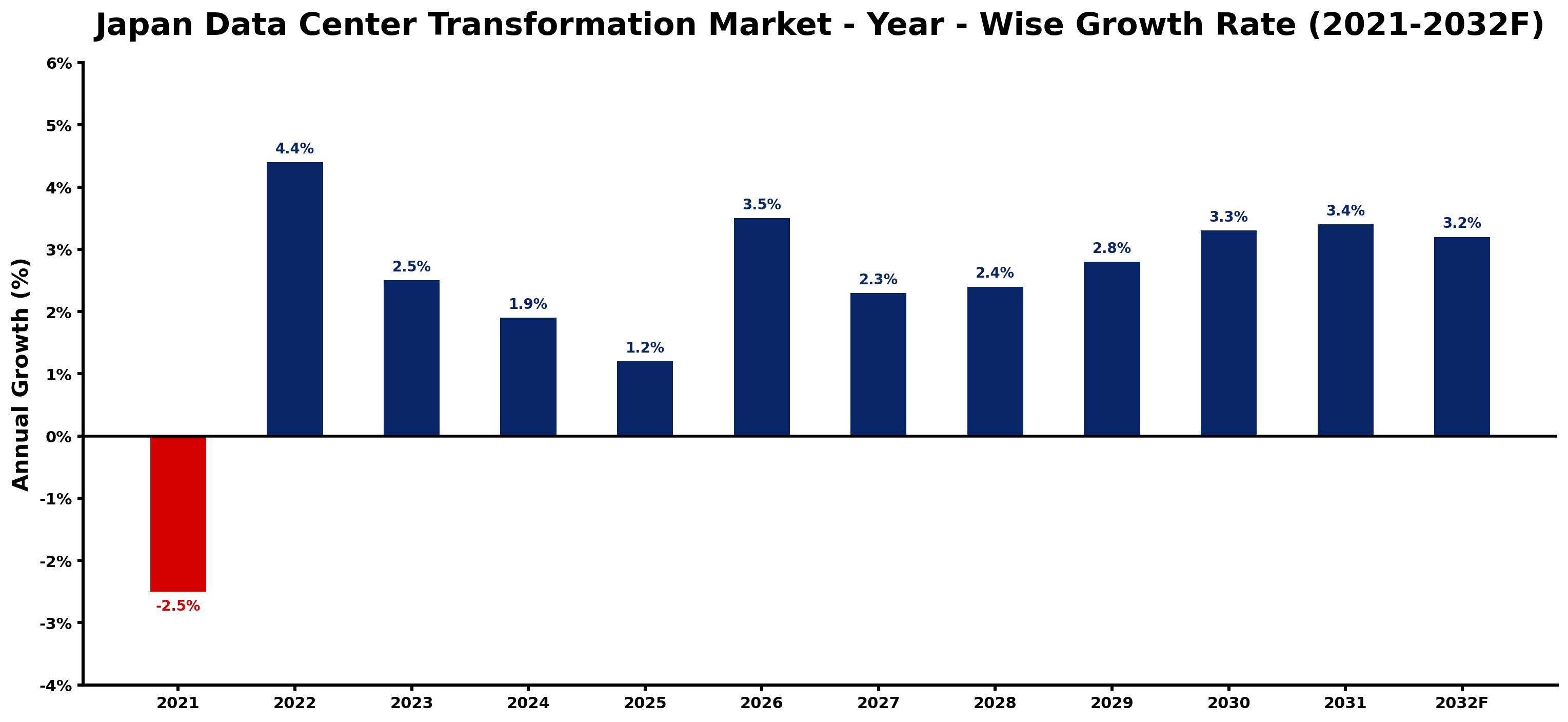
The table below presents the year‑wise growth rates along with the key drivers influencing the market
| Year | Growth Rate | Major Drivers |
| 2021 | -2.5% | Delayed adoption of 5G technology impacting demand. |
| 2022 | 4.4% | Launch of Japan's Digital Agency accelerating data center upgrades |
| 2023 | 2.5% | Increased adoption of AI solutions in corporate environments |
| 2024 | 1.9% | Tokyo's metropolitan area attracting more tech startups |
| 2025 | 1.2% | Post-COVID remote work driving data management needs |
| 2026 | 3.5% | Growing investments in IoT driving edge computing solutions |
| 2027 | 2.3% | Government incentives for energy-efficient cooling technologies |
| 2028 | 2.4% | Rise in e-commerce demand boosting data processing capacity |
| 2029 | 2.8% | 5G rollout enhancing connectivity for data center operations |
| 2030 | 3.3% | Focus on carbon neutrality influencing green data strategies |
| 2031 | 3.4% | Partnerships with local universities for tech research advancements |
| 2032 | 3.2% | Increased regulatory compliance demands for data protection |
Note: Market size estimations and growth projections presented in this report are based on 6Wresearch's proprietary forecasting methodology, utilizing the latest available industry data, government publications, and primary research inputs.
Japan Data Center Transformation Market Key Takeaways
Below are some of the specific key takeaways from the market, including:
- Rapid adoption of cloud computing and hybrid environments is reshaping the data center infrastructure.
- Investment in energy-efficient technologies is becoming a key priority for organizations.
- Colocation services are gaining traction as businesses seek flexibility and scalability.
- Edge computing is emerging as a critical solution to support IoT deployments.
- Cybersecurity measures are increasingly vital to ensure compliance and protect sensitive data.
Evaluation of Restraints in Japan Data Center Transformation Market
The market faces several restraints that could impede growth. High costs associated with adopting new technologies and upgrading existing infrastructure remain a significant barrier for many organizations. A shortage of skilled IT professionals with expertise in data center transformation complicates the situation further, as companies struggle to find the right talent to implement advanced solutions effectively. Compliance with rigorous data privacy regulations also adds layers of complexity and potential delays to transformation initiatives. These challenges necessitate strategic planning and investment in training to overcome the hurdles to modernization.
Japan Data Center Transformation Market Trends
Several key trends are shaping the Japan Data Center Transformation Market. The shift towards cloud computing continues to accelerate, with organizations increasingly adopting hybrid cloud solutions that combine the benefits of public and private clouds. This approach allows for greater flexibility and resource optimization. Additionally, there is a pronounced emphasis on edge computing, driven by the proliferation of IoT devices demanding low-latency processing. Sustainability initiatives are also gaining traction, as businesses seek to reduce their carbon footprint through energy-efficient practices and green technologies.
Japan Data Center Transformation Market Opportunities
The market presents numerous investment opportunities, particularly in areas like infrastructure modernization and cloud migration services. Organizations are keen to embrace cutting-edge technologies such as AI and 5G, which are expected to drive demand for advanced data center solutions. There is also a significant push towards edge computing infrastructure, as companies recognize the need for faster data processing capabilities. The government’s commitment to promoting energy-efficient data centers further underscores the attractiveness of investments in this space.
Government Initiatives in the Japan Data Center Transformation Market
Government policy is crucial in shaping the trajectory of the Japan Data Center Transformation Market. The Japanese government has rolled out various initiatives aimed at enhancing data center efficiency, promoting cybersecurity measures, and facilitating infrastructure development. These efforts are designed to bolster the competitive edge of the data center sector while ensuring compliance with evolving regulatory frameworks.
- A national energy efficiency program launched in early 2025 focuses on incentivizing data centers to adopt green technologies.
- The Data Center Certification System, currently underway, aims to establish standardized benchmarks for performance and security in data centers.
- A public-private initiative planned for 2026 seeks to enhance digital infrastructure across Japan, promoting innovation within the data center industry.
- The Data Center Council, a recently established body, is working to drive industry collaboration on best practices and standards.
- Ongoing regulatory reforms are expected to streamline compliance processes, making it easier for businesses to adapt to new security requirements.
Future Insights of the Japan Data Center Transformation Market
Looking ahead to 2026-2032, the Japan Data Center Transformation Market is expected to see substantial growth as businesses prioritize digital transformation and advanced data management solutions. The demand for high-performance computing will intensify, driven by the rising complexity of applications and data workloads. Additionally, the ongoing expansion of IoT and AI technologies will necessitate further investment in data center capabilities. As remote work becomes a permanent fixture in many industries, the need for reliable, scalable, and secure data centers will only grow.
Japan Data Center Transformation Market Latest Developments
Recent activity in the Japan Data Center Transformation Market has been marked by a surge in innovation and strategic partnerships. Companies are increasingly focused on modernizing their infrastructures to meet the evolving demands of digital operations. The trend toward sustainability is also driving new initiatives aimed at reducing energy consumption and enhancing operational efficiency.
- A major technology vendor announced plans in early 2025 to upgrade its data center facilities to incorporate advanced cooling technologies, enhancing energy efficiency.
- An ongoing initiative launched in mid-2025 focuses on developing edge computing solutions to support the growing number of IoT devices across various sectors.
- A regional operator is currently expanding its colocation services to meet the rising demand for flexible data center solutions.
- Plans are underway for a significant rollout of hybrid cloud solutions expected to begin in late 2026, aiming to bridge the gap between public and private infrastructure.
- A partnership between leading tech firms announced in Q1 2025 aims to advance cybersecurity protocols for data centers, enhancing protections against emerging threats.
Japan Data Center Transformation Market - Key Attractiveness of the Report
- 10 Years of Market Numbers
- Historical Data Starting from 2022 to 2025
- Base Year: 2025
- Forecast Data until 2032
- Key Performance Indicators Impacting the Market
- Major Upcoming Developments and Projects
Key Highlights of the Report:
- Japan Data Center Transformation Market Outlook
- Market Size of Japan Data Center Transformation Market, 2025
- Forecast of Japan Data Center Transformation Market, 2032
- Historical Data and Forecast of Japan Data Center Transformation Revenues & Volume for the Period 2022-2032F
- Japan Data Center Transformation Market Trend Evolution
- Japan Data Center Transformation Market Drivers and Challenges
- Japan Data Center Transformation Price Trends
- Japan Data Center Transformation Porter's Five Forces
- Japan Data Center Transformation Industry Life Cycle
- Historical Data and Forecast of Japan Data Center Transformation Market Revenues & Volume By Service Type for the Period 2022-2032F
- Historical Data and Forecast of Japan Data Center Transformation Market Revenues & Volume By Consolidation services for the Period 2022-2032F
- Historical Data and Forecast of Japan Data Center Transformation Market Revenues & Volume By Optimization services for the Period 2022-2032F
- Historical Data and Forecast of Japan Data Center Transformation Market Revenues & Volume By Automation services for the Period 2022-2032F
- Historical Data and Forecast of Japan Data Center Transformation Market Revenues & Volume By Infrastructure management services for the Period 2022-2032F
- Historical Data and Forecast of Japan Data Center Transformation Market Revenues & Volume By Tier Type for the Period 2022-2032F
- Historical Data and Forecast of Japan Data Center Transformation Market Revenues & Volume By Tier 1 for the Period 2022-2032F
- Historical Data and Forecast of Japan Data Center Transformation Market Revenues & Volume By Tier 2 for the Period 2022-2032F
- Historical Data and Forecast of Japan Data Center Transformation Market Revenues & Volume By Tier 3 for the Period 2022-2032F
- Historical Data and Forecast of Japan Data Center Transformation Market Revenues & Volume By Tier 4 for the Period 2022-2032F
- Historical Data and Forecast of Japan Data Center Transformation Market Revenues & Volume By End User for the Period 2022-2032F
- Historical Data and Forecast of Japan Data Center Transformation Market Revenues & Volume By Cloud Service Providers for the Period 2022-2032F
- Historical Data and Forecast of Japan Data Center Transformation Market Revenues & Volume By Colocation Providers for the Period 2022-2032F
- Historical Data and Forecast of Japan Data Center Transformation Market Revenues & Volume By Enterprises for the Period 2022-2032F
- Historical Data and Forecast of Japan Data Center Transformation Market Revenues & Volume By Data Center Size for the Period 2022-2032F
- Historical Data and Forecast of Japan Data Center Transformation Market Revenues & Volume By Small Data Centers for the Period 2022-2032F
- Historical Data and Forecast of Japan Data Center Transformation Market Revenues & Volume By Medium-sized Data Centers for the Period 2022-2032F
- Historical Data and Forecast of Japan Data Center Transformation Market Revenues & Volume By Large Data Centers for the Period 2022-2032F
- Historical Data and Forecast of Japan Data Center Transformation Market Revenues & Volume By Vertical for the Period 2022-2032F
- Historical Data and Forecast of Japan Data Center Transformation Market Revenues & Volume By BFSI for the Period 2022-2032F
- Historical Data and Forecast of Japan Data Center Transformation Market Revenues & Volume By IT and Telecom for the Period 2022-2032F
- Historical Data and Forecast of Japan Data Center Transformation Market Revenues & Volume By Government and Defense for the Period 2022-2032F
- Historical Data and Forecast of Japan Data Center Transformation Market Revenues & Volume By Healthcare for the Period 2022-2032F
- Historical Data and Forecast of Japan Data Center Transformation Market Revenues & Volume By Transportation for the Period 2022-2032F
- Historical Data and Forecast of Japan Data Center Transformation Market Revenues & Volume By Retail for the Period 2022-2032F
- Historical Data and Forecast of Japan Data Center Transformation Market Revenues & Volume By Energy for the Period 2022-2032F
- Historical Data and Forecast of Japan Data Center Transformation Market Revenues & Volume By Manufacturing for the Period 2022-2032F
- Japan Data Center Transformation Import Export Trade Statistics
- Market Opportunity Assessment By Service Type
- Market Opportunity Assessment By Tier Type
- Market Opportunity Assessment By End User
- Market Opportunity Assessment By Data Center Size
- Market Opportunity Assessment By Vertical
- Japan Data Center Transformation Top Companies Market Share
- Japan Data Center Transformation Competitive Benchmarking By Technical and Operational Parameters
- Japan Data Center Transformation Company Profiles
- Japan Data Center Transformation Key Strategic Recommendations






































