Japan De Identified Health Data Market Size & Growth Rate
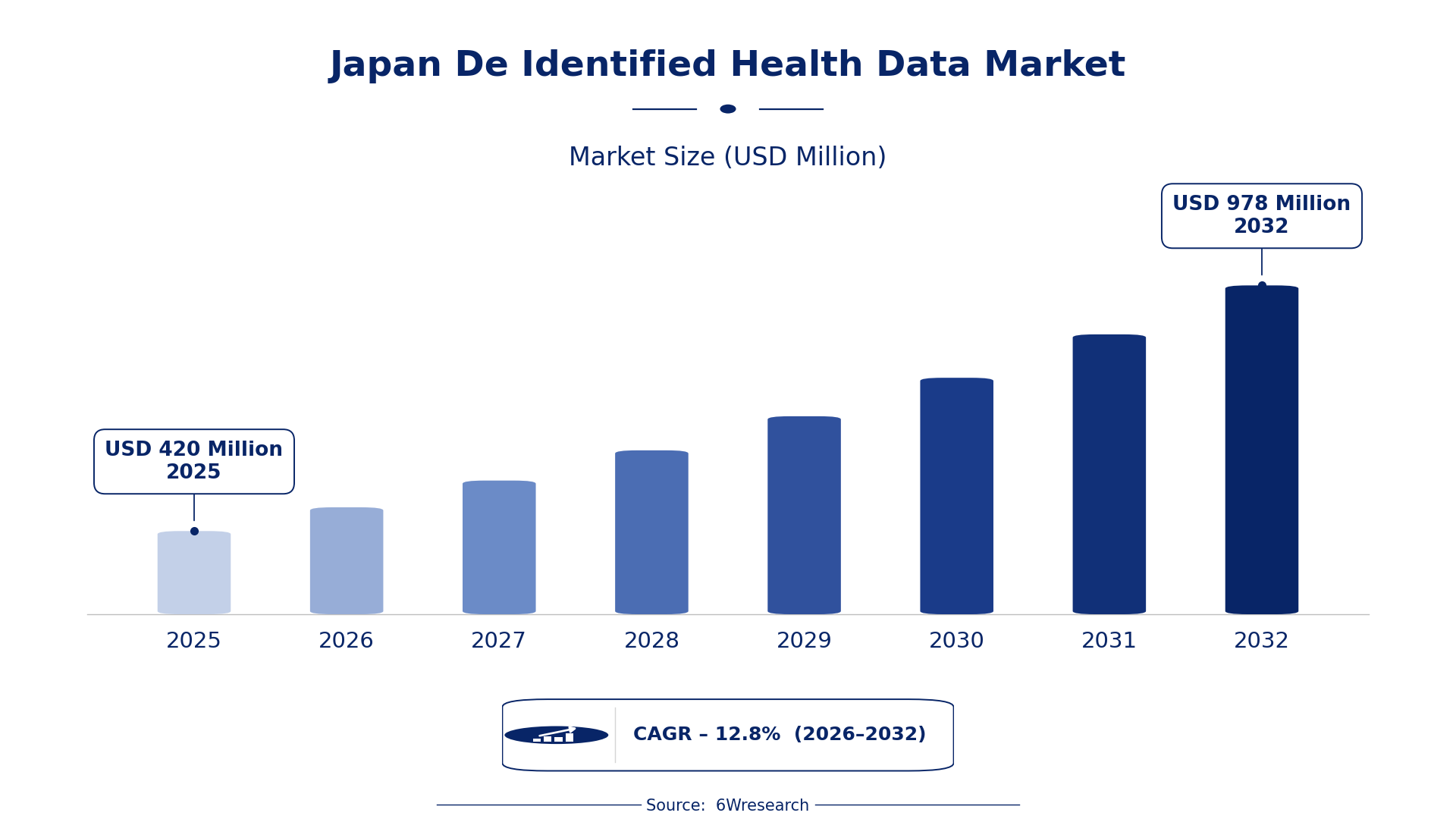
According to 6Wresearch internal database and industry insights, the Japan De Identified Health Data Market was valued at USD 420 Million in 2025 and is projected to reach USD 978 Million by 2032, growing at a CAGR of approximately 12.8% during 2026–2032.
Japan De Identified Health Data Market Highlights
| Report Metric | Details |
| Report Name | Japan De Identified Health Data Market (2026-2032) |
| Market Size 2025 | USD 420 Million |
| Market Size 2032 | USD 978 Million |
| Absolute Growth 2025–2032 | USD 558 Million |
| CAGR 2026–2032 | 12.8% |
| Peak Annual Growth | 13.7% in 2027 |
| Forecast Period | 2026–2032 |
| Historical Data | 2022–2025 |
| Base Year | 2025 |
| Leading Data Type, 2025 | Structured (68% share) |
| Leading End User, 2025 | Healthcare (44% share) |
| Leading Source, 2025 | Electronic Health Records (61% share) |
| Leading Compliance Standard, 2025 | HIPAA (60% share) |
| Fastest-Growing Data Type | Unstructured (17.0% CAGR) |
| Fastest-Growing End User | Research (15.9% CAGR) |
| Fastest-Growing Source | Clinical Trials (17.5% CAGR) |
| Fastest-Growing Compliance Standard | GDPR (15.7% CAGR) |
| Growing Sector | Research |
| Key End Users | Healthcare, Pharmaceutical, Research |
Japan De Identified Health Data Market Year-wise Growth Rate and Key Drivers (2022–2032)
This graph illustrates the annual growth rates of the market from 2022 to 2032, highlighting a steady upward trajectory and projected market expansion over the forecast period.
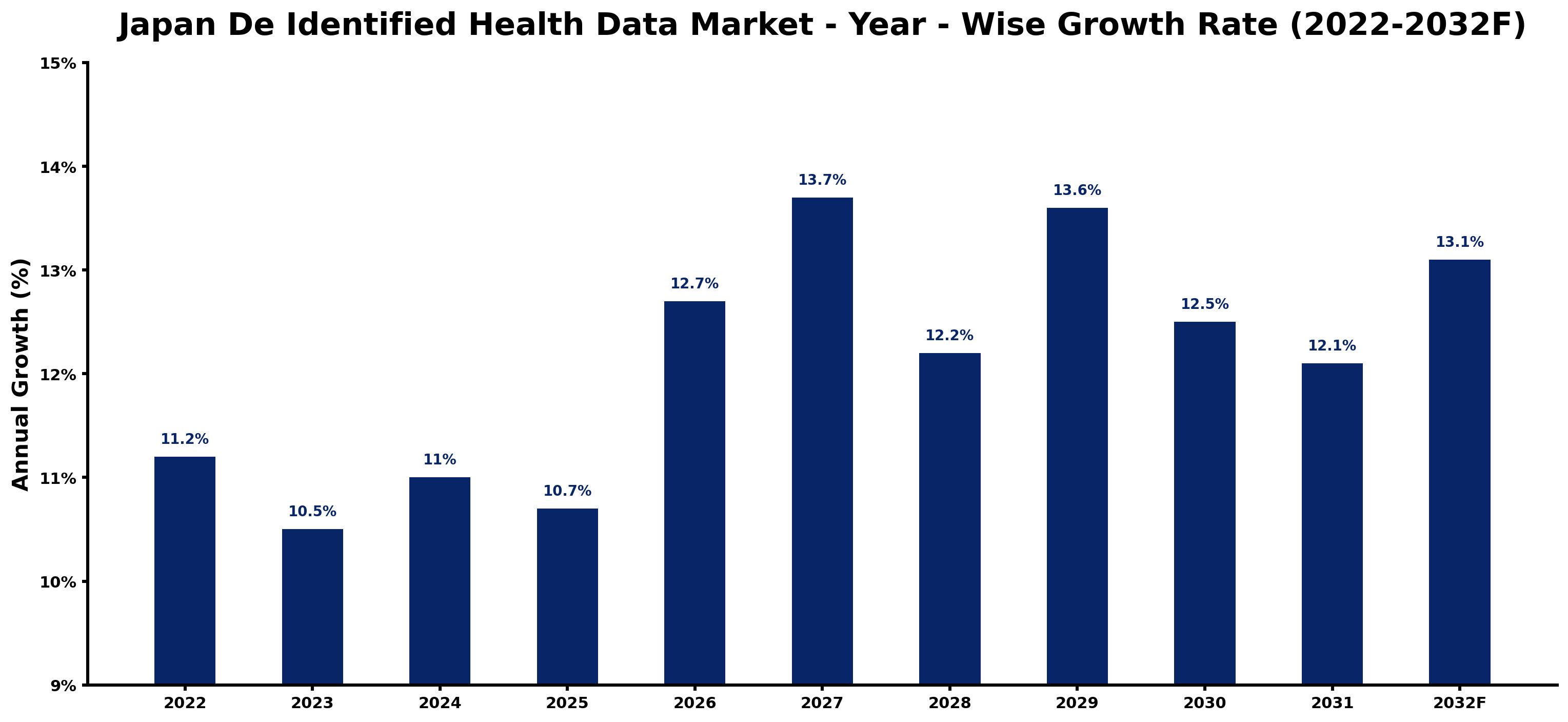
Below, each year's estimated growth is shown next to the factor that most influenced it.
| Year | Estimated Annual Growth (%) | Market Rationale |
| 2022 | 11.2 | The market showed strong demand from healthcare providers and researchers. |
| 2023 | 10.5 | Growth slowed as healthcare data sharing initiatives were ramping up. |
| 2024 | 11.0 | Increased interest in analytics drove faster growth compared to the previous year. |
| 2025 | 10.7 | Demand remained strong, but growth was slower due to market saturation. |
| 2026 | 12.7 | The introduction of new data-sharing technologies is expected to accelerate growth. |
| 2027 | 13.7 | The peak growth year will be driven by rising investments in health data infrastructure. |
| 2028 | 12.2 | Growth is projected to slow as the market stabilises after rapid expansion. |
| 2029 | 13.6 | Demand is expected to surge again as clinical trials increase their reliance on de-identified data. |
| 2030 | 12.5 | Growth will moderate as the market matures and competition intensifies. |
| 2031 | 12.1 | A slight slowdown will occur as the focus shifts to compliance and quality standards. |
| 2032 | 13.1 | Demand is projected to rise as AI technologies enhance data analysis capabilities. |
Note: Market size estimations and growth projections presented in this report are based on 6Wresearch's proprietary forecasting methodology, utilizing the latest available industry data, government publications, and primary research inputs.
Japan De Identified Health Data Market Synopsis
De-identified health data consists of patient information stripped of personal identifiers, ensuring privacy while enabling its use in research, healthcare analytics, and pharmaceutical development. The Japan De Identified Health Data Market is expanding due to the increasing number of electronic health records available for research, with over 10 million records in 2023. Investments in health data infrastructure, amounting to 1 billion yen in 2023, are driving new demand from healthcare providers and research institutions.
Market Dynamics Impact Analysis (2026–2032)
| Factor | Type | Impact | Primary Segment Affected |
| Growing demand for healthcare analytics | Driver | High | Healthcare |
| Increased reliance on electronic health records | Driver | High | Electronic Health Records |
| Rising need for data in clinical trials | Opportunity | High | Clinical Trials |
| Investment in health data infrastructure improvements | Opportunity | High | Research |
| Concerns over data privacy and compliance | Restraint | High | Healthcare |
| Limited access to unstructured data for analytics | Restraint | Medium | Unstructured |
| High costs associated with data compliance | Challenge | High | Healthcare |
| Technological barriers in data integration | Challenge | Medium | Research |
Evaluation of Drivers in Japan De Identified Health Data Market (2026–2032)
These are the developments adding the most demand over the forecast period.
| Drivers | Primary Segment Affected | Why It Matters (Evidence) |
| Increasing healthcare expenditure | Healthcare | Japan's national medical care expenditure was about JPY 46.7 trillion in fiscal 2022, driving demand for data. |
| Growth in electronic health records | Electronic Health Records | Over 10 million electronic health records were available for research in 2023, increasing data accessibility. |
| Expansion of clinical trials | Clinical Trials | Japan conducted over 1,000 clinical trials in 2022, generating substantial de-identified data for analysis. |
| Rising number of research studies | Research | Research institutions published over 500 studies using de-identified health data in 2022, boosting demand. |
| Focus on operational efficiency in healthcare | Healthcare | Healthcare providers are using de-identified data to improve patient care and streamline operations. |
Behind the steady rise in orders sits the substantial increase in healthcare expenditure, which reached approximately JPY 46.7 trillion in fiscal 2022, prompting healthcare providers to seek de-identified data for operational improvements. The availability of over 10 million electronic health records in 2023 has made data more accessible for research, driving demand from academic institutions. Clinical trials generated substantial de-identified data, with over 1,000 trials conducted in 2022, further increasing the need for this information. Research institutions published over 500 studies using de-identified health data in 2022, showcasing the growing reliance on such data for public health insights. Healthcare providers are focusing on operational efficiency, using de-identified data to improve patient care and streamline processes.
Evaluation of Restraints in Japan De Identified Health Data Market
Several factors work against faster growth; the main ones are summarised below.
| Market Restraint | Primary Segment Affected | Why It Matters (Evidence) |
| Limited access to quality de-identified health data | Healthcare | Only 10 million records are currently available for research, impacting timely studies. |
| High costs for acquiring de-identified data | Research | Costs can reach 1 billion yen annually, affecting research capabilities. |
| Stringent data privacy laws | Healthcare | Compliance with regulations can delay clinical studies by several months. |
| Investment in advanced data anonymization tools | Structured | Compliance with JIS Z 8301 standards requires significant investment, costing upwards of 500 million yen. |
| Market saturation in healthcare analytics | Healthcare | Increased competition is limiting growth opportunities for new entrants. |
Japan De Identified Health Data Market Challenges
Hospitals encounter challenges in sourcing adequate de-identified health data, with only 10 million electronic health records available for research. This scarcity stems from stringent privacy regulations, leading to delays in clinical trials that can extend by several months for healthcare providers. Technology providers struggle to develop effective anonymization tools, as compliance with JIS Z 8301 standards demands significant investments, often exceeding 500 million yen. Buyers in the research sector face high acquisition costs for de-identified health data, which can reach 1 billion yen annually, limiting their ability to conduct timely studies.
Trends in the Japan De Identified Health Data Market
Buyers and suppliers in the Japan De Identified Health Data Market are adjusting to the following trends.
- Shift Towards Improved Data Sharing Practices: In 2023, the Tokyo metropolitan area is experiencing a shift towards improved data sharing practices, driven by new initiatives from the Ministry of Health, Labour and Welfare. This is expected to enhance collaboration among healthcare providers and researchers.
- Increase in Clinical Trials: In 2022, Japan conducted over 1,000 clinical trials, highlighting a growing trend towards using de-identified health data for regulatory submissions. This trend is likely to continue as more pharmaceutical companies seek to streamline their processes.
- Growing Demand for Research Studies: Research institutions are increasingly publishing studies using de-identified health data, with over 500 studies released in 2022. This trend reflects a heightened focus on public health research and data-driven insights.
- Adoption of AI in Data Analytics: The integration of AI technologies in healthcare analytics is becoming prevalent, with investments exceeding 1 billion yen in 2023. This shift is projected to improve data analysis capabilities across the sector.
Investment Opportunities in the Japan De Identified Health Data Market
Investors looking at the Japan De Identified Health Data Market should consider the following areas.
- Tokyo as a Hub for Health Data Research: Tokyo is emerging as a hub for health data research, with over 10 million electronic health records available. This presents an opportunity for technology providers to supply advanced data analytics solutions.
- Investing in Data Anonymization Services: With stringent data privacy laws in place, there is a growing need for data anonymization services. Companies can invest in developing compliant tools to support healthcare providers and researchers.
- Improving Data Infrastructure: The ongoing investment in health data infrastructure, projected to exceed 1 billion yen, creates opportunities for suppliers to offer solutions that enhance data accessibility and usability.
- Supporting Research Institutions: Research institutions are increasingly relying on de-identified health data for studies. Suppliers can partner with these institutions to provide necessary data services and tools.
Government Initiatives in the Japan De Identified Health Data Market
The Clinical Trials Act, established in 2017 and in force since 2018, sets rules for conducting and disclosing clinical research, impacting how de-identified health data is used in trials. The AI Promotion Act, introduced in 2025, establishes a national framework for AI research and development, which will influence data utilization in healthcare.
The Pharmaceuticals and Medical Devices Agency (PMDA) oversees the use of de-identified data in trials, ensuring compliance with regulations. The Japan Agency for Medical Research and Development (AMED) funds medical research and development, supporting projects that utilize de-identified health data.
Future Insight of the Japan De Identified Health Data Market
Advancements in data analytics technology will reshape demand for de-identified health data by 2032, facilitating quicker research outcomes. Ongoing investments in health data infrastructure, projected to surpass 1 billion yen, will enhance accessibility for buyers and suppliers. Increased collaboration among research institutions will likely lead to a surge in published studies, driving progress in healthcare analytics. The Ministry of Health, Labour and Welfare's data sharing program will further streamline the efficient use of de-identified health information.
Market Segmentation Analysis
Japan De Identified Health Data Market report covers a detailed analysis of the following market segments:
By Data Type – Structured Leads, Unstructured Expected to Grow Fastest
According to Sachin Kumar Rai, Senior Research Analyst at 6Wresearch, in 2025, Structured led the data type split with a 68% share. Structured data holds the largest share because it is vital for effective analytics and reporting in healthcare environments. For example, healthcare providers depend on structured data to improve operational efficiency and patient care outcomes. Over 2026–2032, Unstructured is expected to post the fastest growth, at a CAGR of 17.0%. Unstructured data is growing rapidly due to its ability to yield valuable insights when analysed correctly. The rising volume of unstructured data from diverse healthcare interactions is driving this segment's expansion. Suppliers should prioritise the development of tools that can efficiently analyse unstructured data to address the increasing demand.
By End User – Healthcare Leads, Research Expected to Grow Fastest
Healthcare held 44% of the Japan De Identified Health Data Market by end user in 2025. The healthcare sector holds the largest share as providers utilise de-identified data to improve patient care and streamline operations. With approximately 8,100 hospitals in Japan, the demand from healthcare institutions remains robust and reliable. Research is set to record the highest CAGR in this split, 15.9% over 2026–2032. Research institutions are the fastest-growing end users as they increasingly rely on de-identified data for diverse studies and public health initiatives. In 2022, over 500 studies were published using this data, highlighting its critical role in advancing research. Suppliers must ensure that de-identified data is readily accessible to meet the rising demands of the research sector.
By Source – Electronic Health Records Lead, Clinical Trials Expected to Grow Fastest
Electronic Health Records accounted for 61% of the market by source in 2025. Electronic health records are the primary source of de-identified data, providing a wealth of information for various applications in healthcare. With over 10 million electronic health records available for research, their significance is clear. The quickest growth will come from Clinical Trials, forecast to expand at a CAGR of 17.5% between 2026 and 2032. Clinical trials are rapidly increasing their contribution to de-identified data, with over 1,000 trials conducted in 2022 alone. This surge in clinical trials is expected to drive the growth of this segment further. Suppliers should prioritise partnerships with clinical trial organisations to tap into this expanding source of data.
By Compliance Standard – HIPAA Leads, GDPR Expected to Grow Fastest
With 60% of compliance standard revenue in 2025, HIPAA was the largest category. HIPAA is the leading compliance standard as it establishes essential guidelines for data protection in the healthcare domain. Its influence on data management practices fosters a high level of confidence among users. GDPR is projected to grow fastest, at a CAGR of 15.7% during 2026–2032. GDPR is rapidly gaining importance as it regulates data privacy and significantly influences the management of de-identified data. The increasing global focus on data privacy is propelling the relevance of this standard. Suppliers should align their data management strategies with GDPR to remain competitive in the market.
Key Attractiveness of the Report
- 10 Years of Market Numbers
- Historical Data Starting from 2022 to 2025
- Base Year 2025
- Forecast Data until 2032
- Key Performance Indicators Impacting the Market
- Major Upcoming Developments and Projects
Key Highlights of the Report:
- Japan De Identified Health Data Market Outlook
- Market Size of Japan De Identified Health Data Market,2025
- Forecast of Japan De Identified Health Data Market, 2032
- Historical Data and Forecast of Japan De Identified Health Data Revenues & Volume for the Period 2022-2032
- Japan De Identified Health Data Market Trend Evolution
- Japan De Identified Health Data Market Drivers and Challenges
- Japan De Identified Health Data Price Trends
- Japan De Identified Health Data Porter's Five Forces
- Japan De Identified Health Data Industry Life Cycle
- Historical Data and Forecast of Japan De Identified Health Data Market Revenues & Volume By Data Type for the Period 2022-2032
- Historical Data and Forecast of Japan De Identified Health Data Market Revenues & Volume By Structured for the Period 2022-2032
- Historical Data and Forecast of Japan De Identified Health Data Market Revenues & Volume By Unstructured for the Period 2022-2032
- Historical Data and Forecast of Japan De Identified Health Data Market Revenues & Volume By End User for the Period 2022-2032
- Historical Data and Forecast of Japan De Identified Health Data Market Revenues & Volume By Pharmaceutical for the Period 2022-2032
- Historical Data and Forecast of Japan De Identified Health Data Market Revenues & Volume By Healthcare for the Period 2022-2032
- Historical Data and Forecast of Japan De Identified Health Data Market Revenues & Volume By Research for the Period 2022-2032
- Historical Data and Forecast of Japan De Identified Health Data Market Revenues & Volume By Source for the Period 2022-2032
- Historical Data and Forecast of Japan De Identified Health Data Market Revenues & Volume By Electronic Health Records for the Period 2022-2032
- Historical Data and Forecast of Japan De Identified Health Data Market Revenues & Volume By Clinical Trials for the Period 2022-2032
- Historical Data and Forecast of Japan De Identified Health Data Market Revenues & Volume By Compliance Standard for the Period 2022-2032
- Historical Data and Forecast of Japan De Identified Health Data Market Revenues & Volume By HIPAA for the Period 2022-2032
- Historical Data and Forecast of Japan De Identified Health Data Market Revenues & Volume By GDPR for the Period 2022-2032
- Japan De Identified Health Data Import Export Trade Statistics
- Market Opportunity Assessment By Data Type
- Market Opportunity Assessment By End User
- Market Opportunity Assessment By Source
- Market Opportunity Assessment By Compliance Standard
- Japan De Identified Health Data Top Companies Market Share
- Japan De Identified Health Data Competitive Benchmarking By Technical and Operational Parameters
- Japan De Identified Health Data Company Profiles
- Japan De Identified Health Data Key Strategic Recommendations
Market Covered
The report covers the following segments.
By Data Type
- Structured
- Unstructured
By End User
- Pharmaceutical
- Healthcare
- Research
By Source
- Electronic Health Records
- Clinical Trials
By Compliance Standard
- HIPAA
- GDPR






































