Japan Digestive Enzyme Feed Market Size & Growth Rate
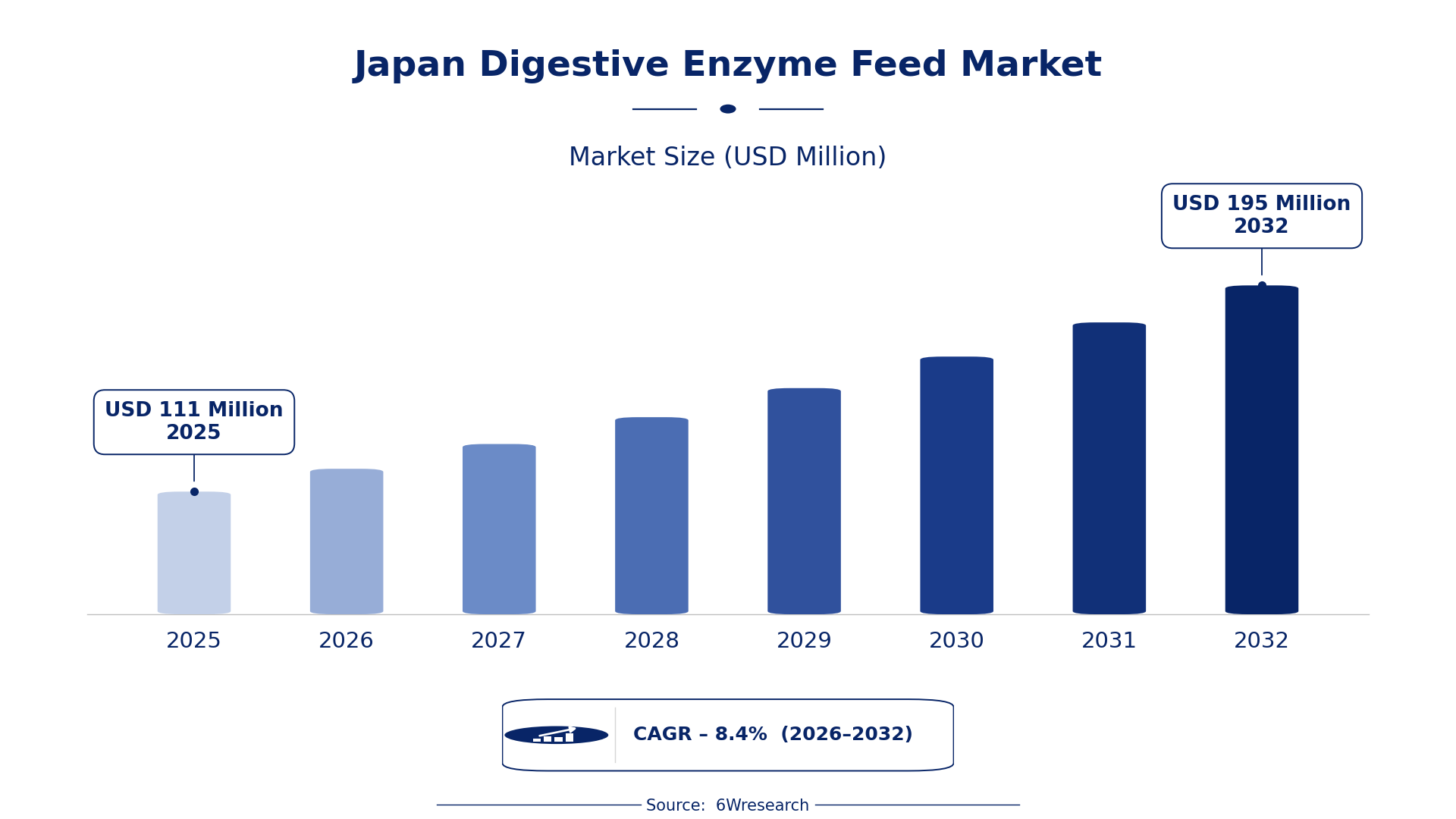
According to 6Wresearch internal database and industry insights, the Japan Digestive Enzyme Feed Market was valued at USD 111 Million in 2025 and is projected to reach USD 195 Million by 2032, growing at a CAGR of approximately 8.4% during 2026–2032.
Japan Digestive Enzyme Feed Market Highlights
| Report Metric | Details |
| Report Name | Japan Digestive Enzyme Feed Market (2026-2032) |
| Market Size 2025 | USD 111 Million |
| Market Size 2032 | USD 195 Million |
| Absolute Growth 2025–2032 | USD 84 Million |
| CAGR 2026–2032 | 8.4% |
| Peak Annual Growth | 9.0% in 2030 |
| Forecast Period | 2026–2032 |
| Historical Data | 2022–2025 |
| Base Year | 2025 |
| Leading Enzyme Type, 2025 | Protease (39% share) |
| Leading Animal Type, 2025 | Poultry (44% share) |
| Leading Form Type, 2025 | Powder (46% share) |
| Leading End User, 2025 | Feed Manufacturers (51% share) |
| Fastest-Growing Enzyme Type | Multi-Enzyme Mix (11.6% CAGR) |
| Fastest-Growing Animal Type | Aquaculture (12.0% CAGR) |
| Fastest-Growing Form Type | Pellet Integrated (12.4% CAGR) |
| Fastest-Growing End User | Commercial Hatcheries (10.7% CAGR) |
| Growing Sector | Aquaculture |
| Key End Users | Feed Manufacturers, Animal Farms, Commercial Hatcheries, Dairy Producers |
Japan Digestive Enzyme Feed Market Year-wise Growth Rate and Key Drivers (2022–2032)
This graph illustrates the annual growth rates of the market from 2022 to 2032, highlighting a steady upward trajectory and projected market expansion over the forecast period.
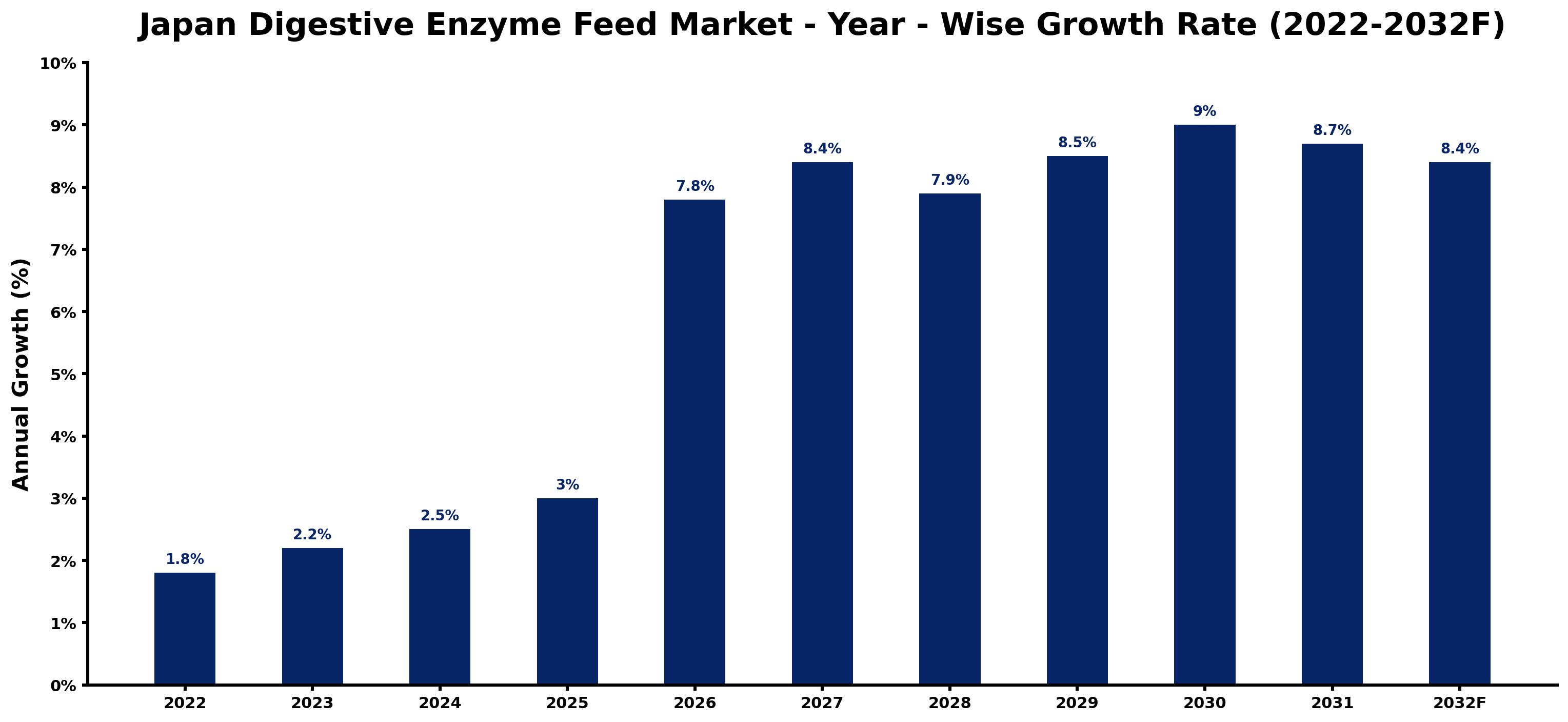
The yearly estimates that follow link every growth rate to its principal driver, so readers can see why the pace changed in each period.
| Year | Estimated Annual Growth (%) | Market Rationale |
| 2022 | 1.8 | The market experienced steady growth, reflecting ongoing demand from the livestock sector. |
| 2023 | 2.2 | Growth accelerated due to rising poultry numbers and increased enzyme adoption in aquaculture. |
| 2024 | 2.5 | Demand continued to rise as feed manufacturers expanded their enzyme offerings. |
| 2025 | 3.0 | The market peaked historically, driven by improved feed conversion ratios in livestock. |
| 2026 | 7.8 | Growth surged as the aquaculture sector is expected to adopt enzyme feeds more widely. |
| 2027 | 8.4 | Demand is projected to increase further, supported by higher feed production and livestock numbers. |
| 2028 | 7.9 | Growth is expected to slow slightly as the market begins to stabilise after rapid expansion. |
| 2029 | 8.5 | The market is projected to rebound with renewed interest in enzyme feeds for poultry and aquaculture. |
| 2030 | 9.0 | A peak growth rate is expected, driven by advancements in enzyme formulations. |
| 2031 | 8.7 | Growth is projected to moderate as the market adjusts to previous peaks in demand. |
| 2032 | 8.4 | The market continues to grow, albeit at a slower rate than in previous years. |
Note: Market size estimations and growth projections presented in this report are based on 6Wresearch's proprietary forecasting methodology, utilizing the latest available industry data, government publications, and primary research inputs.
Japan Digestive Enzyme Feed Market Synopsis
Digestive enzyme feed is a specialized additive that aids in nutrient absorption and promotes animal growth, primarily used in poultry and aquaculture. The Japan Digestive Enzyme Feed Market is expanding due to rising poultry populations, which number approximately 150 million, and the aquaculture sector, valued at over 600 billion yen. Increasing adoption of multi-enzyme mixes and support from the National Federation of Agricultural Cooperative Associations are driving further demand for these feeds.
Market Dynamics Impact Analysis (2026–2032)
| Factor | Type | Impact | Primary Segment Affected |
| Rising poultry population | Driver | High | Poultry |
| Increasing aquaculture sector | Driver | High | Aquaculture |
| Growing demand for multi-enzyme mixes | Opportunity | High | Multi-Enzyme Mix |
| Expansion of commercial hatcheries | Opportunity | High | Commercial Hatcheries |
| Regulatory compliance costs | Restraint | Medium | Feed Manufacturers |
| Limited awareness of enzyme benefits | Restraint | Medium | Animal Farms |
| High competition among feed manufacturers | Challenge | High | Feed Manufacturers |
| Dependency on livestock health trends | Challenge | Medium | Animal Farms |
Evaluation of Drivers in Japan Digestive Enzyme Feed Market (2026–2032)
The table below links each growth driver to the segment it affects and the evidence for it.
| Drivers | Primary Segment Affected | Why It Matters (Evidence) |
| Increased poultry production | Poultry | The poultry population in Japan is approximately 150 million, leading to higher enzyme feed usage for growth. |
| Aquaculture growth | Aquaculture | The aquaculture sector is valued at over 600 billion yen, driving demand for efficient feed solutions. |
| Rising feed conversion efficiency | Swine | The average feed conversion ratio for swine is 3.0, prompting more purchases of enzyme additives. |
| Adoption of multi-enzyme mixes | Cattle | The increasing use of multi-enzyme mixes improves digestion, boosting overall feed efficiency in cattle. |
| Support from agricultural cooperatives | Animal Farms | The National Federation of Agricultural Cooperative Associations promotes enzyme feed adoption among farmers. |
A wider customer base explains much of the growth, as the poultry population in Japan stands at approximately 150 million, prompting increased demand for enzyme feeds. The aquaculture sector, valued at over 600 billion yen, contributes to rising sales of these additives. Improvements in feed conversion efficiency are notable, with swine achieving an average feed conversion ratio of 3.0, prompting more purchases of enzyme products. The adoption of multi-enzyme mixes in cattle is increasing, improving digestion and feed efficiency, while support from agricultural cooperatives encourages farmers to integrate these feeds into their operations.
Evaluation of Restraints in Japan Digestive Enzyme Feed Market
These restraints slow adoption and weigh on supplier margins.
| Market Restraint | Primary Segment Affected | Why It Matters (Evidence) |
| Regulatory compliance costs | Feed Manufacturers | Compliance with the JIS Z 8815 standard increases operational costs for manufacturers, affecting pricing. |
| Limited awareness of enzyme benefits | Animal Farms | Many farmers lack knowledge about the advantages of enzyme feeds, hindering market growth. |
| Competition among feed manufacturers | Feed Manufacturers | Over 300 registered companies create a competitive environment, making it challenging to maintain market share. |
| Dependency on livestock health trends | Animal Farms | Changes in livestock health trends can lead to fluctuations in enzyme feed demand. |
| High production costs for enzyme feeds | Feed Manufacturers | The average feed cost for dairy producers is around 40% of total production costs, limiting investment. |
Japan Digestive Enzyme Feed Market Challenges
Over 50% of poultry feed in Japan includes digestive enzyme feed, yet a lack of skilled technicians in the feed manufacturing sector delays production timelines for suppliers. Compliance with the JIS Z 8815 standard complicates operations for manufacturers, resulting in higher costs that burden buyers with increased prices. The average feed cost for dairy producers, around 40% of total production costs, underscores the financial pressure from these regulatory requirements. Competition from alternative additives compels producers to invest in R&D, which may discourage smaller companies from entering the market due to high initial costs.
Trends in the Japan Digestive Enzyme Feed Market
The following changes are redrawing the Japan Digestive Enzyme Feed Market.
- Shift towards Multi-Enzyme Mixes: The cattle sector is increasingly using multi-enzyme mixes, with an anticipated growth rate of 11.6%. This trend reflects a growing recognition of their benefits in enhancing digestion and feed efficiency.
- Rising Adoption in Aquaculture: Since 2020, the Japanese aquaculture industry has experienced a 20% increase in enzyme usage, driven by the demand for more efficient feed solutions in fish farming, resulting in improved growth rates and overall productivity.
- Stricter Regulations for Feed Quality: The amendment to the Food Sanitation Act in 2018 made HACCP-based hygiene management mandatory, ensuring higher quality standards for feed additives, which benefits both producers and consumers.
- Focus on Commercial Hatcheries: Commercial hatcheries are increasingly incorporating enzyme feeds, with a notable portion of hatchery feeds now including additives to enhance chick growth rates, reflecting a shift in feeding practices.
Investment Opportunities in the Japan Digestive Enzyme Feed Market
The following areas offer the clearest openings for investors and suppliers in the Japan Digestive Enzyme Feed Market.
- Local Partnerships for Distribution: Investing in local distribution channels will ease entry into the expanding market, particularly in areas with high poultry populations, where demand for enzyme feed is on the rise.
- Collaborative Research Initiatives: Partnering with research institutions can enhance product offerings, especially for multi-enzyme mixes, which are becoming more popular among farmers, leading to improved livestock performance.
- Expansion in Aquaculture Facilities: Entering through joint ventures can provide a competitive advantage in the growing aquaculture sector, which is increasingly adopting enzyme feeds to promote fish growth and health.
- Certification for Quality Assurance: Investing in quality assurance processes will attract more buyers, especially in light of the JIS Z 8815 standard, which regulates feed additives and ensures safety.
Government Initiatives in the Japan Digestive Enzyme Feed Market
The Food Sanitation Act amendment, enacted in 2018 and fully applied by June 2021, mandates HACCP-based hygiene management for food businesses, including feed manufacturers. Compliance with this law ensures higher safety standards for enzyme feeds, benefiting both producers and consumers. Additionally, the Industrial Standardization Act, amended in 2019, governs JIS product and test standards, further ensuring quality in feed additives.
In 2023, the Government of Japan adopted the GX Basic Policy, aiming for about JPY 150 trillion in public-private decarbonisation investment over 10 years. The Ministry of Agriculture, Forestry and Fisheries oversees the implementation of these policies, promoting sustainable practices in feed production and usage, which directly impacts enzyme feed adoption.
Future Insight of the Japan Digestive Enzyme Feed Market
By 2032, Japan's livestock feed market will experience a policy-driven shift towards stricter regulatory standards, prompting suppliers to invest in advanced fermentation technologies. The poultry sector is likely to see a continued increase in enzyme usage, while the aquaculture sector, valued at over 600 billion yen, indicates strong demand among producers. New guidelines under JAS will standardise enzyme formulations, ensuring consistent quality and safety across the board. Consequently, buyers will benefit from improved feed efficiency and nutrient absorption, leading to healthier livestock and potentially higher profit margins.
Market Segmentation Analysis
Japan Digestive Enzyme Feed Market report covers a detailed analysis of the following market segments:
By Enzyme Type – Protease Leads, Multi-Enzyme Mix Expected to Grow Fastest
According to Saurav Kr Singh, Senior Research Analyst at 6Wresearch, with 39% of enzyme type revenue in 2025, Protease was the largest category. Protease commands the largest share as it is crucial for breaking down proteins, enhancing nutrient absorption in livestock. Its presence in over 50% of poultry feed in Japan highlights its vital role in optimising feed efficiency. Multi-Enzyme Mix is projected to grow fastest, at a CAGR of 11.6% during 2026–2032. The multi-enzyme mix segment is experiencing rapid growth due to its ability to address the varied digestive requirements of livestock. This trend is particularly evident in the increasing adoption of multi-enzyme mixes in cattle feed, which is driving the segment's expansion. Suppliers should focus on developing multi-enzyme products to align with the growing demand for comprehensive digestion solutions.
By Animal Type – Poultry Leads, Aquaculture Expected to Grow Fastest
Poultry held 44% of the Japan Digestive Enzyme Feed Market by animal type in 2025. Poultry dominates the market as it is the main consumer of enzyme feeds, constituting a significant portion of Japan's livestock population. With approximately 150 million poultry, the demand for effective feed solutions is substantial. The quickest growth will come from Aquaculture, forecast to expand at a CAGR of 12.0% between 2026 and 2032. Aquaculture is the fastest-growing segment, propelled by the rising need for efficient feed solutions in fish farming, as indicated by a 20% increase in enzyme usage since 2020. This trend reflects a broader shift towards sustainable practices within the aquaculture industry. Buyers in the aquaculture sector should consider integrating enzyme feeds to improve feed efficiency and support sustainable growth.
By Form Type – Powder Leads, Pellet Integrated Expected to Grow Fastest
Powder accounted for 46% of the market by form type in 2025. Powder is the leading form type as it is the most common format for enzyme feeds, allowing for easy mixing and application in various feed types. This versatility makes it a preferred choice among feed manufacturers. Pellet Integrated is set to record the highest CAGR in this split, 12.4% over 2026–2032. Pellet integrated forms are growing rapidly as they are specifically designed for convenience in pelleted feeds, which are increasingly popular in the market. This trend reflects a shift towards more user-friendly feed solutions. Suppliers should invest in developing pellet integrated products to meet the rising demand for convenient feed options.
By End User – Feed Manufacturers Lead, Commercial Hatcheries Expected to Grow Fastest
Feed Manufacturers took 51% of end user revenue in 2025, more than any other category. Feed manufacturers lead the market as they are the primary users of enzyme feeds, playing a crucial role in shaping the demand for these additives in livestock nutrition. Their focus on producing high-quality feeds ensures a steady requirement for enzyme solutions. Over 2026–2032, Commercial Hatcheries are expected to post the fastest growth, at a CAGR of 10.7%. Commercial hatcheries are the fastest-growing end user segment, utilising enzyme feeds to enhance chick growth rates, which is essential for their operations. This emphasis on improving growth efficiency indicates a growing trend in hatchery practices. Suppliers should tailor enzyme solutions for commercial hatcheries to take advantage of this expanding market.
Key Attractiveness of the Report
- 10 Years of Market Numbers
- Historical Data Starting from 2022 to 2025
- Base Year 2025
- Forecast Data until 2032
- Key Performance Indicators Impacting the Market
- Major Upcoming Developments and Projects
Key Highlights of the Report:
- Japan Digestive Enzyme Feed Market Outlook
- Market Size of Japan Digestive Enzyme Feed Market, 2025
- Forecast of Japan Digestive Enzyme Feed Market, 2032
- Historical Data and Forecast of Japan Digestive Enzyme Feed Revenues & Volume for the Period 2022-2032F
- Japan Digestive Enzyme Feed Market Trend Evolution
- Japan Digestive Enzyme Feed Market Drivers and Challenges
- Japan Digestive Enzyme Feed Price Trends
- Japan Digestive Enzyme Feed Porter's Five Forces
- Japan Digestive Enzyme Feed Industry Life Cycle
- Historical Data and Forecast of Japan Digestive Enzyme Feed Market Revenues & Volume By Enzyme Type for the Period 2022-2032F
- Historical Data and Forecast of Japan Digestive Enzyme Feed Market Revenues & Volume By Protease for the Period 2022-2032F
- Historical Data and Forecast of Japan Digestive Enzyme Feed Market Revenues & Volume By Amylase for the Period 2022-2032F
- Historical Data and Forecast of Japan Digestive Enzyme Feed Market Revenues & Volume By Cellulase for the Period 2022-2032F
- Historical Data and Forecast of Japan Digestive Enzyme Feed Market Revenues & Volume By Multi-Enzyme Mix for the Period 2022-2032F
- Historical Data and Forecast of Japan Digestive Enzyme Feed Market Revenues & Volume By Animal Type for the Period 2022-2032F
- Historical Data and Forecast of Japan Digestive Enzyme Feed Market Revenues & Volume By Poultry for the Period 2022-2032F
- Historical Data and Forecast of Japan Digestive Enzyme Feed Market Revenues & Volume By Swine for the Period 2022-2032F
- Historical Data and Forecast of Japan Digestive Enzyme Feed Market Revenues & Volume By Cattle for the Period 2022-2032F
- Historical Data and Forecast of Japan Digestive Enzyme Feed Market Revenues & Volume By Aquaculture for the Period 2022-2032F
- Historical Data and Forecast of Japan Digestive Enzyme Feed Market Revenues & Volume By Form Type for the Period 2022-2032F
- Historical Data and Forecast of Japan Digestive Enzyme Feed Market Revenues & Volume By Powder for the Period 2022-2032F
- Historical Data and Forecast of Japan Digestive Enzyme Feed Market Revenues & Volume By Granules for the Period 2022-2032F
- Historical Data and Forecast of Japan Digestive Enzyme Feed Market Revenues & Volume By Liquid for the Period 2022-2032F
- Historical Data and Forecast of Japan Digestive Enzyme Feed Market Revenues & Volume By Pellet Integrated for the Period 2022-2032F
- Historical Data and Forecast of Japan Digestive Enzyme Feed Market Revenues & Volume By End User for the Period 2022-2032F
- Historical Data and Forecast of Japan Digestive Enzyme Feed Market Revenues & Volume By Feed Manufacturers for the Period 2022-2032F
- Historical Data and Forecast of Japan Digestive Enzyme Feed Market Revenues & Volume By Animal Farms for the Period 2022-2032F
- Historical Data and Forecast of Japan Digestive Enzyme Feed Market Revenues & Volume By Dairy Producers for the Period 2022-2032F
- Historical Data and Forecast of Japan Digestive Enzyme Feed Market Revenues & Volume By Commercial Hatcheries for the Period 2022-2032F
- Japan Digestive Enzyme Feed Import Export Trade Statistics
- Market Opportunity Assessment By Enzyme Type
- Market Opportunity Assessment By Animal Type
- Market Opportunity Assessment By Form Type
- Market Opportunity Assessment By End User
- Japan Digestive Enzyme Feed Top Companies Market Share
- Japan Digestive Enzyme Feed Competitive Benchmarking By Technical and Operational Parameters
- Japan Digestive Enzyme Feed Company Profiles
- Japan Digestive Enzyme Feed Key Strategic Recommendations
Market Covered
The following segment groups are covered in the report.
By Enzyme Type
- Protease
- Amylase
- Cellulase
- Multi-Enzyme Mix
By Animal Type
- Poultry
- Swine
- Cattle
- Aquaculture
By Form Type
- Powder
- Granules
- Liquid
- Pellet Integrated
By End User
- Feed Manufacturers
- Animal Farms
- Dairy Producers
- Commercial Hatcheries






































