Japan Digital Television (TV) Market Size & Growth Rate
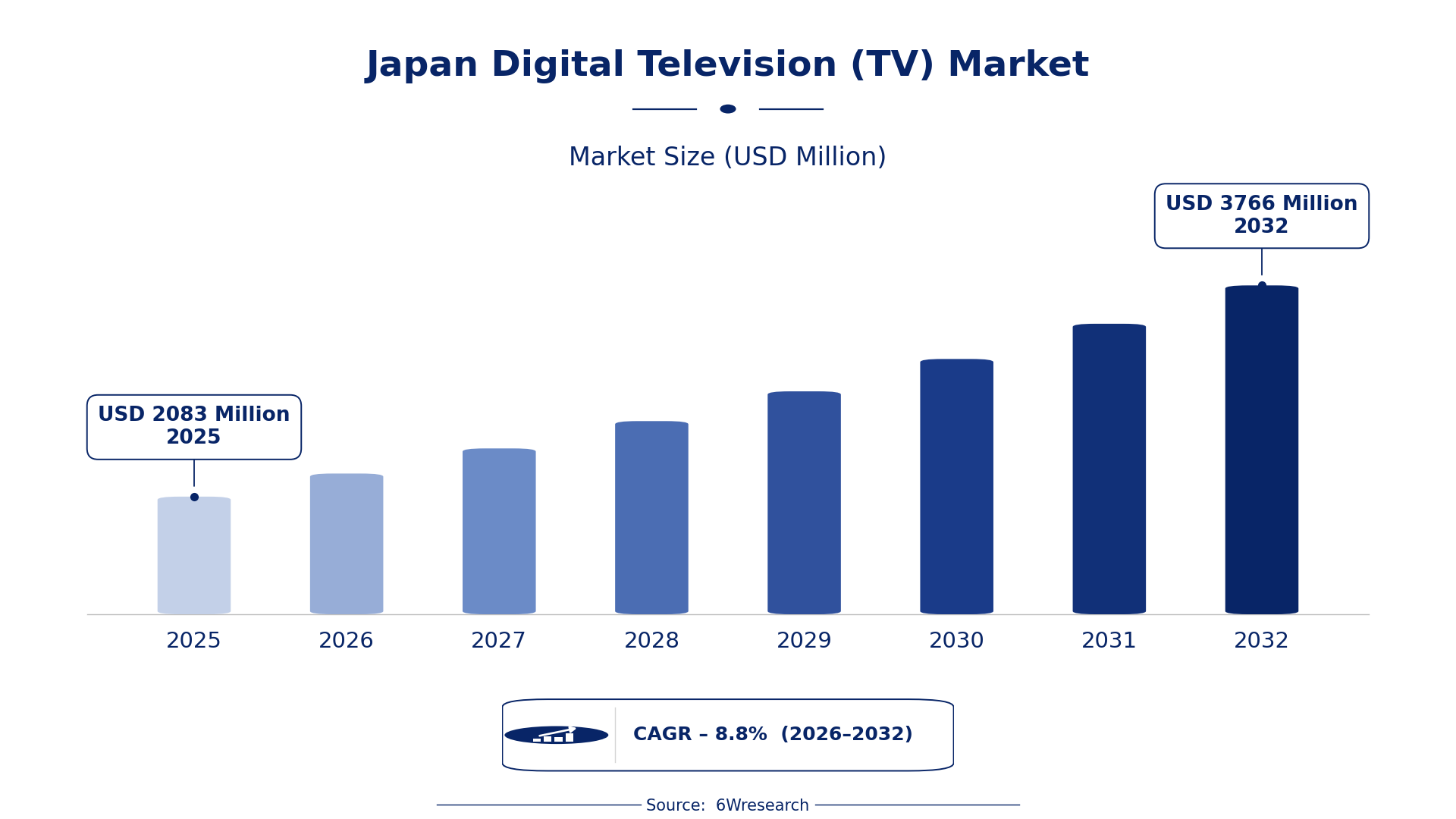
According to 6Wresearch internal database and industry insights, the Japan Digital Television (TV) Market was valued at USD 2,083 Million in 2025 and is projected to reach USD 3,766 Million by 2032, growing at a CAGR of approximately 8.8% during 2026–2032.
Japan Digital Television (TV) Market Highlights
| Report Metric | Details |
| Report Name | Japan Digital Television (TV) Market (2026-2032) |
| Market Size 2025 | USD 2,083 Million |
| Market Size 2032 | USD 3,766 Million |
| Absolute Growth 2025–2032 | USD 1,683 Million |
| CAGR 2026–2032 | 8.8% |
| Peak Annual Growth | 9.4% in 2026 |
| Forecast Period | 2026–2032 |
| Historical Data | 2022–2025 |
| Base Year | 2025 |
| Leading Type, 2025 | SDTV (41% share) |
| Leading Resolution, 2025 | 480p (640 x 480) (52% share) |
| Leading Size, 2025 | 11''-32'' (45% share) |
| Fastest-Growing Type | EDTV (12.0% CAGR) |
| Fastest-Growing Resolution | 720p (1280*720) (11.1% CAGR) |
| Fastest-Growing Size | 32''-42'' (11.5% CAGR) |
| Growing Sector | Digital Content Production |
| Key End Users | Households, content producers, broadcasters, technology firms |
Japan Digital Television (TV) Market Year-wise Growth Rate and Key Drivers (2022–2032)
This graph illustrates the annual growth rates of the market from 2022 to 2032, highlighting a steady upward trajectory and projected market expansion over the forecast period.
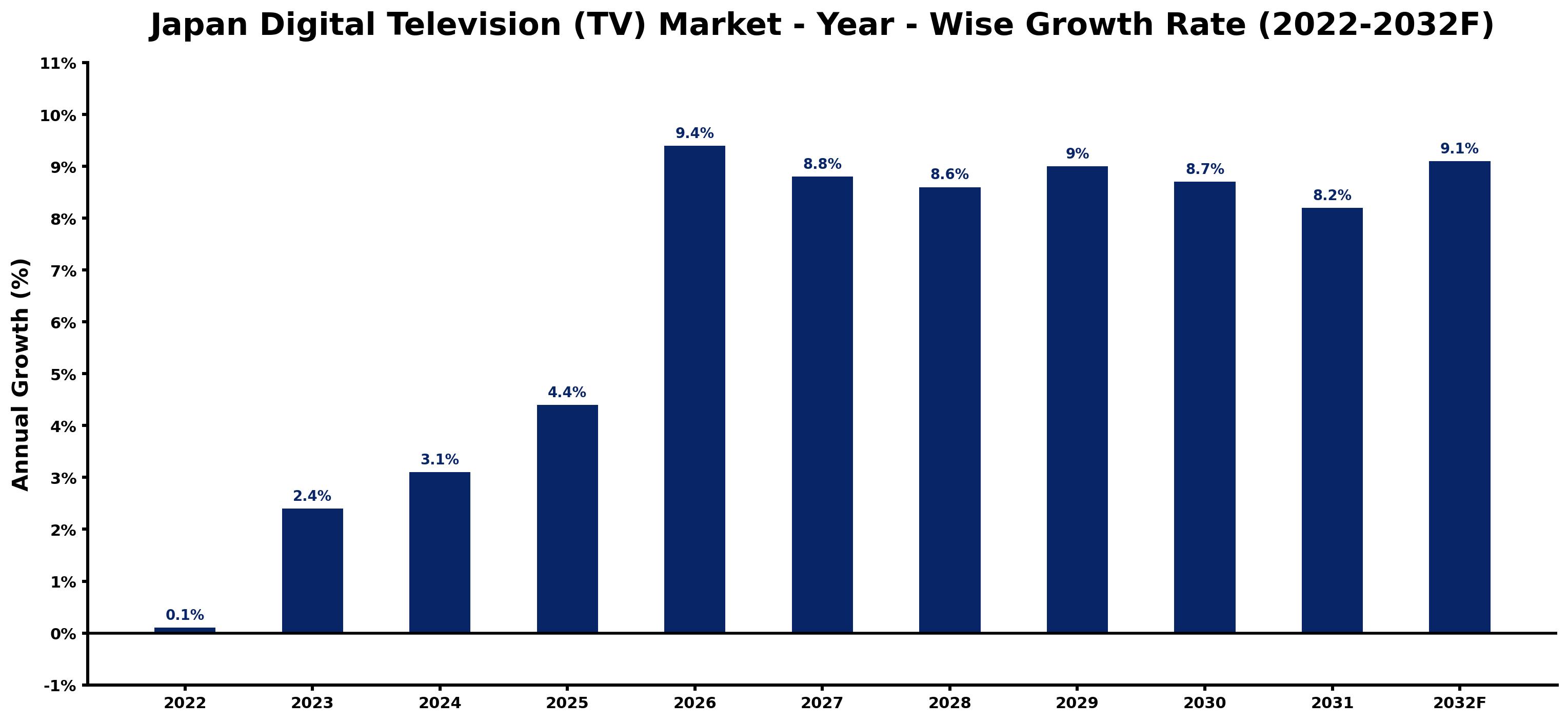
The table below sets out the estimated growth rate for each year and the main factor behind it.
| Year | Estimated Annual Growth (%) | Market Rationale |
| 2022 | 0.1 | The market showed minimal growth as digital TV adoption reached 95%. |
| 2023 | 2.4 | Growth accelerated as households increasingly subscribed to digital services. |
| 2024 | 3.1 | Demand continued to rise due to the popularity of high-definition content. |
| 2025 | 4.4 | The market expanded further with a growing preference for larger screens. |
| 2026 | 9.4 | The introduction of new broadcasting technologies spurred growth. |
| 2027 | 8.8 | Growth slowed slightly as the market began to stabilise after rapid expansion. |
| 2028 | 8.6 | Demand continued to grow, but at a slower rate than the previous year. |
| 2029 | 9.0 | The market rebounded with renewed interest in 4K content offerings. |
| 2030 | 8.7 | Growth decelerated as saturation in urban areas began to affect sales. |
| 2031 | 8.2 | The market maintained growth, driven by ongoing technological advancements. |
| 2032 | 9.1 | Demand surged again with increasing adoption of smart TV features. |
Note: Market size estimations and growth projections presented in this report are based on 6Wresearch's proprietary forecasting methodology, utilizing the latest available industry data, government publications, and primary research inputs.
Japan Digital Television (TV) Market Synopsis
Digital Television (TV) in Japan utilises digital encoding to transmit audio and video signals, primarily for entertainment and information. The Japan Digital Television (TV) Market is expanding, driven by over 100 million households and a high adoption rate of approximately 95%. This growth is supported by the increasing popularity of 4K content and smart TV integrations, alongside initiatives that promote advancements in broadcasting and improve viewer experiences.
Market Dynamics Impact Analysis (2026–2032)
| Factor | Type | Impact | Primary Segment Affected |
| High penetration of digital TV services | Driver | High | HDTV |
| Increased consumer spending on entertainment | Driver | High | SDTV |
| Growing demand for ultra-high-definition content | Opportunity | High | Others (4K) |
| Expansion of smart TV features | Opportunity | High | HDTV |
| Market saturation in urban areas | Restraint | Medium | HDTV |
| Limited interest in lower-resolution TVs | Restraint | Medium | SDTV |
| High competition among digital content providers | Challenge | Medium | HDTV |
| Rapid technological changes requiring constant updates | Challenge | Medium | SDTV |
Evaluation of Drivers in Japan Digital Television (TV) Market (2026–2032)
The following drivers explain most of the expected growth.
| Drivers | Primary Segment Affected | Why It Matters (Evidence) |
| High-definition content demand | HDTV | The increasing availability of high-definition programming drives households to upgrade their TVs, with 4K TV sales increasing by 30% in 2023. |
| Consumer preference for larger screens | 50'' & above | The average screen size for new TVs sold exceeds 50 inches, prompting buyers to invest in larger models for better viewing experiences. |
| Rising subscription costs for digital services | HDTV | The average household spends approximately 10,000 JPY monthly on TV services, leading to increased investments in quality viewing options. |
| Government initiatives promoting digital broadcasting | SDTV | The 'Digital Japan' initiative encourages advancements in digital broadcasting, boosting the adoption of 4K technology among consumers. |
| Technological advancements in broadcasting standards | HDTV | The implementation of JIS standards improves the quality of digital TV equipment, driving consumer confidence and purchases. |
Spending rises because over 100 million households in Japan have adopted digital TV, leading to increased demand for high-definition content. The average household's monthly expenditure of approximately 10,000 JPY on TV services encourages upgrades to larger screens. With the average screen size exceeding 50 inches, consumers are investing in superior viewing experiences. The implementation of JIS standards improves equipment quality, increasing consumer confidence in new purchases. The growing interest in 4K content is prompting more households to upgrade their viewing technology, further driving market growth.
Evaluation of Restraints in Japan Digital Television (TV) Market
The key brakes on demand, and where they bite hardest, are shown below.
| Market Restraint | Primary Segment Affected | Why It Matters (Evidence) |
| Market saturation in urban areas | HDTV | High penetration in cities limits growth opportunities, as most households already own digital TVs. |
| Limited interest in lower-resolution TVs | SDTV | As HDTV becomes the standard, consumers show little demand for outdated resolutions like SDTV. |
| High competition among content providers | HDTV | Intense competition leads to price wars, affecting profitability for providers and limiting investment in new content. |
| Rapid technological changes | SDTV | Suppliers face challenges in keeping up with technological advancements, which can delay product launches. |
| Consumer preference for established brands | HDTV | Established brands dominate the market, making it difficult for new entrants to gain traction. |
Japan Digital Television (TV) Market Challenges
Over 100 million households in Japan depend on digital TV, yet supply chain disruptions for critical components can delay production for manufacturers by up to three months. A lack of skilled technicians in advanced broadcasting technology hampers producers' ability to innovate, risking a loss of market share to more agile competitors. Rapid technological advancements necessitate frequent upgrades, and many suppliers struggle to keep pace, leading to potential obsolescence of their products. Intense competition among content providers drives down prices, which reduces profit margins for producers and limits their capacity to invest in quality improvements.
Trends in the Japan Digital Television (TV) Market
Buyers and suppliers in the Japan Digital Television (TV) Market are adjusting to the following trends.
- Shift from Standard to High Definition: Tokyo is experiencing a shift from standard definition to high-definition broadcasts, with a 30% increase in 4K TV sales in 2023. This trend indicates a growing consumer preference for superior viewing experiences.
- Transition to Smart TVs: Since 2021, the integration of smart features in TVs has become prevalent, driven by the 'Smart TV' initiative. This transition has led to increased consumer engagement with digital content, broadening viewing options.
- Emergence of Ultra-High-Definition Content: The demand for ultra-high-definition content is rising, particularly in Osaka, where 4K programming is becoming more widely available. This trend is pushing consumers to invest in compatible TV sets.
- Growing Preference for Larger Screens: Since 2023, there has been a noticeable shift towards larger screen sizes, particularly in family rooms. The average screen size sold now exceeds 50 inches, reflecting changing consumer preferences.
Investment Opportunities in the Japan Digital Television (TV) Market
The following areas offer the clearest openings for investors and suppliers in the Japan Digital Television (TV) Market.
- Supply of Ultra-High-Definition TVs: There is a growing opportunity to supply ultra-high-definition TVs, particularly in urban areas where demand is high. With 4K TV sales increasing by 30% in 2023, manufacturers can focus on this segment.
- Investment in Smart TV Features: Now is the time to invest in smart TV technologies, as consumers increasingly seek integrated services. Collaborating with local tech firms can facilitate entry into this expanding market.
- Focus on Content Production: Content producers are in high demand as digital TV services expand. The Tokyo International Video Festival showcases innovations, creating opportunities for suppliers to engage with content creators.
- Development of Broadcasting Infrastructure: Investment in broadcasting infrastructure is essential, especially under government initiatives. Partnering with regional broadcasters can improve service delivery and reach.
Government Initiatives in the Japan Digital Television (TV) Market
The Digital Japan initiative promotes digital broadcasting, encouraging producers to enhance their offerings and meet the high consumer demand for quality content. Under this initiative, the government has set standards for digital TV equipment, ensuring compliance with JIS regulations to maintain quality. Additionally, the Semiconductor and Digital Industry Strategy aims to secure domestic semiconductor manufacturing, which is crucial for digital TV production, creating a sustainable supply chain for manufacturers. This framework is expected to support the growth of the digital TV sector in Japan.
In 2023, the government allocated significant funds for digital infrastructure improvements, overseen by the Ministry of Internal Affairs and Communications. This agency is responsible for implementing broadcasting regulations and ensuring that digital TV services meet national standards. The funding aims to enhance the quality of digital content and expand access to advanced broadcasting technologies, which will benefit both producers and consumers in the digital TV market.
Future Insight of the Japan Digital Television (TV) Market
By 2032, the investment pipeline for digital infrastructure is expected to generate substantial demand for advanced broadcasting technologies. The integration of AI and machine learning will transform content delivery, allowing suppliers to offer personalised viewing experiences. The 'Smart TV' initiative will accelerate, resulting in a surge of connected devices that reshape consumer engagement. As 4K TV sales increase by 30% year-on-year, producers must innovate rapidly to align with evolving consumer preferences and maintain their competitive edge.
Market Segmentation Analysis
Japan Digital Television (TV) Market report covers a detailed analysis of the following market segments:
By Type – SDTV Leads, EDTV Expected to Grow Fastest
According to Sumit Sagar, AM at 6Wresearch, in 2025, SDTV led the type split with a 41% share. SDTV holds the largest share as it caters to basic viewing needs for many households, particularly in rural areas where advanced technology is less accessible. With over 100 million digital TV households, a notable portion still relies on SDTV for their entertainment needs. EDTV is set to record the highest CAGR in this split, 12.0% over 2026–2032. EDTV is witnessing rapid growth as urban consumers in cities like Tokyo seek enhanced viewing experiences, driven by the increasing availability of content in better resolutions. This trend is likely to continue as more households upgrade their viewing technology. Suppliers should focus on expanding their EDTV product lines to align with the growing demand for improved viewing quality among consumers.
By Resolution – 480p (640 x 480) Leads, 720p (1280*720) Expected to Grow Fastest
The largest resolution category in 2025 was 480p (640 x 480), at 52% of revenue. The 480p resolution remains the most prevalent as it caters to a segment of users who have not upgraded their viewing technology. This resolution is still found in older models and budget-friendly options, appealing to cost-conscious consumers. Over 2026–2032, 720p (1280*720) is expected to post the fastest growth, at a CAGR of 11.1%. The 720p resolution is gaining traction as streaming services increasingly offer content in this format, attracting users seeking improved quality. This trend is particularly noticeable among younger demographics who prioritise visual clarity. Manufacturers should consider expanding their offerings in 720p to capture the rising interest in better resolution among consumers.
By Size – 11''-32'' Leads, 32''-42'' Expected to Grow Fastest
11''-32'' accounted for 45% of the market by size in 2025. The 11''-32'' size range dominates the market as it serves those seeking portable or secondary viewing options, particularly in smaller living spaces. This segment is especially popular among younger consumers who prefer compact solutions for their digital entertainment. The quickest growth will come from 32''-42'', forecast to expand at a CAGR of 11.5% between 2026 and 2032. The 32''-42'' size range is experiencing the fastest growth, as it becomes the preferred choice for family rooms where a balance of size and affordability is crucial. This shift highlights a consumer trend towards larger screens for an enhanced viewing experience. Retailers should increase their stock of models in the 32''-42'' range to cater to the rising consumer preference for larger screens in family-oriented settings.
Key Attractiveness of the Report
- 10 Years of Market Numbers
- Historical Data Starting from 2022 to 2025
- Base Year 2025
- Forecast Data until 2032
- Key Performance Indicators Impacting the Market
- Major Upcoming Developments and Projects
Key Highlights of the Report:
- Japan Digital Television (TV) Market Outlook
- Market Size of Japan Digital Television (TV) Market, 2025
- Forecast of Japan Digital Television (TV) Market, 2032
- Historical Data and Forecast of Japan Digital Television (TV) Revenues & Volume for the Period 2022-2032
- Japan Digital Television (TV) Market Trend Evolution
- Japan Digital Television (TV) Market Drivers and Challenges
- Japan Digital Television (TV) Price Trends
- Japan Digital Television (TV) Porter's Five Forces
- Japan Digital Television (TV) Industry Life Cycle
- Historical Data and Forecast of Japan Digital Television (TV) Market Revenues & Volume By Type for the Period 2022-2032
- Historical Data and Forecast of Japan Digital Television (TV) Market Revenues & Volume By SDTV for the Period 2022-2032
- Historical Data and Forecast of Japan Digital Television (TV) Market Revenues & Volume By EDTV for the Period 2022-2032
- Historical Data and Forecast of Japan Digital Television (TV) Market Revenues & Volume By HDTV for the Period 2022-2032
- Historical Data and Forecast of Japan Digital Television (TV) Market Revenues & Volume By others for the Period 2022-2032
- Historical Data and Forecast of Japan Digital Television (TV) Market Revenues & Volume By Resolution for the Period 2022-2032
- Historical Data and Forecast of Japan Digital Television (TV) Market Revenues & Volume By 480p (640 x 480) for the Period 2022-2032
- Historical Data and Forecast of Japan Digital Television (TV) Market Revenues & Volume By 720p (1280*720) for the Period 2022-2032
- Historical Data and Forecast of Japan Digital Television (TV) Market Revenues & Volume By 1080p (1920*1080) for the Period 2022-2032
- Historical Data and Forecast of Japan Digital Television (TV) Market Revenues & Volume By Others (4K) for the Period 2022-2032
- Historical Data and Forecast of Japan Digital Television (TV) Market Revenues & Volume By Size for the Period 2022-2032
- Historical Data and Forecast of Japan Digital Television (TV) Market Revenues & Volume By 11''-32'' for the Period 2022-2032
- Historical Data and Forecast of Japan Digital Television (TV) Market Revenues & Volume By 32''-42'' for the Period 2022-2032
- Historical Data and Forecast of Japan Digital Television (TV) Market Revenues & Volume By 42''-50'' for the Period 2022-2032
- Historical Data and Forecast of Japan Digital Television (TV) Market Revenues & Volume By 50'' & above for the Period 2022-2032
- Japan Digital Television (TV) Import Export Trade Statistics
- Market Opportunity Assessment By Type
- Market Opportunity Assessment By Resolution
- Market Opportunity Assessment By Size
- Japan Digital Television (TV) Top Companies Market Share
- Japan Digital Television (TV) Competitive Benchmarking By Technical and Operational Parameters
- Japan Digital Television (TV) Company Profiles
- Japan Digital Television (TV) Key Strategic Recommendations
Market Covered
The report covers the following segments.
By Type
- SDTV
- EDTV
- HDTV
- others
By Resolution
- 480p (640 x 480)
- 720p (1280*720)
- 1080p (1920*1080)
- Others (4K)
By Size
- 11''-32''
- 32''-42''
- 42''-50''
- 50'' & above






































