Japan Dining Tables Market Size & Growth Rate
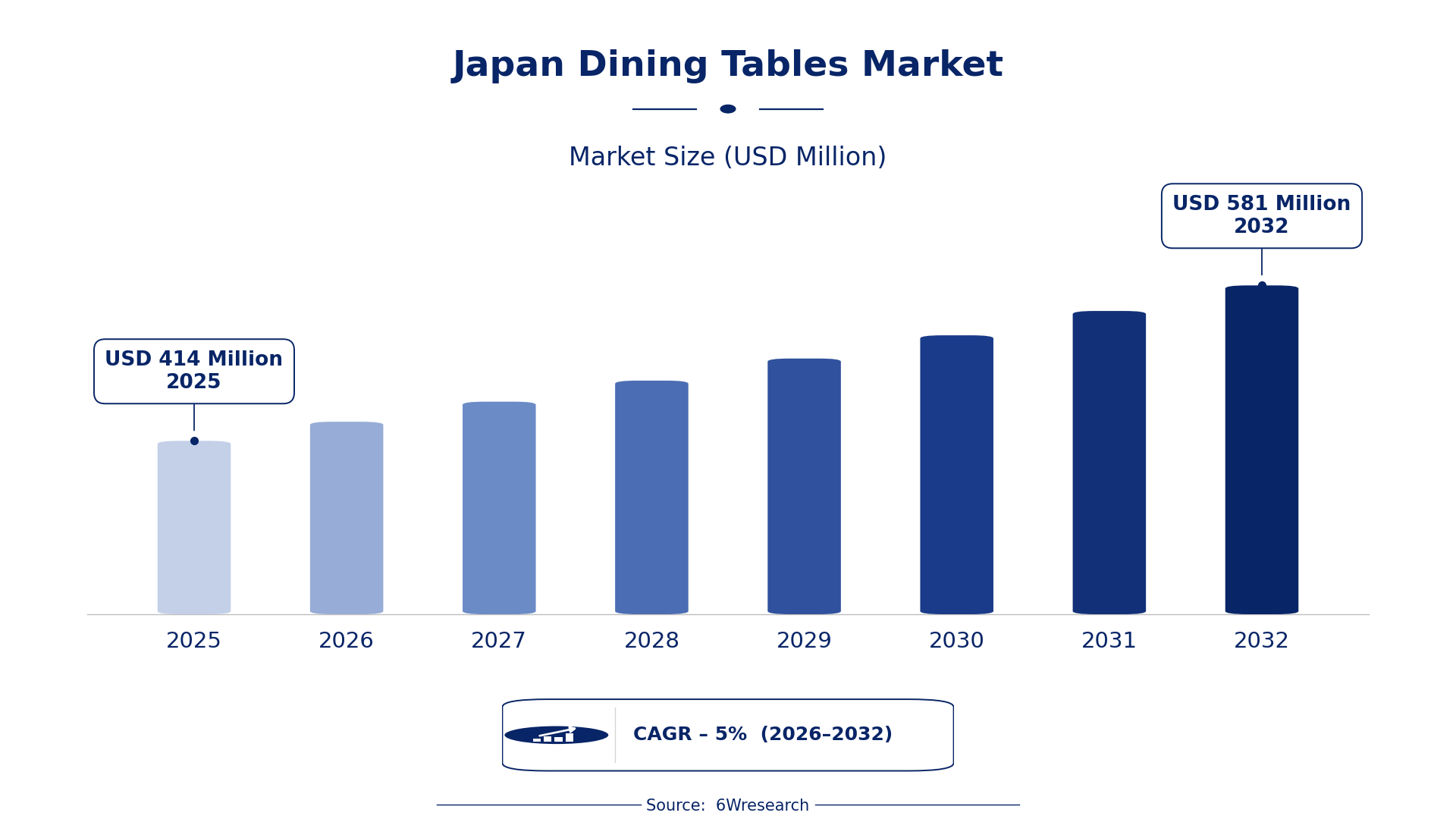
According to 6Wresearch internal database and industry insights, the Japan Dining Tables Market was valued at USD 414 Million in 2025 and is projected to reach USD 581 Million by 2032, growing at a CAGR of approximately 5% during 2026–2032.
Japan Dining Tables Market Highlights
| Report Metric | Details |
| Report Name | Japan Dining Tables Market (2026-2032) |
| Market Size 2025 | USD 414 Million |
| Market Size 2032 | USD 581 Million |
| Absolute Growth 2025–2032 | USD 167 Million |
| CAGR 2026–2032 | 5% |
| Peak Annual Growth | 5.4% in 2027 |
| Forecast Period | 2026–2032 |
| Historical Data | 2022–2025 |
| Base Year | 2025 |
| Leading Material, 2025 | Wood (42% share) |
| Leading Shape, 2025 | Rectangular (44% share) |
| Leading Application, 2025 | Residential (53% share) |
| Fastest-Growing Material | Plastic (6.8% CAGR) |
| Fastest-Growing Shape | Round (6.4% CAGR) |
| Fastest-Growing Application | Food Services (6.9% CAGR) |
| Growing Sector | Residential |
| Key End Users | Homeowners, food service establishments, interior designers |
Japan Dining Tables Market Year-wise Growth Rate and Key Drivers (2022–2032)
This graph illustrates the annual growth rates of the market from 2022 to 2032, highlighting a steady upward trajectory and projected market expansion over the forecast period.
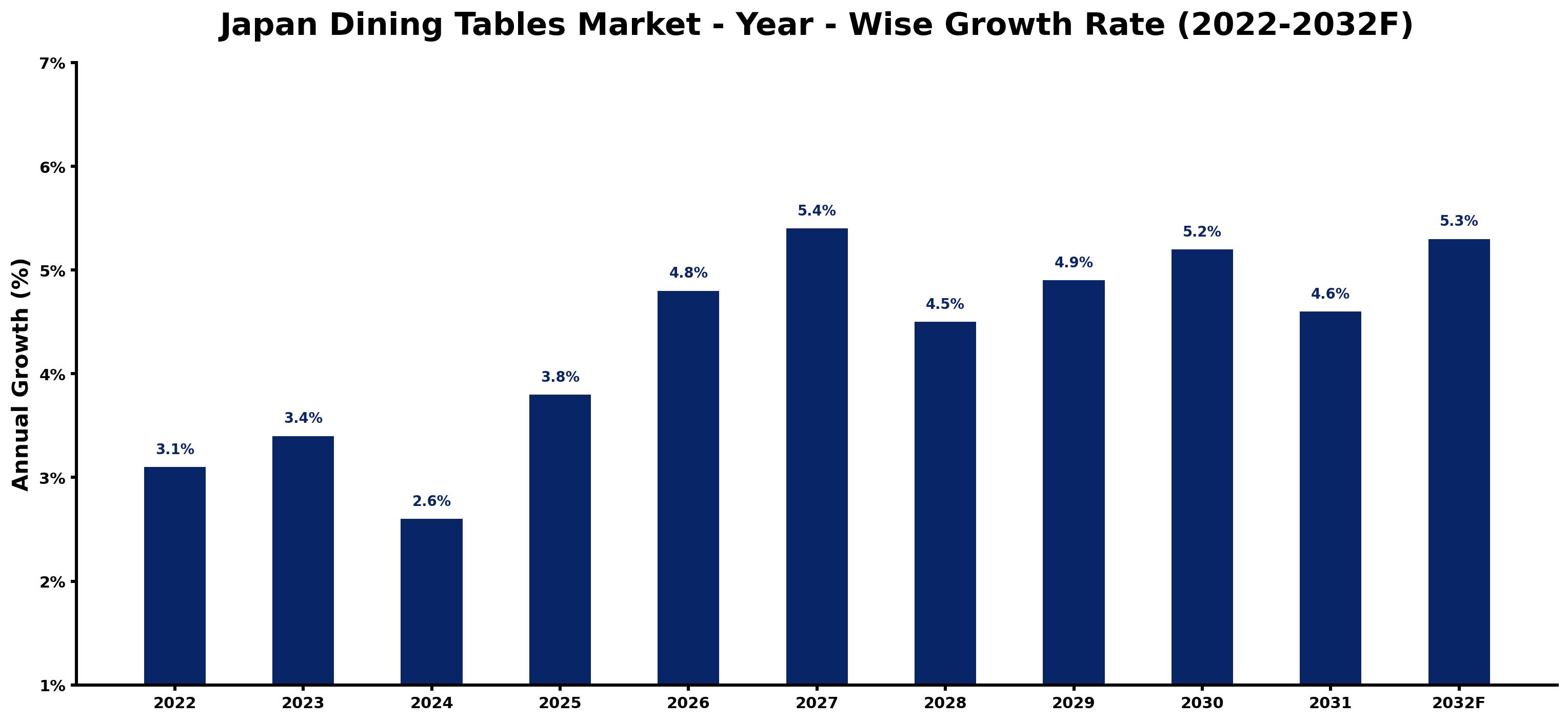
Each row of the following table gives one year's estimated growth and the event or demand shift that explains it.
| Year | Estimated Annual Growth (%) | Market Rationale |
| 2022 | 3.1 | The market experienced steady growth due to ongoing residential construction projects. |
| 2023 | 3.4 | Demand increased as consumer preferences shifted towards larger dining spaces. |
| 2024 | 2.6 | Growth slowed as supply chain issues affected material availability. |
| 2025 | 3.8 | A rise in disposable income led to higher spending on home furnishings. |
| 2026 | 4.8 | Consumer interest in eco-friendly materials is expected to boost demand for sustainable options. |
| 2027 | 5.4 | A surge in hospitality sector investments will drive the peak growth rate. |
| 2028 | 4.5 | Growth is projected to slow as market saturation begins to impact new purchases. |
| 2029 | 4.9 | Increased urbanisation will result in higher demand for compact dining solutions. |
| 2030 | 5.2 | Rising consumer awareness of quality standards will further stimulate purchases. |
| 2031 | 4.6 | Growth is expected to slow as the market adjusts to changing consumer preferences. |
| 2032 | 5.3 | Demand will increase as new eco-friendly dining table designs gain popularity. |
Note: Market size estimations and growth projections presented in this report are based on 6Wresearch's proprietary forecasting methodology, utilizing the latest available industry data, government publications, and primary research inputs.
Japan Dining Tables Market Synopsis
Dining tables are essential furniture pieces designed for dining purposes, typically made from wood, metal, and plastic. The primary applications include residential settings and food service establishments. The Japan Dining Tables Market is expanding, driven by rising residential construction and a thriving hospitality sector. With wood dining tables accounting for over 60% of the market share, demand is further supported by consumer preferences for sustainable materials, as recent initiatives promote eco-friendly manufacturing practices.
Market Dynamics Impact Analysis (2026–2032)
| Factor | Type | Impact | Primary Segment Affected |
| Growing residential construction projects are increasing demand for dining tables. | Driver | High | Residential |
| The rise in eco-friendly material usage presents opportunities for innovation. | Opportunity | High | Wood |
| Supply chain disruptions are affecting the availability of key materials. | Restraint | High | Wood |
| Increased competition from imported dining tables poses a challenge. | Challenge | High | Wood |
| The food service industry's expansion is driving demand for dining tables. | Driver | Medium | Food Services |
| Growing popularity of compact dining solutions offers new market potential. | Opportunity | Medium | Round |
| Rising costs of raw materials are impacting production expenses. | Restraint | Medium | Wood |
| Consumer preferences are shifting towards multifunctional furniture, complicating sales. | Challenge | Medium | Wood |
Evaluation of Drivers in Japan Dining Tables Market (2026–2032)
These are the developments adding the most demand over the forecast period.
| Drivers | Primary Segment Affected | Why It Matters (Evidence) |
| Increasing disposable income leads to higher spending on home furnishings. | Residential | As households earn more, they invest in quality dining tables, with the average price of wooden tables ranging from ¥30,000 to ¥150,000. |
| The expanding food service industry requires more dining tables for customer seating. | Food Services | Valued at approximately ¥24 trillion, this sector drives demand for durable and stylish dining solutions. |
| Rising consumer interest in sustainable products boosts demand for eco-friendly dining tables. | Wood | In 2023, a government initiative promoted sustainable furniture manufacturing, encouraging consumers to choose eco-friendly options. |
| Urbanisation trends are increasing the need for compact and versatile dining solutions. | Wood | As urban populations grow, buyers seek space-efficient designs, with round tables facilitating conversation in smaller areas. |
| The popularity of home dining experiences is driving purchases of dining tables. | Residential | With more people dining at home, there is a greater demand for functional and aesthetically pleasing dining furniture. |
Purchasing is on the rise as consumers show a growing preference for quality dining furniture in their homes. The food service industry, valued at approximately ¥24 trillion, propels the demand for durable dining tables in restaurants and cafes. With rising disposable incomes, households are more inclined to invest in quality pieces, as wooden dining tables typically range from ¥30,000 to ¥150,000. Urbanisation trends are influencing a shift towards compact designs, particularly round tables that encourage conversation in smaller spaces.
Evaluation of Restraints in Japan Dining Tables Market
These are the pressures that could keep growth below its potential.
| Market Restraint | Primary Segment Affected | Why It Matters (Evidence) |
| Supply chain disruptions are limiting the availability of key materials. | Wood | Increased demand for wood dining tables has strained supply chains, affecting production timelines and costs. |
| Rising costs of raw materials are impacting production expenses. | Wood | The price increases for essential materials like wood are squeezing profit margins for manufacturers. |
| Increased competition from imported dining tables poses a challenge. | Wood | Domestic producers face pressure from lower-priced imports, making it difficult to maintain market share. |
| Consumer preferences are shifting towards multifunctional furniture, complicating sales. | Wood | As buyers seek versatile options, traditional dining tables may see reduced interest. |
| Regulatory compliance for quality and safety standards can delay production. | Wood | Compliance with JIS standards requires additional testing and certification, extending lead times. |
Japan Dining Tables Market Challenges
Buyers are contending with rising costs due to the limited availability of sustainable materials, which has increased production expenses by 20% for local manufacturers. Intense competition from imports pressures suppliers, compelling price reductions that may shrink profit margins by 15% annually for domestic producers. A shortage of skilled craftsmen leads to delays, extending lead times by three months for suppliers fulfilling custom orders. Slow technology adoption is hindering efficiency, resulting in a 10% reduction in output for manufacturers who do not modernise their production processes.
Trends in the Japan Dining Tables Market
Several trends are reshaping the Japan Dining Tables Market; the most important are set out below.
- Shift towards Eco-Friendly Materials: Since 2023, a clear shift towards eco-friendly materials in dining table production has emerged. The Japan Furniture Association reported an increase in the use of sustainable materials, with over 30% of new dining tables incorporating recycled elements, appealing to environmentally conscious consumers.
- Transition from Traditional to Modern Designs: In 2023, dining table designs have increasingly gravitated towards modern aesthetics, with sleek lines and minimalist styles gaining popularity. This trend is particularly pronounced in urban areas, where contemporary dining tables are becoming more appealing to younger buyers, reflecting evolving tastes.
- Emergence of Compact Dining Solutions: In 2025, compact dining solutions started to gain traction, especially in urban environments where space is at a premium. Round tables, which facilitate conversation, are becoming the preferred choice for smaller homes, catering to the needs of modern lifestyles.
- Prioritisation of Quality and Durability: Since 2022, consumers have placed a higher emphasis on quality and durability when purchasing dining tables. The average household size of 2.5 persons influences the preference for sturdy, long-lasting furniture, driving demand for well-crafted wooden tables.
Investment Opportunities in the Japan Dining Tables Market
The following opportunities in the Japan Dining Tables Market pair current demand with a clear way in.
- Residential Buyers Seeking Quality: Residential buyers are increasingly in search of high-quality dining tables, with over 60% of the market share attributed to wood. This creates an opportunity for manufacturers to invest in premium materials and craftsmanship.
- Food Services Expanding Dining Options: The food service industry, valued at approximately ¥24 trillion, is actively seeking durable dining solutions. Suppliers can tap into this market by partnering with local restaurants and cafes to offer tailored dining table options.
- Gap in Eco-Friendly Offerings: With over 30% of consumers expressing interest in eco-friendly dining tables, suppliers have a notable gap to address. Collaborating with local artisans to create sustainable products could attract environmentally conscious buyers.
- Urban Areas Requiring Space-Efficient Designs: Urban areas are seeing a growing demand for compact dining solutions, with round tables becoming increasingly popular. Manufacturers can target this market by developing versatile designs suitable for smaller living spaces.
Government Initiatives in the Japan Dining Tables Market
The 2023 initiative promoting sustainable furniture manufacturing complements existing regulations by encouraging the use of eco-friendly materials in production. This initiative aligns with the Economic Security Promotion Act of 2022, which supports supply-chain resilience for critical products, improving the overall sustainability of the furniture sector in Japan.
The Chemical Substances Control Law ensures that furniture products meet safety standards. This law mandates manufacturers to evaluate and control chemical substances, providing consumers with assurance regarding the safety and quality of their dining tables.
Future Insight of the Japan Dining Tables Market
The introduction of new sustainable furniture manufacturing programmes is set to transform the industry by 2032, enabling suppliers to improve production methods. Increased consumer demand for dining tables made from recycled materials will drive innovation in design and functionality. Government support for local manufacturers will promote the adoption of eco-friendly practices. By 2032, the average price of wooden dining tables is anticipated to stabilise around ¥60,000, benefiting both buyers and suppliers.
Market Segmentation Analysis
Japan Dining Tables Market report covers a detailed analysis of the following market segments:
By Material – Wood Leads, Plastic Expected to Grow Fastest
According to Sumit Sagar, AM at 6Wresearch, in 2025, Wood led the material split with a 42% share. Wood dining tables dominate the market due to their traditional appeal and durability, making them a preferred choice for households. In residential applications, they account for over 60% of the market share, reflecting their widespread acceptance among consumers. Plastic is set to record the highest CAGR in this split, 6.8% over 2026–2032. Plastic dining tables are experiencing rapid growth as they cater to outdoor and temporary setups, appealing to a segment of consumers seeking versatility. The rising trend of casual dining and outdoor gatherings is driving this demand. Suppliers should consider expanding their product lines to include more plastic options to meet changing consumer preferences.
By Shape – Rectangular Leads, Round Expected to Grow Fastest
Rectangular took 44% of shape revenue in 2025, more than any other category. Rectangular dining tables are the preferred shape as they efficiently accommodate multiple diners and fit well in various room layouts. Their dominance is particularly notable in residential settings where space optimisation is essential. Over 2026–2032, Round is expected to post the fastest growth, at a CAGR of 6.4%. Round tables are experiencing rapid growth due to their ability to facilitate conversation and create a more intimate dining experience. This trend towards social dining arrangements is propelling their popularity among consumers. Manufacturers should consider expanding their range of round table designs to meet the growing demand for social dining solutions.
By Application – Residential Leads, Food Services Expected to Grow Fastest
Residential held 53% of the Japan Dining Tables Market by application in 2025. The residential application commands the largest market share as it serves a broad base of consumers in need of dining tables for home use. With Japan's average household size of 2.5 persons, there is a clear demand for appropriately sized tables. Food Services are projected to grow fastest, at a CAGR of 6.9% during 2026–2032. The food services sector is experiencing rapid growth, primarily due to its substantial valuation of approximately ¥24 trillion. This surge in demand for dining tables is associated with establishments striving to improve customer seating experiences. Suppliers should prioritise the food services sector to capitalise on the rising demand for dining tables in dining establishments.
Key Attractiveness of the Report
- 10 Years of Market Numbers
- Historical Data Starting from 2022 to 2025
- Base Year 2025
- Forecast Data until 2032
- Key Performance Indicators Impacting the Market
- Major Upcoming Developments and Projects
Key Highlights of the Report:
- Japan Dining Tables Market Outlook
- Market Size of Japan Dining Tables Market, 2025
- Forecast of Japan Dining Tables Market, 2032
- Historical Data and Forecast of Japan Dining Tables Revenues & Volume for the Period 2022-2032
- Japan Dining Tables Market Trend Evolution
- Japan Dining Tables Market Drivers and Challenges
- Japan Dining Tables Price Trends
- Japan Dining Tables Porter's Five Forces
- Japan Dining Tables Industry Life Cycle
- Historical Data and Forecast of Japan Dining Tables Market Revenues & Volume By Material for the Period 2022-2032
- Historical Data and Forecast of Japan Dining Tables Market Revenues & Volume By Wood for the Period 2022-2032
- Historical Data and Forecast of Japan Dining Tables Market Revenues & Volume By Metal for the Period 2022-2032
- Historical Data and Forecast of Japan Dining Tables Market Revenues & Volume By Plastic for the Period 2022-2032
- Historical Data and Forecast of Japan Dining Tables Market Revenues & Volume By Other for the Period 2022-2032
- Historical Data and Forecast of Japan Dining Tables Market Revenues & Volume By Shape for the Period 2022-2032
- Historical Data and Forecast of Japan Dining Tables Market Revenues & Volume By Rectangular for the Period 2022-2032
- Historical Data and Forecast of Japan Dining Tables Market Revenues & Volume By Square for the Period 2022-2032
- Historical Data and Forecast of Japan Dining Tables Market Revenues & Volume By Round for the Period 2022-2032
- Historical Data and Forecast of Japan Dining Tables Market Revenues & Volume By Oval for the Period 2022-2032
- Historical Data and Forecast of Japan Dining Tables Market Revenues & Volume By Application for the Period 2022-2032
- Historical Data and Forecast of Japan Dining Tables Market Revenues & Volume By Residential for the Period 2022-2032
- Historical Data and Forecast of Japan Dining Tables Market Revenues & Volume By Food Services for the Period 2022-2032
- Historical Data and Forecast of Japan Dining Tables Market Revenues & Volume By Other for the Period 2022-2032
- Japan Dining Tables Import Export Trade Statistics
- Market Opportunity Assessment By Material
- Market Opportunity Assessment By Shape
- Market Opportunity Assessment By Application
- Japan Dining Tables Top Companies Market Share
- Japan Dining Tables Competitive Benchmarking By Technical and Operational Parameters
- Japan Dining Tables Company Profiles
- Japan Dining Tables Key Strategic Recommendations
Market Covered
The report covers the following segments.
By Material
- Wood
- Metal
- Plastic
- Other
By Shape
- Rectangular
- Square
- Round
- Oval
By Application
- Residential
- Food Services
- Other






































