Japan Drip Irrigation Automation Market Size & Growth Rate
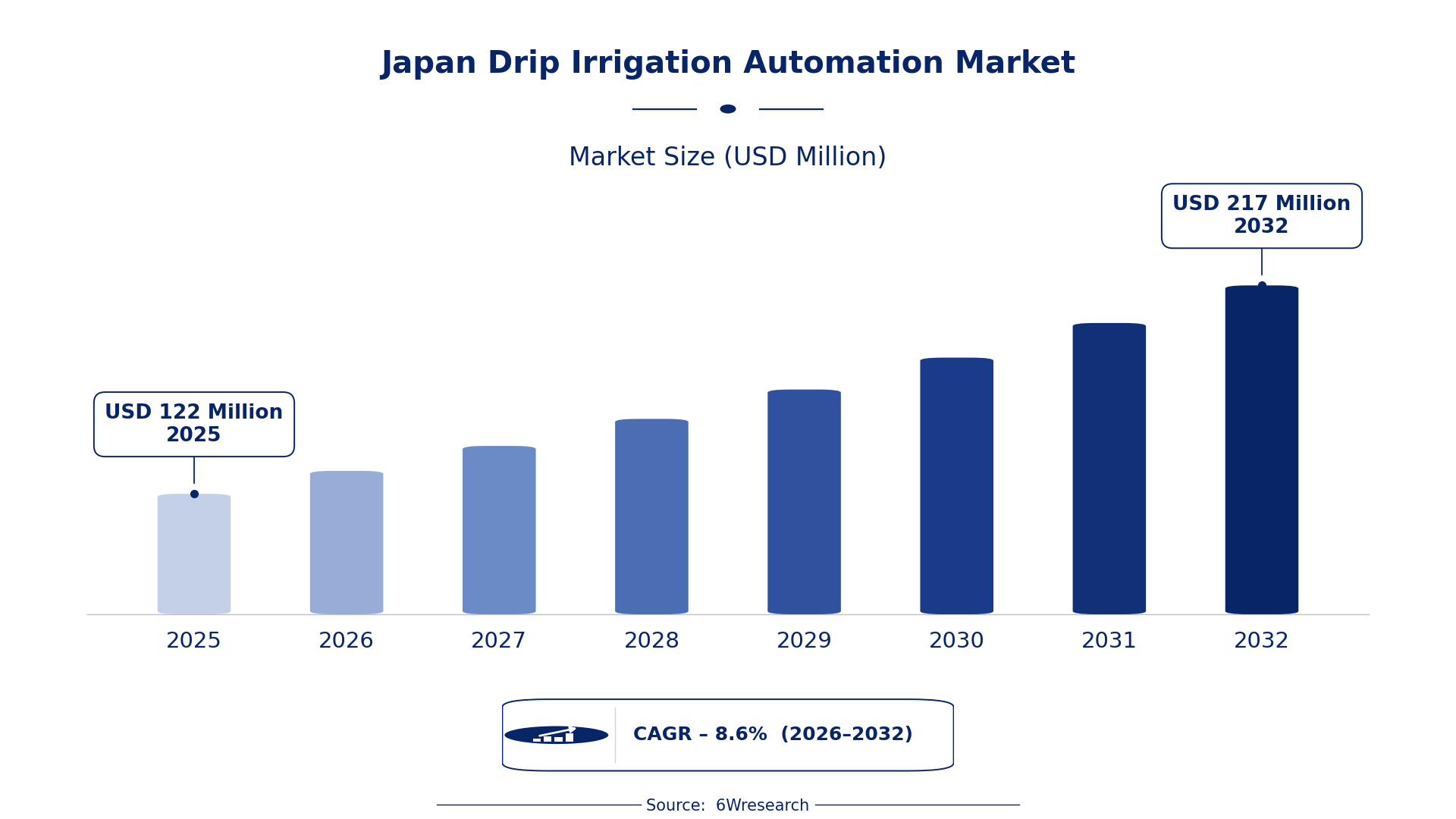
According to 6Wresearch internal database and industry insights, the Japan Drip Irrigation Automation Market was valued at USD 122 Million in 2025 and is projected to reach USD 217 Million by 2032, growing at a CAGR of approximately 8.6% during 2026–2032.
Japan Drip Irrigation Automation Market Highlights
| Report Metric | Details |
| Report Name | Japan Drip Irrigation Automation Market (2026-2032) |
| Market Size 2025 | USD 122 Million |
| Market Size 2032 | USD 217 Million |
| Absolute Growth 2025–2032 | USD 95 Million |
| CAGR 2026–2032 | 8.6% |
| Peak Annual Growth | 9.4% in 2028 |
| Forecast Period | 2026–2032 |
| Historical Data | 2022–2025 |
| Base Year | 2025 |
| Leading System Type, 2025 | Drip Control Valves (36% share) |
| Leading Sensor Integration, 2025 | Soil Moisture Sensors (34% share) |
| Leading Automation Level, 2025 | Fully Automated (32% share) |
| Leading End User, 2025 | Commercial Farms (44% share) |
| Fastest-Growing System Type | Timer-Based Systems (12.4% CAGR) |
| Fastest-Growing Sensor Integration | Manual Overrides (11.7% CAGR) |
| Fastest-Growing Automation Level | Semi-Automated (11.5% CAGR) |
| Fastest-Growing End User | Greenhouses (11.3% CAGR) |
| Growing Sector | commercial agriculture |
| Key End Users | commercial farms, greenhouses, AgriTech companies, horticulture growers |
Japan Drip Irrigation Automation Market Year-wise Growth Rate and Key Drivers (2022–2032)
This graph illustrates the annual growth rates of the market from 2022 to 2032, highlighting a steady upward trajectory and projected market expansion over the forecast period.
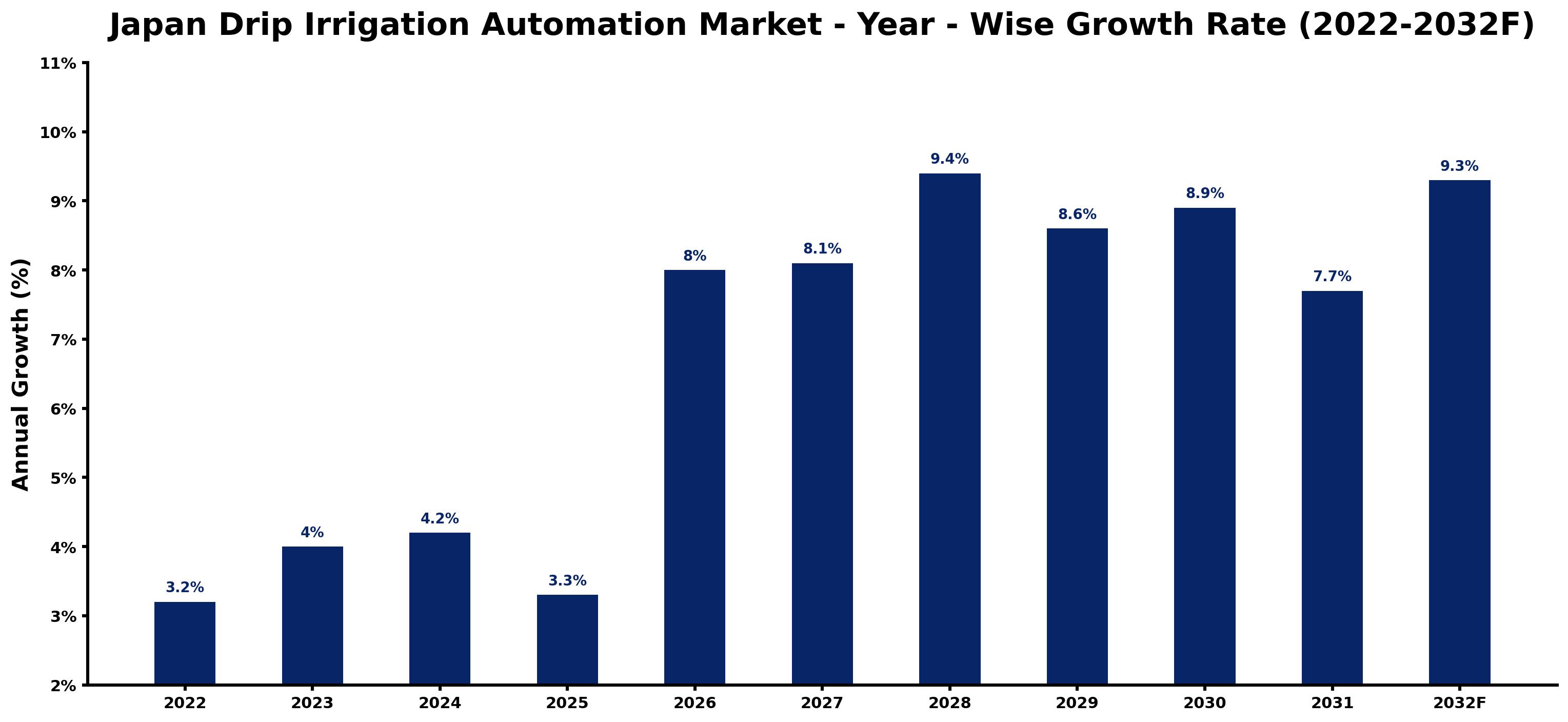
For each year, the table pairs the estimated growth rate with the leading influence on demand, showing how the drivers changed across the period.
| Year | Estimated Annual Growth (%) | Market Rationale |
| 2022 | 3.2 | The agricultural sector showed steady demand for irrigation solutions in this year. |
| 2023 | 4.0 | Increased adoption of smart irrigation technologies boosted market growth. |
| 2024 | 4.2 | The market continued to expand as more farms implemented advanced systems. |
| 2025 | 3.3 | Growth slowed due to market saturation among early adopters of technology. |
| 2026 | 8.0 | Rising investments in smart farming technologies is expected to accelerate demand. |
| 2027 | 8.1 | The trend of improving water efficiency in agriculture will further drive growth. |
| 2028 | 9.4 | Peak growth occurred as automation technologies gained widespread acceptance. |
| 2029 | 8.6 | Growth is projected to slow slightly as the market matures and competition increases. |
| 2030 | 8.9 | Demand is expected to rise again with new innovations in irrigation technology. |
| 2031 | 7.7 | The market is projected to continue growing as sustainability practices gain traction. |
| 2032 | 9.3 | Growth is expected to remain strong due to ongoing technological advancements in irrigation. |
Note: Market size estimations and growth projections presented in this report are based on 6Wresearch's proprietary forecasting methodology, utilizing the latest available industry data, government publications, and primary research inputs.
Japan Drip Irrigation Automation Market Synopsis
Drip irrigation automation utilises technology to optimise water delivery in agriculture, integrating sensors and control systems to improve efficiency and reduce labour costs. The Japan Drip Irrigation Automation Market is growing, driven by the agricultural sector's value of approximately 4 trillion yen, with notable demand from commercial farms and greenhouses. The push for sustainable practices and government support for water-saving technologies are creating new demand, as over 30% of commercial farms adopted smart irrigation solutions by 2022.
Market Dynamics Impact Analysis (2026–2032)
| Factor | Type | Impact | Primary Segment Affected |
| Rising adoption of smart irrigation technologies | Driver | High | Smart Controllers |
| Increased focus on sustainable agricultural practices | Driver | High | Soil Moisture Sensors |
| Growing public and private investment in decarbonisation | Opportunity | High | AgriTech Companies |
| Expansion of urban agriculture initiatives | Opportunity | Medium | Commercial Farms |
| High initial investment costs for advanced systems | Restraint | High | Fully Automated |
| Limited awareness among smaller farms about automation benefits | Restraint | Medium | Semi-Automated |
| Compliance with stringent quality standards | Challenge | High | Flow Regulators |
| Capacity constraints in local manufacturing of irrigation systems | Challenge | Medium | Timer-Based Systems |
Evaluation of Drivers in Japan Drip Irrigation Automation Market (2026–2032)
The following drivers explain most of the expected growth.
| Drivers | Primary Segment Affected | Why It Matters (Evidence) |
| Increased efficiency in water usage | Smart Controllers | Over 30% of commercial farms adopted smart irrigation technologies, leading to higher demand for smart controllers. |
| Focus on sustainable practices | Soil Moisture Sensors | Soil moisture sensors are used in over 50% of greenhouse operations, improving water management and driving purchases. |
| Investment in smart farming technologies | AgriTech Companies | Projected investments of 10 billion yen by AgriTech companies by 2025 will drive demand for automation and related technologies. |
| Government support for water-saving technologies | Commercial Farms | The Ministry of Agriculture promotes water-saving technologies, encouraging adoption among farmers and increasing market activity. |
| Rising urban agriculture initiatives | Fully Automated | The Tokyo Metropolitan area is seeing increased use of automated irrigation systems in urban farms, boosting demand. |
Several shifts outside the market lift sales. In 2022, over 30% of commercial farms adopted smart irrigation technologies, improving efficiency and increasing purchases of smart controllers. The promotion of water-saving technologies has further driven demand, especially for soil moisture sensors, which are now used in over 50% of greenhouse operations. Investments in smart farming technologies are projected to reach 10 billion yen by 2025, stimulating growth in automation.
Evaluation of Restraints in Japan Drip Irrigation Automation Market
The following restraints limit how fast demand can grow.
| Market Restraint | Primary Segment Affected | Why It Matters (Evidence) |
| High initial investment costs for advanced systems | Fully Automated | The cost of implementing fully automated systems can deter smaller farms from adopting new technologies. |
| Limited awareness among smaller farms | Semi-Automated | Many smaller farms lack knowledge about the benefits of semi-automated systems, hindering market growth. |
| Compliance with stringent quality standards | Flow Regulators | Producers must adhere to JIS standards, which can increase production costs and time, impacting pricing strategies. |
| Capacity constraints in local manufacturing | Timer-Based Systems | Limited local manufacturing capacity can delay the availability of timer-based systems for buyers, affecting project timelines. |
| Market saturation among early adopters | Smart Controllers | As early adopters reach saturation, growth in this segment may slow down, limiting new customer acquisition. |
Japan Drip Irrigation Automation Market Challenges
Over 30% of commercial farms adopted smart irrigation technologies, yet competition from traditional irrigation methods limits broader implementation, delaying efficiency improvements for producers. Rising costs, linked to a national minimum wage increase to JPY 1,055 per hour, squeeze budgets and reduce profit margins for farmers. Supply chain issues in sourcing quality components lead to longer installation times, impacting producers' readiness to implement new systems. Buyers face challenges justifying investments in automation, as the average size of commercial farms using drip irrigation is around 5 hectares, making it difficult for smaller operations to afford upgrades.
Trends in the Japan Drip Irrigation Automation Market
Below are the shifts with the largest effect on the Japan Drip Irrigation Automation Market.
- Rise of Smart Agriculture Promotion Project: The 'Smart Agriculture Promotion Project' aims to improve efficiency in water use by 20% by 2025, encouraging more farms to adopt automated systems. This initiative is expected to boost the market for irrigation technologies.
- Shift towards IoT-enabled irrigation systems: Japan is transitioning towards IoT-enabled irrigation systems, with an expected adoption rate of 40% by 2025. This change allows for better data analysis and remote management, benefiting commercial farms and greenhouses.
- Increase in urban agriculture: Urban agriculture is expanding in the Tokyo Metropolitan area, with automated irrigation systems becoming more common. This trend is driven by the need for efficient water use in limited spaces, supporting local food production.
- Growing use of soil moisture sensors: The use of soil moisture sensors has increased, with over 50% of greenhouse operations now employing this technology. This shift improves precise irrigation control, leading to better crop yields.
Investment Opportunities in the Japan Drip Irrigation Automation Market
The following opportunities in the Japan Drip Irrigation Automation Market pair current demand with a clear way in.
- Tokyo Metropolitan area: Urban agriculture in the Tokyo Metropolitan area presents an opportunity for automated irrigation suppliers, with a growing demand for efficient systems as urban farming expands and seeks to optimise water use.
- Investment in smart farming technologies: With projected investments of 10 billion yen by AgriTech companies by 2025, there is a strong opportunity for suppliers of smart irrigation technologies to meet this growing demand for automation.
- Expansion of commercial farms: The average size of commercial farms using drip irrigation is around 5 hectares, indicating a market gap for suppliers to provide advanced irrigation solutions tailored to these operations.
- Growing greenhouse sector: The greenhouse sector is rapidly adopting advanced irrigation technologies, with over 30% of operations implementing smart systems, creating a demand for effective irrigation solutions.
Government Initiatives in the Japan Drip Irrigation Automation Market
The Green Growth Strategy Through Achieving Carbon Neutrality in 2050, updated in 2021, reinforces the commitment to sustainable agriculture. This strategy encourages the adoption of water-saving technologies, creating a supportive framework for drip irrigation automation and its buyers, ensuring compliance with environmental goals.
The Japan Agricultural Cooperatives Association implements initiatives that promote water-saving technologies among commercial farms. This support aids farmers in adopting advanced irrigation systems, ensuring compliance with sustainability goals and enhancing operational efficiency.
Future Insight of the Japan Drip Irrigation Automation Market
The integration of soil moisture sensors will transform demand by 2032, as these technologies enhance water management. The 'Smart Agriculture Promotion Project' aims for a 20% improvement in water use efficiency, benefiting both buyers and suppliers. By 2032, the total installed base of smart controllers is projected to reach 100,000 units, streamlining irrigation processes. Increased investment in sustainable practices will further promote the adoption of automated solutions across the agricultural sector.
Market Segmentation Analysis
Japan Drip Irrigation Automation Market report covers a detailed analysis of the following market segments:
By System Type – Drip Control Valves Lead, Timer-Based Systems Expected to Grow Fastest
According to Saurav Kr Singh, Senior Research Analyst at 6Wresearch, the largest system type category in 2025 was Drip Control Valves, at 36% of revenue. Drip Control Valves hold the largest share because they are vital for regulating water flow in drip systems, which is essential for efficient irrigation practices. Their widespread application in the Tohoku region's rice cultivation underscores their importance in optimising agricultural water management. The quickest growth will come from Timer-Based Systems, forecast to expand at a CAGR of 12.4% between 2026 and 2032. Timer-Based Systems are experiencing rapid growth as they enable farmers to effectively schedule irrigation, which is crucial for optimising water usage. The 25% increase in programmable irrigation systems over the last three years indicates a clear shift towards this efficient technology. Suppliers should focus on developing Timer-Based Systems to meet the rising demand for efficient irrigation solutions.
By Sensor Integration – Soil Moisture Sensors Lead, Manual Overrides Expected to Grow Fastest
Soil Moisture Sensors accounted for 34% of the market by sensor integration in 2025. Soil Moisture Sensors lead the segment as they provide critical data for precise irrigation control, allowing farmers to manage water usage effectively. Their integration in over 50% of greenhouse operations highlights their essential role in modern agricultural practices. Over 2026–2032, Manual Overrides are expected to post the fastest growth, at a CAGR of 11.7%. Manual Overrides are growing quickly as they allow farmers to manually intervene when necessary, complementing automated irrigation systems. This trend reflects an increasing desire for control in irrigation management among farmers. Buyers should consider adding Manual Overrides to improve flexibility and responsiveness in their irrigation strategies.
By Automation Level – Fully Automated Leads, Semi-Automated Expected to Grow Fastest
Fully Automated held 32% of the Japan Drip Irrigation Automation Market by automation level in 2025. Fully Automated systems hold the largest share as they represent the pinnacle of efficiency in irrigation management, allowing for minimal human intervention. Their implementation in commercial farms showcases a commitment to maximising productivity and resource conservation. Semi-Automated is projected to grow fastest, at a CAGR of 11.5% during 2026–2032. Semi-Automated systems are growing rapidly as they provide a balance between automation and manual control, appealing to farmers who desire flexibility. This trend is supported by the increasing adoption of smart technologies in agriculture. Suppliers should consider developing Semi-Automated solutions to cater to the evolving preferences of farmers seeking a mix of automation and control.
By End User – Commercial Farms Lead, Greenhouses Expected to Grow Fastest
Commercial Farms took 44% of end user revenue in 2025, more than any other category. Commercial Farms are the primary users of advanced irrigation systems, largely due to their need for efficient water management in large-scale agricultural operations. The agricultural sector's valuation at approximately 4 trillion yen illustrates the importance of these farms in driving market demand. Greenhouses are set to record the highest CAGR in this split, 11.3% over 2026–2032. Greenhouses are witnessing the fastest growth as they rely heavily on precise irrigation for optimal crop yield, making them key adopters of advanced irrigation technologies. Their commitment to sustainable practices further accelerates the adoption of modern systems. Suppliers should develop tailored solutions for Greenhouses to address their specific irrigation needs and enhance overall crop productivity.
Key Attractiveness of the Report
- 10 Years of Market Numbers
- Historical Data Starting from 2022 to 2025
- Base Year 2025
- Forecast Data until 2032
- Key Performance Indicators Impacting the Market
- Major Upcoming Developments and Projects
Key Highlights of the Report:
- Japan Drip Irrigation Automation Market Outlook
- Market Size of Japan Drip Irrigation Automation Market, 2025
- Forecast of Japan Drip Irrigation Automation Market, 2032
- Historical Data and Forecast of Japan Drip Irrigation Automation Revenues & Volume for the Period 2022-2032F
- Japan Drip Irrigation Automation Market Trend Evolution
- Japan Drip Irrigation Automation Market Drivers and Challenges
- Japan Drip Irrigation Automation Price Trends
- Japan Drip Irrigation Automation Porter's Five Forces
- Japan Drip Irrigation Automation Industry Life Cycle
- Historical Data and Forecast of Japan Drip Irrigation Automation Market Revenues & Volume By System Type for the Period 2022-2032F
- Historical Data and Forecast of Japan Drip Irrigation Automation Market Revenues & Volume By Drip Control Valves for the Period 2022-2032F
- Historical Data and Forecast of Japan Drip Irrigation Automation Market Revenues & Volume By Timer-Based Systems for the Period 2022-2032F
- Historical Data and Forecast of Japan Drip Irrigation Automation Market Revenues & Volume By Smart Controllers for the Period 2022-2032F
- Historical Data and Forecast of Japan Drip Irrigation Automation Market Revenues & Volume By Flow Regulators for the Period 2022-2032F
- Historical Data and Forecast of Japan Drip Irrigation Automation Market Revenues & Volume By Sensor Integration for the Period 2022-2032F
- Historical Data and Forecast of Japan Drip Irrigation Automation Market Revenues & Volume By Soil Moisture Sensors for the Period 2022-2032F
- Historical Data and Forecast of Japan Drip Irrigation Automation Market Revenues & Volume By Manual Overrides for the Period 2022-2032F
- Historical Data and Forecast of Japan Drip Irrigation Automation Market Revenues & Volume By IoT Enabled for the Period 2022-2032F
- Historical Data and Forecast of Japan Drip Irrigation Automation Market Revenues & Volume By Inline Sensors for the Period 2022-2032F
- Historical Data and Forecast of Japan Drip Irrigation Automation Market Revenues & Volume By Automation Level for the Period 2022-2032F
- Historical Data and Forecast of Japan Drip Irrigation Automation Market Revenues & Volume By Fully Automated for the Period 2022-2032F
- Historical Data and Forecast of Japan Drip Irrigation Automation Market Revenues & Volume By Semi-Automated for the Period 2022-2032F
- Historical Data and Forecast of Japan Drip Irrigation Automation Market Revenues & Volume By Cloud Managed for the Period 2022-2032F
- Historical Data and Forecast of Japan Drip Irrigation Automation Market Revenues & Volume By Programmable for the Period 2022-2032F
- Historical Data and Forecast of Japan Drip Irrigation Automation Market Revenues & Volume By End User for the Period 2022-2032F
- Historical Data and Forecast of Japan Drip Irrigation Automation Market Revenues & Volume By Commercial Farms for the Period 2022-2032F
- Historical Data and Forecast of Japan Drip Irrigation Automation Market Revenues & Volume By Greenhouses for the Period 2022-2032F
- Historical Data and Forecast of Japan Drip Irrigation Automation Market Revenues & Volume By AgriTech Companies for the Period 2022-2032F
- Historical Data and Forecast of Japan Drip Irrigation Automation Market Revenues & Volume By Horticulture Growers for the Period 2022-2032F
- Japan Drip Irrigation Automation Import Export Trade Statistics
- Market Opportunity Assessment By System Type
- Market Opportunity Assessment By Sensor Integration
- Market Opportunity Assessment By Automation Level
- Market Opportunity Assessment By End User
- Japan Drip Irrigation Automation Top Companies Market Share
- Japan Drip Irrigation Automation Competitive Benchmarking By Technical and Operational Parameters
- Japan Drip Irrigation Automation Company Profiles
- Japan Drip Irrigation Automation Key Strategic Recommendations
Market Covered
This report examines the market across the segments below.
By System Type
- Drip Control Valves
- Timer-Based Systems
- Smart Controllers
- Flow Regulators
By Sensor Integration
- Soil Moisture Sensors
- Manual Overrides
- IoT Enabled
- Inline Sensors
By Automation Level
- Fully Automated
- Semi-Automated
- Cloud Managed
- Programmable
By End User
- Commercial Farms
- Greenhouses
- AgriTech Companies
- Horticulture Growers






































