Japan Drip Irrigation Equipment Market Size & Growth Rate
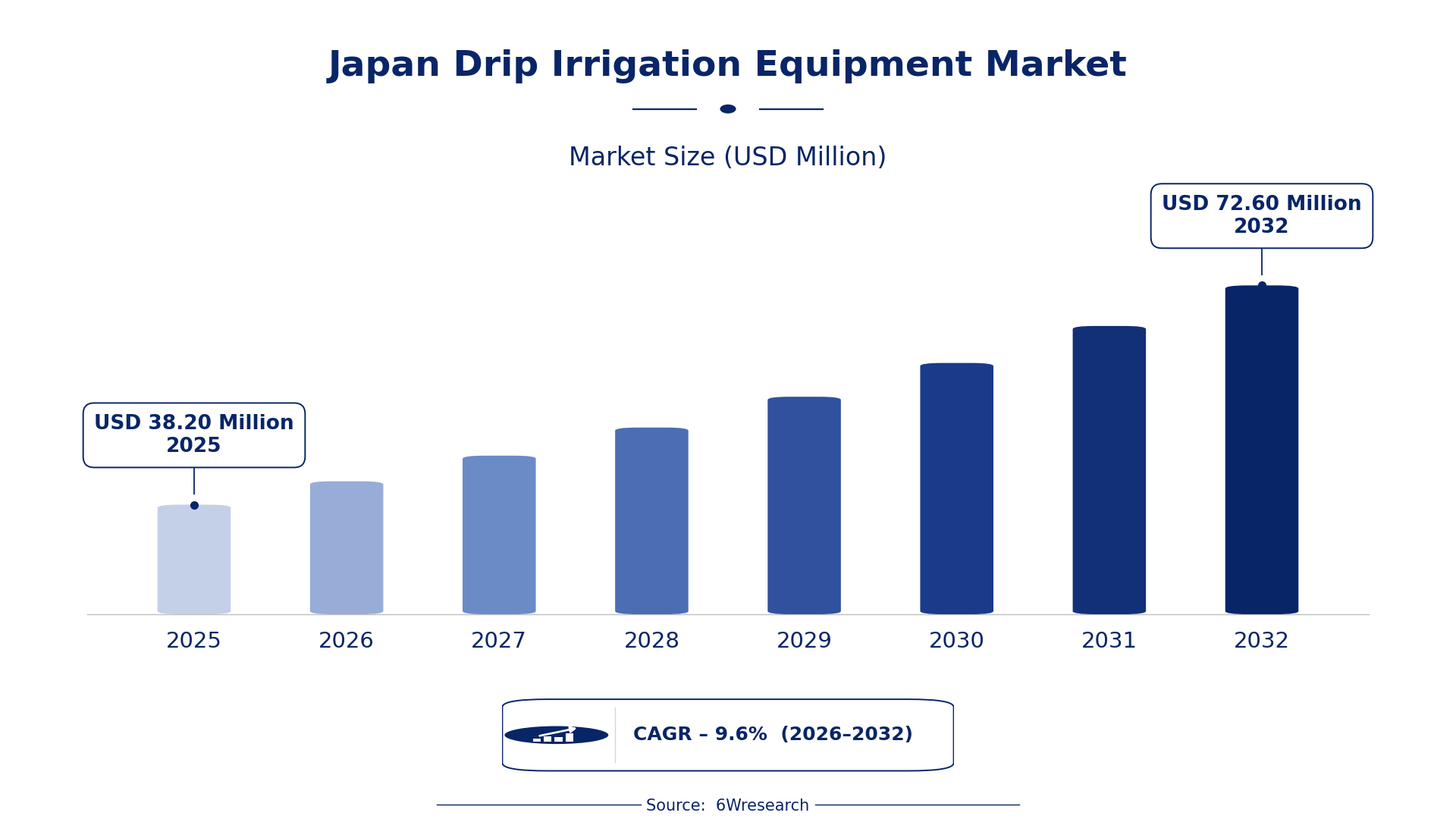
According to 6Wresearch internal database and industry insights, the Japan Drip Irrigation Equipment Market was valued at USD 38.20 Million in 2025 and is projected to reach USD 72.60 Million by 2032, growing at a CAGR of approximately 9.6% during 2026–2032.
Japan Drip Irrigation Equipment Market Highlights
| Report Metric | Details |
| Report Name | Japan Drip Irrigation Equipment Market (2026-2032) |
| Market Size 2025 | USD 38.20 Million |
| Market Size 2032 | USD 72.60 Million |
| Absolute Growth 2025–2032 | USD 34.40 Million |
| CAGR 2026–2032 | 9.6% |
| Peak Annual Growth | 10.5% in 2032 |
| Forecast Period | 2026–2032 |
| Historical Data | 2022–2025 |
| Base Year | 2025 |
| Leading Equipment Type, 2025 | Emitters (41% share) |
| Leading Material Used, 2025 | Plastic (49% share) |
| Leading Automation Level, 2025 | Manual (47% share) |
| Leading End User, 2025 | Small Farmers (49% share) |
| Fastest-Growing Equipment Type | Tubing (13.3% CAGR) |
| Fastest-Growing Material Used | Polyethylene (13.6% CAGR) |
| Fastest-Growing Automation Level | Semi-Automated (13.0% CAGR) |
| Fastest-Growing End User | Commercial Farms (12.7% CAGR) |
| Growing Sector | Commercial Farms |
| Key End Users | Small Farmers, Commercial Farms, Greenhouses, AgriTech Integrators |
Japan Drip Irrigation Equipment Market Year-wise Growth Rate and Key Drivers (2022–2032)
This graph illustrates the annual growth rates of the market from 2022 to 2032, highlighting a steady upward trajectory and projected market expansion over the forecast period.
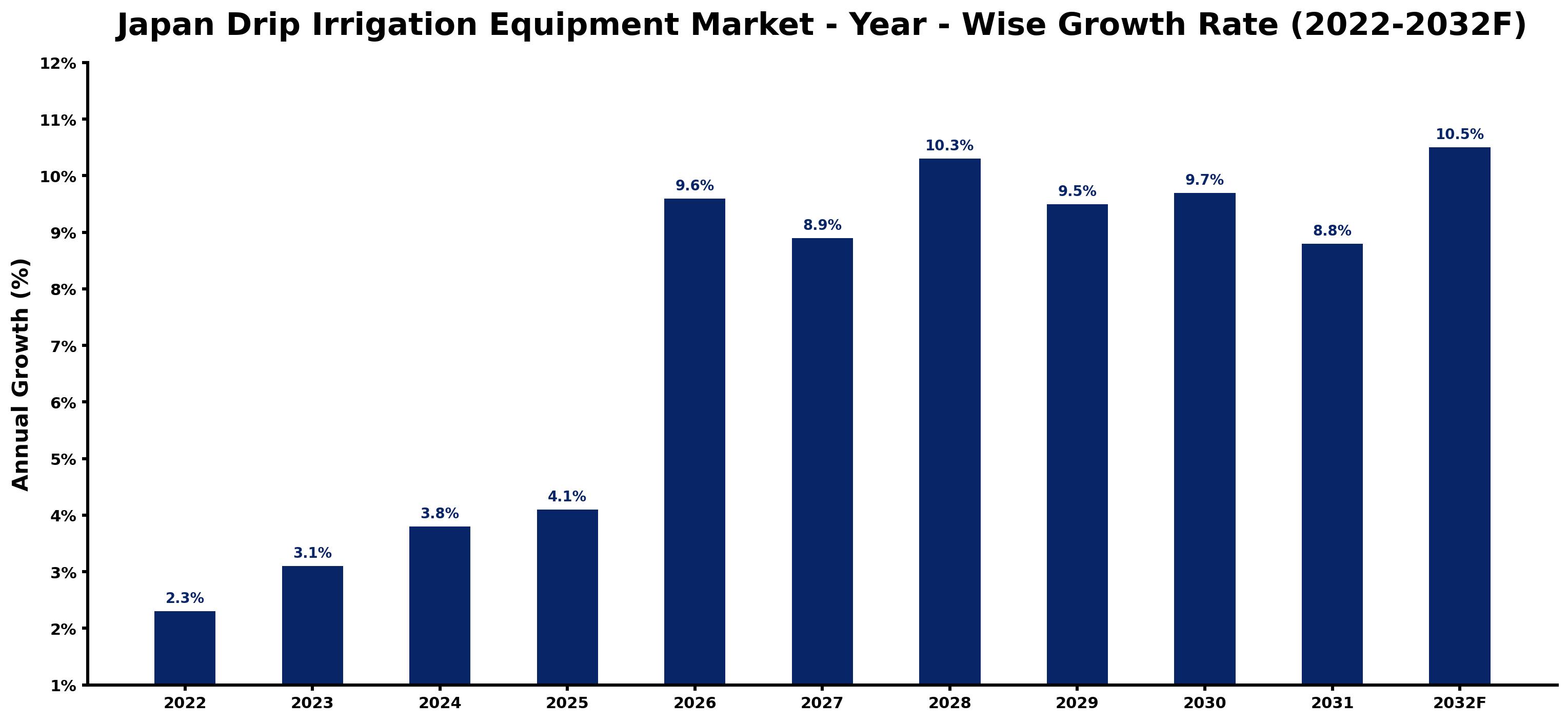
Year by year, the estimates below pair each growth rate with the development that shaped it.
| Year | Estimated Annual Growth (%) | Market Rationale |
| 2022 | 2.3 | The agricultural sector maintained steady operations with existing irrigation methods. |
| 2023 | 3.1 | Increased awareness of water conservation drove higher adoption of efficient irrigation solutions. |
| 2024 | 3.8 | Advancements in technology encouraged farmers to invest in modern irrigation systems. |
| 2025 | 4.1 | Growing emphasis on sustainable practices led to increased drip irrigation usage. |
| 2026 | 9.6 | The introduction of new agricultural initiatives is expected to stimulate demand for advanced irrigation technologies. |
| 2027 | 8.9 | A slight slowdown occurred as market saturation began in some regions. |
| 2028 | 10.3 | Rising crop yields prompted farmers to improve irrigation efficiency further. |
| 2029 | 9.5 | Demand remained strong but showed signs of normalisation in growth rates. |
| 2030 | 9.7 | Technological improvements in automation spurred renewed interest in irrigation systems. |
| 2031 | 8.8 | Market growth is expected to slow as competition intensifies among suppliers. |
| 2032 | 10.5 | The peak growth year is driven by a surge in automated irrigation adoption. |
Note: Market size estimations and growth projections presented in this report are based on 6Wresearch's proprietary forecasting methodology, utilizing the latest available industry data, government publications, and primary research inputs.
Japan Drip Irrigation Equipment Market Synopsis
Drip irrigation equipment delivers water directly to plant roots through a network of tubing and emitters, significantly reducing water waste. The Japan Drip Irrigation Equipment Market is expanding, driven by approximately 1.5 million small farms and a growing emphasis on sustainable agricultural practices. This trend is supported by government initiatives promoting water-saving technologies, with the Ministry of Agriculture, Forestry and Fisheries allocating ¥10 billion in 2023 for agricultural modernization, while advancements in automation and sensor-based systems are further improving efficiency in commercial farms.
Market Dynamics Impact Analysis (2026–2032)
| Factor | Type | Impact | Primary Segment Affected |
| Rising adoption of water-saving technologies | Driver | High | Emitters |
| Increased focus on sustainable agriculture | Driver | High | Emitters |
| Growing demand for efficient irrigation solutions | Opportunity | High | Emitters |
| Expansion of commercial farming operations | Opportunity | High | Emitters |
| Limited awareness among small farmers | Restraint | Medium | Small Farmers |
| High initial investment costs for advanced systems | Restraint | Medium | Emitters |
| Competition from traditional irrigation methods | Challenge | Medium | Emitters |
| Technological barriers in rural areas | Challenge | Medium | Emitters |
Evaluation of Drivers in Japan Drip Irrigation Equipment Market (2026–2032)
These are the developments adding the most demand over the forecast period.
| Drivers | Primary Segment Affected | Why It Matters (Evidence) |
| Increased crop yields due to better irrigation | Emitters | Drip irrigation can reduce water usage by up to 30%, prompting farmers to adopt it for higher efficiency. |
| Government initiatives promoting water conservation | Emitters | The Ministry of Agriculture, Forestry and Fisheries allocated ¥10 billion in 2023, leading to increased purchases. |
| Growing interest in automated irrigation systems | Emitters | The use of automated systems is rising in commercial farms, attracting more buyers. |
| Rising awareness of sustainable practices | Emitters | Farmers are increasingly adopting sustainable methods to meet consumer preferences, driving drip irrigation sales. |
| Technological advancements in irrigation equipment | Emitters | New technologies are making drip systems more accessible and efficient, attracting more buyers. |
Several shifts outside the market lift sales. The agricultural sector's focus on sustainable practices has led to a growing demand for drip irrigation equipment, with Japan's agricultural sector accounting for approximately 1.1% of GDP. The use of automated irrigation systems is rising, particularly in commercial farms, as they improve operational efficiency. The introduction of water-saving technologies is prompting farmers to invest in more efficient irrigation solutions, improving overall productivity.
Evaluation of Restraints in Japan Drip Irrigation Equipment Market
These are the pressures that could keep growth below its potential.
| Market Restraint | Primary Segment Affected | Why It Matters (Evidence) |
| Limited awareness of drip irrigation benefits among small farmers | Small Farmers | Many small farmers are unaware of the advantages of drip systems, limiting their adoption. |
| High initial investment costs for advanced systems | Small Farmers | The cost of installing drip irrigation can deter small farmers from making the switch. |
| Competition from traditional irrigation methods | Emitters | Traditional methods account for over 60% of irrigation practices, making it challenging for drip systems to gain market share. |
| Technological barriers in rural areas | Emitters | Limited access to technology in rural regions affects the adoption of advanced irrigation solutions. |
| Inconsistent government support across regions | Emitters | Variability in government initiatives can affect the availability of funding for irrigation systems. |
Japan Drip Irrigation Equipment Market Challenges
Producers face high labour costs due to Japan's minimum wage increase to JPY 1,055 per hour, which reduces profit margins for farmers. Compliance with JIS standards leads to additional regulatory burdens, causing delays in product availability and increasing expenses for distributors. Limited adoption of advanced irrigation technology results in inefficient water usage, raising operational costs for buyers, particularly impacting small farms. Buyers encounter challenges with the upfront investment for drip irrigation systems, which can reach up to ¥500,000, creating barriers for those with an average farm size of 1.5 hectares.
Trends in the Japan Drip Irrigation Equipment Market
Several trends are reshaping the Japan Drip Irrigation Equipment Market; the most important are set out below.
- Shift towards Automation in Irrigation: Since 2023, there has been a notable shift towards automated irrigation systems in Japan, particularly in commercial farms. This transition is driven by the need for efficiency, with automated systems increasing in use, covering over 20,000 hectares of greenhouse cultivation.
- Emergence of Sensor-Based Irrigation: In 2025, sensor-based irrigation technology began gaining traction in Japan, allowing for precision watering. This innovation is projected to enhance water management, with a significant portion of the agricultural sector adopting these systems.
- Growing Focus on Water Conservation: From 2022, the emphasis on water conservation in agriculture has intensified, leading to increased adoption of drip irrigation. The Ministry of Agriculture, Forestry and Fisheries has been instrumental in promoting water-saving technologies across the sector.
- Expansion of Agricultural Modernization Initiatives: In 2023, agricultural modernization initiatives received a funding boost of ¥10 billion, aimed at improving irrigation practices. This funding is expected to increase the adoption of efficient irrigation systems among farmers.
Investment Opportunities in the Japan Drip Irrigation Equipment Market
Several openings in the Japan Drip Irrigation Equipment Market merit attention from investors.
- Joint Ventures with Local Farmers: Partnering with local farmers in the Tohoku region can facilitate the introduction of advanced drip irrigation systems, addressing the need for modern solutions. This area is known for its agricultural practices, with significant funding available.
- Investment in Automated Systems: Commercial farms are seeking automated irrigation solutions, with a market gap of approximately 30% in adoption rates. Investing in sensor-based technologies can meet this demand effectively.
- Expansion into Greenhouse Cultivation: Greenhouses covering over 20,000 hectares present a prime opportunity for drip irrigation suppliers. Focusing on this segment can lead to substantial growth, given the increasing demand for efficient systems.
- Certification for Quality Standards: Obtaining JIS certification can enhance market entry for new drip irrigation products. This standard is essential for ensuring quality and gaining trust among Japanese farmers.
Government Initiatives in the Japan Drip Irrigation Equipment Market
The Industrial Standardization Act (1949; amended and renamed in 2019) governs JIS product and test standards, ensuring that irrigation equipment meets quality requirements. This law adds a layer of assurance for buyers, promoting confidence in the products they purchase.
The Ministry of Agriculture, Forestry and Fisheries oversees agricultural modernization initiatives, allocating ¥10 billion in 2023 to support the adoption of water-saving technologies. This funding helps farmers access advanced irrigation systems, improving their operational efficiency.
Future Insight of the Japan Drip Irrigation Equipment Market
Automated irrigation systems will reshape demand by 2032, enhancing efficiency and minimising water consumption. The government's commitment to allocate ¥10 billion for agricultural modernization will drive advancements in irrigation technology. Increased focus on water-saving technologies will motivate more farmers to adopt drip irrigation, which can reduce water usage by up to 30%. Support for AgriTech initiatives will promote the integration of modern practices, creating opportunities for both buyers and suppliers.
Market Segmentation Analysis
Japan Drip Irrigation Equipment Market report covers a detailed analysis of the following market segments:
By Equipment Type – Emitters Lead, Tubing Expected to Grow Fastest
According to Saurav Kr Singh, Senior Research Analyst at 6Wresearch, Emitters held 41% of the Japan Drip Irrigation Equipment Market by equipment type in 2025. Emitters dominate the market as they are vital for delivering water directly to plant roots, making them indispensable in drip irrigation systems. Their extensive application in various agricultural settings, particularly in the Tohoku region, solidifies their leading position. Over 2026–2032, Tubing is expected to post the fastest growth, at a CAGR of 13.3%. The tubing segment is growing swiftly as it serves as the primary distribution system for water, increasingly favoured in modern agricultural practices. With the government's allocation of ¥10 billion for agricultural modernization, the demand for effective water delivery systems is projected to surge. Suppliers should prioritise developing their tubing products to cater to the rising demand from contemporary agricultural practices.
By Material Used – Plastic Leads, Polyethylene Expected to Grow Fastest
In 2025, Plastic led the material used split with a 49% share. Plastic is the primary material in drip irrigation equipment, widely utilised for its durability and cost-effectiveness in various components. Its essential role in efficient irrigation systems is underscored by its extensive application across Japan's agricultural sector. Polyethylene is set to record the highest CAGR in this split, 13.6% over 2026–2032. Polyethylene is witnessing the highest growth rate due to its flexibility and suitability for tubing, making it a preferred choice among farmers. The emphasis on water-saving technologies is further increasing the demand for polyethylene in irrigation systems. Suppliers should focus on offering more polyethylene-based products to meet the growing demand for efficient irrigation solutions.
By Automation Level – Manual Leads, Semi-Automated Expected to Grow Fastest
Manual accounted for 47% of the market by automation level in 2025. Manual systems dominate the market as many small farmers still operate traditional irrigation methods, reflecting the agricultural practices prevalent in rural areas. The reliance on manual systems indicates a slower transition to advanced technologies among smaller operations. The quickest growth will come from Semi-Automated, forecast to expand at a CAGR of 13.0% between 2026 and 2032. Semi-automated systems are growing quickly as they offer a balance between manual control and technological efficiency, appealing to modern farms looking to optimise water usage. The increasing adoption of such systems suggests a shift towards more efficient irrigation practices. Suppliers should consider developing semi-automated solutions to cater to the evolving needs of farmers seeking efficiency.
By End User – Small Farmers Lead, Commercial Farms Expected to Grow Fastest
The largest end user category in 2025 was Small Farmers, at 49% of revenue. Small farmers constitute the largest user group in Japan's drip irrigation market, employing these systems to boost productivity on their limited land. Their substantial presence, with approximately 1.5 million small farms, highlights the necessity of addressing this demographic's needs. Commercial Farms are projected to grow fastest, at a CAGR of 12.7% during 2026–2032. Commercial farms are the fastest-growing segment as they increasingly implement advanced irrigation systems for large-scale operations, motivated by the pursuit of efficiency and productivity. The ongoing trend towards agricultural modernisation is driving this segment's rapid expansion. Suppliers should customise their offerings to meet the specific requirements of commercial farms, which are emerging as key players in the market.
Key Attractiveness of the Report
- 10 Years of Market Numbers
- Historical Data Starting from 2022 to 2025
- Base Year 2025
- Forecast Data until 2032
- Key Performance Indicators Impacting the Market
- Major Upcoming Developments and Projects
Key Highlights of the Report:
- Japan Drip Irrigation Equipment Market Outlook
- Market Size of Japan Drip Irrigation Equipment Market, 2025
- Forecast of Japan Drip Irrigation Equipment Market, 2032
- Historical Data and Forecast of Japan Drip Irrigation Equipment Revenues & Volume for the Period 2022-2032F
- Japan Drip Irrigation Equipment Market Trend Evolution
- Japan Drip Irrigation Equipment Market Drivers and Challenges
- Japan Drip Irrigation Equipment Price Trends
- Japan Drip Irrigation Equipment Porter's Five Forces
- Japan Drip Irrigation Equipment Industry Life Cycle
- Historical Data and Forecast of Japan Drip Irrigation Equipment Market Revenues & Volume By Equipment Type for the Period 2022-2032F
- Historical Data and Forecast of Japan Drip Irrigation Equipment Market Revenues & Volume By Emitters for the Period 2022-2032F
- Historical Data and Forecast of Japan Drip Irrigation Equipment Market Revenues & Volume By Tubing for the Period 2022-2032F
- Historical Data and Forecast of Japan Drip Irrigation Equipment Market Revenues & Volume By Filters for the Period 2022-2032F
- Historical Data and Forecast of Japan Drip Irrigation Equipment Market Revenues & Volume By Pressure Regulators for the Period 2022-2032F
- Historical Data and Forecast of Japan Drip Irrigation Equipment Market Revenues & Volume By Material Used for the Period 2022-2032F
- Historical Data and Forecast of Japan Drip Irrigation Equipment Market Revenues & Volume By Plastic for the Period 2022-2032F
- Historical Data and Forecast of Japan Drip Irrigation Equipment Market Revenues & Volume By Polyethylene for the Period 2022-2032F
- Historical Data and Forecast of Japan Drip Irrigation Equipment Market Revenues & Volume By Stainless Steel for the Period 2022-2032F
- Historical Data and Forecast of Japan Drip Irrigation Equipment Market Revenues & Volume By PVC for the Period 2022-2032F
- Historical Data and Forecast of Japan Drip Irrigation Equipment Market Revenues & Volume By Automation Level for the Period 2022-2032F
- Historical Data and Forecast of Japan Drip Irrigation Equipment Market Revenues & Volume By Manual for the Period 2022-2032F
- Historical Data and Forecast of Japan Drip Irrigation Equipment Market Revenues & Volume By Semi-Automated for the Period 2022-2032F
- Historical Data and Forecast of Japan Drip Irrigation Equipment Market Revenues & Volume By Fully Automated for the Period 2022-2032F
- Historical Data and Forecast of Japan Drip Irrigation Equipment Market Revenues & Volume By Sensor-Based for the Period 2022-2032F
- Historical Data and Forecast of Japan Drip Irrigation Equipment Market Revenues & Volume By End User for the Period 2022-2032F
- Historical Data and Forecast of Japan Drip Irrigation Equipment Market Revenues & Volume By Small Farmers for the Period 2022-2032F
- Historical Data and Forecast of Japan Drip Irrigation Equipment Market Revenues & Volume By Commercial Farms for the Period 2022-2032F
- Historical Data and Forecast of Japan Drip Irrigation Equipment Market Revenues & Volume By Greenhouses for the Period 2022-2032F
- Historical Data and Forecast of Japan Drip Irrigation Equipment Market Revenues & Volume By AgriTech Integrators for the Period 2022-2032F
- Japan Drip Irrigation Equipment Import Export Trade Statistics
- Market Opportunity Assessment By Equipment Type
- Market Opportunity Assessment By Material Used
- Market Opportunity Assessment By Automation Level
- Market Opportunity Assessment By End User
- Japan Drip Irrigation Equipment Top Companies Market Share
- Japan Drip Irrigation Equipment Competitive Benchmarking By Technical and Operational Parameters
- Japan Drip Irrigation Equipment Company Profiles
- Japan Drip Irrigation Equipment Key Strategic Recommendations
Market Covered
Coverage by segment is as follows.
By Equipment Type
- Emitters
- Tubing
- Filters
- Pressure Regulators
By Material Used
- Plastic
- Polyethylene
- Stainless Steel
- PVC
By Automation Level
- Manual
- Semi-Automated
- Fully Automated
- Sensor-Based
By End User
- Small Farmers
- Commercial Farms
- Greenhouses
- AgriTech Integrators






































