Japan Driverless Farm Equipment Market Size & Growth Rate
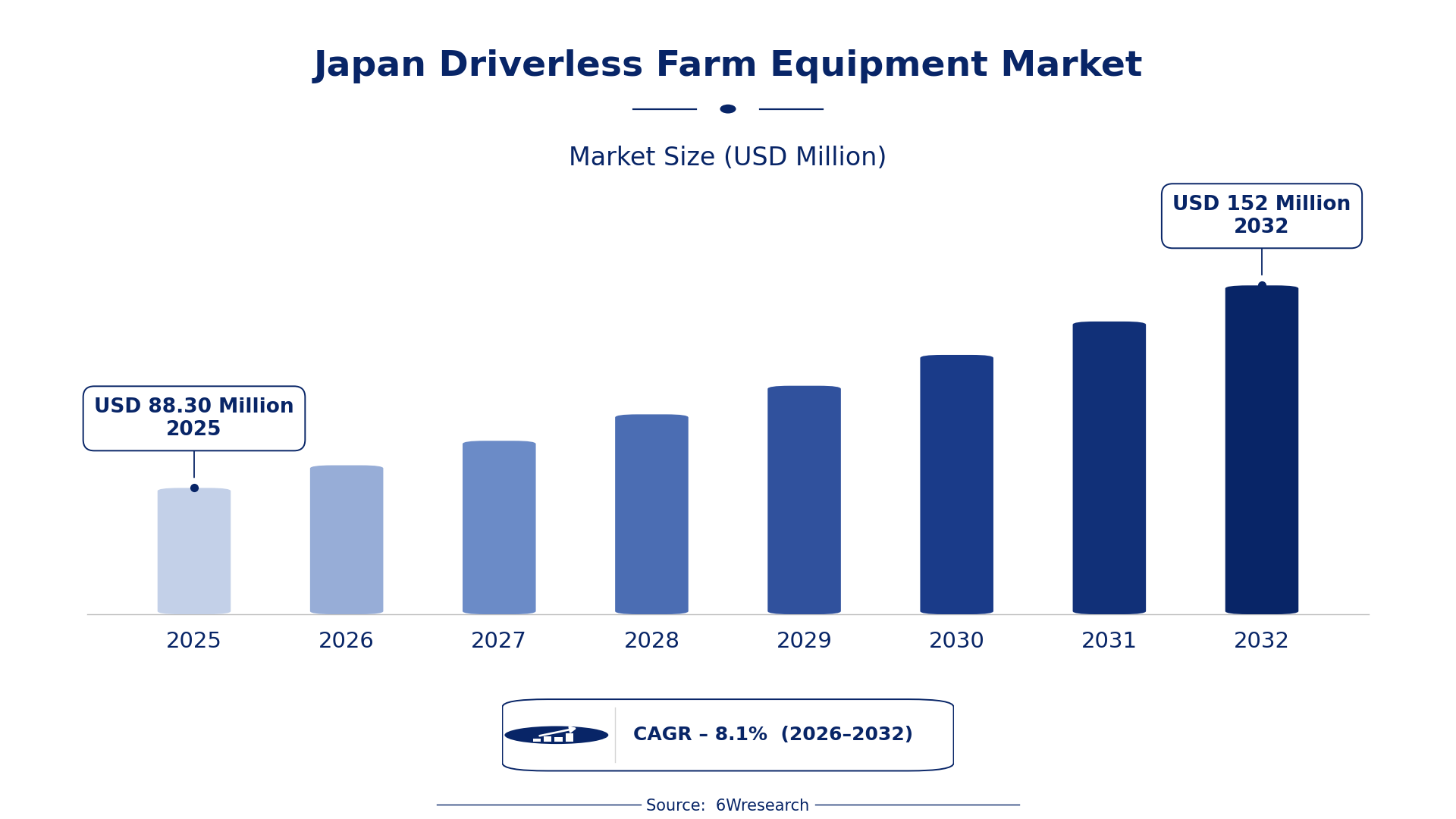
According to 6Wresearch internal database and industry insights, the Japan Driverless Farm Equipment Market was valued at USD 88.30 Million in 2025 and is projected to reach USD 152 Million by 2032, growing at a CAGR of approximately 8.1% during 2026–2032.
Japan Driverless Farm Equipment Market Highlights
| Report Metric | Details |
| Report Name | Japan Driverless Farm Equipment Market (2026-2032) |
| Market Size 2025 | USD 88.30 Million |
| Market Size 2032 | USD 152 Million |
| Absolute Growth 2025–2032 | USD 63.70 Million |
| CAGR 2026–2032 | 8.1% |
| Peak Annual Growth | 9.4% in 2026 |
| Forecast Period | 2026–2032 |
| Historical Data | 2022–2025 |
| Base Year | 2025 |
| Leading Equipment Type, 2025 | Autonomous Tractors (50% share) |
| Leading Navigation System, 2025 | GPS-Based (37% share) |
| Leading Power Source, 2025 | Diesel (38% share) |
| Leading End User, 2025 | Large-Scale Farms (44% share) |
| Fastest-Growing Equipment Type | Robotic Harvesters (11.5% CAGR) |
| Fastest-Growing Navigation System | LiDAR + Vision (11.6% CAGR) |
| Fastest-Growing Power Source | Electric (11.8% CAGR) |
| Fastest-Growing End User | Agricultural Cooperatives (10.6% CAGR) |
| Growing Sector | Agriculture |
| Key End Users | Large-Scale Farms, Agricultural Cooperatives, Precision Farming Firms, Agribusiness Companies |
Japan Driverless Farm Equipment Market Year-wise Growth Rate and Key Drivers (2022–2032)
This graph illustrates the annual growth rates of the market from 2022 to 2032, highlighting a steady upward trajectory and projected market expansion over the forecast period.
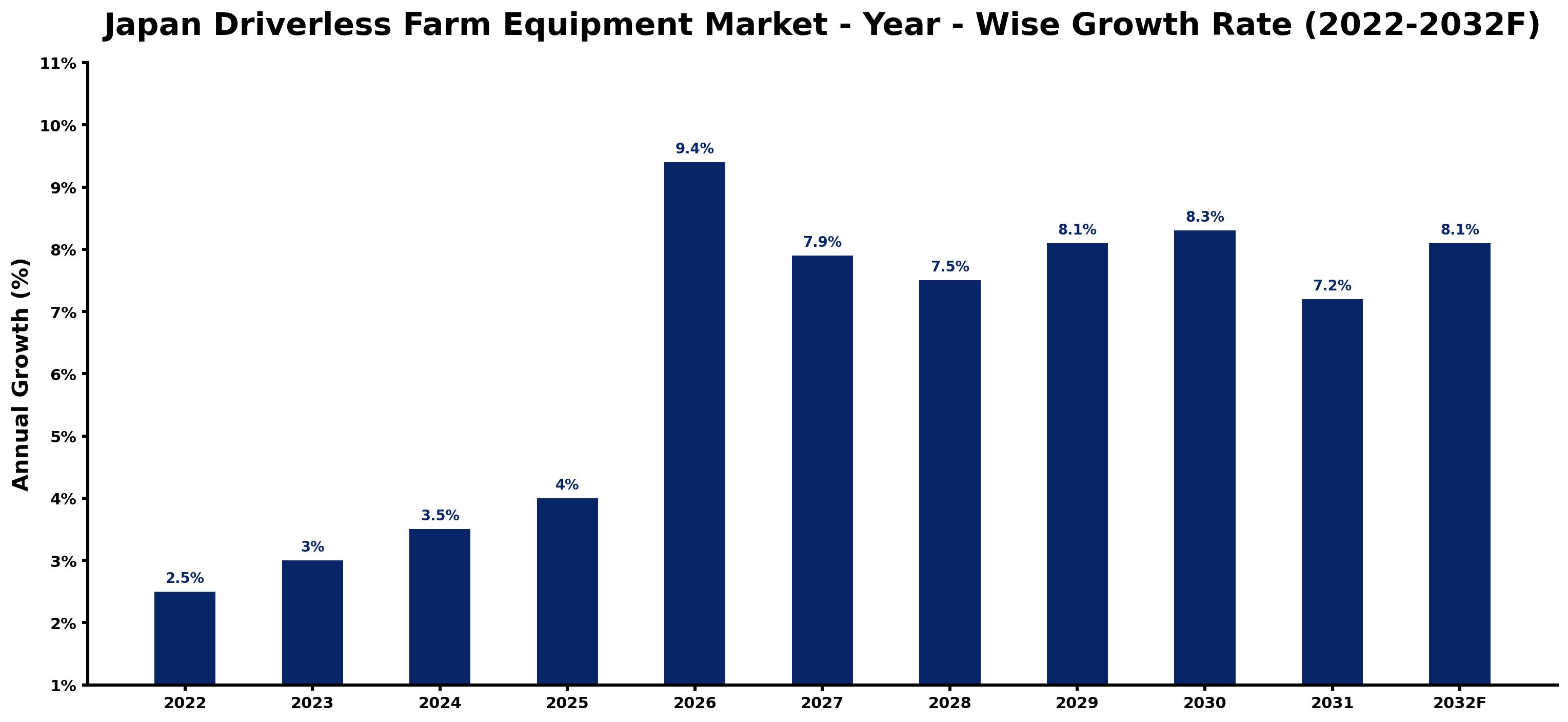
Each row of the following table gives one year's estimated growth and the event or demand shift that explains it.
| Year | Estimated Annual Growth (%) | Market Rationale |
| 2022 | 2.5 | Japan's agricultural sector showed steady activity with increasing interest in automation. |
| 2023 | 3.0 | The adoption of precision farming technologies accelerated, attracting more investments. |
| 2024 | 3.5 | Technological advancements in robotics and AI led to improved efficiency in farming. |
| 2025 | 4.0 | A notable increase in large-scale farms adopting driverless equipment was observed. |
| 2026 | 9.4 | The market is expected to experience growth due to rising investments in agricultural technology. |
| 2027 | 7.9 | Adoption rates are projected to slow slightly as the market adjusts to new technologies. |
| 2028 | 7.5 | Continued interest in automation is expected to keep demand stable despite slower growth. |
| 2029 | 8.1 | Technological improvements are projected to drive renewed interest in driverless farm equipment. |
| 2030 | 8.3 | Investment in sustainable farming practices will support further growth in the market. |
| 2031 | 7.2 | The market growth rate is expected to slow as the sector matures and competition increases. |
| 2032 | 8.1 | Technological advancements are projected to sustain demand for driverless equipment. |
Note: Market size estimations and growth projections presented in this report are based on 6Wresearch's proprietary forecasting methodology, utilizing the latest available industry data, government publications, and primary research inputs.
Japan Driverless Farm Equipment Market Synopsis
Driverless farm equipment refers to autonomous machines such as tractors and harvesters that improve efficiency in agriculture through advanced navigation systems. The Japan Driverless Farm Equipment Market is valued at approximately ¥9 trillion, with strong demand from large-scale farms and agricultural cooperatives. Growth is driven by increased investments in technology, evidenced by a 15% rise in precision farming adoption in 2023, alongside a government allocation of ¥5 billion for agricultural technology development, indicating promising future potential.
Market Dynamics Impact Analysis (2026–2032)
| Factor | Type | Impact | Primary Segment Affected |
| Rising investments in agricultural technology | Driver | High | Autonomous Tractors |
| Growing number of large-scale farms | Driver | High | Robotic Harvesters |
| Increased demand for sustainable farming solutions | Opportunity | Medium | Electric |
| Expansion of agricultural cooperatives facilitating technology access | Opportunity | Medium | Agricultural Cooperatives |
| High initial costs of driverless equipment | Restraint | High | Autonomous Seeders |
| Limited awareness among smaller farms about automation benefits | Restraint | Medium | Driverless Sprayers |
| Technological integration challenges faced by farmers | Challenge | High | GPS-Based |
| Dependence on skilled technicians for maintenance and operation | Challenge | Medium | LiDAR + Vision |
Evaluation of Drivers in Japan Driverless Farm Equipment Market (2026–2032)
Below are the drivers that matter most for revenue growth, with supporting evidence.
| Drivers | Primary Segment Affected | Why It Matters (Evidence) |
| Increased investment in AI and robotics | Robotic Harvesters | This investment leads to greater automation capabilities, allowing farms to increase productivity and reduce labour costs by up to 20%. |
| Expansion of large-scale farms | Autonomous Tractors | As the number of large-scale farms grows, demand for efficient farming solutions, such as autonomous tractors, rises, with over 100,000 farms in Japan. |
| Government support for agricultural technology | Electric | The government allocated ¥5 billion for agricultural technology development, encouraging farmers to adopt electric-powered equipment, improving sustainability. |
| Rising interest in precision farming | Driverless Sprayers | The 15% increase in precision farming adoption in 2023 drives demand for advanced spraying technologies, enhancing crop management efficiency. |
| Technological advancements in navigation systems | GPS-Based | Improvements in GPS technology enhance the accuracy and efficiency of driverless farm equipment, leading to a 25% increase in operational effectiveness. |
What keeps demand rising is the heightened investment in AI and robotics, which boosts automation capabilities in farming. In 2023, a 15% increase in precision farming adoption spurred demand for advanced equipment. The expansion of large-scale farms, now exceeding 100,000 in Japan, further fuels this need for efficient solutions. Improved navigation systems also contribute, enhancing the operational accuracy of driverless farm machines.
Evaluation of Restraints in Japan Driverless Farm Equipment Market
The table below lists the restraints and the evidence behind each.
| Market Restraint | Primary Segment Affected | Why It Matters (Evidence) |
| High initial costs of driverless equipment | Autonomous Seeders | The high upfront investment required for autonomous seeders limits adoption among smaller farms. |
| Limited awareness of automation benefits | Driverless Sprayers | Many smaller farms lack knowledge about the advantages of driverless technology, hindering market growth. |
| Technological integration challenges | GPS-Based | Farmers face difficulties in integrating advanced technologies into existing operations, slowing down adoption. In 2023, 30% of farmers reported these challenges. |
| Dependence on skilled technicians | LiDAR + Vision | The need for skilled technicians for maintenance and operation can deter investment in advanced equipment, with 40% of farms reporting this issue. |
| Regulatory compliance costs | Electric | Meeting safety and environmental regulations can increase operational costs for electric-powered farm equipment, with compliance costs rising by 15%. |
Japan Driverless Farm Equipment Market Challenges
Large-scale farms face challenges due to a shortage of skilled operators for driverless farm equipment, as training programmes struggle to keep pace with technological advancements. This skills gap limits the adoption of autonomous machines, costing these farms up to 15% in potential efficiency gains. Suppliers encounter rising production costs as Japan's minimum wage increases to JPY 1,055 per hour, which can inflate prices for buyers. Supply chain disruptions arise from reliance on specific components, delaying equipment availability and impacting agricultural cooperatives that depend on timely access to machinery. Buyers hesitate to invest in new technology because of high initial costs, which can hinder large-scale farms from modernising their operations.
Trends in the Japan Driverless Farm Equipment Market
Four trends stand out in the Japan Driverless Farm Equipment Market.
- Shift from Traditional to Autonomous Farming: Since 2023, the shift towards autonomous farming is occurring, particularly in the Tohoku region, where large-scale farms are adopting driverless equipment. This transition aligns with a 15% increase in precision farming adoption.
- Emergence of Electric-Powered Equipment: In 2023, electric-powered farm equipment gained traction, with projections indicating a 20% growth by 2025. This trend highlights the agricultural sector's move towards sustainability and reduced emissions.
- Increasing Adoption of AI in Agriculture: The use of AI in agriculture is becoming more prevalent, leading to improved decision-making in farming tasks. This trend is expected to grow as farmers seek efficiency.
- Expansion of Agricultural Cooperatives: Agricultural cooperatives are expanding, with over 1,200 in Japan facilitating shared access to technology. This growth supports the adoption of advanced farming solutions among smaller farms.
Investment Opportunities in the Japan Driverless Farm Equipment Market
Investors looking at the Japan Driverless Farm Equipment Market should consider the following areas.
- Large-Scale Farms Seeking Efficiency: Large-scale farms in Japan are increasingly looking for efficient farming solutions, with over 100,000 farms in the country. Investing in driverless equipment can meet this demand for productivity.
- Supply of Electric-Powered Equipment: With electric-powered farm equipment projected to grow by 20% by 2025, suppliers can focus on providing sustainable solutions. This opportunity is particularly relevant for agricultural cooperatives.
- Partnerships with Agricultural Cooperatives: Collaborating with agricultural cooperatives can facilitate market entry for technology providers, allowing access to a broader customer base. These cooperatives are vital in supporting technology adoption.
- Investment in Precision Farming Solutions: Investing in precision farming technologies is essential, especially in regions like Tohoku, where innovation is thriving. This investment can cater to the growing demand for data-driven agriculture.
Government Initiatives in the Japan Driverless Farm Equipment Market
The Industrial Safety and Health Act of 1972 mandates employer responsibilities regarding hazardous substances and machinery, ensuring safety standards in agricultural equipment. This law influences producers to adhere to safety protocols, ultimately benefiting buyers through safer products. The Act on the Rational Use of Energy, established in 1979, requires large energy users to improve efficiency, impacting the energy consumption of agricultural machinery.
In 2023, the government allocated ¥5 billion for agricultural technology development, administered by the Ministry of Agriculture, Forestry and Fisheries. This funding supports projects aimed at improving the efficiency and sustainability of agricultural practices, benefiting producers and buyers by promoting advanced technologies.
Future Insight of the Japan Driverless Farm Equipment Market
The emergence of advanced navigation systems will reshape demand for driverless farm equipment by 2032, driven by a projected 20% growth in electric-powered machinery by 2025. The JIS Z 1001 standard will improve safety and reliability, prompting more buyers to invest in autonomous technology. Government funding of ¥5 billion for agricultural technology development will stimulate innovation and improve equipment offerings. A national goal to reduce agricultural emissions by 30% by 2030 will further encourage the adoption of eco-friendly practices in the sector.
Market Segmentation Analysis
Japan Driverless Farm Equipment Market report covers a detailed analysis of the following market segments:
By Equipment Type – Autonomous Tractors Lead, Robotic Harvesters Expected to Grow Fastest
According to Saurav Kr Singh, Senior Research Analyst at 6Wresearch, Autonomous Tractors accounted for 50% of the market by equipment type in 2025. Autonomous Tractors hold the largest share due to their widespread application in efficient plowing and planting, particularly in large-scale farms. Their success is backed by a strong installed base, which is crucial for meeting the demands of over 100,000 large-scale farms in Japan. The quickest growth will come from Robotic Harvesters, forecast to expand at a CAGR of 11.5% between 2026 and 2032. Robotic Harvesters are experiencing rapid growth as they fulfil the pressing need for automated crop harvesting, effectively addressing labour shortages in the agricultural sector. The 15% increase in precision farming adoption in 2023 is a key factor driving this segment's expansion. Suppliers must focus on enhancing robotic harvester capabilities to align with the increasing market demand.
By Navigation System – GPS-Based Leads, LiDAR + Vision Expected to Grow Fastest
GPS-Based took 37% of navigation system revenue in 2025, more than any other category. GPS-Based systems dominate the market as they are essential for navigation and positioning, particularly in large-scale farming operations. Their reliability and accuracy have made them the preferred choice among farmers across Japan. LiDAR + Vision is projected to grow fastest, at a CAGR of 11.6% during 2026–2032. LiDAR + Vision technology is the fastest-growing segment because it provides real-time environmental mapping, which is increasingly vital for precision agriculture. The ongoing advancements in agricultural technology development, with a government allocation of ¥5 billion, support this growth. Buyers should consider investing in LiDAR + Vision systems to stay competitive in precision agriculture.
By Power Source – Diesel Leads, Electric Expected to Grow Fastest
With 38% of power source revenue in 2025, Diesel was the largest category. Diesel remains the leading power source for farm machines due to its established efficiency and reliability in traditional farming operations. This dominance is reflected in the widespread use of diesel-powered equipment across Japan's agricultural sector. Electric is set to record the highest CAGR in this split, 11.8% over 2026–2032. Electric power sources are set to grow rapidly as they become increasingly popular for sustainable operations, aligning with national goals for reducing agricultural emissions. This trend indicates a shift towards more eco-friendly farming practices. Suppliers need to adapt their offerings to cater to the growing demand for electric-powered equipment.
By End User – Large-Scale Farms Lead, Agricultural Cooperatives Expected to Grow Fastest
The largest end user category in 2025 was Large-Scale Farms, at 44% of revenue. Large-Scale Farms dominate the market as they are the primary users of advanced farming technologies, utilising these tools to boost efficiency and productivity. With an average size of around 50 hectares, these farms require sophisticated equipment to manage their extensive operations effectively. Over 2026–2032, Agricultural Cooperatives are expected to post the fastest growth, at a CAGR of 10.6%. Agricultural Cooperatives are the fastest-growing segment as they provide shared access to technology, which significantly improves operational efficiency for farmers. The existence of over 1,200 cooperatives in Japan plays a crucial role in facilitating this growth. Suppliers should engage with agricultural cooperatives to enhance their market reach and effectiveness.
Key Attractiveness of the Report
- 10 Years of Market Numbers
- Historical Data Starting from 2022 to 2025
- Base Year 2025
- Forecast Data until 2032
- Key Performance Indicators Impacting the Market
- Major Upcoming Developments and Projects
Key Highlights of the Report:
- Japan Driverless Farm Equipment Market Outlook
- Market Size of Japan Driverless Farm Equipment Market, 2025
- Forecast of Japan Driverless Farm Equipment Market, 2032
- Historical Data and Forecast of Japan Driverless Farm Equipment Revenues & Volume for the Period 2022-2032F
- Japan Driverless Farm Equipment Market Trend Evolution
- Japan Driverless Farm Equipment Market Drivers and Challenges
- Japan Driverless Farm Equipment Price Trends
- Japan Driverless Farm Equipment Porter's Five Forces
- Japan Driverless Farm Equipment Industry Life Cycle
- Historical Data and Forecast of Japan Driverless Farm Equipment Market Revenues & Volume By Equipment Type for the Period 2022-2032F
- Historical Data and Forecast of Japan Driverless Farm Equipment Market Revenues & Volume By Autonomous Tractors for the Period 2022-2032F
- Historical Data and Forecast of Japan Driverless Farm Equipment Market Revenues & Volume By Robotic Harvesters for the Period 2022-2032F
- Historical Data and Forecast of Japan Driverless Farm Equipment Market Revenues & Volume By Autonomous Seeders for the Period 2022-2032F
- Historical Data and Forecast of Japan Driverless Farm Equipment Market Revenues & Volume By Driverless Sprayers for the Period 2022-2032F
- Historical Data and Forecast of Japan Driverless Farm Equipment Market Revenues & Volume By Navigation System for the Period 2022-2032F
- Historical Data and Forecast of Japan Driverless Farm Equipment Market Revenues & Volume By GPS-Based for the Period 2022-2032F
- Historical Data and Forecast of Japan Driverless Farm Equipment Market Revenues & Volume By LiDAR + Vision for the Period 2022-2032F
- Historical Data and Forecast of Japan Driverless Farm Equipment Market Revenues & Volume By RTK Positioning for the Period 2022-2032F
- Historical Data and Forecast of Japan Driverless Farm Equipment Market Revenues & Volume By AI-Guided for the Period 2022-2032F
- Historical Data and Forecast of Japan Driverless Farm Equipment Market Revenues & Volume By Power Source for the Period 2022-2032F
- Historical Data and Forecast of Japan Driverless Farm Equipment Market Revenues & Volume By Diesel for the Period 2022-2032F
- Historical Data and Forecast of Japan Driverless Farm Equipment Market Revenues & Volume By Electric for the Period 2022-2032F
- Historical Data and Forecast of Japan Driverless Farm Equipment Market Revenues & Volume By Solar for the Period 2022-2032F
- Historical Data and Forecast of Japan Driverless Farm Equipment Market Revenues & Volume By Hybrid for the Period 2022-2032F
- Historical Data and Forecast of Japan Driverless Farm Equipment Market Revenues & Volume By End User for the Period 2022-2032F
- Historical Data and Forecast of Japan Driverless Farm Equipment Market Revenues & Volume By Large-Scale Farms for the Period 2022-2032F
- Historical Data and Forecast of Japan Driverless Farm Equipment Market Revenues & Volume By Agricultural Cooperatives for the Period 2022-2032F
- Historical Data and Forecast of Japan Driverless Farm Equipment Market Revenues & Volume By Precision Farming Firms for the Period 2022-2032F
- Historical Data and Forecast of Japan Driverless Farm Equipment Market Revenues & Volume By Agribusiness Companies for the Period 2022-2032F
- Japan Driverless Farm Equipment Import Export Trade Statistics
- Market Opportunity Assessment By Equipment Type
- Market Opportunity Assessment By Navigation System
- Market Opportunity Assessment By Power Source
- Market Opportunity Assessment By End User
- Japan Driverless Farm Equipment Top Companies Market Share
- Japan Driverless Farm Equipment Competitive Benchmarking By Technical and Operational Parameters
- Japan Driverless Farm Equipment Company Profiles
- Japan Driverless Farm Equipment Key Strategic Recommendations
Market Covered
The report covers the following segments.
By Equipment Type
- Autonomous Tractors
- Robotic Harvesters
- Autonomous Seeders
- Driverless Sprayers
By Navigation System
- GPS-Based
- LiDAR + Vision
- RTK Positioning
- AI-Guided
By Power Source
- Diesel
- Electric
- Solar
- Hybrid
By End User
- Large-Scale Farms
- Agricultural Cooperatives
- Precision Farming Firms
- Agribusiness Companies






































