Japan Drone-Based Crop Monitoring Market Size & Growth Rate
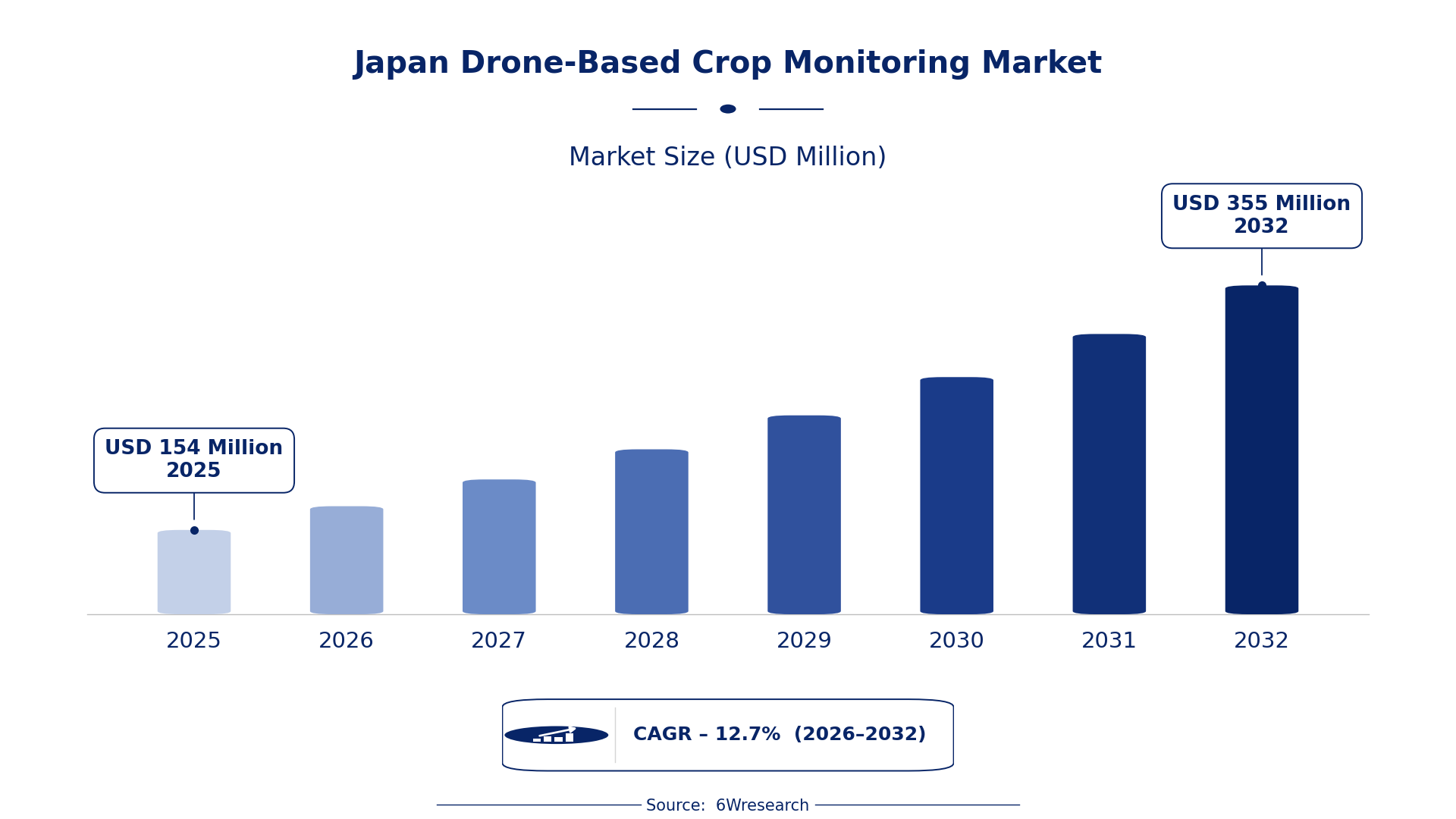
According to 6Wresearch internal database and industry insights, the Japan Drone-Based Crop Monitoring Market was valued at USD 154 Million in 2025 and is projected to reach USD 355 Million by 2032, growing at a CAGR of approximately 12.7% during 2026–2032.
Japan Drone-Based Crop Monitoring Market Highlights
| Report Metric | Details |
| Report Name | Japan Drone-Based Crop Monitoring Market (2026-2032) |
| Market Size 2025 | USD 154 Million |
| Market Size 2032 | USD 355 Million |
| Absolute Growth 2025–2032 | USD 201 Million |
| CAGR 2026–2032 | 12.7% |
| Peak Annual Growth | 13.3% in 2028 |
| Forecast Period | 2026–2032 |
| Historical Data | 2022–2025 |
| Base Year | 2025 |
| Leading Monitoring Type, 2025 | NDVI Analysis (45% share) |
| Leading Imaging Sensor, 2025 | Multispectral Camera (44% share) |
| Leading Crop Type, 2025 | Cereal Crops (33% share) |
| Leading End User, 2025 | Commercial Farmers (34% share) |
| Fastest-Growing Monitoring Type | Soil Moisture Mapping (17.3% CAGR) |
| Fastest-Growing Imaging Sensor | AI + Imaging (16.9% CAGR) |
| Fastest-Growing Crop Type | Fruits & Vegetables (17.6% CAGR) |
| Fastest-Growing End User | Smart Farming Firms (16.6% CAGR) |
| Growing Sector | Agricultural Technology |
| Key End Users | Commercial Farmers, Smart Farming Firms, Agri Consultants |
Japan Drone-Based Crop Monitoring Market Year-wise Growth Rate and Key Drivers (2022–2032)
This graph illustrates the annual growth rates of the market from 2022 to 2032, highlighting a steady upward trajectory and projected market expansion over the forecast period.
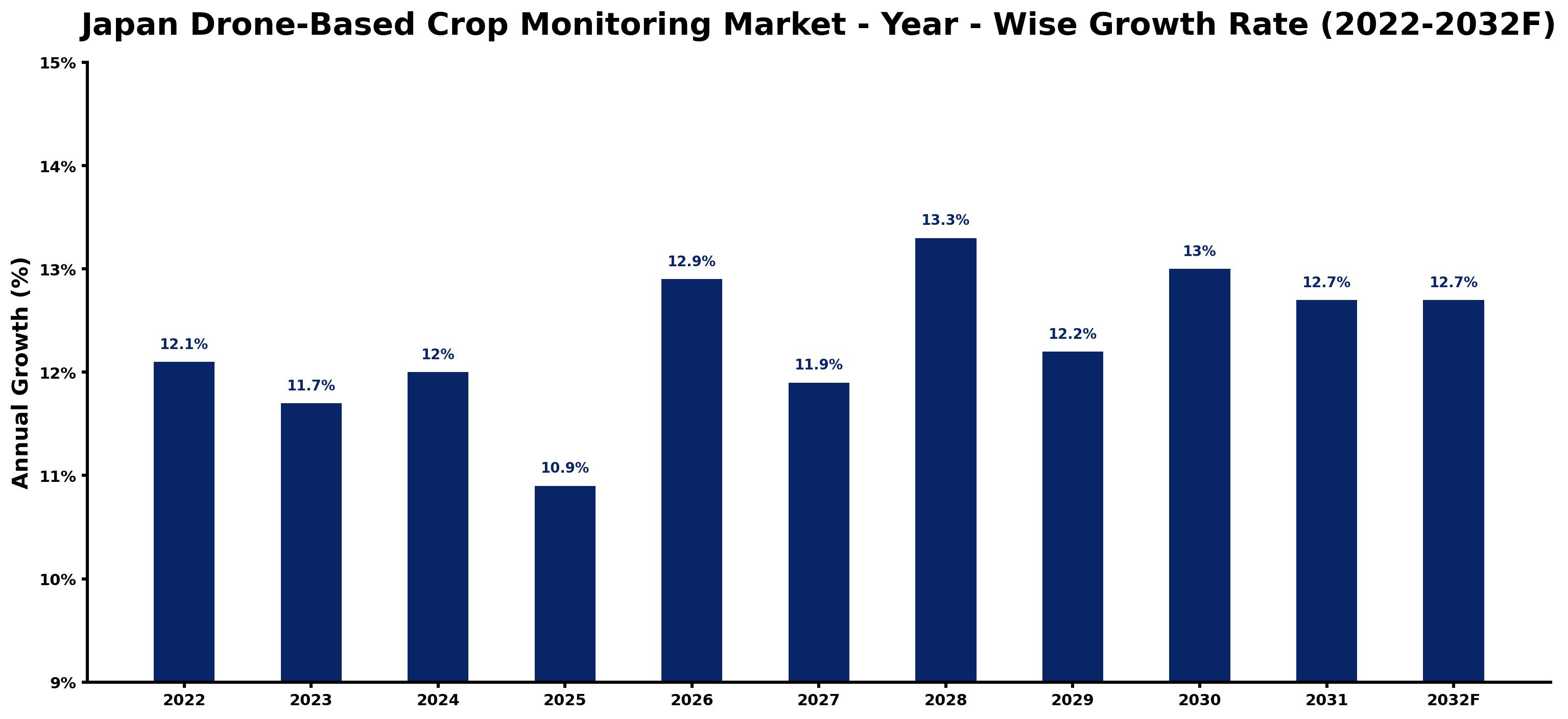
For each year, the table pairs the estimated growth rate with the leading influence on demand, showing how the drivers changed across the period.
| Year | Estimated Annual Growth (%) | Market Rationale |
| 2022 | 12.1 | The agricultural sector saw increased adoption of drone technology for crop monitoring. |
| 2023 | 11.7 | The market experienced slower growth due to a temporary saturation in early adopters. |
| 2024 | 12.0 | Demand accelerated as more farmers recognised the benefits of drone monitoring. |
| 2025 | 10.9 | Growth slowed as the market matured and competition intensified. |
| 2026 | 12.9 | Adoption surged as new technological advancements improved drone capabilities. |
| 2027 | 11.9 | The market growth rate decreased slightly as users became more selective in technology investments. |
| 2028 | 13.3 | A peak in growth occurred due to heightened awareness and government support for smart farming. |
| 2029 | 12.2 | Growth slowed as the market stabilised after the peak in adoption. |
| 2030 | 13.0 | Demand increased again as new applications for drones in agriculture emerged. |
| 2031 | 12.7 | Growth moderated as the market adjusted to the saturation of early adopters. |
| 2032 | 12.7 | The market is expected to maintain steady growth driven by ongoing technological advancements. |
Note: Market size estimations and growth projections presented in this report are based on 6Wresearch's proprietary forecasting methodology, utilizing the latest available industry data, government publications, and primary research inputs.
Japan Drone-Based Crop Monitoring Market Synopsis
Drone-based crop monitoring utilises unmanned aerial vehicles equipped with sensors to assess crop health and optimise agricultural practices. With over 1 million hectares of farmland employing drone technology, the Japan Drone-Based Crop Monitoring Market is expanding due to increasing demand from commercial farmers and government initiatives promoting precision agriculture. The Tohoku region is a key area for drone-based monitoring, supported by a subsidy programme launched in 2023, aiming to increase smart farming adoption by 30% by 2025.
Market Dynamics Impact Analysis (2026–2032)
| Factor | Type | Impact | Primary Segment Affected |
| Growing adoption of NDVI analysis for monitoring rice and vegetable crops | Driver | High | NDVI Analysis |
| Increased investment in agricultural technology by commercial farmers | Driver | High | Commercial Farmers |
| Rising demand for precision agriculture solutions among farmers | Opportunity | High | Smart Farming Firms |
| Emerging applications of AI in agriculture data analysis | Opportunity | Medium | AI + Imaging |
| Limited awareness among small-scale farmers about drone capabilities | Restraint | High | Commercial Farmers |
| High initial costs associated with drone technology adoption | Restraint | Medium | Smart Farming Firms |
| Challenges in integrating drone data with existing farm management systems | Challenge | High | Agri Consultants |
| Regulatory hurdles in drone operations for agricultural purposes | Challenge | Medium | Commercial Farmers |
Evaluation of Drivers in Japan Drone-Based Crop Monitoring Market (2026–2032)
The main growth drivers and the segments they affect most are set out below.
| Drivers | Primary Segment Affected | Why It Matters (Evidence) |
| Increased adoption of NDVI analysis for crop health monitoring | NDVI Analysis | This method provides vital data on crop health, improving yield predictions and resource management. |
| Growing investment in agricultural technology by commercial farmers | Commercial Farmers | Farmers are investing in drones to improve efficiency, with the average farm size being about 1.5 hectares. |
| Rising demand for precision agriculture solutions | Smart Farming Firms | This demand stems from the need for better crop management, with 40% of drone applications focused on fruits and vegetables. |
| Emerging applications of AI in agriculture | AI + Imaging | AI improves data analysis capabilities, resulting in a 20% increase in crop yield reported by agri consultants. |
| Government initiatives promoting smart farming | Commercial Farmers | The Ministry of Agriculture, Forestry and Fisheries supports precision agriculture, increasing awareness and adoption among farmers. |
Spending rises as commercial farmers increasingly adopt NDVI analysis for crop health monitoring, providing data that improves yield predictions. Investment in drone technology is encouraged as farmers seek to optimise operations, particularly given the average farm size of 1.5 hectares. Demand for precision agriculture solutions is growing, especially as fruits and vegetables account for 40% of drone applications.
Evaluation of Restraints in Japan Drone-Based Crop Monitoring Market
These are the pressures that could keep growth below its potential.
| Market Restraint | Primary Segment Affected | Why It Matters (Evidence) |
| Limited awareness among small-scale farmers about drone capabilities | Commercial Farmers | Many small-scale farmers lack knowledge of drone technology, which restricts market growth opportunities. |
| High initial costs associated with drone technology adoption | Smart Farming Firms | The substantial investment required for drones can deter adoption among smaller farming operations. |
| Challenges in integrating drone data with existing farm management systems | Agri Consultants | Incompatibility issues can complicate the use of drone data for effective farm management. |
| Regulatory hurdles in drone operations for agricultural purposes | Commercial Farmers | Strict regulations can delay the deployment of drone technology in farming practices. |
| Dependence on weather conditions for drone operations | Pest Detection | Adverse weather can limit the effectiveness and frequency of drone monitoring. |
Japan Drone-Based Crop Monitoring Market Challenges
Producers manage over 1 million hectares of farmland using drone technology, yet they face supply chain disruptions due to limited domestic manufacturing capabilities, which can delay drone availability by up to six months. Importers encounter high costs, as the average price for drone monitoring services can reach ¥100,000 per hectare, impacting profitability for small-scale farmers. Buyers face intensified competition as new entrants adopt advanced technologies, forcing existing producers to invest heavily in upgrades, which strains financial resources. Regulatory compliance with ISO 9001 standards complicates operations, leading to increased costs for manufacturers and longer timeframes for product launches.
Trends in the Japan Drone-Based Crop Monitoring Market
Buyers and suppliers in the Japan Drone-Based Crop Monitoring Market are adjusting to the following trends.
- Shift from Traditional Monitoring to Drone Technology: Since 2023, the Tohoku region has seen a shift towards drone-based crop monitoring, with over 1 million hectares of farmland adopting this technology, improving efficiency and productivity.
- Transition from Manual to Automated Data Collection: In 2023, farmers increasingly adopted automated data collection methods using drones, resulting in a 20% increase in crop yield reported by agri consultants, showcasing the effectiveness of technology.
- Emergence of AI-Driven Data Analysis: The integration of AI in agriculture has gained traction, with AI + Imaging technologies growing rapidly, resulting in improved decision-making capabilities for farmers and a reported 16.9% CAGR.
- Prioritisation of Precision Agriculture Solutions: The Japanese government aims to increase smart farming adoption by 30% by 2025, driving demand for precision agriculture solutions among commercial farmers.
Investment Opportunities in the Japan Drone-Based Crop Monitoring Market
Several openings in the Japan Drone-Based Crop Monitoring Market merit attention from investors.
- Tohoku Region as a Hub for Drone Technology: The Tohoku region is a key area for drone technology adoption, with over 1 million hectares of farmland using drones, creating opportunities for suppliers to enter this market.
- Growing Demand for Precision Agriculture Solutions: With the government aiming for a 30% increase in smart farming adoption by 2025, there is an opportunity for investment in precision agriculture technologies.
- Investment in AI-Driven Agricultural Solutions: The rise of AI in agriculture presents an opportunity for suppliers to provide advanced data analysis tools, particularly for commercial farmers looking to improve crop yield.
- Expansion of Subsidy Programs for Drone Adoption: The 2023 subsidy program for drone technology adoption offers a chance for suppliers to partner with local agricultural cooperatives to promote their products.
Government Initiatives in the Japan Drone-Based Crop Monitoring Market
The Waste Management and Public Cleansing Act (1970) regulates the treatment of agricultural waste, ensuring that producers adhere to environmental standards. This law impacts drone operators by requiring them to manage waste effectively, encouraging sustainable practices in agriculture. The GX Basic Policy adopted in 2023 aims for JPY 150 trillion in public-private investment over ten years, promoting innovation in agricultural technology, including drones.
The Ministry of Agriculture, Forestry and Fisheries oversees the implementation of subsidy programs for drone technology adoption in agriculture. In 2023, the government allocated ¥5 billion to support farmers in integrating drones into their operations, improving efficiency and productivity.
Future Insight of the Japan Drone-Based Crop Monitoring Market
By 2032, small-scale farmers will see a shift in drone technology adoption, as government initiatives aim for a 30% increase in smart farming by 2025. New imaging technologies will streamline crop monitoring processes, enabling producers to achieve better efficiency and productivity. The introduction of subsidy programs will facilitate access to drone services for a broader range of farmers. Collaboration with research organizations will drive innovation in agricultural practices, benefiting both buyers and suppliers in this evolving market.
Market Segmentation Analysis
Japan Drone-Based Crop Monitoring Market report covers a detailed analysis of the following market segments:
By Monitoring Type – NDVI Analysis Leads, Soil Moisture Mapping Expected to Grow Fastest
According to Saurav Kr Singh, Senior Research Analyst at 6Wresearch, with 45% of monitoring type revenue in 2025, NDVI Analysis was the largest category. NDVI analysis holds the largest share due to its critical role in providing vital data on crop health, particularly in regions like Tohoku where rice and vegetable crops are prevalent. The widespread adoption of this method among farmers enhances its dominance in the market. The quickest growth will come from Soil Moisture Mapping, forecast to expand at a CAGR of 17.3% between 2026 and 2032. Soil moisture mapping is experiencing rapid growth as it is essential for precision irrigation and resource management, especially with the government's push for smart farming adoption by 30% by 2025. This focus on efficient water usage is driving increased interest in this monitoring type. Suppliers should prioritise the development of advanced NDVI and soil moisture mapping technologies to meet the growing demand.
By Imaging Sensor – Multispectral Camera Leads, AI + Imaging Expected to Grow Fastest
The largest imaging sensor category in 2025 was Multispectral Camera, at 44% of revenue. The multispectral camera segment commands the largest share as it is crucial for capturing various wavelengths necessary for comprehensive crop analysis, which is vital for Japanese farmers. Its established use in monitoring cereal crops underpins its market leadership. Over 2026–2032, AI + Imaging is expected to post the fastest growth, at a CAGR of 16.9%. The integration of advanced imaging techniques is the fastest-growing segment, enhancing data analysis and decision-making in agriculture, which is increasingly important as farmers seek to maximise yields. This trend is expected to accelerate adoption rates significantly. Buyers should consider investing in multispectral cameras and advanced imaging solutions to improve their agricultural practices.
By Crop Type – Cereal Crops Lead, Fruits & Vegetables Expected to Grow Fastest
Cereal Crops took 33% of crop type revenue in 2025, more than any other category. Cereal crops dominate the market due to their significant role in the agricultural landscape of Japan, where drone technology is extensively used for monitoring these major crops. This established usage helps maintain a strong market presence for this segment. Fruits & Vegetables are set to record the highest CAGR in this split, 17.6% over 2026–2032. Fruits and vegetables are the fastest-growing crop type for drone monitoring as there is a significant focus on quality and yield improvement, particularly with the increasing consumer demand for fresh produce. This trend is likely to continue as farmers adopt more advanced technologies. Suppliers should focus on developing tailored solutions for monitoring fruits and vegetables to capitalise on this growth opportunity.
By End User – Commercial Farmers Lead, Smart Farming Firms Expected to Grow Fastest
Commercial Farmers accounted for 34% of the market by end user in 2025. Commercial farmers represent the largest share of the market as they are the primary users of drone technology for large-scale operations, particularly in regions with intensive farming practices. Their need for efficiency drives the demand for advanced monitoring solutions. Smart Farming Firms are projected to grow fastest, at a CAGR of 16.6% during 2026–2032. Smart farming firms are the fastest-growing end user segment as they integrate drone data into advanced farming solutions, reflecting a shift towards more technology-driven agricultural practices. This growth is supported by government initiatives promoting smart farming technologies. Suppliers must engage with smart farming firms to ensure their products align with the latest technological advancements in agriculture.
Key Attractiveness of the Report
- 10 Years of Market Numbers
- Historical Data Starting from 2022 to 2025
- Base Year 2025
- Forecast Data until 2032
- Key Performance Indicators Impacting the Market
- Major Upcoming Developments and Projects
Key Highlights of the Report:
- Japan Drone-Based Crop Monitoring Market Outlook
- Market Size of Japan Drone-Based Crop Monitoring Market, 2025
- Forecast of Japan Drone-Based Crop Monitoring Market, 2032
- Historical Data and Forecast of Japan Drone-Based Crop Monitoring Revenues & Volume for the Period 2022-2032F
- Japan Drone-Based Crop Monitoring Market Trend Evolution
- Japan Drone-Based Crop Monitoring Market Drivers and Challenges
- Japan Drone-Based Crop Monitoring Price Trends
- Japan Drone-Based Crop Monitoring Porter's Five Forces
- Japan Drone-Based Crop Monitoring Industry Life Cycle
- Historical Data and Forecast of Japan Drone-Based Crop Monitoring Market Revenues & Volume By Monitoring Type for the Period 2022-2032F
- Historical Data and Forecast of Japan Drone-Based Crop Monitoring Market Revenues & Volume By NDVI Analysis for the Period 2022-2032F
- Historical Data and Forecast of Japan Drone-Based Crop Monitoring Market Revenues & Volume By Pest Detection for the Period 2022-2032F
- Historical Data and Forecast of Japan Drone-Based Crop Monitoring Market Revenues & Volume By Soil Moisture Mapping for the Period 2022-2032F
- Historical Data and Forecast of Japan Drone-Based Crop Monitoring Market Revenues & Volume By Crop Growth Modeling for the Period 2022-2032F
- Historical Data and Forecast of Japan Drone-Based Crop Monitoring Market Revenues & Volume By Imaging Sensor for the Period 2022-2032F
- Historical Data and Forecast of Japan Drone-Based Crop Monitoring Market Revenues & Volume By Multispectral Camera for the Period 2022-2032F
- Historical Data and Forecast of Japan Drone-Based Crop Monitoring Market Revenues & Volume By RGB + Thermal for the Period 2022-2032F
- Historical Data and Forecast of Japan Drone-Based Crop Monitoring Market Revenues & Volume By LiDAR for the Period 2022-2032F
- Historical Data and Forecast of Japan Drone-Based Crop Monitoring Market Revenues & Volume By AI + Imaging for the Period 2022-2032F
- Historical Data and Forecast of Japan Drone-Based Crop Monitoring Market Revenues & Volume By Crop Type for the Period 2022-2032F
- Historical Data and Forecast of Japan Drone-Based Crop Monitoring Market Revenues & Volume By Cereal Crops for the Period 2022-2032F
- Historical Data and Forecast of Japan Drone-Based Crop Monitoring Market Revenues & Volume By Fruits & Vegetables for the Period 2022-2032F
- Historical Data and Forecast of Japan Drone-Based Crop Monitoring Market Revenues & Volume By Legumes for the Period 2022-2032F
- Historical Data and Forecast of Japan Drone-Based Crop Monitoring Market Revenues & Volume By Cash Crops for the Period 2022-2032F
- Historical Data and Forecast of Japan Drone-Based Crop Monitoring Market Revenues & Volume By End User for the Period 2022-2032F
- Historical Data and Forecast of Japan Drone-Based Crop Monitoring Market Revenues & Volume By Commercial Farmers for the Period 2022-2032F
- Historical Data and Forecast of Japan Drone-Based Crop Monitoring Market Revenues & Volume By Agri Consultants for the Period 2022-2032F
- Historical Data and Forecast of Japan Drone-Based Crop Monitoring Market Revenues & Volume By Smart Farming Firms for the Period 2022-2032F
- Historical Data and Forecast of Japan Drone-Based Crop Monitoring Market Revenues & Volume By Co-operatives for the Period 2022-2032F
- Japan Drone-Based Crop Monitoring Import Export Trade Statistics
- Market Opportunity Assessment By Monitoring Type
- Market Opportunity Assessment By Imaging Sensor
- Market Opportunity Assessment By Crop Type
- Market Opportunity Assessment By End User
- Japan Drone-Based Crop Monitoring Top Companies Market Share
- Japan Drone-Based Crop Monitoring Competitive Benchmarking By Technical and Operational Parameters
- Japan Drone-Based Crop Monitoring Company Profiles
- Japan Drone-Based Crop Monitoring Key Strategic Recommendations
Market Covered
The following segment groups are covered in the report.
By Monitoring Type
- NDVI Analysis
- Pest Detection
- Soil Moisture Mapping
- Crop Growth Modeling
By Imaging Sensor
- Multispectral Camera
- RGB + Thermal
- LiDAR
- AI + Imaging
By Crop Type
- Cereal Crops
- Fruits & Vegetables
- Legumes
- Cash Crops
By End User
- Commercial Farmers
- Agri Consultants
- Smart Farming Firms
- Co-operatives






































