Japan Edible Insects for Animal Feed Market Size & Growth Rate
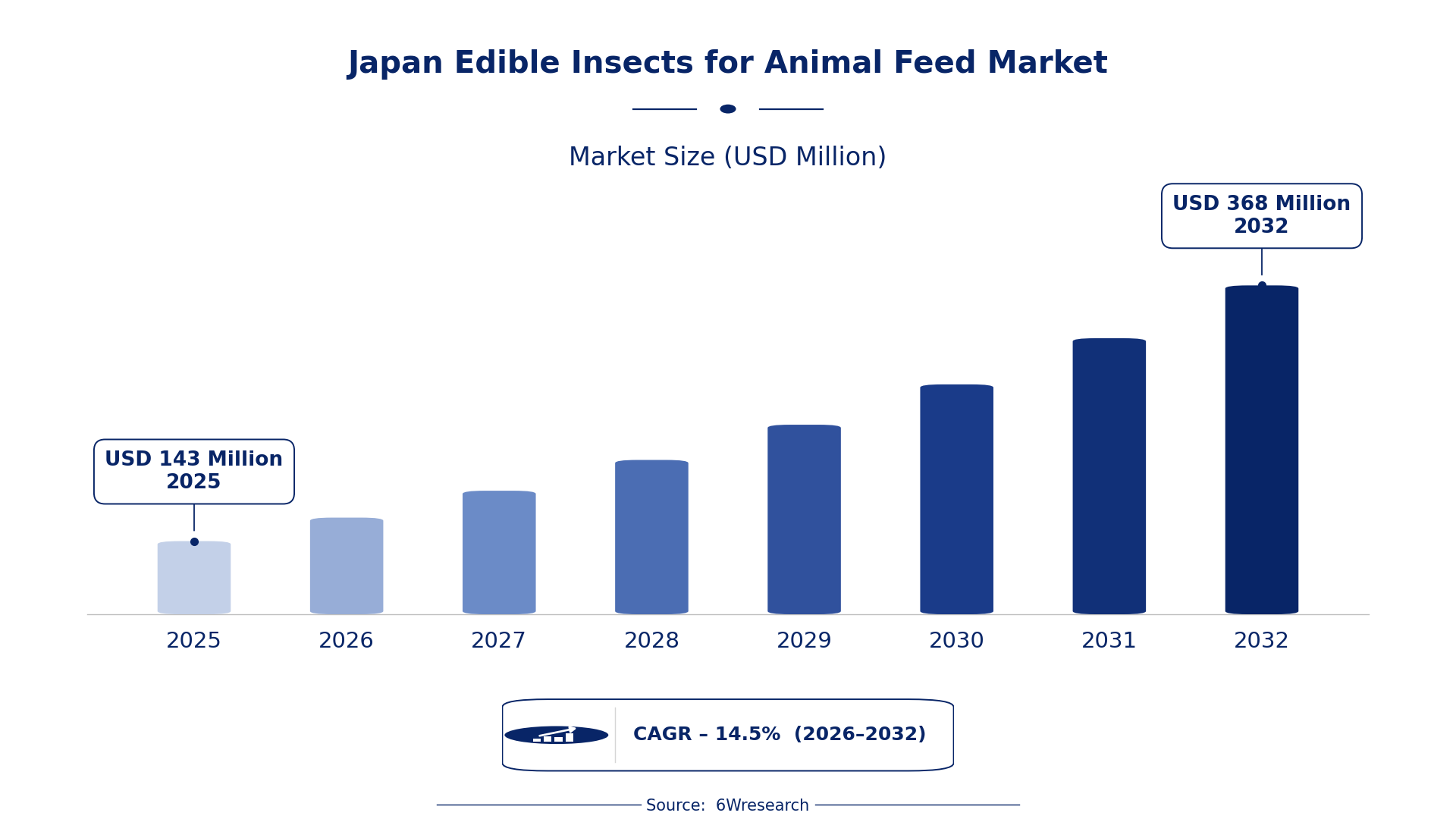
According to 6Wresearch internal database and industry insights, the Japan Edible Insects for Animal Feed Market was valued at USD 143 Million in 2025 and is projected to reach USD 368 Million by 2032, growing at a CAGR of approximately 14.5% during 2026–2032.
Japan Edible Insects for Animal Feed Market Highlights
| Report Metric | Details |
| Report Name | Japan Edible Insects for Animal Feed Market (2026-2032) |
| Market Size 2025 | USD 143 Million |
| Market Size 2032 | USD 368 Million |
| Absolute Growth 2025–2032 | USD 225 Million |
| CAGR 2026–2032 | 14.5% |
| Peak Annual Growth | 15.3% in 2028 |
| Forecast Period | 2026–2032 |
| Historical Data | 2022–2025 |
| Base Year | 2025 |
| Leading Product Type, 2025 | Crickets (51% share) |
| Leading Functionality, 2025 | Protein Source (45% share) |
| Leading Application Area, 2025 | Poultry Feed (35% share) |
| Leading Distribution Channel, 2025 | Direct Sales (37% share) |
| Leading End User, 2025 | Poultry Farms (43% share) |
| Fastest-Growing Product Type | Mealworms (20.0% CAGR) |
| Fastest-Growing Functionality | Energy & Nutrition (18.9% CAGR) |
| Fastest-Growing Application Area | Fish Feed (17.1% CAGR) |
| Fastest-Growing Distribution Channel | Online Platforms (19.0% CAGR) |
| Fastest-Growing End User | Aquaculture (18.4% CAGR) |
| Growing Sector | Poultry Feed |
| Key End Users | Poultry Farms, Aquaculture, Pet Food Manufacturers |
Japan Edible Insects for Animal Feed Market Year-wise Growth Rate and Key Drivers (2022–2032)
This graph illustrates the annual growth rates of the market from 2022 to 2032, highlighting a steady upward trajectory and projected market expansion over the forecast period.
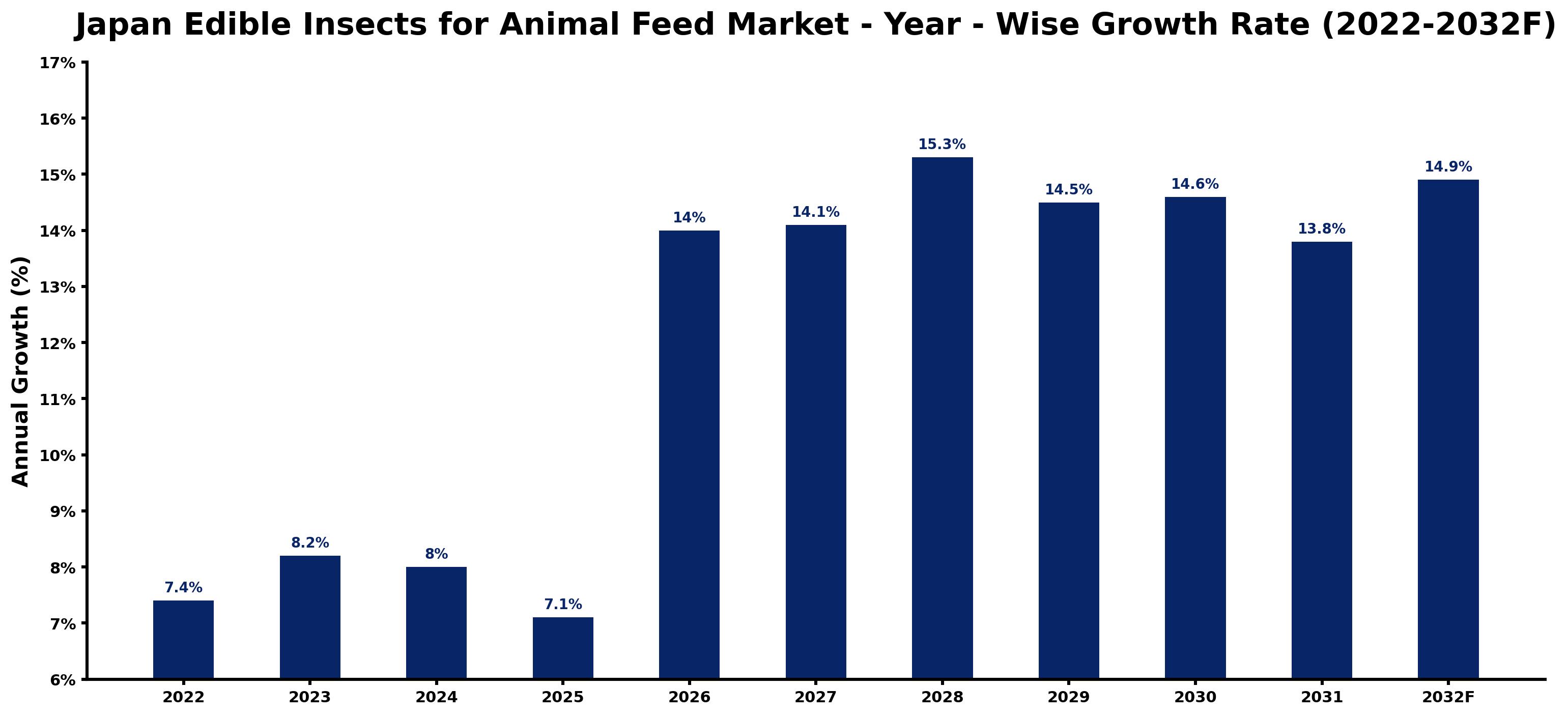
Each row of the following table gives one year's estimated growth and the event or demand shift that explains it.
| Year | Estimated Annual Growth (%) | Market Rationale |
| 2022 | 7.4 | The market showed steady growth due to rising awareness of sustainable feed options. |
| 2023 | 8.2 | Growth accelerated as consumer interest in sustainable protein sources increased. |
| 2024 | 8.0 | Growth slowed slightly as the market adjusted to earlier rapid expansions. |
| 2025 | 7.1 | A further slowdown occurred as market saturation began to take effect. |
| 2026 | 14.0 | Demand surged as awareness of nutritional benefits gained traction among farmers. |
| 2027 | 14.1 | The market continued to expand as investments in insect farming increased. |
| 2028 | 15.3 | Peak growth occurred as technological advancements in insect farming drove efficiency. |
| 2029 | 14.5 | Growth is projected to slow as the market matures and competition intensifies. |
| 2030 | 14.6 | Demand is expected to rise again as new applications for insect protein emerge. |
| 2031 | 13.8 | A slight slowdown is anticipated as the market stabilises after rapid growth. |
| 2032 | 14.9 | Growth is expected to accelerate again as new regulations favour sustainable feed sources. |
Note: Market size estimations and growth projections presented in this report are based on 6Wresearch's proprietary forecasting methodology, utilizing the latest available industry data, government publications, and primary research inputs.
Japan Edible Insects for Animal Feed Market Synopsis
Edible insects for animal feed are a sustainable protein source derived from insects such as crickets and mealworms, raised in controlled environments. The Japan Edible Insects for Animal Feed Market is experiencing growth, driven by increasing demand from poultry farms and aquaculture. The Ministry of Agriculture, Forestry and Fisheries supports initiatives promoting insect farming, while the Tokyo region emerges as a hub for sustainable feed solutions.
Market Dynamics Impact Analysis (2026–2032)
| Factor | Type | Impact | Primary Segment Affected |
| Rising demand for sustainable protein sources | Driver | High | Protein Source |
| Increased investment in insect farming technologies | Driver | High | Crickets |
| Growing consumer preference for sustainable pet food | Opportunity | High | Pet Food |
| Expansion of aquaculture practices incorporating insect protein | Opportunity | High | Fish Feed |
| Regulatory challenges in feed safety compliance | Restraint | High | Poultry Feed |
| Market saturation leading to increased competition | Restraint | Medium | Mealworms |
| High initial investment costs for insect farming | Challenge | High | Black Soldier Fly Larvae |
| Limited consumer awareness of insect-based feed benefits | Challenge | Medium | Grasshoppers |
Evaluation of Drivers in Japan Edible Insects for Animal Feed Market (2026–2032)
Key forces behind demand, with the segment each one moves most, are listed below.
| Drivers | Primary Segment Affected | Why It Matters (Evidence) |
| Technological advancements in insect farming | Crickets | Innovations have improved production efficiency, leading to a high protein content, encouraging more farmers to adopt these practices. |
| Consumer trends towards sustainable pet food | Pet Food | Pet food manufacturers are responding to a growing market, with insects providing high-quality ingredients that appeal to environmentally conscious consumers. |
| Expansion of poultry farms adopting insect protein | Poultry Feed | As poultry farms seek to improve feed quality, the use of mealworms is becoming more prevalent. |
| Growth in aquaculture sector | Fish Feed | Aquaculture is increasingly adopting insect protein, with mealworms being a popular choice due to their nutritional profile. |
| Rising interest in sustainable agriculture | Poultry Feed | Sustainable practices are gaining traction among farmers, leading to increased adoption of insect-based feed solutions. |
Buyers are adding capacity as the market for edible insects is projected to grow, with a focus on protein-rich sources. Crickets contain up to 70% protein by weight, leading poultry farms to incorporate them into their feed formulations. The Tokyo region is emerging as a hub for sustainable feed solutions, further boosting demand for insect protein in livestock diets. The increasing number of aquaculture facilities is also contributing to the rise in demand for insect-based feed products.
Evaluation of Restraints in Japan Edible Insects for Animal Feed Market
These are the pressures that could keep growth below its potential.
| Market Restraint | Primary Segment Affected | Why It Matters (Evidence) |
| Regulatory compliance costs for feed safety | Poultry Feed | The Feed Safety Law imposes strict regulations, increasing operational costs for producers by approximately 15%. |
| Market saturation leading to price competition | Mealworms | As more suppliers enter the market, prices are driven down, impacting profit margins for existing producers. |
| Limited infrastructure for large-scale insect farming | Black Soldier Fly Larvae | The lack of established facilities restricts production capacity, hindering market growth. |
| Consumer resistance to insect-based products | Grasshoppers | Despite nutritional benefits, cultural perceptions limit acceptance, affecting sales in niche markets. |
| High initial investment for farming technology | Crickets | The cost of setting up insect farming operations can exceed USD 100,000, deterring new entrants. |
Japan Edible Insects for Animal Feed Market Challenges
Poultry and aquaculture farms encounter high costs due to limited access to affordable insect feed, raising production expenses by up to 30%. New entrants face skills shortages in insect farming techniques, potentially delaying their operational timelines by several weeks. Supply chain disruptions stem from reliance on a few local suppliers, risking delays in feed availability that can adversely affect livestock health. Regulatory challenges, including compliance with the Feed Safety Law, add burdens on producers, complicating the introduction of new insect-based products.
Trends in the Japan Edible Insects for Animal Feed Market
The trends below show where the Japan Edible Insects for Animal Feed Market is heading.
- Tokyo Leading in Sustainable Feed Solutions: The Tokyo region is becoming a hub for sustainable feed solutions, with over 30 new startups focusing on insect-based products in 2023, reflecting a shift towards environmentally friendly agriculture.
- Increased Use of Mealworms in Aquaculture: Mealworms are being increasingly adopted in aquaculture due to their rich nutritional profile. The sector is set to grow as fish farms seek sustainable feed alternatives, with a projected annual growth of 17.1%.
- Poultry Farms Adopting Insect Protein: Poultry farms are increasingly incorporating insect protein into their feed formulations, with crickets expected to hold a 35% share in 2025. This trend is driven by the need for high-quality, sustainable protein sources.
- Shift Towards Sustainable Pet Food: Pet food manufacturers are responding to consumer trends for sustainability, with a growing number incorporating insects into their formulations. The market for insect-based pet food is anticipated to expand significantly.
Investment Opportunities in the Japan Edible Insects for Animal Feed Market
The following areas offer the clearest openings for investors and suppliers in the Japan Edible Insects for Animal Feed Market.
- Investing in Insect Farming Partnerships: Now is the time to invest in insect farming partnerships, especially in regions like Tokyo, where innovation is thriving. The market gap for sustainable feed solutions is projected to reach USD 100 Million by 2025.
- Focus on Aquaculture Expansion: With the aquaculture sector growing rapidly, suppliers should concentrate on providing insect-based feed solutions. The demand for fish feed is set to increase significantly in the coming years.
- Supplying Insect Protein to Pet Food Manufacturers: The growing pet food segment is seeking high-quality ingredients, presenting an opportunity for suppliers of insect protein. Collaborating with manufacturers can facilitate market entry.
- Investing in Online Distribution Channels: With online platforms growing rapidly, investing in e-commerce for insect-based products can capture a wider audience, particularly among environmentally conscious consumers.
Government Initiatives in the Japan Edible Insects for Animal Feed Market
The Food Recycling Law, enacted in 2000, mandates food businesses to reduce waste by recycling it into feed and fertiliser. This law has facilitated the edible insect industry by promoting alternative protein sources for animal feed. The Economic Security Promotion Act, introduced in 2022, supports supply-chain resilience for critical products, including insect protein, stabilising the market.
In 2023, the Japanese government launched a program to promote insect farming for animal feed, with an investment of USD 5 million to support research and development. The Ministry of Agriculture, Forestry and Fisheries oversees this initiative, which aims to increase production capacity and improve feed safety standards.
Future Insight of the Japan Edible Insects for Animal Feed Market
Technological advancements in automated rearing systems will transform demand for insect protein by 2032, improving production efficiency. Government support programmes will encourage more farmers to adopt insect farming, broadening the supply base. Research initiatives by the Japanese Society of Insect Science will lead to better feed formulations, enhancing livestock nutrition. By 2032, the Tokyo region is expected to become a centre for insect-based feed solutions, shaping market trends.
Market Segmentation Analysis
Japan Edible Insects for Animal Feed Market report covers a detailed analysis of the following market segments:
By Product Type – Crickets Lead, Mealworms Expected to Grow Fastest
According to Vasu Joshi, Associate Consultant at 6Wresearch, Crickets took 51% of product type revenue in 2025, more than any other category. Crickets dominate the market as they provide a high protein content, making them an ideal choice for various livestock applications. Their suitability for poultry and aquaculture farms is evidenced by the significant interest from these sectors in sustainable feed solutions. Mealworms are projected to grow fastest, at a CAGR of 20.0% during 2026–2032. Mealworms are experiencing swift growth due to their nutrient-rich profile and digestibility, which appeals to aquaculture operations. Their increasing use in fish farming highlights a shift towards more sustainable protein sources in the industry. Suppliers must prioritise the promotion and availability of mealworms to take advantage of the growing market interest.
By Functionality – Protein Source Leads, Energy & Nutrition Expected to Grow Fastest
In 2025, Protein Source led the functionality split with a 45% share. The primary use of edible insects as a protein source in animal feed formulations gives this segment the largest share. This functionality is essential for meeting the nutritional requirements of livestock across various sectors. Energy & Nutrition is set to record the highest CAGR in this split, 18.9% over 2026–2032. Energy and nutrition are becoming increasingly important for animal growth and development, leading to a surge in demand for this functionality. The need for efficient feed solutions is propelling this segment's growth. Buyers will benefit from suppliers who can provide energy-rich formulations to support animal health and productivity.
By Application Area – Poultry Feed Leads, Fish Feed Expected to Grow Fastest
With 35% of application area revenue in 2025, Poultry Feed was the largest category. Poultry feed holds the largest share as it plays a vital role in the nutrition of poultry livestock. The robust demand from poultry farms drives the widespread adoption of insect-based feed solutions in this area. The quickest growth will come from Fish Feed, forecast to expand at a CAGR of 17.1% between 2026 and 2032. Fish feed is rapidly gaining popularity as aquaculture increasingly incorporates insect protein into fish diets. This trend is being propelled by the expanding aquaculture sector in Japan, which is actively seeking sustainable feed alternatives. Suppliers should explore expanding their offerings to include fish feed formulations to address the rising demands of aquaculture.
By Distribution Channel – Direct Sales Leads, Online Platforms Expected to Grow Fastest
The largest distribution channel category in 2025 was Direct Sales, at 37% of revenue. Direct sales dominate as a common distribution method for feed products, ensuring that farmers have immediate access to necessary supplies. This channel is well-established within the industry, facilitating efficient transactions. Over 2026–2032, Online Platforms are expected to post the fastest growth, at a CAGR of 19.0%. Online platforms are emerging as a fast-growing channel for niche products, allowing suppliers to reach a broader audience. The convenience of online purchasing is appealing to modern buyers, especially in urban areas. Suppliers must invest in online sales strategies to capture the growing market segment that prefers digital purchasing.
By End User – Poultry Farms Lead, Aquaculture Expected to Grow Fastest
Poultry Farms accounted for 43% of the market by end user in 2025. Poultry farms are the primary consumers of insect-based feed, capturing the largest share in the end-user category. Their significant need for sustainable feed sources is a crucial factor in the growth of this market. Aquaculture is projected to grow fastest, at a CAGR of 18.4% during 2026–2032. Aquaculture is quickly integrating insect protein, reflecting the sector's demand for sustainable and nutritious feed options. This trend is expected to accelerate as fish farming expands to meet market needs. Suppliers should adapt their products to cater to the specific requirements of aquaculture to capitalise on this expanding market.
Key Attractiveness of the Report
- 10 Years of Market Numbers
- Historical Data Starting from 2022 to 2025
- Base Year 2025
- Forecast Data until 2032
- Key Performance Indicators Impacting the Market
- Major Upcoming Developments and Projects
Key Highlights of the Report:
- Japan Edible Insects for Animal Feed Market Outlook
- Market Size of Japan Edible Insects for Animal Feed Market, 2025
- Forecast of Japan Edible Insects for Animal Feed Market, 2032
- Historical Data and Forecast of Japan Edible Insects for Animal Feed Market Revenues & Volume for the Period 2022-2032F
- Japan Edible Insects for Animal Feed Market Trend Evolution
- Japan Edible Insects for Animal Feed Market Drivers and Challenges
- Japan Edible Insects for Animal Feed Market Price Trends
- Japan Edible Insects for Animal Feed Market Porter's Five Forces
- Japan Edible Insects for Animal Feed Market Industry Life Cycle
- Historical Data and Forecast of Japan Edible Insects for Animal Feed Market Revenues & Volume By Product Type for the Period 2022-2032F
- Historical Data and Forecast of Japan Edible Insects for Animal Feed Market Revenues & Volume By Crickets for the Period 2022-2032F
- Historical Data and Forecast of Japan Edible Insects for Animal Feed Market Revenues & Volume By Mealworms for the Period 2022-2032F
- Historical Data and Forecast of Japan Edible Insects for Animal Feed Market Revenues & Volume By Black Soldier Fly Larvae for the Period 2022-2032F
- Historical Data and Forecast of Japan Edible Insects for Animal Feed Market Revenues & Volume By Grasshoppers for the Period 2022-2032F
- Historical Data and Forecast of Japan Edible Insects for Animal Feed Market Revenues & Volume By Functionality for the Period 2022-2032F
- Historical Data and Forecast of Japan Edible Insects for Animal Feed Market Revenues & Volume By Protein Source for the Period 2022-2032F
- Historical Data and Forecast of Japan Edible Insects for Animal Feed Market Revenues & Volume By Energy & Nutrition for the Period 2022-2032F
- Historical Data and Forecast of Japan Edible Insects for Animal Feed Market Revenues & Volume By Amino Acid Supply for the Period 2022-2032F
- Historical Data and Forecast of Japan Edible Insects for Animal Feed Market Revenues & Volume By Digestive Health for the Period 2022-2032F
- Historical Data and Forecast of Japan Edible Insects for Animal Feed Market Revenues & Volume By Application Area for the Period 2022-2032F
- Historical Data and Forecast of Japan Edible Insects for Animal Feed Market Revenues & Volume By Poultry Feed for the Period 2022-2032F
- Historical Data and Forecast of Japan Edible Insects for Animal Feed Market Revenues & Volume By Fish Feed for the Period 2022-2032F
- Historical Data and Forecast of Japan Edible Insects for Animal Feed Market Revenues & Volume By Pig Feed for the Period 2022-2032F
- Historical Data and Forecast of Japan Edible Insects for Animal Feed Market Revenues & Volume By Pet Food for the Period 2022-2032F
- Historical Data and Forecast of Japan Edible Insects for Animal Feed Market Revenues & Volume By Distribution Channel for the Period 2022-2032F
- Historical Data and Forecast of Japan Edible Insects for Animal Feed Market Revenues & Volume By Direct Sales for the Period 2022-2032F
- Historical Data and Forecast of Japan Edible Insects for Animal Feed Market Revenues & Volume By Online Platforms for the Period 2022-2032F
- Historical Data and Forecast of Japan Edible Insects for Animal Feed Market Revenues & Volume By Feed Distributors for the Period 2022-2032F
- Historical Data and Forecast of Japan Edible Insects for Animal Feed Market Revenues & Volume By Specialty Suppliers for the Period 2022-2032F
- Historical Data and Forecast of Japan Edible Insects for Animal Feed Market Revenues & Volume By End User for the Period 2022-2032F
- Historical Data and Forecast of Japan Edible Insects for Animal Feed Market Revenues & Volume By Poultry Farms for the Period 2022-2032F
- Historical Data and Forecast of Japan Edible Insects for Animal Feed Market Revenues & Volume By Aquaculture for the Period 2022-2032F
- Historical Data and Forecast of Japan Edible Insects for Animal Feed Market Revenues & Volume By Pig Farms for the Period 2022-2032F
- Historical Data and Forecast of Japan Edible Insects for Animal Feed Market Revenues & Volume By Pet Food Manufacturers for the Period 2022-2032F
- Japan Edible Insects for Animal Feed Market Import Export Trade Statistics
- Market Opportunity Assessment By Product Type
- Market Opportunity Assessment By Functionality
- Market Opportunity Assessment By Application Area
- Market Opportunity Assessment By Distribution Channel
- Market Opportunity Assessment By End User
- Japan Edible Insects for Animal Feed Market Top Companies Market Share
- Japan Edible Insects for Animal Feed Market Competitive Benchmarking By Technical and Operational Parameters
- Japan Edible Insects for Animal Feed Market Company Profiles
- Japan Edible Insects for Animal Feed Market Key Strategic Recommendations
Market Covered
Coverage by segment is as follows.
By Product Type
- Crickets
- Mealworms
- Black Soldier Fly Larvae
- Grasshoppers
By Functionality
- Protein Source
- Energy & Nutrition
- Amino Acid Supply
- Digestive Health
By Application Area
- Poultry Feed
- Fish Feed
- Pig Feed
- Pet Food
By Distribution Channel
- Direct Sales
- Online Platforms
- Feed Distributors
- Specialty Suppliers
By End User
- Poultry Farms
- Aquaculture
- Pig Farms
- Pet Food Manufacturers






































