Japan Electric Pushback Tractor Market Size & Growth Rate
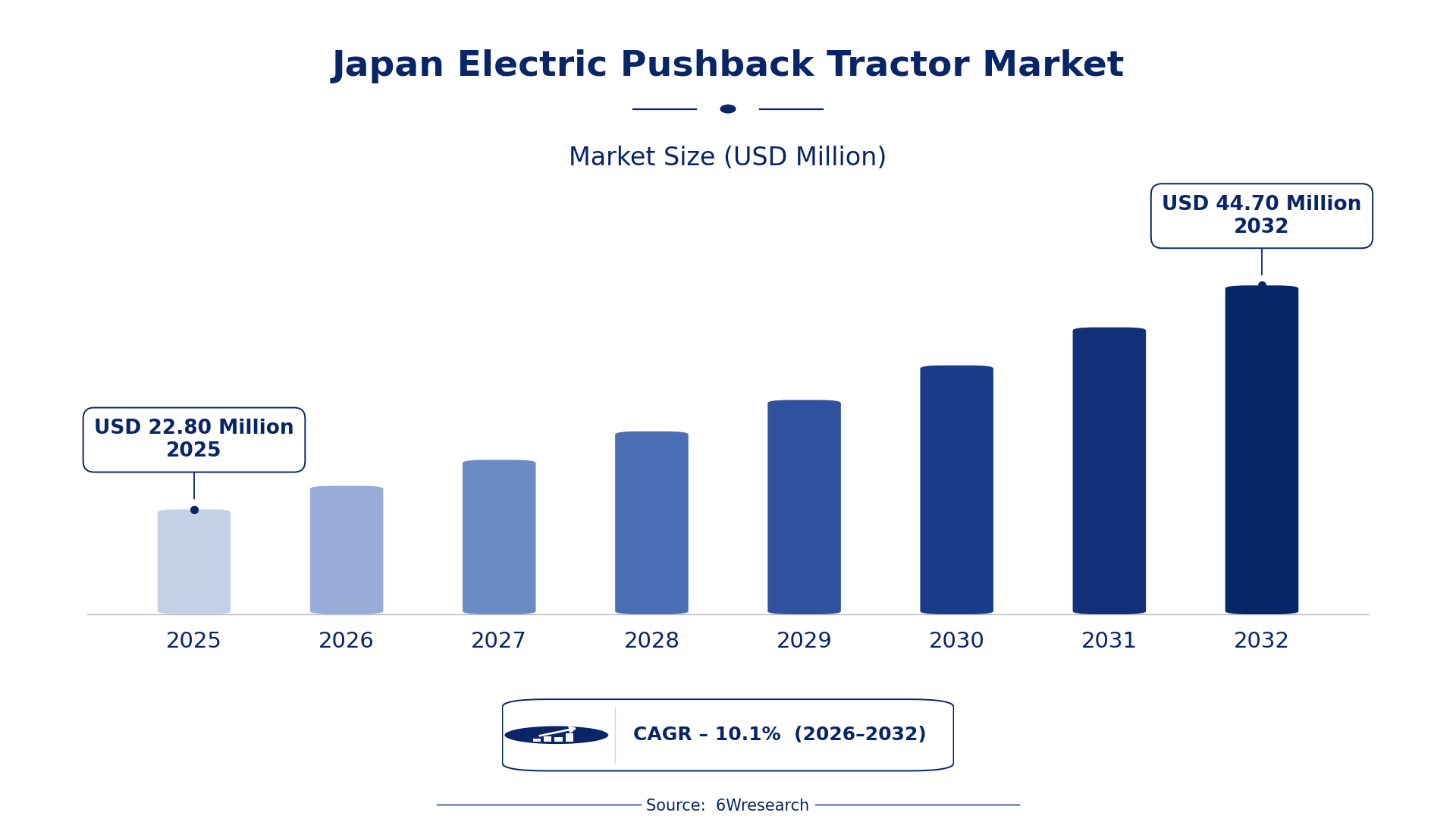
According to 6Wresearch internal database and industry insights, the Japan Electric Pushback Tractor Market was valued at USD 22.80 Million in 2025 and is projected to reach USD 44.70 Million by 2032, growing at a CAGR of approximately 10.1% during 2026–2032.
Japan Electric Pushback Tractor Market Highlights
| Report Metric | Details |
| Report Name | Japan Electric Pushback Tractor Market (2026-2032) |
| Market Size 2025 | USD 22.80 Million |
| Market Size 2032 | USD 44.70 Million |
| Absolute Growth 2025–2032 | USD 21.90 Million |
| CAGR 2026–2032 | 10.1% |
| Peak Annual Growth | 11.0% in 2028 |
| Forecast Period | 2026–2032 |
| Historical Data | 2022–2025 |
| Base Year | 2025 |
| Leading Tractor Type, 2025 | Towbarless (42% share) |
| Leading Power Source, 2025 | Battery Electric (38% share) |
| Leading Application Area, 2025 | Narrow-Body Aircraft (51% share) |
| Leading End User, 2025 | Airports (40% share) |
| Fastest-Growing Tractor Type | Conventional (14.2% CAGR) |
| Fastest-Growing Power Source | Plug-in Hybrid (14.7% CAGR) |
| Fastest-Growing Application Area | Wide-Body Aircraft (12.1% CAGR) |
| Fastest-Growing End User | Airlines (13.0% CAGR) |
| Growing Sector | Aviation |
| Key End Users | Airports, Airlines, Ground Operations Firms |
Japan Electric Pushback Tractor Market Year-wise Growth Rate and Key Drivers (2022–2032)
This graph illustrates the annual growth rates of the market from 2022 to 2032, highlighting a steady upward trajectory and projected market expansion over the forecast period.
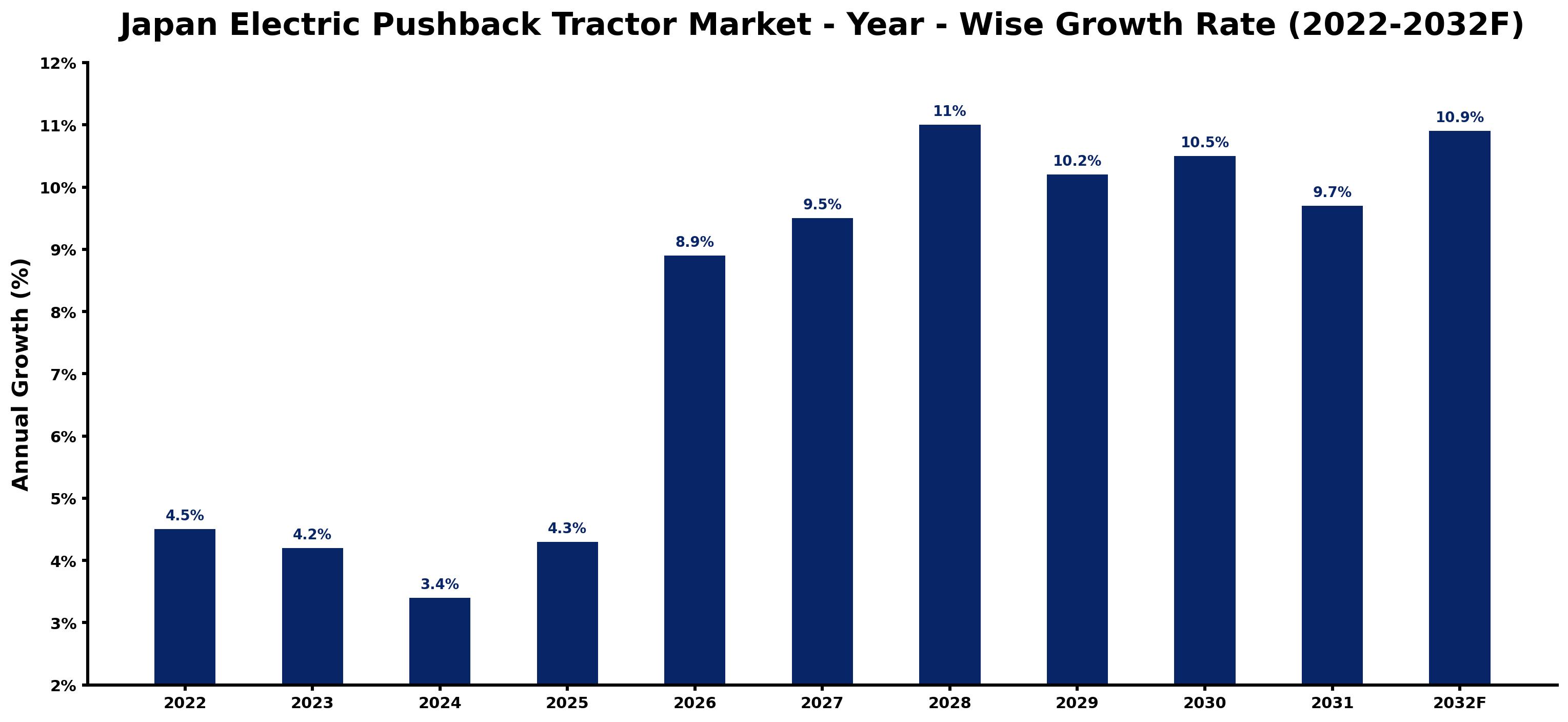
For each year, the table pairs the estimated growth rate with the leading influence on demand, showing how the drivers changed across the period.
| Year | Estimated Annual Growth (%) | Market Rationale |
| 2022 | 4.5 | The aviation sector served over 100 million passengers, driving demand for ground handling solutions. |
| 2023 | 4.2 | Growth slowed due to market adjustments following increased electric vehicle adoption in airports. |
| 2024 | 3.4 | Demand remained steady as airports continued to implement electric pushback tractors for efficiency. |
| 2025 | 4.3 | Increased investments in sustainable aviation practices led to faster growth in electric pushback tractors. |
| 2026 | 8.9 | The market is expected to grow as airports aim for 50% electric vehicle usage by 2030. |
| 2027 | 9.5 | Demand will rise as more airports transition to electric ground support equipment. |
| 2028 | 11.0 | The peak growth year will see substantial investments in electric pushback tractors across airports. |
| 2029 | 10.2 | A slowdown in growth is anticipated as the market stabilises after rapid expansion. |
| 2030 | 10.5 | Growth will accelerate as the Tokyo International Airport aims for 100% electric ground support by 2025. |
| 2031 | 9.7 | The market will see slower growth as the adoption of electric tractors reaches maturity. |
| 2032 | 10.9 | Demand will increase as the government continues to support electric vehicle initiatives. |
Note: Market size estimations and growth projections presented in this report are based on 6Wresearch's proprietary forecasting methodology, utilizing the latest available industry data, government publications, and primary research inputs.
Japan Electric Pushback Tractor Market Synopsis
Electric pushback tractors are specialised vehicles designed for manoeuvring aircraft on the ground, primarily powered by electric batteries. According to the Japan Electric Pushback Tractor Market is experiencing growth driven by rising passenger traffic, sustainability initiatives, and government support for electric vehicle adoption. With over 90 commercial airports in Japan, the focus on reducing emissions and improving operational efficiency is creating a strong demand for these tractors, aiming for 50% electric vehicle usage in airport ground operations by 2030.
Market Dynamics Impact Analysis (2026–2032)
| Factor | Type | Impact | Primary Segment Affected |
| Growing environmental regulations | Driver | High | Battery Electric |
| Increased passenger traffic at airports | Driver | High | Narrow-Body Aircraft |
| Transition to electric ground support equipment | Opportunity | High | Airports |
| Government subsidies for electric vehicle adoption | Opportunity | High | Airlines |
| High initial investment costs for electric tractors | Restraint | Medium | Battery Electric |
| Limited charging infrastructure at some airports | Restraint | Medium | Narrow-Body Aircraft |
| Competition from conventional pushback tractors | Challenge | High | Conventional |
| Technological advancements in battery technology | Challenge | Medium | Plug-in Hybrid |
Evaluation of Drivers in Japan Electric Pushback Tractor Market (2026–2032)
Key forces behind demand, with the segment each one moves most, are listed below.
| Drivers | Primary Segment Affected | Why It Matters (Evidence) |
| Government support for electric vehicle adoption | Battery Electric | The government aims for 50% electric vehicle usage in airport ground operations by 2030, increasing the need for electric pushback tractors. |
| Rising passenger traffic at airports | Narrow-Body Aircraft | With over 100 million passengers in 2022, airports are investing in efficient ground handling solutions, boosting tractor sales. |
| Environmental regulations promoting sustainability | Airports | Japan's commitment to reduce airport ground emissions by 30% by 2030 drives the adoption of electric pushback tractors. |
| Investment in airport infrastructure upgrades | Airlines | The Tokyo International Airport plans to transition to 100% electric ground support equipment by 2025, increasing demand for electric tractors. |
| Operational cost savings from electric tractors | Ground Ops Firms | The average operational cost savings from using electric pushback tractors is estimated at 20%, encouraging adoption among ground operations. |
Purchasing is picking up as airports invest in electric vehicle adoption, aiming for 50% usage by 2030. The Tokyo International Airport plans to transition to 100% electric ground support equipment by 2025, driving demand for electric pushback tractors. With over 100 million passengers served in 2022, airports are focusing on efficient ground handling solutions. The average operational cost savings from electric tractors is estimated at 20%, prompting ground operations firms to adopt these vehicles. Japan's commitment to reducing airport ground emissions by 30% by 2030 further fuels demand for electric pushback tractors.
Evaluation of Restraints in Japan Electric Pushback Tractor Market
These restraints slow adoption and weigh on supplier margins.
| Market Restraint | Primary Segment Affected | Why It Matters (Evidence) |
| High initial costs for electric pushback tractors | Battery Electric | The average price of electric tractors is higher than conventional models, limiting adoption among budget-constrained airports. |
| Limited charging infrastructure at some airports | Narrow-Body Aircraft | Insufficient charging stations at certain airports hinder the widespread use of electric pushback tractors. |
| Competition from conventional pushback tractors | Conventional | Many airports still rely on traditional tractors due to familiarity and lower upfront costs, affecting electric tractor sales. |
| Slow technological advancements in battery capacity | Plug-in Hybrid | Current battery technology limits the operational range of electric tractors, deterring some airports from full adoption. |
| Regulatory hurdles for new technology adoption | Ground Ops Firms | Stringent regulations can delay the implementation of electric pushback tractors in airport operations. |
Japan Electric Pushback Tractor Market Challenges
Supply shortages of electric pushback tractors impede airport operations, particularly in the Tokyo metropolitan area where demand is highest. This scarcity delays the adoption of cleaner technologies, costing airports potential operational efficiencies estimated at 20%. High initial costs for electric tractors deter many buyers, as they require substantial upfront investment compared to traditional models, which can exceed 30% more. Technological limitations slow down advancements, impacting ground handling efficiency for airlines and prolonging the time it takes to meet Japan's 30% emissions reduction target by 2030.
Trends in the Japan Electric Pushback Tractor Market
Four trends stand out in the Japan Electric Pushback Tractor Market.
- Shift Towards Electric Ground Support Equipment: In 2023, Japan hosted an aviation sustainability conference focusing on electric ground support equipment, highlighting the industry's shift towards greener solutions. This trend aligns with the government's target of 50% electric vehicle usage in airport operations by 2030.
- Increase in Electric Tractor Adoption: Since 2021, the Chubu Centrair International Airport has implemented electric tractors in its operations, reflecting a growing trend among airports to adopt sustainable technologies. This shift is expected to improve operational efficiency and reduce emissions.
- Growing Demand for Sustainable Aviation Practices: The Tokyo metropolitan area, with the highest concentration of airports, is increasingly prioritising sustainable aviation practices. This trend is driven by the government's commitment to reduce airport ground emissions by 30% by 2030.
- Focus on Cost Efficiency in Ground Operations: Airports are increasingly looking for cost-efficient solutions, with electric pushback tractors offering an average operational cost savings of 20%. This trend is reshaping ground operations across the country.
Investment Opportunities in the Japan Electric Pushback Tractor Market
The following opportunities in the Japan Electric Pushback Tractor Market pair current demand with a clear way in.
- Electric Pushback Tractors: The demand for electric pushback tractors is rising as airports aim for 50% electric vehicle usage by 2030. Airports are looking to invest in sustainable ground handling solutions, creating opportunities for suppliers.
- Sustainability Initiatives in Airports: Airlines are prioritising sustainability initiatives, especially with the Tokyo International Airport's goal for 100% electric ground support by 2025. Suppliers can enter this market by partnering with local firms to provide electric tractors.
- Government Subsidy Programs: The Japanese government's subsidy program for electric vehicle adoption in airports presents a timely opportunity for suppliers. With funding of approximately USD 10 million available, suppliers can collaborate with airports to supply electric pushback tractors.
- Cargo Handling Operations: The Kansai region is a significant hub for cargo handling operations, creating opportunities for electric pushback tractor suppliers. The growing demand for efficient cargo handling solutions makes this an attractive market.
Government Initiatives in the Japan Electric Pushback Tractor Market
The Electrical Appliance and Material Safety Act ensures that electric pushback tractors meet safety standards, which is essential for compliance in airport operations. This measure protects buyers and promotes confidence in the safety of electric vehicles used in ground handling. The Economic Security Promotion Act supports supply-chain resilience for designated critical products and materials, enhancing the reliability of electric pushback tractors in airport operations.
In 2023, the Japanese government announced a subsidy program for electric vehicle adoption in airports, with funding of approximately USD 10 million. The Ministry of Land, Infrastructure, Transport and Tourism oversees this initiative, aiming to encourage the transition to electric ground support equipment.
Future Insight of the Japan Electric Pushback Tractor Market
Ground handling firms will increasingly seek electric pushback tractors as sustainability becomes a priority. By 2032, government subsidies will encourage suppliers to innovate and expand production capabilities, enhancing availability. The Tokyo International Airport's commitment to transitioning to fully electric equipment will set a benchmark for other facilities. Enhanced collaboration among stakeholders will lead to improved operational practices, ultimately reducing environmental impact in the aviation sector.
Market Segmentation Analysis
Japan Electric Pushback Tractor Market report covers a detailed analysis of the following market segments:
By Tractor Type – Towbarless Leads, Conventional Expected to Grow Fastest
According to Saurav Kr Singh, Senior Research Analyst at 6Wresearch, in 2025, Towbarless led the tractor type split with a 42% share. Towbarless tractors hold the largest market share as they provide efficient aircraft manoeuvring without requiring a towbar. Their adoption is prevalent at major airports like Tokyo International, which emphasises operational efficiency in its ground handling processes. The quickest growth will come from Conventional, forecast to expand at a CAGR of 14.2% between 2026 and 2032. Conventional tractors are experiencing growth as some airports seek budget-friendly alternatives amidst rising operational costs. This segment remains relevant, particularly in facilities that are gradually transitioning to more advanced technologies. Suppliers should highlight the advantages of towbarless tractors to maintain a competitive edge in the market.
By Power Source – Battery Electric Leads, Plug-in Hybrid Expected to Grow Fastest
The largest power source category in 2025 was Battery Electric, at 38% of revenue. Battery electric tractors hold the largest share as they align with Japan's sustainability goals and are the primary choice for modern electric pushback solutions. Their adoption is encouraged by the government's push for reduced emissions in airport operations. Plug-in Hybrid is set to record the highest CAGR in this split, 14.7% over 2026–2032. Plug-in hybrid tractors are gaining traction as airports seek extended operational range without compromising on environmental standards. This trend is particularly relevant as facilities aim to meet government targets for electric vehicle usage. Buyers should consider battery electric options to ensure compliance with upcoming regulations and sustainability initiatives.
By Application Area – Narrow-Body Aircraft Leads, Wide-Body Aircraft Expected to Grow Fastest
Narrow-Body Aircraft took 51% of application area revenue in 2025, more than any other category. Narrow-body aircraft dominate the application area due to their widespread use in both domestic and international flights, particularly at busy airports. This segment is vital for efficient ground handling operations, especially in high-traffic areas such as Tokyo. Over 2026–2032, Wide-Body Aircraft is expected to post the fastest growth, at a CAGR of 12.1%. Wide-body aircraft are seeing rapid growth as airlines expand their long-haul services, which require effective ground support solutions. Airports are increasingly upgrading their fleets to accommodate the operational needs of larger aircraft. Suppliers must align their product offerings to meet the rising demand for support services related to wide-body aircraft.
By End User – Airports Lead, Airlines Expected to Grow Fastest
Airports accounted for 40% of the market by end user in 2025. Airports serve as the primary users of electric pushback tractors, utilising them for efficient aircraft manoeuvring and ground handling. The Tokyo metropolitan area, with its high concentration of airports, exemplifies the significant investment in these sustainable vehicles. Airlines are projected to grow fastest, at a CAGR of 13.0% during 2026–2032. Airlines are rapidly increasing their use of electric pushback tractors to enhance operational efficiency and meet sustainability targets. The government's subsidy programme for electric vehicle adoption in airports is a key factor driving this growth. Suppliers must align their strategies to cater to the increasing demand from airlines for sustainable ground support solutions.
Key Attractiveness of the Report
- 10 Years of Market Numbers
- Historical Data Starting from 2022 to 2025
- Base Year 2025
- Forecast Data until 2032
- Key Performance Indicators Impacting the Market
- Major Upcoming Developments and Projects
Key Highlights of the Report:
- Japan Electric Pushback Tractor Market Outlook
- Market Size of Japan Electric Pushback Tractor Market, 2025
- Forecast of Japan Electric Pushback Tractor Market, 2032
- Historical Data and Forecast of Japan Electric Pushback Tractor Revenues & Volume for the Period 2022-2032F
- Japan Electric Pushback Tractor Market Trend Evolution
- Japan Electric Pushback Tractor Market Drivers and Challenges
- Japan Electric Pushback Tractor Price Trends
- Japan Electric Pushback Tractor Porter's Five Forces
- Japan Electric Pushback Tractor Industry Life Cycle
- Historical Data and Forecast of Japan Electric Pushback Tractor Market Revenues & Volume By Tractor Type for the Period 2022-2032F
- Historical Data and Forecast of Japan Electric Pushback Tractor Market Revenues & Volume By Towbarless for the Period 2022-2032F
- Historical Data and Forecast of Japan Electric Pushback Tractor Market Revenues & Volume By Conventional for the Period 2022-2032F
- Historical Data and Forecast of Japan Electric Pushback Tractor Market Revenues & Volume By Compact Tractor for the Period 2022-2032F
- Historical Data and Forecast of Japan Electric Pushback Tractor Market Revenues & Volume By Dual Mode for the Period 2022-2032F
- Historical Data and Forecast of Japan Electric Pushback Tractor Market Revenues & Volume By Power Source for the Period 2022-2032F
- Historical Data and Forecast of Japan Electric Pushback Tractor Market Revenues & Volume By Battery Electric for the Period 2022-2032F
- Historical Data and Forecast of Japan Electric Pushback Tractor Market Revenues & Volume By Plug-in Hybrid for the Period 2022-2032F
- Historical Data and Forecast of Japan Electric Pushback Tractor Market Revenues & Volume By Solar Integrated for the Period 2022-2032F
- Historical Data and Forecast of Japan Electric Pushback Tractor Market Revenues & Volume By Grid + Battery for the Period 2022-2032F
- Historical Data and Forecast of Japan Electric Pushback Tractor Market Revenues & Volume By Application Area for the Period 2022-2032F
- Historical Data and Forecast of Japan Electric Pushback Tractor Market Revenues & Volume By Narrow-Body Aircraft for the Period 2022-2032F
- Historical Data and Forecast of Japan Electric Pushback Tractor Market Revenues & Volume By Wide-Body Aircraft for the Period 2022-2032F
- Historical Data and Forecast of Japan Electric Pushback Tractor Market Revenues & Volume By Regional Jets for the Period 2022-2032F
- Historical Data and Forecast of Japan Electric Pushback Tractor Market Revenues & Volume By Cargo Handling for the Period 2022-2032F
- Historical Data and Forecast of Japan Electric Pushback Tractor Market Revenues & Volume By End User for the Period 2022-2032F
- Historical Data and Forecast of Japan Electric Pushback Tractor Market Revenues & Volume By Airports for the Period 2022-2032F
- Historical Data and Forecast of Japan Electric Pushback Tractor Market Revenues & Volume By Airlines for the Period 2022-2032F
- Historical Data and Forecast of Japan Electric Pushback Tractor Market Revenues & Volume By Ground Ops Firms for the Period 2022-2032F
- Historical Data and Forecast of Japan Electric Pushback Tractor Market Revenues & Volume By Military Bases for the Period 2022-2032F
- Japan Electric Pushback Tractor Import Export Trade Statistics
- Market Opportunity Assessment By Tractor Type
- Market Opportunity Assessment By Power Source
- Market Opportunity Assessment By Application Area
- Market Opportunity Assessment By End User
- Japan Electric Pushback Tractor Top Companies Market Share
- Japan Electric Pushback Tractor Competitive Benchmarking By Technical and Operational Parameters
- Japan Electric Pushback Tractor Company Profiles
- Japan Electric Pushback Tractor Key Strategic Recommendations
Market Covered
This report examines the market across the segments below.
By Tractor Type
- Towbarless
- Conventional
- Compact Tractor
- Dual Mode
By Power Source
- Battery Electric
- Plug-in Hybrid
- Solar Integrated
- Grid + Battery
By Application Area
- Narrow-Body Aircraft
- Wide-Body Aircraft
- Regional Jets
- Cargo Handling
By End User
- Airports
- Airlines
- Ground Ops Firms
- Military Bases































