Japan Electrical Components Market Size, Share & Growth Rate
The Japan Electrical Components Market was estimated at USD 225 Million in 2025 and is projected to reach USD 243 Million by 2032, growing at a CAGR of 1.1% from 2026 to 2032. This growth trajectory is being driven by several pivotal factors, including the rapid advancements in automation technologies and the increasing integration of IoT within various sectors. Furthermore, the push for energy efficiency and sustainability is prompting a shift toward high-quality, eco-friendly electrical components.
Japan Electrical Components Market Year-wise Growth Rate and Key Drivers
This graph highlights how the Japan Electrical Components Market has steadily grown over the years, supported by major growth factors.
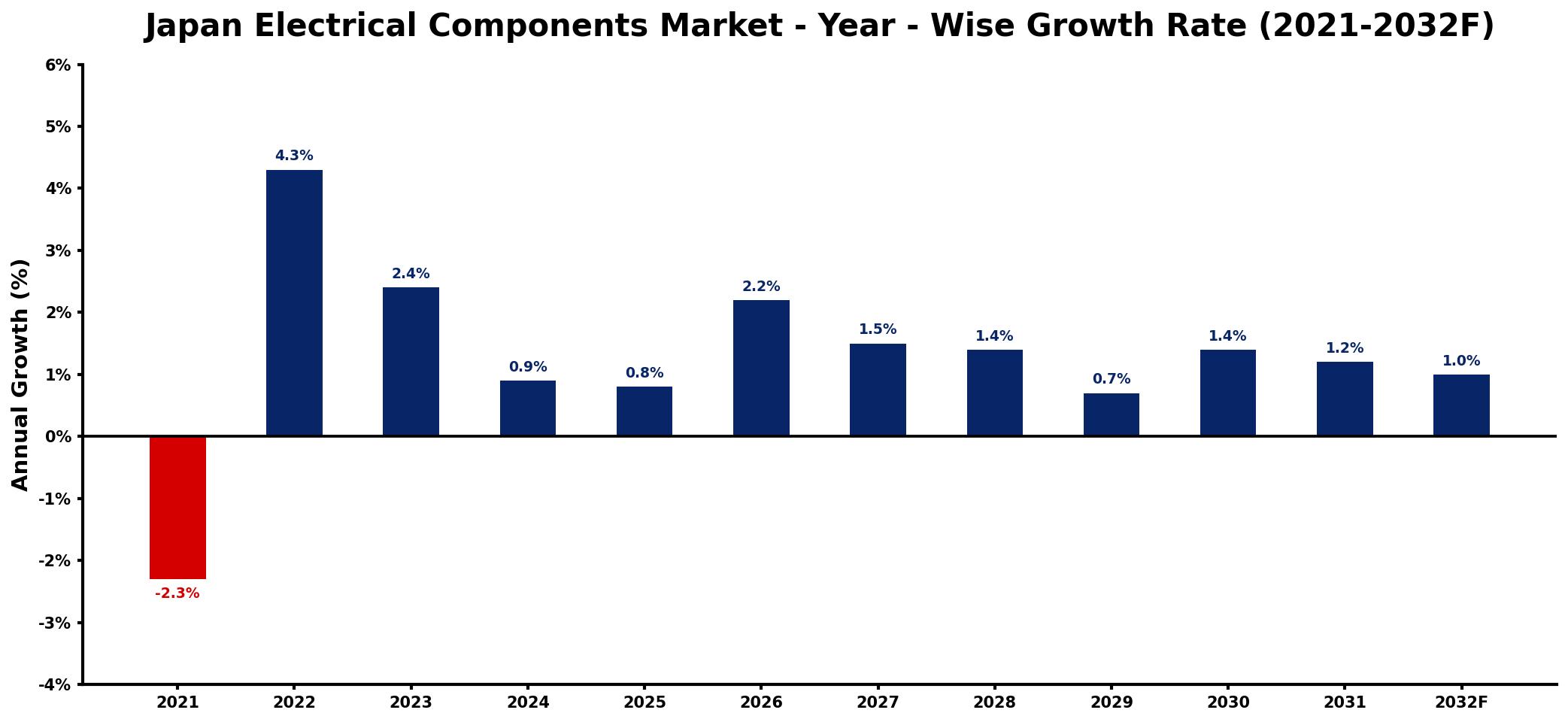
The table below presents the year‑wise growth rates along with the key drivers influencing the market
| Year | Growth Rate | Major Drivers |
| 2021 | -2.3% | decreased industrial production levels |
| 2022 | 4.3% | rising demand from automotive sector |
| 2023 | 2.4% | expansion of renewable energy projects |
| 2024 | 0.9% | increased investments in technology |
| 2025 | 0.8% | growth in consumer electronics market |
| 2026 | 2.2% | surge in smart home applications |
| 2027 | 1.5% | development of electric vehicle infrastructure |
| 2028 | 1.4% | increase in manufacturing automation |
| 2029 | 0.7% | growing automotive sector requirements |
| 2030 | 1.4% | increased domestic production output |
| 2031 | 1.2% | increased overall sector activity |
| 2032 | 1.0% | increased focus on sustainability initiatives |
Note: Market size estimations and growth projections presented in this report are based on 6Wresearch's proprietary forecasting methodology, utilizing the latest available industry data, government publications, and primary research inputs.
Japan Electrical Components Market Synopsis
The demand for electrical components in Japan is witnessing a surge, propelled by the automotive and consumer electronics industries need for innovative, reliable products. This rising demand is underpinned by a strong emphasis on quality and performance, which Japanese manufacturers consistently deliver through rigorous R&D efforts.
On the supply side, Japan's commitment to sustainable practices is driving manufacturers to adopt eco-friendly materials and production processes. The emphasis on smart technologies and renewable energy solutions is reshaping the landscape, paving the way for advanced components that align with global environmental standards.
Japan Electrical Components Market Key Takeaways
- The market is set to grow steadily, with a projected size of USD 243 Million by 2032.
- Technological advancements, particularly in IoT and automation, are significant growth drivers.
- The industry is adapting to an increasing demand for sustainable and eco-friendly electrical components.
- Japan's strict quality standards and regulations ensure a competitive landscape for reliable products.
- Investment opportunities exist in the semiconductor and automation sectors, promising long-term profitability.
Evaluation of Restraints in Japan Electrical Components Market
Despite its potential, the Japan Electrical Components Market grapples with significant challenges. One major constraint is the intense competition from both domestic and international players, which often leads to price wars and impacts profit margins. Furthermore, the continuous need for innovation requires substantial investment in R&D, stretching resources for many companies. Additionally, stringent regulatory frameworks demand rigorous compliance, making it essential for manufacturers to balance costs while ensuring safety and quality standards are met. As the market evolves, navigating these complexities will be crucial for maintaining competitiveness.
Japan Electrical Components Market Trends
A notable trend within the Japan Electrical Components Market is the increasing incorporation of smart technology into products. This shift reflects a broader push towards automation and efficiency, with components designed to be more connected and adaptable. The demand for energy-efficient products is also rising, driven by both consumer preference and regulatory pressure. Additionally, as renewable energy becomes more prevalent, components related to solar and energy storage systems are experiencing heightened interest, highlighting a clear pivot toward sustainable solutions.
Japan Electrical Components Market Opportunities
Investment opportunities in the Japan Electrical Components Market are particularly robust in the semiconductor and automation sectors. The growing trend of electrification in vehicles, alongside a surge in demand for renewable energy, positions semiconductor manufacturers favorably. Electronic components suppliers also stand to benefit as they cater to diverse industries, including automotive and consumer electronics. Automation technologies are gaining traction as industries prioritize efficiency, further enhancing the attractiveness of this market for potential investors.
Government Initiatives in the Japan Electrical Components Market
The Japanese government plays a pivotal role in promoting growth within the Electrical Components Market through various initiatives. Key policies aim to enhance innovation and technological development, fostering a competitive environment for manufacturers. Furthermore, the government emphasizes sustainable practices by offering incentives for energy-efficient technologies and the adoption of renewable energy sources. These initiatives create a supportive framework that encourages investment and drives the advancement of electrical components aligned with global sustainability goals.
Future Insights of the Japan Electrical Components Market
Looking ahead, the Japan Electrical Components Market is poised for considerable growth as it adapts to evolving technological landscapes. The transition toward renewable energy sources and the continuous development of smart technologies will be key influencers. As demand for sophisticated electronic devices and automation rises, the market is expected to see increased interest in components like semiconductors and connectors. Japanese manufacturers, with their strong focus on innovation, are well-positioned to leverage these emerging trends, ensuring a prosperous future for the market through 2032 and beyond.
Japan Electrical Components Market Latest Developments (2025 - 2026)
Recent industry developments indicate a strong alignment with global sustainability goals, with companies increasingly adopting eco-friendly manufacturing processes. The push for innovation has also led to collaborative initiatives among manufacturers to enhance R&D in smart components, reflecting the growing trend toward connected technologies. Additionally, as the automotive sector pivots towards electrification, there has been a notable increase in demand for components tailored for electric vehicles, further shaping the market dynamics.
Japan Electrical Components Market - Key Attractiveness of the Report
- 10 Years of Market Numbers
- Historical Data Starting from 2022 to 2025
- Base Year: 2025
- Forecast Data until 2032
- Key Performance Indicators Impacting the Market
- Major Upcoming Developments and Projects
Key Highlights of the Report:
- Japan Electrical Components Market Outlook
- Market Size of Japan Electrical Components Market, 2025
- Forecast of Japan Electrical Components Market, 2032
- Historical Data and Forecast of Japan Electrical Components Revenues & Volume for the Period 2022-2032F
- Japan Electrical Components Market Trend Evolution
- Japan Electrical Components Market Drivers and Challenges
- Japan Electrical Components Price Trends
- Japan Electrical Components Porter's Five Forces
- Japan Electrical Components Industry Life Cycle
- Historical Data and Forecast of Japan Electrical Components Market Revenues & Volume By Building Automation for the Period 2022-2032F
- Historical Data and Forecast of Japan Electrical Components Market Revenues & Volume By Datacom Accessories for the Period 2022-2032F
- Historical Data and Forecast of Japan Electrical Components Market Revenues & Volume By Security & wiring Accessories for the Period 2022-2032F
- Historical Data and Forecast of Japan Electrical Components Market Revenues & Volume By Cables & Wires for the Period 2022-2032F
- Historical Data and Forecast of Japan Electrical Components Market Revenues & Volume By Datacom Cables for the Period 2022-2032F
- Historical Data and Forecast of Japan Electrical Components Market Revenues & Volume By LV Cables for the Period 2022-2032F
- Historical Data and Forecast of Japan Electrical Components Market Revenues & Volume By MV&HV Cables for the Period 2022-2032F
- Historical Data and Forecast of Japan Electrical Components Market Revenues & Volume By Special Cables for the Period 2022-2032F
- Historical Data and Forecast of Japan Electrical Components Market Revenues & Volume By Industrial Automation for the Period 2022-2032F
- Historical Data and Forecast of Japan Electrical Components Market Revenues & Volume By Automation Controls for the Period 2022-2032F
- Historical Data and Forecast of Japan Electrical Components Market Revenues & Volume By Auxiliary Controls for the Period 2022-2032F
- Historical Data and Forecast of Japan Electrical Components Market Revenues & Volume By Drives & Motion Controls for the Period 2022-2032F
- Historical Data and Forecast of Japan Electrical Components Market Revenues & Volume By Measurement Controls and Relays for the Period 2022-2032F
- Historical Data and Forecast of Japan Electrical Components Market Revenues & Volume By Lighting for the Period 2022-2032F
- Historical Data and Forecast of Japan Electrical Components Market Revenues & Volume By Fixtures for the Period 2022-2032F
- Historical Data and Forecast of Japan Electrical Components Market Revenues & Volume By Lamps & LEDs for the Period 2022-2032F
- Historical Data and Forecast of Japan Electrical Components Market Revenues & Volume By Power Distribution for the Period 2022-2032F
- Historical Data and Forecast of Japan Electrical Components Market Revenues & Volume By Cable Management for the Period 2022-2032F
- Historical Data and Forecast of Japan Electrical Components Market Revenues & Volume By Enclosures & Panels for the Period 2022-2032F
- Historical Data and Forecast of Japan Electrical Components Market Revenues & Volume By LV Electrical Distribution for the Period 2022-2032F
- Historical Data and Forecast of Japan Electrical Components Market Revenues & Volume By Renewable Energies for the Period 2022-2032F
- Historical Data and Forecast of Japan Electrical Components Market Revenues & Volume By HVAC for the Period 2022-2032F
- Historical Data and Forecast of Japan Electrical Components Market Revenues & Volume By Renewable energy for the Period 2022-2032F
- Historical Data and Forecast of Japan Electrical Components Market Revenues & Volume By Safety & Tools for the Period 2022-2032F
- Historical Data and Forecast of Japan Electrical Components Market Revenues & Volume By Safety Equipment for the Period 2022-2032F
- Historical Data and Forecast of Japan Electrical Components Market Revenues & Volume By Working Tools & Accessories for the Period 2022-2032F
- Japan Electrical Components Import Export Trade Statistics
- Market Opportunity Assessment By Building Automation
- Market Opportunity Assessment By Cables & Wires
- Market Opportunity Assessment By Industrial Automation
- Market Opportunity Assessment By Lighting
- Market Opportunity Assessment By Power Distribution
- Market Opportunity Assessment By Renewable Energies
- Market Opportunity Assessment By Safety & Tools
- Japan Electrical Components Top Companies Market Share
- Japan Electrical Components Competitive Benchmarking By Technical and Operational Parameters
- Japan Electrical Components Company Profiles
- Japan Electrical Components Key Strategic Recommendations






































