Japan Electronically Commutated Motor Market Size & Growth Rate
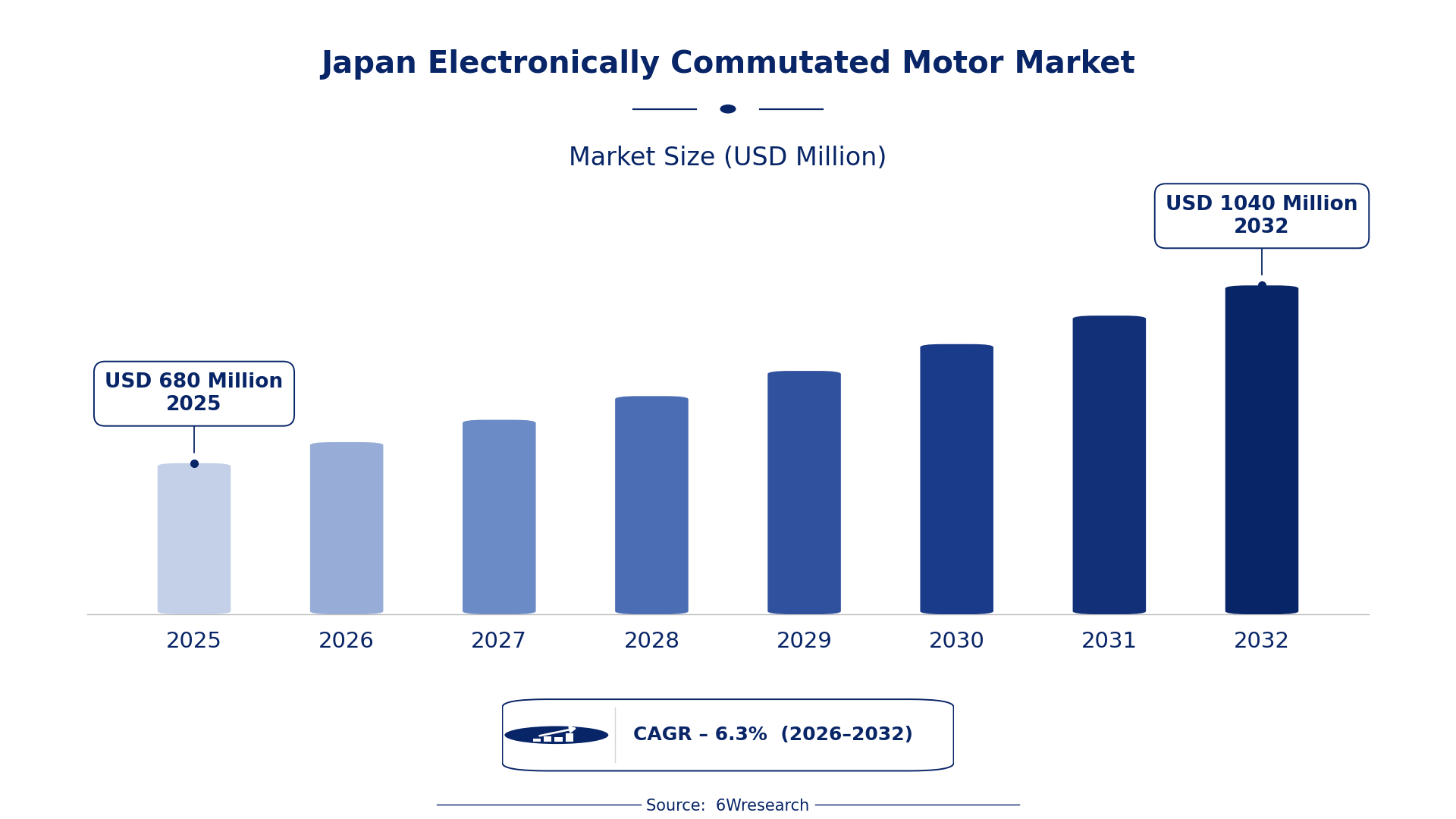
According to 6Wresearch internal database and industry insights, the Japan Electronically Commutated Motor Market was valued at USD 680 Million in 2025 and is projected to reach USD 1,040 Million by 2032, growing at a CAGR of approximately 6.3% during 2026–2032.
Japan Electronically Commutated Motor Market Highlights
| Report Metric | Details |
| Report Name | Japan Electronically Commutated Motor Market (2026-2032) |
| Market Size 2025 | USD 680 Million |
| Market Size 2032 | USD 1,040 Million |
| Absolute Growth 2025–2032 | USD 360 Million |
| CAGR 2026–2032 | 6.3% |
| Peak Annual Growth | 7.1% in 2028 |
| Forecast Period | 2026–2032 |
| Historical Data | 2022–2025 |
| Base Year | 2025 |
| Leading Application, 2025 | Automotive (48% share) |
| Leading Power Rating, 2025 | 1kW to 10kW (41% share) |
| Leading Speed Range, 2025 | 1000 to 3000 RPM (43% share) |
| Leading Control Type, 2025 | Brushless (46% share) |
| Leading Mounting Type, 2025 | Flange Mount (41% share) |
| Fastest-Growing Application | Consumer Electronics (8.7% CAGR) |
| Fastest-Growing Power Rating | 100W to 1kW (8.9% CAGR) |
| Fastest-Growing Speed Range | 3000 to 6000 RPM (8.3% CAGR) |
| Fastest-Growing Control Type | Field-Oriented Control (FOC) (9.2% CAGR) |
| Fastest-Growing Mounting Type | Foot Mount (9.3% CAGR) |
| Growing Sector | Automotive |
| Key End Users | Automotive manufacturers, industrial automation firms, consumer electronics producers |
Japan Electronically Commutated Motor Market Year-wise Growth Rate and Key Drivers (2022–2032)
This graph illustrates the annual growth rates of the market from 2022 to 2032, highlighting a steady upward trajectory and projected market expansion over the forecast period.
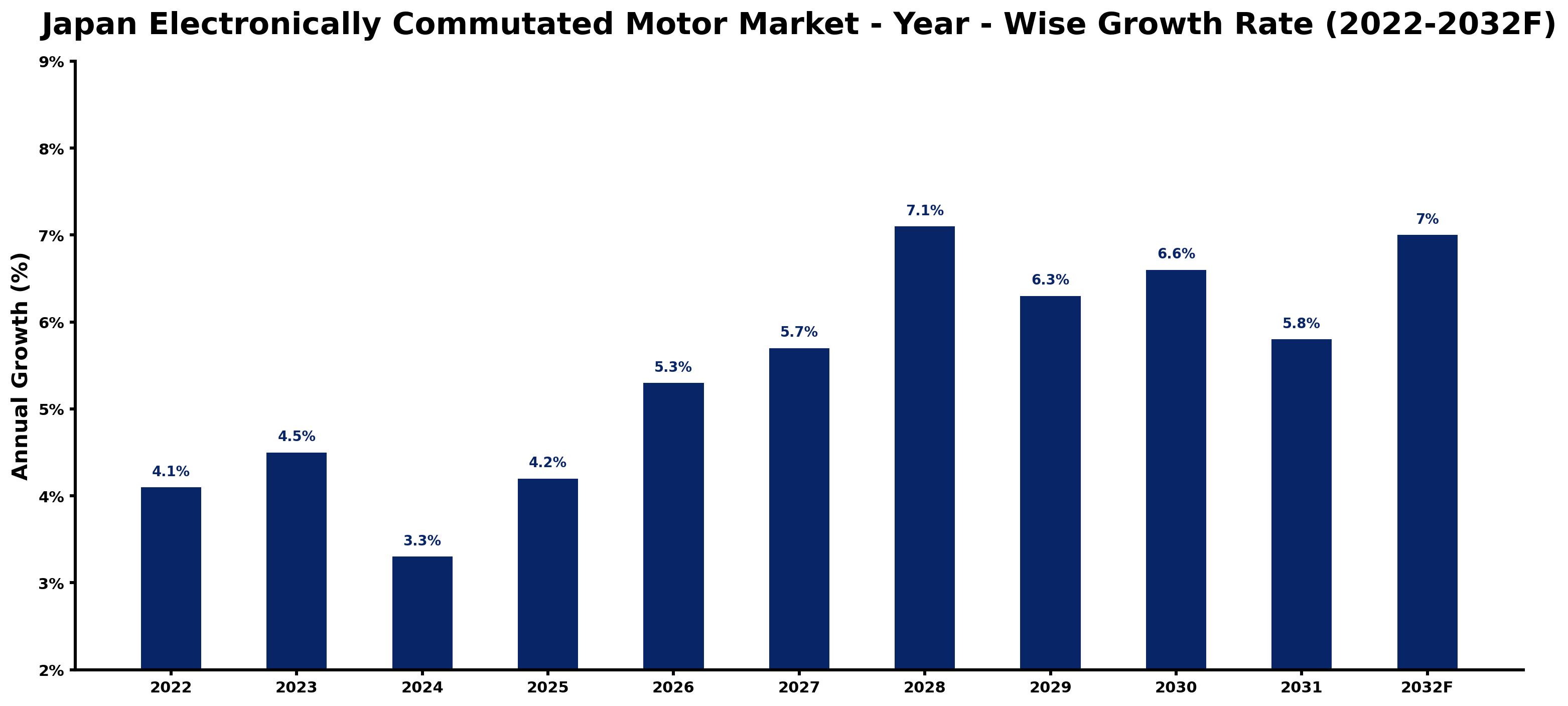
The table below sets out the estimated growth rate for each year and the main factor behind it.
| Year | Estimated Annual Growth (%) | Market Rationale |
| 2022 | 4.1 | The market showed steady growth, reflecting ongoing demand in the automotive sector. |
| 2023 | 4.5 | Growth accelerated due to rising production in the automotive industry and industrial automation. |
| 2024 | 3.3 | Demand growth slowed as market adjustments occurred in the consumer electronics sector. |
| 2025 | 4.2 | The market rebounded with increased orders from automotive and industrial applications. |
| 2026 | 5.3 | Growth is anticipated as energy efficiency standards drive demand for ECMs in various sectors. |
| 2027 | 5.7 | The market will continue to expand with a heightened focus on automation and efficiency. |
| 2028 | 7.1 | The peak growth year will see increased investments in electric vehicle technologies and automation. |
| 2029 | 6.3 | Growth is expected to moderate slightly as the market stabilises after the peak year. |
| 2030 | 6.6 | Demand will rise again, driven by advancements in consumer electronics and automotive sectors. |
| 2031 | 5.8 | The market is likely to experience a slowdown as competition intensifies among manufacturers. |
| 2032 | 7.0 | Growth will accelerate due to renewed investments in energy-efficient technologies. |
Note: Market size estimations and growth projections presented in this report are based on 6Wresearch's proprietary forecasting methodology, utilizing the latest available industry data, government publications, and primary research inputs.
Japan Electronically Commutated Motor Market Synopsis
Electronically Commutated Motors (ECMs) are advanced electric motors that utilise electronic controls for commutation, improving efficiency and performance. These motors find applications in automotive systems, industrial automation, and consumer electronics. The Japan Electronically Commutated Motor Market is expanding due to strong demand from the automotive sector, which produces over 5 million vehicles annually, and the industrial automation market, valued at approximately 15 trillion JPY. Energy efficiency standards are driving the adoption of ECMs across various applications, creating new opportunities for manufacturers and suppliers.
Market Dynamics Impact Analysis (2026–2032)
| Factor | Type | Impact | Primary Segment Affected |
| Rising automotive production | Driver | High | Automotive |
| Growth in industrial automation | Driver | High | Industrial |
| Increased demand for energy-efficient appliances | Opportunity | High | Consumer Electronics |
| Expansion of electric vehicle technologies | Opportunity | High | Automotive |
| High competition among manufacturers | Restraint | Medium | Automotive |
| Fluctuating raw material prices | Restraint | Medium | Automotive |
| Compliance with energy efficiency regulations | Challenge | High | Automotive |
| Capacity constraints in manufacturing | Challenge | Medium | Automotive |
Evaluation of Drivers in Japan Electronically Commutated Motor Market (2026–2032)
Key forces behind demand, with the segment each one moves most, are listed below.
| Drivers | Primary Segment Affected | Why It Matters (Evidence) |
| Increased production of electric vehicles | Automotive | Over 5 million vehicles are produced annually, driving demand for ECMs in automotive components. |
| Growth in industrial automation | Industrial | The industrial automation market is valued at approximately 15 trillion JPY, increasing orders for ECMs. |
| Rising consumer demand for energy-efficient products | Consumer Electronics | The consumer electronics market is projected to reach 10 trillion JPY by 2025, boosting ECM adoption. |
| Technological advancements in ECM design | Automotive | Innovations in ECM technology improve performance, attracting more buyers across sectors. |
| Government energy efficiency initiatives | Automotive | Standards set by the Ministry of the Environment promote the use of ECMs for energy savings. |
Behind the steady rise in orders sits a notable increase in electric vehicle production, with over 5 million vehicles manufactured annually. The industrial automation market, valued at approximately 15 trillion JPY, fuels demand for ECMs as manufacturers seek to improve efficiency. Consumer preferences for energy-efficient products are driving manufacturers to adopt ECMs, particularly in the consumer electronics sector. Technological advancements in ECM design improve performance and reliability, attracting diverse buyers across various applications.
Evaluation of Restraints in Japan Electronically Commutated Motor Market
These are the pressures that could keep growth below its potential.
| Market Restraint | Primary Segment Affected | Why It Matters (Evidence) |
| Intense competition among ECM manufacturers | Automotive | With numerous players in the market, companies face pressure to reduce prices, affecting profitability. |
| Volatility in raw material costs | Automotive | Fluctuating prices of key components can disrupt production schedules and increase operational costs. |
| Strict compliance requirements for energy efficiency | Automotive | Manufacturers must invest in testing and certification processes to meet regulatory standards. |
| Limited manufacturing capacity | Automotive | Some manufacturers struggle to meet rising demand, leading to potential delays in order fulfillment. |
| Challenges in supply chain management | Automotive | Disruptions in the supply chain can delay production and increase lead times for ECMs. |
Japan Electronically Commutated Motor Market Challenges
High production costs for ECMs in Japan present obstacles, as manufacturers face rising material prices that can delay product launches by up to six months. Intense competition from international suppliers compels local producers to lower prices, risking profit margins that may shrink by 15%. A shortage of skilled workers in advanced manufacturing technologies limits production capabilities, leading to delays for the automotive sector, which produces over 5 million vehicles annually. Buyers in the industrial automation market, valued at approximately 15 trillion JPY, experience longer lead times as suppliers struggle to fulfil orders efficiently.
Trends in the Japan Electronically Commutated Motor Market
The shifts below are changing how Japan Electronically Commutated Motor Market products are bought and supplied.
- Shift towards Energy-Efficient Technologies: Tokyo is experiencing a shift towards energy-efficient technologies, with the Ministry of the Environment promoting ECMs. The adoption of brushless motors is increasing due to energy efficiency standards, improving overall performance.
- Growth of Electric Vehicle Applications: The automotive sector is increasingly integrating ECMs into electric vehicles, as showcased at the Tokyo Motor Show 2023. This trend is expected to boost ECM demand in the coming years.
- Rise of Automation in Industrial Settings: Aichi is witnessing a surge in automation, with ECMs being essential for enhancing machinery efficiency. This shift is supported by the industrial automation market valued at approximately 15 trillion JPY.
- Increasing Adoption of Advanced Control Types: The trend towards Field-Oriented Control (FOC) is gaining traction, driven by its efficiency benefits. This control type is anticipated to grow at a CAGR of 9.2% as industries seek improved performance.
Investment Opportunities in the Japan Electronically Commutated Motor Market
The following opportunities in the Japan Electronically Commutated Motor Market pair current demand with a clear way in.
- Investing in Electric Vehicle Components: Now is the ideal time to invest in ECMs for electric vehicles, as Japan produces over 5 million vehicles annually. Collaborating with automotive manufacturers can yield substantial returns.
- Expanding into Industrial Automation Solutions: The industrial automation market, valued at 15 trillion JPY, presents opportunities for ECM suppliers. Establishing partnerships with automation firms can facilitate market entry and growth.
- Supplying Energy-Efficient Appliances: With the consumer electronics market projected to reach 10 trillion JPY by 2025, suppliers should focus on energy-efficient ECMs. Targeting appliance manufacturers can drive significant growth.
- Entering through Certification and Standards Compliance: Manufacturers should pursue ISO 9001 certification to enhance credibility. This approach can attract buyers in sectors prioritising quality and efficiency.
Government Initiatives in the Japan Electronically Commutated Motor Market
The Semiconductor and Digital Industry Strategy, launched by METI in June 2021, aims to secure domestic semiconductor manufacturing, impacting ECM production. This measure encourages manufacturers to invest in advanced technologies, ensuring competitiveness in the market. The strategy includes a funding allocation of 50 billion JPY to support research and development in semiconductor technologies, benefiting ECM producers.
The Economic Security Promotion Act of 2022 supports supply-chain resilience for critical products, including ECMs. This act enables manufacturers to strengthen their supply chains, ensuring a steady flow of materials necessary for production. Under this act, a budget of 30 billion JPY is allocated for enhancing logistics and supply chain management, directly benefiting ECM manufacturers.
Future Insight of the Japan Electronically Commutated Motor Market
Suppliers will adapt to new energy efficiency standards by 2032, as the automotive sector increasingly adopts ECMs to meet regulatory requirements. The industrial automation market will benefit from the Ministry of Economy, Trade and Industry's 2023 programme, which promotes energy-efficient technologies, streamlining production processes. Hospitals will expand their use of ECMs in medical devices, improving patient care and operational efficiency. The consumer electronics market will demand more efficient products, pushing suppliers to innovate and meet specific performance criteria.
Market Segmentation Analysis
Japan Electronically Commutated Motor Market report covers a detailed analysis of the following market segments:
By Application – Automotive Leads, Consumer Electronics Expected to Grow Fastest
According to Ravi Bhandari, Research Head at 6Wresearch, Automotive held 48% of the Japan Electronically Commutated Motor Market by application in 2025. The automotive sector commands the largest share as Japan produces over 5 million vehicles annually, which are heavily reliant on ECMs for essential components. This strong domestic demand from automotive manufacturers solidifies its leading position in the market. The quickest growth will come from Consumer Electronics, forecast to expand at a CAGR of 8.7% between 2026 and 2032. The consumer electronics segment is experiencing rapid growth, with the market projected to reach 10 trillion JPY by 2025, driving increased adoption of ECMs. This surge is attributed to heightened consumer awareness regarding energy efficiency and compliance with regulatory standards. Suppliers should focus on enhancing their product offerings tailored to the consumer electronics sector to seize this growth opportunity.
By Power Rating – 1kW to 10kW Leads, 100W to 1kW Expected to Grow Fastest
1kW to 10kW accounted for 41% of the market by power rating in 2025. The 1kW to 10kW segment leads the market due to its extensive use in industrial applications, which are valued at approximately 15 trillion JPY in Japan. This power range is essential for various industrial automation processes that require robust performance. 100W to 1kW is set to record the highest CAGR in this split, 8.9% over 2026–2032. The 100W to 1kW segment is witnessing rapid growth, primarily driven by its widespread application in consumer electronics and small motors, which are increasingly sought after. This trend highlights the demand for compact and efficient solutions in modern devices. Manufacturers should consider expanding their product lines to include more options in the 100W to 1kW range to meet the rising demand.
By Speed Range – 1000 to 3000 RPM Leads, 3000 to 6000 RPM Expected to Grow Fastest
The largest speed range category in 2025 was 1000 to 3000 RPM, at 43% of revenue. The 1000 to 3000 RPM range dominates the market as it is typical for many industrial motors, crucial for a variety of manufacturing processes. This established range benefits from a substantial installed base in industrial automation applications. Over 2026–2032, 3000 to 6000 RPM is expected to post the fastest growth, at a CAGR of 8.3%. The 3000 to 6000 RPM segment is growing quickly due to its application in consumer electronics, where higher speeds are increasingly necessary for optimal performance. This growth reflects the rising demand for advanced technologies in electronic devices. Suppliers should invest in developing products that cater to the high-speed range to capture the expanding consumer electronics market.
By Control Type – Brushless Leads, Field-Oriented Control (FOC) Expected to Grow Fastest
Brushless took 46% of control type revenue in 2025, more than any other category. The brushless control type leads the market as it is preferred for its efficiency and longevity, making it ideal for applications across automotive and industrial sectors. This preference is further supported by energy efficiency standards that encourage the use of brushless motors. Field-Oriented Control (FOC) is projected to grow fastest, at a CAGR of 9.2% during 2026–2032. Field-Oriented Control (FOC) is the fastest-growing segment because it significantly enhances performance in various applications, particularly in high-efficiency systems. The increasing emphasis on energy-efficient technologies is propelling this segment's growth. Vendors should prioritise the development of FOC technologies to align with market trends towards higher efficiency.
By Mounting Type – Flange Mount Leads, Foot Mount Expected to Grow Fastest
In 2025, Flange Mount led the mounting type split with a 41% share. Flange mount is the leading type due to its common usage in industrial settings, where stability and ease of installation are critical. This mounting type is widely adopted across various industrial applications, reinforcing its market share. The quickest growth will come from Foot Mount, forecast to expand at a CAGR of 9.3% between 2026 and 2032. Foot mount is experiencing the fastest growth as it is widely used in various applications, including consumer electronics and small machinery. The versatility of foot mount designs is appealing to manufacturers looking for adaptable solutions. Manufacturers should consider expanding their offerings in foot mount designs to meet the increasing demand across multiple sectors.
Key Attractiveness of the Report
- 10 Years of Market Numbers
- Historical Data Starting from 2022 to 2025
- Base Year 2025
- Forecast Data until 2032
- Key Performance Indicators Impacting the Market
- Major Upcoming Developments and Projects
Key Highlights of the Report:
- Japan Electronically Commutated Motor Market Outlook
- Market Size of Japan Electronically Commutated Motor Market,2025
- Forecast of Japan Electronically Commutated Motor Market, 2032
- Historical Data and Forecast of Japan Electronically Commutated Motor Revenues & Volume for the Period 2022-2032
- Japan Electronically Commutated Motor Market Trend Evolution
- Japan Electronically Commutated Motor Market Drivers and Challenges
- Japan Electronically Commutated Motor Price Trends
- Japan Electronically Commutated Motor Porter's Five Forces
- Japan Electronically Commutated Motor Industry Life Cycle
- Historical Data and Forecast of Japan Electronically Commutated Motor Market Revenues & Volume By Application for the Period 2022-2032
- Historical Data and Forecast of Japan Electronically Commutated Motor Market Revenues & Volume By Automotive for the Period 2022-2032
- Historical Data and Forecast of Japan Electronically Commutated Motor Market Revenues & Volume By Industrial for the Period 2022-2032
- Historical Data and Forecast of Japan Electronically Commutated Motor Market Revenues & Volume By Consumer Electronics for the Period 2022-2032
- Historical Data and Forecast of Japan Electronically Commutated Motor Market Revenues & Volume By Aerospace and Defense for the Period 2022-2032
- Historical Data and Forecast of Japan Electronically Commutated Motor Market Revenues & Volume By Power Rating for the Period 2022-2032
- Historical Data and Forecast of Japan Electronically Commutated Motor Market Revenues & Volume By Less than 100W for the Period 2022-2032
- Historical Data and Forecast of Japan Electronically Commutated Motor Market Revenues & Volume By 100W to 1kW for the Period 2022-2032
- Historical Data and Forecast of Japan Electronically Commutated Motor Market Revenues & Volume By 1kW to 10kW for the Period 2022-2032
- Historical Data and Forecast of Japan Electronically Commutated Motor Market Revenues & Volume By More than 10kW for the Period 2022-2032
- Historical Data and Forecast of Japan Electronically Commutated Motor Market Revenues & Volume By Speed Range for the Period 2022-2032
- Historical Data and Forecast of Japan Electronically Commutated Motor Market Revenues & Volume By Less than 1000 RPM for the Period 2022-2032
- Historical Data and Forecast of Japan Electronically Commutated Motor Market Revenues & Volume By 1000 to 3000 RPM for the Period 2022-2032
- Historical Data and Forecast of Japan Electronically Commutated Motor Market Revenues & Volume By 3000 to 6000 RPM for the Period 2022-2032
- Historical Data and Forecast of Japan Electronically Commutated Motor Market Revenues & Volume By More than 6000 RPM for the Period 2022-2032
- Historical Data and Forecast of Japan Electronically Commutated Motor Market Revenues & Volume By Control Type for the Period 2022-2032
- Historical Data and Forecast of Japan Electronically Commutated Motor Market Revenues & Volume By Brushed for the Period 2022-2032
- Historical Data and Forecast of Japan Electronically Commutated Motor Market Revenues & Volume By Brushless for the Period 2022-2032
- Historical Data and Forecast of Japan Electronically Commutated Motor Market Revenues & Volume By Sensorless for the Period 2022-2032
- Historical Data and Forecast of Japan Electronically Commutated Motor Market Revenues & Volume By Field-Oriented Control (FOC) for the Period 2022-2032
- Historical Data and Forecast of Japan Electronically Commutated Motor Market Revenues & Volume By Mounting Type for the Period 2022-2032
- Historical Data and Forecast of Japan Electronically Commutated Motor Market Revenues & Volume By Flange Mount for the Period 2022-2032
- Historical Data and Forecast of Japan Electronically Commutated Motor Market Revenues & Volume By Foot Mount for the Period 2022-2032
- Historical Data and Forecast of Japan Electronically Commutated Motor Market Revenues & Volume By Shaft Mount for the Period 2022-2032
- Historical Data and Forecast of Japan Electronically Commutated Motor Market Revenues & Volume By Trunnion Mount for the Period 2022-2032
- Japan Electronically Commutated Motor Import Export Trade Statistics
- Market Opportunity Assessment By Application
- Market Opportunity Assessment By Power Rating
- Market Opportunity Assessment By Speed Range
- Market Opportunity Assessment By Control Type
- Market Opportunity Assessment By Mounting Type
- Japan Electronically Commutated Motor Top Companies Market Share
- Japan Electronically Commutated Motor Competitive Benchmarking By Technical and Operational Parameters
- Japan Electronically Commutated Motor Company Profiles
- Japan Electronically Commutated Motor Key Strategic Recommendations
Market Covered
The report covers the following segments.
By Application
- Automotive
- Industrial
- Consumer Electronics
- Aerospace and Defense
By Power Rating
- Less than 100W
- 100W to 1kW
- 1kW to 10kW
- More than 10kW
By Speed Range
- Less than 1000 RPM
- 1000 to 3000 RPM
- 3000 to 6000 RPM
- More than 6000 RPM
By Control Type
- Brushed
- Brushless
- Sensorless
- Field-Oriented Control (FOC)
By Mounting Type
- Flange Mount
- Foot Mount
- Shaft Mount
- Trunnion Mount






































