Japan Embedded Modem Market Size & Growth Rate
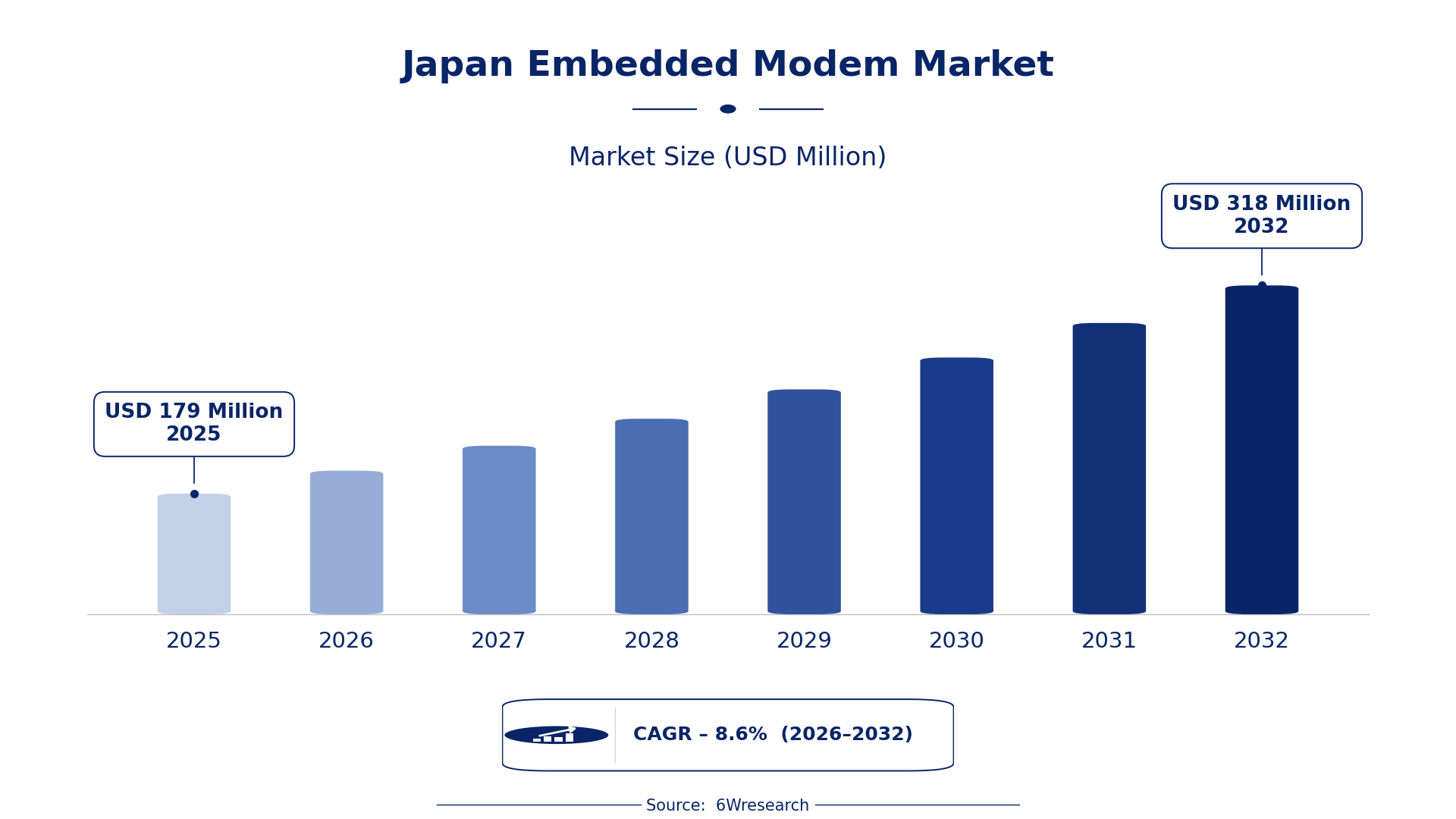
According to 6Wresearch internal database and industry insights, the Japan Embedded Modem Market was valued at USD 179 Million in 2025 and is projected to reach USD 318 Million by 2032, growing at a CAGR of approximately 8.6% during 2026–2032.
Japan Embedded Modem Market Highlights
| Report Metric | Details |
| Report Name | Japan Embedded Modem Market (2026-2032) |
| Market Size 2025 | USD 179 Million |
| Market Size 2032 | USD 318 Million |
| Absolute Growth 2025–2032 | USD 139 Million |
| CAGR 2026–2032 | 8.6% |
| Peak Annual Growth | 9.9% in 2028 |
| Forecast Period | 2026–2032 |
| Historical Data | 2022–2025 |
| Base Year | 2025 |
| Leading Modem Type, 2025 | LTE Cat-M (48% share) |
| Leading Communication Tech, 2025 | Cellular (36% share) |
| Leading Network Type, 2025 | 4G/5G (42% share) |
| Leading End User, 2025 | Smart Device OEMs (50% share) |
| Fastest-Growing Modem Type | NB-IoT (12.5% CAGR) |
| Fastest-Growing Communication Tech | Narrowband IoT (11.6% CAGR) |
| Fastest-Growing Network Type | LPWAN (12.6% CAGR) |
| Fastest-Growing End User | Utilities (11.8% CAGR) |
| Growing Sector | Smart Device Manufacturing |
| Key End Users | Smart Device OEMs, Utilities, Sensor OEMs, Smart Appliance Manufacturers |
Japan Embedded Modem Market Year-wise Growth Rate and Key Drivers (2022–2032)
This graph illustrates the annual growth rates of the market from 2022 to 2032, highlighting a steady upward trajectory and projected market expansion over the forecast period.
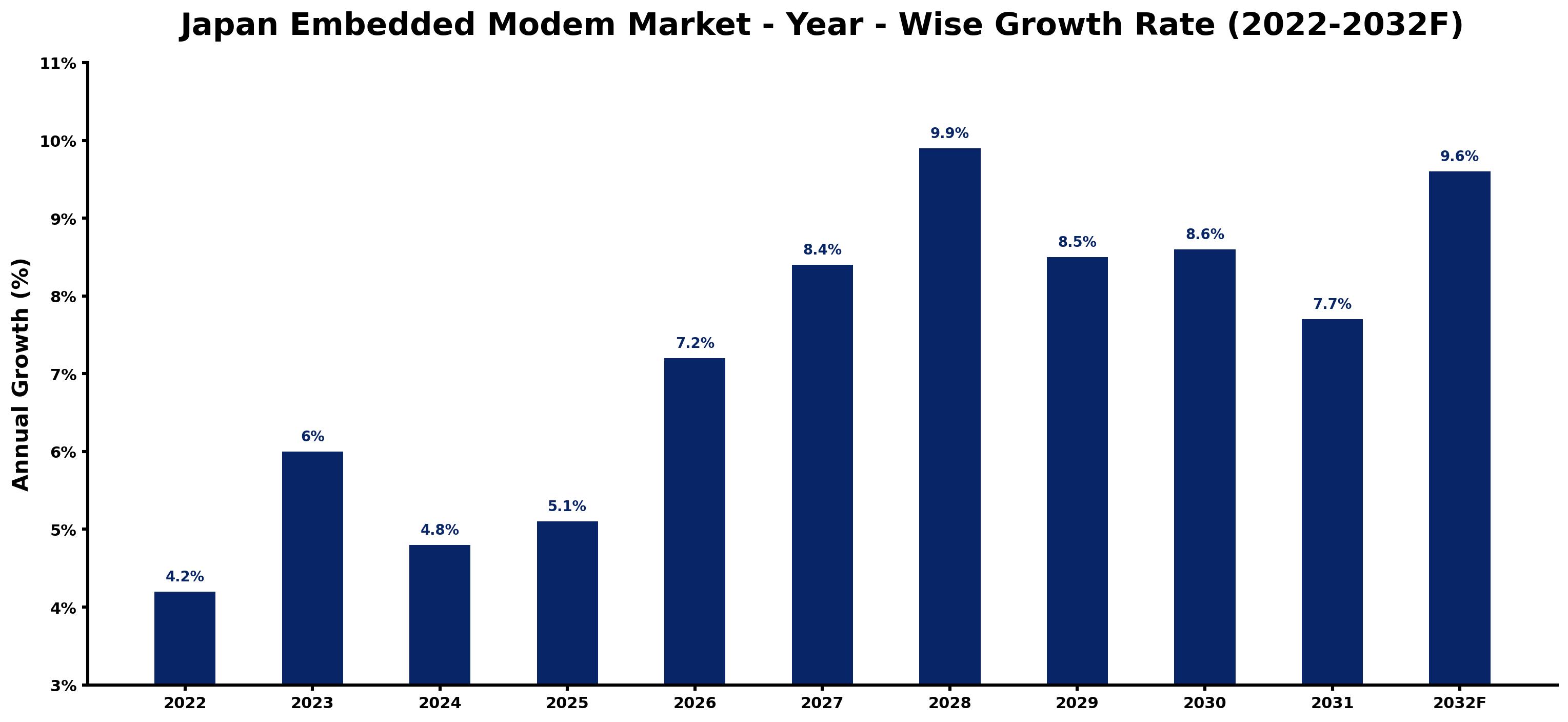
The yearly estimates that follow link every growth rate to its principal driver, so readers can see why the pace changed in each period.
| Year | Estimated Annual Growth (%) | Market Rationale |
| 2022 | 4.2 | The market showed steady demand from urban areas and smart device manufacturers. |
| 2023 | 6.0 | Growth was driven by increased production of IoT devices by smart device OEMs. |
| 2024 | 4.8 | The pace of growth slowed due to market saturation in certain segments. |
| 2025 | 5.1 | Demand accelerated as utilities expanded smart grid applications. |
| 2026 | 7.2 | The market is expected to grow as Narrowband IoT connections rise rapidly. |
| 2027 | 8.4 | Growth is projected to continue with increased investments in IoT infrastructure. |
| 2028 | 9.9 | The market will peak as 4G/5G networks expand to meet rising demand. |
| 2029 | 8.5 | A slight slowdown occurs as the market stabilises after rapid growth. |
| 2030 | 8.6 | Growth resumes as smart appliances become more prevalent in households. |
| 2031 | 7.7 | The market slows again as competition intensifies among embedded modem suppliers. |
| 2032 | 9.6 | Demand is expected to rise as new applications for IoT emerge. |
Note: Market size estimations and growth projections presented in this report are based on 6Wresearch's proprietary forecasting methodology, utilizing the latest available industry data, government publications, and primary research inputs.
Japan Embedded Modem Market Synopsis
Embedded modems facilitate wireless communication across various applications, primarily in cellular and IoT technologies. They are essential for connecting smart devices, utilities, and industrial applications to the internet. The Japan Embedded Modem Market is growing due to rising demand from smart device OEMs and utilities, supported by the national strategy to improve IoT infrastructure, projected to see an investment of 2 trillion yen by 2025. The expansion of 4G/5G networks is driving this growth, ensuring better connectivity for diverse applications.
Market Dynamics Impact Analysis (2026–2032)
| Factor | Type | Impact | Primary Segment Affected |
| Rising production of IoT devices by smart device OEMs | Driver | High | Smart Device OEMs |
| Expansion of smart grid applications by utilities | Driver | High | Utilities |
| Investment in IoT infrastructure in urban areas | Opportunity | High | LTE Cat-M |
| Increasing demand for Narrowband IoT connections | Opportunity | Medium | Narrowband IoT |
| Market saturation in certain segments | Restraint | High | Cellular |
| Regulatory compliance costs for embedded modems | Restraint | Medium | LTE Cat-M |
| High competition among suppliers leading to price pressures | Challenge | High | LTE Cat-M |
| Technological advancements requiring constant updates | Challenge | Medium | Smart Device OEMs |
Evaluation of Drivers in Japan Embedded Modem Market (2026–2032)
The table below links each growth driver to the segment it affects and the evidence for it.
| Drivers | Primary Segment Affected | Why It Matters (Evidence) |
| Increased production of IoT devices | Smart Device OEMs | Smart device OEMs in Japan are projected to increase IoT device production by 15% annually. |
| Expansion of smart grid applications | Utilities | The number of utilities implementing smart meters is expected to reach 20 million by 2025. |
| Growth of 4G/5G networks | Cellular | The total installed base of 4G/5G networks in Japan exceeds 100,000 base stations. |
| Rising adoption of Narrowband IoT | Narrowband IoT | Narrowband IoT is gaining traction with over 5 million connections in Japan. |
| Investment in IoT infrastructure | LTE Cat-M | The total investment in IoT infrastructure in Japan is estimated at 2 trillion yen by 2025. |
What keeps demand rising is the increased production of IoT devices by smart device OEMs, expected to grow by 15% annually, driving purchases of embedded modems. Utilities are expanding smart grid applications, with smart meter implementations anticipated to reach 20 million by 2025, boosting demand for connectivity solutions. The total installed base of 4G/5G networks exceeds 100,000 base stations, facilitating mobile connectivity. Urban areas are seeing substantial investment in IoT infrastructure, estimated at 2 trillion yen by 2025, prompting further investments in embedded modem technologies. As Narrowband IoT connections gain traction, surpassing 5 million, suppliers are responding with tailored products to meet this growing need.
Evaluation of Restraints in Japan Embedded Modem Market
The main factors holding the market back are set out below.
| Market Restraint | Primary Segment Affected | Why It Matters (Evidence) |
| Market saturation in certain segments | Cellular | As the market matures, growth in cellular segments is slowing due to saturation. |
| Regulatory compliance costs for embedded modems | LTE Cat-M | Producers face high costs to meet safety regulations under the Electrical Appliance and Material Safety Act. |
| High competition among suppliers | LTE Cat-M | Intense competition leads to price pressures, affecting profitability for many suppliers. |
| Technological advancements requiring constant updates | Smart Device OEMs | Rapid technological changes necessitate frequent updates, increasing operational costs for OEMs. |
| Limited awareness of IoT benefits among consumers | Utilities | Utilities face challenges in promoting smart grid technologies due to consumer unfamiliarity. |
Japan Embedded Modem Market Challenges
In 2023, Japan's smart device OEMs faced challenges with outdated communication technology, which delayed production timelines and hindered the supply of IoT devices. Urban buyers experienced extended lead times for embedded modems, potentially impacting smart city initiatives that require timely deployment. Compliance with regulatory standards from the Ministry of Internal Affairs and Communications complicates product modifications, raising costs for manufacturers by approximately 10%. Supply chain disruptions have resulted in shortages of critical components, causing delays for producers who rely on these materials to fulfil market demands.
Trends in the Japan Embedded Modem Market
The shifts below are changing how Japan Embedded Modem Market products are bought and supplied.
- Increase in Smart Appliance Adoption: In 2023, the number of smart appliances in Japanese households reached 30 million, indicating a growing trend towards IoT integration. This shift means suppliers must focus on developing compatible embedded modems.
- Growth of Narrowband IoT Connections: Narrowband IoT connections in Japan surpassed 5 million, reflecting a trend in low-power IoT applications. This growth presents opportunities for suppliers to enhance their offerings in this segment.
- Expansion of 4G/5G Networks: The total installed base of 4G/5G networks in Japan exceeds 100,000 base stations, facilitating enhanced connectivity. This expansion is vital for suppliers aiming to meet demand for high-speed applications.
- Development of Smart City Initiatives: The 'Smart City' initiative in Yokohama exemplifies the push towards IoT applications in urban planning. With ongoing projects, suppliers can target urban areas for embedded modem solutions.
Investment Opportunities in the Japan Embedded Modem Market
Where to invest in the Japan Embedded Modem Market: the main openings are set out below.
- Investment in Urban IoT Infrastructure: Urban areas are set to receive an estimated 2 trillion yen investment in IoT infrastructure by 2025. Suppliers can enter this market by collaborating with local governments to provide embedded modems.
- Supply for Smart Grid Applications: Utilities are expanding smart grid technologies, creating a demand for embedded modems. Suppliers should focus on developing solutions tailored for smart meter applications.
- Development of Narrowband IoT Solutions: With over 5 million Narrowband IoT connections, there is a clear gap in the market for specialized modems. Suppliers can target this segment by offering tailored products.
- Focus on Smart Appliance Connectivity: The rise of smart appliances, with 30 million units in households, indicates a need for embedded modems. Suppliers should invest in developing compatible technologies for this growing sector.
Government Initiatives in the Japan Embedded Modem Market
The Economic Security Promotion Act (2022) supports supply-chain resilience for critical products, strengthening the embedded modem market's stability. This law complements older regulations like the Electrical Appliance and Material Safety Act, which ensures safety standards for electrical products sold in Japan. The total investment in IoT infrastructure is estimated at 2 trillion yen by 2025, benefiting embedded modem producers.
The 'Connected Industries' program aims to promote IoT integration in manufacturing, with funding of 10 billion yen allocated to support projects. The Ministry of Internal Affairs and Communications oversees these initiatives, ensuring compliance with telecommunications standards.
Future Insight of the Japan Embedded Modem Market
Investment in IoT infrastructure is projected to reach 2 trillion yen by 2025, creating strong demand for embedded modems by 2032. The 'Society 5.0' initiative will drive advancements in connectivity, prompting suppliers to develop new technologies. Adoption of JIS X 5070 will enhance interoperability among devices, enabling buyers to integrate solutions more effectively. As smart city projects expand, urban areas will see a rise in applications for smart devices, presenting new opportunities for both buyers and suppliers in the embedded modem sector.
Market Segmentation Analysis
Japan Embedded Modem Market report covers a detailed analysis of the following market segments:
By Modem Type – LTE Cat-M Leads, NB-IoT Expected to Grow Fastest
According to Saurav Kr Singh, Senior Research Analyst at 6Wresearch, LTE Cat-M accounted for 48% of the market by modem type in 2025. LTE Cat-M holds the largest share as it is widely used in low-power, wide-area IoT applications, particularly in urban environments. Its integration in smart devices and utilities is vital, supported by the extensive installed base of smart appliances in Japanese households. The quickest growth will come from NB-IoT, forecast to expand at a CAGR of 12.5% between 2026 and 2032. The growth of NB-IoT is propelled by its design for IoT devices requiring low data rates, aligning with the rising demand for smart appliances. With over 5 million NB-IoT connections in Japan, this segment is set for rapid expansion as IoT adoption increases. Suppliers should focus on enhancing LTE Cat-M capabilities while also investing in NB-IoT solutions to meet market demands.
By Communication Tech – Cellular Leads, Narrowband IoT Expected to Grow Fastest
In 2025, Cellular led the communication tech split with a 36% share. Cellular technology leads the market due to its broad application in mobile and IoT connectivity, making it the preferred choice for manufacturers. The established infrastructure and user familiarity further reinforce its dominant position in Japan's embedded modem market. Over 2026–2032, Narrowband IoT is expected to post the fastest growth, at a CAGR of 11.6%. Narrowband IoT is witnessing rapid growth as it is specifically tailored for low-bandwidth IoT applications, which are becoming more prevalent. The increasing number of smart devices amplifies the need for efficient connectivity solutions like Narrowband IoT. Suppliers must prioritise Cellular technology while also innovating in Narrowband IoT to address market needs.
By Network Type – 4G/5G Leads, LPWAN Expected to Grow Fastest
4G/5G held 42% of the Japan Embedded Modem Market by network type in 2025. 4G/5G networks capture the largest share as they are essential for high-speed mobile and IoT applications, ensuring reliable connectivity. The extensive infrastructure, with over 100,000 base stations, supports a diverse range of applications, solidifying its leading role. LPWAN is projected to grow fastest, at a CAGR of 12.6% during 2026–2032. LPWAN is rapidly growing as it meets the demand for low-power, wide-area network solutions, which are crucial for many IoT applications. The increasing deployment of smart devices drives the need for LPWAN, positioning it for notable growth in the future. Suppliers should invest in 4G/5G technologies while exploring LPWAN solutions to cater to varied connectivity requirements.
By End User – Smart Device OEMs Lead, Utilities Expected to Grow Fastest
Smart Device OEMs took 50% of end user revenue in 2025, more than any other category. Smart Device OEMs dominate the market as they are the primary users of embedded modems for connectivity across multiple applications. Their projected increase in IoT device production by 15% annually underscores their critical role in driving market growth. Utilities are set to record the highest CAGR in this split, 11.8% over 2026–2032. Utilities represent the fastest-growing segment as they increasingly adopt embedded modems for smart grid applications, driven by the need for improved efficiency. The expected implementation of 20 million smart meters by 2025 highlights the rapid growth in this sector. For suppliers, aligning product offerings with the requirements of Smart Device OEMs and Utilities will be essential for capturing emerging opportunities.
Key Attractiveness of the Report
- 10 Years of Market Numbers
- Historical Data Starting from 2022 to 2025
- Base Year 2025
- Forecast Data until 2032
- Key Performance Indicators Impacting the Market
- Major Upcoming Developments and Projects
Key Highlights of the Report:
- Japan Embedded Modem Market Outlook
- Market Size of Japan Embedded Modem Market, 2025
- Forecast of Japan Embedded Modem Market, 2032
- Historical Data and Forecast of Japan Embedded Modem Revenues & Volume for the Period 2022-2032F
- Japan Embedded Modem Market Trend Evolution
- Japan Embedded Modem Market Drivers and Challenges
- Japan Embedded Modem Price Trends
- Japan Embedded Modem Porter's Five Forces
- Japan Embedded Modem Industry Life Cycle
- Historical Data and Forecast of Japan Embedded Modem Market Revenues & Volume By Modem Type for the Period 2022-2032F
- Historical Data and Forecast of Japan Embedded Modem Market Revenues & Volume By LTE Cat-M for the Period 2022-2032F
- Historical Data and Forecast of Japan Embedded Modem Market Revenues & Volume By NB-IoT for the Period 2022-2032F
- Historical Data and Forecast of Japan Embedded Modem Market Revenues & Volume By Wi-Fi + Bluetooth for the Period 2022-2032F
- Historical Data and Forecast of Japan Embedded Modem Market Revenues & Volume By LoRaWAN for the Period 2022-2032F
- Historical Data and Forecast of Japan Embedded Modem Market Revenues & Volume By Communication Tech for the Period 2022-2032F
- Historical Data and Forecast of Japan Embedded Modem Market Revenues & Volume By Cellular for the Period 2022-2032F
- Historical Data and Forecast of Japan Embedded Modem Market Revenues & Volume By Narrowband IoT for the Period 2022-2032F
- Historical Data and Forecast of Japan Embedded Modem Market Revenues & Volume By Dual Mode for the Period 2022-2032F
- Historical Data and Forecast of Japan Embedded Modem Market Revenues & Volume By Long Range for the Period 2022-2032F
- Historical Data and Forecast of Japan Embedded Modem Market Revenues & Volume By Network Type for the Period 2022-2032F
- Historical Data and Forecast of Japan Embedded Modem Market Revenues & Volume By 4G/5G for the Period 2022-2032F
- Historical Data and Forecast of Japan Embedded Modem Market Revenues & Volume By LPWAN for the Period 2022-2032F
- Historical Data and Forecast of Japan Embedded Modem Market Revenues & Volume By Local Network for the Period 2022-2032F
- Historical Data and Forecast of Japan Embedded Modem Market Revenues & Volume By Private Network for the Period 2022-2032F
- Historical Data and Forecast of Japan Embedded Modem Market Revenues & Volume By End User for the Period 2022-2032F
- Historical Data and Forecast of Japan Embedded Modem Market Revenues & Volume By Smart Device OEMs for the Period 2022-2032F
- Historical Data and Forecast of Japan Embedded Modem Market Revenues & Volume By Utilities for the Period 2022-2032F
- Historical Data and Forecast of Japan Embedded Modem Market Revenues & Volume By Smart Appliances for the Period 2022-2032F
- Historical Data and Forecast of Japan Embedded Modem Market Revenues & Volume By Sensor OEMs for the Period 2022-2032F
- Japan Embedded Modem Import Export Trade Statistics
- Market Opportunity Assessment By Modem Type
- Market Opportunity Assessment By Communication Tech
- Market Opportunity Assessment By Network Type
- Market Opportunity Assessment By End User
- Japan Embedded Modem Top Companies Market Share
- Japan Embedded Modem Competitive Benchmarking By Technical and Operational Parameters
- Japan Embedded Modem Company Profiles
- Japan Embedded Modem Key Strategic Recommendations
Market Covered
Coverage by segment is as follows.
By Modem Type
- LTE Cat-M
- NB-IoT
- Wi-Fi + Bluetooth
- LoRaWAN
By Communication Tech
- Cellular
- Narrowband IoT
- Dual Mode
- Long Range
By Network Type
- 4G/5G
- LPWAN
- Local Network
- Private Network
By End User
- Smart Device OEMs
- Utilities
- Smart Appliances
- Sensor OEMs






































