Japan Embroidery Equipment Market Size & Growth Rate
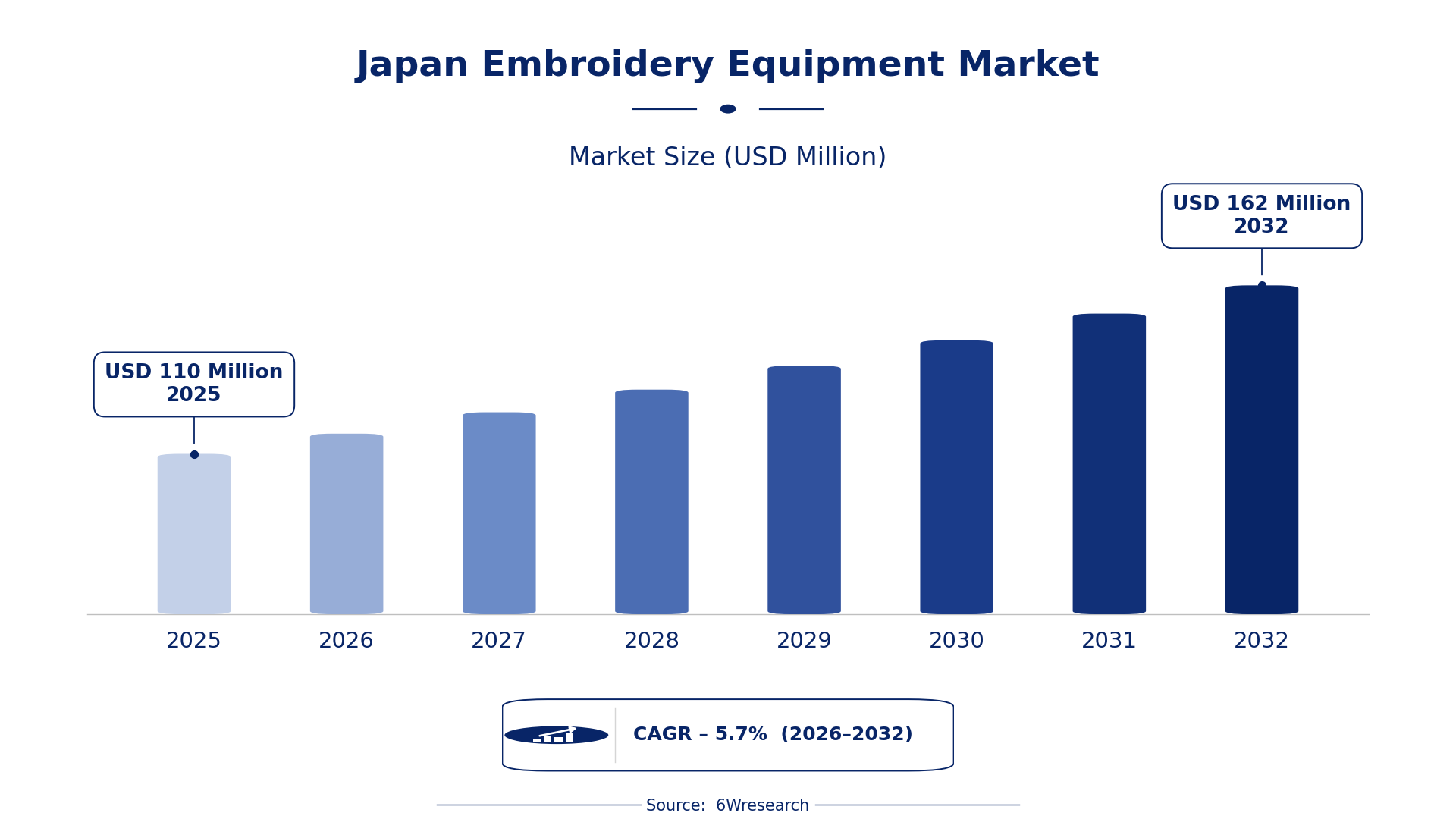
According to 6Wresearch internal database and industry insights, the Japan Embroidery Equipment Market was valued at USD 110 Million in 2025 and is projected to reach USD 162 Million by 2032, growing at a CAGR of approximately 5.7% during 2026–2032.
Japan Embroidery Equipment Market Highlights
| Report Metric | Details |
| Report Name | Japan Embroidery Equipment Market (2026-2032) |
| Market Size 2025 | USD 110 Million |
| Market Size 2032 | USD 162 Million |
| Absolute Growth 2025–2032 | USD 52 Million |
| CAGR 2026–2032 | 5.7% |
| Peak Annual Growth | 6.5% in 2026 |
| Forecast Period | 2026–2032 |
| Historical Data | 2022–2025 |
| Base Year | 2025 |
| Leading Mmachine Type, 2025 | Flat Bed Embroidery Machines (43% share) |
| Leading Technology, 2025 | Computerized Embroidery Machines (58% share) |
| Leading Application, 2025 | Textile Industry (48% share) |
| Leading End use, 2025 | Industrial (50% share) |
| Fastest-Growing Mmachine Type | Multi-Needle Embroidery Machines (7.9% CAGR) |
| Fastest-Growing Technology | Manual Embroidery Machines (8.1% CAGR) |
| Fastest-Growing Application | Fashion Industry (7.5% CAGR) |
| Fastest-Growing End use | Household (7.1% CAGR) |
| Growing Sector | Fashion Industry |
| Key End Users | Textile manufacturers, fashion designers, craft hobbyists, promotional product companies |
Japan Embroidery Equipment Market Year-wise Growth Rate and Key Drivers (2022–2032)
This graph illustrates the annual growth rates of the market from 2022 to 2032, highlighting a steady upward trajectory and projected market expansion over the forecast period.
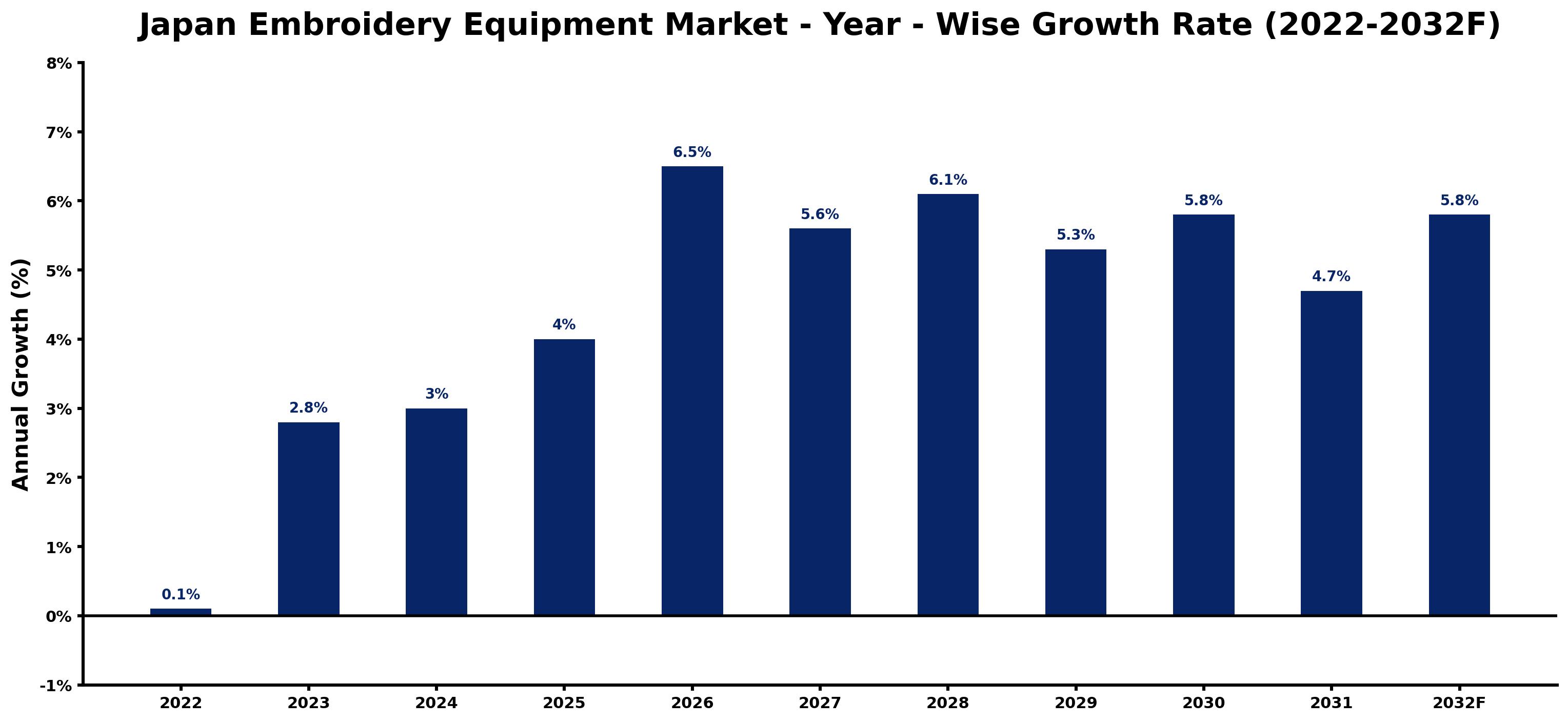
The yearly estimates that follow link every growth rate to its principal driver, so readers can see why the pace changed in each period.
| Year | Estimated Annual Growth (%) | Market Rationale |
| 2022 | 0.1 | Demand for embroidery equipment was stable, reflecting ongoing activity in the textile sector. |
| 2023 | 2.8 | Growth accelerated due to increased orders from the fashion industry, boosting machine sales. |
| 2024 | 3.0 | Continued expansion in the textile market led to higher investments in embroidery technology. |
| 2025 | 4.0 | The rise in exports of embroidery machines indicated a strengthening global market presence. |
| 2026 | 6.5 | A surge in demand from the fashion sector is expected to drive investments in advanced machinery. |
| 2027 | 5.6 | Growth is projected to slow slightly as the market adjusts to increased production capacities. |
| 2028 | 6.1 | Renewed interest in digital embroidery technology will spur further demand from craft markets. |
| 2029 | 5.3 | The market is expected to experience a slowdown as competition intensifies among local manufacturers. |
| 2030 | 5.8 | Technological advancements in embroidery machines will prompt renewed purchasing by businesses. |
| 2031 | 4.7 | A decrease in growth rate will reflect market saturation in certain segments. |
| 2032 | 5.8 | The demand for advanced embroidery solutions is expected to rise, driven by new fashion trends. |
Note: Market size estimations and growth projections presented in this report are based on 6Wresearch's proprietary forecasting methodology, utilizing the latest available industry data, government publications, and primary research inputs.
Japan Embroidery Equipment Market Synopsis
Embroidery equipment includes machines that stitch designs onto fabrics using threads, manufactured through mechanical engineering and computerized technology. The Japan Embroidery Equipment Market is growing due to rising demand from the textile and fashion sectors, with the Textile Industry valued at over 1 trillion JPY. The increasing focus on unique designs and digital embroidery technology is driving market growth, particularly in urban centres like Tokyo, a hub for fashion innovation.
Market Dynamics Impact Analysis (2026–2032)
| Factor | Type | Impact | Primary Segment Affected |
| Increasing demand from the fashion industry drives purchases of advanced embroidery machines. | Driver | High | Commercial Embroidery Machines |
| The rise of digital embroidery technology creates opportunities for new product offerings. | Opportunity | High | Digital Embroidery Machines |
| Export growth of embroidery machines presents challenges for local manufacturers. | Restraint | Medium | Computerized Embroidery Machines |
| High competition among local manufacturers limits pricing flexibility. | Challenge | High | Flat Bed Embroidery Machines |
| Compliance with industrial standards requires additional investments in quality assurance. | Restraint | Medium | Multi-Needle Embroidery Machines |
| Growing interest in home crafting expands the market for smaller embroidery machines. | Opportunity | Medium | Single-Needle Embroidery Machines |
| Rising operational costs due to increased minimum wage pressures manufacturers' margins. | Challenge | High | Manual Embroidery Machines |
| A shortage of skilled labour constrains production capacity in advanced embroidery techniques. | Restraint | Medium | Commercial Embroidery Machines |
Evaluation of Drivers in Japan Embroidery Equipment Market (2026–2032)
The table below links each growth driver to the segment it affects and the evidence for it.
| Drivers | Primary Segment Affected | Why It Matters (Evidence) |
| Growth in the fashion industry boosts demand for high-quality embroidery machines. | Commercial Embroidery Machines | The fashion sector's expansion in Japan has led to increased orders for advanced machines. |
| Technological advancements in embroidery equipment improve design capabilities. | Computerized Embroidery Machines | The adoption of ISO 9001 standards ensures quality, attracting more buyers in the textile market. |
| Increased exports of embroidery machines highlight global demand. | Digital Embroidery Machines | In 2023, exports rose, indicating a strong international market for Japanese products. |
| Rising household spending on textile products stimulates demand for embroidery equipment. | Single-Needle Embroidery Machines | The average household in Japan spends around 5,000 JPY annually on textile-related items. |
| Government initiatives support innovation in embroidery technology. | Multi-Needle Embroidery Machines | Support for manufacturers to adopt new technologies drives sales. |
Purchasing is picking up as the fashion industry in Japan drives demand for advanced embroidery machines. The Textile Industry, valued at over 1 trillion JPY, is investing heavily in computerized embroidery technology to improve production quality. In 2023, exports of embroidery machines rose, reflecting strong international demand. Households are spending around 5,000 JPY annually on textile-related products, boosting the market for single-needle machines. Support for manufacturers to adopt new technologies is leading to more purchases of multi-needle embroidery machines.
Evaluation of Restraints in Japan Embroidery Equipment Market
These restraints slow adoption and weigh on supplier margins.
| Market Restraint | Primary Segment Affected | Why It Matters (Evidence) |
| Increasing operational costs due to rising wages affect profit margins. | Commercial Embroidery Machines | Japan's national minimum wage rose to JPY 1,055 per hour in October 2024, impacting manufacturers. |
| Compliance with industrial standards requires additional investments in quality assurance. | Multi-Needle Embroidery Machines | Manufacturers must adhere to ISO 9001 standards, increasing operational costs. |
| High competition among local manufacturers limits pricing flexibility. | Flat Bed Embroidery Machines | The presence of numerous suppliers in the market creates pricing pressures. |
| A shortage of skilled labour constrains production capacity in advanced embroidery techniques. | Commercial Embroidery Machines | The need for specialized skills in embroidery limits the workforce available to manufacturers. |
| Market saturation in certain segments leads to slower growth rates. | Computerized Embroidery Machines | As the market matures, growth opportunities become limited. |
Japan Embroidery Equipment Market Challenges
Producers in the fashion sector face inflated embroidery machine prices due to supply chain disruptions, which can increase costs by up to 15%. Skills shortages in the workforce hinder production efficiency, causing delays that raise project costs for buyers by approximately 10% per project. Many producers struggle with the financial burden of investing in advanced embroidery technology, limiting their competitiveness in the market. Compliance with ISO 9001 standards incurs additional administrative costs, consuming around 5% of annual revenue for producers, which further strains their operations.
Trends in the Japan Embroidery Equipment Market
The trends below show where the Japan Embroidery Equipment Market is heading.
- Adoption of Digital Embroidery Technology: Craft markets are increasingly adopting digital embroidery technology, with a notable rise in demand for precision designs. In 2023, digital embroidery machine sales grew by 20%, reflecting this trend.
- Shift from Manual to Automated Embroidery Solutions: Textile producers are moving from manual to automated embroidery solutions to improve efficiency. The Tokyo Fashion Week showcased numerous brands using automated machines, highlighting this shift.
- Focus on Eco-Friendly Embroidery Materials: Fashion designers are prioritising eco-friendly materials for embroidery, responding to consumer demand for sustainability. In 2023, 30% of new collections featured sustainable embroidery options.
- Increase in Home Crafting Trends: There is a notable rise in home crafting, with more consumers purchasing embroidery machines for personal use. In 2023, sales of single-needle machines surged by 25% as hobbyists embraced DIY projects.
Investment Opportunities in the Japan Embroidery Equipment Market
The opportunities below stand out in the Japan Embroidery Equipment Market for new entrants and existing suppliers.
- High-Volume Production Demand: With the textile industry valued at over 1 trillion JPY, there is a strong opportunity for high-volume commercial embroidery machines. Manufacturers can target businesses in urban areas to meet this demand.
- Investment in Advanced Embroidery Solutions: Now is the time to invest in advanced embroidery technology, as the fashion industry is projected to grow. Suppliers can enter the market by partnering with local textile manufacturers.
- Joint Ventures for Market Entry: Establishing joint ventures with local firms can facilitate entry into the competitive embroidery equipment market. This approach allows for shared resources and expertise.
- Urban Textile Hubs as Target Markets: Focusing on urban areas like Tokyo for embroidery equipment sales presents a strong opportunity. The concentration of fashion brands in this region drives demand for innovative solutions.
Government Initiatives in the Japan Embroidery Equipment Market
The Industrial Safety and Health Act mandates that producers of embroidery equipment ensure safe operation and compliance with health standards. This law requires manufacturers to conduct regular safety audits and implement necessary improvements, ensuring the safety of both workers and equipment. Compliance with these regulations can involve substantial costs, impacting overall profitability for manufacturers.
The Ministry of Economy, Trade and Industry (METI) oversees regulations that require large energy users in the embroidery sector to report energy consumption and improve efficiency. This regulation encourages manufacturers to adopt energy-efficient technologies, reducing operational costs and promoting sustainability within the industry.
Future Insight of the Japan Embroidery Equipment Market
Digital embroidery technology will reshape demand by 2032, enabling faster production cycles and greater customisation for buyers. The integration of smart technology into embroidery equipment will improve operational efficiency, allowing suppliers to better meet buyer expectations. As the fashion sector grows, the average household's spending on textile-related products will rise, stimulating demand for advanced embroidery solutions. Vocational schools will continue to teach manual techniques, ensuring a skilled workforce for the evolving market.
Market Segmentation Analysis
Japan Embroidery Equipment Market report covers a detailed analysis of the following market segments:
By Mmachine Type – Flat Bed Embroidery Machines Lead, Multi-Needle Embroidery Machines Expected to Grow Fastest
According to Sachin Kumar Rai, Senior Research Analyst at 6Wresearch, Flat Bed Embroidery Machines held 43% of the Japan Embroidery Equipment Market by mmachine type in 2025. Flat Bed Embroidery Machines dominate the market as they are extensively utilised in textile production, particularly for flat surfaces. Their integration into the textile industry's operations, valued at over 1 trillion JPY, solidifies their leading position. Over 2026–2032, Multi-Needle Embroidery Machines are expected to post the fastest growth, at a CAGR of 7.9%. Multi-Needle Embroidery Machines are experiencing rapid growth due to their capability to execute intricate designs with multiple colours simultaneously. This demand surge is fuelled by fashion brands seeking to enhance their collections with detailed embroidery. Suppliers must focus on advancing multi-needle technology to meet the increasing demand for complex design capabilities.
By Technology – Computerized Embroidery Machines Lead, Manual Embroidery Machines Expected to Grow Fastest
With 58% of technology revenue in 2025, Computerized Embroidery Machines was the largest category. Computerized Embroidery Machines hold the largest share as they enable intricate designs and automation, essential for meeting the demands of modern textile production. The adoption of ISO 9001 standards by manufacturers further solidifies their prevalence in the market. Manual Embroidery Machines are projected to grow fastest, at a CAGR of 8.1% during 2026–2032. Manual Embroidery Machines are growing in popularity as consumers seek traditional techniques and crafts, particularly in the context of increasing interest in handmade products. This shift is supported by vocational schools teaching manual techniques across Japan. Buyers may benefit from diversifying their equipment to include manual options, catering to the rising interest in traditional crafts.
By Application – Textile Industry Leads, Fashion Industry Expected to Grow Fastest
Textile Industry accounted for 48% of the market by application in 2025. The Textile Industry is the foremost user of embroidery equipment, employing it extensively for fabric decoration across various products. This sector's robust demand for embroidery solutions is crucial for maintaining its leading market position. The quickest growth will come from Fashion Industry, forecast to expand at a CAGR of 7.5% between 2026 and 2032. The Fashion Industry is rapidly increasing its use of embroidery machines for garment embellishment, driven by events like Tokyo Fashion Week showcasing numerous brands. This trend reflects a growing preference for distinctive and customised fashion items. Suppliers should tailor their offerings to meet the specific needs of the fashion sector, which is increasingly seeking bespoke embroidery solutions.
By End use – Industrial Leads, Household Expected to Grow Fastest
The largest end use category in 2025 was Industrial, at 50% of revenue. The Industrial segment leads the market due to its significant reliance on embroidery equipment for large-scale production processes, essential for meeting high-volume demands. This reliance on efficient machinery is a key factor supporting the segment's dominant market share. Household is set to record the highest CAGR in this split, 7.1% over 2026–2032. Household use of embroidery machines is on the rise as hobbyists and small businesses aim to create personalised items, indicating a shift towards DIY culture. This trend is further propelled by the growing popularity of craft markets across Japan. Suppliers should consider product development targeted at the household segment, capitalising on the increasing interest in personalised and handmade goods.
Key Attractiveness of the Report
- 10 Years of Market Numbers
- Historical Data Starting from 2022 to 2025
- Base Year 2025
- Forecast Data until 2032
- Key Performance Indicators Impacting the Market
- Major Upcoming Developments and Projects
Key Highlights of the Report:
- Japan Embroidery Equipment Market Outlook
- Market Size of Japan Embroidery Equipment Market,2025
- Forecast of Japan Embroidery Equipment Market, 2032
- Historical Data and Forecast of Japan Embroidery Equipment Revenues & Volume for the Period 2022-2032
- Japan Embroidery Equipment Market Trend Evolution
- Japan Embroidery Equipment Market Drivers and Challenges
- Japan Embroidery Equipment Price Trends
- Japan Embroidery Equipment Porter's Five Forces
- Japan Embroidery Equipment Industry Life Cycle
- Historical Data and Forecast of Japan Embroidery Equipment Market Revenues & Volume By Mmachine Type for the Period 2022-2032
- Historical Data and Forecast of Japan Embroidery Equipment Market Revenues & Volume By Flat Bed Embroidery Machines for the Period 2022-2032
- Historical Data and Forecast of Japan Embroidery Equipment Market Revenues & Volume By Multi-Needle Embroidery Machines for the Period 2022-2032
- Historical Data and Forecast of Japan Embroidery Equipment Market Revenues & Volume By Single-Needle Embroidery Machines for the Period 2022-2032
- Historical Data and Forecast of Japan Embroidery Equipment Market Revenues & Volume By Commercial Embroidery Machines for the Period 2022-2032
- Historical Data and Forecast of Japan Embroidery Equipment Market Revenues & Volume By Technology for the Period 2022-2032
- Historical Data and Forecast of Japan Embroidery Equipment Market Revenues & Volume By Computerized Embroidery Machines for the Period 2022-2032
- Historical Data and Forecast of Japan Embroidery Equipment Market Revenues & Volume By Manual Embroidery Machines for the Period 2022-2032
- Historical Data and Forecast of Japan Embroidery Equipment Market Revenues & Volume By Digital Embroidery Machines for the Period 2022-2032
- Historical Data and Forecast of Japan Embroidery Equipment Market Revenues & Volume By Application for the Period 2022-2032
- Historical Data and Forecast of Japan Embroidery Equipment Market Revenues & Volume By Textile Industry for the Period 2022-2032
- Historical Data and Forecast of Japan Embroidery Equipment Market Revenues & Volume By Fashion Industry for the Period 2022-2032
- Historical Data and Forecast of Japan Embroidery Equipment Market Revenues & Volume By Home Dcor for the Period 2022-2032
- Historical Data and Forecast of Japan Embroidery Equipment Market Revenues & Volume By Promotional Products for the Period 2022-2032
- Historical Data and Forecast of Japan Embroidery Equipment Market Revenues & Volume By End use for the Period 2022-2032
- Historical Data and Forecast of Japan Embroidery Equipment Market Revenues & Volume By Industrial for the Period 2022-2032
- Historical Data and Forecast of Japan Embroidery Equipment Market Revenues & Volume By Household for the Period 2022-2032
- Historical Data and Forecast of Japan Embroidery Equipment Market Revenues & Volume By Academic for the Period 2022-2032
- Japan Embroidery Equipment Import Export Trade Statistics
- Market Opportunity Assessment By Mmachine Type
- Market Opportunity Assessment By Technology
- Market Opportunity Assessment By Application
- Market Opportunity Assessment By End use
- Japan Embroidery Equipment Top Companies Market Share
- Japan Embroidery Equipment Competitive Benchmarking By Technical and Operational Parameters
- Japan Embroidery Equipment Company Profiles
- Japan Embroidery Equipment Key Strategic Recommendations
Market Covered
The following segment groups are covered in the report.
By Mmachine Type
- Flat Bed Embroidery Machines
- Multi-Needle Embroidery Machines
- Single-Needle Embroidery Machines
- Commercial Embroidery Machines
By Technology
- Computerized Embroidery Machines
- Manual Embroidery Machines
- Digital Embroidery Machines
By Application
- Textile Industry
- Fashion Industry
- Home Dcor
- Promotional Products
By End use
- Industrial
- Household
- Academic































