Japan Enclosed Conveyor Belts Market Size & Growth Rate
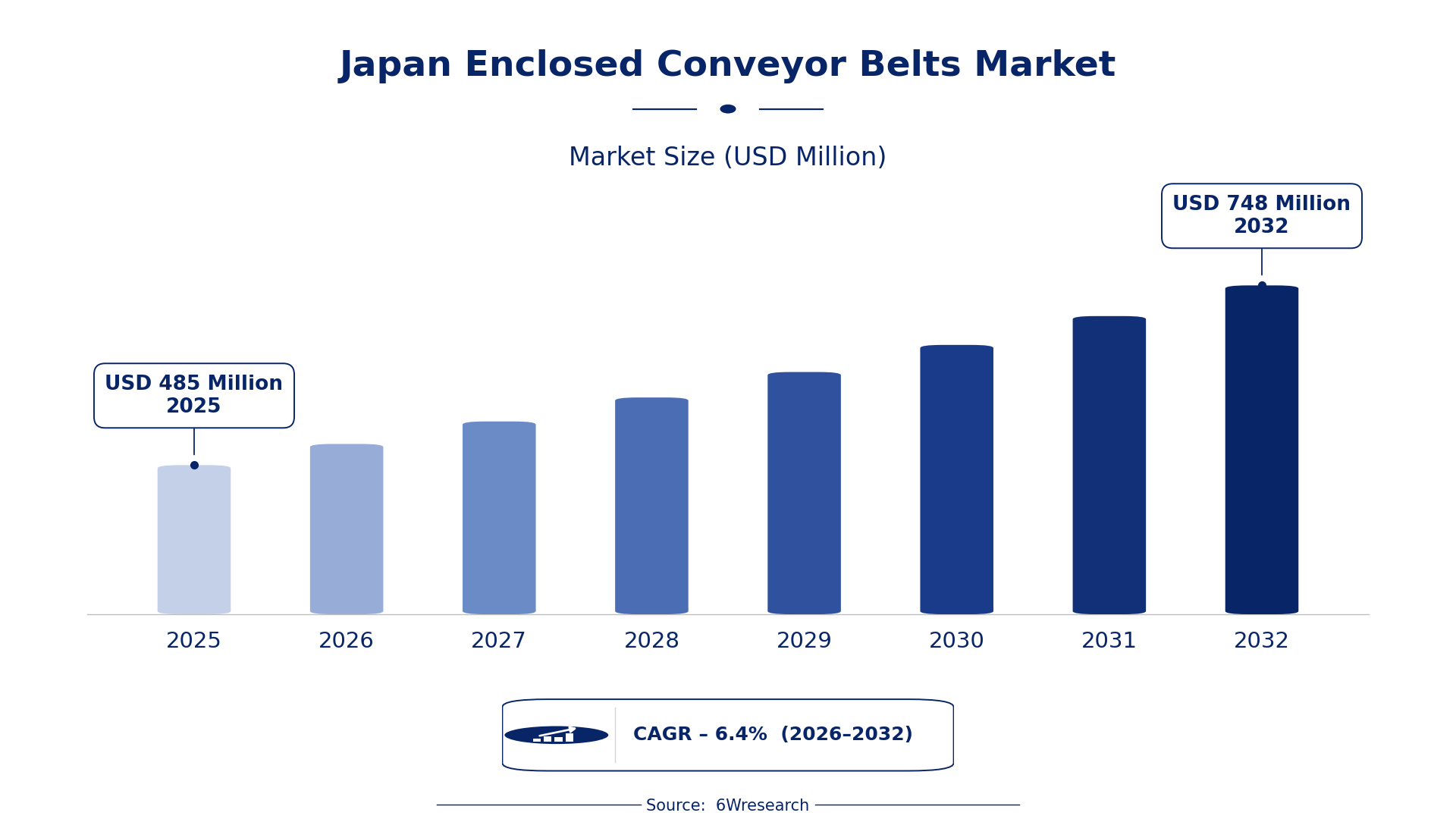
According to 6Wresearch internal database and industry insights, the Japan Enclosed Conveyor Belts Market was valued at USD 485 Million in 2025 and is projected to reach USD 748 Million by 2032, growing at a CAGR of approximately 6.4% during 2026–2032.
Japan Enclosed Conveyor Belts Market Highlights
| Report Metric | Details |
| Report Name | Japan Enclosed Conveyor Belts Market (2026-2032) |
| Market Size 2025 | USD 485 Million |
| Market Size 2032 | USD 748 Million |
| Absolute Growth 2025–2032 | USD 263 Million |
| CAGR 2026–2032 | 6.4% |
| Peak Annual Growth | 7.1% in 2031 |
| Forecast Period | 2026–2032 |
| Historical Data | 2022–2025 |
| Base Year | 2025 |
| Leading Material, 2025 | Rubber (39% share) |
| Leading Design, 2025 | Flat Belt (37% share) |
| Leading Load Capacity, 2025 | Heavy Duty (39% share) |
| Leading Application, 2025 | Food and Beverage (41% share) |
| Leading Belt Width, 2025 | 24 to 36 inches (43% share) |
| Fastest-Growing Material | PVC (9.2% CAGR) |
| Fastest-Growing Design | Modular Belt (8.5% CAGR) |
| Fastest-Growing Load Capacity | Medium Duty (7.8% CAGR) |
| Fastest-Growing Application | Pharmaceuticals (9.1% CAGR) |
| Fastest-Growing Belt Width | Less than 24 inches (9.0% CAGR) |
| Growing Sector | Pharmaceuticals |
| Key End Users | Food and Beverage, Packaging, Pharmaceuticals, Automotive |
Japan Enclosed Conveyor Belts Market Year-wise Growth Rate and Key Drivers (2022–2032)
This graph illustrates the annual growth rates of the market from 2022 to 2032, highlighting a steady upward trajectory and projected market expansion over the forecast period.
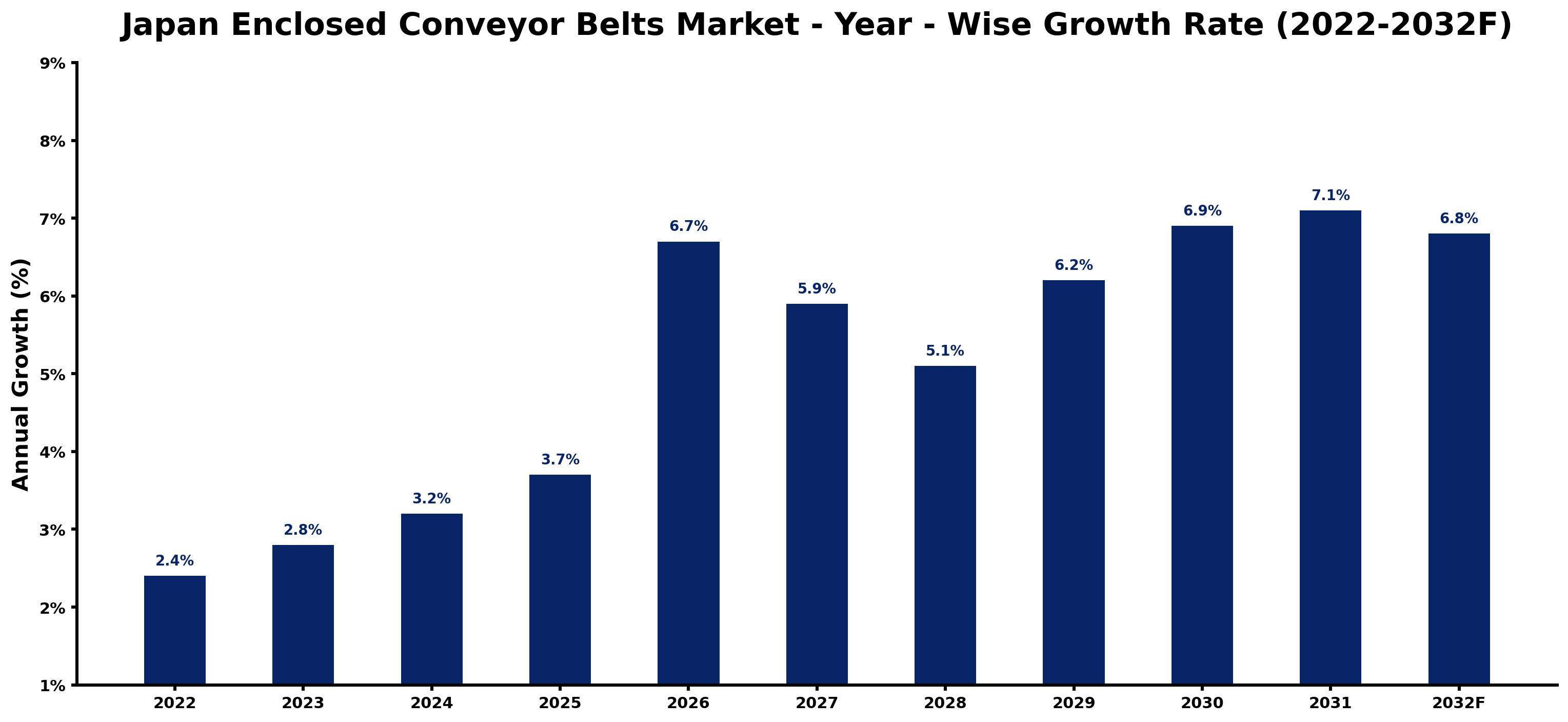
The following figures match every annual growth estimate with the main market development of that year, giving the reasoning behind each rise or slowdown.
| Year | Estimated Annual Growth (%) | Market Rationale |
| 2022 | 2.4 | The market experienced steady growth due to strong demand from the food processing sector. |
| 2023 | 2.8 | Investments in automation within manufacturing boosted conveyor belt usage. |
| 2024 | 3.2 | Demand continued to rise as the pharmaceutical industry expanded operations. |
| 2025 | 3.7 | Growth accelerated with the food processing industry's value reaching 20 trillion yen. |
| 2026 | 6.7 | The market is expected to see a rise driven by automation initiatives in manufacturing. |
| 2027 | 5.9 | Demand growth is projected to slow as the market adjusts to high investment levels. |
| 2028 | 5.1 | The growth rate is expected to continue decelerating amid stabilising demand from sectors. |
| 2029 | 6.2 | A resurgence in demand is anticipated as the logistics sector adopts more automation. |
| 2030 | 6.9 | Continued investment in manufacturing equipment will contribute to rising demand for conveyor systems. |
| 2031 | 7.1 | The market is projected to peak with strong growth driven by production increases in the automotive sector. |
| 2032 | 6.8 | Demand growth is expected to slow as market conditions stabilise in response to peaks. |
Note: Market size estimations and growth projections presented in this report are based on 6Wresearch's proprietary forecasting methodology, utilizing the latest available industry data, government publications, and primary research inputs.
Japan Enclosed Conveyor Belts Market Synopsis
Enclosed conveyor belts, made from materials like PVC, rubber, and steel, transport materials efficiently in a contained environment. They are widely used in food processing, pharmaceuticals, and mining. The Japan Enclosed Conveyor Belts Market is expanding due to the food processing industry's value of approximately 20 trillion yen and the pharmaceutical sector's projected growth to 10 trillion yen by 2025. Automation in manufacturing and the logistics sector's shift towards automation are also driving demand.
Market Dynamics Impact Analysis (2026–2032)
| Factor | Type | Impact | Primary Segment Affected |
| Growing automation in manufacturing processes | Driver | High | Modular Belt |
| Expansion of the food processing industry | Driver | High | Food and Beverage |
| Increased demand for hygienic conveyor systems | Opportunity | High | Pharmaceuticals |
| Rising investments in packaging automation | Opportunity | High | Packaging |
| High initial investment costs for advanced systems | Restraint | Medium | Heavy Duty |
| Limited awareness of conveyor belt benefits in smaller firms | Restraint | Medium | Light Duty |
| Competition from alternative material handling solutions | Challenge | High | Flat Belt |
| Supply chain disruptions affecting raw material availability | Challenge | High | Rubber |
Evaluation of Drivers in Japan Enclosed Conveyor Belts Market (2026–2032)
Demand rests on the following drivers, each shown with the segment it touches most.
| Drivers | Primary Segment Affected | Why It Matters (Evidence) |
| Increased production in the automotive sector | Automotive | The automotive industry produced over 8 million vehicles in 2022, necessitating efficient material handling. |
| Expansion of the pharmaceutical sector | Pharmaceuticals | The pharmaceutical industry is projected to grow to 10 trillion yen by 2025, increasing demand for hygienic conveyor systems. |
| Growth in the food processing industry | Food and Beverage | Japan's food processing industry is valued at approximately 20 trillion yen, driving demand for enclosed conveyor belts. |
| Adoption of automation in logistics | Rubber | The logistics sector in Japan is increasingly adopting automation, increasing the need for enclosed conveyor systems. |
| Investment in manufacturing equipment | Rubber | The government announced a subsidy of 5 billion yen for upgrading manufacturing equipment, including conveyor systems. |
What keeps demand rising is the expansion of the pharmaceutical sector, projected to grow to 10 trillion yen by 2025, increasing the need for hygienic conveyor systems. The food processing industry, valued at approximately 20 trillion yen, also drives demand. In 2022, the automotive sector produced over 8 million vehicles, necessitating efficient material handling solutions. The logistics sector's shift towards automation is creating a greater need for enclosed conveyor systems, as companies seek to improve efficiency with new technologies.
Evaluation of Restraints in Japan Enclosed Conveyor Belts Market
The key brakes on demand, and where they bite hardest, are shown below.
| Market Restraint | Primary Segment Affected | Why It Matters (Evidence) |
| Lack of skilled technicians for maintenance | Food and Beverage | Buyers in the food processing sector struggle with a lack of skilled technicians for conveyor system maintenance, leading to increased downtime. |
| High manufacturing costs due to compliance | Automotive | Suppliers face high manufacturing costs due to stringent compliance with ISO 9001 standards, inflating prices for buyers. |
| Competition from alternative solutions | Rubber | Competition from automated guided vehicles threatens the market share of enclosed conveyor belts in the logistics sector. |
| Supply chain disruptions | Steel | Supply chain disruptions in sourcing raw materials like steel can delay deliveries by several weeks, impacting production schedules. |
| Rising raw material prices | Pharmaceuticals | Increasing prices of raw materials affect the overall cost structure for manufacturers of enclosed conveyor belts. |
Japan Enclosed Conveyor Belts Market Challenges
High maintenance costs challenge buyers in the food processing sector, as the need for specialised technicians can increase operational expenses by up to 15%. Suppliers encounter elevated production costs due to compliance with ISO 9001 standards, which can inflate prices by 20%, directly affecting buyers’ budgets. Intense competition from alternative material handling solutions, such as automated guided vehicles, pressures suppliers, particularly those in the logistics sector, to lower prices. Disruptions in sourcing raw materials like steel can delay deliveries by several weeks, causing production schedule setbacks for manufacturers reliant on timely supply.
Trends in the Japan Enclosed Conveyor Belts Market
Four trends stand out in the Japan Enclosed Conveyor Belts Market.
- Shift Towards Automation in Food Processing: The Tokyo metropolitan area is experiencing a shift towards automation in food processing, with a 15% increase in the use of modular belts due to hygiene concerns. This trend is prompting suppliers to innovate in their product offerings.
- Increase in Heavy Duty Conveyor Belts: There is a growing demand for heavy-duty conveyor belts in the mining sector, particularly in Hokkaido and Akita Prefecture, where mining activities are concentrated. This shift is driving sales in this category.
- Adoption of Hygienic Standards in Pharmaceuticals: The pharmaceutical industry is increasingly prioritising hygienic design standards for conveyor belts, adhering to JIS Z 2801. This trend reflects the industry's commitment to maintaining strict health standards.
- Growth of Modular Belt Applications: Modular belts are becoming more popular in the food and beverage sector, driven by their easy cleaning features. This trend is expected to continue as hygiene becomes a top priority.
Investment Opportunities in the Japan Enclosed Conveyor Belts Market
The opportunities below stand out in the Japan Enclosed Conveyor Belts Market for new entrants and existing suppliers.
- Investment in Automation Technology: Now is the ideal time to invest in automation technology, as the logistics sector is projected to increase conveyor belt usage by 30%. Companies in the logistics sector are seeking efficient material handling solutions.
- Supply of Hygienic Conveyor Systems: With the pharmaceutical sector projected to grow to 10 trillion yen by 2025, there is an opportunity to supply hygienic conveyor systems. Partnering with pharmaceutical manufacturers can facilitate market entry.
- Expansion in Food Processing: The food processing industry, valued at approximately 20 trillion yen, presents opportunities for suppliers of enclosed conveyor belts. Collaborating with food processing facilities can enhance market reach.
- Development of Heavy Duty Solutions: Investing in heavy-duty conveyor solutions is timely, especially in mining areas like Hokkaido. Establishing partnerships with mining companies can open new avenues for growth.
Government Initiatives in the Japan Enclosed Conveyor Belts Market
The Economic Security Promotion Act (2022) supports supply-chain resilience for critical products, adding to the framework established by previous laws. This measure aims to ensure that producers of enclosed conveyor belts can maintain a stable supply of materials and meet industry standards.
In 2023, the Ministry of Economy, Trade and Industry launched a program with a budget of 5 billion yen to enhance automation in manufacturing. This initiative is administered by the Japan Industrial Standards Committee, which oversees regulations for industrial equipment, including conveyor belts.
Future Insight of the Japan Enclosed Conveyor Belts Market
By 2032, automation in manufacturing will reshape demand for enclosed conveyor belts, as government initiatives promote efficiency. The food processing sector will adopt more automated systems, reflecting a trend towards streamlined operations. The pharmaceutical sector will increasingly require hygienic solutions, aligning with evolving health standards. The logistics sector's shift towards automation is expected to boost conveyor belt usage by 30%, as companies seek enhanced material handling efficiency.
Market Segmentation Analysis
Japan Enclosed Conveyor Belts Market report covers a detailed analysis of the following market segments:
By Material – Rubber Leads, PVC Expected to Grow Fastest
According to Ravi Bhandari, Research Head at 6Wresearch, the largest material category in 2025 was Rubber, at 39% of revenue. Rubber holds the largest share in the market due to its exceptional durability and strength, making it essential for heavy-duty applications like mining. The steel industry in Japan relies heavily on rubber conveyor belts for transporting substantial materials, reinforcing its leading position. The quickest growth will come from PVC, forecast to expand at a CAGR of 9.2% between 2026 and 2032. PVC is experiencing rapid growth, especially in the food processing sector where hygiene is paramount. The 15% increase in the use of modular belts in food processing over the last five years highlights this significant trend. Suppliers should focus on enhancing the hygienic features of their PVC products to capitalise on the rising demand in the food processing industry.
By Design – Flat Belt Leads, Modular Belt Expected to Grow Fastest
Flat Belt accounted for 37% of the market by design in 2025. Flat belts are the leading design choice as they are widely used for general applications across various industries. Their adaptability makes them suitable for numerous material handling tasks, ensuring their market dominance. Over 2026–2032, Modular Belt is expected to post the fastest growth, at a CAGR of 8.5%. Modular belts are experiencing the fastest growth, especially in the food and beverage sector where easy cleaning is vital. The heightened focus on hygiene in food processing is propelling this trend forward. Manufacturers should invest in modular belt technology to align with the rising hygiene standards in the food and beverage industry.
By Load Capacity – Heavy Duty Leads, Medium Duty Expected to Grow Fastest
Heavy Duty took 39% of load capacity revenue in 2025, more than any other category. Heavy-duty conveyor belts dominate the market as they are vital for transporting heavy materials in mining operations. The concentration of mining activities in regions like Hokkaido and Akita Prefecture underlines the strength of this segment. Medium Duty is projected to grow fastest, at a CAGR of 7.8% during 2026–2032. Medium-duty belts are seeing rapid growth, being commonly used in general manufacturing applications that are expanding due to increased automation. This trend is likely to continue as manufacturers upgrade their equipment. Suppliers should ensure a robust portfolio of medium-duty belts to address the growing needs of the manufacturing sector.
By Application – Food and Beverage Leads, Pharmaceuticals Expected to Grow Fastest
With 41% of application revenue in 2025, Food and Beverage was the largest category. The food and beverage sector holds the largest share as it is a primary application area for enclosed conveyor belts, supported by Japan's food processing industry valued at approximately 20 trillion yen. The concentration of food processing facilities in the Tokyo metropolitan area further drives demand. Pharmaceuticals are set to record the highest CAGR in this split, 9.1% over 2026–2032. Pharmaceutical applications are growing swiftly due to the strict hygiene standards required, with the sector projected to reach 10 trillion yen by 2025. This growth highlights the increasing need for hygienic conveyor systems. Suppliers should focus on developing conveyor solutions that meet the stringent hygiene requirements of the pharmaceutical industry.
By Belt Width – 24 to 36 inches Lead, Less than 24 inches Expected to Grow Fastest
In 2025, 24 to 36 inches led the belt width split with a 43% share. Belt widths of 24 to 36 inches are the most common as they cater to a variety of industrial applications, providing a standard solution for many processing lines. This width is particularly well-suited for the robust food processing sector in Japan. The quickest growth will come from Less than 24 inches, forecast to expand at a CAGR of 9.0% between 2026 and 2032. Belt widths of less than 24 inches are growing quickly, primarily used in small-scale applications where space constraints are a factor. The trend towards automation in logistics further drives this growth. Manufacturers should consider expanding their range of narrower belts to meet the rising demand for small-scale applications.
Key Attractiveness of the Report
- 10 Years of Market Numbers
- Historical Data Starting from 2022 to 2025
- Base Year 2025
- Forecast Data until 2032
- Key Performance Indicators Impacting the Market
- Major Upcoming Developments and Projects
Key Highlights of the Report:
- Japan Enclosed Conveyor Belts Market Outlook
- Market Size of Japan Enclosed Conveyor Belts Market,2025
- Forecast of Japan Enclosed Conveyor Belts Market, 2032
- Historical Data and Forecast of Japan Enclosed Conveyor Belts Revenues & Volume for the Period 2022-2032
- Japan Enclosed Conveyor Belts Market Trend Evolution
- Japan Enclosed Conveyor Belts Market Drivers and Challenges
- Japan Enclosed Conveyor Belts Price Trends
- Japan Enclosed Conveyor Belts Porter's Five Forces
- Japan Enclosed Conveyor Belts Industry Life Cycle
- Historical Data and Forecast of Japan Enclosed Conveyor Belts Market Revenues & Volume By Material for the Period 2022-2032
- Historical Data and Forecast of Japan Enclosed Conveyor Belts Market Revenues & Volume By PVC for the Period 2022-2032
- Historical Data and Forecast of Japan Enclosed Conveyor Belts Market Revenues & Volume By Rubber for the Period 2022-2032
- Historical Data and Forecast of Japan Enclosed Conveyor Belts Market Revenues & Volume By Polyester for the Period 2022-2032
- Historical Data and Forecast of Japan Enclosed Conveyor Belts Market Revenues & Volume By Steel for the Period 2022-2032
- Historical Data and Forecast of Japan Enclosed Conveyor Belts Market Revenues & Volume By Composite for the Period 2022-2032
- Historical Data and Forecast of Japan Enclosed Conveyor Belts Market Revenues & Volume By Design for the Period 2022-2032
- Historical Data and Forecast of Japan Enclosed Conveyor Belts Market Revenues & Volume By Flat Belt for the Period 2022-2032
- Historical Data and Forecast of Japan Enclosed Conveyor Belts Market Revenues & Volume By Modular Belt for the Period 2022-2032
- Historical Data and Forecast of Japan Enclosed Conveyor Belts Market Revenues & Volume By Wire Mesh for the Period 2022-2032
- Historical Data and Forecast of Japan Enclosed Conveyor Belts Market Revenues & Volume By Roller Bed for the Period 2022-2032
- Historical Data and Forecast of Japan Enclosed Conveyor Belts Market Revenues & Volume By Combination for the Period 2022-2032
- Historical Data and Forecast of Japan Enclosed Conveyor Belts Market Revenues & Volume By Load Capacity for the Period 2022-2032
- Historical Data and Forecast of Japan Enclosed Conveyor Belts Market Revenues & Volume By Light Duty for the Period 2022-2032
- Historical Data and Forecast of Japan Enclosed Conveyor Belts Market Revenues & Volume By Medium Duty for the Period 2022-2032
- Historical Data and Forecast of Japan Enclosed Conveyor Belts Market Revenues & Volume By Heavy Duty for the Period 2022-2032
- Historical Data and Forecast of Japan Enclosed Conveyor Belts Market Revenues & Volume By Extra Heavy Duty for the Period 2022-2032
- Historical Data and Forecast of Japan Enclosed Conveyor Belts Market Revenues & Volume By Application for the Period 2022-2032
- Historical Data and Forecast of Japan Enclosed Conveyor Belts Market Revenues & Volume By Food and Beverage for the Period 2022-2032
- Historical Data and Forecast of Japan Enclosed Conveyor Belts Market Revenues & Volume By Mining and Minerals for the Period 2022-2032
- Historical Data and Forecast of Japan Enclosed Conveyor Belts Market Revenues & Volume By Pharmaceuticals for the Period 2022-2032
- Historical Data and Forecast of Japan Enclosed Conveyor Belts Market Revenues & Volume By Packaging for the Period 2022-2032
- Historical Data and Forecast of Japan Enclosed Conveyor Belts Market Revenues & Volume By Automotive for the Period 2022-2032
- Historical Data and Forecast of Japan Enclosed Conveyor Belts Market Revenues & Volume By Belt Width for the Period 2022-2032
- Historical Data and Forecast of Japan Enclosed Conveyor Belts Market Revenues & Volume By Less than 24 inches for the Period 2022-2032
- Historical Data and Forecast of Japan Enclosed Conveyor Belts Market Revenues & Volume By 24 to 36 inches for the Period 2022-2032
- Historical Data and Forecast of Japan Enclosed Conveyor Belts Market Revenues & Volume By 36 to 48 inches for the Period 2022-2032
- Historical Data and Forecast of Japan Enclosed Conveyor Belts Market Revenues & Volume By 48 to 60 inches for the Period 2022-2032
- Historical Data and Forecast of Japan Enclosed Conveyor Belts Market Revenues & Volume By More than 60 inches for the Period 2022-2032
- Japan Enclosed Conveyor Belts Import Export Trade Statistics
- Market Opportunity Assessment By Material
- Market Opportunity Assessment By Design
- Market Opportunity Assessment By Load Capacity
- Market Opportunity Assessment By Application
- Market Opportunity Assessment By Belt Width
- Japan Enclosed Conveyor Belts Top Companies Market Share
- Japan Enclosed Conveyor Belts Competitive Benchmarking By Technical and Operational Parameters
- Japan Enclosed Conveyor Belts Company Profiles
- Japan Enclosed Conveyor Belts Key Strategic Recommendations
Market Covered
This report examines the market across the segments below.
By Material
- PVC
- Rubber
- Polyester
- Steel
- Composite
By Design
- Flat Belt
- Modular Belt
- Wire Mesh
- Roller Bed
- Combination
By Load Capacity
- Light Duty
- Medium Duty
- Heavy Duty
- Extra Heavy Duty
By Application
- Food and Beverage
- Mining and Minerals
- Pharmaceuticals
- Packaging
- Automotive
By Belt Width
- Less than 24 inches
- 24 to 36 inches
- 36 to 48 inches
- 48 to 60 inches
- More than 60 inches































