Japan Energy Efficiency Market Size & Growth Rate
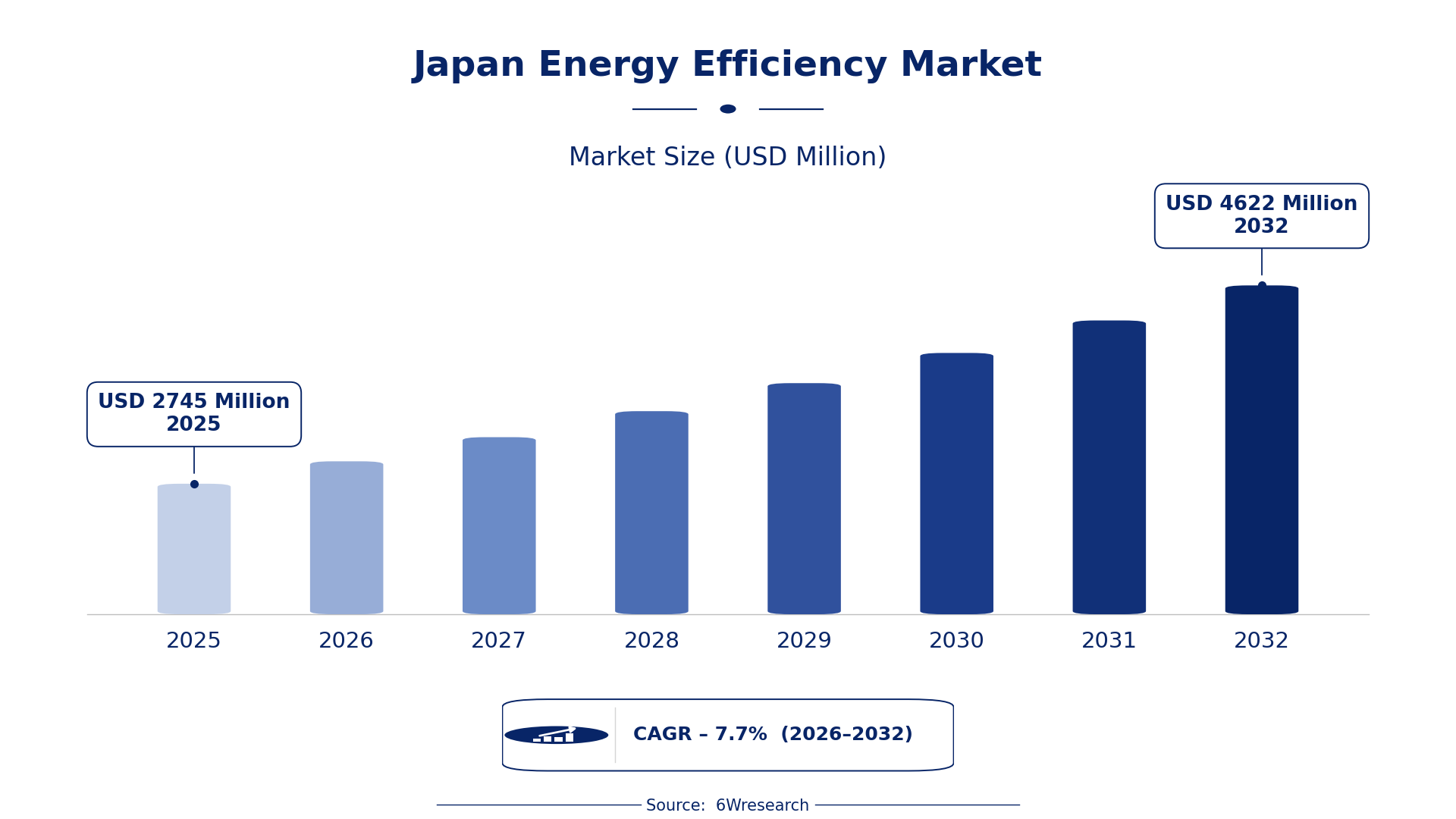
According to 6Wresearch internal database and industry insights, the Japan Energy Efficiency Market was valued at USD 2,745 Million in 2025 and is projected to reach USD 4,622 Million by 2032, growing at a CAGR of approximately 7.7% during 2026–2032.
Japan Energy Efficiency Market Highlights
| Report Metric | Details |
| Report Name | Japan Energy Efficiency Market (2026-2032) |
| Market Size 2025 | USD 2,745 Million |
| Market Size 2032 | USD 4,622 Million |
| Absolute Growth 2025–2032 | USD 1,877 Million |
| CAGR 2026–2032 | 7.7% |
| Peak Annual Growth | 9.2% in 2026 |
| Forecast Period | 2026–2032 |
| Historical Data | 2022–2025 |
| Base Year | 2025 |
| Leading Efficiency Solution, 2025 | Smart Meters (41% share) |
| Leading Technology Used, 2025 | IoT (45% share) |
| Leading Application Area, 2025 | Industrial (39% share) |
| Leading End User, 2025 | Utility Companies (37% share) |
| Fastest-Growing Efficiency Solution | Energy Optimization SW (9.8% CAGR) |
| Fastest-Growing Technology Used | AI-Based (10.8% CAGR) |
| Fastest-Growing Application Area | Commercial (8.9% CAGR) |
| Growing Sector | Urban Infrastructure |
| Key End Users | Utility Companies, Government Agencies, Facility Managers |
Japan Energy Efficiency Market Year-wise Growth Rate and Key Drivers (2022–2032)
This graph illustrates the annual growth rates of the market from 2022 to 2032, highlighting a steady upward trajectory and projected market expansion over the forecast period.
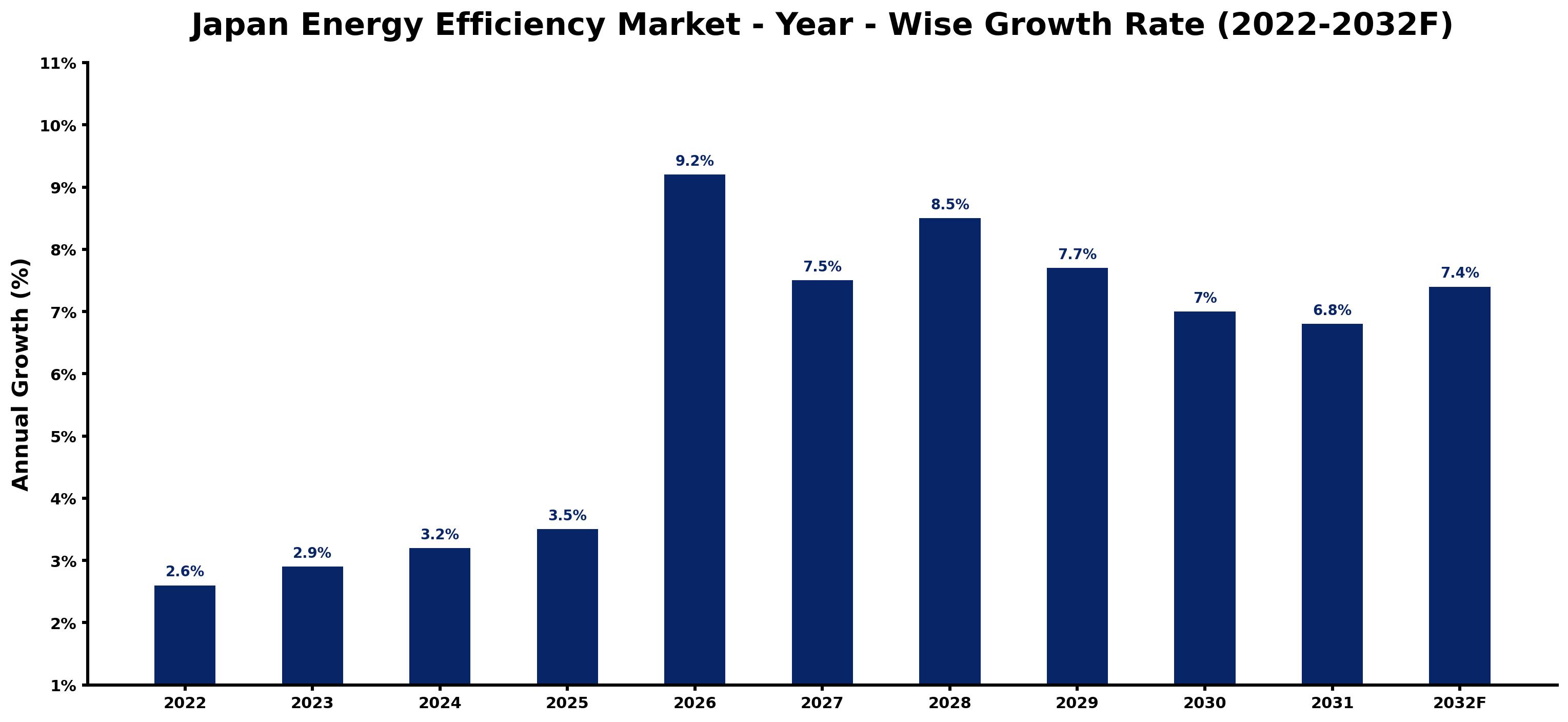
For each year, the table pairs the estimated growth rate with the leading influence on demand, showing how the drivers changed across the period.
| Year | Estimated Annual Growth (%) | Market Rationale |
| 2022 | 2.6 | The market experienced steady growth, driven by increasing awareness of energy efficiency. |
| 2023 | 2.9 | Demand for energy-saving technologies expanded as the government promoted energy conservation initiatives. |
| 2024 | 3.2 | The implementation of smart meters gained traction, leading to higher energy management efficiency. |
| 2025 | 3.5 | Growth accelerated as investments in energy optimization increased due to market demand. |
| 2026 | 9.2 | The market is expected to peak due to substantial public and private investment in decarbonisation initiatives. |
| 2027 | 7.5 | Growth is projected to slow as the market adjusts to the high demand levels achieved in previous years. |
| 2028 | 8.5 | Demand is expected to surge again as new energy efficiency technologies become widely adopted. |
| 2029 | 7.7 | The market will continue to grow but at a slower pace as competition intensifies. |
| 2030 | 7.0 | Growth is projected to moderate as buyers focus on consolidating their energy efficiency gains. |
| 2031 | 6.8 | The market will maintain a steady growth rate as more energy-efficient solutions become available. |
| 2032 | 7.4 | Demand is expected to increase as the government sets ambitious targets for energy consumption reduction. |
Note: Market size estimations and growth projections presented in this report are based on 6Wresearch's proprietary forecasting methodology, utilizing the latest available industry data, government publications, and primary research inputs.
Japan Energy Efficiency Market Synopsis
Energy efficiency in Japan centres on reducing energy consumption through technologies such as smart meters and efficient lighting systems. Strong demand from utility companies, industrial sectors, and government initiatives promoting energy conservation drives the Japan Energy Efficiency Market. Investments, including the JPY 150 trillion earmarked for decarbonisation, are set to further stimulate market growth, leading to a projected size of USD 4,622 million by 2032.
Market Dynamics Impact Analysis (2026–2032)
| Factor | Type | Impact | Primary Segment Affected |
| Growing demand for energy-efficient solutions from utility companies | Driver | High | Utility Companies |
| Increased adoption of smart meters and energy optimization software | Driver | High | Smart Meters |
| Investment opportunities in urban energy efficiency projects | Opportunity | High | Urban Infra |
| Rising need for energy management in commercial buildings | Opportunity | High | Commercial |
| High initial costs of energy-efficient technologies | Restraint | Medium | Efficient Lighting Systems |
| Limited awareness among small businesses about energy efficiency benefits | Restraint | Medium | Energy Optimization SW |
| Competition among suppliers leading to price wars | Challenge | High | Energy Optimization SW |
| Technological advancements outpacing current infrastructure | Challenge | Medium | Smart Meters |
Evaluation of Drivers in Japan Energy Efficiency Market (2026–2032)
The table below links each growth driver to the segment it affects and the evidence for it.
| Drivers | Primary Segment Affected | Why It Matters (Evidence) |
| Increasing energy consumption in residential areas | Residential | The average household consumes approximately 3,000 kWh annually, prompting investments in energy-saving technologies. |
| Government initiatives promoting energy efficiency | Government Agencies | The Energy Efficiency Labeling Program helps consumers identify energy-efficient products, boosting demand. |
| Adoption of LED lighting in commercial buildings | Efficient Lighting Systems | By 2023, LED adoption reached 70% in commercial buildings, driving further purchases of energy-efficient lighting. |
| Growth in urban infrastructure projects | Urban Infra | The Tokyo Metropolitan Government aims for a 30% reduction in greenhouse gas emissions by 2030, enhancing energy efficiency demand. |
| Rising investments in AI for energy management | AI-Based | The government encourages AI adoption through grants, increasing demand for advanced energy management solutions. |
Buyers are expanding capacity as utility companies strive to enhance energy management, with over 10 million smart meters installed throughout Japan. The average household consumes around 3,000 kWh annually, creating demand for energy optimisation software. The goal to cut greenhouse gas emissions by 30% by 2030 fuels investments in energy-efficient technologies. The rise of LED lighting in commercial buildings has spurred additional purchases of energy-saving solutions.
Evaluation of Restraints in Japan Energy Efficiency Market
The table below lists the restraints and the evidence behind each.
| Market Restraint | Primary Segment Affected | Why It Matters (Evidence) |
| High initial costs of implementing energy-efficient technologies | Efficient Lighting Systems | The upfront investment required for LED technology can deter smaller businesses from adopting solutions. |
| Limited awareness about energy efficiency benefits among small businesses | Energy Optimization SW | Many small enterprises are unaware of the advantages of energy optimization, resulting in lower adoption rates. |
| Regulatory compliance costs for energy efficiency standards | Smart Meters | Meeting requirements from the Act on the Rational Use of Energy can impose financial burdens on producers. |
| Resistance to change from traditional energy practices | Demand-Side Management | Many consumers and businesses prefer familiar energy consumption methods over new efficiency practices. |
| Technological advancements outpacing current infrastructure | AI-Based | Existing systems may not support the integration of advanced AI solutions, limiting their effectiveness. |
Japan Energy Efficiency Market Challenges
In 2023, Japan is grappling with a shortage of key components for energy efficiency technologies, which delays project timelines for suppliers and escalates costs for buyers. Regulatory complexities stemming from the Energy Conservation Act complicate compliance for hospitals and clinics, resulting in higher operational costs and potential fines. Buyers are facing rising energy expenses, as the average household consumption stands at approximately 3,000 kWh annually, compelling them to explore alternative solutions. High initial costs impede technology adoption, preventing producers from investing in advanced energy management systems, ultimately limiting their competitiveness in the market.
Trends in the Japan Energy Efficiency Market
The trends below show where the Japan Energy Efficiency Market is heading.
- Shift in Focus to Urban Energy Efficiency: Utility companies are increasingly prioritising urban energy efficiency projects, spurred by the Tokyo Metropolitan Government's 30% emission reduction target by 2030. This trend has led to a surge in demand for energy-efficient technologies, with investments expected to exceed ¥50 billion.
- Transition to Smart Energy Solutions: In 2022, the launch of the 'Smart Energy City' initiative marked a shift towards smart energy solutions in Japan. This initiative aims to integrate advanced technologies, resulting in increased energy efficiency across urban areas, with over 10 million smart meters already installed.
- Emergence of AI in Energy Management: The adoption of AI-based solutions in energy management is gaining traction, supported by government grants. This shift is expected to improve efficiency measures, with an anticipated CAGR of 10.8% for AI-based technologies by 2032.
- Growing Demand for LED Lighting: The adoption of LED lighting technologies is rapidly increasing, with 70% penetration in commercial buildings by 2023. This trend reflects a broader commitment to energy efficiency, as businesses seek to reduce operational costs and environmental impact.
Investment Opportunities in the Japan Energy Efficiency Market
Several openings in the Japan Energy Efficiency Market merit attention from investors.
- Investment in Urban Energy Efficiency Projects: Utility companies are actively seeking solutions for urban energy efficiency, with the government allocating ¥50 billion for related projects. This presents a prime opportunity for suppliers to collaborate with local governments and penetrate the market.
- Expansion of Energy Optimization Software: With a rising demand for energy management solutions, suppliers can invest in energy optimisation software. The residential sector, which accounts for 30% of total energy consumption, offers a significant growth opportunity.
- Partnerships for Smart Meter Implementation: Utility companies are keen to advance their smart meter installations, which have exceeded 10 million units. Collaborating with local partners can facilitate entry into this growing market segment.
- Development of AI-Based Energy Solutions: The increasing emphasis on AI in energy management presents a valuable opportunity for suppliers. The government promotes AI adoption through grants, making this an appealing area for investment.
Government Initiatives in the Japan Energy Efficiency Market
The Act on the Rational Use of Energy (1979; METI) mandates large energy users to improve energy efficiency and report their energy use. This legislation has established the foundation for energy efficiency standards in Japan, significantly influencing the market. The Hydrogen Society Promotion Act (2024) supports low-carbon hydrogen and ammonia supply chains with price-gap support, encouraging investment in cleaner energy alternatives.
The Japan Energy Agency supervises energy efficiency initiatives, funding various projects to improve energy management. In 2023, the government allocated ¥50 billion for energy efficiency projects in urban areas, assisting utility companies and facility managers in implementing energy-saving measures.
Future Insight of the Japan Energy Efficiency Market
The 'Smart Energy City' initiative will propel urban energy efficiency projects by 2032, enhancing collaboration between public and private sectors. The government aims for a 20% reduction in energy consumption by 2030, prompting suppliers to innovate and develop new solutions. With a projected ¥150 trillion investment in decarbonisation over the next decade, buyers will gain access to advanced technologies. ISO 50001 adoption will standardise energy management systems, streamlining the implementation of energy-saving technologies across various sectors.
Market Segmentation Analysis
Japan Energy Efficiency Market report covers a detailed analysis of the following market segments:
By Efficiency Solution – Smart Meters Lead, Energy Optimization SW Expected to Grow Fastest
According to Saurav Kr Singh, Senior Research Analyst at 6Wresearch, Smart Meters accounted for 41% of the market by efficiency solution in 2025. Smart meters dominate this segment as they are crucial for monitoring energy usage, with over 10 million units installed in Japan by 2023. Their importance is highlighted by government initiatives like the 'Smart Energy City' programme that encourages the integration of energy-saving technologies. Energy Optimization SW is set to record the highest CAGR in this split, 9.8% over 2026–2032. Energy optimization software is rapidly gaining traction as businesses increasingly prioritise energy efficiency, supported by government grants that stimulate the adoption of such solutions. This growth is likely to continue as firms strive to meet ambitious energy reduction targets. Suppliers should focus on creating integrated solutions that combine smart meters and energy optimization software to address the growing demand.
By Technology Used – IoT Leads, AI-Based Expected to Grow Fastest
IoT held 45% of the Japan Energy Efficiency Market by technology used in 2025. The IoT segment leads the market by facilitating connectivity that supports energy efficiency, enabling effective monitoring and control of energy systems. Its integration across various applications enhances energy management strategies, making it a vital component of the market. AI-Based is projected to grow fastest, at a CAGR of 10.8% during 2026–2032. AI-based technologies are experiencing rapid growth as they refine energy management solutions, allowing for more accurate analytics and decision-making. The increasing emphasis on smarter energy systems will likely accelerate this growth as companies seek efficiency improvements. Buyers should invest in IoT and AI-based technologies to optimise energy management and maintain competitiveness in a changing market.
By Application Area – Industrial Leads, Commercial Expected to Grow Fastest
The largest application area category in 2025 was Industrial, at 39% of revenue. The industrial sector is the largest application area for energy optimization, accounting for a substantial share of energy consumption. This sector's commitment to reducing energy use aligns with government goals to lower emissions, driving significant investments in energy efficiency. Over 2026–2032, Commercial is expected to post the fastest growth, at a CAGR of 8.9%. The commercial sector is growing the fastest as businesses adopt energy-saving technologies to reduce operational costs and comply with efficiency standards. This trend is propelled by heightened sustainability awareness and regulatory pressures, further increasing demand. Suppliers must customise their offerings to cater to the commercial sector, which is swiftly embracing energy-efficient solutions.
By End User – Utility Companies Lead and Record the Fastest Growth
Utility Companies took 37% of end user revenue in 2025, more than any other category. Utility companies are the dominant end user, playing a critical role in implementing energy efficiency initiatives that shape energy management practices nationwide. Their influence is pivotal in promoting the adoption of technologies that enhance energy conservation. The same category are also set to grow fastest, at a CAGR of 9.6% during 2026–2032. Utility companies are also the fastest-growing end user as they broaden their services to include energy efficiency solutions for clients, motivated by regulatory demands and market trends favouring sustainability. Their leading position reinforces their significance in the energy efficiency market. Suppliers should establish robust partnerships with utility companies to strengthen their market presence and leverage their influence in advancing energy efficiency.
Key Attractiveness of the Report
- 10 Years of Market Numbers
- Historical Data Starting from 2022 to 2025
- Base Year 2025
- Forecast Data until 2032
- Key Performance Indicators Impacting the Market
- Major Upcoming Developments and Projects
Key Highlights of the Report:
- Japan Energy Efficiency Market Outlook
- Market Size of Japan Energy Efficiency Market, 2025
- Forecast of Japan Energy Efficiency Market, 2032
- Historical Data and Forecast of Japan Energy Efficiency Revenues & Volume for the Period 2022-2032F
- Japan Energy Efficiency Market Trend Evolution
- Japan Energy Efficiency Market Drivers and Challenges
- Japan Energy Efficiency Price Trends
- Japan Energy Efficiency Porter's Five Forces
- Japan Energy Efficiency Industry Life Cycle
- Historical Data and Forecast of Japan Energy Efficiency Market Revenues & Volume By Efficiency Solution for the Period 2022-2032F
- Historical Data and Forecast of Japan Energy Efficiency Market Revenues & Volume By Smart Meters for the Period 2022-2032F
- Historical Data and Forecast of Japan Energy Efficiency Market Revenues & Volume By Energy Optimization SW for the Period 2022-2032F
- Historical Data and Forecast of Japan Energy Efficiency Market Revenues & Volume By Demand-Side Management for the Period 2022-2032F
- Historical Data and Forecast of Japan Energy Efficiency Market Revenues & Volume By Efficient Lighting Systems for the Period 2022-2032F
- Historical Data and Forecast of Japan Energy Efficiency Market Revenues & Volume By Technology Used for the Period 2022-2032F
- Historical Data and Forecast of Japan Energy Efficiency Market Revenues & Volume By IoT for the Period 2022-2032F
- Historical Data and Forecast of Japan Energy Efficiency Market Revenues & Volume By AI-Based for the Period 2022-2032F
- Historical Data and Forecast of Japan Energy Efficiency Market Revenues & Volume By Real-Time Data for the Period 2022-2032F
- Historical Data and Forecast of Japan Energy Efficiency Market Revenues & Volume By LED Technology for the Period 2022-2032F
- Historical Data and Forecast of Japan Energy Efficiency Market Revenues & Volume By Application Area for the Period 2022-2032F
- Historical Data and Forecast of Japan Energy Efficiency Market Revenues & Volume By Residential for the Period 2022-2032F
- Historical Data and Forecast of Japan Energy Efficiency Market Revenues & Volume By Industrial for the Period 2022-2032F
- Historical Data and Forecast of Japan Energy Efficiency Market Revenues & Volume By Commercial for the Period 2022-2032F
- Historical Data and Forecast of Japan Energy Efficiency Market Revenues & Volume By Urban Infra for the Period 2022-2032F
- Historical Data and Forecast of Japan Energy Efficiency Market Revenues & Volume By End User for the Period 2022-2032F
- Historical Data and Forecast of Japan Energy Efficiency Market Revenues & Volume By Utility Companies for the Period 2022-2032F
- Historical Data and Forecast of Japan Energy Efficiency Market Revenues & Volume By Power Plants for the Period 2022-2032F
- Historical Data and Forecast of Japan Energy Efficiency Market Revenues & Volume By Facility Managers for the Period 2022-2032F
- Historical Data and Forecast of Japan Energy Efficiency Market Revenues & Volume By Government Agencies for the Period 2022-2032F
- Japan Energy Efficiency Import Export Trade Statistics
- Market Opportunity Assessment By Efficiency Solution
- Market Opportunity Assessment By Technology Used
- Market Opportunity Assessment By Application Area
- Market Opportunity Assessment By End User
- Japan Energy Efficiency Top Companies Market Share
- Japan Energy Efficiency Competitive Benchmarking By Technical and Operational Parameters
- Japan Energy Efficiency Company Profiles
- Japan Energy Efficiency Key Strategic Recommendations
Market Covered
Coverage by segment is as follows.
By Efficiency Solution
- Smart Meters
- Energy Optimization SW
- Demand-Side Management
- Efficient Lighting Systems
By Technology Used
- IoT
- AI-Based
- Real-Time Data
- LED Technology
By Application Area
- Residential
- Industrial
- Commercial
- Urban Infra
By End User
- Utility Companies
- Power Plants
- Facility Managers
- Government Agencies






































