Japan Energy Infrastructure Market Size & Growth Rate
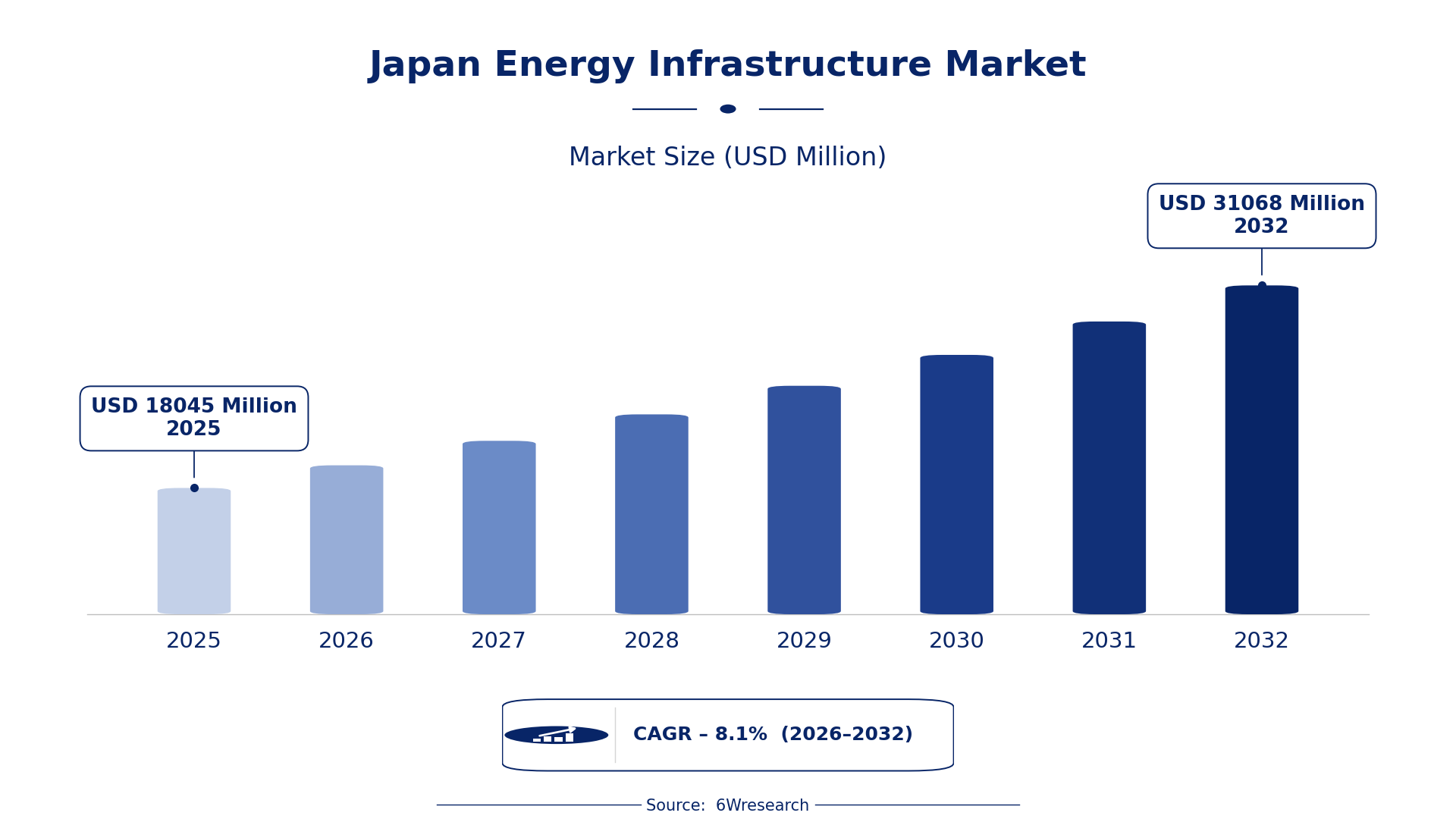
According to 6Wresearch internal database and industry insights, the Japan Energy Infrastructure Market was valued at USD 18,045 Million in 2025 and is projected to reach USD 31,068 Million by 2032, growing at a CAGR of approximately 8.1% during 2026–2032.
Japan Energy Infrastructure Market Highlights
| Report Metric | Details |
| Report Name | Japan Energy Infrastructure Market (2026-2032) |
| Market Size 2025 | USD 18,045 Million |
| Market Size 2032 | USD 31,068 Million |
| Absolute Growth 2025–2032 | USD 13,023 Million |
| CAGR 2026–2032 | 8.1% |
| Peak Annual Growth | 8.6% in 2032 |
| Forecast Period | 2026–2032 |
| Historical Data | 2022–2025 |
| Base Year | 2025 |
| Leading Infrastructure Type, 2025 | Grid Infrastructure (46% share) |
| Leading Component Focus, 2025 | Transmission Lines (32% share) |
| Leading Application Zone, 2025 | Urban Areas (47% share) |
| Leading End User, 2025 | Government Utilities (34% share) |
| Fastest-Growing Infrastructure Type | Substation Equipment (11.7% CAGR) |
| Fastest-Growing Component Focus | Transformers (12.0% CAGR) |
| Fastest-Growing Application Zone | Regional Grids (10.1% CAGR) |
| Fastest-Growing End User | Energy Distributors (10.3% CAGR) |
| Growing Sector | Regional Grids |
| Key End Users | Urban Areas, Regional Grids, Solar & Wind Farms, Rural Areas |
Japan Energy Infrastructure Market Year-wise Growth Rate and Key Drivers (2022–2032)
This graph illustrates the annual growth rates of the market from 2022 to 2032, highlighting a steady upward trajectory and projected market expansion over the forecast period.
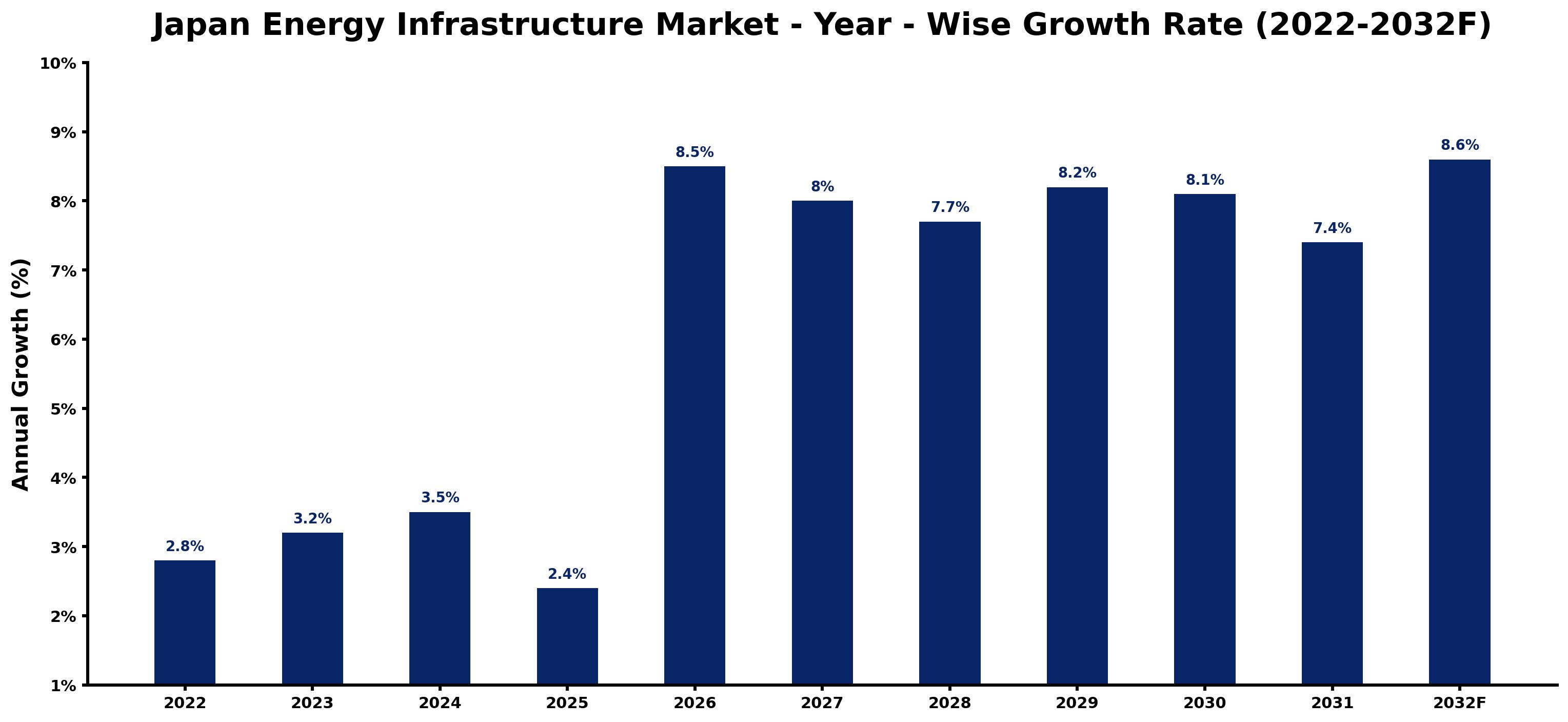
Below, each year's estimated growth is shown next to the factor that most influenced it.
| Year | Estimated Annual Growth (%) | Market Rationale |
| 2022 | 2.8 | The market experienced steady growth due to ongoing infrastructure projects. |
| 2023 | 3.2 | Demand increased as investments in renewable energy initiatives gained traction. |
| 2024 | 3.5 | Growth accelerated with the implementation of new energy efficiency standards. |
| 2025 | 2.4 | A slowdown occurred as some projects faced delays in funding and approvals. |
| 2026 | 8.5 | The market is expected to rebound with heightened investments in renewable energy infrastructure. |
| 2027 | 8.0 | Growth is projected to slow slightly as competition intensifies among energy distributors. |
| 2028 | 7.7 | Demand is expected to continue rising as urban areas expand energy requirements. |
| 2029 | 8.2 | The market is projected to see renewed growth driven by advancements in smart grid technology. |
| 2030 | 8.1 | A slight slowdown is expected as some renewable projects face regulatory hurdles. |
| 2031 | 7.4 | Growth will decelerate as the market adjusts to evolving energy policies. |
| 2032 | 8.6 | The market will peak with substantial investments in energy infrastructure projects. |
Note: Market size estimations and growth projections presented in this report are based on 6Wresearch's proprietary forecasting methodology, utilizing the latest available industry data, government publications, and primary research inputs.
Japan Energy Infrastructure Market Synopsis
Energy infrastructure in Japan encompasses systems for electricity generation, transmission, and distribution, with a primary emphasis on renewable sources. The Japan Energy Infrastructure Market is expanding due to the GX Basic Policy, which aims for JPY 150 trillion in decarbonisation investments over the next decade. With a target of 36% renewable electricity by 2030, demand from government utilities and energy distributors is increasing, driven by initiatives such as the Feed-in Tariff system.
Market Dynamics Impact Analysis (2026–2032)
| Factor | Type | Impact | Primary Segment Affected |
| Government initiatives promoting renewable energy integration | Driver | High | Renewable Integration |
| Investment in smart grid technologies enhancing efficiency | Driver | High | Smart Grid Tech |
| Growing urban populations increasing energy demands | Opportunity | High | Urban Areas |
| Expansion of regional grids to support energy distribution | Opportunity | High | Regional Grids |
| High costs associated with infrastructure upgrades | Restraint | Medium | Grid Infrastructure |
| Regulatory challenges hindering project approvals | Restraint | Medium | Substation Equipment |
| Competition among energy distributors affecting pricing | Challenge | High | Energy Distributors |
| Technological advancements requiring continuous investment | Challenge | Medium | Transformers |
Evaluation of Drivers in Japan Energy Infrastructure Market (2026–2032)
Demand rests on the following drivers, each shown with the segment it touches most.
| Drivers | Primary Segment Affected | Why It Matters (Evidence) |
| Government initiatives for renewable energy | Renewable Integration | The government aims for 36% of electricity from renewables by 2030, driving demand for integration technologies. |
| Investment in smart grid technologies | Smart Grid Tech | The Battery Industry Strategy targets 150 GWh of domestic battery manufacturing capacity by 2030, boosting demand for smart grid solutions. |
| Urban population growth | Urban Areas | Japan's population of approximately 126 million increases demand for reliable energy supply in cities. |
| Expansion of regional grids | Regional Grids | Regional grids support local energy needs, prompting investments in infrastructure development. |
| Increased focus on energy efficiency | Substation Equipment | The Act on the Rational Use of Energy obliges large energy users to improve efficiency, driving demand for substations. |
Investment in smart grid technologies is rising, with the Battery Industry Strategy aiming for 150 GWh of domestic battery manufacturing capacity by 2030. Urban population growth increases the need for reliable energy supply in cities. The expansion of regional grids addresses local energy needs, prompting infrastructure investments.
Evaluation of Restraints in Japan Energy Infrastructure Market
The following restraints limit how fast demand can grow.
| Market Restraint | Primary Segment Affected | Why It Matters (Evidence) |
| High costs associated with infrastructure upgrades | Grid Infrastructure | Upgrading existing infrastructure requires substantial capital, impacting project timelines and budgets. |
| Regulatory challenges hindering project approvals | Substation Equipment | Complex approval processes delay the implementation of critical energy projects. |
| Intense competition among energy distributors affecting pricing | Energy Distributors | Price wars can reduce profit margins for distributors, impacting their financial health. |
| Technological advancements requiring continuous investment | Transformers | Keeping up with rapid technological changes demands ongoing capital investment, straining budgets. |
| Limited availability of skilled workforce | Smart Grid Tech | A shortage of skilled professionals in advanced technologies can slow project execution. |
Japan Energy Infrastructure Market Challenges
Producers encounter strict regulations enforcing energy efficiency standards, leading to compliance costs that may exceed ¥50 billion annually. Competition escalates as Japan strives for 36% of electricity from renewable sources by 2030, compelling many producers to invest heavily in new technologies and potentially delaying project timelines by up to two years. Buyers face rising electricity prices due to high costs linked to renewable energy integration, which could increase household bills by 15% over the next five years. The demand for approximately ¥150 trillion in decarbonisation investment strains financial resources for both public and private sectors.
Trends in the Japan Energy Infrastructure Market
Four trends stand out in the Japan Energy Infrastructure Market.
- Initiation of the Green Growth Strategy: The government initiated the Green Growth Strategy in 2023, targeting JPY 150 trillion in investments over ten years. This shift is driving demand for renewable integration technologies.
- Implementation of Advanced Metering Technologies: Since 2023, Japan has been implementing advanced metering technologies, improving energy efficiency. This transition is expected to improve grid reliability and reduce energy losses.
- Increased Energy Demand in Urban Areas: With Japan's population reaching approximately 126 million, urban areas are experiencing increased energy demands. This trend is pushing investments in infrastructure to ensure reliable electricity supply.
- Growth of Regional Grid Infrastructure: Regional grids are expanding to support local energy needs, particularly in the Tohoku region, which is key for wind farm development. This expansion is vital for improving energy distribution.
Investment Opportunities in the Japan Energy Infrastructure Market
Several openings in the Japan Energy Infrastructure Market merit attention from investors.
- Local Partnerships for Renewable Projects: Forming joint ventures with local firms can facilitate renewable energy project development, particularly in urban areas where demand is high. The government aims for 36% renewable electricity by 2030.
- Investment in Smart Grid Solutions: Supplying smart grid technologies presents a strong opportunity as energy efficiency is promoted. Urban areas are prime targets for these investments, improving reliability.
- Development of Regional Grids: Investing in regional grid infrastructure is essential to meet local energy demands, especially in areas like Tohoku. Collaborating with local utilities can streamline entry into this market.
- Supply of Substation Equipment: The demand for substation equipment is rising due to regulatory standards. Partnering with government utilities can provide access to lucrative contracts in this sector.
Government Initiatives in the Japan Energy Infrastructure Market
The Hydrogen Society Promotion Act, enacted in 2024, supports low-carbon hydrogen and ammonia supply chains by providing price-gap support. This measure encourages producers to invest in cleaner technologies, aligning with Japan's decarbonisation goals. The Act complements existing regulations by providing additional support for the transition to a hydrogen-based economy.
The Agency for Natural Resources and Energy oversees energy policy implementation, approving funding for renewable energy projects. In 2023, the government allocated ¥200 billion for such initiatives, promoting sustainable practices across the country. This funding is essential for advancing infrastructure and meeting renewable targets.
Future Insight of the Japan Energy Infrastructure Market
The rollout of smart grid initiatives will support advanced metering technologies, improving energy management systems by 2032. The target of 10 million electric vehicles will drive infrastructure upgrades, creating opportunities for suppliers and enhancing accessibility for consumers. Japan's commitment to reducing greenhouse gas emissions by 26% by 2030 will stimulate innovation in clean technologies. The government’s allocation of ¥200 billion for renewable energy projects will further accelerate development in the sector.
Market Segmentation Analysis
Japan Energy Infrastructure Market report covers a detailed analysis of the following market segments:
By Infrastructure Type – Grid Infrastructure Leads, Substation Equipment Expected to Grow Fastest
According to Saurav Kr Singh, Senior Research Analyst at 6Wresearch, Grid Infrastructure held 46% of the Japan Energy Infrastructure Market by infrastructure type in 2025. Grid infrastructure holds the largest share because it is essential for energy distribution across Japan. With over 1,000 km of high-voltage transmission lines operational, it underpins the reliability of electricity supply in both urban and rural settings. The quickest growth will come from Substation Equipment, forecast to expand at a CAGR of 11.7% between 2026 and 2032. Substation equipment is experiencing rapid growth as it plays a critical role in voltage regulation within expanding energy networks. The government's initiatives to integrate renewable energy sources are driving the demand for advanced substations to manage energy fluctuations effectively. Suppliers should focus on developing advanced substation technologies to meet the increasing demand for efficient energy management.
By Component Focus – Transmission Lines Lead, Transformers Expected to Grow Fastest
Transmission Lines accounted for 32% of the market by component focus in 2025. Transmission lines hold the largest share as they are essential for transporting electricity across Japan's vast distances. Their extensive network supports the reliability of the national grid, crucial for meeting the energy demands of approximately 50 million households. Over 2026–2032, Transformers are expected to post the fastest growth, at a CAGR of 12.0%. Transformers are experiencing rapid growth because they are critical for voltage transformation, necessary for integrating new renewable energy sources. With over 2,500 solar farms operational, the demand for efficient transformer systems will continue to surge. Suppliers should focus on developing advanced transformer technologies to meet the increasing energy integration requirements.
By Application Zone – Urban Areas Lead, Regional Grids Expected to Grow Fastest
Urban Areas took 47% of application zone revenue in 2025, more than any other category. Urban areas represent the largest segment due to their high demand for reliable energy supply to support dense populations and economic activities. This concentration of energy needs drives substantial investment in infrastructure to ensure stability and efficiency. Regional Grids are projected to grow fastest, at a CAGR of 10.1% during 2026–2032. Regional grids are growing rapidly as they address local energy needs and facilitate the integration of renewable sources. The increasing emphasis on decentralised energy solutions is propelling the development of regional grid systems. Suppliers should consider tailored solutions for regional grids to capitalise on the shift towards localised energy management.
By End User – Government Utilities Lead, Energy Distributors Expected to Grow Fastest
The largest end user category in 2025 was Government Utilities, at 34% of revenue. Government utilities lead the market as primary operators of energy infrastructure, managing essential services for the population. Their role in implementing national energy policies ensures a consistent demand for infrastructure components. Energy Distributors are set to record the highest CAGR in this split, 10.3% over 2026–2032. Energy distributors are experiencing the fastest growth as they are essential for managing energy supply across approximately 50 million households. The increasing complexity of energy distribution networks necessitates their expansion and modernisation. Buyers should engage with energy distributors to align infrastructure investments with evolving energy distribution needs.
Key Attractiveness of the Report
- 10 Years of Market Numbers
- Historical Data Starting from 2022 to 2025
- Base Year 2025
- Forecast Data until 2032
- Key Performance Indicators Impacting the Market
- Major Upcoming Developments and Projects
Key Highlights of the Report:
- Japan Energy Infrastructure Market Outlook
- Market Size of Japan Energy Infrastructure Market, 2025
- Forecast of Japan Energy Infrastructure Market, 2032
- Historical Data and Forecast of Japan Energy Infrastructure Revenues & Volume for the Period 2022-2032F
- Japan Energy Infrastructure Market Trend Evolution
- Japan Energy Infrastructure Market Drivers and Challenges
- Japan Energy Infrastructure Price Trends
- Japan Energy Infrastructure Porter's Five Forces
- Japan Energy Infrastructure Industry Life Cycle
- Historical Data and Forecast of Japan Energy Infrastructure Market Revenues & Volume By Infrastructure Type for the Period 2022-2032F
- Historical Data and Forecast of Japan Energy Infrastructure Market Revenues & Volume By Grid Infrastructure for the Period 2022-2032F
- Historical Data and Forecast of Japan Energy Infrastructure Market Revenues & Volume By Substation Equipment for the Period 2022-2032F
- Historical Data and Forecast of Japan Energy Infrastructure Market Revenues & Volume By Renewable Integration for the Period 2022-2032F
- Historical Data and Forecast of Japan Energy Infrastructure Market Revenues & Volume By Distribution Lines for the Period 2022-2032F
- Historical Data and Forecast of Japan Energy Infrastructure Market Revenues & Volume By Component Focus for the Period 2022-2032F
- Historical Data and Forecast of Japan Energy Infrastructure Market Revenues & Volume By Transmission Lines for the Period 2022-2032F
- Historical Data and Forecast of Japan Energy Infrastructure Market Revenues & Volume By Transformers for the Period 2022-2032F
- Historical Data and Forecast of Japan Energy Infrastructure Market Revenues & Volume By Inverters/Storage for the Period 2022-2032F
- Historical Data and Forecast of Japan Energy Infrastructure Market Revenues & Volume By Smart Grid Tech for the Period 2022-2032F
- Historical Data and Forecast of Japan Energy Infrastructure Market Revenues & Volume By Application Zone for the Period 2022-2032F
- Historical Data and Forecast of Japan Energy Infrastructure Market Revenues & Volume By Urban Areas for the Period 2022-2032F
- Historical Data and Forecast of Japan Energy Infrastructure Market Revenues & Volume By Regional Grids for the Period 2022-2032F
- Historical Data and Forecast of Japan Energy Infrastructure Market Revenues & Volume By Solar & Wind Farms for the Period 2022-2032F
- Historical Data and Forecast of Japan Energy Infrastructure Market Revenues & Volume By Rural Areas for the Period 2022-2032F
- Historical Data and Forecast of Japan Energy Infrastructure Market Revenues & Volume By End User for the Period 2022-2032F
- Historical Data and Forecast of Japan Energy Infrastructure Market Revenues & Volume By Government Utilities for the Period 2022-2032F
- Historical Data and Forecast of Japan Energy Infrastructure Market Revenues & Volume By Energy Distributors for the Period 2022-2032F
- Historical Data and Forecast of Japan Energy Infrastructure Market Revenues & Volume By Clean Energy Firms for the Period 2022-2032F
- Historical Data and Forecast of Japan Energy Infrastructure Market Revenues & Volume By Rural Cooperatives for the Period 2022-2032F
- Japan Energy Infrastructure Import Export Trade Statistics
- Market Opportunity Assessment By Infrastructure Type
- Market Opportunity Assessment By Component Focus
- Market Opportunity Assessment By Application Zone
- Market Opportunity Assessment By End User
- Japan Energy Infrastructure Top Companies Market Share
- Japan Energy Infrastructure Competitive Benchmarking By Technical and Operational Parameters
- Japan Energy Infrastructure Company Profiles
- Japan Energy Infrastructure Key Strategic Recommendations
Market Covered
Coverage by segment is as follows.
By Infrastructure Type
- Grid Infrastructure
- Substation Equipment
- Renewable Integration
- Distribution Lines
By Component Focus
- Transmission Lines
- Transformers
- Inverters/Storage
- Smart Grid Tech
By Application Zone
- Urban Areas
- Regional Grids
- Solar & Wind Farms
- Rural Areas
By End User
- Government Utilities
- Energy Distributors
- Clean Energy Firms
- Rural Cooperatives































